Social Media Creative Strategy: 8-Step Framework
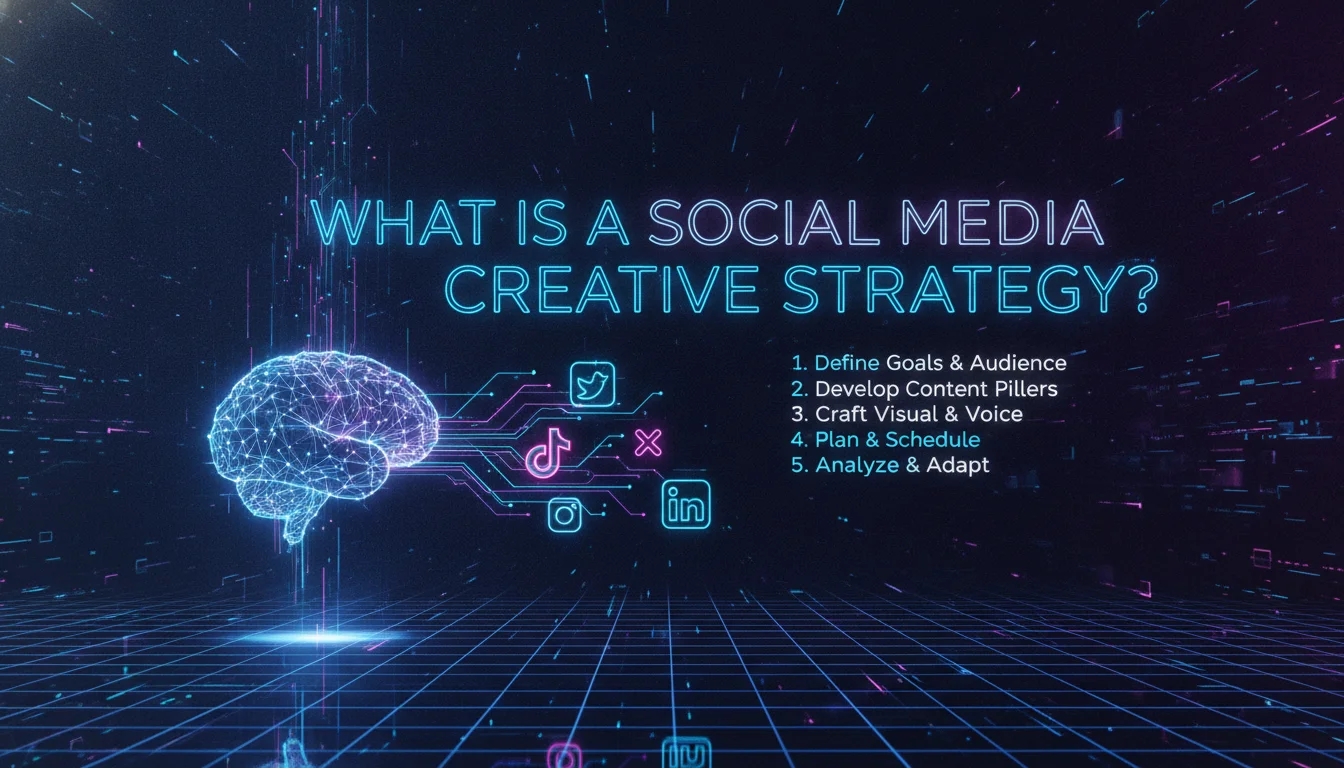
Social media creative strategy is a documented plan that aligns visual storytelling, content formats, and audience insights with measurable business goals. It guides every post, campaign, and interaction to build brand awareness, engagement, and conversions.
Key Takeaways
- A creative strategy connects visual identity, content formats, and measurement to business goals.
- SMART goals and audience personas are the foundation before any creative work begins.
- Creative direction ensures cohesive visuals and narratives across every platform.
- Track metrics like leads generated, web referrals, and conversion rate, not just likes.
- Use a structured 8-step framework to test, evaluate, and adjust continuously.
- Platform-specific creative is non-negotiable: what works on TikTok will fall flat on LinkedIn.
What Is a Social Media Creative Strategy?
Definition and Core Components
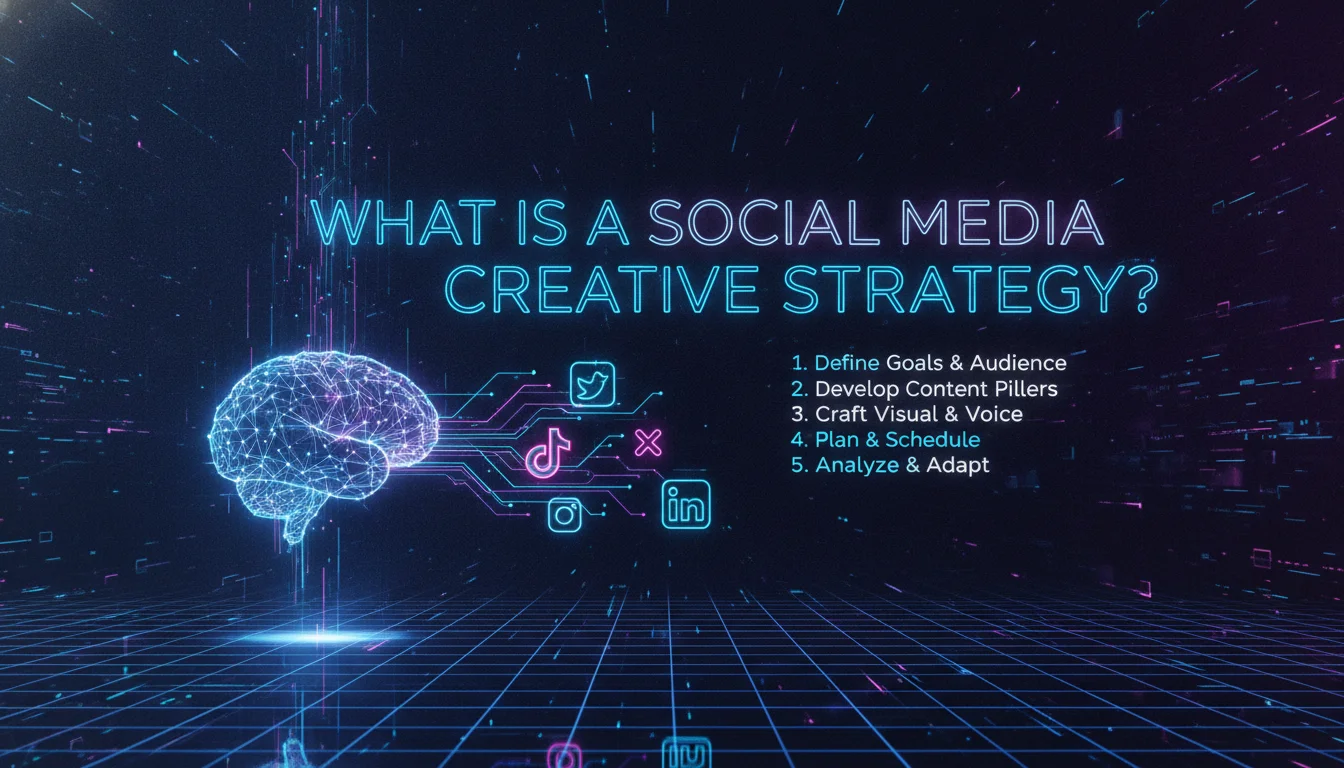
A this type of strategy is the creative blueprint that defines how a brand expresses itself across social platforms. According to the American Marketing Association, a social media marketing strategy is not just about posting content. It is about having a clear, intentional plan that connects your brand with the right people, on the right platforms, at the right time. The creative layer takes that plan further by specifying the visual style, tone, story angles, and content formats that bring the strategy to life.
A complete this kind of creative strategy includes audience definition, platform selection, content pillars, visual identity guidelines, a content calendar, and performance metrics. The Digital Marketing Institute defines a social media strategy as a comprehensive plan that outlines goals, tactics, and metrics tracked to measure performance. The creative component ensures that every tactical asset, whether a short video, a carousel, or a static image, reinforces the same brand promise.
Why Creative Strategy Matters More Than Tactics
Platforms like Instagram, TikTok, YouTube, LinkedIn, and X are crowded. According to Salesforce, the average person spends 143 minutes per day on social media, and there are over 5 billion social media users worldwide. Without a the media creative strategy, brands become noise. A creative strategy gives every post a purpose, a consistent visual language, and a measurable reason to exist.
Many teams confuse tactics with strategy. A tactic is posting a reel every day. A strategy defines why that reel exists, which audience segment it targets, what visual identity it uses, and which metric will prove it worked. This distinction is why frameworks from Hootsuite and the American Marketing Association both start with goals and audience research before any content is created.
The Role of Creative Direction
Creative direction is the guiding principle for the visual and narrative elements of your social media content. According to Socialfly, effective creative direction ensures that your social media presence is cohesive, visually appealing, and aligned with your brand’s identity. It helps you cut through the noise and captivate your target audience.
A strong creative direction defines logo usage, color palette, typography, imagery style, and the emotional tone of every asset. Without it, even a well-planned posting calendar can look fragmented and off-brand. Creative direction is the bridge between a written strategy and the actual content your audience sees.
“Social media marketing is a dynamic mix of messaging, timing, creativity, and analytics. To make it work, you need a clear, purposeful plan, one that aligns your efforts, amplifies your brand, and delivers results.” – American Marketing Association
Pros and Cons of a Formal Social Media Creative Strategy
Pros
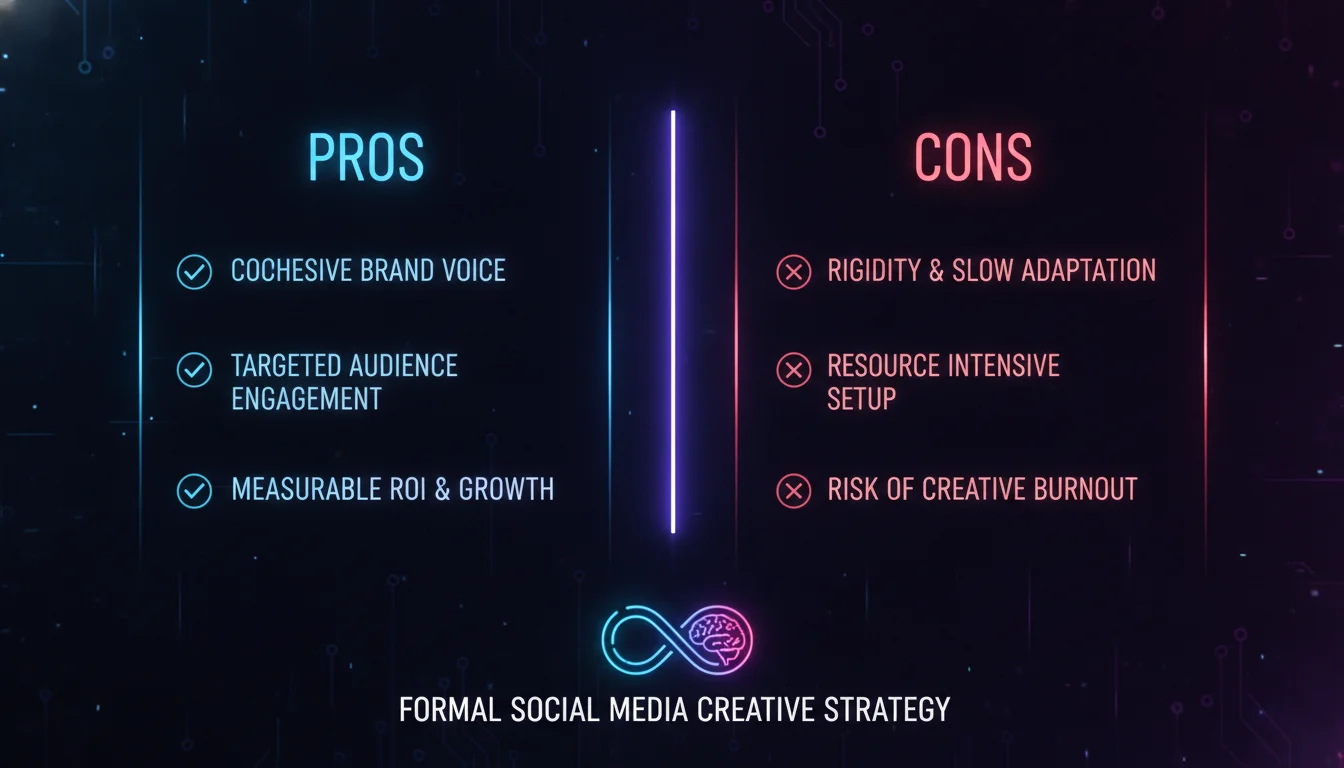
- Gives every post a clear purpose tied to a business goal, not just a posting quota
- Creates visual and narrative consistency that builds brand recognition over time
- Makes ROI measurement straightforward by linking creative output to defined KPIs
- Reduces last-minute scrambling through planned content calendars and approval workflows
- Enables smarter platform decisions by matching creative formats to audience behavior
Cons
- Requires upfront investment in research, persona development, and brand guideline creation
- Can feel rigid if teams don’t build in room for real-time trend response
- Demands cross-functional collaboration, which adds review cycles and potential bottlenecks
- Needs regular updating as algorithms, platforms, and audience preferences shift
How to Build a Social Media Creative Strategy in 8 Steps
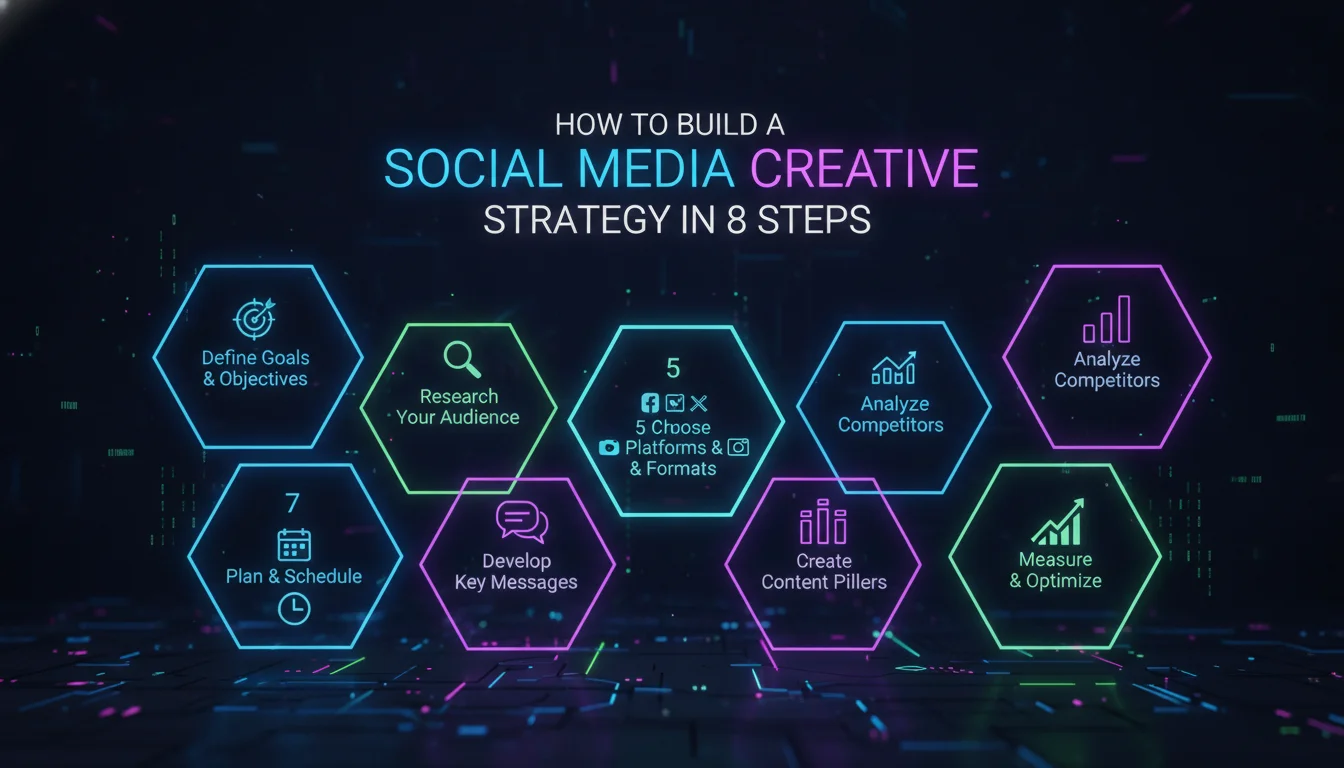
This section synthesizes the eight-step frameworks from the American Marketing Association and Hootsuite into a single actionable process. Follow these steps in order, and you’ll have a working social media by the end.
- Step 1: Set SMART social media goals that align with business objectives.
- Step 2: Learn everything you can about your audience through personas and social listening.
- Step 3: Research the competition to identify gaps and opportunities.
- Step 4: Conduct a social media audit of your existing profiles and content.
- Step 5: Set up accounts and improve existing profiles to match your creative direction.
- Step 6: Find inspiration from competitors, industry leaders, and trend data.
- Step 7: Create a social media content calendar that maps creative assets to dates and channels.
- Step 8: Test, evaluate, and adjust your strategy based on performance data.
Steps 1–3: Foundation – Goal Setting, Audience Research, and Competitive Analysis
The first three steps build the strategic foundation for every creative decision. SMART goals give your creative team a clear target. The American Marketing Association defines SMART as Specific, Measurable, Attainable, Relevant, and Time-bound. Instead of “grow our audience,” a SMART goal sounds like: “Increase Instagram followers by 20% over the next six months to support our brand awareness campaign.” That level of specificity tells your designers and copywriters exactly what success looks like.
Audience research is equally critical. Hootsuite recommends creating audience personas based on demographics, interests, and behaviors. A retail brand might build separate personas for frequent buyers, first-time visitors, and lapsed customers. Social listening tools capture real-time conversations about your industry, revealing pain points and content opportunities that no internal brainstorm can replicate.
Steps 4–6: Execution – Audit, Setup, and Inspiration
A social media audit is a systematic review of every existing profile, post, and engagement metric. It tells you what has worked, what hasn’t, and where your brand currently stands. After the audit, optimize your profiles: update bios, profile images, link trees, and pinned posts to match your new creative direction.
Finding inspiration is not copying. It means studying competitor content, analyzing industry trends, and observing what resonates with your audience. Tools like Trendspottr, BuzzSumo, and Feedly can surface emerging topics and formats. This step feeds the creative pipeline without losing originality.
Steps 7–8: Optimization – Content Calendar and Test-and-Adjust
A social media content calendar is the operational backbone of your creative strategy. It maps each creative asset to a specific date, platform, format, and goal. Hootsuite emphasizes that a calendar ensures consistent publishing and prevents last-minute scrambling. The calendar should include post copy, visuals, the target metric for each post, and the approval status.
The final step is continuous optimization. Test different creative variations, evaluate the results, and adjust your approach. This is not a one-time exercise. Social media algorithms and audience preferences change constantly, so your creative strategy must evolve with them.
Aligning Goals, Audience, and Platforms
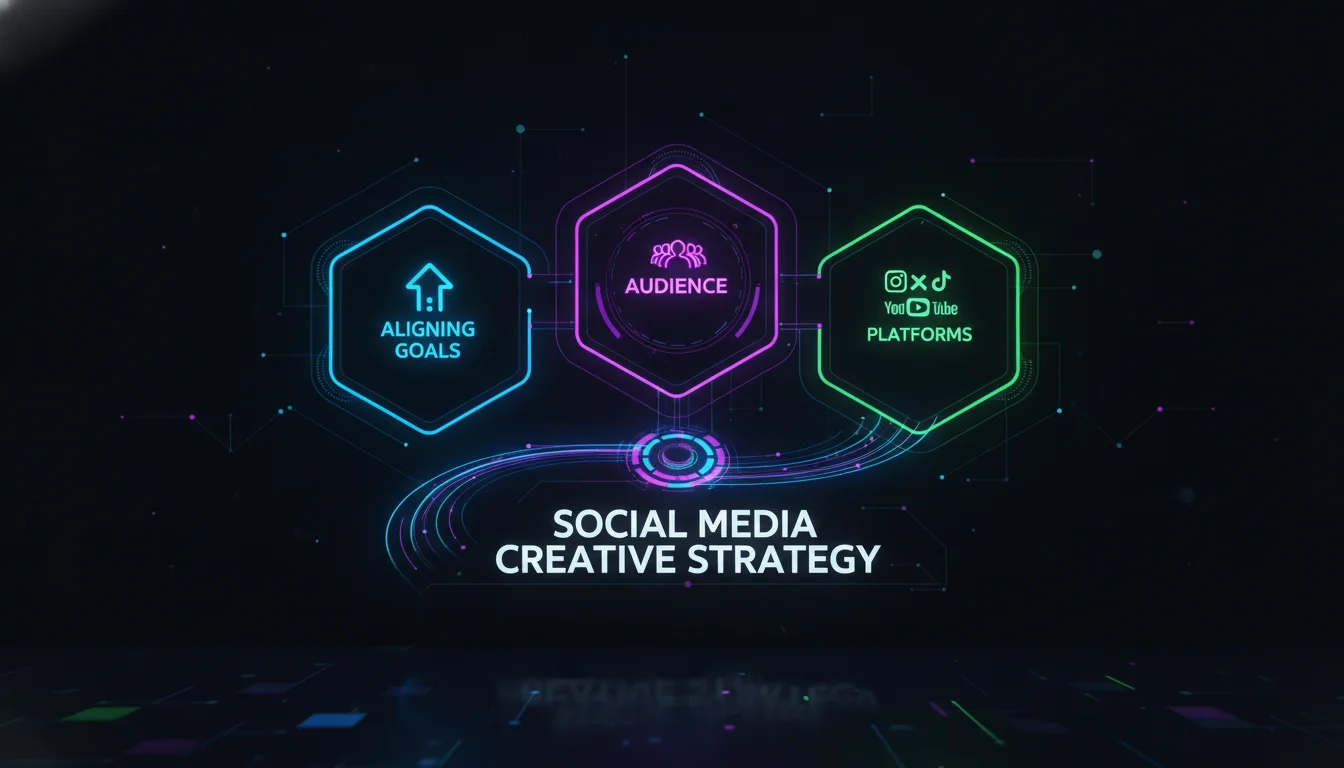
SMART Goals and Funnel Alignment
Every great this type of strategy starts with SMART goals. The American Marketing Association breaks goals into three funnel stages: top of funnel (awareness) uses impressions, reach, and new followers; middle of funnel (consideration) uses clicks, engagement, and website traffic; bottom of funnel (conversion) uses leads, purchases, and downloads. By aligning each creative asset to a funnel stage, you avoid the common mistake of creating content that looks good but drives no business result.
If your goal is brand awareness, your creative team should produce storytelling posts that highlight brand values and personality, not just product promotions. If your goal is lead generation, the creative should support targeted ad campaigns or special promotions that move people to act.
Audience Personas and Social Listening
Knowing who your audience is and what they want to see is key to creating content they’ll like, comment on, and share. As Hootsuite puts it, if you’re not engaged in social media listening, you’re creating your business strategy with blinders on. Listening reveals real people actively talking about your brand or industry online. Those insights should directly shape your creative concepts, tone, and even posting times.
Persona development turns raw listening data into actionable creative briefs. A persona for a B2B decision-maker on LinkedIn requires a very different visual style and message than a persona for a Gen Z shopper on TikTok. Your this kind of creative strategy must specify these differences so every platform feels native, not repurposed.
Choosing the Right Platforms
Not every platform deserves your creative energy. According to the Digital Marketing Institute, citing Datareportal’s 2026 Global Social Media Statistics, the typical social media user actively uses or visits an average of 6.5 different social platforms each month, and 96.7% of internet users aged 16 and above in 54 of the world’s largest economies use at least one social or messaging platform each month. That reach is enormous, but it doesn’t mean you need to be everywhere.
Adobe Express recommends prioritizing two to three core platforms rather than spreading thin across every network. Platform-specific creative is essential: a TikTok video needs fast pacing and native trends, while a LinkedIn post benefits from thought leadership and professional tone. Your the media creative strategy should define which platforms get custom creative and which get lighter adaptation.
Creative Direction and Visual Identity
Visual Brand Guidelines
Establishing a strong visual identity is essential for a cohesive and recognizable presence. Socialfly advises developing comprehensive visual branding guidelines that outline the use of your logo, color palette, typography, imagery, and other visual elements. These guidelines ensure consistency across all social media platforms and content types. Consistency builds the mental availability that makes your brand memorable.
Your strategy should include an easy-to-access brand kit. This kit should specify color hex codes, approved fonts, image styles, iconography, and the type of photography or illustration allowed. When every asset follows the same rules, your feed looks intentional, not accidental.
Content Formats and Platform-Specific Creative
Video is the dominant format on social media as of 2026. Adobe Express reports that 25% of internet users find new products to buy on social media. Creative teams must prioritize short-form video, live video, and interactive formats like polls and quizzes. The execution must vary by platform: a 15-second vertical reel on Instagram requires different pacing, caption style, and visual treatment than a 2-minute YouTube video.
Your social media should define which content pillars you’ll create, what formats each pillar uses, and how often each format appears. Common pillars include educational content, behind-the-scenes, user-generated content, product features, and thought leadership. Mapping pillars to platforms prevents creative fatigue and keeps the feed varied but cohesive.
Inspiration, Trends, and AI Tools
Staying current with trends is part of creative direction. Socialfly recommends regularly consuming industry blogs, social media influencer content, and competitor analysis. Tools like Trendspottr, BuzzSumo, and Feedly can identify emerging trends and what resonates with your target audience. Trend-jacking must always pass through your brand lens, though. Not every trend fits every brand.
AI tools are reshaping creative workflows. Coursera notes that the Meta Social Media Marketing Professional Certificate now includes must-have AI skills for social media marketers. Generative AI agents can help produce copy variations, thumbnail ideas, and video scripts. AI should support human creative direction, not replace it. Your creative strategy should define where AI is used and where human judgment is required.
“Developing a social media strategy typically involves outlining your goals, determining the most effective content types to create, and measuring performance.” – Coursera Staff, Social Media Content Strategy Guide (Updated June 2026)
Content Planning, Tools, and Collaboration
Building a Social Media Content Calendar
A content calendar is the tactical output of your this type of strategy. It schedules every post, story, reel, and campaign across all active platforms. Hootsuite’s step 7 specifically calls for a content calendar that maps creative assets to dates. Include the post copy, visual asset, target platform, format, and the primary metric each post is designed to move.
Calendars also help you plan for seasonal moments, product launches, and real-time events. By planning at least one month in advance, creative teams can avoid last-minute rushes and maintain quality. Many teams use Google Sheets, Trello, or Asana to manage the calendar collaboratively.
Tools for Creation, Scheduling, and Publishing
Mastering creative direction requires a diverse toolkit. Socialfly highlights content creation tools like Adobe Creative Cloud, Canva, and Figma for creating visually compelling graphics, videos, and animations. For scheduling and publishing, tools like Hootsuite, Buffer, and Sprout Social streamline the workflow. These tools let you plan, approve, and publish content without logging into each platform individually.
Your this kind of creative strategy should specify which tools are mandatory for your team. A small team might use Canva for design and Buffer for scheduling. A larger enterprise might rely on Adobe Creative Cloud and Sprout Social. The key is consistency: every team member follows the same tool stack and workflow.
Collaboration and Feedback Workflows
Effective creative direction is collaborative. Socialfly recommends gathering feedback from your team, stakeholders, and even your audience. Tools like Google Docs, Trello, and Asana facilitate smooth collaboration. A clear review process prevents bottlenecks and ensures that every asset passes through brand, legal, and performance checks before publishing.
Define roles clearly in your the media creative strategy: who creates, who reviews, who approves, and who publishes. A two-step approval process, one for creative quality and one for strategic alignment, keeps the pipeline moving without sacrificing standards.
Paid Advertising and Influencer Partnerships
When to Add Paid Amplification
Organic reach alone rarely scales a brand fast enough to meet aggressive growth goals. Paid social advertising extends the reach of your best creative assets to audiences who haven’t discovered you yet. The most effective approach is to identify your top-performing organic posts first, then put budget behind the creative that already resonates. This reduces wasted spend and keeps your strategy grounded in real audience data rather than assumptions.
Hootsuite notes that paid campaigns often optimize for brand awareness, while organic posts measure acquisition and engagement. Your strategy should define a clear budget allocation between paid and organic, with distinct creative briefs for each. Paid creative typically needs stronger calls to action and tighter visual hierarchy than organic content.
Influencer and Creator Partnerships
Creator partnerships are one of the fastest ways to build credibility with a new audience. The key is alignment: the creator’s audience, aesthetic, and values must match your brand’s creative direction. A mismatched partnership produces content that feels forced and performs poorly on both sides.
When building creator partnerships into your social media, define the deliverables, approval process, and performance metrics upfront. Treat creators as creative collaborators, not just distribution channels. The best partnerships produce content that neither brand nor creator could make alone, and that authenticity is exactly what social audiences reward.
Measuring and Optimizing Your Social Media Creative Strategy
Meaningful Metrics vs Vanity Metrics
Hootsuite warns that vanity metrics like retweets and likes are easy to track but hard to connect to real business value. Your creative strategy should focus on targets such as leads generated, web referrals, and conversion rate. These metrics connect creative output directly to revenue or pipeline impact. A lead magnet post may get fewer likes than a meme, but if it drives 50 new email signups, it is more valuable.
Different channels may require different metrics. Paid campaigns often optimize for brand awareness, while organic posts may measure acquisition and engagement. Align each metric to the goal set in step one. This alignment makes it easier to show the value of your work and get executive buy-in.
Testing, Evaluating, and Adjusting
Testing is the engine of continuous improvement. Hootsuite’s step 8 is “Test, evaluate, and adjust your strategy.” That means running A/B tests on creative variations, different headlines, visuals, calls to action, or posting times, and then doubling down on what works. The American Marketing Association also emphasizes that social media marketing is a dynamic mix of messaging, timing, creativity, and analytics. Without iteration, performance plateaus.
Your this type of strategy should include a monthly review cadence. During that review, compare performance against SMART goals, identify top-performing creative themes, and document lessons learned for the next content sprint. This turns creative work from a guess into a system.
Competitive Research and Social Listening
Competitive research is not a one-time step. You should continuously monitor what competitors are doing on social media. Hootsuite includes “research the competition” as step 3, but it also informs ongoing optimization. Social listening tools can reveal when competitors launch new campaigns, when sentiment shifts, and when your audience asks questions you’re not answering.
Feed these insights back into your content calendar and creative briefs. A monthly competitive snapshot covering content themes, formats, engagement rates, and audience comments keeps your social media creative strategy ahead of the curve rather than reactive.
Comparing Social Media Creative Strategy Frameworks
Different organizations structure the creative strategy process differently. The table below compares four widely used frameworks based on their first step, creative focus, and recommended metrics.
| Framework Source | First Step | Creative Focus | Metrics Recommended |
|---|---|---|---|
| American Marketing Association | Set SMART goals | Storytelling, brand values, funnel-aligned content | Impressions, reach, engagement, leads, purchases |
| Hootsuite | Set SMART goals aligned to business objectives | Audience personas, content calendar, platform-specific creative | Leads generated, web referrals, conversion rate |
| Digital Marketing Institute | Define social media strategy and benefits | Brand awareness, customer relationships, trend tapping | Engagement, website traffic, lead generation |
| Coursera | Outline goals and effective content types | Content strategy, brand presence, Meta AI skills | KPIs, ROI, content performance analysis |
How the Frameworks Differ
The core difference lies in emphasis. The American Marketing Association leans toward storytelling and funnel alignment. Hootsuite prioritizes measurable business outcomes and social listening. Digital Marketing Institute frames the creative strategy as a comprehensive plan for brand awareness and ROI. Coursera integrates AI and professional certification into the skill-building process. None is universally best. The right choice depends on your team size, industry, and maturity.
Choosing a Framework for Your Team
Start with the Hootsuite or AMA eight-step sequence if you need a rigorous operational process. If your team is small or just starting, adopt a simplified version: set one SMART goal, research one audience persona, choose two platforms, and create a monthly calendar. Add competitive research and social listening as you scale. The most important thing is to document your social media creative strategy so it can be repeated, measured, and improved.
Frequently Asked Questions
What is a social media creative strategy?
A social media creative strategy is a documented plan that aligns visual storytelling, content formats, and audience insights with measurable business goals. It defines the creative direction, content pillars, and platform-specific execution for every post and campaign.
How often should I post on social media?
Posting frequency depends on your audience and platform. The key is consistency, not volume. A content calendar helps you maintain a steady cadence that matches your team’s capacity and your audience’s expectations.
What tools do I need for a social media creative strategy?
You need a mix of creation tools like Canva, Figma, or Adobe Creative Cloud, and scheduling tools like Hootsuite, Buffer, or Sprout Social. Collaboration tools like Trello or Asana help manage reviews and approvals across your team.
Which metrics should I track for my social media creative strategy?
Focus on metrics tied to business goals, such as leads generated, web referrals, and conversion rate. Vanity metrics like likes and retweets can be tracked, but they should not be your primary measure of success.
How does creative direction differ from content strategy?
Content strategy defines what you’ll say and where you’ll say it. Creative direction defines how it will look and feel. Creative direction ensures visual and narrative consistency across all platforms, while content strategy focuses on topics, formats, and scheduling.
Turning Your Social Media Creative Strategy into Results
A social media creative strategy is not a document that sits on a shelf. It’s a living system that connects SMART goals, audience insights, creative direction, content calendars, and performance metrics. The brands that win on social media in 2026 are those that treat creativity as a measurable business function, not a guessing game.
Start with clear goals, build a visual identity, plan relentlessly, and optimize continuously. Use the eight-step framework above, adopt the right tools, and keep your audience at the center. That’s how a social media creative strategy becomes real brand awareness, engagement, and measurable revenue.
According to the American Marketing Association, every post, campaign, and interaction should move you closer to your marketing goals, not just add to the noise. Let your social media creative strategy be the blueprint that ensures exactly that.
Ready to build something bold? Contact Emin Media for a free brand consultation and let’s build a social media creative strategy that actually moves the needle.
Enjoyed this article?
Contact Emin Media for a free brand consultation and let's create something amazing together.
Get in TouchRelated Articles
Digital Storytelling for Brands: The Complete Guide
Digital storytelling for brands builds real audience connections through narrative. Learn proven techniques, formats, and…
Design Thinking for Marketing: A 2026 Guide
Design thinking for marketing builds campaigns around real user needs. Learn the 5 phases, common…
Creative Direction for Video Shoots: A Complete Guide
Master creative direction for video shoots with proven steps, tools, and strategies that build brand…