Social Media Content Strategy: Build One That Works

A social media content strategy is a documented plan that connects every post, channel, and metric to a specific business goal. Without one, you’re publishing on instinct and measuring nothing that matters. This guide gives you the exact framework to build one that performs.
Key Takeaways
- A content strategy is a documented plan linking content creation, distribution, and measurement to business goals.
- Platform-specific content matters: According to Econsultancy data cited by Sprinklr, 67% of marketers with a custom content strategy per platform saw improved ROI.
- Tailored ads outperform generic ones: Facebook Business data shows ads matched to Facebook’s native behavior generated 3x more click-through rates than cross-platform creative.
- Start with SMART goals, then research your audience, audit competitors, and build a monthly content calendar.
- Treat your strategy as a living document: review performance weekly and update as platforms and audiences shift.
- Platform choice is a strategic decision, not a default. Pick the channels that match your audience and do them well.
A social media strategy keeps your efforts intentional. Without one, you chase trends, run ads on guesswork, and post on impulse.
Hootsuite 2026 Social Media Strategy Guide
What Is a Social Media Content Strategy?

Definition and Core Components
A this type of strategy is a systematic framework that governs your content creation and distribution on social media, helping you achieve your goals efficiently. According to Sprinklr, the main components include audience analysis, content creation, platform strategy and optimization, competitor analysis, engagement strategy, scheduling and publishing, analytics, and budget allocation. That list matters because it moves the conversation away from one-off posts and toward a repeatable operating model.
Hootsuite adds a useful frame: a social media marketing strategy is a summary of everything you plan to do and hope to achieve on social media. The more specific and concise that summary is, the more effective the plan becomes. Instead of treating social as a loose collection of ideas, you treat it as a measurable system with inputs, outputs, and feedback loops.
Why a Strategy Beats Random Posting
Without a documented plan, teams default to reactive publishing. They post when inspiration strikes, chase whatever trend is trending, and measure success by vanity metrics. The American Marketing Association compares diving into social media without a strategy to cooking a gourmet meal without a recipe: you might get lucky, but chances are it will be a mess. A this kind of content strategy gives every post a job. It tells you who the content is for, which platform it belongs on, and what success looks like.
This is especially important for organizations managing multiple accounts or multiple stakeholders. Your the media content strategy becomes the connective tissue between marketing, customer service, sales, and brand teams. When a leader asks why the company is posting a certain type of content, the strategy provides the answer before the question is even asked.
Why a Social Media Content Strategy Matters

Alignment with Business Goals
A strong strategy does far more than grow your follower count. Sprout Social argues that the most effective approach aligns social media objectives to wider business goals. That includes building awareness and reaching new customers, but it also extends to customer care, product feedback, and driving sales. When social media supports the full business, every post becomes a potential contributor to revenue, retention, or product improvement.
Clearview Social reinforces this point: a strong social media helps brands stay consistent, relevant, and visible in front of their target audience. It ensures content supports business goals, reflects brand voice, and drives engagement over time. That is the difference between posting to fill a feed and posting to move a metric.
Consistency and Trust
Consistency is one of the most underrated competitive advantages in social media. When followers know what to expect from your brand, they are more likely to return, engage, and recommend you. A defined content strategy removes the guesswork from daily publishing. Clearview Social notes that brands can build trust, grow their following, and turn social activity into business results when they have a clear plan in place.
Consistency also protects your brand voice. Without a strategy, different team members may write posts in completely different tones, causing the brand to feel fragmented. Your content strategy documents the voice, the visual style, and the core messages that should appear across every platform.
Measurable ROI
Perhaps the most concrete reason to invest in a this type of strategy is measurable return on investment. Data from Econsultancy, cited by Sprinklr, shows that 67% of marketers with a custom content strategy for every platform saw an improvement in ROI. That figure is not about posting more often. It is about publishing platform-specific content that matches user behavior and content style.
Facebook Business data, also cited by Sprinklr, found that ads tailored to Facebook’s user behavior and content style generated 3x more click-through rates than generic, cross-platform ads. A one-size-fits-all approach leaves real performance on the table. A well-constructed this kind of content strategy gives each platform the creative treatment it needs to perform.
Pros and Cons
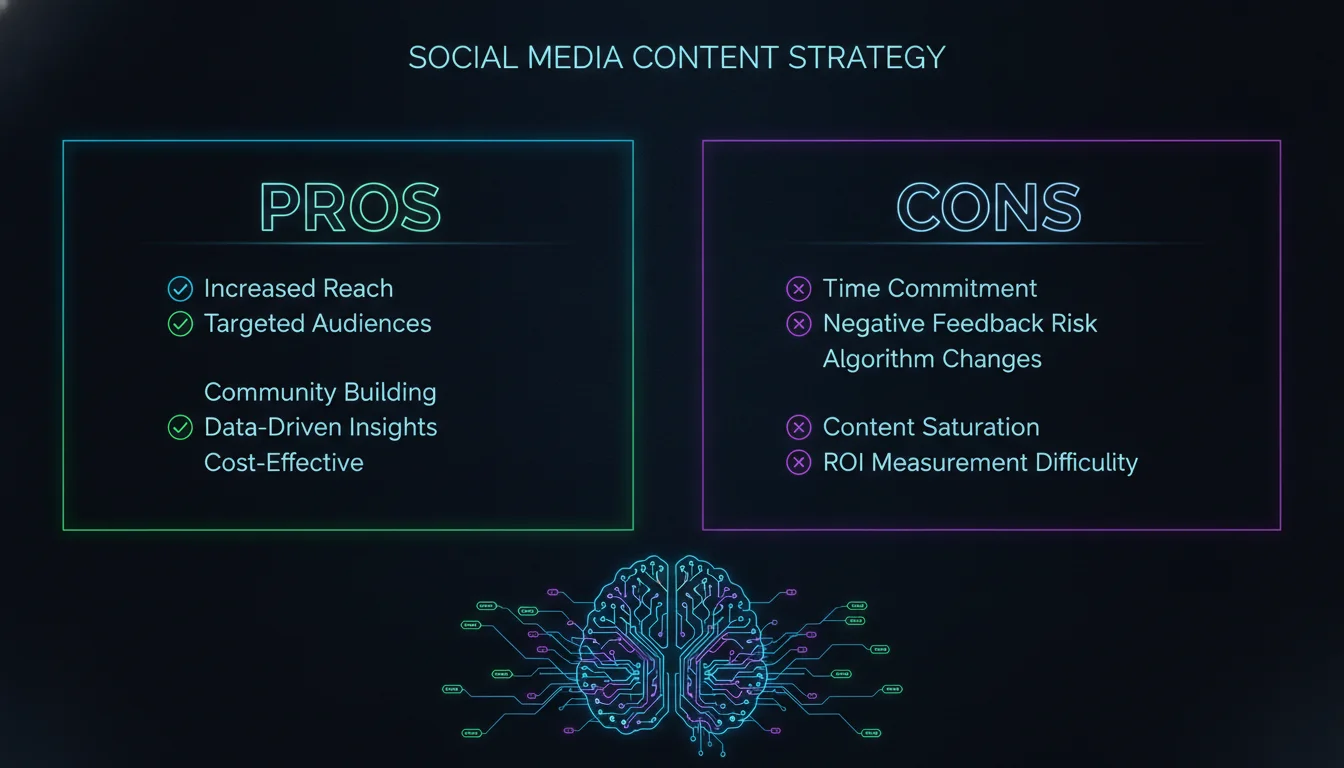
Pros
- Measurable results: Every post maps to a goal, making ROI easier to track and report.
- Brand consistency: A documented strategy keeps voice, visuals, and messaging aligned across every channel and team member.
- Better platform performance: Platform-specific content consistently outperforms generic cross-channel reposts, as the Econsultancy and Facebook Business data confirm.
- Smarter resource allocation: You stop wasting budget on platforms that don’t serve your audience and double down on the ones that do.
- Faster decision-making: When the strategy is documented, daily content decisions take minutes instead of meetings.
Cons
- Upfront time investment: Building a proper strategy requires audience research, competitor audits, and goal-setting before a single post goes live.
- Requires ongoing maintenance: A strategy that isn’t reviewed regularly becomes stale. Weekly check-ins and quarterly updates are non-negotiable.
- Can feel rigid for small teams: Smaller teams may struggle to stick to a content calendar when resources are stretched thin.
- Platform changes disrupt plans: Algorithm updates and new features can make a carefully built strategy obsolete overnight.
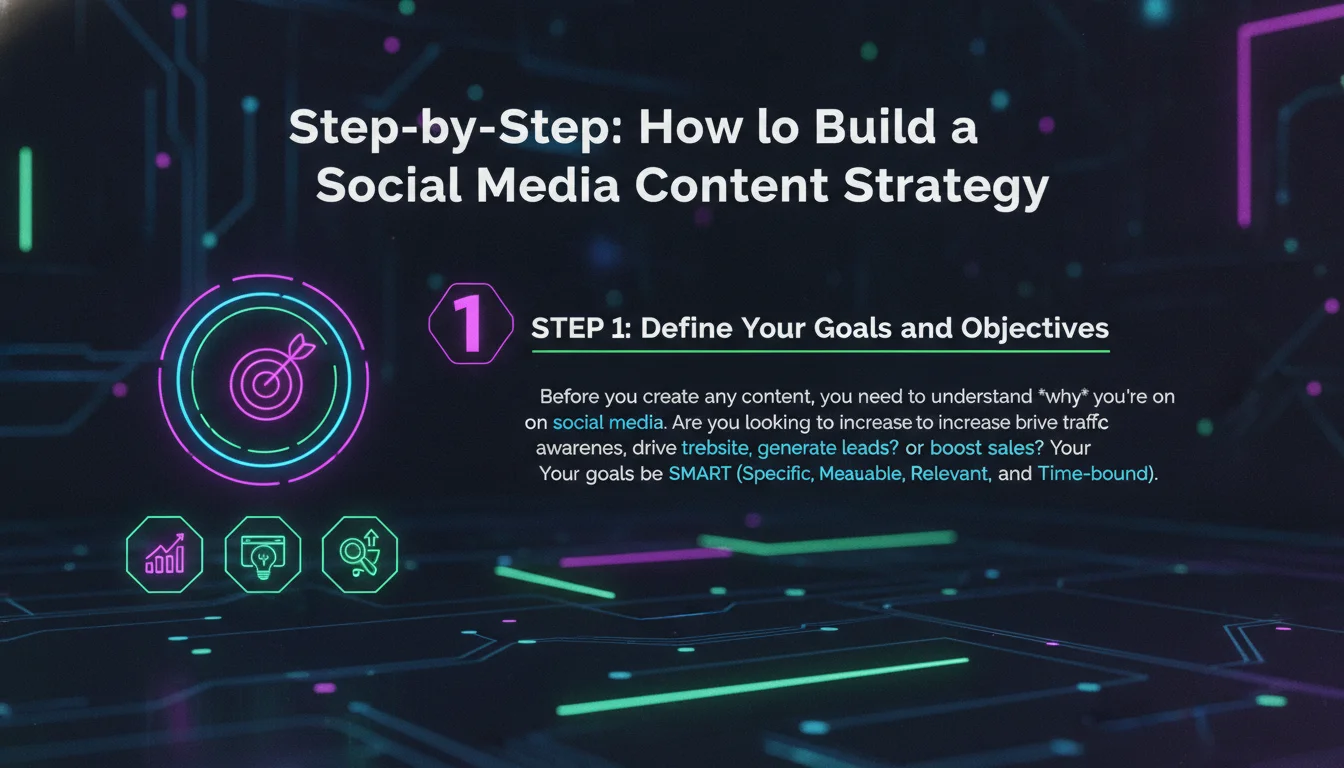
Step-by-Step: How to Build a Social Media Content Strategy
The 8-Step Process at a Glance
You can build a the media content strategy by following a clear, repeatable sequence. This eight-step process synthesizes frameworks from the American Marketing Association, Coursera, Sprout Social, and Hootsuite into one operational checklist.
- Set SMART goals. Define what you want to achieve, with numbers and deadlines.
- Understand your target audience. Research demographics, behaviors, pain points, and preferred platforms.
- Reflect on your brand voice. Decide how your brand sounds, looks, and shows up on social.
- Audit competitors and current content. Identify gaps, strengths, and opportunities in your niche.
- Choose platforms and content types. Match content formats to each network’s strengths and user expectations.
- Develop a content plan. Outline themes, content pillars, posting cadence, and ownership.
- Build a content calendar. Schedule posts in advance and assign responsibilities.
- Measure results and iterate. Track metrics against goals weekly and adjust the plan.
Steps 1–4: Foundation
The first four steps establish the strategic foundation. The American Marketing Association recommends starting with SMART goals: Specific, Measurable, Attainable, Relevant, and Time-bound. Instead of a vague goal like “grow our audience,” you might set a goal to “increase Instagram followers by 20% over the next six months to support our brand awareness campaign.” This kind of goal guides content choices and makes ROI easier to report.
Understanding your target audience is not optional. Hootsuite advises researching who your audience actually is, down to age, location, and platform. That research tells you where to show up and what kind of content will resonate. Without it, you end up creating content for everyone and connecting with no one. After audience research, reflect on your brand voice. How does your brand sound in a comment section? Is it playful, formal, authoritative, or empathetic? Documenting this early prevents inconsistent posting later.
Finally, audit your current social content and your competitors. Sprout Social includes competitor analysis and a current content audit as distinct steps. Look at what has performed well, what has underperformed, and what your competitors are doing that you are not. This audit reveals the gap between where you are and where you need to be.
Steps 5–8: Execution and Measurement
Once the foundation is set, choose the right platforms and content types. Not every platform is right for every brand. UC Santa Barbara recommends selecting the platform that best aligns with your goals, objective, and target audience, and doing it well rather than spreading yourself thin across every network. This platform-first thinking is supported by the Sprinklr data on platform-specific ROI.
Next, develop a social media content plan. This is where content pillars, themes, and posting cadence come together. A content plan defines what you will post, how often, and who is responsible. The final execution tool is a content calendar. UCSB defines a social media content calendar as a document that visualizes your content strategy by tracking all posts for the week, month, or year. Scheduling posts ahead of time gives you control over publishing and lets you focus on the big picture instead of day-to-day scrambling.
Measurement closes the loop. Hootsuite recommends treating your strategy as a living document and checking social performance weekly. Look at the metrics that map to your goals. If a content type is underperforming, adjust it. If a platform is driving strong results, invest more there. This iterative process is what separates a static plan from a high-performing strategy.
Comparing Social Media Content Strategy Frameworks
AMA vs. Sprout Social vs. Hootsuite
| Source | Number of Steps | Core Emphasis | Unique Element |
|---|---|---|---|
| American Marketing Association | 8 | SMART goals, funnel alignment | Customer service response time example |
| Sprout Social | 12 | Audience research, competitor analysis, influencer partnerships | Free content strategy templates |
| Hootsuite | 7 | Concise, measurable social media plan | Weekly performance reviews |
| Coursera | 8 | Content types, brand presence, measurement | Meta Social Media Marketing Certificate |
Which Framework Fits Your Team
Small teams with limited resources may prefer the Hootsuite seven-step approach because it is concise and emphasizes measurement. Enterprise teams managing multiple brands and markets may find Sprout Social’s twelve-step framework more useful, especially because it includes influencer partnerships and content audits. Organizations that need a strong educational foundation may benefit from Coursera’s eight-step structure, which pairs the process with a Meta Social Media Marketing Professional Certificate.
The right framework depends on your team’s maturity, resources, and goals. What matters is not the exact number of steps but that the plan is specific enough to guide daily decisions and flexible enough to evolve.
Key Differences Worth Noting
The American Marketing Association explicitly includes customer service as a social media goal. You might set a target like responding to all customer inquiries within two hours on social media. Sprout Social adds influencer partnerships as a dedicated step, reflecting the growing role of creators in content distribution. Hootsuite’s emphasis on weekly performance checks makes it especially useful for teams that need fast feedback loops.
These differences are not contradictions. They reflect different priorities. The best social media borrows the relevant pieces from each framework and adapts them to your brand’s situation.
Platform-Specific Considerations
Instagram, Facebook, and LinkedIn
Platform-specific thinking is not a nice-to-have. The Econsultancy data showing a 67% ROI improvement for custom per-platform strategies makes that point clearly. On Instagram, visual storytelling and short-form video dominate. The American Marketing Association notes that features like Instagram Shopping and Facebook Shops make selling directly on social easier than ever. On LinkedIn, B2B audiences expect thought leadership, data-driven insights, and a professional tone.
Facebook remains powerful for community building and paid social. The Facebook Business finding of 3x higher click-through rates for tailored ads underscores how important it is to match ad creative to Facebook’s native behavior. Generic cross-platform posts simply do not perform as well.
TikTok, YouTube, and X
TikTok rewards authenticity, speed, and trend participation. YouTube supports long-form educational content and product demos. X, formerly Twitter, is best for real-time engagement, customer support, and news. The content that works on one platform will often fail on another unless you adapt the format, tone, and pacing.
Your content strategy should specify which content types map to each platform. A 60-second customer testimonial may work on YouTube, but that same video may need to be recut into a 15-second TikTok clip with bold text overlays to land effectively.
Matching Content Types to Platforms
UCSB’s advice is practical: when in doubt, pick the most appropriate platform and do it well. That principle applies at the content level too. Instead of posting the same image carousel everywhere, consider what each audience expects. Instagram may favor high-quality visuals, LinkedIn may favor long-form posts with data, and TikTok may favor raw, fast-paced video. Sprinklr includes platform strategy and optimization as a core component of the framework, reinforcing that platform nuance belongs inside the content strategy, not as an afterthought.
Influencer Partnerships and Paid Social
Where Creators Fit Into Your Strategy
Influencer partnerships are no longer a bonus tactic. Sprout Social includes them as a dedicated step in its twelve-step this type of strategy framework, which signals how central creator collaboration has become to content distribution. The logic is straightforward: creators already have the trust and attention of the audiences you want to reach. Partnering with the right ones extends your brand’s reach into communities that paid ads alone cannot access.
When building influencer partnerships into your this kind of content strategy, start by identifying creators whose audience overlaps with your target customer. Micro-creators with highly engaged niche followings often outperform larger accounts with passive audiences. Define clear deliverables, content guidelines, and performance metrics before any partnership goes live.
Paid Social Budget Allocation
Sprinklr lists budget allocation as a core component of any the media content strategy, and it deserves more attention than most brands give it. Paid social amplifies organic content that is already performing. Boosting a post that has already earned strong organic engagement is almost always more efficient than cold-targeting a brand-new creative.
A practical starting point: allocate paid budget by platform based on where your audience is most active and where your organic content performs best. Review that allocation monthly and shift spend toward the platforms delivering the strongest cost-per-result. This keeps your budget working as hard as your content.
The best social media content strategy borrows the relevant pieces from each framework and adapts them to your brand’s situation. There is no universal playbook, only principles you apply with intention.
Emin Media, based on synthesis of AMA, Hootsuite, and Sprout Social frameworks
Measuring Success and Iterating
Metrics That Matter
The American Marketing Association recommends aligning goals to the marketing funnel. At the top of the funnel, track impressions, reach, and new followers. At the middle of the funnel, track clicks, engagement, and website traffic. At the bottom of the funnel, track leads, purchases, and downloads. These metrics connect social activity to business outcomes instead of leaving you with a pile of likes that do not mean anything.
Coursera also highlights measuring performance as a core step in any social media content strategy. It is not enough to publish content. You need to know which content types drive the actions that matter to your business.
Weekly vs. Monthly Reviews
Hootsuite recommends checking social performance weekly and updating the plan as platforms, audiences, and your business change. A weekly review might include tracking follower growth, engagement rate, click-through rate, and lead form completions. A monthly review can take a broader view, assessing which content pillars performed best and which platforms deserve more investment.
This cadence keeps your social media content strategy from becoming stale. If something is not working, you will catch it in days rather than months.
Using Data to Refine Content
Data should drive content decisions. If a particular content format consistently underperforms, stop producing it or experiment with a new angle. If a platform delivers high-quality leads, allocate more resources there. Sprout Social includes measuring results as a distinct step, with a focus on using analytics to refine the content plan. The result is a continuous improvement loop: set goals, publish content, measure performance, and refine.
Common Mistakes and How to Avoid Them
Posting Without a Plan
The most common mistake is posting for the sake of posting. Hootsuite is direct: without a strategy, you chase trends, run ads on guesswork, and post on impulse. A social media content strategy prevents this by giving every post a purpose. It forces you to answer why you are publishing something before you hit send.
One-Size-Fits-All Content
Repurposing the same creative across every platform without adaptation is one of the fastest ways to waste budget. The 67% ROI improvement for custom strategies and the 3x click-through lift for tailored Facebook ads prove that platform-specific creative matters. Your social media content strategy should include a content adaptation matrix that spells out how each asset changes per platform.
Neglecting the Operational Side
Another mistake is ignoring the operational details that keep a strategy running. UCSB’s best practices checklist includes confirming leadership support, establishing an objective, identifying your audience and goals, understanding available resources, defining a workflow process, and preparing a succession plan for staff turnover. Neglecting these operational details leads to burnout, inconsistent posting, and brand voice drift.
As of 2026, the brands winning on social are not the ones posting the most. They are the ones with the clearest plan, the sharpest creative, and the discipline to measure what matters. A documented social media content strategy is what makes that possible.
Frequently Asked Questions
What is a social media content strategy?
A social media content strategy is a documented plan that outlines what content you will create, where you will publish it, and how you will measure success. It aligns content decisions with business goals and audience needs across every platform you use.
What is the 5-3-1 rule on social media?
The 5-3-1 rule is a content mix guideline: for every 10 posts, five are curated from others, three are original content, and one is promotional. It keeps feeds valuable without becoming too sales-heavy and helps maintain audience trust over time.
What are the 7 C’s of social media strategy?
The 7 C’s are common pillars: content, context, community, conversation, connection, conversion, and consistency. They help teams remember that social media is about building relationships as much as it is about publishing content.
What is the 5-3-2 rule on Instagram?
The 5-3-2 rule suggests that out of every 10 Instagram posts, five should be curated, three should be original, and two should be fun or personal. It balances value, brand voice, and authenticity in a way that keeps audiences engaged without feeling like a constant sales pitch.
What are the 5 pillars of content strategy?
Commonly, the five pillars are goal setting, audience research, content creation, distribution, and measurement. Each pillar supports the others, and together they form a complete social media content strategy that can be tracked, refined, and scaled.
How often should I update my social media content strategy?
Review performance weekly and update the strategy quarterly or whenever there is a major platform change, audience shift, or business goal update. This keeps the plan relevant, effective, and aligned with where your brand is headed.
Ready to stop guessing and start building something that actually works? Contact Emin Media for a free brand consultation and let’s build a social media content strategy that turns your brand into a presence people remember.
Enjoyed this article?
Contact Emin Media for a free brand consultation and let's create something amazing together.
Get in TouchRelated Articles

Visual Content Marketing Trends for 2026
Visual content marketing trends for 2026 are reshaping how brands connect. Discover AI visuals, interactive…

Brand Voice Examples 2026: Build a Voice That Sticks
Explore the best brand voice examples 2026 has to offer. Learn frameworks, archetypes, and steps…

What Are the 3 Cs of SEO? Content, Code & Credibility
What are the 3 Cs of SEO? Learn how Content, Code, and Credibility work together…