Brand Voice Examples 2026: Build a Voice That Sticks
Key Takeaways
- Brand voice is the consistent personality a brand expresses through language across every channel.
- Understanding the difference between brand voice and tone is essential for effective, context-aware communication.
- Real-world brand voice examples 2026 from Nike, Apple, Wendy’s, and others show exactly what a strong voice looks like in practice.
- A well-defined brand voice builds customer trust, sharpens recognition, and separates you from competitors.
- Creating a brand voice means defining core attributes, vocabulary rules, tone variants, and before/after examples your team can actually use.
- As of 2026, AI-generated content makes a distinctive brand voice the single most important differentiator between forgettable and memorable brands.
Brand Voice Examples 2026: Build a Voice That Sticks
Brand voice examples 2026 are the clearest proof that how a brand speaks is just as powerful as what it sells. A consistent, distinct voice builds trust, drives recognition, and turns casual buyers into loyal advocates.
What Is Brand Voice?
Brand voice is the distinct personality a brand expresses through its language, tone, and style across all communication channels. It covers word choice, sentence structure, and emotional undertones, ensuring every message sounds like it came from the same source. A strong brand voice builds trust, sharpens recognition, and creates deeper connections with customers over time.
Defining Brand Voice
Brand voice is not merely about what you say but how you say it. It reflects the brand’s core values and personality, making it recognizable and relatable to the audience. A brand voice can be:
- Confident: Assertive and self-assured, often seen in tech brands like Apple.
- Playful: Light-hearted and fun, typical of brands like Innocent Drinks.
- Inspirational: Motivating and uplifting, as exemplified by Nike.
Brand Voice vs. Brand Tone: The Distinction That Actually Helps
Voice and tone are not the same thing, and confusing them is one of the most common mistakes brands make. Voice is fixed. It does not change with situation, channel, or customer mood. It is the brand’s underlying personality: the vocabulary it uses, the rhythm of its sentences, the attitude it brings to every word. Tone is variable. It dials within voice depending on context. Celebratory in a “you just hit your first 100 customers” email. Apologetic in a billing-error message. Measured in a security update. Same voice underneath, but the dial has moved.
The Mailchimp content style guide is the clearest public example of this in action. The voice is fixed: warm, plainspoken, occasionally playful. The tone variants for success states, error states, billing, and marketing each carry a specific note on what shifts. That document is worth reading even if you are not building a SaaS product.
“Voice is who you are. Tone is how you adapt. A calm voice can still be urgent – that’s tone doing its job on top of voice.” – ClickGrow Brand Intelligence, 2026
The Importance of Brand Voice
A well-defined brand voice is crucial for several reasons:
- Consistency: Ensures all communications reflect the brand’s identity, which is vital for building trust.
- Connection: Creates emotional connections with the audience, making the brand more relatable.
- Differentiation: Distinguishes the brand from competitors, especially in crowded markets.
According to research cited by Publora, consistent brand presentation across all platforms can increase revenue by up to 23%. A Sprout Social study found that 64% of consumers want brands to connect with them, and voice is the primary vehicle for that connection. Edelman’s Trust Barometer reports that 81% of consumers say they need to trust a brand before they will buy from it, and a consistent, authentic voice is one of the strongest trust signals available.
How Brand Voice Actually Works: The Five Elements
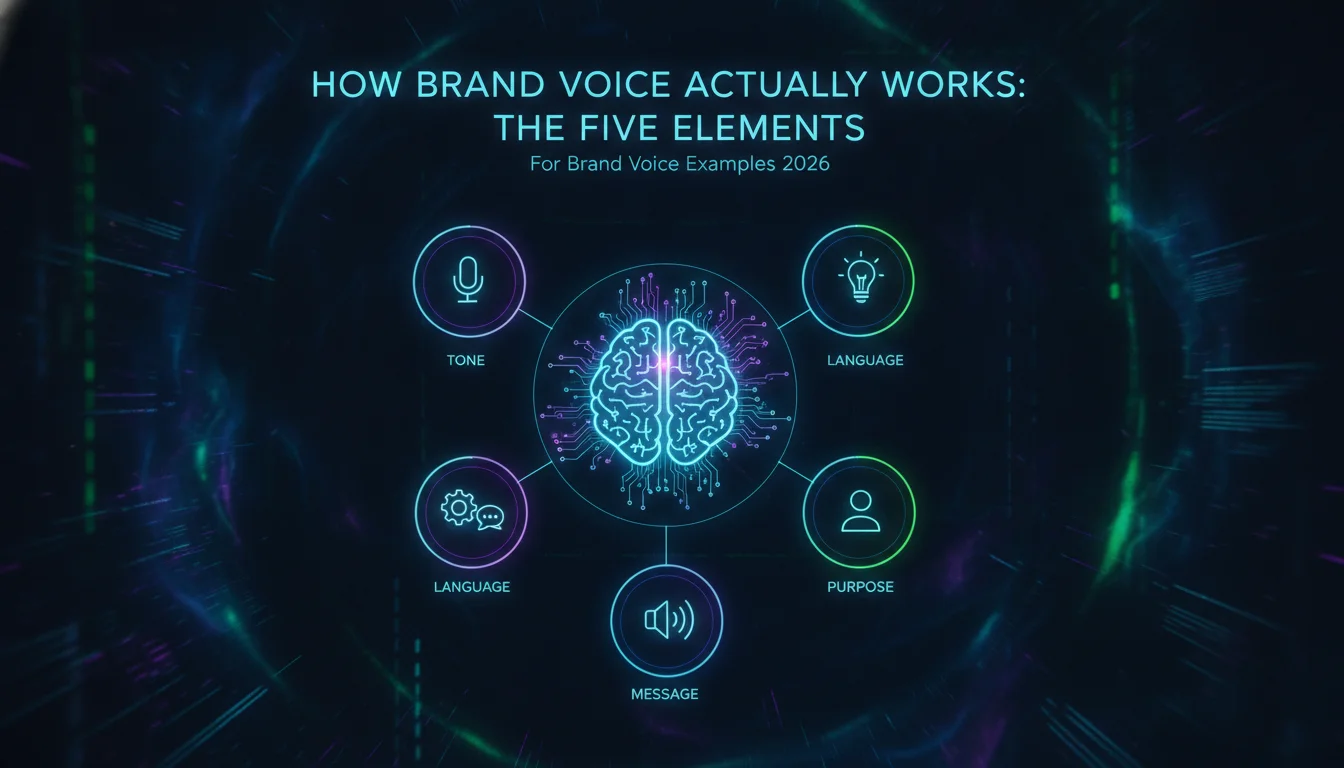
A working brand voice is built from five specific components. Skip any one of them and the document will not survive contact with new writers, freelancers, or agency partners.
1. Three to Five Voice Attributes
Short, opinionated, and specific. Avoid bland adjectives that mean nothing in practice. Push toward attributes that carry built-in trade-offs.
- Weak: Friendly, professional, helpful.
- Strong: Confident without arrogance. Warm without being cloying. Plainspoken, never corporate. Slightly cheeky in marketing, never cheeky in error messages.
The trade-off is what makes the attribute usable. “Friendly” does not constrain a writer. “Warm without cloying” does.
2. Vocabulary: Use and Avoid
A two-column list is one of the most practical tools in any voice guide. It cuts off-voice copy faster than any other element.
| Use | Avoid |
|---|---|
| customers | users |
| we’ll fix this | the issue will be resolved |
| sign in | log in |
| free | complimentary |
| no, here’s why | we’re unable to accommodate |
3. Sentence Rhythm
Short and direct, or long and lyrical? Contractions allowed or banned? Sentence fragments as rhetorical devices, or always grammatically complete? Apple uses short declarative sentences, often three-beat. Stripe writes longer, more technical sentences that respect the reader’s intelligence. Innocent Drinks goes lowercase, chatty, with frequent fragments. Each is a deliberate choice that gives the voice its texture.
4. Tone Variants by Context
Specify the tone for the main contexts your brand writes in. One paragraph per context with a do-this/not-this example is enough.
- Marketing and ads: Usually the most expressive end of the voice.
- Onboarding: Warm, encouraging, plainspoken.
- Support replies: Calm, attentive, no jargon.
- Error and empty states: Clear, brief, no blame.
- Legal and policy: Precise, no fluff, but still recognizably the brand.
5. Before and After Examples
This is the single most useful part of any voice guide. Take a generic piece of copy and show it rewritten on-voice. These examples teach the voice faster than any description can.
- Generic: “We are sorry to inform you that your payment did not go through. Please update your billing information.”
- On-voice (warm, plainspoken): “Your payment didn’t go through – looks like your card might have expired. Update your billing info and we’ll try again automatically.”
“The brand voice guides that get used are the ones that show rather than tell. What actually changes writing behavior is seeing the difference between a sentence that embodies the brand and one that doesn’t.” – Branded By, 2026
The 8 Brand Voice Archetypes
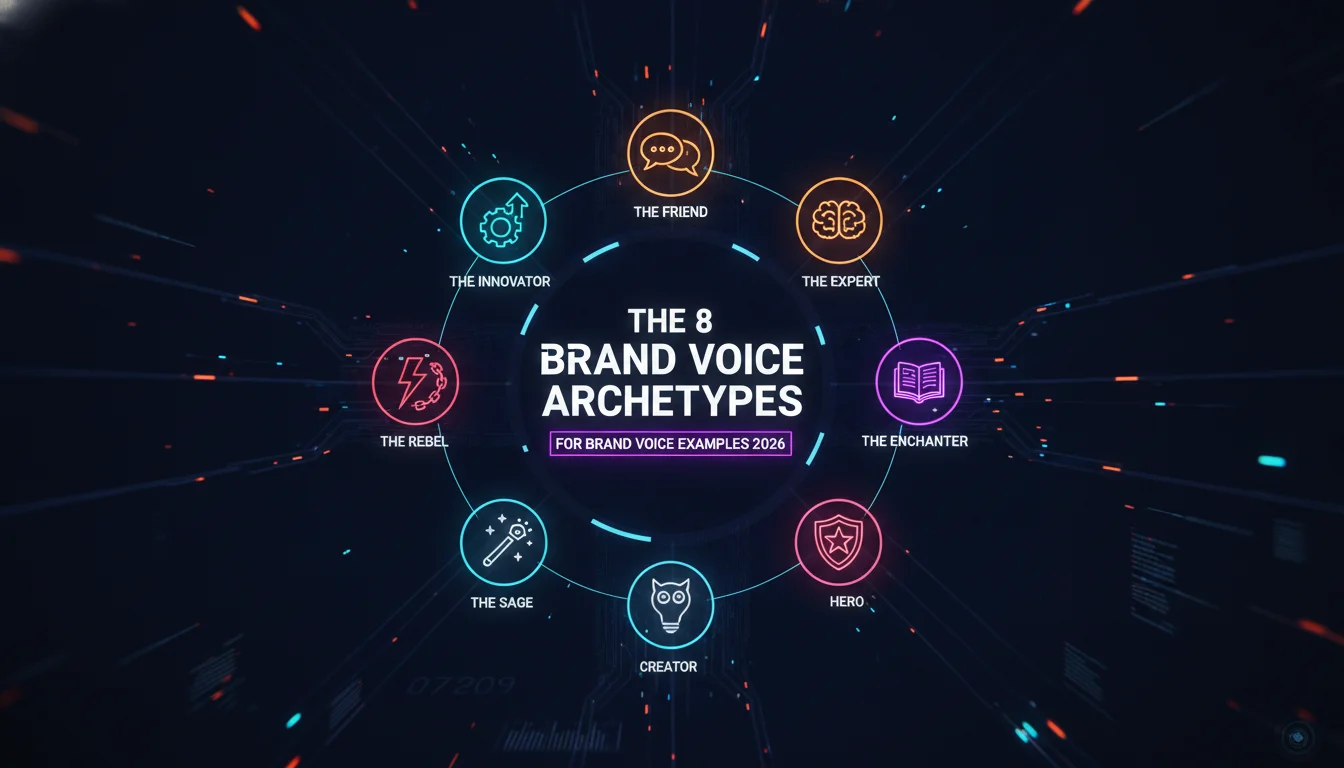
Brand voice archetypes give your team a fast starting point. Pick the one closest to your brand’s personality, then customize from there. These eight archetypes cover the full range of brand voice examples 2026 practitioners are working with right now.
| Archetype | Best For | Sample Line |
|---|---|---|
| Playful | D2C, food, pets, kids | “Your dog already loves it. We’re just the messenger.” |
| Expert / Authoritative | B2B, legal, finance, healthcare | “Five-year audit. Zero misclassified deductions. That’s the standard.” |
| Premium / Luxurious | High-ticket services, hospitality, design | “A single room. Twenty-three years of practice. Available, by appointment, to four guests at a time.” |
| Witty | SaaS, agencies, modern services | “Your old CRM was free. So is gravity. Both have costs.” |
| Warm / Empathetic | Coaching, home services, local businesses | “We’ll be there before noon, take the photos, and let you know the moment we know more.” |
| Bold / Challenger | Startups, disruptors, new entrants | “The 14-day refund window is a lie. Ours is forever.” |
| Calm / Minimalist | Design tools, wellness, premium tech | “One feature. Done well. Available Tuesday.” |
| Rebel / Disruptor | Advocacy brands, niche communities, opinionated creators | “We pick a side. We stay there.” |
These archetypes come from ClickGrow’s 2026 brand intelligence research and reflect the range of voices performing well across social, email, and web copy right now.
Examples of Successful Brand Voices in 2026
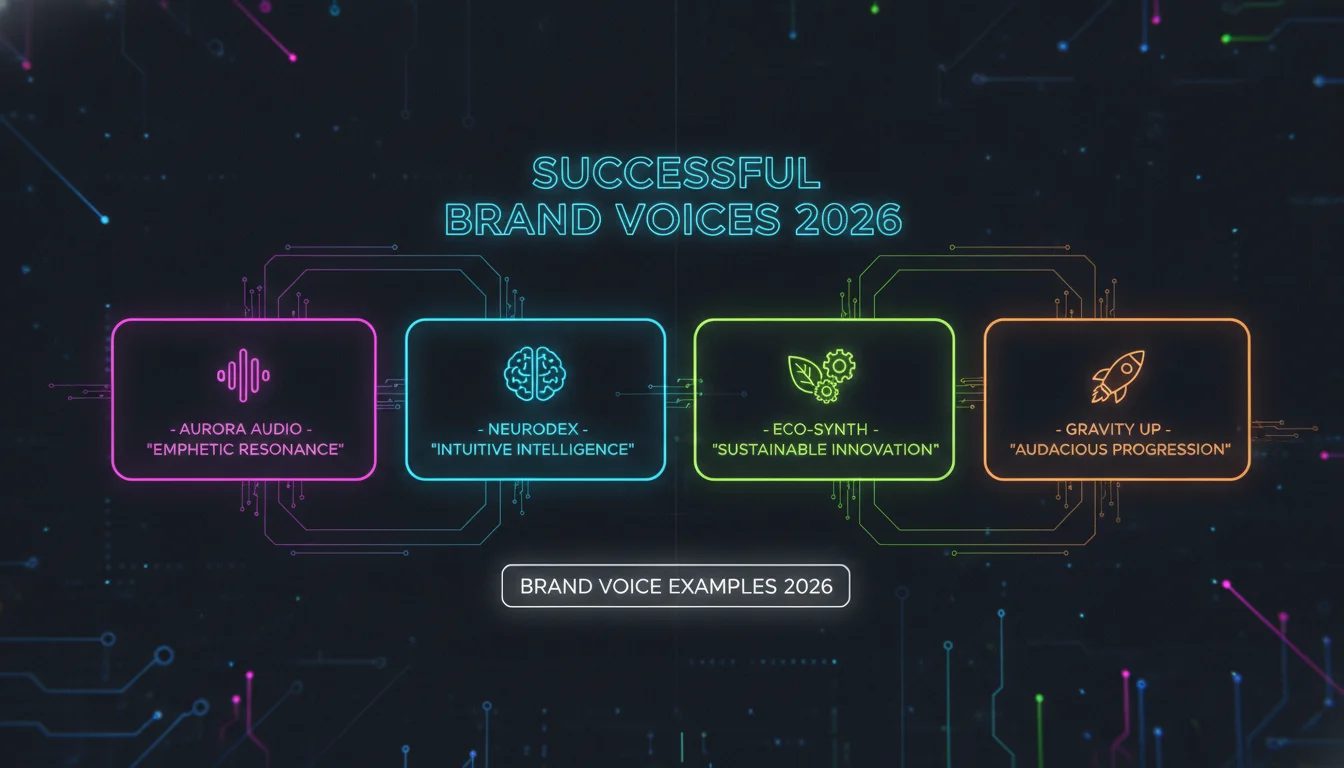
Studying real brand voice examples 2026 is the fastest way to understand what a strong voice looks like in practice. Here are five brands that have built voices their audiences recognize instantly.
Nike: The Motivational Voice
Nike’s brand voice is motivational, promoting determination, courage, and resilience. Their messaging consistently includes:
- Imperative Language: Commands like “Just Do It” encourage action without hesitation.
- Emotional Appeal: Campaigns built around personal stories of athletes, not product specs.
- Visual Storytelling: Inspirational imagery that reinforces the verbal message.
Rather than selling a running shoe, Nike sells the idea of becoming a runner. That shift from product feature to emotional benefit is the core of their voice strategy, and it shows up in every campaign, caption, and product description they publish.
Apple: The Confident Innovator
Apple’s brand voice is characterized by simplicity and confidence. Key elements include:
- Minimalist Language: Clear, concise messaging that avoids jargon entirely.
- Design Focus: Emphasizing aesthetics and functionality over feature lists.
- Three-Beat Sentences: “It just works. Beautifully. From the first second.” That rhythm is deliberate and instantly recognizable.
Wendy’s: The Witty Challenger
Wendy’s brand voice is playful and humorous, often using sarcasm to engage with customers. Their approach includes:
- Social Media Engagement: Quick-witted responses that resonate with a younger audience.
- Brand Personality: A cheeky tone that sets them apart from every other fast-food brand.
- Memorable Campaigns: Creative marketing that leverages humor instead of production budgets.
Coca-Cola: The Nostalgic Connector
Coca-Cola’s brand voice uses nostalgic marketing to offer consumers something more valuable than a beverage. Their voice appeals to consumers by promoting experiences of happiness, joy, friendship, and family, with Coca-Cola as the central feature. The “Share a Coke” campaign, which labeled bottles with 250 common names, is a textbook example of voice-driven marketing: the product became a vehicle for personal connection.
Slack: The Efficient Friend
Slack’s brand voice caters to business professionals using casual friendliness and efficiency. The brand appeals to its target market with simple, no-frills communication. Rather than witty one-liners, Slack promotes clarity and speed, giving customers what they actually want: a professional tool that feels human to use.
Comparison of Brand Voice Examples
| Brand | Voice Type | Key Characteristics | Best Channel |
|---|---|---|---|
| Nike | Motivational | Empowering language, emotional storytelling, strong visuals | Video, social, OOH |
| Apple | Confident | Simplicity, clarity, design focus, three-beat rhythm | Product pages, ads |
| Wendy’s | Witty | Humor, sarcasm, engaging social media presence | Twitter/X, social |
| Coca-Cola | Nostalgic | Emotional connections, community focus, shared experiences | TV, experiential |
| Slack | Efficient | Casual friendliness, professional tone, straightforward communication | Email, product UI |
| Mailchimp | Warm / Plainspoken | Contractions, fragments, jokes only where they don’t block clarity | Email, onboarding |
| Innocent Drinks | Playful | Lowercase, chatty, frequent fragments, self-aware humor | Packaging, social |
A Worked Example: Building a Voice from Scratch
Abstract frameworks only go so far. Here is how a real brand voice development process looks in practice.
Imagine a boutique fitness studio launching its first digital presence. The founders know they are not a big-box gym. They want to feel personal, expert, and a little irreverent. Here is how they would build their voice using the five-element framework.
Step 1: Define attributes. After a team workshop, they land on three: “Direct without being harsh. Expert without being intimidating. Warm without being soft.” Each attribute has a flip side, which is what makes it usable.
Step 2: Build the vocabulary list. Words they use: “your body,” “show up,” “real progress,” “we’ll be honest.” Words they avoid: “wellness journey,” “transform your life,” “complete” (too vague), “results-driven” (too corporate).
Step 3: Set sentence rhythm. Short declarative sentences for marketing copy. Warmer, slightly longer sentences for email. No exclamation marks in error messages or billing communications.
Step 4: Write tone variants. Instagram captions get the most personality. Support emails get calm and clear. Class descriptions get expert and encouraging.
Step 5: Create before/after examples. Generic: “Our certified trainers will help you achieve your fitness goals in a supportive environment.” On-voice: “Our trainers are blunt about what works. They’re also the first to celebrate when it does.”
That five-step process takes roughly half a day with the right people in the room. The output is a voice guide your whole team can actually use, not a PDF that lives in a shared drive and gets ignored.
How to Apply This: Building Your Brand Voice Step by Step
Creating a unique brand voice involves deliberate choices at every level. Here is a structured approach that works for brands of any size.
Step 1: Define Core Attributes
Identify three to five key attributes that represent your brand’s personality. Push past generic adjectives and find the trade-off in each one. For example:
- Bold: Unafraid to challenge norms, but never reckless.
- Empathetic: Understanding and supportive, but never patronizing.
- Innovative: Always exploring new ideas, but grounded in what actually works.
Step 2: Establish Vocabulary
Create a two-column list of words and phrases that align with your brand voice. This should include:
- Words to Use: Terms that embody your brand’s personality and feel natural to your audience.
- Words to Avoid: Jargon, corporate-speak, or phrases that create distance.
Step 3: Determine Tone Variations
Recognize that tone shifts depending on context, even while voice stays fixed. For example:
- Support Emails: Calm and reassuring. No blame, no jargon.
- Marketing Materials: Enthusiastic and energetic. This is where your voice gets to stretch.
- Social Media Posts: Playful and informal. Match the platform’s energy without losing your identity.
Step 4: Write Before and After Examples
Take three to five real pieces of your existing copy and rewrite them on-voice. These examples become the most-used pages in your voice guide. New writers will reach for them before they reach for the attribute list.
Step 5: Document and Distribute
A voice guide only works if people can find it and use it. Keep it short enough to read in one sitting. Distribute it to every writer, designer, social media manager, and agency partner who touches your brand. Run a brief training session when you launch it. Then audit your content quarterly to catch drift before it becomes a pattern.
Common Mistakes to Watch Out For
Most brand voice projects fail not in the definition phase but in the execution. Here are the mistakes we see most often, and how to avoid them.
Mistake 1: Attributes Without Trade-offs
“Friendly, professional, approachable” describes almost every brand on the planet. These adjectives give your team nothing to work with. Every attribute needs a flip side: “warm, never cloying” or “confident, never arrogant.” The constraint is what makes the attribute useful.
Mistake 2: Voice That Only Lives in Marketing
Your brand voice is not just for ad copy. It needs to show up in support emails, error messages, invoice language, and onboarding flows. If your marketing sounds like one brand and your support emails sound like a different company, customers notice. That inconsistency erodes trust faster than almost anything else.
Mistake 3: Copying a Competitor’s Voice
Wendy’s sarcasm works because it is authentic to their brand history and team culture. If a B2B software company tries to replicate that voice, it reads as forced and off-brand. Study the brand voice examples 2026 has produced, but build from your own values, not someone else’s personality.
Mistake 4: No Before/After Examples
A voice guide without examples is a list of adjectives. Writers cannot write from adjectives alone. They need to see the difference between a generic sentence and an on-voice sentence. Three to five before/after pairs per tone variant is the minimum.
Mistake 5: Never Auditing the Voice
Brand voice can drift over time, especially as teams grow and content volume increases. Schedule a quarterly audit. Pull a random sample of content from each channel and check it against your voice guide. If you find consistent drift in one direction, update the guide rather than fighting the drift.
Brand Voice in 2026: What’s Changed and What’s Coming
As of 2026, the brand voice conversation has shifted significantly. AI-generated content now floods every channel, from social captions to blog posts to product descriptions. The result is a sea of copy that sounds competent but interchangeable. According to Storyflow’s 2026 practitioner guide, AI content sounds generic because it was given generic instructions, not because it cannot match a voice. The fix is a voice guide specific enough to argue with: traits with flip sides, banned phrases, and real examples fed to the AI every time it drafts.
This means a distinctive brand voice is now more valuable than it has ever been. Brands that have invested in a clear, documented voice have a real competitive advantage. Their AI-assisted content sounds like them. Everyone else’s sounds like everyone else.
Nielsen Norman Group’s framework maps brand voice along four dimensions: formality, humor, respect, and energy. As of 2026, the brands winning on social media are those who have made deliberate, specific choices on all four axes, not just one or two. Vague positioning on any dimension creates content that blends into the background.
Looking ahead, the brands that will stand out are those treating their voice guide as a living document. They update it when language evolves, when their audience shifts, and when new channels demand new tone variants. Voice is not a one-time project. It is an ongoing editorial practice.
For a deeper look at how brand identity connects to visual systems, see our guide to brand identity and design at Emin Media. And if you are building a content strategy alongside your voice work, our digital marketing services page outlines how we approach both together.
Pros and Cons of Developing a Formal Brand Voice
Pros
- Consistency at scale: Every writer, agency, and AI tool produces content that sounds like the same brand.
- Faster content production: Writers spend less time second-guessing tone when the guide is clear.
- Stronger trust signals: Consistent voice is one of the clearest indicators of a credible, established brand.
- Competitive differentiation: A distinctive voice is harder to copy than a logo or color palette.
- Better AI output: A specific voice guide dramatically improves the quality of AI-assisted content.
Cons
- Upfront time investment: Building a proper voice guide takes a focused half-day to full-day workshop, plus revision cycles.
- Risk of rigidity: An overly prescriptive guide can stifle creativity and make content feel formulaic.
- Requires ongoing maintenance: Voice drift happens. Without quarterly audits, the guide becomes outdated quickly.
- Adoption challenges: A guide only works if the team uses it. Training and buy-in take real effort.
Frequently Asked Questions
What is the difference between brand voice and tone?
Brand voice is the consistent personality of a brand, while tone refers to the emotional inflection that varies depending on context. Voice remains stable across every channel and situation, whereas tone adapts: celebratory in a success email, calm in a support reply, urgent in a cart-abandonment message.
Can you give me some examples of brand voice?
The clearest brand voice examples 2026 practitioners reference are Nike (motivational, imperative, emotionally driven), Apple (confident, minimalist, design-led), Wendy’s (witty, sarcastic, social-first), Mailchimp (warm, plainspoken, occasionally playful), and Innocent Drinks (lowercase, chatty, self-aware). Each brand uses its voice consistently across every touchpoint, from packaging to error messages.
How can I develop my brand voice?
Start by defining three to five core attributes with their flip sides, then build a vocabulary list of words to use and avoid. Add tone variants for your main content contexts, write three to five before/after examples, and document everything in a guide your whole team can access. Audit the guide quarterly to catch drift before it becomes a pattern.
Why is brand voice important?
A strong brand voice builds customer trust, sharpens recognition, and differentiates your brand from competitors. According to research cited by Publora, consistent brand presentation can increase revenue by up to 23%, and Edelman’s Trust Barometer reports that 81% of consumers need to trust a brand before buying from it. Voice is one of the strongest trust signals available.
Can brand voice change over time?
Yes, brand voice can and should evolve as a company grows, shifts its audience, or enters new markets. The key is intentional evolution rather than accidental drift. Regular audits and deliberate updates to the voice guide keep the brand relevant without losing the consistency that customers have come to recognize.
How does brand voice impact marketing performance?
A well-defined brand voice makes marketing content more memorable, more relatable, and more likely to drive engagement and loyalty. It also speeds up content production because writers spend less time second-guessing decisions. As of 2026, it also directly improves AI-assisted content quality: a specific voice guide gives AI tools the constraints they need to produce on-brand output instead of generic copy.
What is the 3-7-27 rule in branding?
The 3-7-27 rule suggests that it takes roughly 3 exposures for someone to recognize a brand, 7 to remember it, and 27 to develop genuine trust and preference. A consistent brand voice accelerates this process by making every touchpoint feel familiar and intentional, compressing the time it takes to move from recognition to trust.
Ready to build a brand voice that your audience actually remembers? Contact Emin Media for a free brand consultation and let’s build something bold together.
Enjoyed this article?
Contact Emin Media for a free brand consultation and let's create something amazing together.
Get in TouchRelated Articles
Digital Marketing for Creatives: A Bold Guide
Digital marketing for creatives builds real visibility and sales. Learn strategies for social media, SEO,…
Branding & Design Agency Tips That Actually Work
Discover branding and design agency tips to choose the right partner, set clear goals, and…
Creative Agency Pitch Deck Tips That Win Clients
Master creative agency pitch deck tips that win clients in 2026. Learn storytelling, design, and…