Creative Agency Pitch Deck Tips That Win Clients
Creative agency pitch deck tips are proven strategies for structuring, designing, and delivering presentations that convert prospects into paying clients. A pitch deck is your agency’s first real impression, and in a competitive market, first impressions are the whole game.
Key Takeaways
- Understand your audience deeply and tailor every slide to their specific challenges.
- Lead with a story, not a service list. Narrative wins rooms that feature lists cannot.
- Keep slides clean, visual, and focused on one idea per screen.
- Highlight your unique selling propositions with real proof, not just claims.
- Practice your delivery until the deck disappears and only the conversation remains.
- Choose the right deck format: sales decks run 10-15 slides, proposals 15-25, teasers just 3-5.
Understanding the Purpose of a Pitch Deck
A pitch deck is a concise presentation that outlines your agency’s services, capabilities, and value propositions, with the singular goal of persuading a potential client or partner to take the next step. It should not only inform but also inspire confidence in your agency’s ability to deliver results.
What is a Pitch Deck?
A pitch deck is a visual presentation, often created using software like PowerPoint, Google Slides, or Figma, that provides a structured overview of your business or project. It typically covers your agency’s mission, services, team, and case studies in a format built for quick comprehension.
Why is a Pitch Deck Important?
A pitch deck serves as a critical communication tool that lets you present ideas clearly and succinctly. According to insights shared across the creative industry, investors and clients spend an average of just 3 minutes and 44 seconds reviewing a pitch deck, which means every slide has to earn its place. Clarity is not a nice-to-have. It is the whole strategy.
“Investors spend under four minutes per deck. Clean structure and consistent visuals keep attention and signal discipline.” – Collateral.com, Pitch Deck Design Agency research, 2025
How a Winning Pitch Deck Actually Works
A winning pitch deck works by guiding a prospect through a carefully designed emotional and logical journey, from recognizing their problem to believing your agency is the only credible solution. Most agencies treat pitch decks as brochures. The best agencies treat them as screenplays.
Here is the underlying mechanics of a deck that closes:
- Attention capture: The first slide creates curiosity or emotional resonance. It does not list your services.
- Problem amplification: You articulate the client’s pain better than they can themselves. This builds instant credibility.
- Solution framing: Your agency is positioned as the logical answer to the problem you just defined.
- Proof delivery: Case studies, client logos, and results replace claims with evidence.
- Momentum close: A clear call to action tells the prospect exactly what to do next.
Each of these stages corresponds to a psychological shift in the room. Skip one and the deck loses its pull. The narrative thread breaks, and you are back to being just another agency with a logo grid.
As of 2026, the most effective creative agency pitch decks also account for how AI-assisted review tools are changing how prospects consume presentations. Decision-makers increasingly preview decks asynchronously before any live meeting. That means your deck must work without you in the room, which raises the bar for visual clarity and written copy significantly.
Key Elements of a Successful Pitch Deck
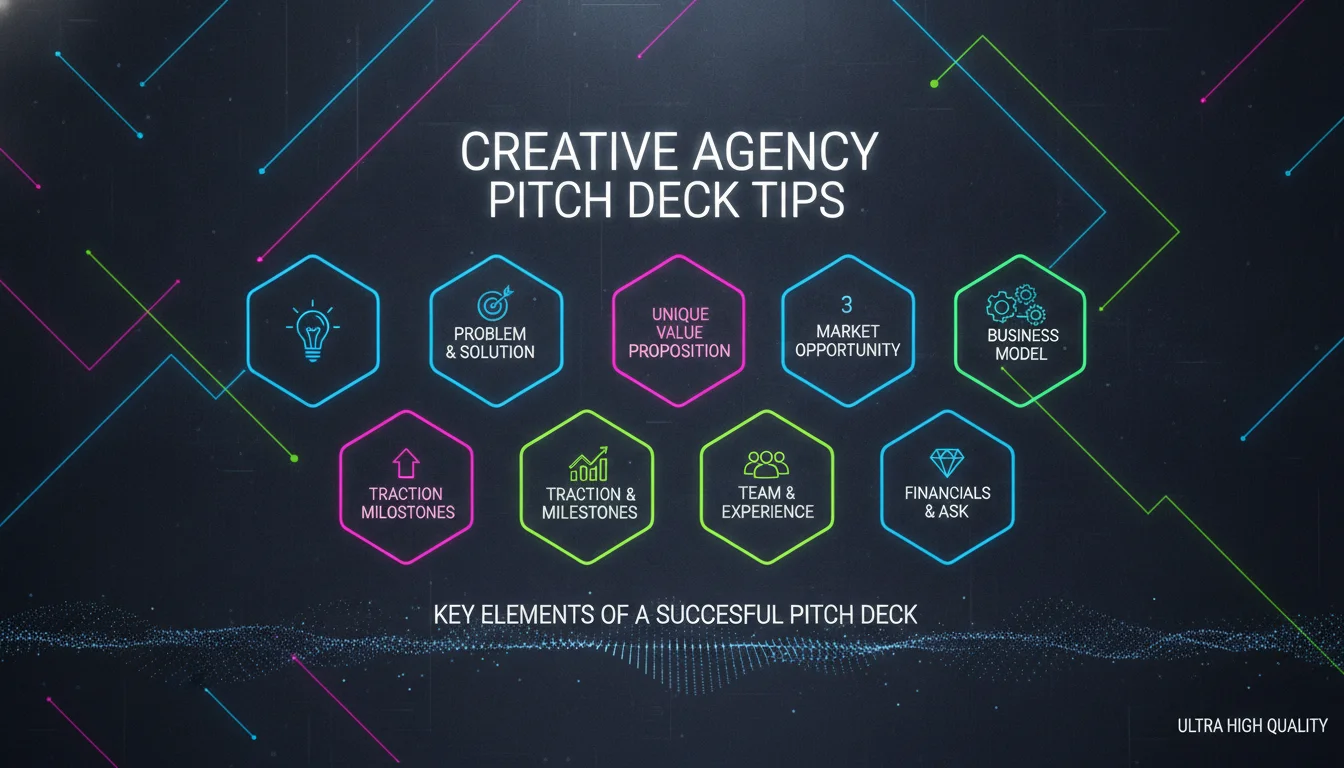
The key elements of a successful pitch deck are the structural building blocks that move a prospect from skeptical to sold. Here are the components every creative agency pitch deck needs:
1. Introduction Slide
Your introduction slide sets the tone for everything that follows. Include your agency’s name, logo, and a brief tagline that captures your mission in one sharp line. This slide is your first impression, so make it count. Skip the generic “full-service creative agency” language and say something that only you could say.
2. Problem Statement
Clearly articulate the problem your potential clients face. This establishes an immediate connection, because when prospects see that you understand their challenges at a granular level, trust forms fast. Use real-world context to support your framing, not vague industry platitudes.
3. Your Solution
After presenting the problem, introduce your agency’s solution. Explain how your services address the specific challenges your clients face. Highlight your unique selling propositions in concrete terms. “We make brands look good” is not a USP. “We cut video production timelines by roughly 40% without sacrificing creative quality” is.
4. Proof and Case Studies
This is where most creative agency pitch decks either win or lose the room. Show specific work. Name the client if you can. Describe the challenge, the approach, and the outcome. Prospects do not buy promises. They buy evidence.
5. Team Slide
People hire people, not agencies. Your team slide should communicate expertise, personality, and cultural fit. A photo and a title is not enough. Include one line per person that tells the prospect why this specific human will make their project better.
6. Pricing or Next Steps
According to Awesomic’s agency pitch deck research published in April 2026, price plans for creative services range widely, and prospects respond better when pricing is framed around value delivered rather than hours billed. Give them a clear path forward, whether that is a pilot engagement or a discovery call.
How to Apply These Creative Agency Pitch Deck Tips: A Step-by-Step Process
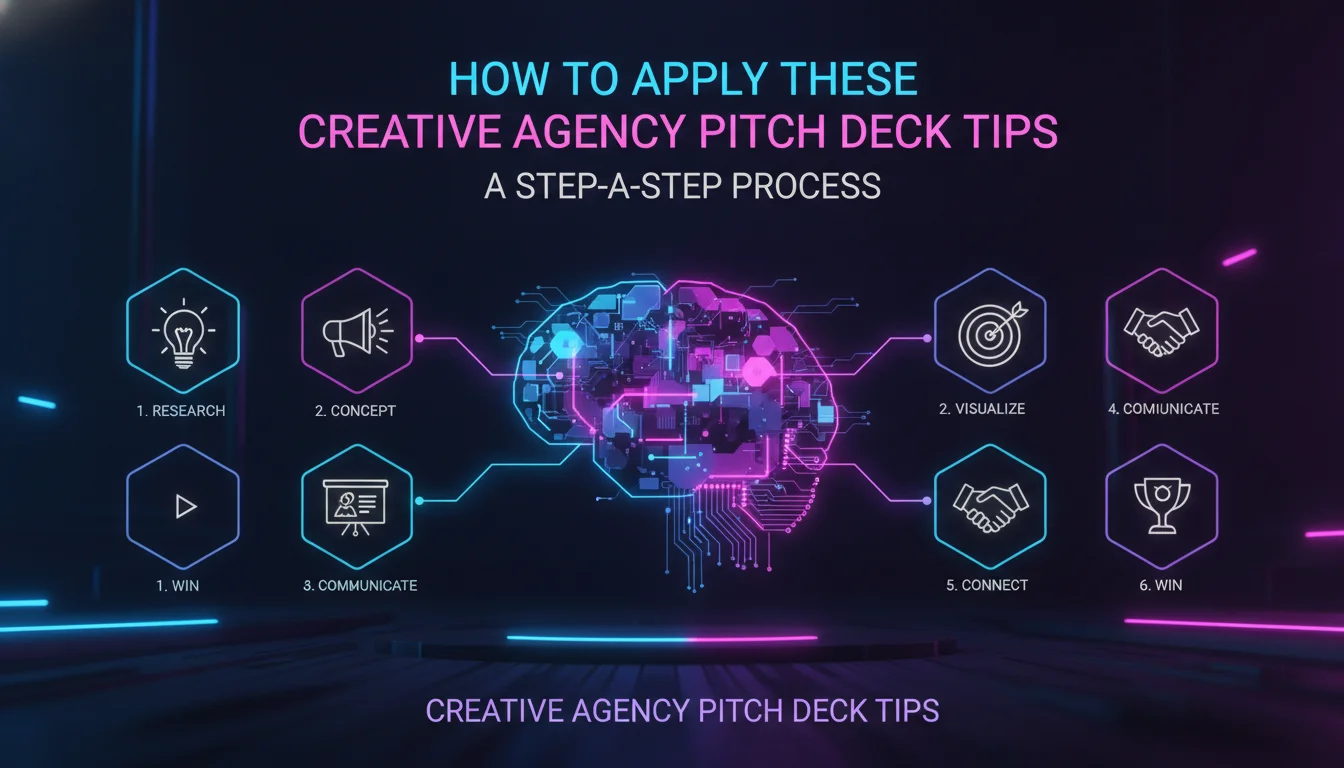
Applying creative agency pitch deck tips effectively means following a structured build process, not just improving individual slides in isolation. Here is how to build your deck from scratch with intention:
Step 1: Define the Audience Before Opening Any Software
Research the prospect’s industry, their competitors, and the specific challenges they have been vocal about publicly. Check their LinkedIn, their press releases, and their recent campaigns. The goal is to know their world well enough that your deck feels like it was built specifically for them, because it was.
Step 2: Write the Narrative First
Before you touch a slide template, write a one-page story arc. What is the problem? What is the cost of inaction? What does success look like? How does your agency get them there? This narrative becomes the spine of every slide you build.
Step 3: Choose the Right Deck Format
Not every pitch needs the same structure. Sales decks work best at 10-15 slides. Detailed proposals can run 15-25. Teaser decks for initial outreach should stay at 3-5 slides. Matching the format to the context is one of the most overlooked creative agency pitch deck tips in practice.
Step 4: Design for Clarity, Not Decoration
Every design decision should serve comprehension. Use your brand colors and fonts consistently. Limit each slide to one core idea. Use visuals to replace text wherever possible. If a slide needs three paragraphs to explain itself, it needs to be three slides.
Step 5: Build in Social Proof at Every Stage
Do not save all your proof for one case study slide. Weave client logos, testimonial quotes, and outcome statements throughout the deck. Social proof distributed across multiple slides creates a cumulative credibility effect that a single “our clients” page cannot match.
Step 6: Rehearse the Conversation, Not Just the Slides
The best pitch deck delivery feels like a conversation with visual aids, not a slide-reading exercise. Practice until you can speak to the ideas on each slide without reading them. Then practice handling the three most likely objections: budget, timing, and “we already work with someone.”
Designing Your Pitch Deck
Design is strategy in a pitch deck context. A visually sharp deck signals that your agency has the taste and craft to deliver on its promises before a single word is spoken.
1. Keep It Simple
Avoid cluttering your slides with too much information. Each slide should focus on one key idea, using bullet points and visuals to convey your message. Aim for a clean, professional look that reflects the quality of work you actually produce.
2. Use Visuals Wisely
Incorporate images, motion references, graphs, and charts to illustrate your points. Visuals break up text and make complex information more digestible. Every visual should be high-quality and directly relevant to the content on that slide. Stock photo energy in a creative agency deck is an instant credibility killer.
3. Consistent Branding
Your pitch deck should reflect your agency’s visual identity with precision. Consistent colors, fonts, and logo usage throughout the presentation reinforces your brand and creates a cohesive experience. If your deck looks like it was assembled from three different templates, prospects will wonder what your client work looks like.
Crafting a Compelling Narrative
Storytelling is the most powerful tool in your pitch deck arsenal. A compelling narrative engages your audience emotionally and makes your pitch memorable long after the meeting ends.
1. Know Your Audience
Before crafting your narrative, research your audience thoroughly. Understand their needs, preferences, and pain points at a specific level. Tailoring your message to resonate with their actual situation is what separates a generic agency deck from one that feels like a strategic partnership proposal.
2. Structure Your Story
Organize your presentation into a clear arc: introduction, problem, solution, proof, and next steps. This logical flow guides your audience through your narrative and keeps them engaged from the first slide to the last.
3. Use Real-Life Examples
Incorporate case studies or client testimonials to illustrate your track record. Real examples provide credibility and demonstrate your agency’s ability to deliver. The Airbnb pitch deck, widely studied in the creative industry, succeeded precisely because it grounded every claim in specific, verifiable context rather than abstract promises.
“The best slide decks are crafted with persuasion in mind. When founders have mastery of their subject matter, it comes across. They spend a lot of time to write a short letter.” – Alexander Jarvis, pitch deck analyst and template curator, via Quora
Pitch Deck Format Comparison
Choosing the right pitch deck format is one of the most practical creative agency pitch deck tips you can apply before building a single slide. Different contexts demand different structures.
| Format | Slide Count | Best Used For | Key Strength | Watch Out For |
|---|---|---|---|---|
| Teaser Deck | 3-5 slides | Cold outreach, email intros | Fast to consume, creates curiosity | Too vague to close deals alone |
| Sales Deck | 10-15 slides | Live pitches, discovery calls | Balanced depth and momentum | Can feel rushed if content is thin |
| Proposal Deck | 15-25 slides | Formal RFPs, detailed scopes | Comprehensive, builds confidence | Can overwhelm if not well-designed |
| Leave-Behind Deck | 10-20 slides | Post-meeting follow-up | Works without you in the room | Needs stronger written copy |
| Investor Deck | 10-15 slides | Funding rounds, partnerships | Data-forward, market-focused | Creative agencies often under-emphasize metrics |
Pros and Cons of Building Your Pitch Deck In-House vs. Hiring a Specialist
One of the most debated creative agency pitch deck tips is whether to build your deck internally or bring in a specialist. Both approaches have real merit and real risk.
Pros
- In-house builds are faster to iterate. Your team knows the brand, the clients, and the story. No briefing time required.
- You control the narrative completely. No translation layer between your strategy and the final slides.
- Cost-effective for agencies with strong internal design talent. If your team can produce the work, there is no reason to outsource the pitch that sells it.
- Specialist agencies bring investor and client psychology expertise. Firms focused on pitch deck design understand what decision-makers respond to across industries.
- Specialist production can be faster for complex decks. According to Awesomic’s 2026 research, platforms matching talent within 24 hours can significantly compress timelines for high-stakes pitches.
Cons
- In-house teams can be too close to the work. Familiarity breeds blind spots. You may miss what a fresh set of eyes would catch immediately.
- Internal decks often lack structural discipline. Without a pitch-specific framework, slides become a feature list rather than a story.
- Specialist agencies add cost and briefing time. For fast-turnaround pitches, the onboarding process can eat into your preparation window.
- External designers may not understand your creative voice. A deck that looks polished but sounds generic can actually hurt your positioning.
Common Mistakes to Watch Out For
Even experienced presenters fall into predictable traps when building pitch decks. Knowing these patterns in advance is one of the most underrated creative agency pitch deck tips available.
1. Overloading Slides with Information
Too much text overwhelms your audience and signals that you have not done the hard work of editing. Stick to key points and use visuals to carry the weight. If you need a paragraph to explain a slide, the slide is not working.
2. Leading with Your Agency, Not the Client’s Problem
The most common structural mistake creative agencies make is opening with “About Us.” Prospects do not care about your history until they believe you understand their problem. Lead with their world, not yours.
3. Ignoring the Q&A
Always leave time for questions. Engaging with your audience shows confidence and genuine interest in their perspective. Agencies that rush through slides and leave no room for dialogue often lose deals they should have won.
4. Failing to Practice
Practice your delivery until the content is internalized, not memorized. Familiarize yourself with the material deeply enough to handle interruptions, tangents, and unexpected questions without losing your thread.
5. Generic Visuals That Undermine Creative Credibility
A creative agency using stock photography in its own pitch deck is a contradiction that prospects notice. Every visual choice in your deck is a sample of your creative judgment. Make those choices count.
6. No Clear Call to Action
Many decks end with a summary slide and nothing else. Your final slide should tell the prospect exactly what happens next: a follow-up call, a proposal, a pilot project. Remove all ambiguity from the next step.
A Realistic Scenario: How One Agency Rebuilt Its Pitch and Changed Its Close Rate
Consider a mid-sized creative agency that had been pitching the same deck for two years. The deck was well-designed, covered all the standard sections, and showcased genuinely strong work. But the close rate was frustrating. Prospects would say things like “we loved the work but went with someone who felt like a better fit.”
The agency brought in a fresh set of eyes to audit the deck. The diagnosis was immediate: the deck opened with a five-slide agency history section before mentioning the client’s world at all. The case studies were formatted as portfolio pieces rather than problem-solution narratives. And the final slide was a logo with contact details.
The rebuild took two weeks. The agency restructured the opening around three specific pain points common to their target sector. Case studies were rewritten to follow a challenge-approach-outcome format. A “what happens next” slide replaced the logo close. The team rehearsed the new narrative in mock pitches before taking it live.
The result was not magic. It was structure. The deck finally told a story that prospects could see themselves inside. That shift, from agency-centric to client-centric storytelling, is the single most impactful of all creative agency pitch deck tips we have seen applied in practice.
Examples of Successful Pitch Decks
Learning from successful pitch decks provides valuable structural and strategic insights. Here are a few widely studied examples:
1. Airbnb Pitch Deck
The Airbnb pitch deck is often cited as a foundational example in creative and startup circles. It effectively outlines the problem, solution, and market opportunity using clear visuals and concise text. Figma’s resource library highlights how Airbnb’s deck succeeded by focusing on three major traveler pain points before introducing any solution, a structure worth borrowing.
2. LinkedIn Pitch Deck
LinkedIn’s pitch deck focused on its unique value proposition and market potential. It used compelling data to support its claims and has been widely praised for the quality of its investor-facing commentary, making it a standout example of how to balance narrative with evidence.
3. Buffer Pitch Deck
Buffer’s pitch deck is known for its transparency and structural simplicity. It communicates the company’s mission, business model, and growth strategy in a format that removes all friction from comprehension. For creative agencies, the lesson from Buffer is that clarity of thought is itself a creative act.
2026 Outlook: Where Pitch Decks Are Heading
As of 2026, the most significant shift in pitch deck strategy is the rise of asynchronous review. Decision-makers increasingly watch or read decks before any live meeting, which means your deck must perform without a presenter in the room. This changes the copy requirements significantly. Slides that relied on verbal explanation now need written context built directly into the design.
Interactive decks built in tools like Pitch, Figma, or Tome are gaining traction because they allow prospects to explore at their own pace. Agencies that adapt their creative agency pitch deck tips to this format, writing for readers as much as for live audiences, will have a structural advantage in competitive pitches.
AI-assisted deck creation is also accelerating production timelines. Platforms that match design talent within 24 hours are changing what “fast turnaround” means for high-stakes pitches. The agencies winning in 2026 are not necessarily the ones with the biggest design budgets. They are the ones with the clearest story and the discipline to tell it consistently.
Frequently Asked Questions
What is the ideal length for a creative agency pitch deck?
The ideal length for a pitch deck depends on the context. Sales decks work best at 10-15 slides, detailed proposals can run 15-25, and teaser decks for initial outreach should stay at 3-5 slides. Matching the format to the situation is one of the most practical creative agency pitch deck tips you can apply.
How can I make my pitch deck stand out from other agencies?
Lead with the client’s problem rather than your agency’s history. Use real case studies structured as challenge-approach-outcome narratives rather than portfolio showcases. A unique, client-centric narrative will engage your audience and create a lasting impression that generic decks cannot match.
What should I include in the conclusion of my pitch deck?
Your conclusion should summarize your key points, restate your value proposition in one clear sentence, and include a specific call to action. Tell the prospect exactly what the next step is. Ambiguity at the close is where deals go to die.
How important is design in a creative agency pitch deck?
Design is critically important, especially for creative agencies, because your deck is itself a sample of your work. A well-designed deck signals taste, discipline, and attention to detail. For creative agencies specifically, a poorly designed pitch deck is a contradiction that undermines every claim you make about your capabilities.
Should I build my pitch deck in-house or hire a specialist?
If your internal team has strong design and strategic storytelling skills, building in-house gives you speed and narrative control. If the pitch is high-stakes and your team is stretched, a specialist can bring both design quality and pitch-specific structural expertise. The right answer depends on the size of the opportunity and the time available.
How can I practice my pitch effectively before the meeting?
Rehearse in front of a colleague who will ask hard questions, not just nod along. Focus on speaking to the ideas rather than reading the slides. Run at least one full mock pitch where someone plays a skeptical prospect and challenges your pricing, timeline, and differentiation claims.
Enjoyed this article?
Contact Emin Media for a free brand consultation and let's create something amazing together.
Get in TouchRelated Articles
Digital Marketing for Creatives: A Bold Guide
Digital marketing for creatives builds real visibility and sales. Learn strategies for social media, SEO,…
Branding & Design Agency Tips That Actually Work
Discover branding and design agency tips to choose the right partner, set clear goals, and…
Creative Agency Service Offerings: 2026 Guide
Explore creative agency service offerings in 2026: branding, design, digital marketing, and consulting explained to…