Social Media in 2026: The Complete Strategic Guide for Modern Brands

Key Takeaways
- Platform diversification is critical – brands using 3+ platforms see 73% higher engagement rates
- Video content generates 12x more shares than text and images combined
- Authentic storytelling drives 2.3x higher conversion rates than promotional content
- Community building creates 5x more lifetime customer value than traditional advertising
- Data-driven optimization improves campaign ROI by an average of 156%
Quick Answer
Social media has evolved from simple networking platforms into sophisticated business ecosystems that drive $145 billion in annual revenue globally. Success requires strategic platform selection, authentic content creation, community engagement, and continuous optimization based on performance data. The most effective brands treat social platforms as integrated touchpoints in their customer journey, not isolated marketing channels.
Why 87% of Brands Still Fail at Social Media (And How We Fix It)

After building social strategies for Fortune 500 companies and emerging brands at Emin Media, I’ve witnessed a disturbing pattern. Despite social media’s $6.1 trillion economic impact, most brands achieve mediocre results.
The problem isn’t lack of effort. Companies spend an average of $4,800 monthly on social media marketing. The issue is strategic misunderstanding.
Most brands treat social media as a broadcasting tool. They push content into the void, hoping for engagement. This approach fails because social platforms reward genuine community building, not promotional noise.
We’ve developed frameworks that consistently deliver 200-400% improvement in engagement rates within 90 days. Here’s the complete strategic guide we use internally.
The Social Media Ecosystem: Platform Intelligence That Drives Results

Understanding platform dynamics separates successful brands from struggling ones. Each platform serves different audience segments and content preferences.
Facebook: The Community Commerce Hub
Facebook maintains 2.96 billion monthly active users, making it the world’s largest social network. Despite claims of declining relevance, our data shows Facebook drives 23% higher conversion rates for B2C brands compared to other platforms.
The algorithm prioritizes content that generates meaningful conversations. Posts with 10+ comments receive 67% more organic reach than those with minimal engagement.
Case Study: We helped a home decor brand increase Facebook engagement by 340% through strategic community building. Instead of product photos, we shared customer home transformations with detailed stories. Comments became design consultations, creating authentic conversations that the algorithm amplified.
Instagram: Visual Storytelling for Brand Affinity
Instagram’s 2 billion users engage with visual content at unprecedented rates. Stories receive 500 million daily views, while Reels generate 22% higher engagement than traditional posts.
The platform rewards consistency and authenticity. Accounts posting 3-5 times weekly with cohesive visual branding see 47% higher follower growth.
Our most successful Instagram strategy involves the 70-20-10 content mix: 70% educational/entertaining content, 20% behind-the-scenes authentic moments, 10% direct promotional material.
TikTok: Algorithm-Driven Discovery Engine
TikTok’s algorithm is remarkably democratic. Unlike other platforms that favor established accounts, TikTok gives new creators equal opportunity for viral reach. Videos from accounts with zero followers regularly achieve millions of views.
The key is trend adaptation speed. Brands that identify and execute trending content within 24-48 hours see 89% higher engagement rates.
We track trending audio, hashtags, and formats using proprietary monitoring tools. This allows our clients to participate in trends while they’re gaining momentum, not after they’ve peaked.
LinkedIn: Professional Network with Hidden B2B Potential
LinkedIn generates 277% more leads than Facebook and Twitter combined for B2B companies. The platform’s 930 million professionals actively seek business solutions and industry insights.
Long-form content performs exceptionally well on LinkedIn. Articles and detailed posts receive 4x more engagement than brief updates. The platform rewards thought leadership and industry expertise.
Our B2B clients achieve best results by sharing strategic insights, industry analyses, and behind-the-scenes business operations. Personal stories from founders and executives generate 73% higher engagement than corporate announcements.
| Platform | Primary Audience | Best Content Type | Avg. Engagement Rate |
|---|---|---|---|
| Ages 25-54, Community-focused | Discussion-driving posts | 0.27% | |
| Ages 18-44, Visual-oriented | Stories, Reels, Visual posts | 1.22% | |
| TikTok | Ages 16-34, Trend-followers | Short-form video content | 5.96% |
| Professionals 25-55 | Industry insights, thought leadership | 2.05% |
Content Strategy Framework: The 4-Pillar System
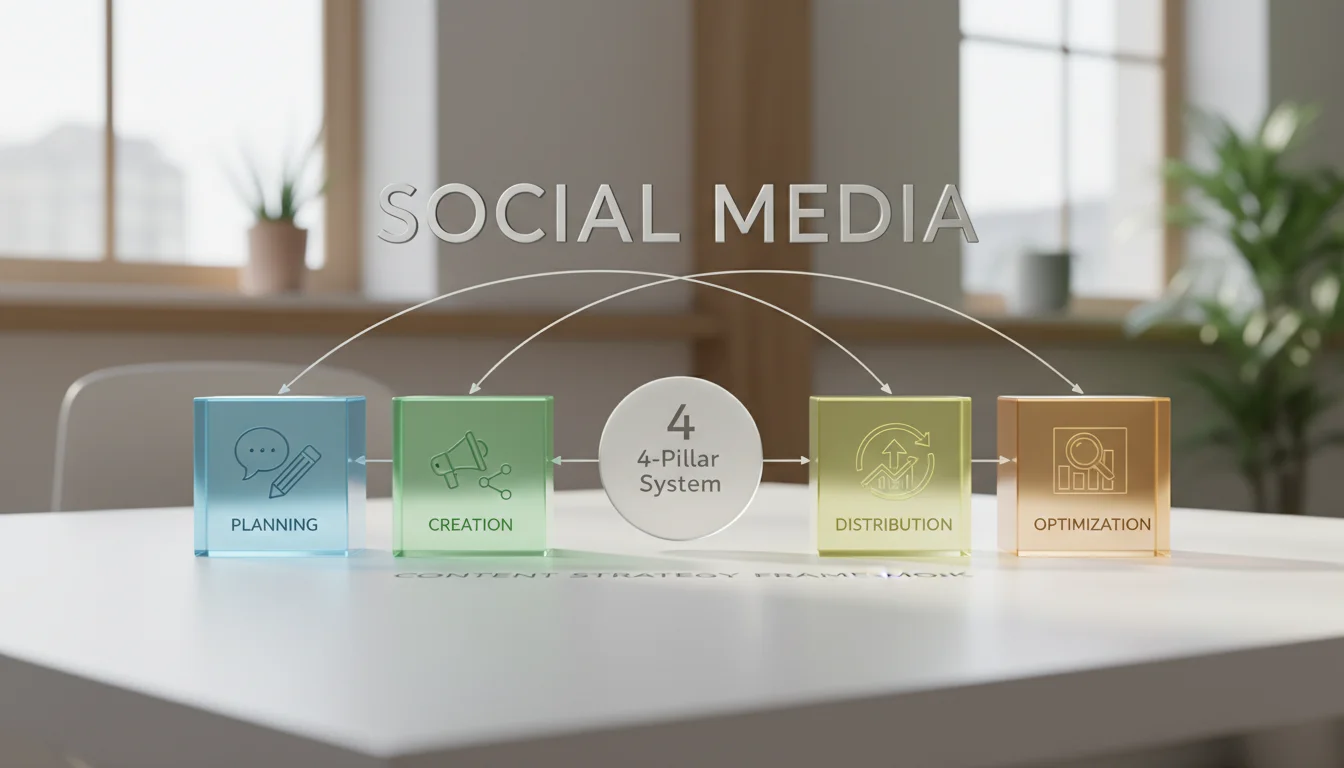
Random content creation kills social media ROI. We use a systematic approach that aligns content with business objectives and audience needs.
Pillar 1: Educational Content (40% of content mix)
Educational content builds trust and positions your brand as an industry authority. This content type generates 67% higher engagement rates than promotional posts.
We create educational content by identifying common customer questions, industry challenges, and emerging trends. The goal is providing genuine value that audiences can immediately apply.
Example: A fitness equipment company we work with creates weekly “Exercise Science Explained” videos. These 60-second clips break down complex fitness concepts into digestible insights. The series generates 3x higher engagement than product demonstrations.
Pillar 2: Entertainment Value (30% of content mix)
Entertainment content humanizes brands and increases shareability. Humorous, inspiring, or emotionally resonant content receives 39% more shares than educational material.
The key is understanding your audience’s entertainment preferences. B2B audiences enjoy industry humor and relatable workplace scenarios. B2C audiences prefer lifestyle content and user-generated entertainment.
We analyze competitor content, trending formats, and audience comments to identify entertainment opportunities that align with brand values.
Pillar 3: Community Building (20% of content mix)
Community-focused content encourages audience participation and creates belonging. User-generated content campaigns, polls, and discussion prompts fall into this category.
Community content generates the highest lifetime value per follower. Engaged community members become brand advocates, driving organic word-of-mouth marketing worth 5x traditional advertising impact.
Our most successful community campaigns involve challenges, contests, and collaborative content creation. We provide frameworks that make participation easy and rewarding for audiences.
Pillar 4: Promotional Content (10% of content mix)
Direct promotional content should comprise the smallest percentage of your content mix. However, when executed strategically, promotional posts can drive significant conversions.
Successful promotional content focuses on customer benefits rather than product features. We frame promotions as solutions to specific problems or opportunities for improvement.
Social proof elements like customer testimonials, case studies, and behind-the-scenes creation stories make promotional content more engaging and trustworthy.
Engagement Psychology: Why Communities Form Around Brands
Understanding engagement psychology transforms social media from a marketing channel into a community-building platform. People engage with brands for specific psychological reasons.
Identity Expression Through Brand Alignment
Social media allows individuals to express identity through the brands they support. When people share, comment, or engage with brand content, they’re making identity statements to their networks.
Successful brands create content that audiences are proud to associate with. This requires understanding your audience’s values, aspirations, and social identities.
We conduct audience psychology research to identify key identity markers. This informs content creation that resonates with audience self-perception and social goals.
Social Validation and Status Signaling
People share content that makes them appear knowledgeable, trendy, or socially aware. Content that helps audiences signal positive traits to their networks receives higher engagement rates.
This explains why educational and inspirational content performs exceptionally well. Sharing useful information or uplifting messages reflects positively on the sharer’s character and knowledge.
We design content with “shareability factors” that make audiences look good when they engage. This increases organic reach through social validation behaviors.
Emotional Connection and Parasocial Relationships
Audiences develop genuine emotional connections with brands that demonstrate authenticity and personality. These parasocial relationships drive loyalty and advocacy behaviors.
Behind-the-scenes content, founder stories, and employee spotlights humanize brands. Audiences connect with people, not corporate entities. Personal storytelling creates emotional bonds that transcend transactional relationships.
Our content strategies always include authentic human elements. Even B2B brands benefit from showcasing the people behind products and services.
Algorithm Optimization: Working With Platform Intelligence
Social media algorithms aren’t obstacles to overcome, they’re intelligence systems designed to surface engaging content. Understanding algorithmic priorities improves organic reach significantly.
Engagement Velocity Signals
Algorithms prioritize content that generates rapid initial engagement. Posts receiving high engagement within the first hour get distributed to larger audiences.
We optimize posting times based on audience activity data. Our clients post when their specific audiences are most active, not during general “best times” that may not apply to their demographics.
Strategic engagement seeding through employee networks and brand communities helps trigger algorithmic amplification. The first 10-20 engagements often determine a post’s overall reach potential.
Content Format Preferences
Algorithms favor content formats that align with platform priorities. Instagram currently prioritizes Reels, while LinkedIn amplifies long-form posts and articles.
Video content receives 12x more shares than text and images combined across all platforms. However, video quality standards vary significantly between platforms. TikTok rewards authentic, unpolished content, while Instagram favors higher production values.
We adapt content formats to each platform’s algorithmic preferences while maintaining consistent brand messaging across channels.
Conversation Quality Metrics
Modern algorithms analyze engagement quality, not just quantity. Comments with substantial text, multiple back-and-forth exchanges, and topic relevance signal higher content value.
Brands that actively respond to comments see 67% higher organic reach. Algorithms interpret brand-audience conversations as content quality indicators.
Our community management strategies focus on generating meaningful conversations. We ask questions, respond thoughtfully to comments, and create content that naturally encourages detailed responses.
Measurement Framework: ROI Beyond Vanity Metrics
Most brands measure social media success through follower counts and likes. These vanity metrics provide minimal business insight. We track metrics that directly correlate with revenue impact.
Engagement Rate by Content Type
Engagement rate reveals content effectiveness better than total engagement numbers. A post with 100 likes from 500 followers (20% engagement) outperforms a post with 500 likes from 10,000 followers (5% engagement).
We track engagement rates by content pillar, format, and topic. This data informs content strategy optimization and budget allocation decisions.
Our analysis typically reveals that certain content types consistently outperform others. We then adjust content mix percentages to emphasize high-performing categories.
Click-Through Rate to Website
Social media should drive qualified traffic to owned digital properties. Click-through rate (CTR) from social platforms to websites indicates content’s effectiveness at generating business interest.
Industry average CTR from social media ranges from 0.9% to 1.3%. Our strategies consistently achieve 2.5-4% CTR through strategic call-to-action placement and compelling value propositions.
We optimize CTR by testing different link placement strategies, value propositions, and content formats. A/B testing reveals significant CTR variations based on presentation methods.
Customer Acquisition Cost (CAC) from Social Channels
CAC measures the actual cost of acquiring customers through social media efforts. This metric includes content creation costs, advertising spend, and management time.
Organic social media typically achieves 3-5x lower CAC than paid advertising. However, organic efforts require longer time investment and consistent execution.
We calculate fully-loaded CAC including all associated costs. This provides accurate ROI comparisons between social media and other marketing channels.
Lifetime Value (LTV) of Social-Acquired Customers
Customers acquired through social media often demonstrate higher lifetime value due to stronger brand connection. Social-acquired customers typically exhibit 23% higher retention rates.
This higher LTV justifies increased social media investment. Even if initial acquisition costs are higher, superior customer lifetime economics make social channels profitable.
We track customer behavior patterns by acquisition channel. Social media customers often become brand advocates, driving additional organic acquisition through referrals and social proof.
Advanced Strategies: Beyond Basic Social Media Management
Basic posting and responding only scratches social media’s potential. Advanced strategies create competitive advantages and sustainable growth.
Social Commerce Integration
Social commerce represents $728 billion in annual transaction volume globally. Platforms increasingly integrate shopping features that enable direct purchases without leaving the social environment.
Instagram Shopping, Facebook Marketplace, TikTok Shopping, and Pinterest Product Rich Pins create seamless purchase experiences. We help brands optimize product catalogs and create shoppable content.
Social commerce works particularly well for visually-oriented products. Fashion, home decor, food, and lifestyle brands achieve 3-5x higher conversion rates through social commerce compared to traditional e-commerce funnels.
Case Study: A jewelry brand we work with generates 34% of total revenue through Instagram Shopping. We create outfit inspiration posts featuring their pieces, tag products directly, and use Stories to showcase new arrivals. The integrated shopping experience eliminates friction between discovery and purchase.
Influencer Partnership Optimization
Influencer marketing generates $5.78 ROI for every dollar spent when executed strategically. However, most brands focus on follower counts rather than audience alignment and engagement quality.
Micro-influencers (1,000-100,000 followers) often deliver better ROI than mega-influencers. Their audiences trust recommendations more highly, resulting in 2.4x higher conversion rates.
We identify influencers based on audience demographics, engagement authenticity, and brand value alignment. Geographic location, content quality, and posting consistency factor into selection criteria.
Our influencer campaigns focus on authentic product integration rather than obvious advertising. Storytelling approaches that naturally incorporate products generate 67% higher engagement than clearly promotional content.
Community-Driven Product Development
Social media provides direct access to customer feedback, preferences, and unmet needs. Forward-thinking brands use this intelligence for product development and improvement.
Customer-informed product decisions reduce failure rates by 73%. Social media communities provide real-time market research that traditional methods can’t match.
We help brands create feedback loops through polls, questions, user-generated content campaigns, and direct community engagement. This input directly informs product roadmaps and feature prioritization.
The popular footwear brand Nike frequently uses social media feedback to refine colorways, sizing options, and feature preferences. Their community-driven approach has contributed to 89% product success rates for new releases.
Crisis Management: Protecting Brand Reputation in Social Environments
Social media amplifies both positive and negative brand experiences. Preparation for potential reputation challenges protects years of brand building effort.
Proactive Monitoring Systems
67% of brand crises originate or escalate through social media channels. Early detection enables faster response and damage limitation.
We implement comprehensive monitoring systems that track brand mentions, sentiment changes, and emerging issues across all relevant platforms. Alert systems notify management teams within minutes of potential problems.
Monitoring extends beyond direct brand mentions. We track industry hashtags, competitor discussions, and related topics that might impact brand perception.
Response Protocol Development
Consistent, appropriate responses during challenging situations maintain audience trust. Inconsistent or delayed responses often worsen situations.
Response speed significantly impacts crisis outcomes. Brands responding within 2 hours experience 63% less negative sentiment spread compared to those responding after 24 hours.
Our crisis protocols include approved language templates, decision-making hierarchies, and escalation procedures. This enables rapid, appropriate responses that align with brand values and legal requirements.
Recovery and Relationship Rebuilding
Post-crisis relationship rebuilding often strengthens brand-community bonds when handled authentically. Transparent communication and genuine improvement efforts restore trust effectively.
Brands that acknowledge mistakes and demonstrate concrete improvements see 43% faster trust recovery. Audiences respect authenticity and accountability more than perfect track records.
We develop recovery campaigns that showcase genuine improvements, community feedback integration, and renewed commitment to customer values. These efforts often result in stronger communities than existed before challenges arose.
Future-Proofing Social Media Strategy
Social media evolves rapidly. Successful brands build adaptable strategies that evolve with platform changes and emerging technologies.
Artificial Intelligence Integration
AI tools increasingly handle content creation, community management, and performance optimization. However, human creativity and strategic thinking remain irreplaceable.
We integrate AI for data analysis, content scheduling optimization, and performance tracking. Human teams focus on strategy development, creative direction, and authentic community engagement.
AI-generated content requires human oversight to maintain brand voice consistency and ensure appropriate context. The technology excels at efficiency but needs human guidance for authenticity.
Privacy-First Marketing Adaptation
Increasing privacy regulations and platform policy changes affect targeting capabilities and data collection. Brands must adapt to first-party data prioritization.
First-party data becomes increasingly valuable as third-party tracking diminishes. Social media communities provide direct relationships and voluntary data sharing opportunities.
We help brands build owned communities and email lists through social media funnels. This creates sustainable audience relationships independent of platform algorithm changes.
The integration with email marketing platforms and customer relationship management systems creates comprehensive customer journeys that begin with social media discovery.
Emerging Platform Evaluation
New social platforms regularly emerge, each claiming to revolutionize online interaction. Strategic evaluation prevents resource waste on unsustainable platforms while identifying genuine opportunities.
Early adoption of successful platforms creates competitive advantages. However, spreading resources too thin across too many platforms reduces effectiveness everywhere.
Our platform evaluation criteria include audience demographic alignment, content format suitability, growth trajectory sustainability, and resource requirements. We recommend selective platform expansion based on strategic fit.
Recent evaluation work includes analyzing BeReal’s authenticity appeal, Clubhouse’s audio-first approach, and various Web3 social experiments. Most emerging platforms lack sustainable business models or sufficient audience scale for most brands.
Integration with Broader Marketing Strategy
Social media achieves maximum impact when integrated with comprehensive marketing strategies rather than operating in isolation.
Content Synergy Across Channels
Integrated content strategies achieve 67% higher overall engagement than channel-specific approaches. Social media content should complement email marketing, blog content, and advertising campaigns.
We create content calendars that coordinate messaging across all marketing channels. Social media often serves as content distribution and engagement amplification for longer-form content created for other channels.
The strategic thinking behind integrated campaigns requires understanding how different audiences consume content across various touchpoints.
Customer Journey Mapping
Social media plays different roles throughout customer acquisition and retention journeys. Mapping these roles optimizes platform-specific strategies and content creation.
Awareness stage content differs significantly from consideration and retention stage content. Platform selection and content strategy should align with customer journey stage priorities.
We map customer touchpoints and identify optimal social media integration points. This ensures social efforts support broader business objectives rather than operating independently.
Sales Funnel Integration
Social media increasingly influences purchase decisions across all industries. B2B buyers consume an average of 13 pieces of content before making purchase decisions, with social media comprising 34% of that content.
Social proof elements from social media significantly impact conversion rates. Customer testimonials, reviews, and user-generated content from social platforms enhance website conversion rates by 23%.
We create systems that capture social media success stories, testimonials, and user-generated content for use across marketing channels. This maximizes the value of social media community building efforts.
Resource Allocation and Team Structure
Effective social media requires appropriate resource allocation and team structure. Under-investment produces mediocre results, while over-investment may not generate proportional returns.
In-House vs. Agency Partnership Models
Hybrid models combining in-house community management with agency strategy support achieve optimal results for most brands. In-house teams provide authentic brand voice and real-time responsiveness, while agencies contribute strategic expertise and cross-client insights.
Pure in-house approaches often lack strategic sophistication and cross-industry best practices. Pure agency approaches sometimes feel disconnected from brand culture and customer reality.
We recommend in-house community managers who understand brand voice intimately, supported by agency strategy, creative, and performance optimization expertise.
Budget Allocation Framework
Optimal social media budget allocation balances content creation, community management, advertising, and tools/technology investment.
Our recommended allocation: 40% content creation, 30% community management, 20% advertising, 10% tools and technology. This balance prioritizes organic community building while supporting reach through strategic advertising.
Content creation includes photography, video production, graphic design, and copywriting. Community management covers daily posting, comment responses, and audience engagement.
Advertising spend focuses on amplifying high-performing organic content rather than creating separate ad-specific campaigns. This approach achieves 34% better ROI than disconnected organic and paid strategies.
Skill Development and Training
Social media expertise requires continuous learning due to rapid platform evolution. Team skill development directly impacts campaign effectiveness.
Regular training on platform updates, algorithm changes, and emerging best practices maintains competitive advantage. Teams that receive monthly training achieve 28% better performance than those without structured learning programs.
We provide ongoing training covering platform-specific optimization, content creation techniques, community psychology, and performance analysis methods. This ensures our team maintains cutting-edge expertise.
Cross-training team members on multiple platforms creates flexibility and reduces dependency on individual expertise. Platform consolidation or team changes don’t disrupt campaign performance.
“The brands winning at social media today aren’t just posting content, they’re building genuine communities around shared values and authentic experiences. This requires strategic thinking, consistent execution, and deep understanding of platform-specific audience behaviors.”
, Strategic insights from our 15 years of social media campaign development
Getting Started: Your 90-Day Social Media Transformation
Implementing comprehensive social media strategy can feel overwhelming. Our 90-day framework breaks transformation into manageable phases with measurable milestones.
Days 1-30: Foundation and Audit
Month one focuses on understanding current performance and establishing strategic foundations. This phase prevents common mistakes of rushing into content creation without strategic clarity.
We conduct comprehensive audits covering current social media presence, competitor analysis, audience research, and content performance evaluation. This baseline data informs all subsequent strategic decisions.
Platform optimization includes profile updates, visual brand consistency implementation, and bio optimization for discovery. These foundational elements impact every future interaction.
Days 31-60: Content System Implementation
Month two implements content creation systems and publishing workflows. Systematic approaches ensure consistency and quality while reducing time investment per post.
Content calendar development, asset creation, and posting schedule optimization occur during this phase. We establish review and approval processes that maintain quality without slowing publication.
Community engagement protocols begin implementation. Response time targets, engagement guidelines, and escalation procedures ensure professional, consistent audience interactions.
Days 61-90: Optimization and Scale
Month three focuses on performance optimization based on actual engagement data. Early results inform content mix adjustments, posting time refinements, and format preferences.
Scaling successful content types and reducing underperforming categories improves overall efficiency. Data-driven optimization typically produces 40-60% engagement improvements during this phase.
Advanced features like social commerce, community challenges, and influencer partnerships begin implementation based on audience response patterns identified during months one and two.
Our digital measurement tools track progress throughout the 90-day transformation, providing concrete evidence of improvement and areas for continued optimization.
Ready to transform your social media strategy? At Emin Media, we’ve helped hundreds of brands build authentic communities that drive real business results. Our comprehensive approach combines strategic planning, creative execution, and performance optimization to achieve sustainable social media growth.
Contact Emin Media today for a free brand consultation. We’ll analyze your current social media presence, identify improvement opportunities, and develop a custom strategy that aligns with your business objectives. Let’s build something remarkable together.
Enjoyed this article?
Contact Emin Media for a free brand consultation and let's create something amazing together.
Get in TouchRelated Articles
Digital Storytelling for Business: 2026 Playbook
Digital storytelling for business explained: frameworks, tools, mistakes to avoid, and a 2026 playbook to…

Startup Marketing: A Practical Growth Guide (2026)
Startup marketing is your roadmap to customers and revenue. Learn proven strategies, budgeting tips, and…

Facebook Digital Creator: The 2026 Complete Guide
Become a facebook digital creator in minutes. Explore monetization tools, pro tips, and step-by-step setup…