What Are the 3 Cs of SEO? Content, Code & Credibility
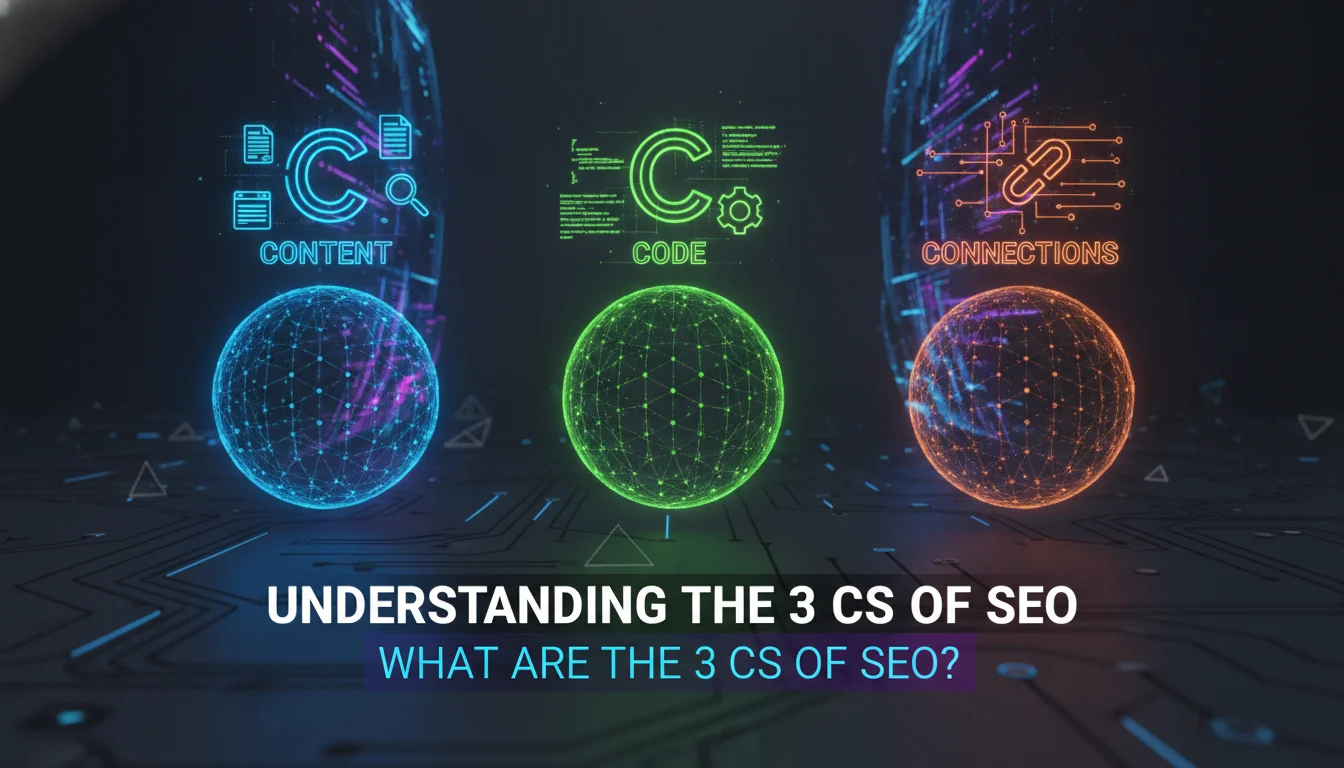
What are the 3 Cs of SEO? They are Content, Code, and Credibility. These three components form the foundation of any effective search engine optimization strategy, shaping how search engines rank your site and how users decide to trust it.
Key Takeaways
- The answer to what are the 3 Cs of SEO is simple: Content, Code, and Credibility.
- All three must work together. Strength in one area cannot fully compensate for weakness in another.
- Content should match user intent, demonstrate genuine expertise, and follow Google’s E-E-A-T guidelines.
- Code must be clean, fast, mobile-ready, and structured so search engines can crawl every page without friction.
- Credibility is built through quality backlinks, consistent brand mentions, and user engagement signals.
- As of 2026, a fourth element, Citation, is gaining traction as AI answer engines reshape how content gets surfaced.
Understanding the 3 Cs of SEO
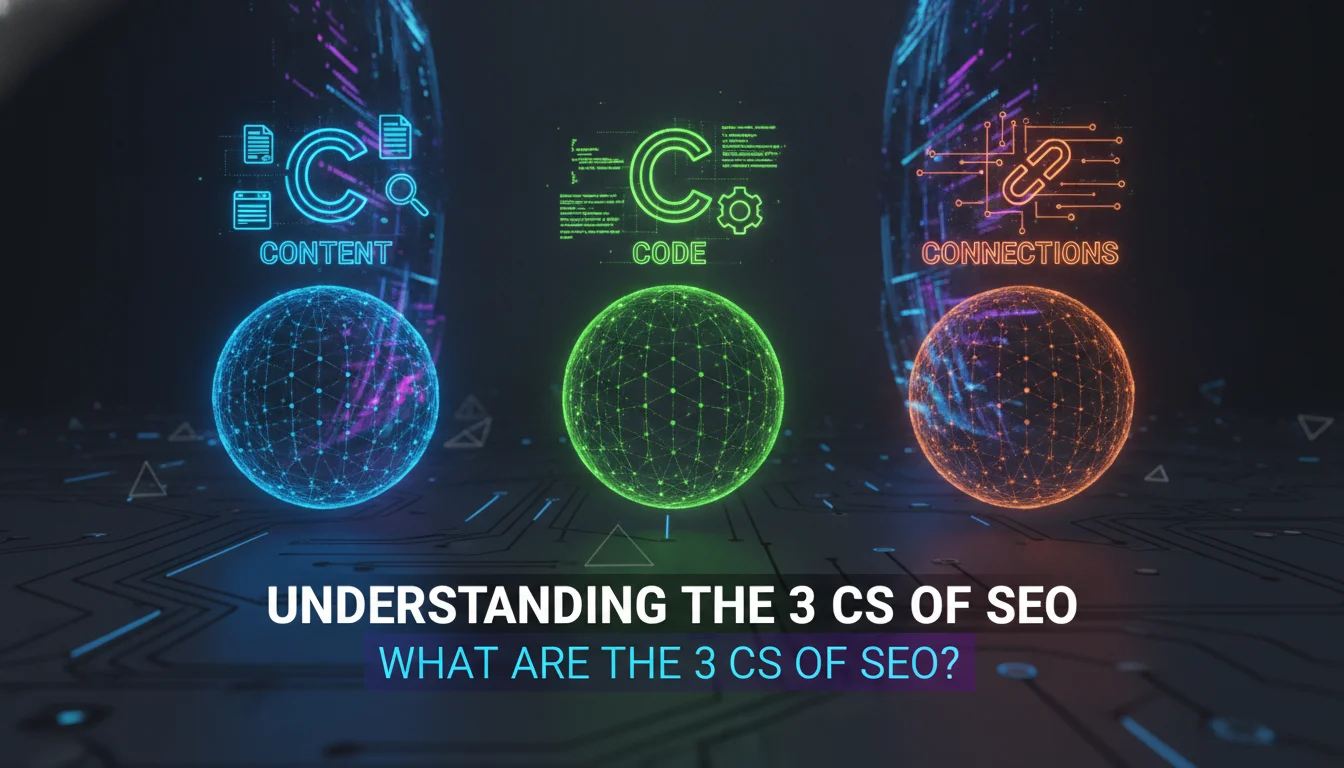
The 3 Cs of SEO give you a clear, memorable system for improving search visibility without chasing every algorithm update. Rather than scrambling after new tricks, you focus on what search engines have always rewarded: value, usability, and trust. The framework was popularized by Kent Lewis of Anvil Media, who distilled years of SEO practice into three pillars that still hold up today. Each C is distinct, but none of them works in isolation.
1. Content: The Core of SEO
Content is the foundation of search visibility because it is the primary signal search engines use to understand what your site is about and whether it deserves to rank. Without keyword-rich, well-structured HTML text on your key pages, search engine spiders have almost nothing to evaluate. As Anvil Media’s original framework put it, spiders can’t read what they can’t see.
Quality and Relevance
For content to perform, it must be both high-quality and genuinely relevant to the people searching for it. Google’s E-E-A-T guidelines (Experience, Expertise, Authoritativeness, and Trustworthiness) make clear that content should come from someone with real knowledge of the subject. The “Experience” dimension, added in recent years, specifically rewards first-hand involvement. A product review written by someone who actually used the product carries more weight than one assembled from spec sheets.
According to research cited by Ahrefs and Semrush, first-page results tend to provide comprehensive answers rather than surface-level summaries. Leading with the answer, then elaborating, is now the structural standard that both featured snippets and AI answer engines prefer.
Keyword Optimization
Keyword research remains essential, but the goal has shifted. You’re no longer stuffing a phrase into every paragraph. You’re mapping content to search intent. Include your target phrase in the headline, early in the body copy, and again near the close. Bold, italicize, or hyperlink key phrases where it adds clarity. Never add keywords just for the sake of adding them. Write for the human reader first, and the spider will follow.
Content Types That Drive SEO
- Blog Posts: Ideal for informational queries. Lead with the answer, then go deeper. Structure with H2 and H3 headings so AI engines can extract clear responses.
- Service and Category Pages: These capture research-phase queries. Include structured Q&A content and topical context beyond keyword-optimized paragraphs.
- Product Descriptions: Go beyond specifications. Describe the problem the product solves. Answer engines respond well to clear cause-and-effect language.
- Videos and Infographics: Visual content boosts engagement and shareability, but always pair them with descriptive HTML text so spiders can index the context.
- FAQ Pages: These have graduated from afterthought to strategic asset. They directly target People Also Ask results and AI snippet extraction.
2. Code: The Technical Foundation
Code is the delivery mechanism for all your content. It refers to the technical structure of your website that allows search engines to crawl, index, and rank your pages effectively. Think of it as the foundation of a house: not flashy, but without it, everything else crumbles.
Why Clean Code Matters
With the spread of database-driven content management systems and visual editors, site code has become bloated and difficult for spiders to parse. Search engines struggle with certain programming languages and poorly structured markup. The solution is to build to widely accepted web standards. Less is more. Clean HTML, logical heading hierarchy, and minimal render-blocking scripts all make it easier for Google to understand and index your content.
A well-optimized site also benefits real users. Accessible, standards-compliant code works across the broadest range of browsers and connection speeds, improving the experience for everyone who visits.
Technical SEO Elements to Prioritize
- Page Speed and Core Web Vitals: Fast-loading pages improve user experience and are a confirmed Google ranking signal. Slow pages lose visitors before they even read a word.
- Mobile Responsiveness: With the majority of searches now happening on phones, a site that isn’t fully responsive will struggle to rank. Google’s mobile-first indexing means your mobile experience is the one being evaluated.
- Secure Connections (HTTPS): Using HTTPS protects user data and is a direct ranking factor for Google. There is no good reason to run an HTTP site in 2026.
- Clean URLs: Replace dynamic strings of database parameters with readable, keyword-rich URLs. A clean URL is easier for both spiders and users to understand.
- XML Sitemaps and Indexing: Submit a sitemap so search engines can find every page you want indexed. Actively manage which pages get crawled.
- Meta Tags and Alt Text: Every page needs a keyword-optimized title tag, meta description, and alt text on images. These are small details with outsized impact.
Structured Data
Implementing schema markup helps search engines understand the content of a page at a deeper level. This can produce rich snippets in search results, which improve click-through rates and make your listing stand out visually. For e-commerce sites, product schema makes attributes machine-readable. For service businesses, FAQ schema directly feeds People Also Ask results.
3. Credibility: Building Trust
Credibility is what separates a site that ranks from one that stalls. It signals to search engines that your content is trustworthy, authoritative, and worth recommending to users. Building credibility doesn’t happen overnight. It’s earned through consistent effort across multiple channels.
The Role of Backlinks
Backlinks from reputable websites tell search engines that your content is valuable. As Anvil Media’s framework established, quality over quantity is the mantra for any link-building effort. A single link from a high-authority, relevant industry site carries far more weight than dozens of links from low-quality directories. Sites that use link farms to inflate their link count often face penalties because those links lack relevance and genuine editorial intent.
User Engagement Signals
Time on site, bounce rate, and how users interact with your content all contribute to credibility signals. Engaging content that keeps visitors reading, clicking, and returning sends a clear message to search engines: this site is worth recommending. According to Google’s quality guidelines, user satisfaction is a core measure of content quality.
Building Authority in Your Niche
Authority is built by consistently producing expert content, earning brand mentions across the web, and engaging with your audience through social media and community spaces. Guest blogging on respected industry publications, participating in forums, and being cited as a source all strengthen your credibility profile. Author bios, credentials, and transparent about pages also support E-E-A-T signals that Google’s quality raters look for.
How the 3 Cs of SEO Work Together
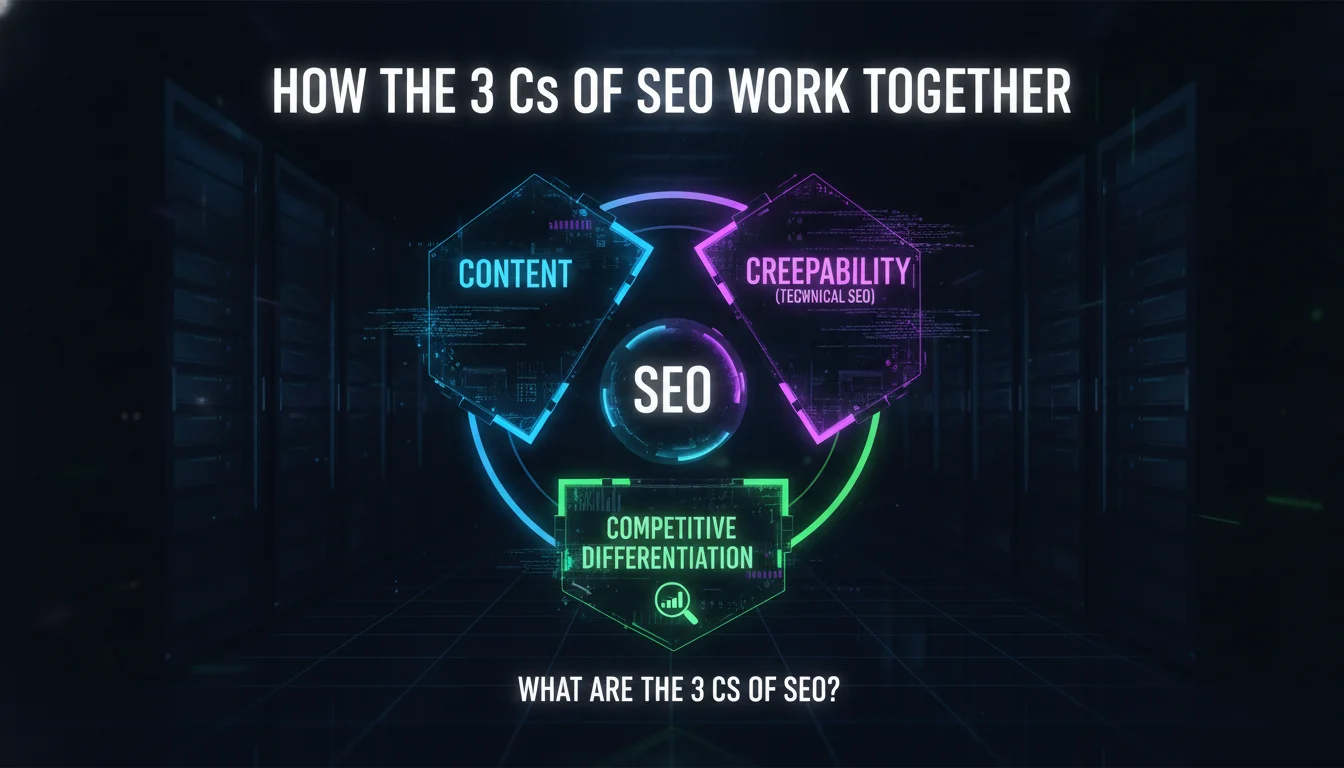
The 3 Cs of SEO are most powerful when they reinforce each other, not when they operate in silos. A site with brilliant content but broken code may never get indexed properly. A technically perfect site with no credibility will struggle to outrank established competitors. And a credible domain with thin, irrelevant content will waste its authority on pages that don’t convert.
“The fundamentals of SEO can be boiled down to The 3 Cs: content, code and credibility. Each one brings its own strengths, but banded together, they’re a unified force.” – Kent Lewis, Anvil Media
Content and Code: The Delivery System
Content needs a solid technical foundation to reach its audience. If a site’s code is poorly structured, search engines may not index the content at all, regardless of how good it is. Conversely, high-quality content that earns engagement improves technical metrics like dwell time and return visits, which feed back into rankings. The two are in constant dialogue.
Credibility Amplifies Both
A credible site earns more backlinks, which drives more traffic, which generates more engagement signals, which strengthens technical metrics. High-quality content that is well-optimized and backed by credible sources attracts links naturally. A credible website is also more likely to be shared, cited, and recommended, creating a compounding effect that generic sites cannot replicate.
How the 3 Cs of SEO Actually Work: The Underlying Mechanics
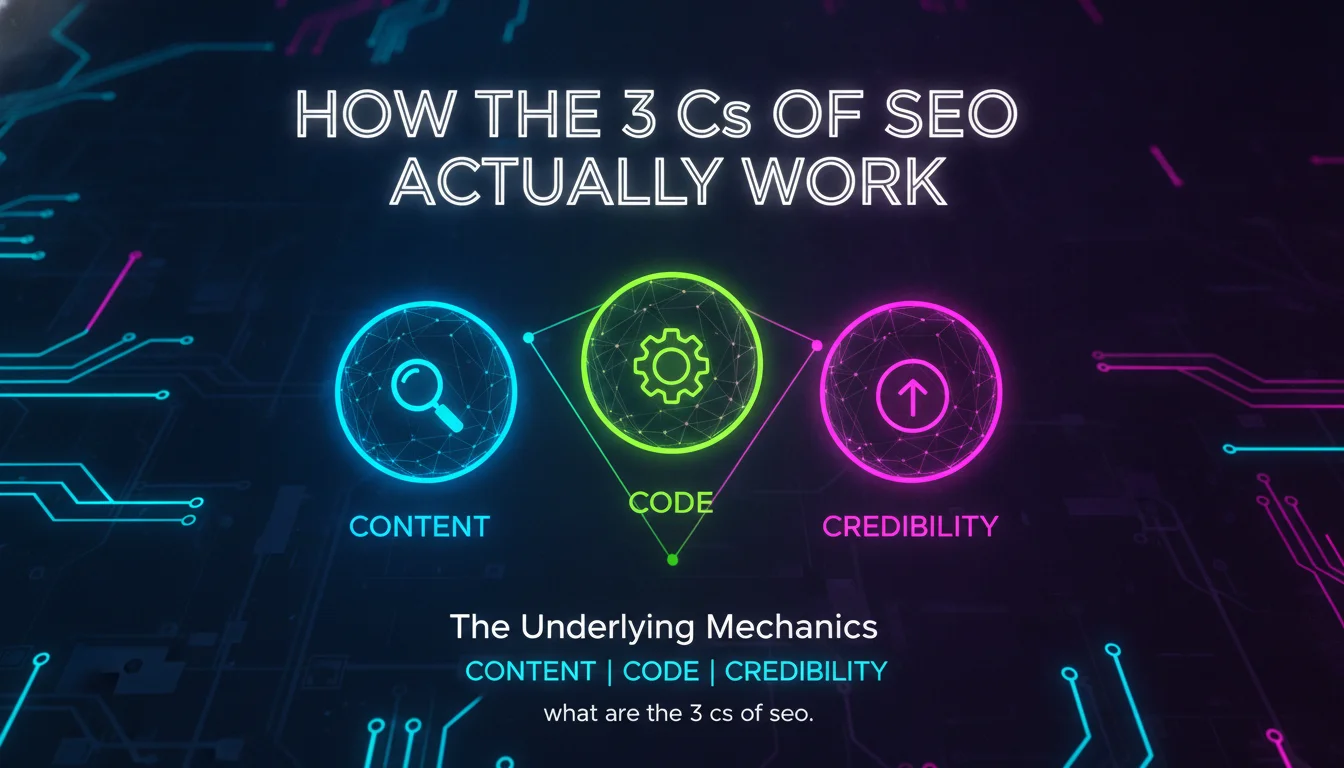
Understanding what are the 3 Cs of SEO is one thing. Understanding the mechanics behind them is what separates practitioners who get results from those who spin their wheels.
When a search engine spider visits your site, it follows links from page to page, reading HTML text and recording what it finds. It cannot interpret images, Flash animations, or JavaScript-rendered content with the same reliability it reads plain HTML. This is why content written in clean, crawlable markup is so critical. The spider reads your text, evaluates your heading structure, checks your internal links, and moves on. If your code is bloated or your content is buried behind scripts, the spider may leave before it finds your most important pages.
Once indexed, your pages compete against thousands of others for the same search queries. Google’s ranking algorithm evaluates relevance (does this page answer the query?), authority (do credible sites link to it?), and experience (do users who visit it stay and engage?). These three dimensions map almost perfectly onto Content, Credibility, and Code.
As of 2026, AI Overviews and answer engines like ChatGPT and Perplexity add another layer. According to data cited by RocketWeb, roughly 69% of Google searches end without a click, and Google’s AI Overviews appear on a significant share of desktop searches. This means your content must now be structured not just to rank, but to be cited directly by AI systems. Clear, direct answers at the top of each section, proper schema markup, and strong credibility signals all increase the likelihood of AI citation.
How to Apply the 3 Cs of SEO: A Practical Step-by-Step Guide
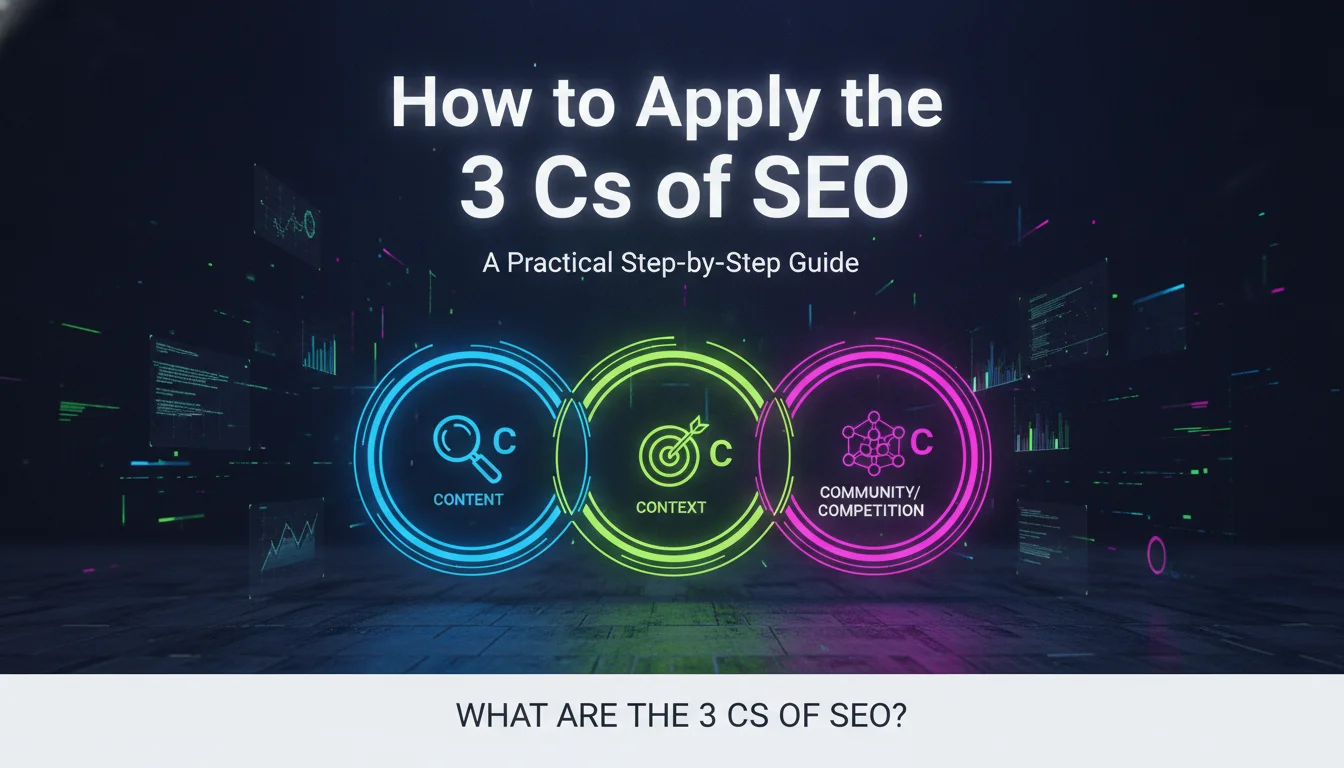
Knowing what are the 3 Cs of SEO is the starting point. Applying them systematically is where the results come from. Here’s how to put all three to work in a structured, repeatable process.
Step 1: Audit Your Current SEO Baseline
Before you build, you need to know where you stand. Run a full SEO audit covering all three Cs. Tools like Google Search Console, Semrush, and Ahrefs will surface crawl errors, thin content, missing meta tags, slow pages, and weak backlink profiles. Document every issue. Prioritize by impact: technical errors that block indexing come first, then content gaps, then credibility gaps.
Step 2: Build a Content Strategy Around Search Intent
Map your content to the four types of search intent: informational, navigational, transactional, and commercial investigation. For each target keyword, ask: what does the person searching this actually want? Then create content that answers that question directly, completely, and better than the current top results. Use Google’s People Also Ask results as a free brief for FAQ content. Structure every piece with a direct answer in the first paragraph, followed by supporting detail.
Step 3: Clean Up Your Technical Foundation
Fix crawl errors first. Then address page speed, mobile responsiveness, and HTTPS. Audit every page’s title tag, meta description, heading structure, and alt text. Implement schema markup on your most important page types. Submit an updated XML sitemap. Set up canonical tags to prevent duplicate content issues. This work is unglamorous, but it is the difference between content that gets indexed and content that disappears.
Step 4: Build Credibility Deliberately
Credibility is not a passive outcome. You have to pursue it. Identify the high-authority sites in your industry and find legitimate ways to earn links from them. Write guest posts for respected publications. Get your brand mentioned in industry roundups. Create original research or data that others want to cite. Build out your author profiles with real credentials. Engage consistently on social media and in community spaces where your audience gathers.
Step 5: Measure, Iterate, and Repeat
SEO is not a one-time project. Review your rankings, traffic, and engagement metrics at least quarterly. When rankings drop, diagnose which C is failing. A sudden drop often points to a technical issue. A slow decline usually signals a content or credibility problem. Adjust your strategy based on data, not assumptions. The brands that win at SEO treat it as an ongoing discipline, not a campaign.
Comparison: Content vs. Code vs. Credibility
| Dimension | Content | Code | Credibility |
|---|---|---|---|
| Primary Function | Answers user queries and demonstrates expertise | Enables crawling, indexing, and fast delivery | Signals authority and trustworthiness to search engines |
| Key Tools | Keyword research tools, content calendars, CMS | Google Search Console, PageSpeed Insights, schema validators | Ahrefs, Semrush backlink analysis, Google Analytics |
| Time to Impact | Weeks to months depending on competition | Days to weeks for technical fixes | Months to years for domain authority growth |
| Biggest Mistake | Keyword stuffing or ignoring search intent | Slow load times and unindexed pages | Chasing low-quality links instead of earning relevant ones |
| Quick Win | Update existing pages to match current search intent | Fix Core Web Vitals and add schema markup | Earn one high-authority backlink from a relevant source |
| 2026 Priority | E-E-A-T signals and AI-citation-ready structure | Mobile-first performance and structured data | Brand mentions and author authority across the web |
Common Mistakes to Watch Out For
Most SEO failures trace back to imbalance across the 3 Cs. Here are the patterns we see most often, and how to avoid them.
Treating the 3 Cs as Separate Projects
Many teams assign content to one person, technical SEO to another, and link building to a third, with no coordination between them. The result is a site where great content sits on slow, poorly structured pages that nobody links to. The 3 Cs must be managed as an integrated system, not three independent workstreams.
Keyword Stuffing Instead of Intent Matching
Packing a keyword phrase into every sentence does not help rankings. It actively hurts them. Search engines are sophisticated enough to recognize when content is written for spiders rather than people. Write for your reader. Use the keyword naturally, vary your phrasing, and focus on answering the question completely.
Ignoring Technical Debt
Every site accumulates technical debt over time: broken links, outdated redirects, missing alt text, bloated scripts. Teams focused on content creation often let this pile up until it becomes a serious crawl problem. Schedule a technical audit at least twice a year and fix issues before they compound.
Chasing Backlink Quantity Over Quality
Link farms and paid link schemes still exist, and some teams still use them. Google’s quality guidelines are explicit: links from irrelevant or low-authority sources can trigger penalties. One editorial link from a respected industry publication is worth more than a hundred directory submissions. Build links the way you’d want a journalist to cover you: by doing something worth linking to.
Neglecting E-E-A-T Signals
As of 2026, Google’s quality raters are specifically looking for evidence of real-world experience and expertise. Anonymous content with no author attribution, no credentials, and no original perspective scores poorly on E-E-A-T. Put real names on your content. Build out author bios. Cite credible sources. Make it clear that a human with genuine knowledge wrote what you published.
Skipping Structured Data
Schema markup is still underused by most small and mid-sized sites. It’s one of the highest-leverage technical improvements you can make, directly feeding rich snippets, People Also Ask results, and AI citation systems. If you’re not using it, you’re leaving visibility on the table.
Pros and Cons of the 3 Cs Framework
Pros
- Simple and memorable: Three categories are easy to communicate to clients, stakeholders, and team members who aren’t SEO specialists.
- Comprehensive coverage: Content, Code, and Credibility between them address every major ranking factor Google has confirmed publicly.
- Durable across algorithm updates: Because the framework focuses on fundamentals rather than tactics, it doesn’t become obsolete when Google changes its algorithm.
- Actionable at every level: Whether you’re a solo founder or a marketing team of ten, each C maps to concrete tasks you can assign and measure.
- Scales with ambition: The framework works for a local service business trying to rank in one city and for an enterprise brand competing globally.
Cons
- Can oversimplify complex tradeoffs: Real SEO decisions often involve nuanced prioritization that three buckets can’t fully capture.
- Credibility takes time: For new sites, the Credibility pillar can feel out of reach. Building domain authority is a long game that requires patience most clients don’t have.
- Doesn’t explicitly address AEO: As AI answer engines reshape search, some practitioners argue a fourth C (Citation) is needed to cover Answer Engine Optimization.
- Framework alone won’t execute itself: Knowing the 3 Cs is not the same as implementing them. Without a clear process and consistent effort, the framework stays theoretical.
A Realistic Scenario: Applying the 3 Cs to a Service Business
Picture a mid-sized interior design studio. They have a beautiful website with stunning portfolio images, but they rank on page four for their core service keywords. They’re getting almost no organic traffic. Sound familiar?
We’d start with a Content audit. Almost every page is image-heavy with minimal HTML text. Search engines see gorgeous photos but almost nothing to index. The fix: write detailed service descriptions, add a blog covering design trends and client FAQs, and optimize every page with clear headings and keyword-aligned copy. Each blog post leads with a direct answer to a common client question.
Next, Code. The site loads slowly on mobile because of uncompressed images and render-blocking scripts. There’s no schema markup, no XML sitemap, and several pages return crawl errors. We compress images, implement lazy loading, add LocalBusiness and Service schema, and submit a clean sitemap to Google Search Console. Within weeks, crawl coverage improves noticeably.
Finally, Credibility. The studio has been featured in two local lifestyle publications but never asked for a backlink. We reach out, secure those links, and identify three industry directories worth listing in. We also build out the lead designer’s author bio with credentials and link it to every blog post. Over the following months, organic rankings climb steadily for their primary service terms.
This is what are the 3 Cs of SEO in practice: not abstract theory, but a sequence of concrete actions that compound over time.
The 3 Cs of SEO in 2026: What’s Changing
The core answer to what are the 3 Cs of SEO hasn’t changed. Content, Code, and Credibility remain the foundation. But the context around them has shifted significantly this year.
According to data cited by RocketWeb, roughly 69% of Google searches now end without a click, as AI Overviews and featured snippets answer queries directly on the results page. ChatGPT serves over 800 million users weekly. Perplexity, Gemini, and voice assistants are all pulling answers from the web and serving them directly, often without sending a visitor to your site.
This changes the stakes for all three Cs. Content must now be structured to be cited, not just ranked. That means leading with direct answers, using clear heading hierarchies, and writing in a way that AI systems can extract and attribute. Code must support structured data more aggressively than ever, because schema markup is a primary signal for AI citation systems. And Credibility now extends beyond backlinks to include brand mentions, author authority, and the breadth of your presence across trusted web properties.
Some practitioners, including the team at RocketWeb, have proposed a fourth C: Citation. The idea is that being cited by AI answer engines is now a distinct goal that requires its own strategy, separate from traditional link building. Whether you adopt a four-C or three-C model, the underlying principle is the same: build something genuinely useful, make it technically accessible, and earn the trust of your industry. That formula has worked since the early days of search, and it will keep working as the medium evolves.
For a deeper look at how content strategy connects to broader brand building, explore our thoughts on brand storytelling and digital marketing and our full range of creative and SEO services.
Implementing the 3 Cs in Your SEO Strategy
To effectively implement what are the 3 Cs of SEO, you need a plan that treats all three components as equally important. Here are the core actions to build into your workflow.
Audit Your Current SEO
Conduct a full SEO audit to identify gaps across content, code, and credibility. Tools like Google Analytics, Semrush, and Ahrefs provide the clearest picture of where you stand and where the biggest opportunities are.
Develop a Content Strategy
Create a content plan focused on producing high-quality, relevant material that addresses real user needs. Anchor every piece to a specific search intent. Use keyword research to ensure your content aligns with what people are actually searching for, not just what you think they want.
Optimize Technical SEO
Ensure your site’s code is clean, fast, and mobile-friendly. Regularly update meta tags, alt text, heading structures, and structured data. Treat technical SEO as ongoing maintenance, not a one-time project.
Build Credibility
Pursue high-quality backlinks from relevant, authoritative sources. Engage your audience through social media and community involvement. Establish your brand and your authors as recognized voices in your niche. Credibility compounds: the more you build, the easier it becomes to earn more.
“Even if every page of your site has a reasonable occurrence of your target term, and the URL and tags are optimized, you still may never appear in the first 100 pages without credibility. To push above the competition, you need to acquire links from relevant industry sites that are ideally popular and visible in search for your target terms.” – Kent Lewis, Anvil Media
Frequently Asked Questions
What are the 3 Cs of SEO?
The 3 Cs of SEO are Content, Code, and Credibility. Content covers everything users and search engines read on your site. Code refers to the technical structure that enables crawling and indexing. Credibility is the trust and authority your site earns through backlinks, engagement, and consistent expertise.
What are the three pillars of SEO?
The three pillars of SEO are broadly described as technical SEO, on-page SEO, and off-page SEO. These map closely onto the 3 Cs framework: Code covers technical SEO, Content covers on-page SEO, and Credibility covers off-page SEO. Both frameworks point to the same underlying truth: you need all three to compete effectively.
What are the three main types of SEO?
The three main types of SEO are on-page SEO (optimizing content and HTML elements on individual pages), technical SEO (improving site structure, speed, and crawlability), and off-page SEO (building authority through backlinks and brand signals). Each type corresponds directly to one of the 3 Cs of SEO.
What are the top 3 SEO ranking factors?
While Google has never published a definitive ranked list, the most consistently cited ranking factors are content relevance and quality, backlink authority, and technical site health. These align directly with the 3 Cs of SEO: Content, Credibility, and Code. Getting all three right is more important than optimizing any single factor in isolation.
How does content impact SEO?
Content impacts SEO by providing the primary signals search engines use to understand your site’s relevance to a given query. High-quality content that matches search intent, demonstrates expertise, and earns engagement improves both rankings and user satisfaction. According to Google’s E-E-A-T guidelines, content created by someone with genuine experience and knowledge is weighted more heavily.
How can I build credibility for my website?
You build credibility by earning high-quality backlinks from relevant, authoritative sites, engaging consistently with your audience, and producing content that others want to cite and share. Author credentials, transparent about pages, and brand mentions across trusted web properties all contribute to the credibility signals that search engines evaluate. This is a long-term effort, but the compounding returns make it one of the highest-value investments in SEO.
How often should I update my SEO strategy?
Review your SEO strategy at least quarterly to account for algorithm changes, shifts in user behavior, and competitive moves in your space. A quarterly review lets you catch technical issues before they compound, refresh content that has lost relevance, and identify new credibility opportunities. Major algorithm updates may require an immediate review outside the regular cycle.
Ready to put the 3 Cs of SEO to work for your brand? Contact Emin Media for a free brand consultation and let’s build something that ranks, resonates, and converts.
Enjoyed this article?
Contact Emin Media for a free brand consultation and let's create something amazing together.
Get in TouchRelated Articles
Visual Content Marketing Trends for 2026
Visual content marketing trends for 2026 are reshaping how brands connect. Discover AI visuals, interactive…
Brand Voice Examples 2026: Build a Voice That Sticks
Explore the best brand voice examples 2026 has to offer. Learn frameworks, archetypes, and steps…

Brand Photography for Social Media: 2026 Guide
Master brand photography for social media with our 2026 guide. Plan shoots, choose photographers, and…