Graphic Design for Marketing: Strategy Meets Visual
Key Takeaways
- Graphic design for marketing is the strategic use of visual elements to communicate marketing messages and shape customer decisions.
- Marketing decides what to say and where. Design decides how the message looks and feels. Both disciplines analyze the audience, but their core functions differ.
- Color psychology, typography, imagery, composition, and originality directly influence brand recognition, emotional connection, and purchasing behavior.
- Marketing design is a recognized specialty within graphic design, focused on digital ads, social media, packaging, and web creative.
- HubSpot Academy and the Digital Marketing Institute offer a free course covering color theory, typography, composition, and brand style guides across 4 lessons, 10 videos, and 1 quiz totaling 1 hour and 3 minutes.
- In digital advertising, creative development and testing are now the primary levers for campaign performance, making design quality a direct business driver.
Graphic design for marketing is the strategic use of visual elements, including typography, color, imagery, and composition, to communicate a brand’s message, support promotional goals, and shape customer decisions across digital and physical channels.
What Is Graphic Design for Marketing?
for marketing is the application of visual communication principles to promote a product, service, or idea with a specific business outcome in mind. It is not simply about making things look attractive. Every color choice, typeface, and layout decision exists to serve a promotional goal: capture attention, communicate value, and prompt action.
The Definition and Scope
Merriam-Webster defines graphic design as “the art or profession of using design elements (such as typography and images) to convey information or create an effect,” as cited by Amp’d Designs. Marketing, by contrast, is “the process or technique of promoting, selling, and distributing a product or service.” When the two merge, the result is visual communication built for a specific business objective.
That definition matters because it clarifies what separates this type of marketing from general design work. A social media graphic, a digital ad, a product label, or a website hero section can all be beautiful. They only qualify as marketing design when they are created with a clear understanding of the target audience, the channel, and the desired outcome.
Marketing Design as a Specialty
Graphic design is a broad discipline, and marketing design is one of its recognized specialties. According to SketchDeck, marketing design is “the marriage of graphic design principles with the goals of marketing strategy.” It focuses on producing creative assets for specific marketing channels that highlight a company’s product or service, including digital ad design, social media graphics, email creative, presentation decks, and other materials that sit inside a campaign framework.
“Marketing design is the marriage of graphic design principles with the goals of marketing strategy.” – SketchDeck
The distinction between general graphic design and marketing design is practical, not philosophical. A general graphic designer may create a logo, a poster, or a publication with strong aesthetic principles. A marketing designer starts from a strategy that defines what message needs to be delivered, to whom, on what channel, and with what measurable result. The visual output is then evaluated against marketing outcomes such as engagement, conversion, or brand recall, not just visual polish.
Why Visual Communication Matters
Visual communication is one of the fastest ways to transmit a message. As Maryville University notes in its discussion of graphic design and marketing, the old adage that a single picture is worth a thousand words rings especially true in this field. In a crowded digital environment, consumers scroll quickly and decide within seconds whether a piece of content deserves attention. Well-executed this kind of for marketing uses hierarchy, contrast, and emotional cues to earn that attention and direct the viewer toward a specific action.
Effective visual communication also reduces cognitive load. Instead of reading lengthy text, a viewer can absorb a brand’s personality, offer, or value proposition through a single image or layout. That efficiency is why the design for marketing appears across every customer touchpoint, from social feeds to product packaging to websites.
Graphic Design and Marketing: Where the Work Divides
The relationship between graphic design and marketing is often misunderstood because both disciplines share the same goal: shaping how customers perceive a business. Understanding where one ends and the other begins is essential for building teams, briefing agencies, and evaluating creative work.
The Marketing Side: Research, Positioning, Channels
Marketing is fundamentally a research and decision discipline. According to Amp’d Designs, marketing revolves around analyzing data to determine the best positioning, language to use, target audience, and ways to reach that audience. Good marketing is based on significant research. The methods that follow a marketing strategy often include social media posts, ad campaigns, SEO, and print mailers. These are the logistical foundation for design.
In practical terms, deciding whether to use print mailers to reach an audience is a marketing decision. Deciding what to say in ad copy to articulate what the business does is also a marketing decision. These choices define the boundaries within which design will operate. Without a clear marketing strategy, designers are asked to create visuals without direction, and the result is often inconsistent or off-target.
The Design Side: Translating Strategy into Visuals
Graphic design is also based on research, but its research is about communicating the marketing method. A graphic designer hears the information discovered during market research and translates those findings into visuals. That means the look and feel of a website, the layout of social media templates, the design of a logo, and the creative treatment of an ad campaign all belong to design. Good design creates an emotional connection between a business and its customers by using visuals to grab attention and spark curiosity.
The look and feel of a website to grab an audience’s attention is design, not marketing. The layout of social media templates to create a consistent visual style is design, not marketing. These distinctions help businesses understand why one provider may not be able to do both at a high level, even though the disciplines are deeply intertwined.
Where the Two Disciplines Overlap
Both marketing and design analyze the business, research the industry, and examine the audience. The difference lies in focus: marketing focuses on the methods you use to reach your audience and sell products or services, while design focuses on the visual communication of those methods and research findings. The overlap is exactly where marketing lives, where a visual choice is evaluated not only on aesthetics but also on whether it advances a promotional objective.
The table below compares general graphic design, marketing design, and marketing strategy across five dimensions to clarify how the roles differ and where they intersect.
| Dimension | General Graphic Design | Marketing Design | Marketing Strategy |
|---|---|---|---|
| Primary focus | Aesthetic communication and visual problem-solving | Visual assets that support campaign goals | Research, positioning, channel selection, and messaging |
| Key question | Does this communicate clearly and look strong? | Does this visual drive the intended marketing action? | What should we say, to whom, and where? |
| Typical outputs | Logos, posters, brand identity, publications | Digital ads, social graphics, email creative, landing pages | Campaign plans, audience profiles, channel calendars, copy platforms |
| Success metric | Visual coherence, brand recognition, craft quality | Engagement, conversion, click-through, lead generation | Reach, cost per acquisition, market share movement |
| Skill emphasis | Color theory, typography, composition, originality | Design skills plus marketing strategy and brand alignment | Data analysis, consumer research, copywriting, media planning |
This table synthesizes distinctions drawn from Amp’d Designs and SketchDeck. Neither source presents a formal matrix, but both describe the roles in ways that map naturally onto these categories.
Pros and Cons of Investing in Graphic Design for Marketing
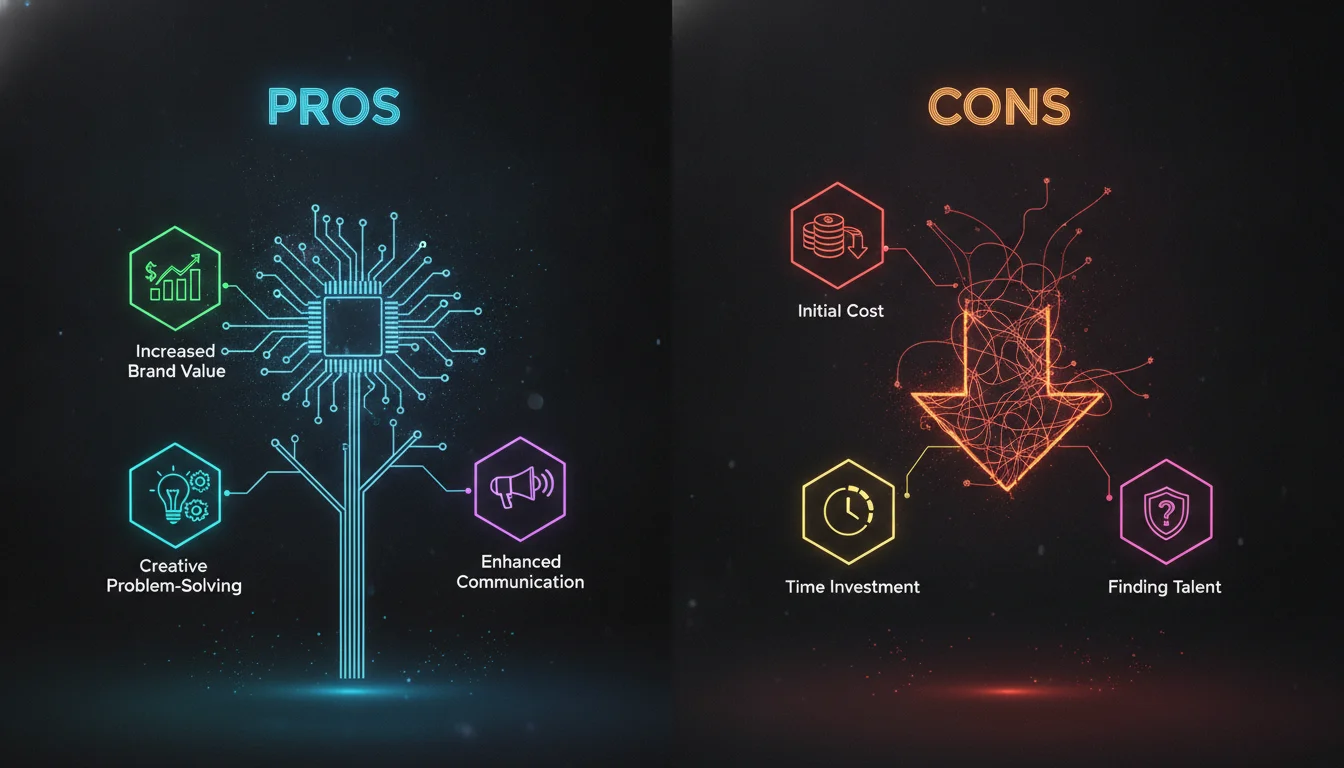
graphic design delivers real business value, but it also comes with trade-offs worth understanding before you commit resources.
Pros
- Stronger brand recognition: Consistent visual systems make a brand easier to identify and recall across every channel, building trust over time.
- Higher engagement: According to Nossi, graphic design plays a key role in social media marketing by creating visually appealing content that engages and attracts the audience, outperforming text-only posts.
- Direct influence on purchasing decisions: Nossi confirms that graphic design in product packaging directly influences consumer purchasing decisions and brand perception, making design a revenue driver, not just a cost center.
- Creative testing advantage: In digital advertising, SketchDeck notes that creative development and testing are the primary levers for campaign performance. Strong design gives marketing teams more variables to test and optimize.
- Emotional connection: Well-executed for marketing creates a cohesive image that resonates with consumers, building recognition and loyalty over time.
Cons
- Requires strategic alignment: Design without a clear marketing brief produces attractive assets that miss the business objective. The two disciplines must work together or the investment is wasted.
- Consistency demands ongoing effort: A brand style guide helps, but maintaining visual consistency across channels, teams, and vendors requires active management and regular audits.
- Creative testing takes time: Producing multiple design variations for A/B testing is resource-intensive. Small teams may struggle to generate enough creative volume to reach statistically meaningful results.
- Originality is harder than it looks: As Maryville University notes, logos and graphics that are too similar to existing work risk being dismissed. Genuine originality requires skill, research, and creative discipline.
Core Visual Principles in Graphic Design for Marketing
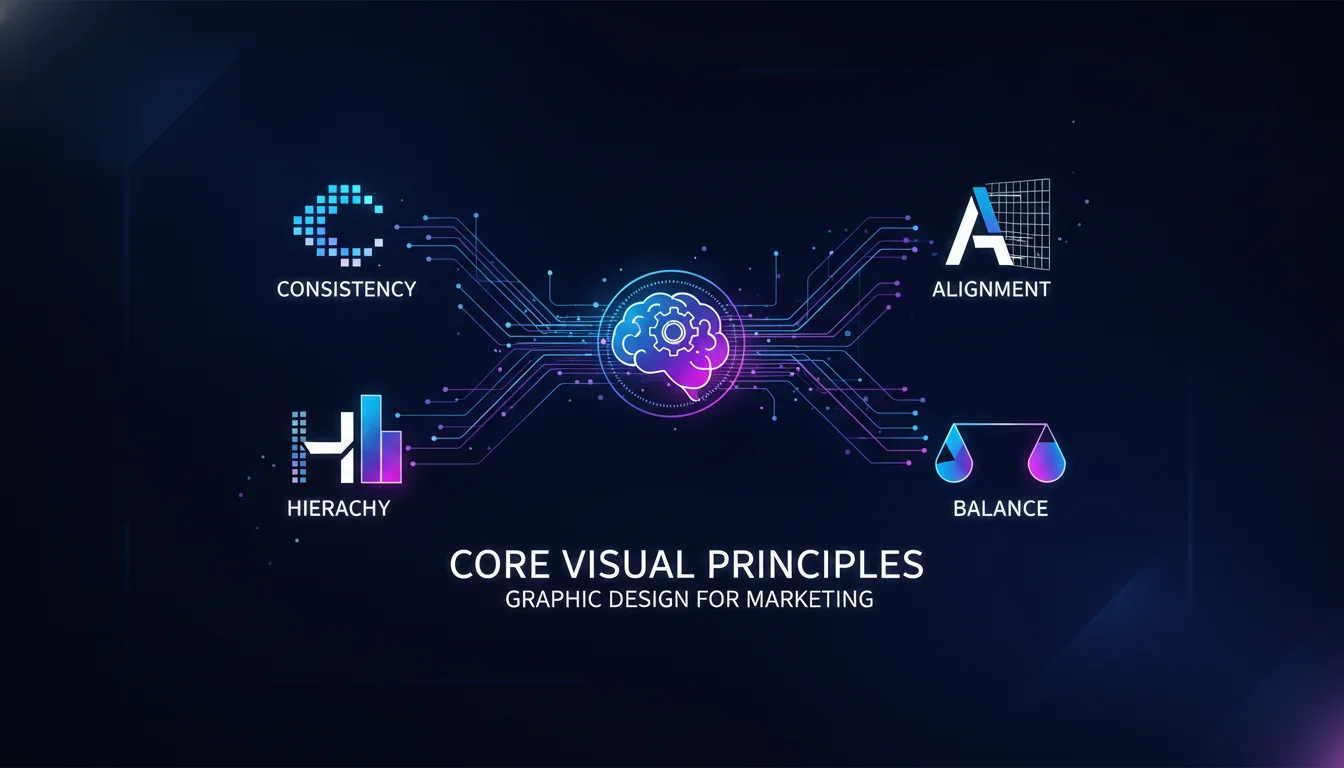
Mastering this type of marketing starts with four foundational principles. These are not optional extras; they determine whether a graphic communicates clearly or gets ignored.
Color Psychology and Combinations
Color is one of the most powerful tools in marketing design because it carries meaning before a viewer reads a single word. According to Maryville University, color dominates the natural world and is cemented into human experience, especially in memories, and can affect an individual’s immediate mood. In marketing, certain color combinations automatically convey messages. Red evokes a sense of energy and spirit, while blue suggests dependability and sincerity.
Designers also use color relationships from the color wheel to create specific effects. Analogous colors, such as yellow, green, and blue, sit next to each other and create harmonious, smooth designs. Complementary colors, which sit opposite each other on the wheel, provide the most striking contrasts. The designer’s task is to select a combination that aligns with the brand message and the audience’s expectations.
Typography, Imagery, and Composition
Typography, imagery, and composition are the structural building blocks of any marketing graphic. HubSpot Academy’s free course, created with the Digital Marketing Institute, teaches these concepts explicitly. The curriculum covers color theory, imagery, typography, and composition, and explains how to build a unified vision of a business through a brand style guide. These fundamentals determine whether a graphic feels professional and whether the visual hierarchy guides the viewer toward the most important information.
Composition refers to how elements are arranged within a frame. Strong composition uses scale, spacing, alignment, and contrast to create a clear visual path. Imagery choices, whether photography or illustration, add context and emotional resonance. Typography shapes tone: serif type may feel traditional, while sans-serif often feels modern. When these elements work together, the result is a graphic that communicates clearly even at a glance.
Originality and Brand Distinction
Originality is a core requirement in marketing design. Logos can make or break a company’s identity, especially if they are too similar to existing logos. The same principle applies to any graphic image: if it is too close to something that has been done hundreds of times before, the viewer may dismiss it. Good marketing must be memorable to be most effective.
Originality does not always mean inventing entirely new ideas. As Maryville University points out, some of the best visual designs are remixes, created by integrating elements from other sources of inspiration in a new or innovative way. Brand distinction matters because attention is limited. In a feed full of competing visuals, a brand with a consistent, original visual system is easier to recognize and recall, and that recognition compounds over time.
“Graphic design serves as the visual backbone of branding, playing a crucial role in how a company presents itself to the world.” – Nossi College of Art
Marketing Channels Where Graphic Design Drives Results
this kind of for marketing operates differently depending on the channel. Each platform has its own format constraints, audience behavior, and performance metrics. Here is where the work shows up most clearly.
Digital Ad Design and Creative Testing
Digital advertising is one of the most demanding channels for marketing design. According to SketchDeck, the paid advertising space is overcrowded and the cost of paid advertising continues to rise. Automatic bid management and budget allocation have leveled the playing field, which means the only way digital marketing teams can impact ad campaign success is through creative development and testing. In that environment, design quality and variation become direct levers for performance.
This changes the role of the designer. Instead of producing a single final asset, marketing designers often produce multiple versions for A/B testing, with different headlines, color treatments, layouts, and imagery, so the marketing team can identify which creative resonates. The designer must understand the campaign objective and channel constraints, not just the visual problem.
Social Media and Content Marketing Graphics
Graphic design plays a key role in social media marketing by creating visually appealing content that engages and attracts the audience, according to Nossi. Social feeds are visually dense, and graphics must compete for attention against personal content, news, and other brands. Consistent templates, on-brand color palettes, and clear visual hierarchy help a brand stand out while maintaining a recognizable identity.
Upwork’s guidance on promoting a graphic design business emphasizes that posts on social media, email campaigns, and general blog content ideally incorporate high-quality visuals that intrigue customers and invite them to learn more. That insight applies to graphic design for marketing broadly: visuals are not decorative add-ons but essential elements that determine whether content earns engagement or gets scrolled past.
Product Packaging and Brand Perception
Product packaging is another area where graphic design for marketing directly influences consumer decisions. Nossi states that the importance of graphic design in product packaging cannot be overstated, as it directly influences consumer purchasing decisions and brand perception. A package is often the last brand touchpoint before purchase, and its design must communicate value, differentiate the product on shelf, and reinforce the brand’s visual identity.
Packaging design draws on many of the same principles as other marketing graphics: color psychology, typography, composition, and originality. It also adds physical constraints such as materials, form factor, and legibility at small sizes. A well-designed package merges marketing strategy with practical production, another example of why marketing design is a distinct specialty.
Website Design and User Experience
Graphic design is essential for website design and user experience, creating a visually appealing and user-friendly interface that enhances the overall brand experience. A website is often the most sustained interaction a customer has with a brand, which means every layout decision, color choice, and typographic hierarchy carries weight. Graphic design for marketing on the web must balance aesthetic appeal with functional clarity, guiding visitors toward conversion actions without visual clutter getting in the way.
Building a Cohesive Brand Identity with Visual Systems
A strong visual system is what separates brands that get remembered from brands that get scrolled past. Graphic design for marketing works best when it operates inside a consistent, well-documented visual framework.
Brand Style Guides and Consistency
One of the most effective ways to sustain graphic design for marketing is to codify visual rules in a brand style guide. HubSpot Academy’s course includes a lesson on building brand guidelines and consistency, teaching learners how to develop a unified vision of their business through a style guide. A style guide typically specifies logo usage, color palette, typography, imagery style, and spacing rules so that every asset, whether created by an in-house team, freelancer, or agency, feels like part of the same brand.
Consistency is not just about looking neat. According to Nossi, effective graphic design creates a cohesive image that resonates with consumers, building recognition and loyalty. When every touchpoint uses the same visual language, the brand becomes easier to recognize and trust. Without consistency, even strong individual designs can dilute brand identity and confuse the audience.
Applying Visual Identity Across Campaigns
Cohesive multichannel campaigns are now a priority for businesses. Upwork’s article notes that brands realize the importance of developing cohesive, multichannel campaigns that allow them to target customers across different platforms, and visuals have become an important part of this process. A single campaign may require assets for display ads, social posts, email headers, landing pages, and print materials. Each asset must feel visually connected while adapting to the format and context of its channel.
Marketing designers manage this by starting from the brand style guide and then adapting layouts, crops, and messaging hierarchy per channel. The goal is not identical repetition but consistent recognition. A viewer who sees a digital ad and then a landing page should immediately identify both as coming from the same brand.
The Role of Logo Design and Brand Elements
A logo is often the most concentrated expression of a brand’s visual identity. Maryville University emphasizes that logos can make or break the identity of a company. The logo anchors the visual system and appears across all marketing materials, from social media avatars to product packaging to website headers. Other brand elements, including color palette, typography, iconography, and photography style, derive from and support the logo’s visual logic.
When graphic design for marketing is executed well, the logo and supporting elements work together to communicate the brand’s personality. A tech company might use sleek, modern designs to convey innovation and forward-thinking, while an organic food brand may opt for earthy tones and natural imagery to emphasize sustainability, as Nossi illustrates. Those choices are not arbitrary. They are designed to align with the brand’s mission and the expectations of its audience.
How to Approach Graphic Design for Marketing: A Step-by-Step Process
Graphic design for marketing follows a clear sequence that connects strategy to visual execution. Skip any step and the final asset is likely to miss the mark.
Step 1: Define the Marketing Objective
Start with the business goal: awareness, engagement, lead generation, conversion, or retention. Without a clear objective, design choices become subjective and impossible to evaluate. Every visual decision downstream should trace back to this starting point.
Step 2: Research the Audience and Channel
Use market research to understand the target audience, the message, and the platform. According to Amp’d Designs, marketing revolves around analyzing data to determine positioning, language, and target audience. Graphic design for marketing starts from that data, not from personal aesthetic preference.
Step 3: Translate Strategy into Visual Concepts
Choose color, typography, imagery, and composition that align with the brand and the message. Sketch multiple directions before committing. The best marketing designers explore at least two or three distinct creative approaches before presenting a recommendation.
Step 4: Produce Channel-Specific Assets
Adapt the approved concept into required formats: digital ads, social posts, email graphics, packaging, or web layouts. Each asset must meet the platform’s specifications and the brand’s visual system. A Facebook ad and a billboard version of the same campaign should feel related but be optimized for their respective contexts.
Step 5: Test, Measure, and Iterate
In data-driven channels, produce variations and let performance guide refinement. SketchDeck notes that in digital advertising, creative development and testing are the primary levers for improving campaign success. Evaluation should always reference the original marketing objective. For brand awareness campaigns, metrics might include reach and recall. For digital ads, click-through and conversion rates matter. For packaging, retail sales and brand perception surveys provide feedback.
Common Pitfalls to Avoid
One common mistake is treating design as decoration rather than communication. If a graphic is visually striking but fails to support the marketing message, it is not effective marketing design. Another pitfall is inconsistency: when assets from different campaigns or providers do not share a visual language, the brand loses recognition and trust. A third pitfall is copying existing work too closely. Maryville’s guidance on originality is clear: too similar to existing logos or images, and the audience may dismiss the content entirely.
Skills, Tools, and Education for Marketing Designers
Getting good at graphic design for marketing requires both visual craft and strategic literacy. The good news: the fundamentals are learnable, and strong free resources exist to get you started.
Essential Skills from Marketing and Design
A marketing designer needs color theory, typography, composition, and originality on the visual side, as covered in Maryville’s analysis and HubSpot Academy’s curriculum. On the strategic side, the ability to read a marketing brief, understand audience data, and connect visual choices to campaign goals is equally important. The best designers are those who can bridge the research of marketing and the visual communication of design.
Soft skills also matter. Marketing designers often work alongside content writers, media buyers, and product teams. They must explain visual decisions in terms of strategy, accept performance feedback, and iterate quickly. The ability to manage multiple formats and deadlines is implicit in the channel-specific demands described by SketchDeck and Upwork.
Free and Low-Cost Learning Paths
Formal education is not the only route into graphic design for marketing. HubSpot Academy and the Digital Marketing Institute offer a free graphic design course for beginners that teaches learners to create professional and budget-friendly graphics for businesses. The course covers color theory, imagery, typography, composition, and brand style guides across 4 lessons, 10 videos, and 1 quiz totaling 1 hour and 3 minutes. It is a practical starting point for small business owners, marketers, and designers seeking fundamentals.
Beyond that course, a self-directed path works well: study color relationships and typography principles, recreate and remix existing designs for practice, develop a personal brand style guide, and seek feedback from marketing collaborators. Amp’d Designs also offers a free Brand Health Checkup guide to help businesses analyze their branding and website foundations, which is useful for designers evaluating their own work against real business criteria.
Tools for Creating Professional, Budget-Friendly Graphics
The sources reviewed here do not endorse specific software brands, but they all emphasize principles over tools. Whether using professional design software or accessible web-based editors, the same fundamentals apply: color theory, typography, imagery, and composition. Budget-friendly graphics do not require expensive tools. They require the disciplined application of visual principles and a consistent style guide. The HubSpot Academy course is explicitly designed for budget-friendly creation, which suggests the barrier to professional-looking graphic design for marketing is knowledge, not tool cost.
For business promotion, Upwork recommends calculating marketing spend with its Free Marketing Cost Calculator before investing in channels. That is not a design tool, but it helps designers and small business owners allocate resources across the channels where their visual assets will be used. Tool choice should follow strategy, not precede it.
The Future of Graphic Design in Marketing
Graphic design for marketing is not standing still. Technology, data, and audience behavior are all shifting what designers are expected to produce and how they are expected to produce it.
Interactive and Immersive Visual Experiences
Nossi’s outlook suggests that the future of graphic design in marketing and advertising is expected to continue evolving with advancements in technology, focusing on interactive and immersive experiences to engage the audience. This shift does not replace foundational visual principles. It extends them into new formats such as motion, interactivity, and augmented reality. A marketing designer will still need to control color, typography, and composition, but those skills will be applied in more dynamic media.
For businesses, this means graphic design for marketing must become more flexible. Static assets remain important, but they increasingly coexist with animated social posts, interactive landing pages, and immersive brand experiences. Designers who can adapt their visual systems to these formats will be better positioned to create sustained engagement.
Creative Testing in a Data-Driven Environment
The rise of data-driven marketing does not diminish design. It changes how design is produced and evaluated. SketchDeck’s analysis of digital ad design is explicit: as automated bid management and budget allocation level the playing field, creative development and testing become the primary levers for performance. Designers are not just makers of final assets. They are partners in experimentation. Multiple creative variations, rapid iteration, and performance feedback loops are now part of the design process.
This environment rewards designers who can separate personal preference from performance truth. A visual direction may be personally appealing but underperform with the target audience. The marketing designer’s job is to interpret results and adjust without losing brand coherence.
Human Judgment in an AI-Assisted Field
Questions about whether AI will replace graphic designers are common, but the competitor content reviewed here does not provide a quantitative replacement rate. The evidence points toward a role shift rather than a replacement. AI can generate images and layouts, but it does not yet replace the strategic judgment required to align visuals with marketing goals, brand identity, and audience nuance. Amp’d Designs even maintains a post titled “Why You Should Never Ask AI for Design Feedback,” which suggests the human eye and strategic context remain critical to evaluating design quality.
The most defensible conclusion from available evidence: graphic design for marketing will continue to require human judgment for strategy, emotional connection, and originality. Tools may accelerate production and testing, but the designer who understands marketing outcomes will remain essential.
Why Graphic Design for Marketing Is a Strategic Asset
Graphic design for marketing is not an add-on to strategy. It is the visual execution of strategy. When design is disconnected from marketing, businesses produce inconsistent assets that may look attractive but fail to drive awareness, engagement, or sales. When design is integrated with marketing, every visual, from a social post to a product package, works toward the same business goal.
The sources reviewed here all point in the same direction, even though they approach the topic from different angles. Amp’d Designs distinguishes the research and channel decisions of marketing from the visual communication of design. SketchDeck defines marketing design as a specialty that marries design principles with marketing goals. Nossi shows how design shapes brand identity, social media, packaging, and web experience. Maryville explains the enduring power of color and originality. HubSpot Academy proves the fundamentals are learnable in about an hour. Upwork connects visuals to multichannel campaign success. Together, they reinforce a central idea: graphic design for marketing is a strategic asset because it turns strategy into something people can see, feel, and act on.
The next step for any business or designer is to audit current visual assets against the marketing objectives and the brand style guide. Identify gaps, apply the step-by-step process outlined above, and invest in the practical skills that make visual communication measurable. In a crowded market, the brands that win attention are those that combine marketing discipline with design craft.
Ready to build something bold? Contact Emin Media for a free brand consultation and let’s turn your strategy into visuals that perform.
Frequently Asked Questions
What does a graphic designer do in marketing?
A graphic designer in marketing translates market research and marketing strategy into visual assets such as logos, social media graphics, digital ads, package designs, and website layouts. The goal is to create visuals that support promotional objectives and build brand recognition. Design and strategy must work together for the output to drive measurable results.
Is AI replacing graphic designers?
The available evidence points toward a role shift rather than a full replacement. AI can assist with image generation and layout production, but human judgment remains essential for strategic alignment, originality, and emotional connection. Amp’d Designs notes that AI is not a reliable substitute for the human eye when evaluating design quality.
What are 7 types of graphic design?
Common specialties within graphic design include visual identity design, marketing and advertising design, web and UI design, publication design, packaging design, motion design, and environmental design. Marketing design is one recognized specialty within that broader field, focused specifically on assets that support campaign goals and measurable business outcomes.
What is the highest paid job in graphic design?
The competitor sources reviewed here do not include specific salary figures for graphic design roles. Career progression in marketing design typically leads to roles such as creative director, marketing design lead, or head of brand, but no compensation data is available from the sources analyzed here.
What is the difference between graphic design and marketing?
Marketing chooses what to say, to whom, and through which channels based on research and data analysis. Graphic design decides how those messages look and feel through typography, color, imagery, and composition. Both disciplines analyze the business and audience, but their core functions differ: marketing is a research and decision discipline, while design is a visual communication discipline.
How can I learn graphic design for marketing?
You can start with free resources such as HubSpot Academy’s graphic design course with the Digital Marketing Institute, which covers color theory, typography, composition, and brand style guides across 4 lessons, 10 videos, and 1 quiz totaling 1 hour and 3 minutes. Amp’d Designs also offers a free Brand Health Checkup guide for evaluating your current visual assets against real business criteria.
Enjoyed this article?
Contact Emin Media for a free brand consultation and let's create something amazing together.
Get in TouchRelated Articles
Digital Marketing for Creatives: A Bold Guide
Digital marketing for creatives builds real visibility and sales. Learn strategies for social media, SEO,…
Branding & Design Agency Tips That Actually Work
Discover branding and design agency tips to choose the right partner, set clear goals, and…
Creative Agency Pitch Deck Tips That Win Clients
Master creative agency pitch deck tips that win clients in 2026. Learn storytelling, design, and…