Data-Driven Marketing: The Creative’s Guide for 2026
Key Takeaways
- Data-driven marketing replaces assumptions with customer data to guide decisions, targeting, and campaign optimization.
- It uses behavioral, demographic, and real-time data to personalize experiences across channels.
- Benefits include sharper targeting, richer segmentation, and stronger ROI. Coursera reports that 96 percent of marketers use data to understand their customers.
- Common data sources include CRM systems, website analytics, social platforms, and first-party customer data.
- A disciplined strategy requires data governance, cross-channel integration, and privacy compliance.
Data-driven marketing is the practice of using customer data, behavioral signals, and analytics to guide marketing decisions and improve return on investment. It replaces guesswork with evidence, so teams reach the right audience with the right message.
What Is Data-Driven Marketing?
Definition and Core Concepts
driven marketing is a strategic approach that pulls information from a variety of sources to understand consumer behavior, preferences, and trends. According to Salesforce, it’s the process of using analytics to inform marketing decisions and deliver personalized experiences for a target audience.
Think of it as swapping the mood board for a dashboard, without losing the creative instinct that made the mood board worth building in the first place. At its core, this type of marketing collects customer interactions, website analytics, social engagement, and market research, then hunts for patterns that add up to a real understanding of the customer. Unlike traditional marketing, which often runs on assumptions, this approach lets brands show up at the right moment with the right offer.
According to Coursera, 96 percent of marketers now use data to better understand their customers. That number tells you how far the industry has moved: customer data isn’t a side project anymore, it’s the backbone of the decision. The strongest teams treat data as a creative input, not just a report that gets filed after the campaign wraps.
Predictive analysis is another defining piece of the puzzle. Data-driven marketers use historical behavior to anticipate what a customer wants next, which supports personalization aimed at the strongest possible return. This is what turns marketing from a reactive function into a proactive one, capable of acting before a customer even signals intent.
How Data-Driven Marketing Differs from Traditional Marketing
Traditional marketing leans on market studies and assumptions about the audience, which usually means trial and error. Brands launch several campaigns hoping one sticks. this kind of marketing flips that script: it lets teams measure and refine in real time, which means faster, sharper decisions.
Adverity reports that two out of three leading marketers say data-based decisions beat gut instinct. That finding says a lot about the gap between intuition-led marketing and evidence-led marketing. Digital tools now make large-scale data collection, real-time monitoring, and automation possible, which cuts costs while improving results.
| Aspect | Traditional Marketing | data driven |
|---|---|---|
| Decision basis | Assumptions and market studies | Customer data and real-time analytics |
| Audience understanding | Broad demographics, limited feedback | Behavioral segmentation and unified profiles |
| Measurement | Delayed, often incomplete | Real-time, granular, and continuous |
| Personalization | Limited or one-size-fits-all | Highly personalized at scale |
| Campaign optimization | Trial and error, post-campaign | Continuous optimization during campaign |
A traditional radio spot can’t tell you the exact demographics of listeners or what percentage clicked through to a website afterward. A digital campaign built on analytics tracks that behavior precisely. That gap is exactly why so many brands now treat a data-informed approach as a competitive necessity rather than a nice-to-have.
Digital transformation has created its own feedback loop of expectation. Because so many companies now use data to shape customer experience, audiences expect personalized, interactive engagement as a baseline. That expectation raises the bar for every brand, no matter the industry or budget.
The Benefits for Modern Brands
Improved Targeting and Personalization
Better targeting means brands can segment audiences and tailor messaging so it actually resonates instead of just reaching a screen. By analyzing customer data, marketing teams can group audiences by behavior, not just demographics, and personalized campaigns consistently see higher engagement because they speak to individuals rather than crowds. Salesforce notes that this level of personalization builds a smoother customer experience that supports long-term relationships.
Marketing needs to be data-driven in order to compete. Basing strategies on robust data leads to more accurate insights, faster decisions, and more effective campaigns. – Adobe Experience Cloud Team
Picture it this way: past purchase behavior, browsing history, or demographic traits become the brief for the next campaign. A brand can automatically recommend a product based on a previous order, or reshape a website’s homepage for different audience segments. That’s personalization at scale, something a traditional media plan simply can’t replicate.
Better Segmentation and Sharper Insights
Good segmentation goes beyond age and location. driven marketing pulls from website analytics, social interactions, and purchase history to build a fuller picture of what customers actually care about, then groups audiences by shared behaviors and needs instead of guesswork.
Customer segmentation is the process of splitting a customer base into groups based on shared traits or behaviors. It’s what allows a brand to speak directly to the motivations of distinct groups instead of running one generic campaign and hoping it lands with everyone.
Campaign Optimization and Increased ROI
this type of marketing gives teams a fuller picture of customer needs, so decisions get made on evidence instead of instinct. Because metrics can be tracked and assessed in real time, campaigns can shift as behaviors change, and that agility is what protects and grows return on investment.
Adverity notes that this approach helps marketers measure and improve strategies as they run, not just after the fact. That means better campaign performance and smarter budget allocation. Teams can pull spend from underperforming channels and put it behind the messages that are actually converting.
Core Data Sources and Components
First-Party, Second-Party, and Third-Party Data
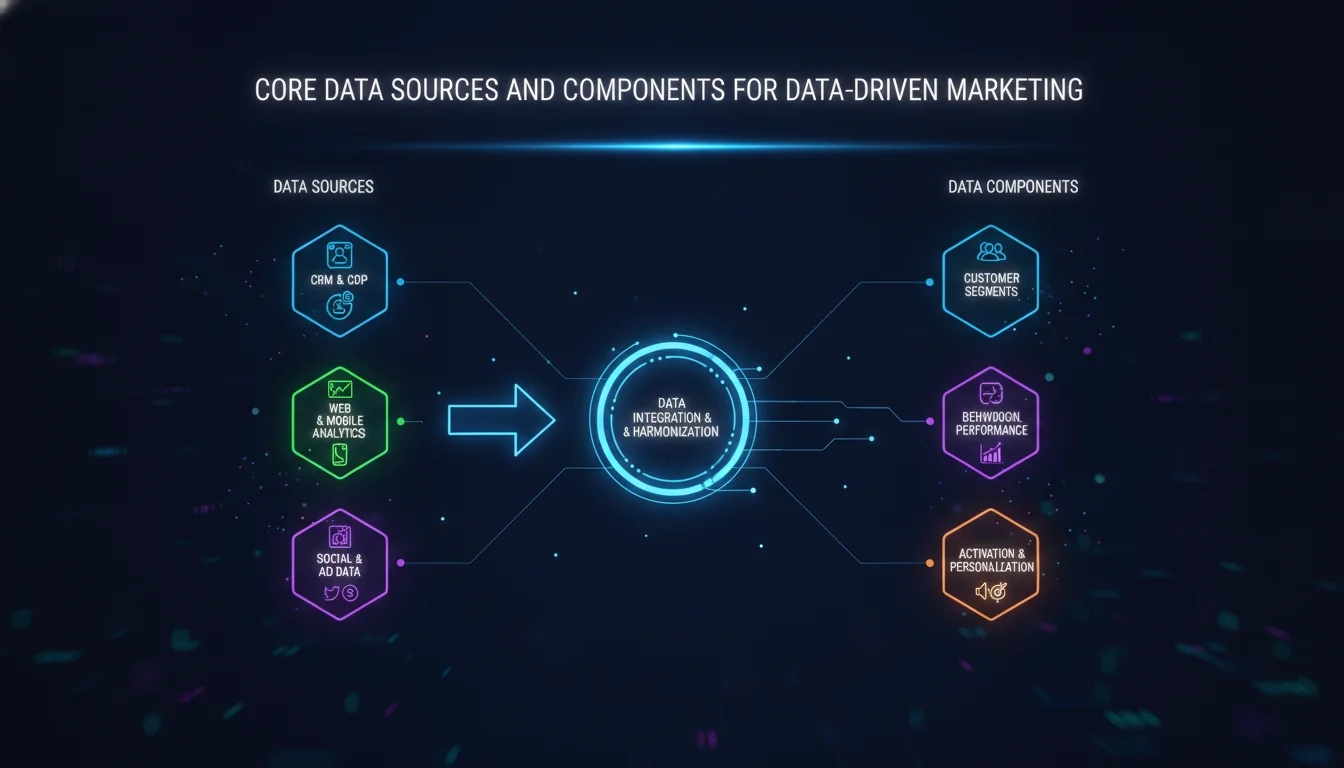
this kind of marketing draws on several data types. First-party data is what a company collects directly, like website interactions, purchase history, and CRM records. Second-party data is another organization’s first-party data shared through partnership. Third-party data comes aggregated from outside providers.
First-party data tends to be the most valuable of the three because it’s accurate, privacy-compliant, and directly relevant to your audience. Data Drive Marketing, an agency focused on measurable results, highlights activating first-party data across multiple channels to drive growth for agencies and automotive dealerships. Leaning into first-party data reduces reliance on rented audiences and builds real long-term data ownership.
Common Data Sources and Marketing Tools
Modern marketing teams draw from a wide mix of sources. According to Semrush, common data sources include CRM platforms like Salesforce, website analytics tools like Google Analytics, email marketing platforms like Mailchimp, social platforms like Instagram, and competitive intelligence tools like Semrush’s Traffic Analytics.
- CRM platforms centralize customer interactions and track relationships over time.
- Website analytics reveal how visitors engage with content and where conversions happen.
- Social platforms provide engagement, sentiment, and audience signals.
- Email marketing platforms track opens, clicks, and purchase follow-through.
- Market research and surveys fill in the gaps with declared preferences data can’t capture alone.
Semrush also points out that marketers can run their own surveys and experiments to generate useful data. Combine behavioral signals with declared preferences and you get a far richer view of the customer than any single source provides on its own.
How to Build a Strategy: 6 Practical Steps
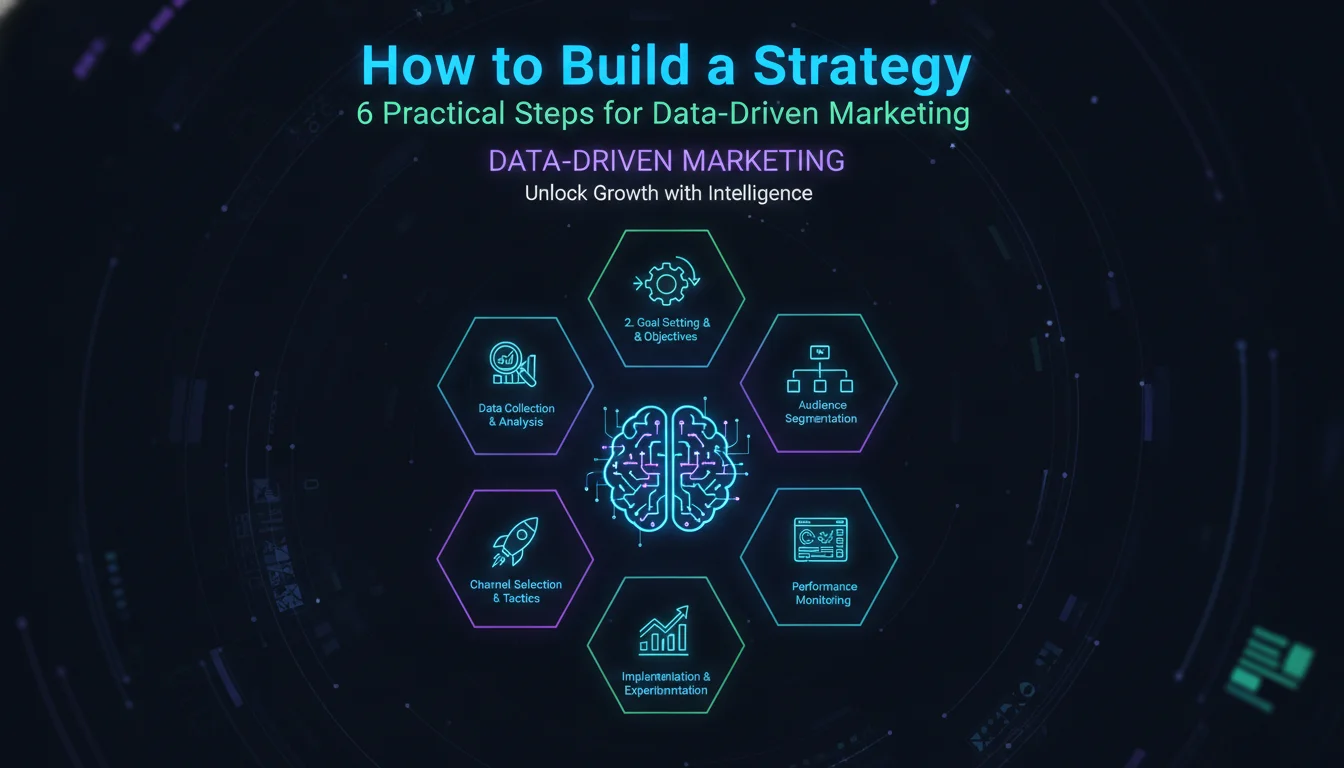
Step-by-Step Framework
Building a data-driven marketing strategy doesn’t demand a full overhaul on day one. These six steps create a practical path from raw data to measurable outcomes, and they work as of 2026 whether you’re a five-person startup or an established brand.
- Step 1: Define clear marketing objectives. Start with specific, measurable goals like increasing conversion rate, lowering customer acquisition cost, or improving retention.
- Step 2: Audit available data sources. Map what you already collect from your website, CRM, email, social, and point of sale.
- Step 3: Consolidate data into a single view. Break down silos and merge channel data into unified customer profiles.
- Step 4: Analyze patterns and segment audiences. Use analytics tools to spot behaviors, preferences, and trends across customer groups.
- Step 5: Activate insights in campaigns. Apply segmentation and personalization to messaging, offers, and channel choice.
- Step 6: Measure, learn, and refine. Track real-time metrics and build feedback loops that adjust campaigns based on what the data actually shows.
This framework holds for B2B and B2C brands alike. The point is continuous improvement, not a set-it-and-forget-it plan. Every round of campaigns generates more data, which makes the next round smarter.
Aligning Data with Business Goals
A common mistake is collecting data for its own sake. Data-driven marketing works when data initiatives connect directly to business outcomes like revenue growth, market share, or customer lifetime value. Ask what decision the data needs to support before you invest in new tools or pipelines.
An automotive dealership might prioritize lead quality and sales metrics, while an e-commerce brand focuses on cart abandonment and repeat purchase rate. The same data infrastructure can serve very different goals as long as the objectives are clear from the start. That alignment also stops teams from wasting budget on tools that report interesting but ultimately irrelevant metrics.
Selecting the Right Technology Stack
The right stack depends on your organization’s size, budget, and goals. Core components usually include a customer data platform for unified profiles, a CRM for relationship management, web analytics for behavioral tracking, and marketing automation tools for delivery. Adverity notes that many marketers struggle just accessing, analyzing, and comparing their own data, which is exactly why integration matters as much as any single tool’s feature list.
For teams that want a one-stop-shop option, agencies like Data Drive Marketing offer white-label programmatic media buying, SEO optimization, and data activation services. The goal is tools that connect to each other, not tools that create new silos. A fragmented stack undercuts the very visibility your strategy depends on.
Real-World Data-Driven Marketing Examples
Cross-Channel Data Sharing and Omnichannel Activation
Customers rarely stick to one channel, which makes data silos one of the biggest roadblocks brands face. Sharing data across channels helps unify the customer profile. If a shopper spots a product on social media, that same product should be easy to find later on the website. Adobe’s Experience Cloud team notes that sharing data between channels keeps the conversation smooth as prospects move back and forth.
Insights from one channel can also sharpen another. A landing page CTA that converts well can shape a social campaign, and the reverse works too. This connected thinking sits at the center of omnichannel marketing, which aims for a consistent experience no matter where a customer touches the brand.
Personalized Content and Predictive Campaigns
Notable examples include targeting digital ads based on past customer demographics, using paid search insights to guide SEO strategy, and building personalized content from user data, the way Spotify Wrapped turns listening history into a shareable moment. Cart abandonment emails are another familiar tactic: nudging customers about products left behind in an online cart recovers sales that would otherwise disappear.
Predictive analytics pushes this further by using historical behavior to anticipate what happens next. A retailer might send a replenishment reminder before a product runs out, while a streaming service recommends content based on viewing history. These tactics only work with a steady, accurate flow of data and a system built to act on it quickly.
Agency and First-Party Data Activation
Data Drive Marketing specializes in activating first-party data across multiple channels to drive measurable growth. Their services span streaming media activation, display and video, paid search, social, and SEO optimization. For automotive clients, they lean into full-service digital marketing backed by accountability through metrics like leads and sales.
This example proves data-driven marketing isn’t reserved for enterprise budgets. Agencies can deliver white-label solutions that let smaller organizations benefit from advanced analytics and programmatic buying without building an in-house data team. That’s a faster path to measurable results for brands with limited resources.
Measuring Performance: Key Metrics That Matter
Key Metrics and KPIs
Effective data-driven marketing needs a defined set of KPIs, full stop. Common metrics include conversion rate, click-through rate, customer acquisition cost, customer lifetime value, engagement rate, and return on ad spend, and the right mix depends on the campaign’s goal and channel.
A paid search campaign might prioritize cost per acquisition, while a content initiative tracks organic traffic and time on page. The principle stays the same across the board: every campaign needs a measurable outcome tied to a business objective. A KPI is simply a quantifiable measure used to judge the success of a campaign or activity.
Real-Time Analytics and Feedback Loops
One of the biggest advantages of digital tools is real-time monitoring. Marketers can watch a campaign perform live and adjust targeting, creative, or budget on the fly. Salesforce points out that metrics can be tracked and assessed in real time so strategy can shift the moment customer behavior does.
This feedback loop turns marketing into a system that actually learns. Instead of waiting for a campaign to close out before evaluating results, teams optimize continuously, cutting waste and protecting ROI. Measure, learn, refine: that cycle is the core discipline behind any strong data-driven marketing program.
Overcoming Common Challenges
Data Silos and Integration Barriers
Data silos happen when information gets trapped inside separate platforms or departments. For data-driven marketing to actually work, trends from one channel need to reach the others. Adobe’s team calls out silos as a major obstacle to omnichannel strategy, and fixing that requires both new technology and new process.
A practical fix is a customer data platform or a centralized analytics warehouse pulling from CRM, web, email, and advertising platforms. The goal is one unified customer view that supports coherent messaging across every touchpoint. Without that integration, even the sharpest analytics tools only produce fragmented insight.
Data Quality, Privacy, and Governance
Collecting and organizing an abundance of information can get overwhelming fast. Salesforce identifies data accuracy and privacy as real challenges, especially as regulations tighten and consumer expectations shift. Poor data quality produces flawed insight, and privacy missteps damage trust that’s hard to rebuild.
Governance covers data ownership, consent management, and compliance with regulations like GDPR or CCPA. Clean, well-governed data is the price of entry for reliable analysis and personalization. Brands that skip governance often watch their data-driven initiatives collapse under the weight of bad inputs.
The sheer amount of data from a near-infinite combination of media, devices, and platforms means marketers who master it will out-compete those who don’t. – Tom Benton, CEO of the Data and Marketing Association
Skills and Organizational Alignment
Data-driven marketing also needs people who can interpret data and act on it, not just collect it. Coursera points to roles like marketing manager and marketing specialist, and highlights skills like marketing analytics, A/B testing, and data storytelling as essential. Programs like Google’s Digital Marketing & E-commerce Professional Certificate have become a common on-ramp for marketers building these skills. Organizations often stumble when data teams and creative teams operate in separate rooms.
Closing that gap takes cross-functional collaboration, training, and a shared vocabulary. Marketing teams don’t need to become data scientists, but they do need enough fluency to ask sharp questions and trust the answers they get back. A culture that rewards evidence over opinion matters just as much as the tech stack sitting underneath it.
Pros and Cons
Pros
- Sharper targeting and personalization that boosts engagement and conversion
- Real-time measurement that lets teams optimize mid-campaign instead of after the fact
- Smarter budget allocation, shifting spend toward what’s actually working
- A stronger, more complete view of the customer across every touchpoint
Cons
- Data silos and fragmented tech stacks can undercut even a strong strategy
- Privacy regulations and consent management add real operational complexity
- Requires ongoing investment in tools, integration, and data literacy
- Poor data quality can produce confident-sounding but flawed conclusions
Data-driven marketing isn’t a single tool or a checklist. It’s an operating model that turns customer information into a creative and competitive advantage. Combine real-time analytics, cross-channel data sharing, and disciplined measurement, and you replace guesswork with evidence, then deliver campaigns that feel personal and perform like it. As of 2026, that’s no longer optional. It’s the baseline for any brand serious about growth. Our team at Emin Media builds these systems alongside the creative work itself, because a beautiful campaign with no measurement plan is just an expensive guess. If you’re rethinking your brand’s approach to strategy, our piece on brand storytelling frameworks and our breakdown of social media trends pair well with everything above. Let’s build something bold. Contact Emin Media for a free brand consultation.
Frequently Asked Questions
What does data-driven marketing mean?
Data-driven marketing means using customer data, behavioral signals, and analytics to guide marketing decisions and personalize campaigns. It replaces intuition with evidence, helping brands reach the right audience at the right time.
What is the 40-40-20 rule in marketing?
The 40-40-20 rule is a direct marketing heuristic that credits campaign success mostly to audience selection and offer strength, with creative execution playing a smaller role. It reinforces the value of data-driven targeting over guesswork, though creative quality still shapes how an offer lands.
What are some examples of data-driven marketing strategies?
Examples include retargeting ads based on browsing history, sending cart abandonment emails, personalizing content like Spotify Wrapped, and using paid search insights to inform SEO strategy. Cross-channel data sharing is another common approach.
What does data marketing do?
Data marketing collects, analyzes, and activates customer information to improve targeting, messaging, and campaign performance. It supports segmentation, personalization, and real-time measurement across channels.
How is data-driven marketing different from traditional marketing?
Traditional marketing relies on assumptions and market studies, which often leads to trial and error. Data-driven marketing uses real-time customer data to optimize campaigns continuously, which improves accuracy and ROI.
What skills are needed for data-driven marketing roles?
Relevant skills include marketing analytics, A/B testing, data storytelling, customer segmentation, and familiarity with tools like Google Analytics and CRM platforms. Roles such as marketing manager and marketing specialist commonly draw on these skills.
Enjoyed this article?
Contact Emin Media for a free brand consultation and let's create something amazing together.
Get in TouchRelated Articles
Digital Marketing for Creatives: A Bold Guide
Digital marketing for creatives builds real visibility and sales. Learn strategies for social media, SEO,…
Video SEO for Creative Agencies: The 2026 Playbook
Video SEO for creative agencies is how you turn portfolio reels into search traffic. Get…
Creative Brand Photography: The Complete Guide
Creative brand photography is your visual voice. Learn how to plan shoots, find the right…