Brand Social Media Strategy: Build It Right
Key Takeaways
- A brand social media strategy is not a content calendar. It is the operational system that aligns audience insight, platform choice, and creative consistency with measurable business goals.
- SMART goals, specific, measurable, attainable, relevant, and time-bound, are the foundation because without them ROI cannot be proven.
- Brand presence is not brand building: research from Sprout Social shows 89% of marketers use social media for awareness, but only 55% use it for community, and community is where differentiation lives.
- Platform-specific expression matters: Instagram favors visual storytelling, LinkedIn rewards thought leadership, TikTok requires cultural fluency.
- Use evidence-based frameworks like Hootsuite’s 8-step process instead of unverifiable viral rules such as 5-5-5 or 3-7-27.
- Review your strategy quarterly. Social platforms shift fast, and a plan that worked in Q1 may be stale by Q3.
A brand social media strategy is a plan that defines how a brand uses social platforms to express identity, reach target audiences, and achieve measurable business outcomes. It connects audience insight, content architecture, and platform choices to goals like awareness, leads, and loyalty.
What Is a Brand Social Media Strategy?
Defining the Term and Its Scope
A media strategy is a comprehensive plan that outlines social media goals, the tactics used to achieve them, and the metrics tracked to measure performance. According to the Digital Marketing Institute, it should drive brand awareness and engagement across social channels for target audiences, generate leads, and cultivate customer relationships. Unlike a loose collection of posts, a this type of strategy is a deliberate system that connects every piece of content to a business objective.
The scope extends well beyond publishing. It includes audience research, competitive analysis, platform selection, content architecture, community management, and performance measurement. Think of it as the bridge between brand identity and customer action.
The Difference Between Social Media Presence and Brand Building
Helms Workshop draws a critical distinction: social media presence means you exist on platforms; social branding means you have thoughtfully shaped how your brand lives, expresses itself, and builds relationships in those digital spaces. This distinction matters because 90% of consumers report buying from brands they follow on social media, yet many brands only post promotional content without building community.
Research from Sprout Social, cited by Helms Workshop, reveals that while 89% of marketers use social media for brand awareness, only 55% use it for building meaningful communities. That gap is where a this kind of media strategy either creates durable loyalty or fades into the feed. Strong strategies treat social platforms as brand amplification channels, not brand creation tools.
Why 2026 Demands a Strategic Approach
The social media landscape in 2026 is defined by saturation and high expectations. According to Strong Brand Social, 4.5 billion people worldwide use social media, while YouScan reports over five billion social media users worldwide. The average person spends nearly 2.5 hours daily on social platforms. The question is no longer whether to be present, but how to be meaningfully different. A the social media strategy is the only reliable way to stand out without burning budget on random posting.
Pros and Cons of Building a Brand Social Media Strategy
Pros
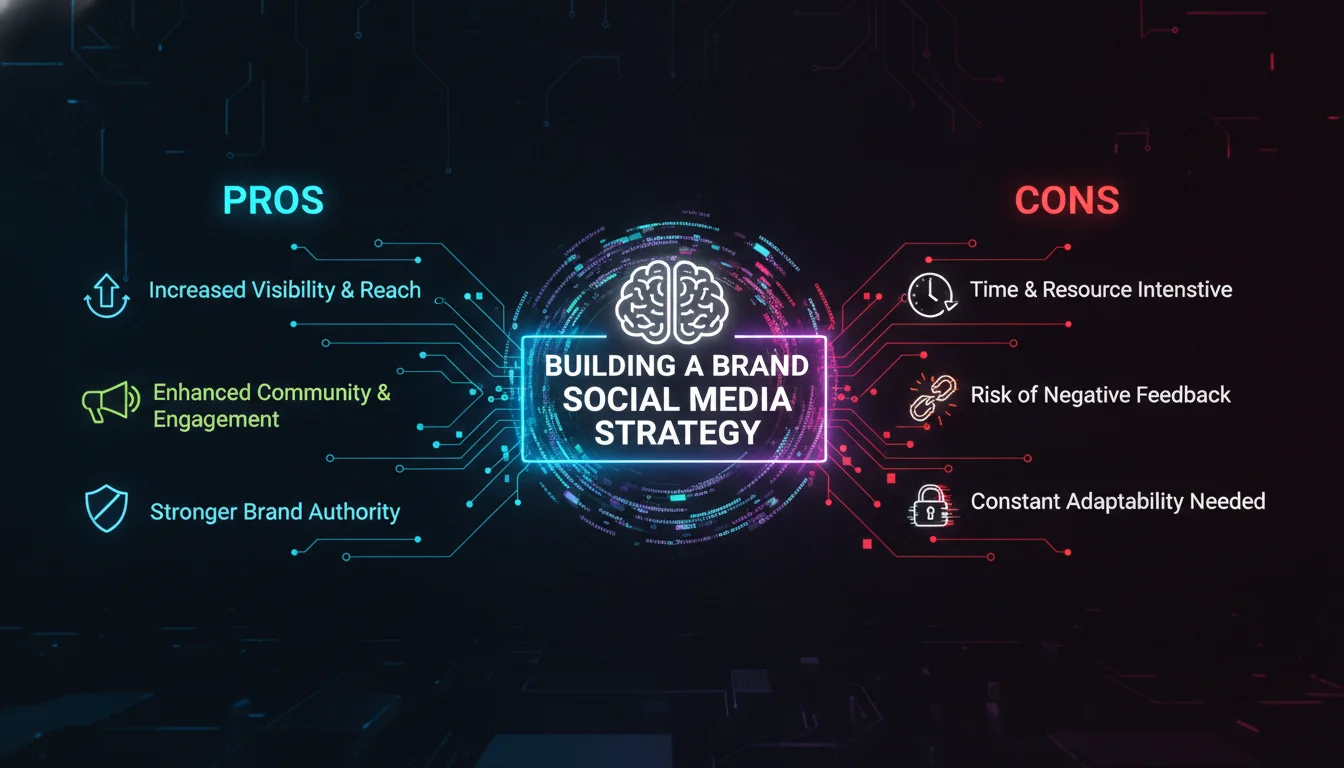
- Measurable ROI: SMART goals tie every post to a business outcome, making it possible to prove the value of social investment to leadership.
- Audience clarity: Deep persona research means content speaks to real desires, not assumptions, which drives higher engagement and better-quality leads.
- Competitive advantage: A documented strategy reveals gaps competitors leave open, letting you capture underserved audiences on underserved platforms.
- Brand consistency: Defined visual and verbal identity guidelines keep every caption, story, and reply on-brand, regardless of who hits publish.
- Adaptability: A quarterly review cycle means the strategy evolves with algorithm changes and audience shifts instead of becoming obsolete.
Cons
- Time investment upfront: Audience research, competitive audits, and identity work take real hours before a single post goes live.
- Requires cross-functional buy-in: A strategy only works if design, copy, and leadership align. Siloed teams produce siloed content.
- Results are not instant: Community building and brand recognition compound over months, not weeks. Impatient stakeholders can derail long-term thinking.
- Platform volatility: Algorithm changes and new features can make a carefully planned content calendar feel outdated overnight.
Why a Brand Social Media Strategy Is a Business System, Not a Posting Plan
From Vanity Metrics to Business Metrics
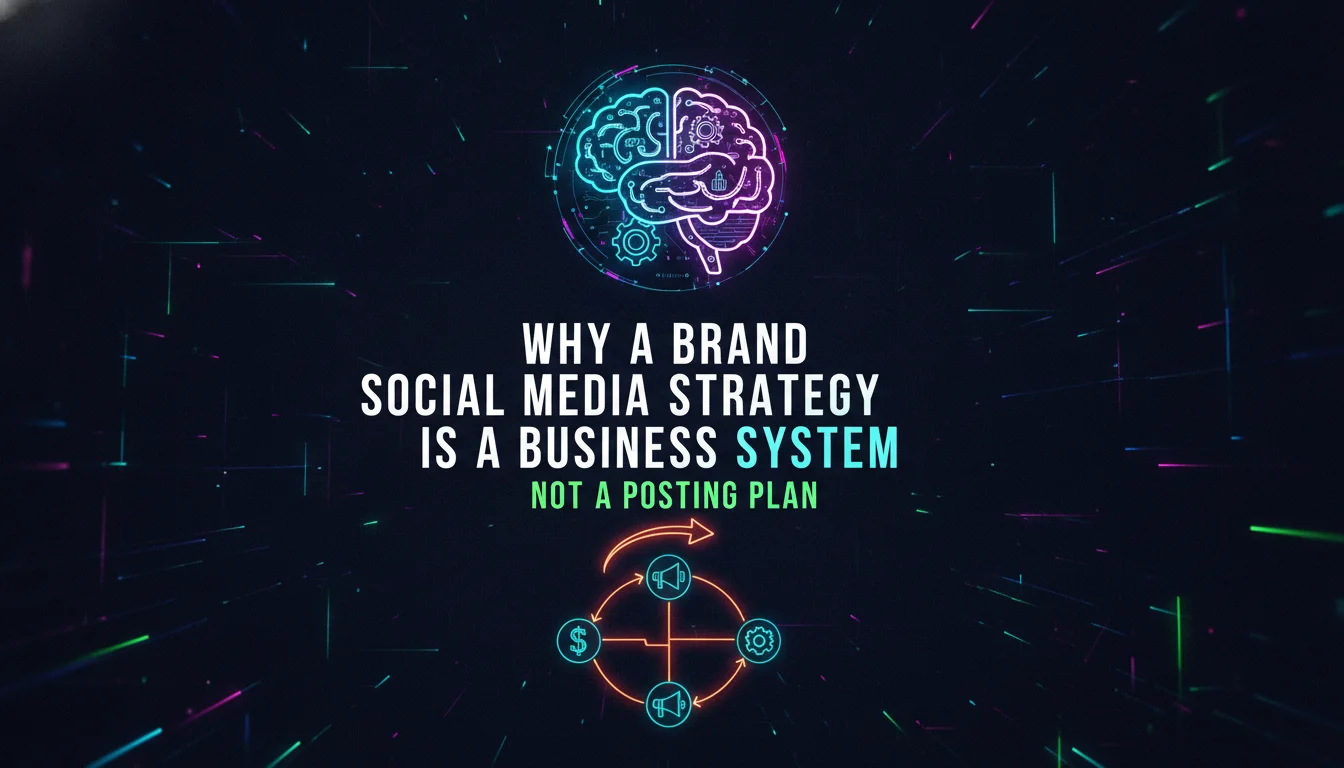
Many teams mistake activity for progress. Likes, retweets, and follower counts are easy to track but difficult to connect to revenue. A strategy forces discipline by measuring leads generated, web referrals, and conversion rate. Hootsuite advises tracking different goals for different channels: paid campaigns for brand awareness, organic posts for acquisition and engagement. Without a strategic framework, social media becomes a cost center rather than a growth engine.
The Role of Social Listening and Competitive Intelligence
Social listening is foundational to a brand social. It means monitoring conversations about your brand, competitors, and industry to extract actionable insights. As Hootsuite puts it: if you are not engaged in social media listening, you are creating your business strategy with blinders on. Competitive analysis complements listening by showing what competitors do well and where they fall short. A brand may dominate Facebook but ignore Instagram, creating an opening for your brand to capture an underserved audience.
Real-world data proves the value. Jugnoo, an Uber-like service for auto-rickshaws in India, used Facebook Analytics to learn that 90% of users who referred other customers were between 18 and 34 years old, and 65% of that group used Android. Targeting ads accordingly led to a 40% lower cost per referral. That is the kind of measurable outcome a media strategy should produce.
“If you’re not engaged in social media listening, you’re creating your business strategy with blinders on – and you’re missing out on mountains of actionable insights from real people who are actively talking about you or your industry online.” – Hootsuite Social Media Strategy Guide
Connecting Social Signals to Revenue
The connection between social activity and revenue is not automatic. It requires a system that maps audience signals to conversion paths. A this type of strategy establishes that mapping by aligning social goals with broader marketing strategy. Hootsuite recommends writing down at least three social media goals to start. These goals should be SMART: specific, measurable, attainable, relevant, and time-bound. “Grow our Instagram audience by 50 new followers per week” is a SMART goal that can be tracked and tied to lead acquisition over time.
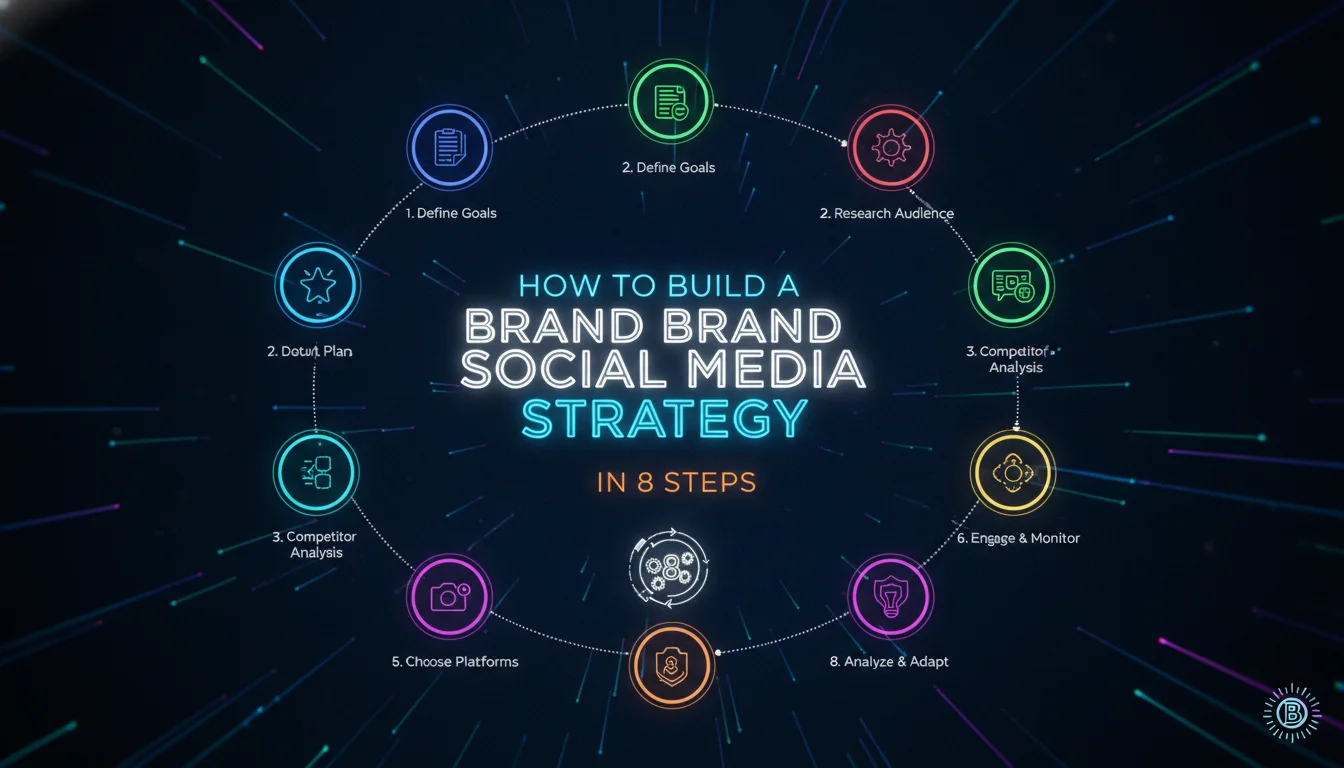
How to Build a Brand Social Media Strategy in 8 Steps
The Step-by-Step Process
The most widely referenced operational framework comes from Hootsuite’s 8-step guide. It is a practical, sequenced method for moving from intention to iteration. Follow these steps in order to build a this kind of media strategy that withstands algorithm changes.
- Step 1: Set SMART social media goals. Define specific, measurable, attainable, relevant, and time-bound objectives aligned with business outcomes.
- Step 2: Learn everything about your audience. Build audience personas based on demographics, buying motivations, and emotional needs. Use social analytics to gather real-world data on followers, location, language, and interaction patterns.
- Step 3: Research the competition. Conduct a competitive analysis to understand who competitors are, what they do well, and where they are weak. Use social listening to spot content gaps and underserved platforms.
- Step 4: Conduct a social media audit. Review your existing accounts, content performance, and brand consistency. Identify what works and what needs improvement.
- Step 5: Set up accounts and improve profiles. Optimize bios, visual assets, and links for each platform. Ensure every profile reflects your brand identity accurately.
- Step 6: Find inspiration. Study brands, creators, and industry leaders for content ideas without copying. Look for themes that align with your brand values and audience interests.
- Step 7: Create a social media content calendar. Plan posts by platform, format, and timing to maintain consistency and reduce last-minute scrambling.
- Step 8: Test, evaluate, and adjust. Track meaningful metrics, learn from performance data, and iterate. Social media is never static; your strategy should evolve quarterly.
Why Sequence Matters
The order of these steps is deliberate. Goals come first because they determine which metrics matter. Audience research comes second because content that does not resonate with real people will fail regardless of frequency. Competitive analysis and auditing provide the baseline. Only after these foundations are set do you optimize profiles and create content. Skipping to content creation without research is the most common cause of social media failure. A the social media strategy built without audience insight is just organized guessing.
Common Mistakes to Avoid
Three mistakes undermine the process. First, setting vague goals like “increase engagement” instead of specific targets. Second, treating every platform as if it has the same audience and content norms. Third, neglecting the test-and-adjust step. Posting and never reviewing performance means you cannot replicate success or correct failure. The American Marketing Association reinforces that a social media marketing strategy is a blueprint for turning online activity into real business impact, not just adding to the noise.
Free Tools and Templates to Accelerate Your Strategy
Where to Start Without Starting from Scratch
Free tools and templates accelerate strategy development by giving teams a structured starting point. The Digital Marketing Institute highlights social media strategy templates and free tools as a practical way to move from planning to execution faster. Hootsuite offers downloadable strategy guides and content calendar templates. Canva provides visual identity templates that keep brand consistency intact across platforms. YouScan’s social listening dashboards let teams monitor brand health, track sentiment, and conduct competitive benchmarking in real time.
For crisis management, YouScan’s platform surfaces brand mentions and sentiment shifts before they escalate. Brand health tracking tools like these close the loop between strategy and reality: you set goals, publish content, then monitor whether audience perception is moving in the right direction. That feedback loop is what separates a living strategy from a document that collects dust.
“A social media strategy is a comprehensive plan that outlines your social media goals, the tactics used to achieve them, and the metrics tracked to measure performance. It should help drive brand awareness and engagement across social channels for your target audiences, generate leads, and help cultivate customer relationships.” – Digital Marketing Institute
Platform-Specific Brand Expression: The Portfolio Approach
Instagram, LinkedIn, TikTok, and X as Brand Territories
Each social platform functions as a distinct brand territory. Helms Workshop notes that Instagram favors visual storytelling and aspirational lifestyle positioning. LinkedIn rewards thought leadership and professional credibility. TikTok demands creativity, humor, and cultural participation. X (formerly Twitter) values timely commentary and conversational engagement. A strategy must adapt expression to each platform while maintaining consistent brand identity.
Spreading identical content across all channels dilutes impact. Sophisticated social branding adapts brand expression to platform norms. Canva emphasizes that for young people, platforms like TikTok serve as their primary search engine, so brands without a presence risk losing Gen Z and Millennial consumers. The portfolio approach treats each platform as a different room in the same branded house.
The Patagonia Model of Platform Adaptation
Patagonia provides a clear example of consistent brand personality across different platforms. On Instagram, the outdoor apparel brand shares environmental photography and adventure stories that embody values of conservation and exploration. On LinkedIn, it publishes thought leadership about corporate environmental responsibility. On X, it engages in environmental advocacy and activism. The content differs, but the underlying personality, earnest, activist, environmentally committed, remains unmistakably consistent. This is the benchmark for a brand social that balances adaptation with identity.
Visual and Verbal Identity Consistency
Visual consistency is non-negotiable. Helms Workshop points to Glossier, which built a beauty empire partly through distinctively minimal, millennial-pink social branding that became visually synonymous with the brand. Airbnb’s photography style, warm, authentic, human-centered, reinforces its “belong anywhere” position. A media strategy must define color palettes, typography, photography style, and graphic treatments. Verbal identity is equally important: word choices and emotional tone must be consistent across every caption, reply, and story.
A Comparison of Leading Strategy Frameworks
Hootsuite’s 8-Step Playbook vs. Brand-First Approaches
Hootsuite’s framework is execution-oriented, walking teams from SMART goals to iteration. It excels at operational completeness. Brand-first approaches, such as Helms Workshop’s social media branding model, start with identity clarity: who you are, what you stand for, who you serve, and what makes you different. Both are necessary, but the starting point differs. A this type of strategy benefits from combining the two. Define identity first, then execute with Hootsuite’s discipline.
AMA’s Strategic Blueprint and DMI’s ROI Focus
The American Marketing Association’s 8-step guide similarly emphasizes SMART goals, audience research, and platform focus. The Digital Marketing Institute adds a strong ROI lens, citing Datareportal’s 2026 Global Social Media Statistics: the world spends over 15 billion hours consuming content on social platforms each day, 96.7% of internet users aged 16 and above in 54 of the world’s largest economies use at least one social or messaging platform monthly, the typical user actively uses 6.5 different platforms monthly, and spends an average of 18 hours and 36 minutes weekly on social media. This data justifies investment but does not replace strategic clarity.
Choosing the Right Framework for Your Brand
The table below compares four leading frameworks. Choose based on your stage: early-stage brands need brand-first identity work; mature brands need ROI optimization; teams with no process need Hootsuite’s operational playbook.
| Framework | Core Focus | Key Steps | Best For |
|---|---|---|---|
| Hootsuite’s 8-Step Social Media Strategy | Measurable execution from goals to iteration | SMART goals, audience research, competitive analysis, audit, profiles, inspiration, calendar, test/evaluate | Teams needing a complete operational playbook |
| Helms Workshop Social Media Branding | Brand expression and community building | Identity clarity, visual consistency, platform-specific storytelling, value-driven engagement | Brands prioritizing recognition and emotional connection |
| AMA’s 8 Simple Steps | Blueprint from online activity to business impact | SMART goals, audience, platform focus, content mapping, metrics | Marketers seeking a practical, strategy-first roadmap |
| Digital Marketing Institute ROI Approach | Driving brand awareness and ROI | Goals, tactics, metrics, content optimization, influencer opportunities | Brands needing direct revenue attribution |
Decoding Social Media Rules: 5-5-5, 3-7-27, 5-3-1
Where These Rules Come From
Search engines surface these numeric rules frequently in People Also Ask, but they lack authoritative definitions in the competitor content examined for this article. The 5-5-5 rule, 3-7-27 rule, and 5-3-1 rule appear to be practitioner shorthand for engagement cadence or content mix. No industry standards body defines them. They are best understood as viral heuristics rather than evidence-based strategy. A this kind of media strategy should not depend on unverifiable mnemonics.
Why Most Mnemonic Rules Fail as Strategy
Mnemonic rules fail for three reasons. First, they ignore brand context. A B2B SaaS brand and a DTC skincare brand have radically different audience behaviors. Second, they reduce nuanced community management to a formula, which leads to performative engagement. Third, they are not measurable against business outcomes. The 5-5-5 rule may keep a team busy, but it does not guarantee leads, retention, or brand lift. A the social media strategy built on SMART goals and competitive insight is inherently more defensible.
What to Use Instead
Instead of chasing numbered rules, use the feedback loop already described: set SMART goals, research your audience, monitor competitors, create platform-adapted content, and measure outcomes. If you still want a cadence heuristic, create your own based on your audience data. Look at the ratio of curated to original content that your analytics show drives the most meaningful engagement. That is a real strategy, not a slogan.
Common Mistakes That Undermine a Brand Social Media Strategy
Treating All Platforms the Same
A single piece of content copied to every channel ignores the distinct norms of Instagram, LinkedIn, TikTok, and X. The Digital Marketing Institute explicitly notes that a Facebook audience will be very different from a TikTok one. A strategy must account for these differences in format, tone, and timing.
Optimizing for Likes Instead of Outcomes
Vanity metrics create a false sense of progress. Hootsuite recommends focusing on leads generated, web referrals, and conversion rate. Likes do not pay salaries. A brand social that does not tie social activity to revenue will eventually lose executive buy-in. Start with at least three SMART goals that connect to business objectives.
Neglecting Community and Listening
Social media is a two-way channel. Brands that broadcast and ignore replies miss the community-building opportunity that Helms Workshop identifies as the differentiator between presence and branding. Social listening is not a luxury. It is the intelligence layer of a media strategy. Use it to understand emotional needs, buying objections, and real customer language.
The Strategic Payoff of a Brand Social Media Strategy
The Synthesis: Brand, Audience, and Feedback Loop
A brand social media strategy succeeds when three elements come together: a clearly defined brand identity, deep audience understanding, and a continuous feedback loop of measurement and iteration. The Helms Workshop framework provides the identity foundation; Hootsuite and AMA provide the operational discipline; Datareportal and YouScan quantify the opportunity. No single source captures the whole picture, but together they form a robust system.
From Strategy to Execution
Execution is where most strategies fail. A documented plan is only useful if it drives daily decisions about what to post, where to engage, and how to respond. Use the 8-step process as a checklist. Revisit your brand social media strategy quarterly to incorporate new platform features, audience shifts, and competitive moves. Social media changes fast, but strategic principles endure.
The 2026 Imperative
As of 2026, a brand social media strategy is not optional. With billions of users active daily and consumers increasingly turning to social platforms for product discovery, customer service, and identity affiliation, the quality of your social branding directly impacts purchase consideration and customer loyalty. The brands that win will be those that treat social media as a brand system, not a posting obligation. Start with identity, build with data, and optimize with discipline.
Ready to build something that actually moves the needle? Contact Emin Media for a free brand consultation and let’s build your brand social media strategy from the ground up.
Frequently Asked Questions
What is a brand social media strategy?
A brand social media strategy is a comprehensive plan that defines how a brand will use social platforms to express identity, reach audiences, and achieve measurable goals. It includes audience research, platform selection, content planning, and metrics tracking.
What is the difference between social media marketing and social media branding?
Social media marketing focuses primarily on promotional content and immediate conversions. Social media branding takes a longer view, using consistent visual identity, distinctive voice, and authentic storytelling to shape how audiences perceive and emotionally connect with the brand over time.
What are SMART goals in social media?
SMART goals are specific, measurable, attainable, relevant, and time-bound. An example is “Grow our Instagram audience by 50 new followers per week,” which is clear, trackable, and tied to a timeframe.
What is the 5-5-5 rule for social media?
The 5-5-5 rule is a social media engagement heuristic without a single authoritative definition. It is often used as shorthand for balancing different content types, but it should not replace audience research and measurable goal setting.
What are the 5 pillars of brand strategy?
The five pillars of brand strategy are not standardized across the industry, but they commonly include identity, audience, differentiation, consistency, and community. Helms Workshop emphasizes clarity about who you are, what you stand for, who you serve, and what makes you different as the foundation for any social branding work.
How often should I update my brand social media strategy?
Review your brand social media strategy at least quarterly. Social platforms evolve, audience behaviors shift, and competitive dynamics change, so a quarterly review keeps your strategy aligned with current conditions.
Enjoyed this article?
Contact Emin Media for a free brand consultation and let's create something amazing together.
Get in TouchRelated Articles
Digital Storytelling for Brands: The Complete Guide
Digital storytelling for brands builds real audience connections through narrative. Learn proven techniques, formats, and…
Design Thinking for Marketing: A 2026 Guide
Design thinking for marketing builds campaigns around real user needs. Learn the 5 phases, common…
Creative Direction for Video Shoots: A Complete Guide
Master creative direction for video shoots with proven steps, tools, and strategies that build brand…