What Is the 5 Rule Social Media? The 5-5-5 Explained
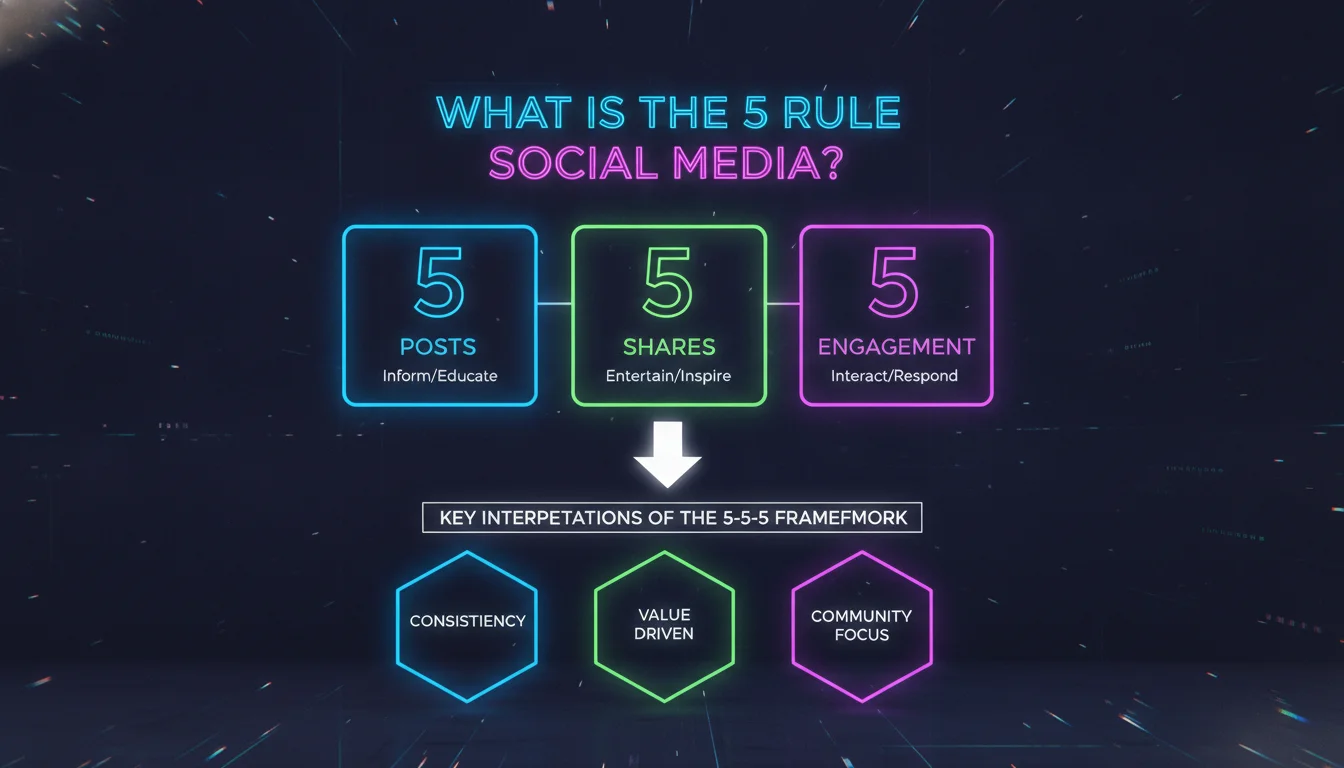
What is the 5 rule social media strategy? It is most commonly known as the 5-5-5 rule, a framework that balances content creation, curation, and daily engagement to build a genuine following instead of a broadcast feed.
Key Takeaways
- What is the 5 rule social media? It most commonly refers to the 5-5-5 rule, a flexible framework that balances content creation, curation, and active engagement to build a real social media presence.
- The rule has three primary interpretations: a weekly content mix (5 curated, 5 original, 5 personal posts), a daily engagement quota (like, comment, connect with 5 each), and a consistency habit (5 posts weekly for 5 weeks with 5 brand signals).
- Unlike rigid percentage-based rules like 70-20-10 or 5:3:2, the 5-5-5 rule emphasizes actionable daily habits while staying adaptable across platforms and goals.
- Algorithms reward consistent, two-way interaction, which makes the engagement piece of the rule a real growth lever when it’s done authentically.
- To make it work, brands need to avoid over-automation, tailor the ratio to each platform, and treat the rule as a starting point, not an unbreakable law.
What Is the 5 Rule Social Media? Key Interpretations of the 5-5-5 Framework
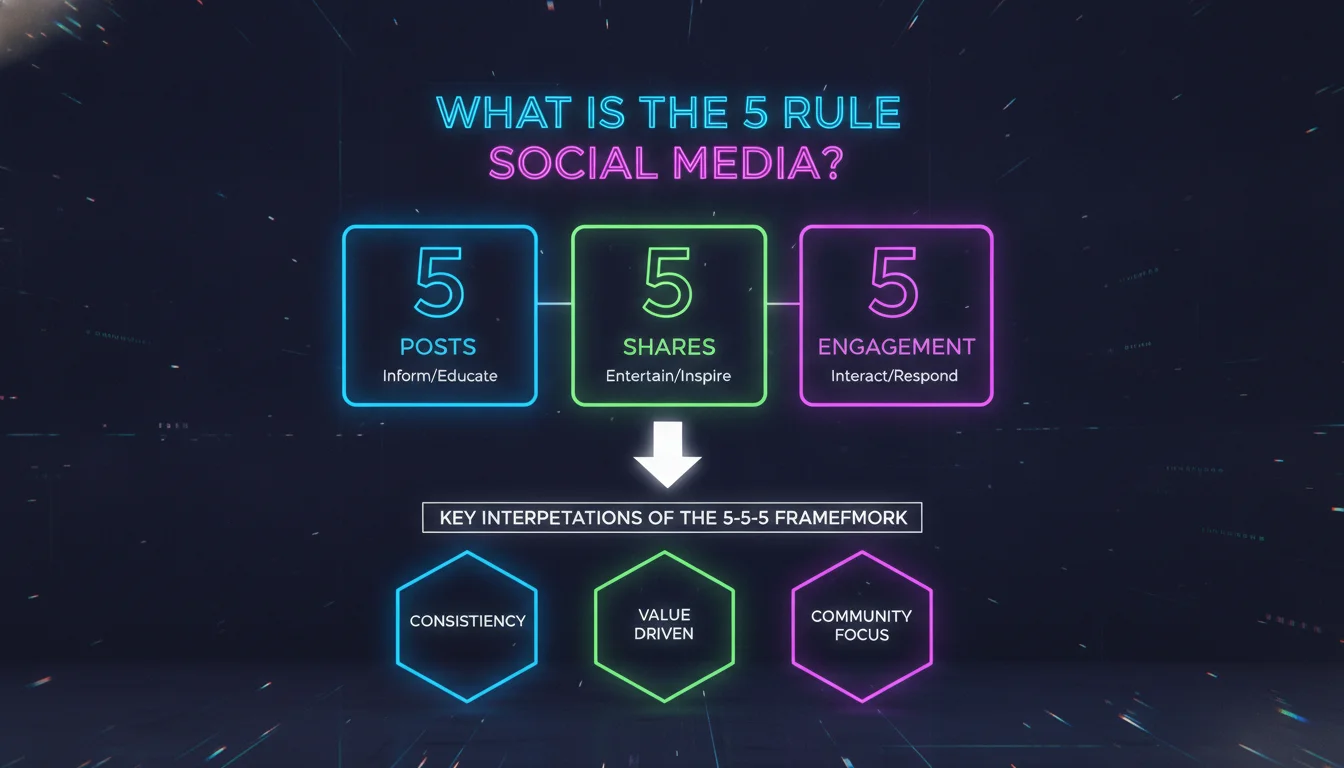
The question “what is the 5 rule social media” almost always leads back to the 5-5-5 rule, a flexible strategy for structuring your social activity week to week. The core idea is simple, but its real value is in how adaptable it is. Marketers and creators have shaped the 5-5-5 rule into three distinct but complementary versions: one built around content planning, one around daily engagement, and one around brand consistency. Together, they form a full system for sustainable social growth.
People searching “what is the 5 rule social media” usually land on one of these variations first. Below, we break down each one so you can choose the version, or blend of versions, that fits your goals and your bandwidth.
The Content Creation Interpretation: Balancing Curated, Original, and Personal Posts
One of the most common definitions of the 5-5-5 rule comes from content planning. According to a detailed guide by Intertec Data Solutions, the framework splits a week’s worth of posts into three balanced groups of five:
- Five curated posts: Sharing articles, industry news, or user-generated content that signals your brand is plugged into the conversation, not just talking about itself.
- Five original posts: Creating your own content, blogs, infographics, videos, that showcases your expertise and drives conversions.
- Five personal or behind-the-scenes posts: Giving a glimpse into your company culture, your team, or your day-to-day to humanize the brand.
This structure kills the “what should I post today” panic. Instead of a random publishing schedule, you get a predictable rhythm that keeps your feed fresh, varied, and audience-first. Small business owners and solo marketers tend to gravitate toward this version because it hands them clear weekly targets without piling on the overwhelm.
A related take comes from isazeni solutions, which frames the 5-5-5 rule as “5 new posts, 5 re-shares, and 5 responses” on a daily quota. This shifts the lens from a weekly content calendar to a daily habit, but the principle holds: mix owned, earned, and engagement activity so you never slide into a one-way broadcasting trap.
The Daily Engagement Interpretation: Like, Comment, and Connect
Another widely shared answer to what is the 5 rule social media centers on proactive community building. In a 2026 LinkedIn article, CNM Global Innovation lays out the engagement side of the 5-5-5 rule as a daily habit:
- Like at least five relevant posts from your niche audience or peers.
- Comment thoughtfully on five posts, adding value, not just emojis.
- Connect or follow five new people you genuinely want to build a relationship with.
This version is about being a good citizen on the platform. It tells algorithms you’re active and engaged, but more importantly, it builds real familiarity and trust with your community over time. As Anne Duffy, a marketer who shared the rule in a Facebook group, puts it: “It’s not about numbers. It’s about building relationships that lead to growth.”
“It’s not about numbers. It’s about building relationships that lead to growth.”
The daily engagement approach works especially well on platforms where the feed runs on interactions: Instagram, LinkedIn, and X. A Twitter-specific spin from Nicole Pyles on WOW! Women on Writing even adds an “unfollow 5” step daily, turning it into more of a 5-5-5-5 rule for keeping your feed sharp.
The Consistency and Branding Interpretation: Five Posts, Five Weeks, Five Signals
The third interpretation, also from CNM Global Innovation, is about sustained visibility. Here, the 5-5-5 rule calls for:
- Five quality posts per week, not spamming, just a manageable cadence that keeps your brand top-of-mind.
- Five consistent weeks of posting to build algorithm momentum. Social platforms often need a month or more to recognize a pattern and start rewarding it with reach.
- Five clear brand signals in every post: tone, visual identity, message clarity, a call-to-action, and relevance to the audience. These signals train viewers to recognize your content instantly in a crowded feed.
This version answers the question “how long does social media growth actually take” with a realistic timeframe and a quality-over-quantity mindset. It also turns the 5-5-5 rule into a diagnostic tool: if five weeks pass with no traction, review your brand signals instead of just posting more.
How the 5-5-5 Rule Differs from Other Social Media Content Ratios
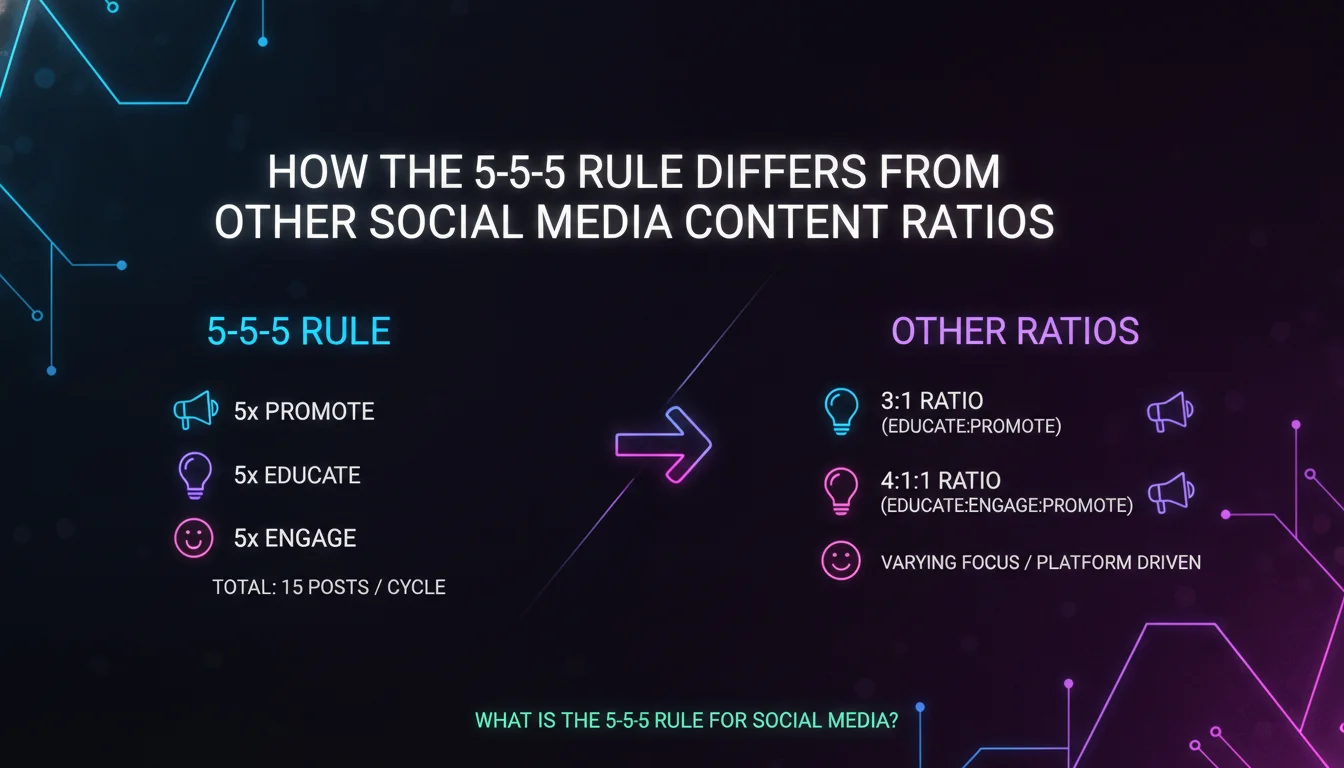
The 5-5-5 rule differs from other content ratios by focusing on countable, repeatable actions instead of fixed percentages. When you search what is the 5 rule social media, you’ll also run into a cluster of related frameworks: 5:3:2, 5-3-1, 70-20-10, and 60-30-10. All of them try to bring structure to your content mix, but the 5-5-5 rule stands apart because it’s built on actionable, countable behaviors rather than fuzzy percentages. Knowing the differences helps you pick the right system for your stage and style.
The 5:3:2 Rule: A Closer Look at Percentage-Based Curation
The 5:3:2 rule, popularized by marketers on platforms like LinkedIn, suggests that out of every 10 posts, five should be curated from other sources, three should be original, and two can be promotional. That’s essentially a 50/30/20 split. As Business.com frames it, this ensures you’re not over-selling while keeping your feed genuinely valuable. The rule is intuitive and works well for brands with a solid network of industry sources to pull from.
Unlike the 5-5-5 rule’s third pillar, engagement, the 5:3:2 rule focuses almost entirely on what you post, not how you interact with others. It’s a content distribution strategy, where the 5-5-5 rule is a fuller social strategy. Brands with strong content teams but weak community engagement often find the 5-5-5 rule’s daily interaction quota fills a gap that percentage rules simply miss.
The 5-3-1 Rule and Other “5” Variations
The 5-3-1 rule, as outlined by Inspired Vibe, recommends:
- Five posts to build trust (educational, behind-the-scenes).
- Three posts for engagement (polls, questions, contests).
- One promotional post.
This is a more granular cousin of the 5:3:2 rule, naming post purposes explicitly. It works particularly well on visually driven platforms like Instagram and TikTok, where engagement mechanics are baked into the experience, think Stories polls or Duets. The 5-5-5 rule can absorb this version easily: the “5 original” pillar can carry the trust and engagement posts, while the “5 reshare” pillar covers curated content.
The 70-20-10 and 60-30-10 Rules: Value-Heavy Alternatives
The 70-20-10 rule allocates 70% of content to value-add material (educate, entertain, inspire), 20% to sharing others’ content, and only 10% to direct promotion. According to Intertec Data Solutions, this model suits established brands with a loyal following, the kind of audience that already trusts you enough that overt sales pitches can stay rare. The 5-5-5 rule, by contrast, doesn’t prescribe a strict promotional cap. It trusts that mixing curated, original, and engagement activity will let promotion find its own modest place.
The 60-30-10 rule shifts the lens slightly: 60% thought leadership and industry insight, 30% sharing and commenting on others’ content, 10% promotion. It’s a solid fit for B2B consultancies and personal brands where credibility is the real currency. The thread connecting all these rules is that they aim to prevent the “digital billboard” effect, a problem the 5-5-5 rule solves by forcing activity beyond self-publishing.
Why the 5-5-5 Rule Works: Psychological and Algorithmic Advantages
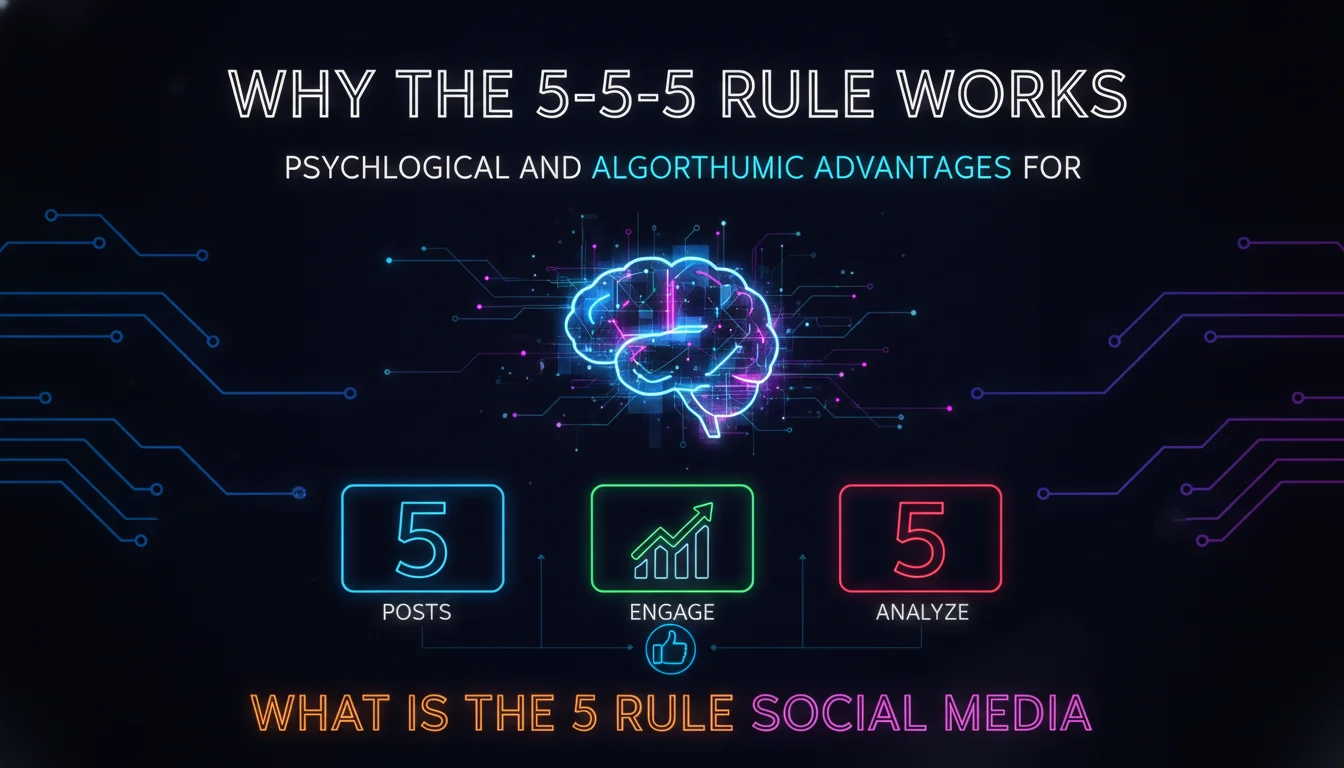
The 5-5-5 rule works because it aligns with both human psychology and platform algorithms at the same time. It’s not a magic fix, but a framework that builds habits sturdy enough to survive a busy quarter.
Overcoming Marketing Blindness Through Value Balance
Modern audiences have developed a sharp “marketing blindness”: they scroll past anything that reads like an ad. The 5-5-5 rule directly counters this by requiring that most of your social presence isn’t about you. When five of your weekly posts are curated from other voices, you signal that you’re a connector, not just a seller. When five daily engagements are genuine interactions, you become a familiar name in the community. As CNM Global Innovation puts it, “Audiences don’t follow brands to be sold to; they follow brands to learn, connect, and trust.”
Algorithm Rewards for Active Engagement
Social platform algorithms, from LinkedIn’s “meaningful interactions” signal to Instagram’s relationship-based ranking, favor accounts that actively engage with others. When you like, comment, and connect daily, you send a clear signal that you’re a real, invested user rather than a passive broadcaster. Platforms then tend to give your own posts a visibility boost because you’re read as a “good citizen.” The engagement pillar of the 5-5-5 rule creates this cycle on purpose, something purely percentage-based rules tend to overlook.
Building Trust and Familiarity Consistently
Brand research consistently shows that audiences need multiple exposures and interactions before they feel comfortable engaging with a brand. The consistency interpretation of the 5-5-5 rule, five weeks of steady posting, mirrors that reality directly. By the time you’ve held a quality five-post-per-week cadence for over a month, your audience starts to expect and look forward to your content. The five brand signals per post (tone, visuals, clarity, CTA, relevance) speed up recognition even further, building a cohesive brand experience across every touchpoint.
“In today’s digital ecosystem, social media success is no longer about posting frequently; it’s about posting strategically. Brands that win on social platforms understand one simple truth: attention is earned, not demanded. The 5-5-5 rule ensures brands show up with clarity, credibility, and consistency.”
A Step-by-Step Guide to Implementing the 5-5-5 Rule
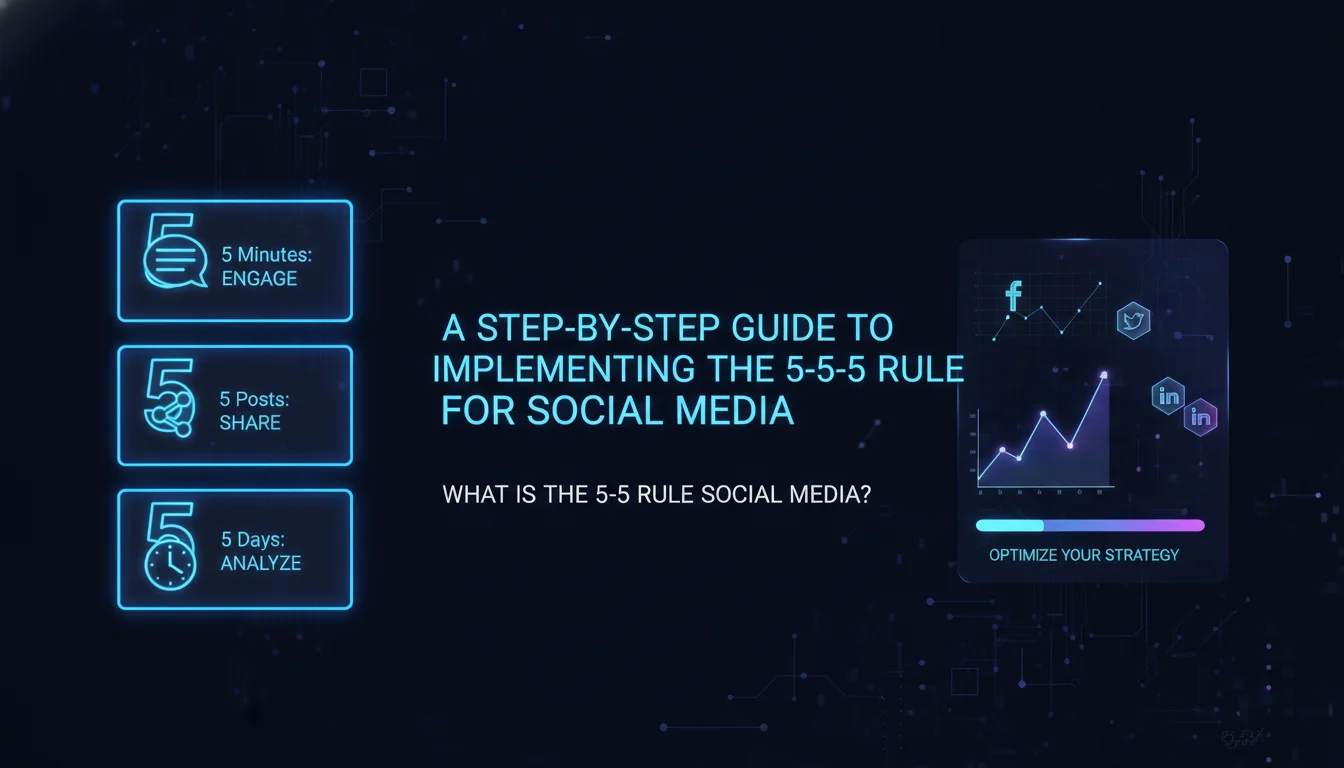
You implement the 5-5-5 rule by auditing your current mix, picking one interpretation to start with, scheduling the content half, and running the engagement half live every day. Here’s how to put it into practice without burning out.
Step 1: Audit Your Current Content and Engagement Mix
Before adopting any framework, take stock. Pull the last 30 days of social activity. Categorize each post as curated, original, or personal for the content version, or note your daily likes, comments, and new connections for the engagement version. Identify the gap: are you flooding your feed with sales messages and never resharing others? Posting constantly but never replying? This audit gives you a baseline and makes the shift feel tactical instead of theoretical.
Step 2: Plan Your Content Calendar with the 5-5-5 Structure
Choose your primary interpretation first. For the content version, draft a weekly template: Monday, Wednesday, Friday for original posts, Tuesday and Thursday for curated, Saturday and Sunday for personal or flexible spots. List trusted sources for curation, industry blogs, influencers, even customer accounts. For the engagement version, block short windows on your calendar for focused community interaction. Scheduling tools can handle the posting half, but the engagement half has to happen live.
Step 3: Schedule and Use Tools for Efficiency
Use a social media management tool to queue up content batches ahead of time. Most tools let you preview your feed visually, so you don’t accidentally stack three curated pieces in a row. Set reminders for your engagement sprint. Some tools even surface high-relevance accounts to interact with based on your niche, which speeds up the “connect with 5 new people” step considerably.
Step 4: Execute Daily Engagement Tasks
This is where most brands stumble. The engagement pillar of the 5-5-5 rule demands real interaction. When liking, actually look at the post first. When commenting, add insight or a question, not just “great post.” When connecting, personalize the invitation with a note. Quality beats speed here, and these small touches are what separate you from a bot. If you’re running the Twitter variant, add the five daily unfollows to keep your feed sharp.
Step 5: Measure and Adjust Based on Analytics
After five consistent weeks, per the consistency interpretation, review your analytics. Look at profile visits, follower growth, engagement rates, and click-throughs. If progress is slow, check your brand signals or shift the mix, maybe your audience wants more original how-to content and less curated industry news. The advantage of the 5-5-5 rule is that its simplicity makes A/B testing easy. You might start with the weekly content version, notice engagement is still flat, then layer in the daily habit on top.
Common Mistakes to Avoid When Applying the 5 Rule Social Media
The most common mistake with the 5 rule social media approach is treating engagement as a checkbox instead of a real interaction. Even a simple framework can be botched. Watch for these pitfalls.
Over-Reliance on Automation Without Human Touch
The word “rule” makes the 5-5-5 approach sound mechanical, but social media is inherently human. Auto-likers and comment bots do more harm than good, since algorithms detect inauthentic behavior and quietly suppress reach. The engagement part of the rule has to come from a real person who understands context. If you delegate it, train your team to treat each interaction as a small networking moment, not a task to clear off a list.
Neglecting Platform-Specific Nuances
Twitter’s fast-moving feed might tolerate five tweets a day, but LinkedIn’s professional audience usually prefers one strong post daily. Instagram rewards visual consistency over sheer post volume. TikTok’s algorithm cares more about watch time than comment counts. The 5-5-5 rule is a guideline, not a straitjacket. Adapt posting frequency and engagement tactics to each platform’s norms. On LinkedIn, for instance, you might post five times a week but do your real engagement through DMs rather than public comments.
Failing to Adapt the Ratio to Your Audience’s Preferences
Some audiences love a steady stream of curated industry updates; others want deep original tutorials. If your data shows personal posts getting ignored while original videos get shared heavily, shift your 5-5-5 balance, say, to 7 original, 3 curated, and 5 personal, or drop the personal pillar for a season. The rule is a starting hypothesis, not a permanent mandate. Check in with your community regularly or run polls to confirm your mix still resonates.
Expert Insights: What Marketers Say About the 5-5-5 Rule
This sentiment shows up across the industry, not just in one framework. Practitioners like Anne Duffy note that “the 5-5-5 rule helps you give before you ask, which is the heart of attraction marketing.” The underlying idea is that social media is a relationship system, and your daily habits shape your brand’s reputation more than any single viral post ever will. When the rule becomes part of your team’s routine instead of a one-off campaign, social selling gets embedded into company culture itself.
Here at Emin Media, we treat the 5-5-5 rule the same way we treat a brand identity system: as scaffolding, not scripture. If your visual identity and your posting habits both feel like an afterthought, no ratio is going to save you. Check out our thoughts on brand storytelling frameworks and our social media trends roundup for how we build the creative side of this equation.
5-5-5 Rule vs. 70-20-10: Which Framework Suits Your Brand?
The 5-5-5 rule suits brands that want actionable daily habits, while 70-20-10 suits established brands that already have a loyal audience. Here’s a side-by-side comparison of the four most discussed social media content rules, so you can see which aligns with your current resources and long-term vision.
| Rule | Content Distribution | Primary Focus | Best For |
|---|---|---|---|
| 5-5-5 (Weekly Content) | 5 curated, 5 original, 5 personal posts | Balanced feed that humanizes brand | Small businesses, solo marketers, brands wanting structure without complexity |
| 5-5-5 (Daily Engagement) | Like, comment, connect with 5 each daily | Community building and relationship signals | Any brand struggling with reach; service businesses |
| 70-20-10 | 70% value, 20% shared, 10% promotional | Thought leadership and audience goodwill | Established brands with loyal following; B2C audiences |
| 60-30-10 | 60% expertise, 30% shared, 10% promotional | Credibility and industry conversation | Consultants, B2B firms, personal brands |
You can layer the daily engagement 5-5-5 on top of any content ratio. You might run a 70-20-10 posting mix while also committing to five daily meaningful interactions, giving you the structure of one framework and the relationship-building of the other.
Pros and Cons of the 5-5-5 Rule
Pros
- Removes decision fatigue by giving you clear, countable daily or weekly targets instead of a blank content calendar.
- Builds genuine engagement habits that algorithms tend to reward, since platforms favor accounts that interact rather than just broadcast.
- Works across multiple platforms and can be layered on top of other content ratios like 70-20-10.
- Gives you a built-in diagnostic checkpoint: five weeks of consistency lets you evaluate what’s working before making major changes.
Cons
- The numeric quotas can feel arbitrary or rigid for teams with limited time or small audiences.
- Without genuine human input, the engagement pillar can slide into hollow, bot-like interactions that platforms penalize.
- Different sources define the rule differently, which can create confusion about which version to actually follow.
- It doesn’t account for platform-specific nuances on its own. You still have to adapt frequency and tone to each channel.
What’s Missing: The Broader Context You Should Know
Beyond the core 5-5-5 interpretations, a few adjacent ideas are worth knowing. Inspired Vibe also references a 60/40 guideline as another simple content-balancing approach, a reminder that most of these rules are variations on the same theme: mix value with promotion, and mix speaking with listening. As of 2026, the specific ratio matters less than the discipline of tracking it consistently. Whichever version of the 5-5-5 rule you choose, treat the numbers as training wheels, not a permanent constraint. Once the habit sticks, you’ll likely adjust the ratio based on what your own analytics tell you.
Frequently Asked Questions
What exactly is the 5 rule social media?
The 5 rule social media concept typically refers to the 5-5-5 framework, which can mean posting 5 curated, 5 original, and 5 personal pieces of content per week, or completing 5 daily engagement actions like likes, comments, and new connections. It’s a flexible system built to balance creation, curation, and conversation.
Is the 5-5-5 rule only for posting content?
No, it has three core interpretations. The content version focuses on weekly post mix, the engagement version is purely about interacting with other accounts, and the consistency version emphasizes sustained branding. Most people who succeed with it combine at least two of these interpretations.
Can I apply the 5-5-5 rule if I’m a solo entrepreneur with limited time?
Yes. Start with the low-time version: 5 thoughtful comments daily plus 5 curated posts per week using a scheduling tool. That alone shifts your presence from broadcast mode to community mode without demanding hours of content creation.
How does the 5-5-5 rule compare to the 5:3:2 rule?
The 5:3:2 rule guides the percentage of post types (curated, original, promotional), while the 5-5-5 rule typically sets a fixed numerical quota for engagement or community actions. The 5-5-5 rule tends to be more actionable for daily habits, while 5:3:2 works more as a content distribution philosophy.
What is the 5-3-1 rule for social media?
The 5-3-1 rule recommends five posts that build trust, three posts focused on engagement like polls or questions, and one promotional post. It’s a more specific cousin of the 5:3:2 rule and works especially well on visual platforms like Instagram and TikTok.
Will the 5-5-5 rule work on all social media platforms?
Yes, but it needs adapting. On Twitter, five daily tweets and five engagements feel normal; on LinkedIn, five posts per week is aggressive but doable if the quality holds up. Adjust frequency and engagement method to the platform’s culture, but the core idea of balancing inward and outward activity applies everywhere.
How long until I see results from the 5-5-5 rule?
Per the consistency interpretation, commit to at least five weeks of sustained effort before evaluating results. Growth metrics tend to compound, so early patience matters. Watch leading indicators like reply rates and profile clicks before expecting a jump in followers.
Ready to stop guessing at ratios and start building a social presence with real creative direction behind it? Contact Emin Media for a free brand consultation, and let’s build something bold together.
Enjoyed this article?
Contact Emin Media for a free brand consultation and let's create something amazing together.
Get in TouchRelated Articles
Social Media Campaign Strategy 2026 That Wins
Master social media campaign strategy 2026 with community-first frameworks, revenue attribution, AI tools, and serialized…

Digital Marketing Blog Topics That Actually Rank in 2026
Find digital marketing blog topics that win AI search and readers alike. Real frameworks, formats,…

Social Media Marketing Strategy Guide 2026
Build a winning social media marketing strategy in 2026. Learn 7 proven steps, key frameworks,…