Digital Marketing Blog Topics That Actually Rank in 2026

Key Takeaways
- Digital marketing blog topics should align with current trends like AI search, voice queries, and video content to attract traffic.
- A mix of how-to guides, listicles, case studies, and industry news creates a balanced content strategy that serves both readers and search engines.
- Using data from tools like Google Search Console and competitor blogs helps uncover high-performing topics your audience actively searches for.
- EEAT (Experience, Expertise, Authoritativeness, Trustworthiness) matters. Choose topics that let you show firsthand knowledge and real insight, not recycled advice.
- Don’t ignore niche angles like local SEO, platform-specific tactics, and sustainability marketing. They’re where a lot of the easy wins live.
Digital marketing blog topics are the subject ideas a brand publishes to attract organic traffic, build trust, and answer the exact questions its audience is typing into search engines. Picking the right ones is part creative instinct, part data science.
Your blog’s topic list directly determines whether it attracts curious readers, generates leads, or fades into digital wallpaper. The right blog topics work like a bridge between what your audience needs to know and how search engines (and now AI models) evaluate your expertise. Think of your editorial calendar as a mood board: every post should feel intentional, not random.
“The best digital marketing blogs don’t just list tips. They answer the questions your audience is typing into search engines right now.”
– Emin Media Content Strategy Team
Why Digital Marketing Blog Topics Matter in 2026

this type of topics matter in 2026 because AI-generated answers, zero-click searches, and shrinking attention spans have made topic selection a survival skill, not a nice-to-have. As the Digital Marketing Institute’s blog shows, AI search and shifting social media reach are reshaping how content gets discovered in the first place. Choosing this kind of blog topics that anticipate these shifts keeps your content visible in both traditional search engines and AI answer engines.
Blogs as the Hub of Your Marketing Strategy
A blog is still the foundation of inbound marketing, full stop. It’s where you prove expertise, capture long-tail organic traffic, and feed your social and email channels with fresh material worth sharing. According to marketing writer Shamsul Anam Emon, a blog “can serve as a hub for all your agency’s news, updates, and insights, and can also help boost your SEO efforts.” Publish consistently and you’re building a library of assets that keeps working long after the post goes live.
The Role of Search Intent in Topic Selection
Every topic needs a clear search intent behind it: informational, commercial, transactional, or navigational. Keyword research tools show you exactly what your audience types into Google before they ever land on your site. After Google folded AI search data into Search Console (Neil Patel’s blog reported this development in August 2026), marketers can now see which AI-generated overviews are surfacing their content. That visibility helps you refine topics to directly address what AI engines are prioritizing right now.
Top Digital Marketing Blog Topic Categories for 2026
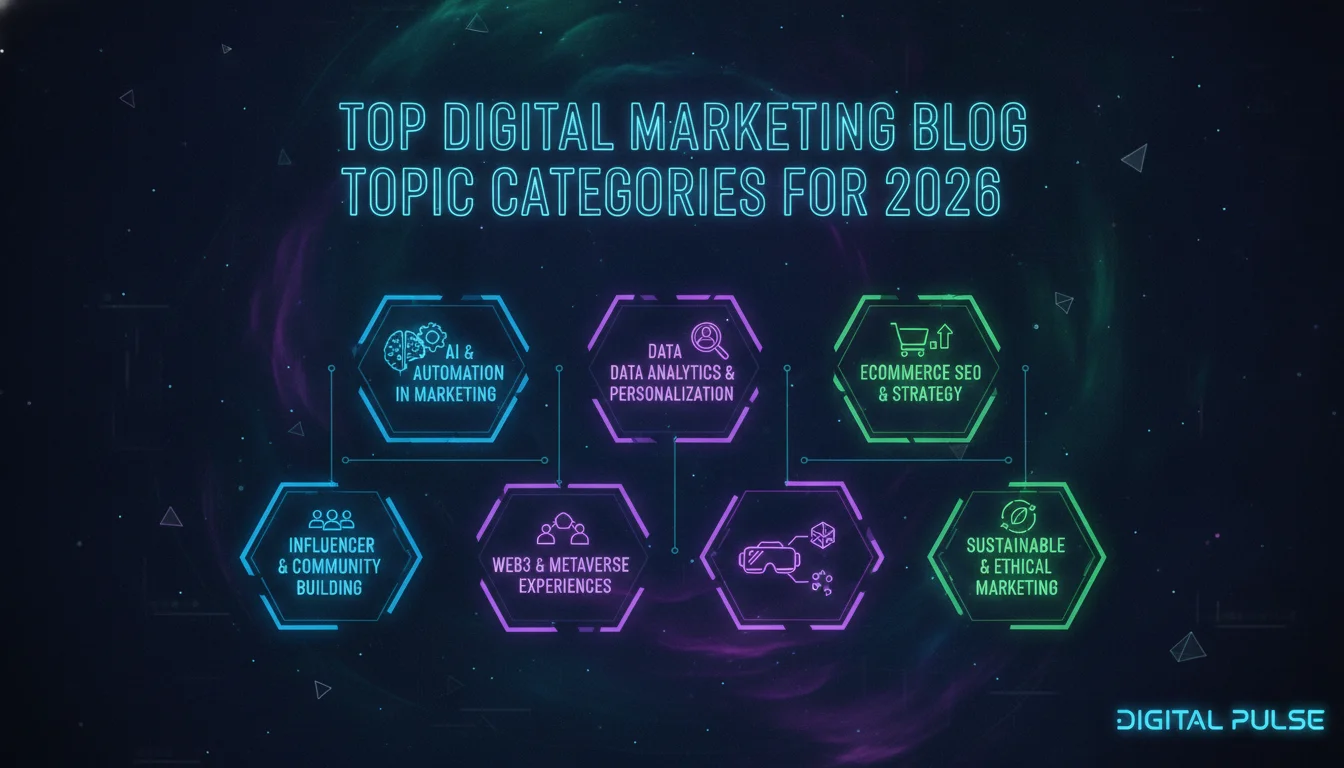
The strongest editorial calendars organize the marketing blog topics into a handful of core categories tied to the channels marketers actually use. Breadth without structure just creates noise. Here are the categories backed by real examples from leading publications.
SEO and AI-Powered Search
SEO now stretches well past keywords into AI Engine Optimization, or AEO. Posts explaining how AI search works, breaking down AI glossary terms, or unpacking Google’s Search Generative Experience are in serious demand. The Digital Marketing Institute has run pieces like “AI Search Glossary: Essential Terms for the AI-Driven Search Era” and “The Top Experts and Resources to Follow in AI Search.” Covering this category positions your brand as forward-thinking rather than reactive.
Content Marketing and Storytelling
Content pillars, customer journey mapping, and AI-assisted writing are some of the hottest subtopics going right now. DMI’s “What are Content Pillars and Why are They Important?” and “How to Map Your Content to the Customer Journey Using AI” are solid templates to study. These posts attract marketers hunting for actionable frameworks, not just inspiration.
Social Media Marketing and Community
TikTok now gives creators more control over keyword metadata, a shift Neil Patel’s blog covered in July 2026, which makes social media SEO one of the fastest-growing subtopics in the space. Social listening, influencer marketing, and community-as-infrastructure round out the angle. Posts like “How to Use Social Listening to Understand Your Audience” and “10 Steps to Navigate a Social Media Crisis” stay relevant year after year because the underlying problems never really go away.
Email Marketing and Automation
Email is old, but paired with AI it’s more useful than ever. Topics like “Transform Your Email Marketing with AI” and “Email Marketing Best Practices for Maximizing Open and Click Rates” remain practical and searchable. Accessibility in email design is an emerging niche worth claiming before your competitors do.
Data, Analytics, and Performance Tracking
Marketers want measurement, not vibes. Posts that demystify analytics, like “Demystifying Google Analytics: Key Metrics to Monitor,” or explore data visualization tools tend to resonate with readers who need to justify budget to a boss. These topics attract the professionals actually accountable for ROI.
How AI and Voice Search Are Shaping Blog Topic Selection

AI and voice search are shaping blog topic selection by forcing writers to answer questions in natural, conversational language instead of just chasing keywords. Traditional keyword-stuffing doesn’t cut it anymore. You have to think about how your content gets summarized in an AI snapshot and how it sounds when read aloud by a voice assistant.
Optimizing Topics for AI Overviews and Answer Engines
Answer engines like ChatGPT and Gemini tend to cite clear, definitional content, according to reporting from Neil Patel’s blog on how AI search data now surfaces inside Google Search Console. Writing posts that open with a direct answer in the first paragraph meaningfully increases your odds of getting featured. For topics, that means prioritizing informational queries like “What is a customer data platform?” and structuring the post to deliver a standalone answer before going deeper.
Voice Search and Conversational Queries
Voice search skews local and long-tail, which changes how you frame a headline. Topics like “The Impact of Voice Search on Local SEO Strategies” and “How to Optimize Your Website for Voice Search Queries” address this shift directly. Framing headlines as natural questions, like “How Do I Choose the Right Email Marketing Tool?”, makes your content more likely to get picked up in voice results.
Using AI Tools for Topic Research
Tools like AnswerThePublic and Ubersuggest, which now integrates directly with ChatGPT per Neil Patel’s blog, use AI to surface the real questions people are asking. Lean on these tools and you’ll generate a list of digital marketing grounded in actual curiosity, not just what a marketer assumes people want to know.
Content Formats That Work as Digital Marketing Blog Topics

Not every blog post format performs the same way, and the format you pick shapes both engagement and SEO outcomes. Below is a breakdown of the formats worth prioritizing, with real examples pulled from top marketing blogs.
| Content Format | Purpose | SEO Potential | Example Topic (2026) |
|---|---|---|---|
| How-To / Tutorial | Teach a specific skill or process | High, targets long-tail informational queries | “How to Use AI to Improve Your UX” (DMI) |
| Listicle / Resource Roundup | Curate tools, tips, or examples | Medium-High, easy to scan and share | “40 Blog Topics for Digital Marketing Agencies” (Medium) |
| Case Study | Showcase real-world results and build credibility | Medium, attracts bottom-funnel traffic | “How Small Businesses Can Compete by Building Trust” (DMI) |
| Industry News / Analysis | Report on recent developments | Low-Medium, time-sensitive but high authority signal | “AI Search Data Now in Google Search Console” (Neil Patel) |
| Tool Review / Comparison | Help readers choose marketing software | Medium, good for commercial intent | “The AI Marketing Tool Landscape in 2026” (DMI) |
Generate 30 High-Value Blog Topics in an Hour
Follow this process to build a list of blog topics tailored to your niche fast:
- Brainstorm categories. List the main pillars of your expertise (SEO, social ads, content marketing).
- Tap into AI tools. Use ChatGPT or AnswerThePublic to pull common questions for each pillar.
- Analyze competitors. Visit top agency blogs and note which topics get the most shares and comments.
- Check search volume. Use Ubersuggest or Google Keyword Planner to filter for topics with real search demand, even a modest amount.
- Prioritize based on intent. Confirm each topic clearly serves an informational, commercial, or transactional need.
Evaluating Topic Performance Over Time
Once a post goes live, track its performance in Google Search Console and watch for rising queries. As the Coursera roundup of marketing blogs points out, the best blogs continuously adapt to what readers actually engage with rather than sticking to an original plan. Refine your topic list based on real data, not just your first-draft assumptions.
Leveraging Data and Analytics to Find High-Performing Topics
A data-driven approach to finding this type of topics removes the guesswork by showing you exactly where the content gaps and opportunities already exist. Instead of staring at a blank doc wondering what to write, you let the data point the way.
Using Search Console and Keyword Tools
Check the “Queries” report in Google Search Console for keywords already sending traffic your way. Anything ranking on page 2 or 3 is an immediate opportunity for a dedicated post. Tools like Semrush or Ahrefs can also reveal which topics your competitors already rank for, giving you a head start on building something more thorough.
Analyzing Competitor Blog Strategies
Visit leading marketing blogs, HubSpot, Neil Patel, Search Engine Land, and catalogue their most popular posts. Pay attention to what they cover repeatedly. Neil Patel’s blog, for example, frequently addresses AI search data, AnswerThePublic usage, and TikTok metadata changes, which signals those subtopics have staying power.
Tapping into Industry Trends and Social Listening
Social platforms, Reddit threads, and industry webinars surface pain points in real time. A question pulled from a Reddit thread or LinkedIn poll can become a post that resonates because it came straight from the audience rather than a brainstorm session. Monitoring tools can surface recurring questions worth turning into full posts.
Don’t Skip These Niche Digital Marketing Blog Topics
The niche digital marketing blog topics most brands skip, like local SEO, international SEO, and platform-specific tactics, are often the easiest to rank for because competition is thinner. Local SEO content built around “near me” behavior and Google Business Profile optimization draws in service-area businesses that generic national content misses entirely. International SEO, covered in agency roundups like the one from writer Shamsul Anam Emon, opens the door to a completely different audience segment hunting for hreflang guidance and localization tactics.
Platform-specific tactics deserve their own lane too. Instagram engagement mechanics, Facebook ad creative testing, and even a deep dive into Reddit marketing (DMI has run a full guide on this) all pull in readers who’ve outgrown generic “social media tips” content. Sustainability and greenwashing in marketing is another underused angle. DMI’s coverage of what constitutes greenwashing shows there’s real reader appetite for brands willing to talk honestly about environmental claims.
The Role of Experience and Authority in Topic Selection
Experience and authority shape topic selection because Google’s EEAT guidelines reward content built on firsthand knowledge over generic advice. Choosing topics tied to your team’s actual work boosts both credibility and rankings.
EEAT and Your Blog Content
Write about challenges you’ve personally solved, campaigns you’ve run, or tools you’ve actually tested. A post about how you approached a specific ad copy testing process carries more weight than a generic explainer on A/B testing that could’ve been written by anyone. This approach naturally leads to digital marketing blog topics that are genuinely yours and hard for competitors to copy.
Showcasing Expertise Through Case Studies
Case studies remain one of the most trusted formats in the industry. As Dummies.com puts it, “the term case study carries more perceived value than the term article, blog post, or video.” Structure yours with a clear breakdown of strategy, execution, and results, and you’ve got a piece that attracts backlinks and conversions at the same time.
Case studies work because readers trust proof over promises. A well-documented result, even a modest one, beats a polished opinion piece every time it comes to earning trust with a skeptical audience.
Incorporating First-Hand Experience and Opinion
Don’t shy away from opinion pieces. Posts that predict industry shifts or push back on common practices, like “Is Performance Max Right for Your Campaign?”, position you as someone with a point of view worth following. These topics tend to spark discussion and get shared far more than neutral explainers.
Digital Marketing Blog Topics for Beginners vs. Advanced Marketers
Catering to multiple experience levels widens your reach without diluting your voice. Beginners need foundational knowledge; advanced readers want nuanced tactics and emerging trends.
Beginner-Friendly Topic Ideas
Beginners search for definitions and step-by-step guides above almost everything else. Examples include “What is PPC Marketing?”, “The Importance of Content Marketing in the Digital Age,” and “How to Create an Effective Social Media Content Calendar.” These topics attract new learners and build a broad subscriber base you can nurture over time.
Topics for Advancing Skills
For intermediate marketers, topics like “Agile Marketing Metrics That Matter,” “How to Measure the ROI of Influencer Marketing,” or “The Art and Science of A/B Testing” bridge the gap between basics and real strategy. They show deeper competence and keep experienced readers coming back for more.
Topics for Agency Owners and Strategists
Agency owners need content about growth, team management, and high-level strategy. Posts such as “Why the Line Between B2B and B2C Marketing Is Disappearing,” “Cybersecurity Risks of Using AI in Marketing,” and “How to Improve Marketing Performance with Cross-Functional Collaboration” speak directly to this audience. Getting this category right builds high-value relationships with potential clients before they ever fill out a contact form.
Future-Proofing Your Digital Marketing Blog Topics
Future-proofing your digital marketing blog topics means building an editorial calendar that anticipates AI-driven shifts instead of reacting to them after the fact. The pace of change isn’t slowing down as of 2026, so your strategy has to look forward.
Monitoring AI-Driven Changes
AI isn’t a passing trend. It’s embedded in platforms, analytics, and creative tools across the board. Covering topics like “AI Agents vs Automation,” “The AI Marketing Tool Landscape,” and “AI and Brand Risk” keeps your blog aligned with the conversations that matter most this year and beyond.
Adapting to Zero-Click Searches
With more answers appearing directly on the results page, your blog needs to offer something beyond the snippet. Choose topics that reward a deeper read: comprehensive guides, original analysis, and multimedia content that simply can’t be summarized in a paragraph.
Embracing Multimedia and Interactive Content
Blogs that weave in video, infographics, and interactive tools like quizzes or calculators tend to be more engaging and shareable. A topic like “How to Create Engaging Video Content” can include an embedded tutorial video, turning a single post into a richer resource. This multimedia layer improves dwell time and signals quality to search engines watching how people actually use the page.
Pros and Cons of Building a Content Strategy Around Trending Topics
Pros
- Trending digital marketing blog topics capture search demand while interest is at its peak, often before competitors catch up.
- They give you natural material for social promotion and newsletter features without extra creative lift.
- Covering fresh developments (like AI search updates) signals to readers and search engines that your brand stays current.
Cons
- Trend-driven posts can go stale fast, requiring regular updates to stay accurate and useful.
- Chasing every trend can crowd out evergreen content that generates traffic for years.
- Some trending topics have short search windows, meaning the SEO payoff is limited compared to timeless how-to content.
Your editorial calendar is a living asset, not a static document. By consistently choosing digital marketing blog topics that blend data with creative instinct, you build a blog that ranks and earns reader trust at the same time, which is the real competitive advantage. If your team needs help turning this framework into an actual content engine, explore our services or check out our thoughts on brand storytelling frameworks and social media trends for more direction.
Frequently Asked Questions
What is the best topic for a digital marketing blog?
The best topic combines strong search demand with your team’s actual expertise. Heading into 2026, AI-powered search, content pillar strategy, and social media SEO are especially strong areas because they address real shifts happening in the industry right now.
What is the 3-3-3 rule in marketing?
The 3-3-3 rule is a content planning framework: identify 3 core audience personas, brainstorm 3 content pillars for each, then map 3 blog post ideas per pillar. It’s a simple way to keep your editorial calendar balanced instead of lopsided toward one topic.
What are some good digital marketing blog topics for beginners?
Beginner-friendly topics include “What is PPC Marketing?”, “The Importance of Content Marketing in the Digital Age,” “How to Create an Effective Social Media Content Calendar,” and “Email Marketing Best Practices for Maximizing Open Rates.”
What are the 7 areas of digital marketing?
The seven core areas are SEO, content marketing, social media marketing, pay-per-click advertising, email marketing, data analytics, and mobile marketing. Each one can spin off dozens of specific blog post ideas on its own.
How do I find trending digital marketing blog topics?
Use tools like Google Trends, AnswerThePublic, and social listening platforms to spot emerging conversations early. It also helps to analyze competitor blogs and monitor industry news sites like Search Engine Land for real-time inspiration.
Ready to stop guessing at your content calendar? Contact Emin Media for a free brand consultation, and let’s build something bold together.
Enjoyed this article?
Contact Emin Media for a free brand consultation and let's create something amazing together.
Get in TouchRelated Articles

Creative Brand Photography: The Complete Guide
Creative brand photography is your visual voice. Learn how to plan shoots, find the right…

Digital Storytelling for Brands: The Complete Guide
Digital storytelling for brands builds real audience connections through narrative. Learn proven techniques, formats, and…

Creative Direction for Video Shoots: A Complete Guide
Master creative direction for video shoots with proven steps, tools, and strategies that build brand…