What Is a Brand Strategist? The Complete Guide
Key Takeaways
- A brand strategist defines and develops a brand’s identity and positioning in the market.
- They analyze market trends and consumer behavior to inform long-term brand strategies.
- Brand strategists work across industries and collaborate with marketing, HR, and leadership teams.
- Core skills include creativity, strategic communication, analytical thinking, and project management.
- Career paths lead to roles in consultancy, brand management, and creative direction.
- As of 2026, brand strategy is increasingly central to business decisions, not just marketing campaigns.
What is a brand strategist? A brand strategist is a professional who develops and implements strategies that shape a brand’s identity and positioning in the market. They analyze consumer behavior, competitive landscapes, and cultural signals to build brands that resonate deeply with target audiences.
Understanding the Role of a Brand Strategist
What is a brand strategist, really? The role goes far beyond designing logos or writing taglines. According to the D&AD, a good brand strategist translates complex ideas into clear communication that everyone involved in a project can act on, from creatives to clients. That translation work is the core of the job.
Brand strategists are not marketing planners. One practitioner with 25 years of experience notes that only roughly 5% of their work results in a campaign. The remaining work spans cultural change programs, product portfolio overhauls, customer experience redesigns, identity redesigns, and brand measurement tools. That scope surprises most people who assume branding lives inside the marketing department.
As Anna Lewis, a brand strategist with over 20 years of experience, puts it: your brand is every part of your business, and it’s how it’s felt by everyone who encounters it. Customers, yes, but also suppliers, partners, stakeholders, and your own people.
“A brand is a central organising principle that any organisation can use to create sustainable value.” – Rita Clifton, former Chairman of Interbrand
That framing changes everything. Brand strategy isn’t a marketing function. It’s an organizational one.
Responsibilities of a Brand Strategist
The responsibilities of a brand strategist are extensive and vary by organization, but the core duties remain consistent across industries:
- Market Research: Conducting thorough research to understand consumer preferences, industry trends, and competitive positioning.
- Brand Development: Creating and refining brand identity, including messaging, visual direction, and overall tone.
- Strategic Planning: Developing long-term brand strategies that align with business objectives and market opportunities.
- Brand Standards: Defining and communicating brand standards, then verifying compliance across all channels.
- Collaboration: Working closely with marketing, sales, HR, and product teams to ensure brand consistency across every touchpoint.
- Brand Measurement: Building tools and frameworks to track brand awareness, perception, and performance over time.
According to CSUN’s Tseng College, brand strategists analyze audiences, study market trends, and shape the messaging and visual direction that define how a brand shows up across platforms. Unlike professionals in general marketing roles, they focus on long-term positioning rather than campaign execution alone.
Skills Required for Brand Strategists
Successful brand strategists bring a rare combination of left-brain and right-brain thinking to every project. Here’s what the role demands:
- Analytical Skills: The ability to read data, spot patterns, and translate market trends into strategic decisions.
- Creative Thinking: A strong creative instinct to develop distinctive brand identities and campaigns that cut through noise.
- Strategic Communication: Excellent verbal and written skills to articulate brand strategy to executives, creatives, and clients alike.
- Project Management: The organizational discipline to manage multiple workstreams, stakeholders, and deadlines simultaneously.
- PR and Marketing Literacy: Understanding how brand strategy connects to public relations, media, and marketing execution.
- Data Analysis: Comfort with performance monitoring and analytics tools to measure brand health over time.
How Brand Strategy Actually Works: The Mechanics
Brand strategy works by establishing a central organizing principle for an organization, then systematically applying that principle across every decision the business makes. Think of it as the operating system running beneath every campaign, product launch, and customer interaction.
The 2025 Journal of Business Research describes brand strategy as “a comprehensive and forward-looking framework that guides firms’ decisions and behaviors.” That definition matters because it positions brand strategy as a business tool, not just a creative one.
Here’s how the mechanics break down in practice:
Step 1: Define the Core Principle
Every strong brand strategy starts with a single, defensible idea. What does this organization stand for? What problem does it solve that no one else solves in quite the same way? This isn’t a tagline exercise. It’s a deep diagnostic that involves leadership interviews, customer research, competitive analysis, and cultural mapping. The output is a brand platform: purpose, values, positioning, and personality.
Step 2: Translate the Principle into Communication Architecture
Once the core principle is defined, brand strategists build a messaging framework. This acts as a blueprint for all communication, featuring key messages, proof points, and audience-specific variations. According to the Hubbard School of Journalism at the University of Minnesota, this framework is used in everything from media relations and internal campaigns to content creation and leadership communication.
Step 3: Apply the Principle Across Touchpoints
Brand strategy only creates value when it’s applied consistently. That means the same organizing principle should shape the website, the sales deck, the job postings, the packaging, the social media voice, and the way the CEO speaks at a conference. Brand strategists work across departments to make this happen, which is why the role requires strong internal influence skills, not just creative talent.
Step 4: Measure and Refine
Brand strategy isn’t set-and-forget. Strategists track brand awareness, perception shifts, and audience sentiment over time. They use surveys, social listening tools, and sales performance data to assess whether the strategy is working and where it needs refinement.
“Strong brands start with strong strategy. Without it, a brand tends to take on a life of its own – and not in a good way.” – Anna Lewis, Brand Strategist, 20+ years experience
What Makes a Brand Strategist Different?
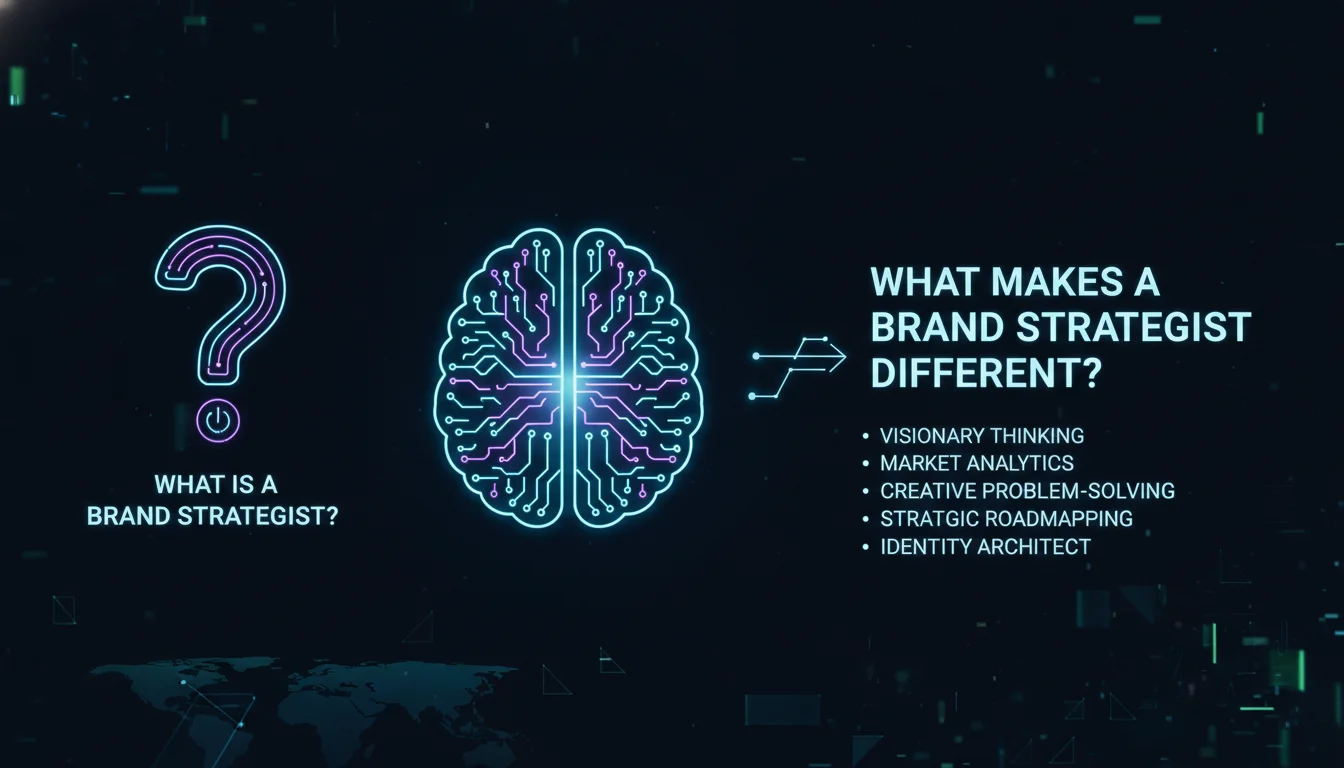
What is a brand strategist compared to other marketing and creative roles? The distinction is sharper than most people expect. Brand strategists shape the essence of a brand. Other roles execute against it.
Brand Strategist vs. Marketing Strategist
This is the comparison that confuses most hiring managers. Here’s the clearest way to think about it: brand strategists focus on driving consumer behavior by defining who the brand is. Marketing strategists focus on activating that behavior through campaigns and channels.
- Focus: Brand strategists concentrate on long-term identity and positioning. Marketing strategists focus on short-term campaigns and conversions.
- Scope: Brand strategists consider the full brand experience, including internal culture and stakeholder perception. Marketing strategists primarily focus on driving sales.
- Collaboration: Brand strategists work across departments including HR and leadership. Marketing strategists work more closely with sales and media teams.
Brand Strategist vs. Brand Manager
Brand managers and brand strategists are often listed as similar job titles, but the work differs in orientation. A brand manager tends to oversee day-to-day brand compliance and consistency. A brand strategist is more focused on developing the strategy itself, often working upstream before execution begins. Similar titles you’ll see in job listings include Product Line Manager, Product Strategy Manager, and Product Line Leader.
Brand Strategist in Various Industries
Brand strategists are employed across a wide range of industries, including:
- Technology: Helping tech companies define their unique value propositions in crowded markets.
- Retail: Crafting brand experiences that resonate with consumers both online and in-store.
- Healthcare: Developing trust and credibility through effective communication strategies.
- Nonprofits: Building strong brand identities that connect with donors, volunteers, and communities.
- Entertainment: Shaping cultural positioning for studios, platforms, and talent brands.
- Consumer Goods: Differentiating products in categories where functional differences are minimal.
Brand Strategist vs. Marketing Strategist: Comparison Table
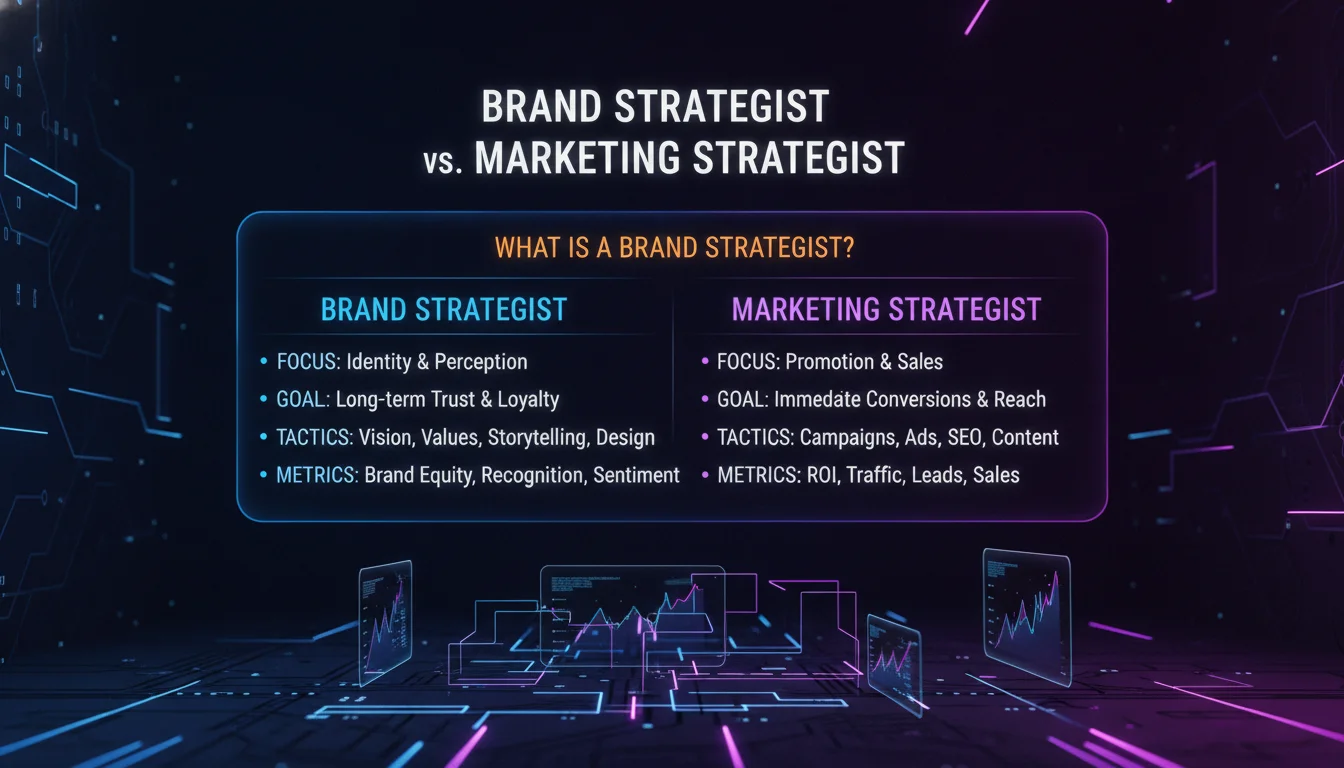
Use this table to quickly understand where the two roles overlap and where they diverge.
| Dimension | Brand Strategist | Marketing Strategist |
|---|---|---|
| Primary Focus | Long-term brand identity and positioning | Short-term campaign execution and conversions |
| Time Horizon | 3-10 years | Quarterly to annual |
| Key Output | Brand platform, messaging framework, identity system | Campaign plans, media buys, content calendars |
| Primary Stakeholders | Leadership, HR, product, marketing | Sales, media, content, paid acquisition |
| Success Metric | Brand awareness, perception, loyalty | Leads, conversions, ROAS |
| Typical Deliverable | Brand strategy document, brand guidelines | Campaign brief, performance report |
| Works Most With | Creative directors, executives, researchers | Copywriters, designers, media buyers |
How to Apply Brand Strategy: A Practical Framework
Applying brand strategy effectively requires moving from abstract principles to concrete actions. Here’s how brand strategists actually do the work, whether inside an agency or in-house.
1. Run a Brand Audit
Before building anything new, document what already exists. Collect all current brand materials: website copy, social profiles, sales decks, email templates, and customer reviews. Look for inconsistencies in tone, visual style, and messaging. This audit reveals the gap between how the brand intends to show up and how it actually does.
2. Conduct Audience and Competitor Research
Interview real customers. Run surveys. Analyze competitor positioning. Map out where competitors cluster in the market and where white space exists. The goal is to find a position that’s both true to the organization and differentiated in the market. This research phase is where most of the strategic insight comes from.
3. Build the Brand Platform
Synthesize your research into a brand platform document. This typically includes: brand purpose (the why), brand values (the ethical backbone), brand personality (the voice and tone), target audience profiles, and a positioning statement. This document becomes the reference point for every creative and communication decision that follows.
4. Develop the Messaging Framework
Translate the brand platform into a messaging architecture. Write the core brand message, then develop audience-specific variations. Create proof points that support each key message. This framework should be specific enough to guide a copywriter but flexible enough to work across channels.
5. Activate Across Channels
Work with designers, writers, and digital teams to apply the brand platform across every touchpoint. Website, social media, packaging, internal communications, and executive messaging should all reflect the same organizing principle. Consistency is what builds recognition over time.
6. Measure and Iterate
Set up brand health tracking from day one. Use a combination of quantitative metrics (awareness, share of voice, net promoter score) and qualitative feedback (customer interviews, social listening) to assess performance. Revisit the brand strategy annually and adjust based on market shifts and business evolution.
Common Mistakes in Brand Strategy (And What to Watch For)
Brand strategy fails more often from avoidable errors than from bad ideas. Here are the patterns we see most frequently, both in client work and across the industry.
Confusing Brand Identity with Brand Strategy
A logo refresh is not a brand strategy. Visual identity is one output of brand strategy, not the strategy itself. Organizations that invest heavily in design without first doing the strategic work end up with beautiful brands that say nothing distinctive. The strategy has to come first.
Skipping the Internal Audience
Brand strategy that only faces outward misses half the equation. As Anna Lewis notes, the most impactful brand work happens when leadership and HR are deeply invested, not just the marketing team. Your employees are your most powerful brand ambassadors. If they don’t understand or connect with the brand values, no external campaign will compensate.
Treating Brand Strategy as a One-Time Project
Brand strategy is a living framework, not a document you file away after launch. Markets shift. Audiences evolve. Competitors move. Organizations that treat their brand platform as fixed tend to find it feeling stale within a few years. Build in regular review cycles from the start.
Positioning Too Broadly
The temptation to appeal to everyone is one of the most common brand strategy mistakes. A brand that tries to mean everything to everyone ends up meaning nothing to anyone. The strongest brands are specific, even polarizing. They attract the right audience precisely because they’re willing to not appeal to the wrong one.
Measuring the Wrong Things
Brand strategy is often judged by short-term sales metrics, which is the wrong lens. Brand building operates on a longer time horizon than campaign performance. Measuring brand strategy success requires tracking awareness, perception, and loyalty over months and years, not just conversion rates from the last campaign.
Brand Strategy in Action: A Realistic Scenario
Here’s how what is a brand strategist looks in practice, through a realistic scenario we see regularly in our work at Emin Media.
A mid-sized technology company comes to us. They’ve been growing steadily, but their sales team keeps hearing the same objection: “We’re not sure how you’re different from your competitors.” Their website is technically accurate but emotionally flat. Their social media looks like three different companies. Their job postings don’t reflect the culture they’re trying to build.
This is a brand strategy problem, not a marketing problem.
We start with a brand audit and stakeholder interviews: founders, sales reps, customer success managers, and actual customers. What emerges is a consistent theme that no one has ever articulated clearly. The company’s real differentiator isn’t their technology. It’s the way they treat implementation as a partnership rather than a handoff. Every customer mentions it. No competitor claims it.
We build a brand platform around that insight. The positioning statement, messaging framework, and brand voice all flow from that single, specific truth. We work with the design team to update the visual identity to reflect it. We rewrite the website, the sales deck, and the onboarding materials. We brief the HR team on how to reflect the brand values in hiring and internal communications.
Six months later, the sales team reports that the “how are you different” objection has nearly disappeared. The brand is doing the work that the sales team used to do manually in every conversation.
That’s what a brand strategist actually delivers.
Pros and Cons of Hiring a Brand Strategist
Understanding the trade-offs helps you decide whether to hire in-house, work with an agency, or bring in a consultant.
Pros
- Long-term clarity: A defined brand platform gives every team a shared reference point for decisions, reducing internal confusion and misalignment.
- Competitive differentiation: Strong brand positioning helps you stand out in crowded markets where product features alone aren’t enough.
- Customer loyalty: Brands with clear, consistent identities build emotional connections that translate into repeat business and word-of-mouth referrals.
- Internal alignment: Brand strategy that includes employees creates stronger culture and more authentic external communication.
- Better marketing ROI: When brand strategy is clear, every marketing campaign performs better because the messaging is already sharp and consistent.
Cons
- Long time horizon: Brand strategy results aren’t immediate. Organizations expecting quick wins from brand work often get frustrated before the compounding effects kick in.
- Requires organizational buy-in: Brand strategy only works when leadership is invested. A strategy that lives in a PDF and never gets implemented is wasted effort.
- Hard to measure short-term: Traditional marketing metrics don’t capture brand health well. You need to invest in brand tracking tools and qualitative research.
- Can be expensive: Senior brand strategists and reputable agencies command significant fees. The investment is justified by long-term returns, but it requires upfront commitment.
How to Become a Brand Strategist
Becoming a brand strategist is one of the more accessible creative careers because there’s no single required credential. What matters is a combination of relevant experience, demonstrated thinking, and a strong portfolio.
Educational Requirements
While there’s no specific degree required, most brand strategists hold backgrounds in marketing, communications, journalism, or business administration. According to CSUN’s Tseng College, a master’s in design and innovation can be especially valuable for professionals pursuing advanced roles, as it deepens understanding of customer needs and strengthens strategic thinking capabilities. An MBA is also a common path for those moving into senior strategy roles.
Gaining Experience
Experience in marketing, advertising, or related fields is the most direct path in. Internships and entry-level positions at creative agencies or in-house marketing teams provide exposure to real brand challenges. The goal is to work on projects where you’re thinking about positioning and identity, not just executing tasks.
Building a Portfolio
A strong portfolio is the single most important asset for an aspiring brand strategist. Include case studies that show your thinking process, not just the final output. Document the research you conducted, the strategic insight you developed, and the measurable impact of the work. Employers want to see how you think, not just what you made.
Career Progression
Brand strategists typically progress from junior strategist or brand analyst roles into senior strategist positions, then into strategic consultant, client director, or digital marketing manager roles. Some move into brand management or creative direction. Others build independent consultancies. The career path is genuinely varied, which is part of what makes it compelling.
The Importance of Brand Strategy in Business
A well-defined brand strategy is essential for any business that wants to establish a durable market presence. This isn’t a nice-to-have. It’s the foundation everything else is built on.
Building Customer Loyalty
Effective brand strategies build customer loyalty by creating emotional connections between the brand and its audience. When customers feel aligned with a brand’s values and mission, they’re more likely to stay, refer others, and forgive the occasional misstep. That loyalty is a genuine competitive advantage that’s very hard for competitors to replicate.
Enhancing Market Position
A strong brand strategy helps businesses differentiate themselves from competitors, carving out a unique position in the market. That differentiation can lead to increased market share and stronger pricing power over time. Brands that are clearly positioned don’t have to compete on price alone.
Guiding Business Decisions
Brand strategies serve as a guiding framework for business decisions, ensuring that all actions align with the brand’s mission and values. This alignment produces more cohesive marketing efforts, stronger internal culture, and better overall performance. When a new product, partnership, or campaign is being evaluated, the brand platform provides the filter.
Measuring Brand Strategy Success
Measuring brand strategy success requires a different toolkit than measuring campaign performance. The metrics operate on a longer time horizon and capture perception, not just behavior.
Brand Awareness Metrics
Tracking brand awareness involves measuring reach, impressions, and engagement across channels. Surveys and social media analytics provide insight into how well the brand is recognized in its target market. Share of voice, the percentage of industry conversation your brand owns relative to competitors, is a particularly useful indicator.
Customer Feedback
Gathering customer feedback through surveys, interviews, and reviews helps assess brand perception and identify gaps between intended positioning and actual perception. This qualitative data is often more revealing than quantitative metrics alone. It tells you not just whether people know your brand, but how they feel about it.
Sales Performance
Ultimately, brand strategy should influence sales performance over time. An increase in inbound leads, improved close rates, and stronger customer retention can all indicate that the brand strategy is resonating. The key is tracking these metrics over a long enough period to separate brand effects from campaign effects.
Brand Strategy in 2026: What’s Changing
As of 2026, the role of what is a brand strategist is evolving faster than at any point in the past decade. Several forces are reshaping the discipline.
AI-generated content has flooded every channel with generic messaging. The result is that authentic, specific, and human brand voices are becoming more valuable, not less. Brands that invested in clear positioning before the AI content wave are now reaping the benefits of standing out in a sea of sameness.
Brand strategy is also moving closer to the C-suite. This year, more organizations are treating brand as a business strategy function rather than a marketing function. That shift means brand strategists are increasingly involved in product development, hiring strategy, and investor communications, not just campaign briefs.
Social media platforms continue to fragment audiences, making consistent brand identity more important as a unifying force. When your audience encounters your brand across a dozen different platforms and contexts, the brand platform is what holds the experience together.
For creative agencies and in-house teams alike, the demand for skilled brand strategists continues to grow. If you’re considering this career path or looking to hire for this role, the timing is strong.
At Emin Media, we work with brand owners, founders, and marketing leaders to build brand strategies that are specific, defensible, and built to last. If you’re ready to define what your brand actually stands for, contact Emin Media for a free brand consultation. Let’s build something bold.
You can also explore our thinking on brand strategy and creative direction on the Emin Media blog, or learn more about our branding and digital marketing services.
Frequently Asked Questions
What is a brand strategist?
A brand strategist is a professional who develops and implements strategies to shape a brand’s identity and positioning in the market. They work across research, strategic planning, messaging, and cross-functional collaboration to ensure a brand is clear, consistent, and differentiated from competitors.
What does a brand strategist actually do day to day?
Day to day, a brand strategist might be conducting stakeholder interviews, analyzing competitor positioning, writing a messaging framework, presenting a brand platform to leadership, or working with a design team to ensure visual identity reflects the brand strategy. The work is rarely the same two days in a row, which is part of what makes the role compelling.
How much do brand strategists get paid?
Brand strategist salaries vary based on experience, industry, and location. Entry-level roles in Europe often start in the range of 30,000 to 35,000 euros gross per year, according to ISC Paris career data. Senior strategists and consultants in larger markets typically earn significantly more. Independent brand strategy consultants set their own rates based on project scope.
Is a brand strategist a good job?
Brand strategy is a genuinely rewarding career for people who enjoy combining creative thinking with analytical rigor. The work is varied, the impact is tangible, and the career path offers real progression into senior leadership and consultancy. It’s also one of the more accessible creative careers because there’s no single required credential.
What industries employ brand strategists?
Brand strategists work across technology, retail, healthcare, nonprofits, entertainment, consumer goods, and advertising agencies. Some work in-house on a single brand, while others join creative agencies where they work across multiple clients and industries simultaneously.
What is the difference between a brand strategist and a marketing strategist?
Brand strategists focus on long-term brand identity and positioning, defining who the brand is and what it stands for. Marketing strategists focus on activating that identity through campaigns, media, and conversion-focused tactics. The brand strategist sets the foundation. The marketing strategist builds on it.
Enjoyed this article?
Contact Emin Media for a free brand consultation and let's create something amazing together.
Get in TouchRelated Articles
Digital Storytelling for Brands: The Complete Guide
Digital storytelling for brands builds real audience connections through narrative. Learn proven techniques, formats, and…
Design Thinking for Marketing: A 2026 Guide
Design thinking for marketing builds campaigns around real user needs. Learn the 5 phases, common…

Creative Direction for Video Shoots: A Complete Guide
Master creative direction for video shoots with proven steps, tools, and strategies that build brand…