Visual Storytelling in Marketing: Strategy & Examples
- Visual storytelling in marketing is the strategic use of images, video, graphics, and design to communicate a brand narrative and drive action.
- The human brain processes visual information far faster than text and retains it significantly longer, making visuals your most powerful communication tool.
- Effective visual storytelling rests on four pillars: color, composition, context, and consistency.
- Different formats, from infographics to short-form video, serve different funnel stages and audience behaviors.
- Measurement should connect visual assets to engagement, recall, and conversion metrics, not just views.
Visual Storytelling in Marketing: Strategy, Types, Examples
Visual storytelling in marketing is the strategic use of images, video, graphics, and design to communicate a brand narrative, evoke emotion, and drive customer action. It is not decoration. It is the primary mechanism through which modern audiences process and remember brand messages.
Key Takeaways
- Visual storytelling is a memory-formation strategy, not just an aesthetic choice. Emotion-driven visuals create lasting brand impressions.
- The four Cs, color, composition, context, and consistency, are the structural backbone of every effective visual narrative.
- Short-form video, infographics, brand photography, and animation each serve distinct roles across the customer journey.
- Measurement must go beyond views. Track attention, emotion, and action metrics to connect visuals to real business outcomes.
- A repeatable six-step strategy, from brand story definition to iterative testing, separates brands that grow from brands that post and pray.
What Is Visual Storytelling in Marketing?
Defining Visual Storytelling
Visual storytelling is the process of conveying a narrative or message using visual media. Unlike standalone images or decorative graphics, it involves a coherent sequence of visual elements, images, video, icons, typography, animation, designed to communicate a story arc, evoke emotion, and guide the audience toward a specific understanding or action. Foundation Inc. describes it as much more than just whipping up images with brand colors. It is about creating a coherent, engaging narrative across every channel.
In a marketing context, in marketing is the strategic deployment of these visual narratives to achieve business goals such as brand awareness, lead generation, customer retention, and conversion. It is the difference between a product photo that shows a feature and a short video that shows a customer overcoming a problem with that product. The former informs. The latter connects.
The Marketing-Specific Application
In marketing, visual storytelling becomes an indispensable tool for standing out in saturated feeds. The goal is not simply to capture attention but to hold it long enough for a message to sink in. Brands use this type of marketing to simplify complex ideas, humanize their operations, and differentiate their value proposition. An infographic can compress a 15-page white paper into a 30-second visual read. A behind-the-scenes photo series can make a B2B software company feel genuinely human.
From Ancient Rock Carvings to Digital Feeds
Visual storytelling is not a digital invention. IED notes that narration through images preceded other forms of communication: ancient rock carvings and Egyptian hieroglyphics combined evocative imagery with narrative structure long before written language. The mechanisms that made those stories memorable, sequence, symbolism, emotion, still operate on Instagram, TikTok, and YouTube. The difference today is speed and scale. Modern this kind of in marketing must work within milliseconds and across multiple platforms simultaneously.
Why Visual Storytelling Works: The Neuroscience and Retention Evidence
Neurological Processing Speed
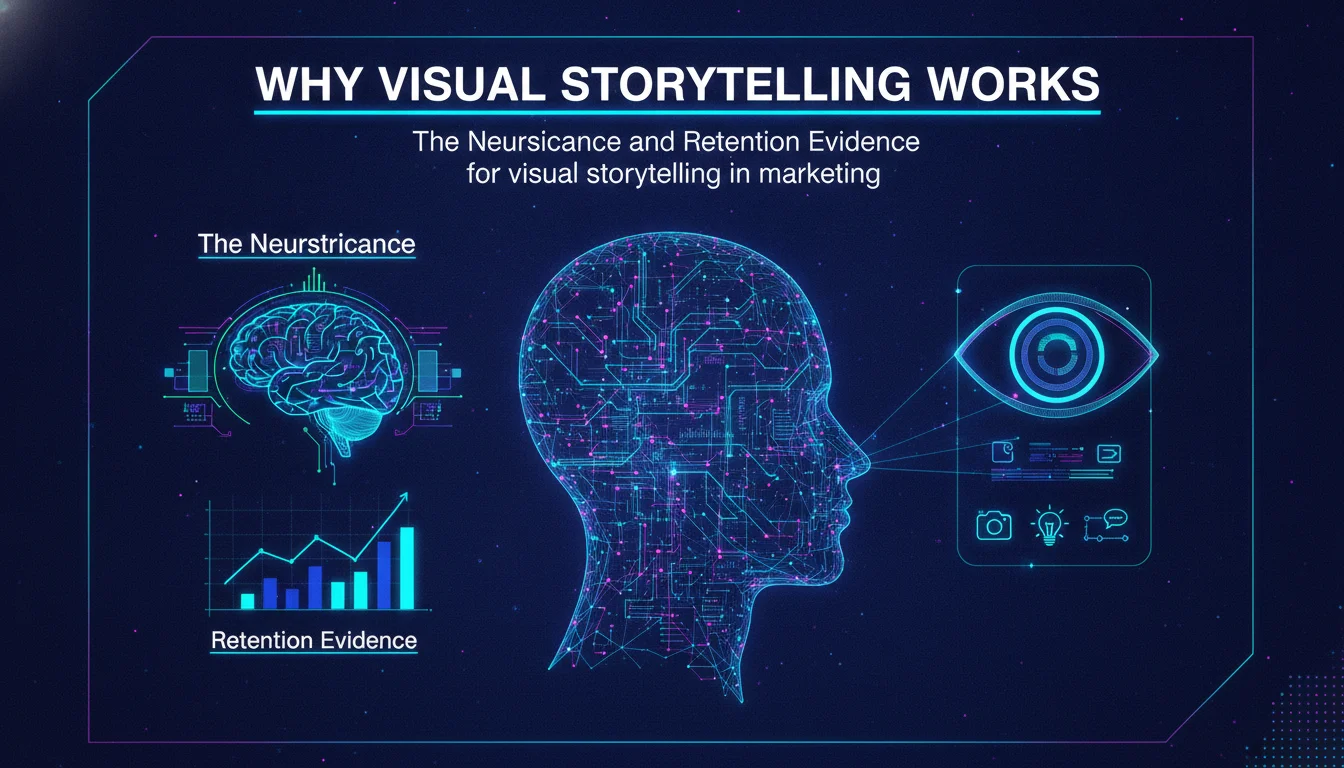
The human brain is wired for visual impact. Entrepreneurs’ Organization reports that roughly half of the human brain is involved in visual processing, and MIT neuroscientists found that the brain can identify images seen for as little as 13 milliseconds. By comparison, reading comprehension runs between four and eight words per second. This asymmetry matters enormously for marketers. A well-designed visual can communicate a message before a single sentence is fully read. If you cannot say it visually, you are already losing attention.
Emotional Encoding and Memory
Visual information activates the brain’s amygdala and hippocampus, the regions associated with emotion and memory. When a viewer processes a brand story through images or video, those regions light up and create a lasting impression. This neurological response is why the storytelling in marketing is more than an aesthetic choice. It is a memory-formation strategy. A customer who feels an emotional response to a brand’s visual narrative is far more likely to recall that brand when a purchase decision arises.
“People are increasingly more interested in the person behind the company than the corporate brand. People are becoming less trusting of corporate brand messaging; interest in the stories and lives of the entrepreneurs behind the brand is on the rise.” – Marina Byezhanova, EO Canada Bridge
The Retention Gap
Retention data reinforces the neurological case. According to Foundation Inc., viewers retain about 95% of a message when they watch it visually, compared to 10% when reading it in text. IED adds that after three days, people remember 10% of text-only information, but if that text is combined with an image, recall rises to 65%. These figures explain why content with relevant images gets 94% more views than content without, as reported by Forbes Technology Council. marketing is not just a creative tactic. It is a retention multiplier.
Pros and Cons of Visual Storytelling in Marketing
Pros
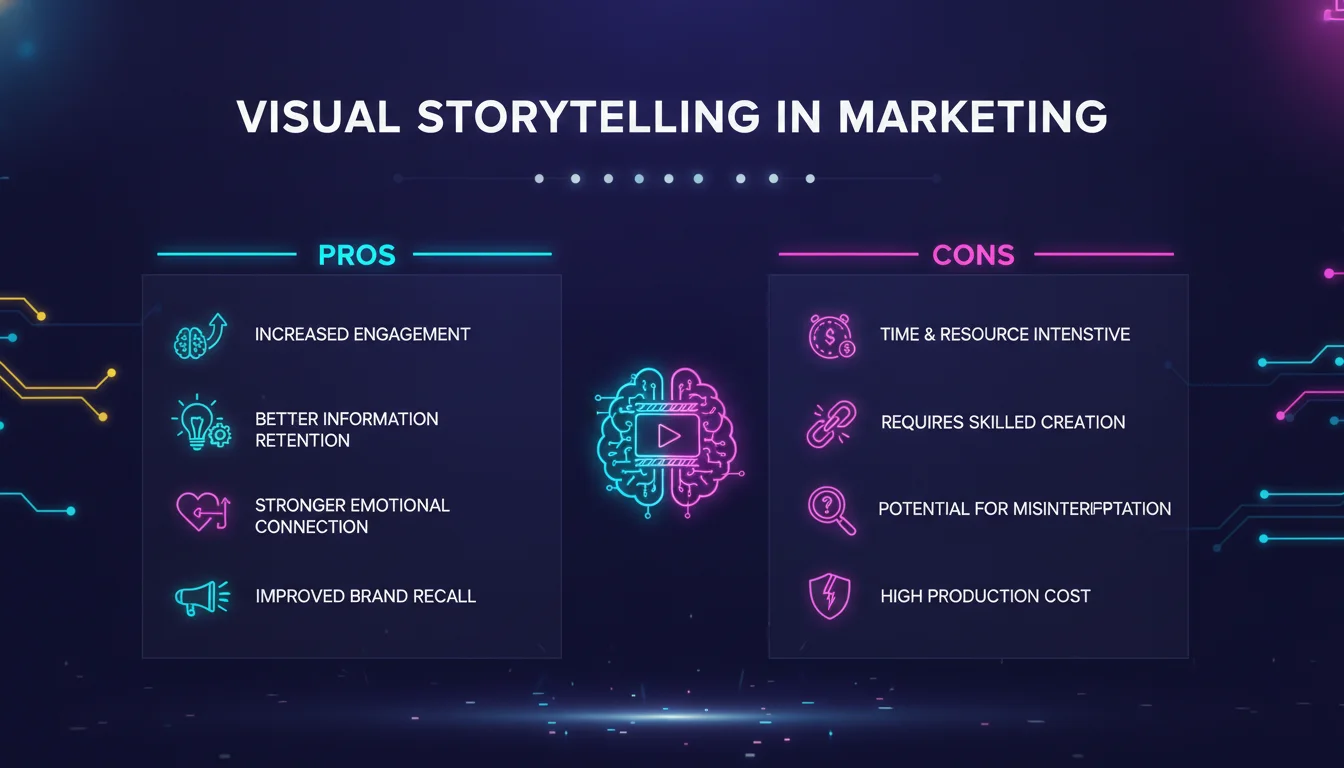
- Dramatically higher retention: Visual messages are retained at a far greater rate than text-only content, giving your brand a lasting presence in the audience’s memory.
- Faster communication: Visuals bypass the slow processing of written language. Your story lands before a caption is fully read.
- Stronger emotional connection: Imagery activates the brain’s emotion and memory centers, building the kind of brand affinity that drives loyalty, not just clicks.
- Platform algorithm advantage: Social platforms consistently favor visual content in their distribution logic, giving visual-first brands organic reach advantages.
- Scalable across formats: One core brand story can be adapted into infographics, video, photography, and animation for every channel and funnel stage.
Cons
- Higher production investment: Quality visual content requires skilled designers, videographers, or animators. The bar for “good enough” keeps rising as audiences grow more visually literate.
- Consistency is hard to maintain at scale: As content volume grows, keeping color, composition, and brand voice aligned across teams and platforms becomes a real operational challenge.
- Measurement is more complex: Attributing business outcomes to specific visual assets requires proper tagging, A/B testing infrastructure, and patience. Vanity metrics are easy to collect but misleading.
- Accessibility gaps: Visual-first content can exclude audiences with visual impairments if alt text, captions, and audio descriptions are not built into the production workflow.
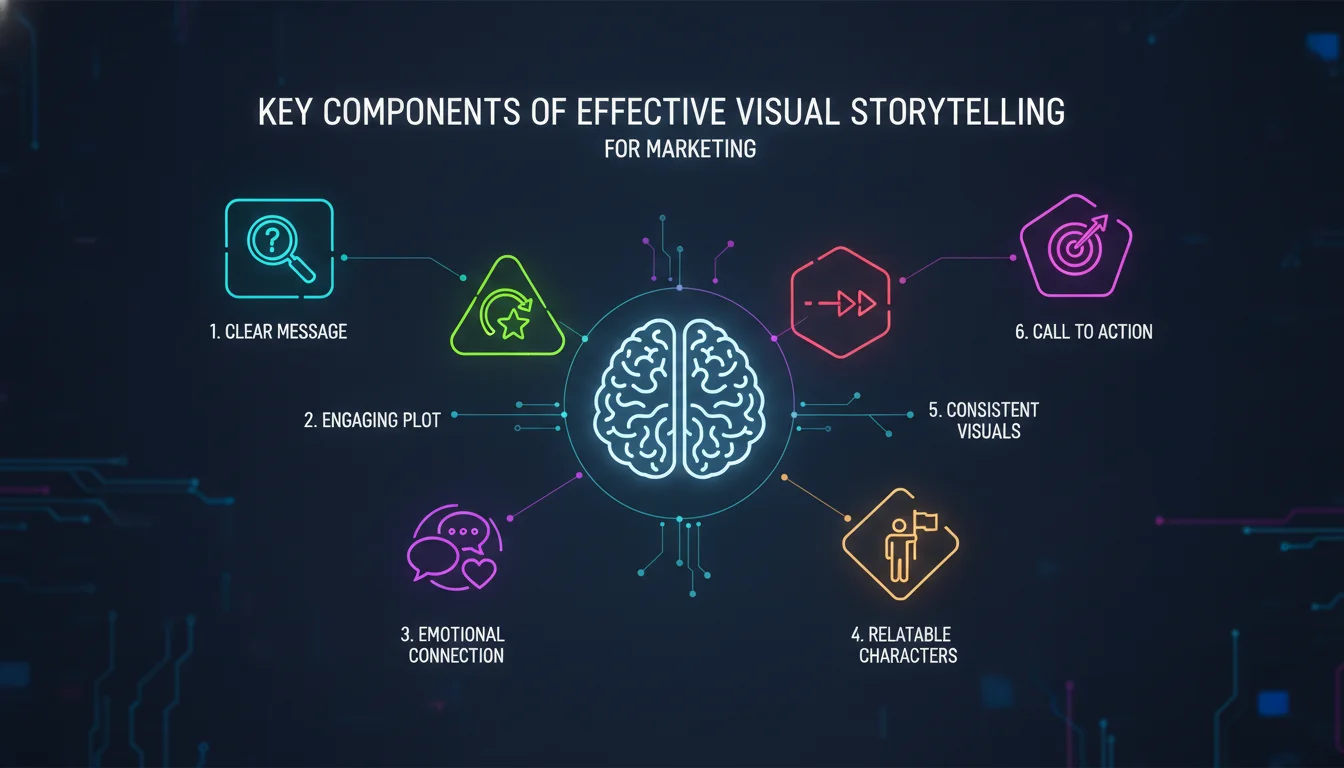
Key Components of Effective Visual Storytelling
Color: The Emotional Foundation
Color is a fundamental element in visual storytelling. Different hues produce distinct psychological effects: warm colors like red and orange create feelings of excitement and passion, while cool colors like blue and green evoke calm and trust. In visual storytelling, a consistent color palette aligns with brand personality and reinforces recognition across every asset. Foundation Inc. advises using contrasting colors to highlight key messages and calls to action, ensuring that visual emphasis matches narrative importance.
Composition: Guiding the Eye
Composition determines what a viewer sees first, second, and last. Effective visual composition uses principles such as the rule of thirds, leading lines, and focal points to direct attention toward the most important element of a story. In a product explainer video, the subject’s face or the product’s key feature should occupy the visual center of gravity. Without intentional composition, even the most beautiful images fail to convey a clear narrative.
Context and Consistency: The Glue of the Story
Context places a visual within a meaningful frame. A customer testimonial photo on a landing page means something different than the same photo on a corporate careers page. Consistency ensures that every image, icon, font, and transition reinforces the same brand identity. The four Cs, color, composition, context, and consistency, work together. A brand that changes its visual style from one platform to the next fractures its narrative and weakens recall. in marketing is strongest when all four components are deliberately aligned.
Types of Visual Storytelling in Marketing
Infographics and Data Visualization
Infographics are visual representations of information designed to make complex ideas digestible. They transform dense statistics, timelines, and process flows into scannable narratives. Infographics are a core type of this type of marketing because they reduce cognitive load and improve comprehension. In B2B marketing, infographics often serve as lead magnets. In B2C, they drive social shares. Data visualization, a related discipline, focuses on turning quantitative evidence into charts, graphs, and heatmaps that support a story.
Short-Form Video and Animation
Short-form video has become the dominant visual storytelling format on platforms like TikTok, Instagram Reels, and YouTube Shorts. Its strength lies in combining motion, sound, and narrative in under 60 seconds. Short-form video is often the highest-impact vehicle for this kind of in marketing because it shows rather than tells. Animation extends this further by visualizing abstract concepts, such as how software works or how a supply chain moves, that live-action footage cannot easily capture.
Brand Photography and User-Generated Content
Brand photography humanizes a company by showcasing real people, real workspaces, and real customer moments. User-generated content (UGC) adds authenticity by letting customers tell their own visual stories with a product. This type of the storytelling in marketing builds trust because it feels less polished but more genuine. A customer photo of a fitness tracker on a run carries more social proof than a studio product shot. As Marina Byezhanova noted, audiences are increasingly drawn to the person behind the brand, not the brand’s official voice.
Film-Inspired Visual Narratives
Some of the most memorable brand visuals borrow directly from cinematic storytelling. Think of the opening two minutes of Pixar’s Wall-E: no dialogue, pure visual narrative, and an emotional punch that lands instantly. Brafton highlights this kind of visual storytelling as a model for marketers. Brands that structure their video content around a clear emotional arc, setup, tension, resolution, consistently outperform those that lead with product features. GIFs and short looping clips apply the same principle in micro-format, capturing a single emotional beat in two seconds or less.
Comparing Visual Storytelling Formats
| Format | Primary Use | Emotional/Engagement Strength | Typical Channels |
|---|---|---|---|
| Infographics | Simplify complex data | High comprehension and shareability | Blog, LinkedIn, Pinterest |
| Short-form video | Capture attention fast | High emotional connection | TikTok, Instagram Reels, YouTube Shorts |
| Brand photography | Humanize and build trust | Relatability and authenticity | Website, social media, email |
| Animation | Explain abstract concepts | Memorability and clarity | YouTube ads, landing pages |
| Data visualization | Present evidence | Credibility and authority | Reports, white papers, webinars |
| UGC | Build social proof | Authenticity and trust | Instagram, TikTok, product pages |
How to Build a Visual Storytelling Strategy Step by Step
A Process, Not a One-Off Asset
A visual storytelling strategy is a repeatable system for planning, producing, distributing, and measuring visual narratives. It begins with brand clarity and ends with iterative improvement. The following steps synthesize best practices from brand builders and content strategists who have done this across industries and budgets.
Step 1: Define Your Brand Story
Identify the core narrative you want to tell: origin, mission, customer problem, or transformation. This story must be true, consistent, and relevant to your audience. IED emphasizes that knowing your brand’s values and the message you want to convey is the prerequisite for any effective visual strategy. Without this clarity, every visual asset you produce will feel disconnected.
Step 2: Map the Story to Customer Journey Stages
Determine which visual stories serve awareness, consideration, decision, and advocacy. An introductory brand video suits awareness. A detailed case-study infographic fits the decision stage. Mapping ensures you are not producing content randomly but building a visual narrative that moves people through the funnel with intention.
Step 3: Choose Visual Formats by Channel Behavior
Match each story beat to the format that performs best on the intended platform. Short vertical video works on TikTok. Long-form infographics work on LinkedIn. Cinematic brand films work on YouTube. The same core story should be adapted, not simply resized, for each platform’s audience expectations.
Step 4: Apply the Four Cs
Develop a visual identity guide covering color, composition, context, and consistency. Every asset, from social posts to product pages, should follow this guide. This is not a creative constraint. It is the system that makes your brand recognizable at a glance, which is the whole point of marketing.
Step 5: Produce and Test in Small Batches
Create three to five variations of a key visual story and test them against a small audience segment before scaling. Pay attention to engagement signals, not just views. Which version stops the scroll? Which drives a click? Which generates a comment that reveals emotional resonance? Those signals are your creative brief for the next round.
Step 6: Measure, Learn, and Iterate
Track the right metrics, identify which visual narratives drive action, and feed those insights back into your next content sprint. This loop, baseline, test, analyze, iterate, is what separates brands that grow their visual storytelling capability over time from those that produce content and hope for the best.
Choosing the Right Visual Channels and Formats
Matching Format to Platform Behavior
Not all visual stories belong on every platform. Instagram and TikTok reward vertical, fast-paced, emotionally immediate visuals. LinkedIn rewards professional, informative visuals like infographics and short interview clips. YouTube rewards longer-form narratives that hold attention for minutes at a time. Effective visual storytelling in marketing is channel-aware: the same core story should be adapted for each platform’s audience expectations, not copy-pasted across all of them.
Owned, Earned, and Paid Visuals
Owned visuals include website images, email graphics, and product demo videos. Earned visuals include customer-generated content, press features, and influencer posts. Paid visuals include social ads, native advertising, and sponsored videos. A balanced visual storytelling strategy uses all three. Owned assets establish control. Earned assets provide social proof. Paid assets accelerate reach when the organic story is already working.
The Role of DAM and Asset Management
As visual volume grows, brands need systems to organize, store, and retrieve assets efficiently. According to PhotoShelter research cited by Forbes Technology Council, 85% of marketers say the demand for fast content has increased, especially visual content like images and videos. A digital asset management (DAM) system helps teams avoid duplicate work and maintain version control, which directly supports consistency, one of the four Cs.
“The demand for visually engaging material has never been higher. Swiftly creating and deploying visual content isn’t just a trend but a necessity to stand out in a saturated market.” – Andrew Fingerman, CEO of PhotoShelter, via Forbes Technology Council
Measuring the Impact of Visual Storytelling in Marketing
Moving Beyond Vanity Metrics
Views and likes are easy to count but weak indicators of business value. A more useful measurement framework connects visual assets to three outcomes: attention, emotion, and action. Attention metrics include view-through rate, average watch time, and scroll-stopping rate. Emotion metrics include sentiment analysis, comment quality, and brand-lift surveys. Action metrics include click-through rate, conversion rate, and revenue attributed to specific visual campaigns.
A Simple Measurement Loop
To measure visual storytelling in marketing effectively, follow this loop: set a baseline for each metric, tag every visual asset with UTM parameters and tracking pixels, run controlled A/B tests comparing visual variants, and review results every two weeks. When a particular visual narrative outperforms, analyze which component, color, composition, context, or consistency, drove the lift. Apply that learning to the next batch. This is how creative intuition becomes a repeatable competitive advantage.
Qualitative Signals Matter
Not all impact is numeric. Customer comments, direct messages, and unsolicited shares often reveal emotional resonance that numeric metrics miss. Brafton notes that visual storytelling has exceptional potential to generate traffic and convert leads at every stage of the sales funnel. Combining quantitative data with qualitative listening creates a complete picture of how visual stories actually move audiences, and that picture is what informs your next creative decision.
Visual Storytelling in Advertising: What the Research Shows
Academic research on visual storytelling as an advertising approach consistently points to the same conclusion: emotional narrative structure outperforms rational feature presentation. When ads are built around a visual story arc, setup, conflict, resolution, audiences engage longer and recall the brand more accurately. This is not a new insight. It is the same principle that made Egyptian hieroglyphics effective thousands of years ago, now validated by neuroscience and campaign performance data across digital channels.
As of 2026, the most effective brand campaigns we see across Cannes Lions shortlists and AdAge case studies share a common thread: they prioritize visual narrative over product specification. The brands that win awards and market share are the ones that make audiences feel something before they explain anything.
Why Visual Storytelling in Marketing Is Non-Negotiable
The Strategic Imperative
As consumer attention spans shorten and social feeds become more visually dominated, brands cannot afford to rely on text alone. Visual storytelling in marketing is no longer a differentiator. It is table stakes for any brand that wants to be seen, remembered, and chosen. The evidence is clear: faster neural processing, higher retention, and greater engagement all point in the same direction.
The Path Forward
Begin with the four Cs, build a repeatable strategy around the six-step framework, choose formats that fit each channel, and measure outcomes rigorously. The brands that succeed will not be those with the largest budgets. They will be the ones that tell the clearest, most emotionally resonant visual stories consistently over time.
Visual storytelling in marketing is the art and science of making your brand impossible to ignore and easy to remember. Every image, video, and infographic is a chance to deepen that story. Use every one of them with intention.
Ready to build a visual brand that actually sticks? Contact Emin Media for a free brand consultation and let’s build something bold together.
Frequently Asked Questions
What is visual storytelling in marketing?
Visual storytelling in marketing is the strategic use of images, video, graphics, and design to communicate a brand narrative, evoke emotion, and drive customer action. It goes beyond decoration by creating a coherent story arc that aligns with business goals and moves audiences through the customer journey.
Why is visual storytelling important for brands?
Visual storytelling matters because the human brain processes visual information far faster than text and retains visual messages significantly longer. Brands that invest in visual storytelling in marketing see higher engagement, stronger emotional connections, and better recall at the moment of purchase.
What are the main types of visual storytelling?
Common types include infographics, data visualization, short-form video, animation, brand photography, and user-generated content. Each type serves a different purpose, from simplifying complex ideas to building trust through authenticity, and each performs differently depending on the platform and funnel stage.
How do you measure visual storytelling ROI?
Measure visual storytelling ROI by tracking attention metrics like view-through rate and watch time, emotion metrics like sentiment and brand lift, and action metrics like click-through rate and conversions. Combine quantitative data with qualitative customer feedback for a complete picture of impact.
What tools support visual storytelling in marketing?
Tools range from graphic design platforms and video editing software to digital asset management systems. Foundation Inc. highlights tools for creating compelling visuals across infographics, animation, and social content. The right tool depends on your team’s skill level, content volume, and distribution channels.
How does visual storytelling differ from traditional content marketing?
Traditional content marketing often relies on text-based articles and reports, while visual storytelling prioritizes imagery, video, and design as the primary narrative vehicle. It is faster to process, more emotionally engaging, and consistently generates higher engagement rates than text-only content, according to research cited by both Foundation Inc. and Forbes Technology Council.
Enjoyed this article?
Contact Emin Media for a free brand consultation and let's create something amazing together.
Get in TouchRelated Articles
Digital Marketing for Creatives: A Bold Guide
Digital marketing for creatives builds real visibility and sales. Learn strategies for social media, SEO,…
Branding & Design Agency Tips That Actually Work
Discover branding and design agency tips to choose the right partner, set clear goals, and…
Creative Agency Pitch Deck Tips That Win Clients
Master creative agency pitch deck tips that win clients in 2026. Learn storytelling, design, and…