Social Media Advertising Tips That Actually Work
Social media advertising tips are actionable guidelines for planning, launching, and optimizing paid campaigns on Facebook, Instagram, TikTok, LinkedIn, and YouTube. They cover audience targeting, creative format selection, budgeting, and performance measurement to improve return on ad spend.
Key Takeaways
- Define your audience and KPIs before launching any paid campaign. Clear targeting and measurement goals make optimization possible.
- Match ad format to platform and funnel stage. Image, video, carousel, and story ads each serve different objectives.
- Use the 80/20 content rule and native creative. Value-driven content outperforms promotional-only feeds.
- Test, measure, and iterate continuously. A/B testing and analytics are the engine of paid social success.
- Start with a learning budget. Even $10 per day can produce useful data for retargeting or local campaigns.
As of 2026, the social media landscape is increasingly pay-to-play. Organic reach has never been more competitive, and audiences reward content that feels native to each platform. Applying these advertising tips consistently helps brands convert attention into measurable business outcomes.
The biggest mistake is treating paid social as a megaphone instead of a dialogue. The best this type of tips connect audience insight with platform-native creative, then let measurement discipline drive scale.
What Is Social Media Advertising?
Definition and Core Mechanics
Social media advertising is the practice of promoting products, services, or brands through paid content on social platforms. It involves creating and sharing digital advertising content on networks like Facebook, Instagram, TikTok, LinkedIn, Pinterest, Reddit, and YouTube to attract attention and encourage specific actions such as purchases, sign-ups, or website visits.
Put simply: social media advertising is the paid subset of social media marketing that uses targeted ad placements to reach users quickly. It is distinct from organic posting, which relies on non-paid distribution.
Paid Ads vs. Organic Social Media Marketing
Social media marketing includes both paid and organic efforts. Organic marketing covers content creation, community engagement, and influencer partnerships. Advertising focuses on paid strategies to reach an audience quickly. While organic builds long-term trust, paid social accelerates reach and conversion.
Many this kind of advertising tips emphasize that paid and organic should reinforce each other. An ad may interrupt a feed, but the landing page, brand voice, and follow-up content determine whether that attention converts. Brands that align organic storytelling with paid distribution tend to see stronger overall performance.
The Role of Paid Social in 2026
According to Adobe Express, nearly 5.2 billion people now use social media around the world. That scale makes paid social one of the most powerful distribution channels available to modern businesses.
At the same time, social users now spend an average of 2 hours and 31 minutes per day on social platforms, according to Bannerflow. This intensive usage creates enormous opportunity for advertisers who can capture attention with the right message at the right moment.
Why Social Media Advertising Tips Matter in 2026
The Scale of Social Media Attention
Social platforms are the world’s most active digital environments, and the numbers back that up. According to Landingi, citing Smart Insights, 62.3% of the global population is active on social platforms. With billions of users and daily session lengths measured in hours, paid placements offer a direct line to consumers during high-intent discovery and entertainment moments.
Smart targeting means ads can appear to the most relevant audience segments by demographic, interest, behavior, or job title, depending on the platform. This precision is a core reason the media advertising tips increasingly focus on data-driven audience design.
The Shift Toward Paid Discovery
Feeds are now driven by algorithms that prioritize engaging content, not chronological posts. For brands, this means organic reach often falls short. Paid social gives marketers a way to guarantee visibility among users who do not yet follow their accounts.
According to Adobe Express, 80% of people make purchasing decisions based on social media posts. That figure suggests paid social is not just a brand awareness tool but a direct influence on purchase behavior. Separately, Landingi reports that 75% of internet users research products via social media, citing Oberlo, which means your ads are meeting buyers exactly where they already shop.
Common Mistakes That Good Tips Address
Common mistakes include launching ads without a defined audience, using the same creative across every platform, setting unclear KPIs, and ignoring analytics after launch. Another frequent misstep is treating paid social like traditional display ads instead of creating native, platform-appropriate content.
Effective social media advertising tips correct these errors by introducing structure: define the audience, select platform-specific formats, set measurable goals, and iterate based on performance data. Doing so turns ad spend from a gamble into a system.
How to Build a Social Media Advertising Strategy in 7 Steps
Define Goals, Audience, and KPIs
A winning strategy starts with clarity. Define what you want to accomplish, whether that is brand awareness, traffic, leads, or sales, then set SMART goals. SMART stands for Specific, Measurable, Attainable, Relevant, and Time-bound.
SMART goals are a framework for setting objectives that are clear enough to track and realistic enough to achieve. They prevent vague goals like “grow our audience” from undermining campaign focus.
A Step-by-Step Launch Process
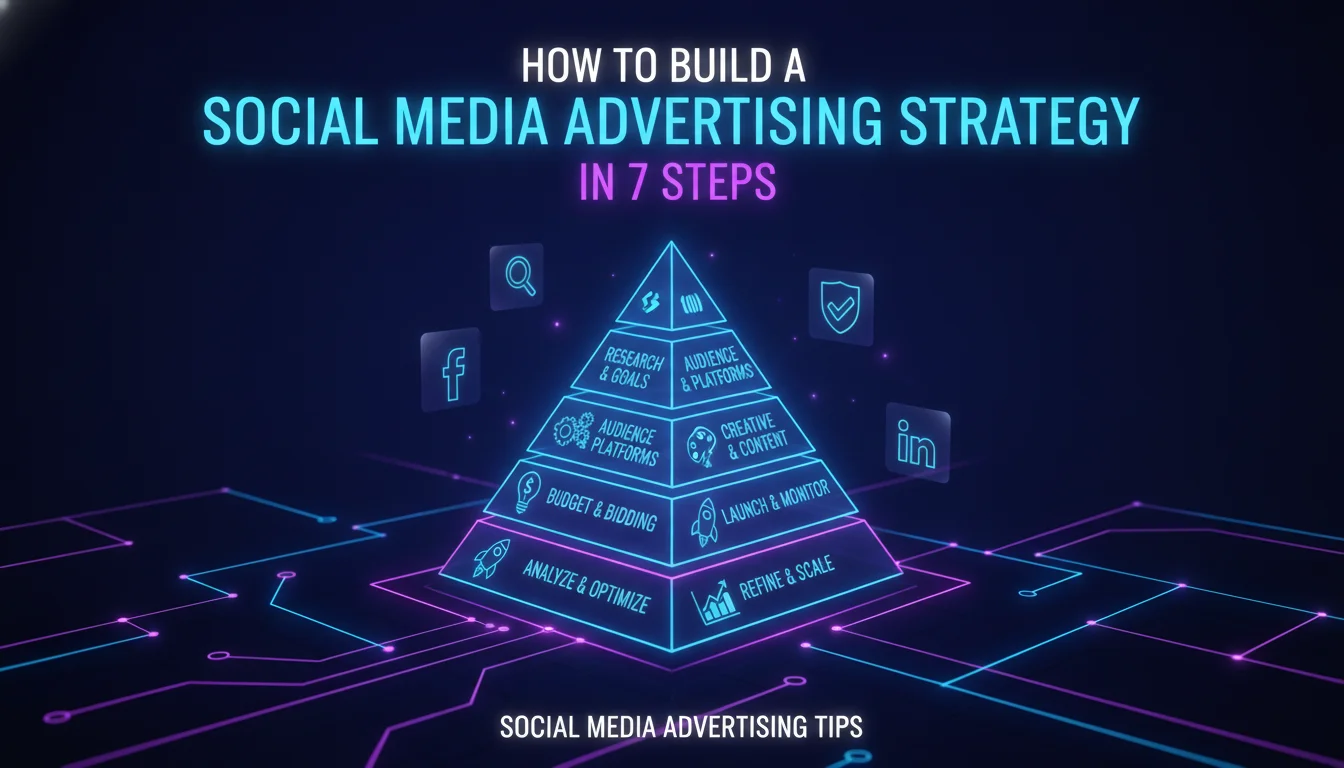
- Step 1: Determine your target audience. Use platform data, customer personas, and past purchase behavior to define who you want to reach.
- Step 2: Decide what kind of social ads will best showcase your product or service. Choose among image, video, carousel, story, or collection formats based on the customer journey.
- Step 3: Set key performance indicators (KPIs). Common KPIs include cost per click, click-through rate, conversion rate, and return on ad spend.
- Step 4: Create and set up your ads. Write copy, design visuals, configure placements, and set budgets at the campaign and ad set level.
- Step 5: Measure your ad success. Use native platform analytics or third-party tools to track impressions, engagement, and conversions.
- Step 6: Refine your audience targeting. Exclude underperforming segments, create lookalike audiences, and layer in retargeting.
- Step 7: A/B test and optimize. Run controlled experiments on headlines, creative, and CTAs. Scale what works and pause what does not.
Choosing Ad Formats and Placements
After defining the audience and KPIs, match ad formats to the platform and the stage of the funnel. Awareness campaigns may favor video and story ads, while conversion campaigns often perform better with carousel or collection ads that showcase multiple products.
Placement selection also matters. Automatic placements can work for some advertisers, but manual control ensures your ads appear in contexts that align with your creative and objective. Testing both approaches often reveals the best balance.
Launching, Measuring, and Iterating
Launching is not the end of the process. Monitor performance daily or weekly, compare against KPIs, and adjust bids, budgets, or creative based on data. The most successful advertisers treat social ads as an ongoing experiment rather than a one-time campaign.
These social media advertising tips are designed to be repeated: every new campaign should start with a clear hypothesis and end with a learning that informs the next iteration. Over time, this loop compounds into lower costs and higher returns.
Social Media Advertising Tips for Platform and Audience Targeting
Platform-Specific Strengths
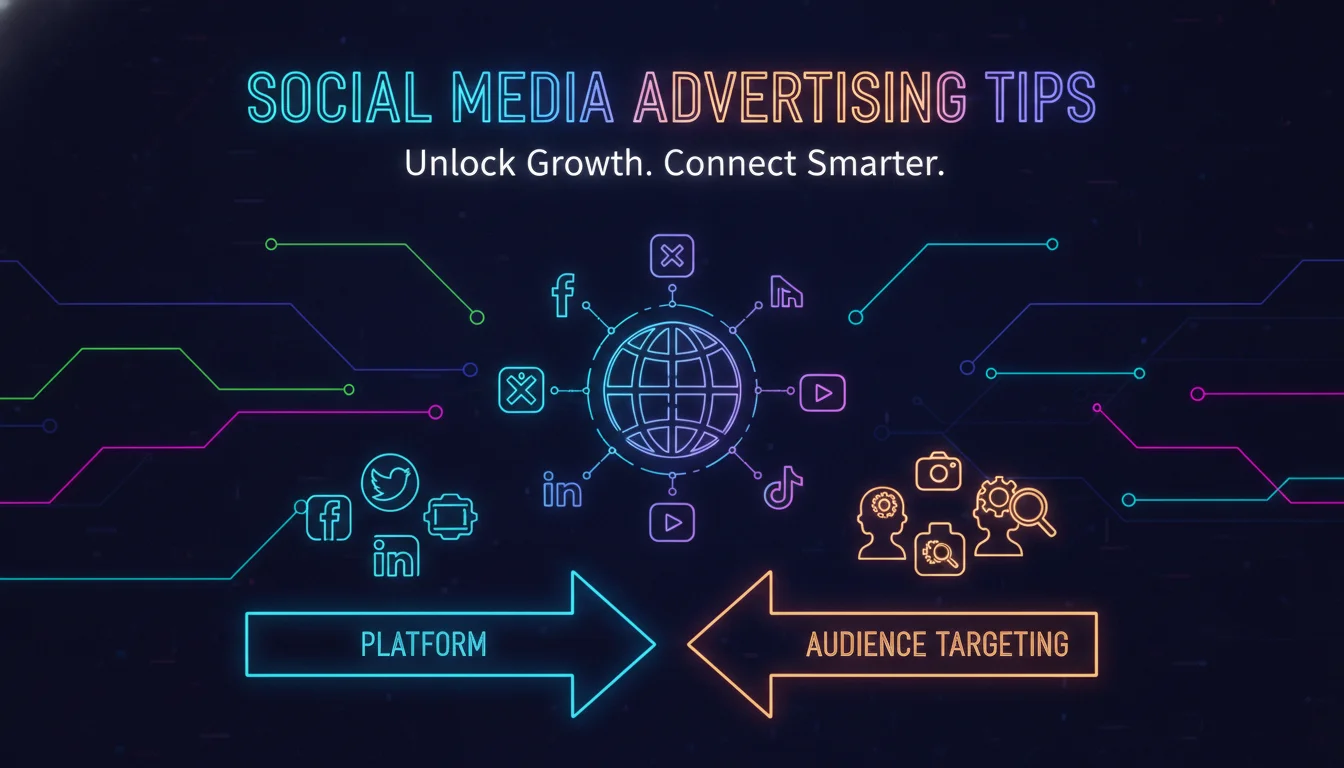
Each platform has unique strengths, and matching your social media advertising tips to the right channel is half the battle. Meta platforms such as Facebook and Instagram offer extensive demographic and interest targeting along with powerful custom audiences from website traffic. TikTok excels at hashtag and interest-based discovery with native short-form video. LinkedIn is the go-to for B2B targeting by job title, company, and seniority. YouTube supports keyword, topic, and placement targeting across the funnel, while Pinterest is strong for visual discovery and shopping intent.
A B2B whitepaper ad may perform well on LinkedIn but feel out of place on TikTok. The right platform choice is more important than the size of the ad budget.
Audience Research and Retargeting
Audience research is the foundation of paid social. Build custom audiences from website visitors, email lists, and app users, then create lookalike audiences to reach people similar to your best customers. These methods go beyond basic demographic targeting to reach users with demonstrated intent or affinity.
Retargeting is a paid social tactic that serves ads to users based on prior website, app, or content interactions. It is one of the highest-intent targeting methods available to advertisers, and most social media advertising tips rank it above cold prospecting for efficiency.
Comparison of Platform Advertising Options
| Platform | Primary Ad Formats | Targeting Strengths | Cost Considerations |
|---|---|---|---|
| Meta (Facebook/Instagram) | Image, video, carousel, story, Reels | Demographics, interests, behaviors, custom/lookalike audiences | Flexible; CPC varies by audience and objective |
| TikTok | In-feed video, Spark Ads, TopView | Interests, hashtags, lookalikes, age/region | Often lower CPM but requires native short-form video |
| Sponsored content, message ads, text ads | Job title, company, industry, seniority | Higher CPC but strong B2B intent | |
| YouTube | Skippable in-stream, bumper, discovery | Keywords, topics, placements, remarketing | Cost per view can be low; requires video creative |
| Promoted Pins, shopping ads, carousel | Keywords, interests, demographics | Good for visual and shopping intent; moderate CPC |
Types of Social Media Ads and Creative Best Practices
Image, Video, Carousel, and Story Ads
Image ads are static visual ads with a short call to action, carousel ads are multi-card ads that users can swipe horizontally, and story ads are full-screen vertical ephemeral ads that appear between organic stories. Each format serves a different purpose in the customer journey.
Adobe Express recommends short videos under one minute for higher impact. A home improvement brand, for example, might run a 30-second time-lapse of a DIY renovation to capture attention and encourage service exploration. Video ads can also show up in search engine results, extending their reach beyond social feeds.
Native Creative and Copy Tips
Among the most practical social media advertising tips: make ads feel native to the platform. Use vertical video for TikTok and Reels, square or vertical for Facebook feed, and text-light images that let the caption do the work. The 80/20 rule is a common guideline: 80% of content should offer value, like tips, inspiration, or education, while only 20% should be directly promotional.
Every ad should include a clear CTA such as “Shop now” or “Subscribe here.” Keep headlines short, lead with the benefit, and test variations to find what resonates. Consistent brand voice and visual identity help ads feel less intrusive and more like organic content.
Using Social Proof and Urgency
Social proof, including ratings, testimonials, user-generated content, and influencer endorsements, can significantly lift ad performance. Urgency tactics such as limited-time offers or countdowns work particularly well in story ads and retargeting campaigns.
Many social media advertising tips recommend pairing social proof with a strong offer: a customer review next to a “Buy one, get one” promotion can increase both click-through and conversion rates. The goal is to reduce friction and give users a reason to act now.
Social Commerce and Influencer Partnerships
In-App Shopping and Social Commerce Trends
Social commerce is one of the fastest-growing areas in paid social. Platforms like Instagram, TikTok, and Pinterest now offer native shopping features that let users browse and buy without leaving the app. For advertisers, this shortens the path from discovery to purchase and removes friction that typically kills conversions.
The most forward-thinking social media advertising tips now treat the platform itself as the storefront. Product tags in Reels, shoppable Pins, and TikTok Shop integrations are no longer optional extras. They are core to any conversion-focused paid social strategy in 2026.
Influencer Partnerships as a Paid Amplifier
Influencer partnerships sit at the intersection of organic credibility and paid reach. Brands can boost creator content as Spark Ads on TikTok or as whitelisted posts on Instagram, turning authentic creator content into high-performing paid placements. This approach often outperforms brand-produced creative because it feels native to the feed.
The key is selecting creators whose audience genuinely overlaps with your target customer. A micro-influencer with a tightly engaged niche community can deliver stronger results than a celebrity with a broad but passive following. Pair influencer content with retargeting to capture users who engaged but did not convert.
According to the American Marketing Association, a clear social media strategy defines your audience, pinpoints where to focus your efforts, maps out the kind of content that resonates, and sets the metrics that prove it’s all working. Every post, campaign, and interaction should move you closer to your marketing goals.
Pros and Cons of Social Media Advertising
Pros
- Precise audience targeting. Reach specific demographics, interests, and behaviors that match your ideal customer profile.
- Measurable results. Track impressions, clicks, conversions, and ROAS in real time through native platform dashboards.
- Flexible budgets. Social advertising is accessible to businesses of all sizes, from $10-per-day test campaigns to large-scale brand pushes.
- Creative variety. Image, video, carousel, story, and collection formats let you match the ad experience to the funnel stage.
- Speed to market. Paid social can reach new audiences within hours of campaign launch, far faster than organic growth.
Cons
- Ad fatigue is real. Audiences tire of seeing the same creative repeatedly, which raises costs and drops performance if you do not refresh regularly.
- Auction-based pricing can be unpredictable. Costs fluctuate based on competition, seasonality, and platform algorithm changes.
- Creative demands are high. Platform-native content requires ongoing production investment, especially for short-form video.
- Attribution is complex. Multi-touch journeys across platforms make it difficult to assign credit accurately without advanced measurement setups.
Budgeting and Cost Management for Social Media Advertising
How Social Media Ad Budgets Work
Social platforms operate on auction-based pricing models. Advertisers set daily or lifetime budgets, define bid strategies, and compete for ad impressions. Costs vary by audience size, competition, objective, and creative quality, but flexible budgets make social advertising accessible to businesses of all sizes.
Budget-focused social media advertising tips begin with clear campaign objectives. A conversion objective often costs more per action than a reach or engagement objective, but it may deliver stronger business results. Understanding this trade-off is essential for allocating spend wisely.
Is $10 a Day Enough for Facebook Ads?
For small retargeting campaigns, local reach, or early testing, $10 per day can generate useful data and incremental conversions. It is rarely enough to scale a broad cold-audience acquisition campaign, but it can serve as a testing floor. Treat it as a learning budget rather than a growth budget.
The key is to allocate the daily budget to one or two tightly defined ad sets. Spreading $10 across too many segments dilutes data and makes optimization difficult. Once a segment proves profitable, budgets can be increased with confidence.
Tips for Maximizing Spend Efficiency
- Use audience exclusions to avoid paying to show ads to existing customers or irrelevant segments.
- Start with manual placements before expanding to automatic placements.
- Refresh creative before ad fatigue raises frequency and cost per result.
- Optimize landing pages to convert the clicks you already pay for.
- Retarget warm audiences before investing heavily in cold prospecting.
Measuring and Optimizing Social Media Advertising Performance
KPIs and Attribution
Measurement-driven social media advertising tips require clear KPIs. Common metrics include click-through rate (CTR), cost per click (CPC), cost per thousand impressions (CPM), conversion rate, and return on ad spend (ROAS). Platform attribution windows vary, so compare click-through and view-through conversions where available.
Alignment between ad KPIs and business goals is essential. A high CTR with low conversion rate may indicate a mismatch between ad creative and landing page, while strong ROAS may hide an overly small audience that cannot scale. Review both top-of-funnel and bottom-of-funnel metrics regularly to avoid misleading conclusions.
A/B Testing and Creative Refresh
A/B testing is a controlled experiment comparing two versions of an ad, such as headline, image, or CTA, to determine which performs better against a specific metric. It is one of the most reliable ways to improve paid social performance, and it sits at the heart of every serious set of social media advertising tips.
Run A/B tests with one variable changed at a time. Once a winner emerges, scale that version and launch a new test. Creative fatigue sets in when frequency climbs and performance declines, so refresh visuals and messaging before costs rise. A structured testing cadence keeps campaigns from stagnating.
Aligning Ads with Landing Pages
According to Landingi, social media can drive traffic, but high-converting landing pages turn that traffic into leads, sales, and loyal customers. Every ad click should land on a focused, goal-oriented page that matches the ad’s promise and CTA.
Landing page speed, mobile responsiveness, and message match are critical. A disconnect between ad and page increases bounce rates and wastes ad spend. These social media advertising tips work best when the entire click-to-conversion path is optimized, not just the ad itself.
The most effective social media advertising tips combine audience-first planning, platform-native creative, disciplined budgeting, and continuous measurement. Brands that treat paid social as a measurable system, not a one-off boost, will outperform those that chase reach alone. Ready to build something bold? Contact Emin Media for a free brand consultation and let’s build a paid social strategy that actually moves the needle.
Frequently Asked Questions
What is the 5 5 5 rule for social media?
The 5-5-5 rule is a consistency guideline: comment on 5 posts, like 5 posts, and share or meaningfully engage with 5 posts per day. It helps increase visibility and build community by maintaining active participation across your chosen platforms.
What is the 5-3-1 rule for social media?
The 5-3-1 rule is a content mix guideline: for every 10 pieces of content, share 5 pieces of curated content, 3 pieces of original content, and 1 promotional post. This balance keeps audiences engaged without overwhelming them with sales messaging.
Is $10 a day enough for Facebook ads?
Yes, for testing, retargeting, or local reach, $10 per day can generate useful data and incremental conversions. Scaling to larger cold audiences usually requires a higher daily budget, so treat $10 as a learning floor rather than a growth ceiling.
What are the 7 C’s of social media marketing?
The 7 C’s are often listed as customer, content, context, community, convenience, consistency, and conversion. They provide a framework for building an effective social presence that drives business results across both organic and paid channels.
What is the difference between social media advertising and social media marketing?
Social media marketing includes organic and paid efforts such as content creation, community engagement, and ads. Social media advertising is the paid subset focused on reaching targeted audiences through paid placements to drive specific actions like purchases or sign-ups.
Enjoyed this article?
Contact Emin Media for a free brand consultation and let's create something amazing together.
Get in TouchRelated Articles

Digital Storytelling for Brands: The Complete Guide
Digital storytelling for brands builds real audience connections through narrative. Learn proven techniques, formats, and…

Design Thinking for Marketing: A 2026 Guide
Design thinking for marketing builds campaigns around real user needs. Learn the 5 phases, common…

Creative Direction for Video Shoots: A Complete Guide
Master creative direction for video shoots with proven steps, tools, and strategies that build brand…