Media Marketing: The Complete 2026 Guide
Media marketing is the practice of using paid, owned, earned, and shared channels to reach audiences and drive measurable business outcomes. It spans traditional outlets like TV and print, plus digital channels like social media, search, and email.
Key Takeaways
- Media marketing covers paid, owned, earned, and shared channels. Social media is one powerful subset, not the whole picture.
- As of October 2025, more than 6 billion social media users exist worldwide, according to Investopedia.
- The average person spends 143 minutes per day on social platforms, per Salesforce data.
- A strong strategy aligns business objectives, audience insight, channel selection, creative content, and performance measurement.
- AI will automate routine tasks but will not replace the human judgment needed for community building and brand trust.
- Careers span media planning, content strategy, analytics, and community management, with data fluency increasingly essential.
What Is Media Marketing?
Definition and Core Principles
Media marketing is the discipline of planning, buying, creating, and optimizing brand messages across multiple channels. Those channels can be paid, owned, earned, or shared. They include traditional outlets such as television, radio, newspapers, magazines, and out-of-home placements, as well as digital properties like websites, search engines, social platforms, email, and streaming services.
A media marketer works to place the right message in front of the right audience at the right time on the right channel. The goal is rarely just awareness. Effective campaigns drive action: a purchase, a sign-up, a download, a store visit, or a recommendation.
Media Marketing vs. Social Media Marketing
Social media marketing is a subset of the broader discipline, not a synonym for it. According to Investopedia, social media marketing is the use of social media platforms to build a brand, increase sales, and drive website traffic. The broader practice includes social media but also covers search, display, broadcast, print, outdoor, and other channels.
This distinction matters. Teams that focus only on social platforms often miss the role of search intent, email retention, and offline touchpoints. A complete plan coordinates all of these channels around a unified message and shared performance metrics.
The Modern Media Mix
A useful way to organize the discipline is the paid, owned, earned framework. Owned media is any channel a brand controls directly: a website, blog, app, or email list. Paid media is any placement a brand pays for, including TV spots, print ads, paid search, display ads, and sponsored social posts. Earned media is third-party coverage a brand does not pay for, such as press mentions, reviews, shares, and organic recommendations.
Shared media, a fourth category, includes social platforms where brands and audiences co-create visibility. Each category supports the others. Paid media can amplify owned content, owned content can generate earned coverage, and earned coverage can reduce paid acquisition costs over time.
Why This Discipline Matters for Modern Brands
Reach, Targeting, and Audience Access
The scale of modern audiences is enormous. Investopedia reported more than 6 billion social media users worldwide as of October 2025. Salesforce notes that the average person spends 143 minutes per day on platforms like Facebook, Instagram, TikTok, YouTube, and LinkedIn. These figures explain why the field has shifted from a supporting function to a core growth engine.
Traditional channels still play a role when brands need broad, mass-market reach. Dr. Jessica Rogers, senior associate dean of business programs at Southern New Hampshire University, put it clearly:
“Traditional media is a great way to reach a broad consumer base, whereas digital media has the ability to reach very specific audiences.” – Dr. Jessica Rogers, SNHU
Data, Measurement, and Customer Insight
One of the defining advantages of digital channels is measurement. Platforms capture impressions, clicks, engagement, conversions, and audience demographics in real time. This data lets marketers test creative, adjust targeting, and allocate budget based on what actually works.
Social platforms also enable two kinds of interaction that traditional channels cannot match: customer-to-customer and firm-to-customer. That interaction creates electronic word-of-mouth (eWOM), which can be measured and used to improve campaigns. Customer relationship management (CRM) is the practice of managing those interactions across channels to improve retention and lifetime value.
Rather than being overwhelmed by the volume, variety, and velocity of big data, modern tools can extract customer information and turn it into actionable market analysis. Investopedia also warns that not all demographics have equal access to social platforms, so relying only on digital channels may unintentionally exclude some groups.
Cost-Effectiveness and Brand Accountability
Compared with many traditional placements, digital channels can be highly targeted and relatively cost-effective to start. They do require continuous content production, community management, and reputation monitoring. Salesforce reports that 81% of people believe social media increases brand accountability, which means brands must respond quickly and transparently.
This accountability is a double-edged sword. It builds trust when handled well and amplifies mistakes when ignored. Any serious strategy should include clear guidelines for response times, tone, and crisis escalation.
Pros and Cons
Pros
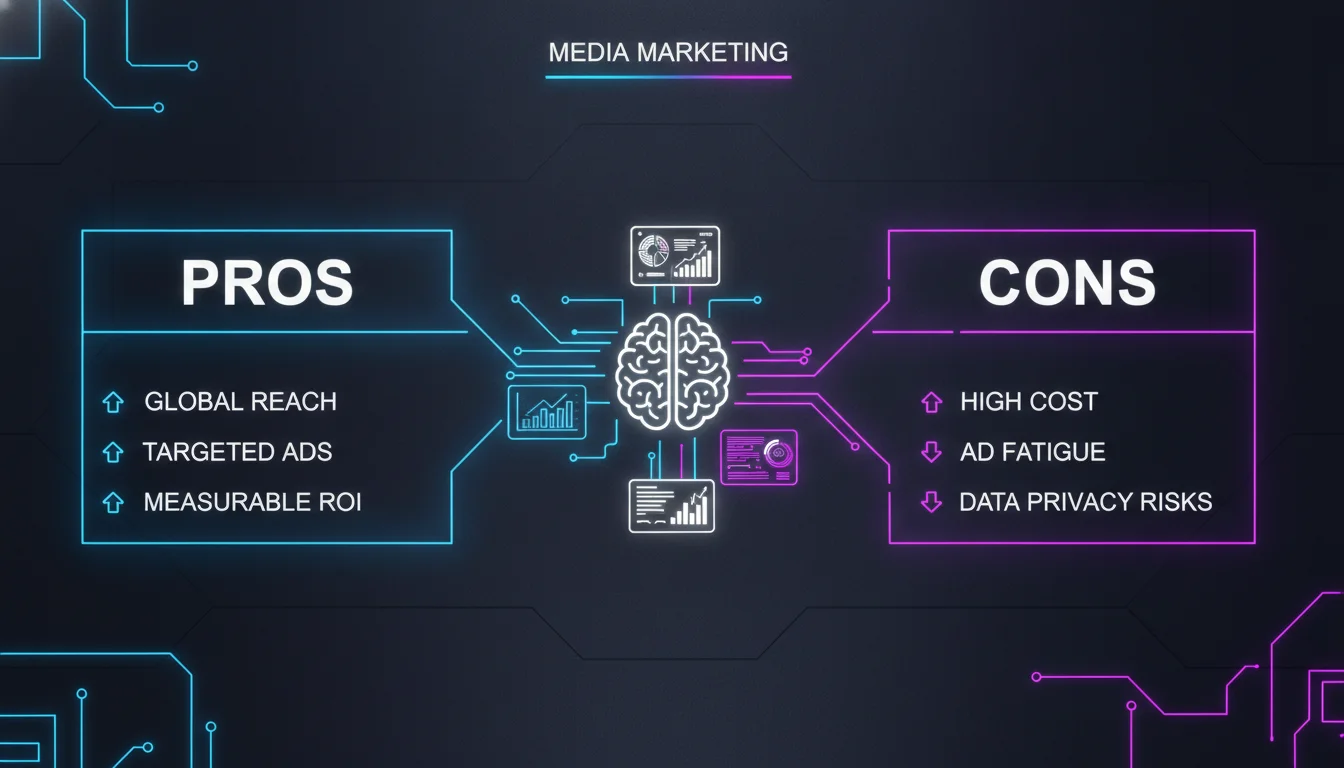
- Precise targeting: Digital channels let you reach specific audiences by age, location, interest, job title, and behavior, far beyond what traditional placements allow.
- Real-time measurement: Impressions, clicks, conversions, and cost-per-acquisition are visible immediately, enabling fast optimization.
- Two-way engagement: Unlike TV or print, social platforms create genuine dialogue between brands and customers, building loyalty and surfacing product feedback.
- Scalable reach: With more than 6 billion social media users worldwide, even modest budgets can reach meaningful audiences.
- Earned amplification: Strong creative and community work generates shares, reviews, and press coverage that extend reach without additional spend.
Cons
- Constant content demands: Owned and social channels require a steady stream of fresh, high-quality content to stay relevant.
- Algorithm dependency: Platform changes can dramatically reduce organic reach overnight, making paid support increasingly necessary.
- Reputation risk: Public-facing channels amplify both praise and criticism. A slow or tone-deaf response can damage brand trust quickly.
- Privacy and data shifts: Reduced access to third-party data is forcing brands to invest more heavily in first-party data collection through owned channels.
- Digital exclusion: Relying solely on digital channels may unintentionally exclude audiences without reliable online access, as Investopedia notes.
The Core Types of Media Marketing
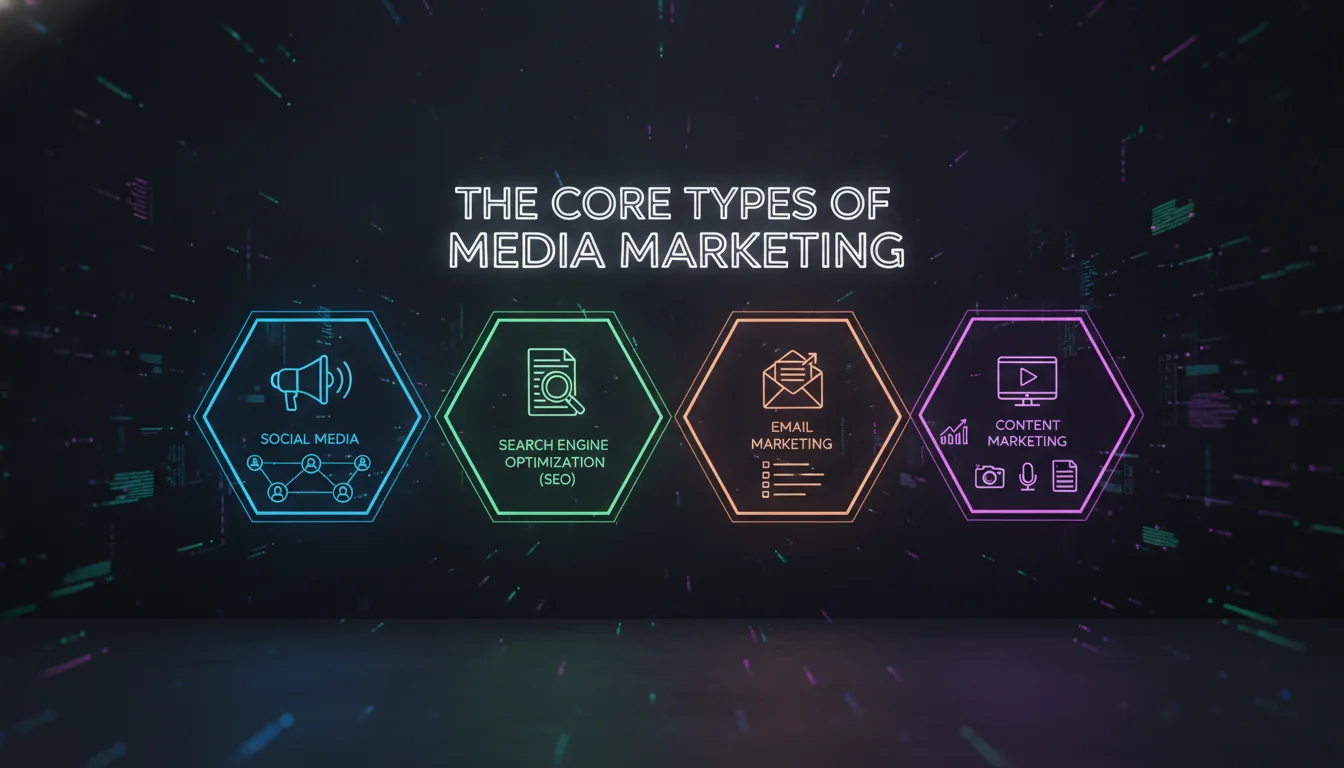
Paid Media
Paid media is any placement a brand pays for to reach an audience. This includes traditional channels such as TV, radio, print, and out-of-home, as well as digital formats like pay-per-click search ads, display ads, social ads, and sponsored content. Paid placements are often used to accelerate reach, launch a product, or capture demand that already exists.
The main strength of paid media is speed and scale. Its main weakness is cost and decreasing trust when messages feel interruptive. A well-run paid campaign is targeted, measurable, and integrated with organic content so each reinforces the other.
Owned Media
Owned media is the set of channels a brand controls directly. Websites, blogs, mobile apps, email newsletters, and branded social profiles all fall into this category. These channels give brands full control over messaging, design, and data collection.
Owned media is the foundation of long-term brand building because it creates an audience a brand can reach without paying each time. Content marketing, SEO, and email marketing are the most common owned-media disciplines that drive organic traffic and nurture relationships over time.
Earned and Shared Media
Earned media is exposure a brand does not pay for: news coverage, reviews, word-of-mouth, and organic social sharing. Shared media refers to content distributed by audiences on social platforms. Both types depend on quality, relevance, and trust.
Earned and shared media often carry higher credibility than paid placements because they come from third parties or peers. The challenge is that they cannot be directly controlled. Brands can encourage them through PR, influencer partnerships, community engagement, and standout creative work.
Digital Marketing Disciplines Within the Mix
Within the broader framework, several specific disciplines deserve attention. Affiliate marketing (also called influencer marketing) bridges the gap between brands and consumers by using industry experts and content creators to drive referrals. Email marketing nurtures existing relationships and drives repeat purchases through owned channels. Mobile marketing reaches audiences through apps, SMS, and mobile-optimized experiences. Pay-per-click advertising captures high-intent search demand at the moment of decision. SEO builds long-term organic visibility. Each discipline plays a distinct role, and the strongest strategies combine several of them around a shared objective.
How a Media Marketing Strategy Works
Step 1: Define Business Objectives
Start with outcomes such as brand awareness, lead generation, website traffic, or sales. Every channel selection and content decision should connect back to one of these goals. Vague objectives produce vague results.
Step 2: Identify and Learn Your Target Audience
Understand age, location, income, interests, job title, and media habits. Use surveys, social listening, and analytics data to build a clear picture of who you are trying to reach and where they spend their time.
Step 3: Conduct a Competitive Analysis
Study what competitors do across paid, owned, earned, and shared channels. Note their successes and failures. The goal is not to copy them but to identify gaps and opportunities your brand can own.
Step 4: Audit Your Current Media Presence
Review existing content, profiles, ad accounts, and performance data. Identify gaps and quick wins before adding new channels or budgets.
Step 5: Select Channels and Create a Content Calendar
Choose platforms where your audience is already active. Plan content themes, formats, and posting cadence. A calendar keeps teams aligned and prevents the reactive, inconsistent posting that kills brand credibility.
Step 6: Produce Best-in-Class Content
Create messages and assets designed for each channel, with clear calls to action and a consistent brand voice. What works on TikTok will not work on LinkedIn. Native formats outperform repurposed content almost every time.
Step 7: Track Performance and Adjust
Measure engagement, reach, conversions, and return on investment. Reallocate budget and refine creative based on data. This framework echoes the action plan recommended by Hootsuite and cited by Investopedia.
Common Pitfalls to Avoid
- Being everywhere without a plan. Spreading resources too thin leads to inconsistent content and wasted budget.
- Ignoring data. Without measurement, your strategy becomes guesswork.
- Treating every channel the same. What works on TikTok may fail on LinkedIn.
- Neglecting community management. Unanswered comments can damage trust faster than any ad can rebuild it.
- Chasing vanity metrics. Likes and impressions matter, but conversions and retention matter more.
Measurement and Optimization
Key metrics vary by objective. For awareness, track reach and impressions. For engagement, track likes, comments, shares, and saves. For conversion, track click-through rate, cost per acquisition, and return on ad spend. According to Investopedia, businesses use engagement, reach, and conversions to measure social media campaign success.
Optimization is continuous. The strongest teams test creative variations, audience segments, and placements, then double down on what works. A/B testing and incrementality testing help separate correlation from causation.
Social Media as a Strategic Pillar
Platform Roles and Audience Fit
Social media is one of the highest-impact subsets of the broader discipline. Facebook, Instagram, TikTok, YouTube, LinkedIn, and X are among the most widely used platforms for brand building. Each has different strengths. YouTube is built for long-form video and search. Instagram and TikTok reward visual storytelling and short-form video. LinkedIn is designed for B2B networking and thought leadership. Facebook offers broad demographic reach and community tools. X is often used for real-time conversation and news.
Choosing the right platforms depends on audience and objectives. A B2B software brand may focus on LinkedIn and YouTube, while a consumer fashion label may prioritize Instagram and TikTok. Be present where your audience already spends time, not where a trend suggests you should be.
Community Management and Engagement
Community management is the practice of responding to comments, messages, mentions, and reviews on social platforms. It turns one-way broadcasting into two-way dialogue. Adobe’s business blog describes social media marketing as two-way dialogue rather than one-way messaging, unlike traditional TV, magazine, and billboard ads.
Strong community management builds loyalty, reduces churn, and creates user-generated content. It also surfaces customer pain points and product feedback that can inform broader strategy and even product development.
“Social media marketing is the process of creating and publishing content on social media platforms to build connections with your target audience, promote your products or services, and turn consumers into loyal customers.” – Salesforce
Metrics That Matter
Social media metrics fall into three broad buckets. Engagement metrics include likes, comments, shares, saves, and direct messages. Reach metrics include impressions, follower growth, and video views. Conversion metrics include link clicks, website sessions, sign-ups, and sales.
A common mistake is optimizing only for engagement. A post can generate likes but no leads. The strongest social teams tie platform metrics to business outcomes through UTM tracking, landing pages, and CRM integration.
Influencer and Affiliate Marketing
Influencer marketing has become a significant channel within social strategy. As SNHU notes, affiliate and influencer marketing bridges the gap between consumers and organizations by using industry experts and social media creators to drive referrals and sales. The key is choosing partners whose audiences genuinely align with your brand, not just those with the largest follower counts. Micro-influencers with highly engaged niche audiences often outperform celebrity partnerships on a cost-per-conversion basis.
Traditional vs. Digital Media Marketing
Comparison Table
| Approach | Key Strengths | Key Limitations | Best For |
|---|---|---|---|
| Traditional media marketing | Broad reach, high trust, strong brand building | Higher cost, limited targeting, harder to measure | Mass-market brand awareness |
| Digital media marketing | Precise targeting, real-time data, lower entry cost | Ad fatigue, platform dependency, privacy shifts | Performance-driven campaigns |
| Social media marketing | Two-way engagement, earned sharing, community | Constant content demands, algorithm changes, reputation risk | Brand loyalty and customer connection |
When to Use Traditional, Digital, or Both
Traditional channels remain effective for broad consumer products, local brand visibility, and high-trust categories such as healthcare, finance, and automotive. Print, radio, and out-of-home can create tactile, memorable impressions that digital ads may not match.
Digital channels are often better for niche targeting, direct response, and measurable performance. Most mature brands use both: traditional channels build reach and credibility while digital channels drive conversion and retention.
Integrating Channels for Omnichannel Reach
Omnichannel strategy means delivering a consistent message across every touchpoint, from a billboard to a social ad to an email. Integration improves recall and reduces wasted spend. A TV spot can be repurposed into short social videos, and a social campaign can drive traffic to owned channels where first-party data is captured.
The goal is not to run the same ad everywhere. Tell one story in formats native to each channel. That requires centralized brand guidelines, shared creative assets, and a measurement framework that connects cross-channel influence to business outcomes.
Ethical Considerations and Brand Responsibility
Avoiding Mishaps and Protecting Trust
Social platforms amplify both success and failure at speed. A poorly timed post, an insensitive campaign, or a slow crisis response can generate significant backlash. Brands that treat social channels as broadcast-only tools, without monitoring or community management, are most vulnerable.
Ethical practice in this space means being transparent about sponsored content and paid partnerships, respecting audience data and privacy, and ensuring campaigns do not unintentionally exclude or misrepresent communities. As Investopedia notes, not all demographics have equal access to digital channels, so a responsible strategy considers who might be left out.
The brands that earn long-term trust are those that respond to criticism honestly, acknowledge mistakes quickly, and maintain a consistent voice whether things are going well or not.
Careers and Skills in a Growing Field
Common Job Roles
Careers in this field span strategic, creative, analytical, and technical roles. Common titles include media planner, media buyer, social media manager, content strategist, digital marketing manager, SEO specialist, paid media specialist, community manager, influencer marketing manager, and marketing analyst.
Each role has a different focus. Media planners and buyers decide where ads run and negotiate placements. Social media managers handle platforms and engagement. Content strategists shape stories and formats. Analysts turn performance data into optimization decisions.
Essential Skills and Credentials
Successful practitioners combine creative judgment, strategic thinking, and data fluency. Writing and visual communication are essential because content is the core product. Analytical skills are equally important because modern campaigns generate large volumes of performance data. Familiarity with tools for social scheduling, ad buying, web analytics, and CRM is increasingly expected.
Formal credentials can help. Many universities and platforms offer certificates in digital marketing, social media, media planning, and marketing analytics. Degrees in marketing, communications, business, or data analytics are common entry points. A portfolio of measurable results, though, often carries more weight than a certificate alone.
Where the Jobs Are
Roles exist in agencies, in-house brand teams, media companies, publishers, and technology platforms. Agency roles offer variety across clients and industries. In-house roles offer deeper product and customer knowledge. Media companies such as Media Marketing, which covers regional advertising news across Bosnia and Herzegovina, Croatia, Serbia, Slovenia, Montenegro, and nearby markets, highlight the demand for local expertise in this field.
Remote and hybrid roles have expanded access to global employers. The field is competitive, but candidates who understand both creative storytelling and performance measurement are consistently in demand.
The Future of Media Marketing
AI, Automation, and Generative Tools
Artificial intelligence is already changing the field through automated bidding, content generation, predictive analytics, and chatbots. AI can draft social copy, generate ad variations, recommend audiences, and optimize budgets in real time. It reduces repetitive work but does not replace strategic judgment.
Automation tools handle scheduling, reporting, and audience segmentation at scale. The most effective teams use AI to multiply human creativity, not substitute for it. A team that masters AI-assisted workflows can test more ideas and learn faster than one that relies on manual processes alone.
Will AI Replace Social Media Marketing?
No. AI is unlikely to replace social media marketing entirely, but it will reshape the work. AI can generate content and analyze data, but it cannot build genuine community, understand cultural nuance, or earn trust the way human marketers do. Social media marketing is fundamentally about relationships, and relationships require human empathy and judgment.
The likely outcome is augmentation, not replacement. Routine tasks such as reporting, tagging, scheduling, and initial copy drafts will be automated. Human marketers will focus on strategy, creative direction, brand voice, crisis response, and high-stakes engagement.
Emerging Platforms and Consumer Behavior
Platform dynamics continue to shift. Short-form video, social commerce, and private messaging are growing. Brands are experimenting with augmented reality, live shopping, and creator partnerships. Privacy changes are also forcing marketers to rely less on third-party data and more on first-party data collected through owned channels.
The brands that win will be those that build direct relationships with audiences through owned and shared channels. The ability to adapt to platform changes while staying grounded in customer needs will separate the leaders from the laggards.
Frequently Asked Questions
What is media marketing?
Media marketing is the practice of using paid, owned, earned, and shared channels to reach target audiences, build brand awareness, and drive actions such as purchases or sign-ups. It includes traditional outlets like TV and print as well as digital channels like social media, search, and email.
What does a media marketer do?
A media marketer plans, buys, creates, and optimizes brand messages across channels. Daily work may include audience research, content creation, ad campaign management, community engagement, and performance reporting.
Will AI replace social media marketing?
AI will automate many routine tasks, but it will not replace the human skills needed for authentic community building, cultural insight, and trust. Social media marketing is likely to become more strategic, with AI handling data and production while humans focus on relationships and creative direction.
Who are the big 4 in marketing?
The term “big 4” is not fixed. It can refer to the largest agency holding companies, the dominant digital ad platforms, or the largest consulting firms, depending on context and market. Always clarify the specific category when using the term.
What are the main types of media marketing?
The main types are paid media, owned media, and earned media, with shared media often added as a fourth category. Digital disciplines within the mix include affiliate marketing, content marketing, email marketing, mobile marketing, pay-per-click, SEO, and social media marketing, as outlined by SNHU’s breakdown of digital marketing types.
How do I start a career in media marketing?
Start by learning the fundamentals of marketing, digital channels, and analytics. Build a portfolio through internships, freelance projects, or personal brand experiments. Consider certifications in social media, SEO, or media buying to demonstrate practical skills to employers.
Ready to Build Something Bold?
Media marketing is no longer a single channel or a support function. It is the operating system through which brands understand audiences, deliver messages, measure impact, and build lasting customer relationships. The discipline spans traditional and digital, paid and organic, owned and earned, and it rewards organizations that can coordinate all of these pieces around clear business objectives.
The next decade will bring more automation, more platform change, and more pressure to prove return on investment. The fundamentals remain constant: know your audience, tell a clear story, choose the right channels, measure what matters, and keep learning. Teams that master those fundamentals while embracing new tools will define what comes next.
If you’re ready to build a strategy that actually moves the needle, contact Emin Media for a free brand consultation. Let’s build something bold together.
Enjoyed this article?
Contact Emin Media for a free brand consultation and let's create something amazing together.
Get in TouchRelated Articles
Digital Storytelling for Brands: The Complete Guide
Digital storytelling for brands builds real audience connections through narrative. Learn proven techniques, formats, and…
Design Thinking for Marketing: A 2026 Guide
Design thinking for marketing builds campaigns around real user needs. Learn the 5 phases, common…
Creative Direction for Video Shoots: A Complete Guide
Master creative direction for video shoots with proven steps, tools, and strategies that build brand…