SEO Digital Marketing: Strategy & How It Works
Key Takeaways
- SEO digital marketing is the practice of optimizing your website and content to earn higher organic rankings and qualified traffic without paying for ads.
- Modern seo digital marketing combines technical, on-page, and off-page tactics to build authority and relevance across search engines.
- Organic search drives 39% of global eCommerce traffic, and the first five organic results capture 69% of all clicks.
- Effective seo digital marketing strategies align with user intent, mobile experience, and continuous algorithm changes.
- SEO is a long-term investment: according to the American Marketing Association, businesses earn over $22 for every dollar spent.
- Local SEO, E-E-A-T signals, and AI-ready content structure are now non-negotiable parts of any serious strategy.
SEO digital marketing is the practice of optimizing your website and content to rank higher in organic search results, attracting qualified traffic without paid ads. It blends technical, on-page, and off-page strategies into one compounding growth channel.
As more consumers turn to Google to find products, services, and answers, brands that ignore digital marketing risk becoming invisible to their best prospects. According to the American Marketing Association, Google processes over 8.5 billion searches every day, and 58% of online searches now happen on mobile devices. This guide breaks down what seo digital marketing truly means, how it works, and the concrete steps you need to build a strategy that delivers real results.
What Is SEO in Digital Marketing?
SEO digital marketing is the process of aligning your website and content with search engine algorithms to improve rankings on search engine results pages (SERPs). Unlike paid advertising, which buys visibility, SEO earns it by demonstrating relevance and authority. It works alongside content marketing, social media, and email to drive sustainable, compounding growth.
Breaking Down SEO and Digital Marketing
Digital marketing covers every online effort to reach and engage customers, from social ads to email campaigns. SEO is the engine that makes those efforts discoverable when users actively search. Without it, even brilliant content stays buried.
Think of digital marketing as a store in a busy city. SEO is the sign above the door, the map listing, and the word-of-mouth that guides customers inside. It involves optimizing everything from your site’s technical structure to the keywords in your blog posts, all with the goal of appearing higher in organic results.
Why SEO Is Essential for Digital Marketing Success
Organic search drives 39% of all traffic to eCommerce websites, per the American Marketing Association. Organic search also accounts for the largest share of Google searches by intent, with more than half of all queries classified as informational. Brands that invest in seo digital marketing see compounding returns: higher rankings lead to more clicks, more trust, and ultimately more conversions.
Expert Insight: “As Moz co-founder Rand Fishkin illustrated with ‘Mozlow’s Hierarchy of SEO Needs,’ a successful SEO strategy builds from technical foundations to on-page relevance to off-page authority. Skipping any layer undermines long-term performance.”
Industry Perspective: “SEO is no longer confined to search engines like Google or Bing. It’s also important to consider social networks, rank videos on YouTube, and treat TikTok as a search engine as more people turn to them to find information.” – Digital Marketing Institute, 2025
How Search Engines Work
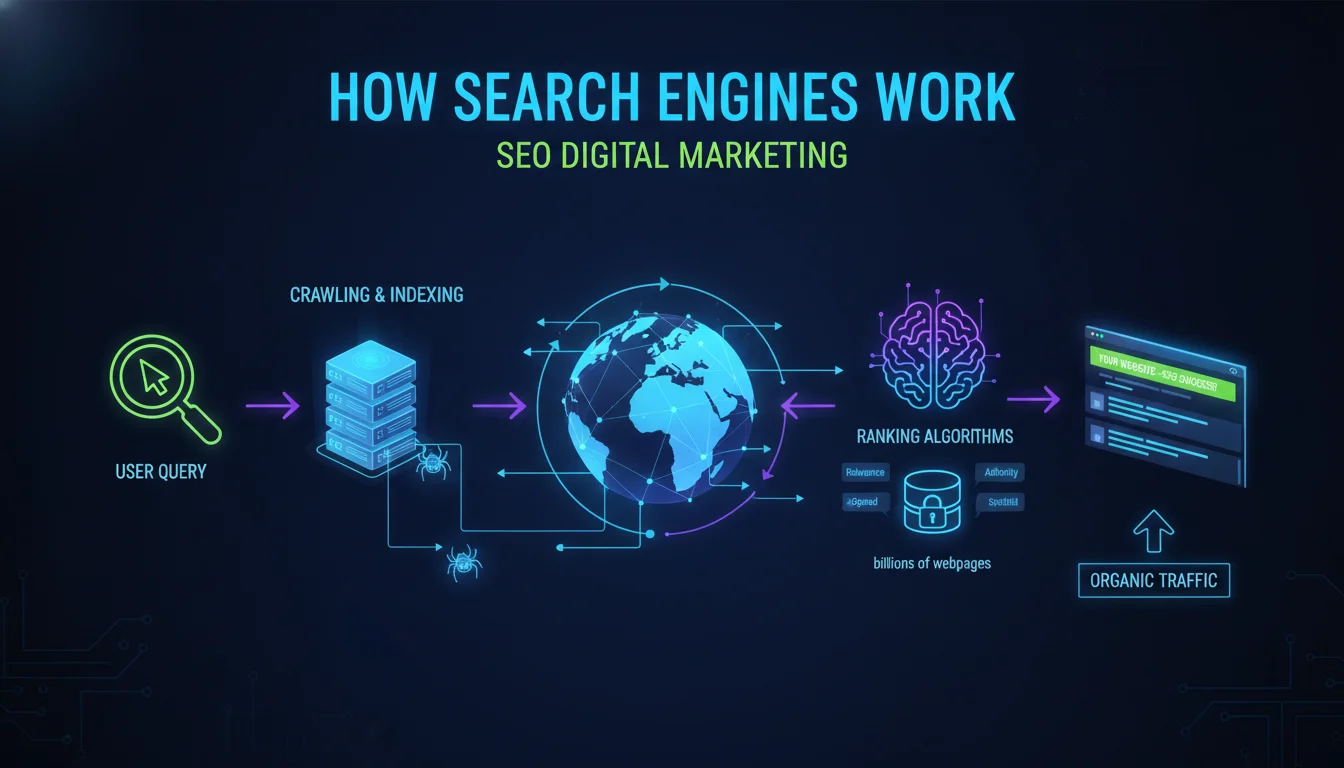
To master seo digital marketing, you must first understand how search engines discover and organize information. The process involves three core steps: crawling, indexing, and ranking. Each step determines whether your website appears when someone types a relevant query.
Crawling and Indexing: The Discovery Phase
Search engines use automated bots (spiders or crawlers) to surf the web, following links from page to page. When a crawler lands on your site, it reads the content, code, and metadata, then stores a snapshot in a massive database called the index. If your site’s structure is confusing or pages are blocked by a robots.txt file, crawlers may miss important content. Technical SEO practices like submitting an XML sitemap and optimizing your internal linking ensure that every valuable page gets indexed.
Ranking Algorithms: How Search Engines Order Results
Once indexed, pages are ranked based on hundreds of signals. Google’s algorithm evaluates keyword relevance, backlink quality, page speed, mobile-friendliness, and user experience. Modern algorithms use AI systems like RankBrain and BERT to understand the context behind queries, not just the exact words. That’s why seo digital marketing in 2026 focuses on satisfying user intent: providing the best answer, not just the right keywords.
The Role of AI in Search
Artificial intelligence now directly shapes how results are displayed. Google’s AI Overviews may answer questions directly on the SERP, reducing clicks for some queries. This shift makes it even more critical to structure content so it can be cited by AI: use clear headings, concise definitions, and authoritative sources. SEO professionals must adapt by creating content that is both human-friendly and machine-readable.
The Three Pillars of SEO
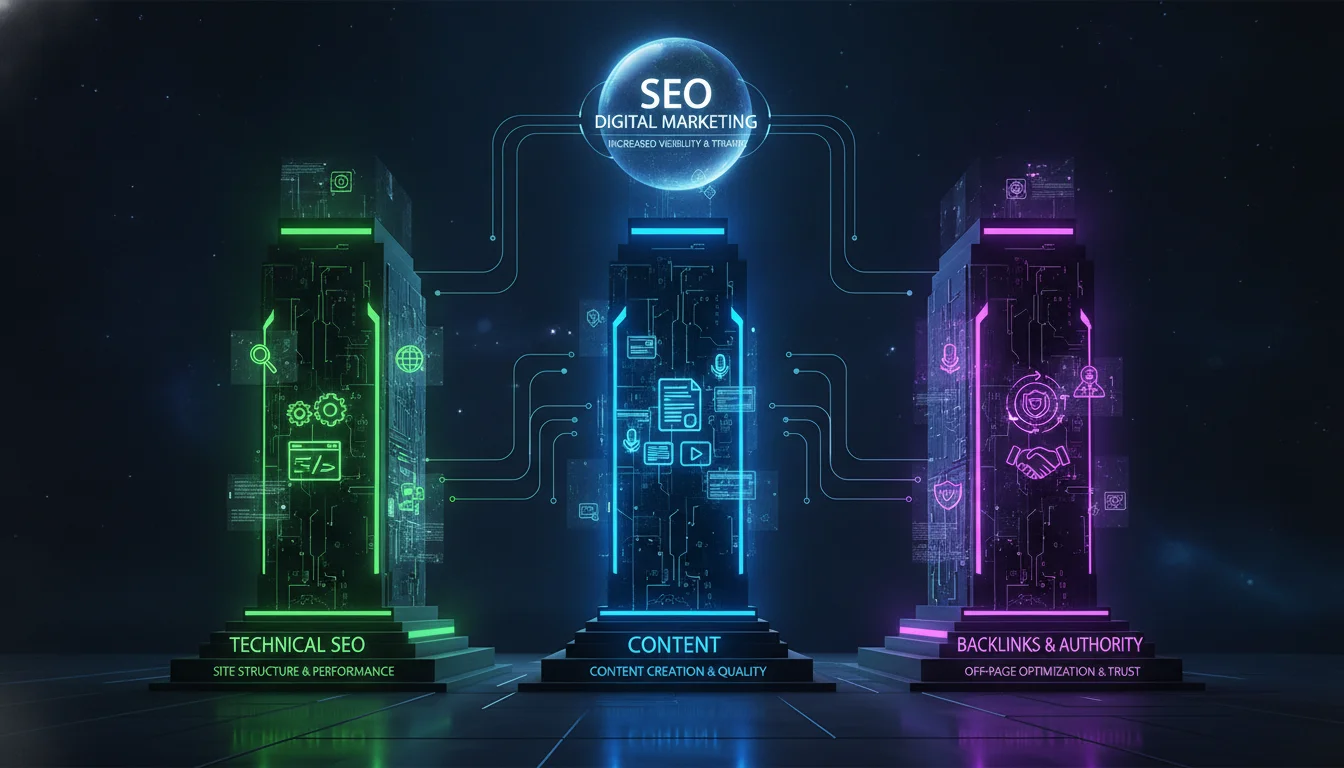
Every seo digital marketing strategy rests on three foundational pillars: technical optimization, on-page optimization, and off-page optimization. Neglect one, and the entire structure weakens. Together, they form the backbone of a search-friendly website.
Technical SEO: The Foundation
Technical SEO covers behind-the-scenes improvements that help search engines crawl and index your site efficiently. Key elements include:
- Site speed: Pages that load quickly rank higher and reduce bounce rates. Google’s Core Web Vitals set the benchmark.
- Mobile-friendliness: With 58% of searches on mobile, responsive design is mandatory.
- Structured data: Schema markup helps search engines understand your content and earn rich snippets.
- Secure connection (HTTPS): SSL certificates signal trust and are a confirmed ranking factor.
- XML sitemaps: A roadmap for crawlers to find all important pages.
Regular technical audits using tools like Google Search Console or Screaming Frog catch issues before they harm rankings.
On-Page SEO: Content and User Experience
On-page SEO involves optimizing the content and HTML source code of individual pages. This includes:
- Keyword research: Identifying terms your audience searches for, such as “seo digital marketing strategies,” and using them naturally in titles, headings, and body text.
- High-quality content: Answering user questions thoroughly and engagingly, with original research or unique insights.
- Title tags and meta descriptions: Compelling snippets that appear on SERPs and influence click-through rates.
- Internal linking: Connecting related pages to guide users and spread link equity.
- Image optimization: Using descriptive file names and alt text to improve accessibility and image search rankings.
The goal is a user experience where visitors find exactly what they need, quickly and without friction.
Off-Page SEO: Building Authority
Off-page SEO refers to actions taken outside your website to improve its reputation. The most critical factor is backlinks: links from other websites to yours. Search engines treat each quality backlink as a vote of confidence. Earning them requires:
- Guest blogging on reputable industry sites.
- Digital PR to get mentioned in news outlets or trade publications.
- Creating link-worthy resources such as original studies, infographics, or interactive tools.
- Building relationships with influencers and partners who naturally link to your content.
Social media signals aren’t direct ranking factors, but they amplify content reach, which can lead to more backlinks over time.
SEO vs. Paid Search: Key Differences
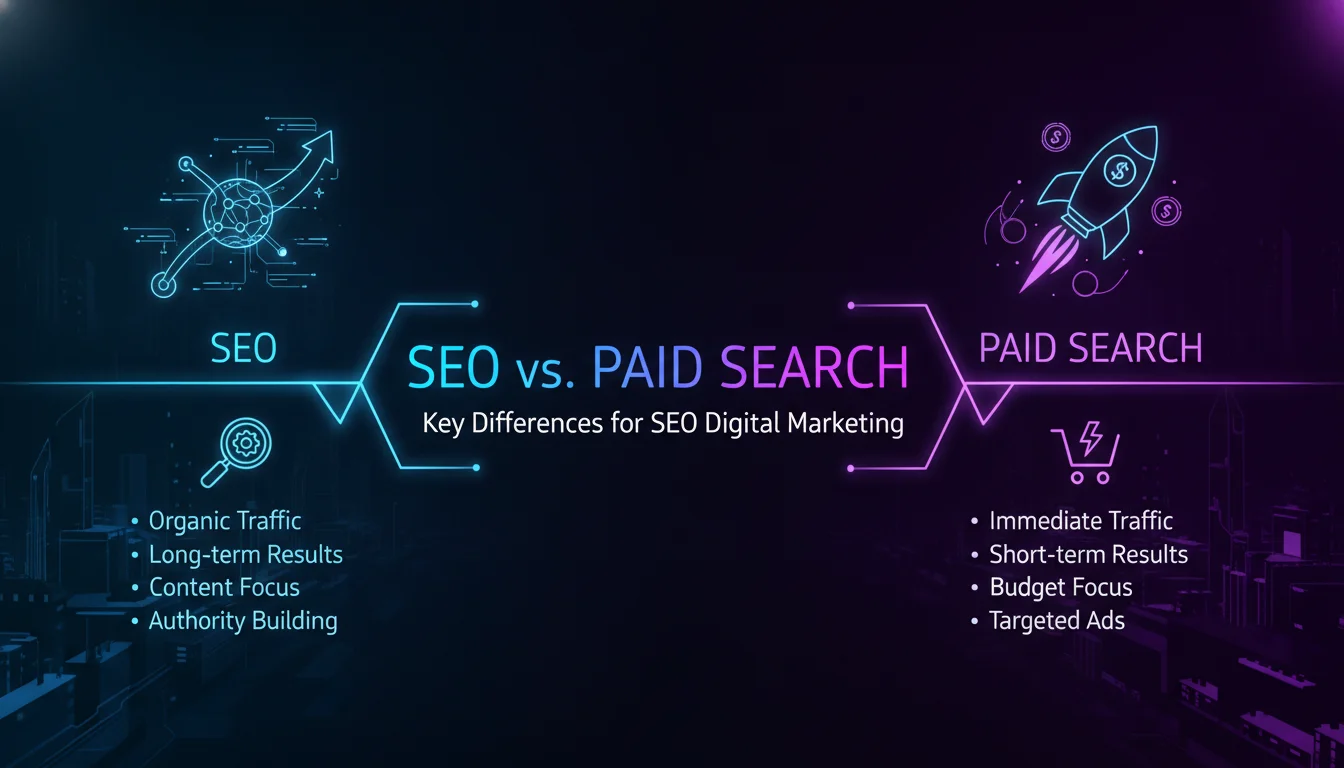
Many businesses confuse SEO with paid search (also called SEM or PPC). While both appear on search engines, they operate on fundamentally different models. The table below breaks down the core distinctions.
| Aspect | SEO (Organic Search) | Paid Search (PPC) |
|---|---|---|
| Cost | Free traffic, but requires investment in time and resources | Pay per click (CPC); you buy visits |
| Time to Results | Weeks to months for significant traction | Almost immediate after campaign launch |
| Placement | Appears below paid ads, usually organic blue links | Top of SERP, marked as “Sponsored” |
| Click-Through Rate | 69% of clicks go to the first 5 organic results | Lower CTR; many users skip ads |
| Trust Factor | High trust; users perceive organic results as more credible | Lower trust; some users distrust advertisements |
| Sustainability | Long-term benefits; traffic continues even if you pause efforts | Traffic stops the moment you stop paying |
When to Use Each Approach
SEO is ideal for building a long-term, cost-effective foundation, especially for informational and navigational queries. Paid search works best for time-sensitive promotions, competitive commercial keywords, or launching a new product. The most successful seo digital marketing strategies often combine both: use PPC to test keywords and drive immediate traffic while organic rankings build.
The Real Cost of SEO
Organic clicks are free, but effective SEO demands real investment in skilled talent, content creation, and tools. The ROI is compelling, though. According to the American Marketing Association, businesses earn more than $22 for every dollar spent on SEO. When you factor in the compound nature of organic traffic, content that ranks today can bring visitors for years, making the lifetime value far exceed that of paid campaigns.
The Evolution of SEO: From Keywords to User Experience
Understanding SEO’s history helps marketers avoid outdated tactics that can trigger penalties. The journey from keyword-stuffed pages to AI-driven ranking mirrors the internet’s maturation.
Early SEO Tactics (1990s to 2000s)
In the web’s infancy, search engines relied heavily on on-page signals. Webmasters could rank by repeating keywords dozens of times, hiding text with white-on-white CSS, or building spammy link directories. These black-hat techniques often worked temporarily but degraded search quality for everyone.
Major Algorithm Updates That Shaped SEO
Google’s landmark updates forced seo digital marketing to evolve:
- Panda (2011): Penalized thin, low-quality content and duplicate pages.
- Penguin (2012): Targeted unnatural link schemes and keyword stuffing.
- Hummingbird (2013): Shifted focus to semantic search and user intent rather than exact-match keywords.
- RankBrain (2015): Introduced machine learning to interpret ambiguous queries.
- BERT (2019): Improved understanding of natural language, especially conversational searches.
- Helpful Content System (2022 to present): Rewards people-first content and demotes sites created solely for search engines.
Modern SEO in the Age of AI
Today, seo digital marketing is about providing genuine value. Google’s E-E-A-T guidelines (Experience, Expertise, Authoritativeness, Trustworthiness) are central to how pages are evaluated. AI tools like ChatGPT and Google’s AI Overviews are changing how users consume information, but they also create real opportunities: well-structured, authoritative content can be cited by generative engines, amplifying your brand’s reach well beyond traditional blue-link results.
E-E-A-T: The Trust Framework Behind Modern Rankings
E-E-A-T stands for Experience, Expertise, Authoritativeness, and Trustworthiness, and it’s the quality framework Google’s human reviewers use to evaluate pages. It matters most for YMYL (Your Money or Your Life) topics: health, finance, legal advice, and anything else where bad information causes real harm.
Practically, building E-E-A-T means publishing content written by credentialed authors, citing reputable sources, earning mentions from authoritative publications, and keeping your site’s factual claims accurate and up to date. For brands, it also means having a clear About page, transparent contact information, and genuine customer reviews. None of this is a quick fix. E-E-A-T is built over months of consistent, honest publishing.
Local SEO: Getting Found in Your Market
Local SEO is the practice of optimizing your online presence to attract customers searching for businesses in a specific geographic area. If you serve a local market, this is one of the highest-ROI moves in your entire seo digital marketing toolkit.
Google Business Profile Optimization
Your Google Business Profile (GBP) is the single most important local SEO asset. A fully optimized profile includes your business name, address, phone number, hours, category, photos, and a keyword-rich description. Consistent NAP (Name, Address, Phone) data across your website and all directories signals legitimacy to Google’s local algorithm.
Beyond the basics, actively collecting and responding to Google reviews builds social proof and improves local pack rankings. Posts, Q&A responses, and updated photos keep your profile fresh and signal an active business.
Local Citations and On-Page Signals
Local citations are mentions of your business on directories like Yelp, Apple Maps, and industry-specific platforms. Consistency matters more than volume. One conflicting address across listings can suppress your local rankings. On your website, include location-specific landing pages with city or neighborhood names, embedded maps, and locally relevant content to reinforce geographic relevance.
Common SEO Mistakes and How to Fix Them
Even experienced teams make these errors. Knowing them saves months of wasted effort in any seo digital marketing program.
- Targeting keywords without checking intent: Ranking for a term that attracts researchers, not buyers, fills your analytics with traffic that never converts. Fix it by mapping every target keyword to a clear intent (informational, commercial, transactional) before you write a word.
- Ignoring technical health: Slow load times, broken internal links, and duplicate meta tags quietly drain rankings. Run a full crawl audit at least quarterly.
- Publishing thin content: A 300-word page rarely satisfies a complex query. Depth, original perspective, and genuine answers to follow-up questions are what separate ranking content from filler.
- Chasing backlinks over relevance: A link from a tangentially related site with low authority does little. Focus on earning links from publications your target audience actually reads.
- Skipping structured data: FAQ, Article, and Product schema markup give search engines explicit signals and increase your chances of earning rich results. Most CMS platforms make implementation straightforward.
- Never updating old content: Google favors recency for many queries. A content refresh, adding new data, updating examples, and expanding thin sections, can recover rankings faster than publishing a brand-new article.
How to Implement an Effective SEO Digital Marketing Strategy
Building a strategy from scratch may feel overwhelming, but breaking it into phased steps makes it manageable. Below is a proven process to start and sustain your seo digital marketing efforts.
Step 1: Conduct Comprehensive Keyword Research
Keyword research is the process of discovering what terms your target audience types into search engines. Use tools like Google Keyword Planner, Ahrefs, or Semrush to:
- Identify seed keywords related to your business (e.g., “seo digital marketing services”).
- Analyze search volume, competition, and intent (informational, commercial, navigational, transactional).
- Find long-tail variations (“how to do seo for digital marketing beginners”) that are less competitive and more specific.
Organize keywords into topic clusters, mapping each cluster to a pillar page and supporting blog posts. This structure signals topical authority to search engines.
Step 2: Create High-Quality, Intent-Focused Content
Content is the currency of seo digital marketing. Write comprehensive, engaging articles, guides, and landing pages that directly answer user questions. For best results:
- Target one primary keyword per page, along with secondary keywords used naturally.
- Use clear headings (H1, H2, H3) and short paragraphs for readability.
- Incorporate multimedia (images, videos, infographics) to enhance engagement.
- Regularly update content to keep it fresh and accurate. Google favors recency for many queries.
More than half of all Google searches are informational. Creating how-to guides, tutorials, and explainer articles captures that audience at the exact moment they’re looking for answers.
Step 3: Optimize Technical Elements
Technical SEO ensures search engines can access and understand your site. Key actions include:
- Run a full technical audit with a tool like Screaming Frog or Sitebulb.
- Fix broken links, duplicate meta tags, and slow-loading pages.
- Implement structured data (schema) for articles, products, FAQs, and reviews.
- Ensure responsive design and test mobile usability via Google Search Console.
- Set up proper redirects (301s) for any moved or deleted pages.
Step 4: Build Quality Backlinks
Off-page SEO is largely about earning backlinks from authoritative sites. A consistent link-building campaign might involve:
- Creating original research or surveys that journalists and bloggers will cite.
- Guest posting on reputable industry blogs.
- Reclaiming unlinked brand mentions (where a site mentions you but doesn’t link).
- Collaborating with influencers or partners for co-branded content.
Focus on quality over quantity. A single link from a high-authority domain like a university or government site can outweigh dozens of low-quality links.
Step 5: Monitor, Measure, and Adapt
SEO is not a set-it-and-forget-it channel. Use analytics tools to track:
- Organic traffic (Google Analytics).
- Keyword rankings (Semrush, Ahrefs).
- Click-through rate (CTR) from Google Search Console.
- Conversion rate for organic visitors.
- Backlink profile growth (Majestic, Ahrefs).
Review performance regularly, identify pages that are slipping, and adjust your approach based on what’s actually working. Ongoing optimization is what separates brands that sustain rankings from those that spike and fade.
Measuring SEO Success: Key Metrics and Tools
Data-driven seo digital marketing relies on tracking the right metrics. Vanity metrics like raw backlink counts can mislead. Focus on numbers that tie directly to business outcomes.
Organic Traffic and Keyword Rankings
Organic traffic is the number of visitors arriving from unpaid search results. It’s the most direct indicator of SEO health. Pair it with keyword ranking data to see which terms drive the most visits. Watching a target page climb from position 8 to position 3 and seeing traffic respond validates your optimization work in concrete terms.
Conversion Rates and ROI
Traffic must convert to leads or sales to matter. Set up goals in Google Analytics to track when organic visitors complete desired actions: form fills, purchases, newsletter sign-ups. Calculate the value of those conversions against your SEO investment. With businesses earning over $22 for every $1 spent, a well-executed strategy often pays for itself faster than most marketing channels.
Essential SEO Tools
No single tool covers every need. Professionals build a stack that includes:
- Google Search Console: Free, essential for monitoring indexation, Core Web Vitals, and search queries.
- Google Analytics 4: Tracks user behavior, acquisition channels, and conversions.
- Semrush or Ahrefs: Paid tools offering keyword research, competitor analysis, rank tracking, and site audits.
- Screaming Frog: Desktop crawler for technical audits.
- Looker Studio (formerly Data Studio): Creates dashboards combining data from multiple sources.
Investing in the right tools speeds up insight generation and keeps you ahead of algorithm shifts before they hurt rankings.
The Future of SEO in Digital Marketing
As of 2026, seo digital marketing continues to shift in ways that reward brands willing to think beyond the traditional blue-link result. Several trends are defining the near-term path forward.
AI and Generative Search
Google’s AI Overviews and Bing’s Copilot are already altering how answers appear on SERPs. These features synthesize information from multiple sources, sometimes answering queries without a click. To stay visible, brands must optimize for generative engines: provide clear, concise, well-cited information that AI models can reference. Implementing FAQ schema, creating definitive guides, and earning authoritative backlinks all increase the likelihood of being sourced.
Voice Search and Mobile Optimization
With 58% of searches coming from mobile devices and smart speaker adoption growing, voice search optimization is no longer optional. Voice queries are typically longer, more conversational, and often phrased as questions. Structuring content with question-based headings and natural language captures this traffic. Fast-loading, mobile-first designs are also mandatory, as mobile usability directly impacts rankings.
Video and Social Search
Platforms like YouTube and TikTok are becoming search engines in their own right. A complete seo digital marketing strategy in 2026 must address video SEO: optimizing titles, descriptions, and thumbnails, and using transcripts to make video content crawlable. Social media profiles often rank for brand names too, so maintaining active, optimized social channels supports overall visibility in ways that pure on-site SEO cannot replicate.
Want to see how we apply these principles for real brands? Explore our digital marketing services or read our take on brand strategy and content marketing on the Emin Media blog.
Pros and Cons
Pros
- Compounding returns: Content that ranks today keeps driving traffic for months or years without additional ad spend.
- High trust factor: Organic results are perceived as more credible than paid ads by most users.
- Cost efficiency: The long-term cost per acquisition from organic search typically beats paid channels once rankings are established.
- Brand authority: Consistent top rankings position your brand as the go-to expert in your space.
- Supports every other channel: Strong SEO amplifies the performance of content marketing, social media, and email by making your assets discoverable.
Cons
- Slow to start: Meaningful results typically take 4 to 12 months, making SEO a poor fit for campaigns that need immediate traffic.
- Algorithm dependency: A single Google core update can shift rankings overnight, requiring constant monitoring and adaptation.
- Requires sustained investment: Content creation, technical maintenance, and link building are ongoing costs, not one-time projects.
- Competitive niches are brutal: Established players with years of authority are genuinely hard to displace, especially on high-volume commercial keywords.
Ready to build something that lasts? Contact Emin Media for a free brand consultation and let’s map out an SEO strategy built around your actual business goals.
Frequently Asked Questions
What is SEO in digital marketing?
SEO digital marketing is the process of improving a website’s visibility in organic search results through technical, on-page, and off-page optimizations. It attracts relevant traffic without paying for ads, making it a core component of any complete digital strategy.
Can I do SEO myself?
Yes, many aspects of SEO can be self-taught using free resources like Google’s SEO Starter Guide, online courses, and community forums. Technical elements and sustained content creation often require specialized expertise or tools, so many businesses eventually bring in professionals to accelerate results.
Is SEO a good career?
SEO is a fast-growing field with strong demand, since every online business needs search visibility. The role evolves constantly, offering continuous learning opportunities, and experienced practitioners command competitive salaries across agency, in-house, and freelance settings.
What are the 4 types of SEO?
The four main types are: on-page SEO (content and HTML), off-page SEO (backlinks and authority), technical SEO (crawling and indexing), and local SEO (optimizing for location-based searches). Some practitioners also recognize video SEO as a distinct discipline, particularly given the rise of YouTube and TikTok as search platforms.
How long does SEO take to show results?
SEO is a long-term strategy. You can typically expect noticeable improvements within 4 to 12 months, depending on competition, industry, and the quality of your optimizations. Quick wins are possible through technical fixes and content refreshes, but sustainable rankings require patience and consistent effort.
What is the difference between SEO and SEM?
SEO focuses on organic, unpaid rankings, while Search Engine Marketing (SEM) includes both organic and paid search (PPC). In common usage, SEM often refers specifically to paid advertising, making it a complement to SEO rather than a replacement.
Enjoyed this article?
Contact Emin Media for a free brand consultation and let's create something amazing together.
Get in TouchRelated Articles
Visual Content Marketing Trends for 2026
Visual content marketing trends for 2026 are reshaping how brands connect. Discover AI visuals, interactive…
Brand Voice Examples 2026: Build a Voice That Sticks
Explore the best brand voice examples 2026 has to offer. Learn frameworks, archetypes, and steps…
What Are the 3 Cs of SEO? Content, Code & Credibility
What are the 3 Cs of SEO? Learn how Content, Code, and Credibility work together…