Motion Graphics Design Agency Guide 2026
A motion graphics design agency is a creative studio that produces animated visual content, from explainer videos to UI animations, built to communicate brand messages and drive measurable audience engagement. Every minute, 600 hours of video are uploaded online, according to DEPT Agency, which means standing out requires motion that actually moves people.
Key Takeaways
- A design agency specializes in animated content that sharpens brand storytelling and boosts viewer retention.
- Core services span explainer videos, animated logos, UI animations, 2D and 3D animation, and social media motion content.
- Choosing the right agency means evaluating portfolio depth, production process transparency, and strategic alignment with your goals.
- Motion graphics simplify complex ideas, evoke emotion, and keep audiences engaged far longer than static content.
- Production tools like Adobe After Effects, Blender, and Figma are industry standards that top agencies use daily.
- Working with a specialized studio gives you scalability, creative expertise, and access to data-driven optimization you can’t replicate in-house.
What is a Motion Graphics Design Agency?
A this type of agency is a specialized creative firm that produces animated visual content designed to communicate messages with clarity and emotional impact. These studios combine animation technique, brand strategy, and storytelling craft to create videos, advertisements, and interactive media that earn attention in crowded digital feeds.
Defining Motion Graphics
Motion graphics are animated graphic designs that blend visual elements with movement to convey information or tell a story. Text, illustrations, and imagery move dynamically together, making them ideal for marketing, advertising, product education, and social content. Think of them as design that breathes: static ideas given a pulse.
Key Services Offered
- Explainer Videos: Short, focused animations that break down a product or service into something anyone can understand in under two minutes.
- Animated Logos: Dynamic brand marks that add personality and memorability to every touchpoint.
- UI Animations: Micro-interactions and interface motion that improve digital product experience and guide user attention.
- 2D and 3D Animation: From flat, graphic-forward 2D styles to depth-rich 3D renders, agencies match the visual language to the brand’s world.
- Social Media Motion Content: Short-form animated ads and GIFs built for platform-native performance.
- Animated Presentations and eBooks: Branded motion content that makes sales decks and reports worth opening.
Importance of Motion Graphics in Marketing
Motion graphics serve as one of the most powerful tools available to modern marketers because they do three things simultaneously: simplify complex ideas, evoke emotion, and keep viewers engaged longer than static content. According to Superside’s research, motion graphics are proven to increase viewer retention and click-through rates across digital platforms. High-performing motion content is also shareable, which amplifies organic reach without additional ad spend.
“Most forward-thinking companies are using motion to enhance their brands and digital experiences to ensure they stand out in the crowded digital reality of today.” – DEPT Agency
Why Choose a Motion Graphics Design Agency?
Partnering with a this kind of design agency gives your brand access to specialized skills, professional-grade tools, and a structured creative process that most in-house teams simply can’t replicate at scale. Here’s what that partnership actually looks like in practice.
Expertise and Experience
Motion graphics agencies employ skilled designers and animators who understand the craft of visual storytelling at a deep level. Their experience means they know which animation style fits a fintech brand versus a consumer lifestyle brand, and they can execute that vision without a steep learning curve on your end. As Motionographer has documented since 2006, the motion design community is built on specialized craft that takes years to develop.
Access to Professional Production Tools
Top agencies work daily with industry-standard software: Adobe After Effects for compositing and motion design, Blender for 3D animation and rendering, and Figma for UI animation prototyping. This technical depth ensures the final product is not only visually sharp but built to spec for every platform it lives on, whether that’s a broadcast spot, a website hero, or a 15-second social ad.
Scalability and Flexibility
Working with a motion graphics agency means you can scale up for a full campaign or commission a single asset without rebuilding your internal team each time. Agencies like Motion The Agency offer fixed-price models that give marketing departments predictable costs and fast turnarounds, which matters when campaign timelines compress. The flexibility to iterate across multiple versions is something traditional project-based studios often can’t offer.
Data-Driven Creative Optimization
The best agencies don’t just hand over a file and disappear. They use creative analytics to measure how motion content performs and optimize messaging based on real audience data. According to Superside, this approach directly impacts return on investment by aligning creative decisions with marketing objectives rather than aesthetic preference alone.
Pros and Cons
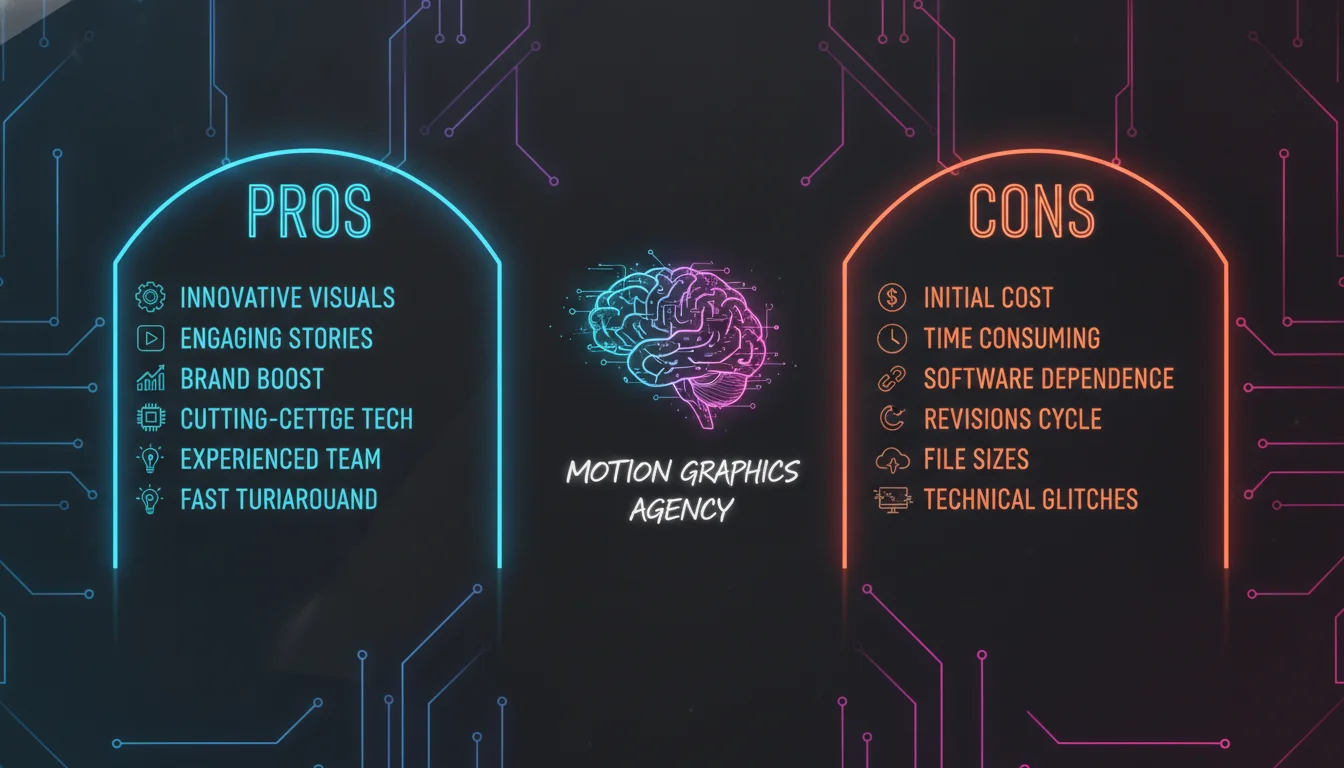
Pros
- Specialized craft: You get animators and motion designers who do this full-time, not generalists splitting attention across ten disciplines.
- Faster production: Established agencies have refined workflows. Duck.Design, for example, offers 12 and 24-hour turnaround options for certain deliverables.
- Brand consistency: A full-service motion graphics design agency can pull animated content into your broader branding and marketing materials for a cohesive visual identity.
- Scalable output: From a single logo animation to a multi-channel video campaign, agencies flex to meet demand without you hiring and firing.
- Access to advanced tools: After Effects, Blender, Figma, and 3D rendering pipelines that would cost significant budget to license and staff internally.
Cons
- Cost premium: Quality motion work carries a real price tag. Budget-tier agencies often deliver budget-tier results.
- Creative alignment takes time: The first project with any new agency involves a learning curve as they absorb your brand voice and visual standards.
- Iteration limits: Some agencies cap revision rounds, which can create friction if your internal approval process is complex.
- Availability constraints: Top studios book out. If you need motion content on short notice, your options narrow quickly.
How to Choose the Right Motion Graphics Design Agency
Selecting the right motion graphics design agency comes down to three non-negotiables: portfolio quality, process transparency, and proven results in your category. Here’s how to evaluate each one without wasting time on the wrong fit.
Step 1: Evaluate Their Portfolio Honestly
Don’t just look at whether the work is beautiful. Ask whether it’s strategically purposeful. A great motion graphics portfolio shows range across styles, clear brand alignment in each piece, and evidence that the animation serves the message rather than overshadowing it. Look for projects in your industry or with comparable complexity to what you need.
Step 2: Understand Their Production Process
Ask exactly how they move from brief to delivery. A transparent process, covering concept development, storyboarding, production, revision rounds, and final delivery, signals a mature studio that respects your time and budget. DEPT Agency describes their process as starting with listening, then collecting references into a storyboard, then translating that into animation with sound and voiceover. That kind of structured clarity is what you want to hear.
Step 3: Check Client Testimonials and Case Studies
Testimonials tell you about the experience of working with an agency. Case studies tell you about the results. Prioritize case studies that include performance context: did the video increase conversions, improve engagement rates, or support a successful product launch? Feedback from clients in your industry carries the most weight.
Step 4: Assess Strategic Fit
The agency’s aesthetic sensibility needs to align with your brand’s visual world. If your brand is warm, human, and story-driven, a studio that defaults to cold, tech-forward 3D renders is going to create friction at every revision. Look at their default style and ask whether it matches where you want to go, not just where you are now.
The Motion Graphics Production Process
The production process at a professional motion graphics design agency follows a clear sequence that keeps creative decisions grounded in strategy at every stage.
Step 1: Concept Development
The agency works with you to understand your goals, target audience, and the specific message the animation needs to carry. This stage produces a creative brief that everyone signs off on before a single frame is designed. Skipping this step is the most common reason motion projects go sideways.
Step 2: Storyboarding
Once the concept is locked, the agency builds a storyboard that maps the visual flow of the animation scene by scene. Think of it as the architectural blueprint: it shows you exactly what you’re getting before production begins, which saves revision time and budget downstream.
Step 3: Production and Animation
Designers build the visual assets and animate them according to the approved storyboard. Sound design, music, and voiceover are integrated during this phase to create a complete sensory experience. This is where tools like After Effects and Blender do the heavy lifting.
Step 4: Review, Revision, and Delivery
The agency presents the draft animation for client review. Feedback is incorporated across agreed revision rounds, and the final file is delivered in the formats your platforms require, whether that’s MP4 for social, MOV for broadcast, or Lottie JSON for web animation.
Benefits of Investing in Motion Graphics
Investing in motion graphics produces compounding returns across brand awareness, audience engagement, and conversion performance.
Enhanced Engagement
Motion captures attention more effectively than static images or text. In a feed full of still images, a well-crafted animation stops the scroll. That initial capture translates into longer time-on-page, higher video completion rates, and more meaningful brand interactions.
Improved Brand Recall
Dynamic visuals reinforce brand identity in a way that static design simply can’t match. When your logo animates, your brand colors move with intention, and your typography has rhythm, audiences remember you. Brand recall is the foundation of long-term marketing efficiency.
Increased Conversion Rates
Motion graphics drive conversions by simplifying complex information and guiding viewers toward a clear action. An explainer video on a landing page can reduce the cognitive load of a purchase decision significantly, which is why product pages with video consistently outperform those without, according to industry data from HubSpot.
Organic Amplification
High-quality motion content gets shared. When animation is genuinely surprising or emotionally resonant, audiences distribute it for you across social platforms. That organic amplification extends your reach without proportionally increasing your media spend.
“Motion graphics are uniquely effective at driving conversions, as they simplify complex ideas, evoke emotions and keep viewers engaged longer.” – Superside, 2026
Tools and Software Used by Motion Graphics Agencies
Professional motion graphics studios rely on a core set of industry-standard tools that determine both the quality ceiling and the stylistic range of their output.
- Adobe After Effects: The industry standard for 2D motion graphics, compositing, and visual effects. Nearly every professional motion graphics design agency uses it as their primary production environment.
- Blender: An open-source 3D animation and rendering platform that has become a serious professional tool, used by agencies including Motion The Agency for 3D renders and complex animations.
- Figma: The go-to tool for UI animation prototyping, allowing motion designers to create and communicate interface animations before development begins.
- Cinema 4D: Widely used for broadcast-quality 3D motion graphics, particularly in title sequences and product visualization.
- Lottie / Bodymovin: A workflow that exports After Effects animations as lightweight JSON files for web and app integration, making motion graphics practical for digital product teams.
Comparison of Top Motion Graphics Design Agencies
| Agency Name | Specialization | Notable Clients | Average Turnaround Time |
|---|---|---|---|
| Superside | Motion ads, animated videos, animated logos | Various startups and enterprises | 12-24 hours |
| Duck.Design | Explainer videos, animated logos, GIFs | Social Trading, Lotto, Maecenas | 12-24 hours to 1-2 weeks |
| NinjaPromo | 2D and 3D animations, explainer videos | Multiple industries | 1-3 weeks |
| DEPT Agency | 3D, 2D, AR, brand motion design | Enterprise brands globally | Project-based |
| Motion The Agency | UI animation, 2D, 3D, sizzle reels | USA, UK, AUS clients | Fast turnaround, fixed-price |
Brand Spotlight: What Great Motion Graphics Look Like in Practice
The DEMO Festival, co-organized by DEPT Agency, is one of the clearest examples of motion graphics at genuine cultural scale. In November 2019, the festival took over Amsterdam Centraal station, one of the Netherlands’ busiest transit hubs, and ran motion design content across 80 digital screens for 24 hours straight, reaching over 250,000 passengers in a single day. That’s not a marketing campaign. That’s motion design as public art, and it demonstrates exactly what’s possible when a motion graphics design agency operates at the intersection of craft and strategy.
The lesson for brand owners: motion graphics aren’t just a deliverable. They’re a medium. The agencies that understand that distinction are the ones worth working with.
Frequently Asked Questions
What is the salary of a motion graphic designer?
The salary of a motion graphic designer varies based on experience, specialization, and location. In the United States, salaries generally range from $50,000 to $100,000 annually, with senior motion designers and creative directors commanding the higher end of that range.
What does a motion graphic designer do?
A motion graphic designer creates animated graphics and visual effects for videos, advertisements, digital interfaces, and branded content. They combine design skills with animation technique to translate brand messages into moving visuals that engage and inform audiences.
How much money do motion designers make?
Motion designers’ earnings vary widely depending on their skill level, the complexity of their projects, and whether they work in-house or freelance. Based on industry data, experienced motion designers working with established studios or agencies typically earn in the $60,000 to $100,000 range annually.
What are the top companies for motion graphics?
As of 2026, leading motion graphics studios include Superside, Duck.Design, NinjaPromo, DEPT Agency, and Motion The Agency, each known for distinct specializations ranging from high-volume motion ads to bespoke 3D brand animation. The right choice depends on your budget, timeline, and the visual complexity of your project.
Why should I hire a motion graphics design agency?
Hiring a motion graphics design agency gives you access to specialized animation skills, professional production tools, and a structured creative process that most in-house teams can’t replicate efficiently. The result is higher-quality content produced faster, with strategic intent built into every frame.
What types of projects can a motion graphics agency handle?
A motion graphics agency can handle explainer videos, animated logos, UI animations, social media motion content, broadcast spots, animated presentations, 3D product visualizations, and full multi-channel video campaigns. The scope depends on the studio’s specialization, so always review their portfolio for work that matches your project type.
Ready to make your brand move? Contact Emin Media for a free brand consultation and let’s build something bold together.
Enjoyed this article?
Contact Emin Media for a free brand consultation and let's create something amazing together.
Get in TouchRelated Articles
Digital Marketing for Creatives: A Bold Guide
Digital marketing for creatives builds real visibility and sales. Learn strategies for social media, SEO,…
Branding & Design Agency Tips That Actually Work
Discover branding and design agency tips to choose the right partner, set clear goals, and…
Creative Agency Pitch Deck Tips That Win Clients
Master creative agency pitch deck tips that win clients in 2026. Learn storytelling, design, and…