Motion Graphics Agency: What They Do & How to Choose
A motion graphics agency is a specialized creative firm that produces animated visual content for brands, campaigns, and digital platforms. These studios blend artistic craft with technical skill to tell stories that static content simply cannot. Their core output: animation, video production, and motion-driven marketing.
Key Takeaways
- A motion graphics agency combines animation, storytelling, and strategy to make brands impossible to ignore.
- Core services span 2D animation, 3D renders, UI animation, explainer videos, and branded motion content.
- Motion graphics are proven to increase viewer retention and click-through rates across social and digital platforms.
- Choosing the right agency means evaluating portfolio depth, communication style, and strategic alignment with your goals.
- As of 2026, AI-assisted workflows and interactive content are reshaping how motion agencies operate and deliver.
- Cost varies widely based on project scope, agency reputation, and turnaround speed – always discuss budget upfront.
What is a Motion Graphics Agency?
A motion graphics agency is a creative studio built around one core belief: moving images communicate what static ones cannot. These teams design, produce, and deliver animated content across every media format – from social reels to product launch films to full brand identity systems in motion. According to DEPT Agency, every minute, 600 hours of video are uploaded online, which means your content needs to be genuinely different to cut through. A skilled motion graphics agency makes that difference by design.
The best agencies don’t just animate. They listen first. They study your brand, map out a storyboard, and then translate your vision into motion with sound design, voice-over, and visual rhythm working together. Studios like FEVR, DEPT, and the teams behind Motionographer’s featured work show what’s possible when creative direction meets technical precision.
“Most forward-thinking companies are using motion to enhance their brands and digital experiences to ensure they stand out in the crowded digital reality of today.” – DEPT Agency
The Importance of Motion Graphics in Marketing
Motion graphics matter because attention is the scarcest resource in digital marketing. Static ads get scrolled past. Motion stops the scroll. Here’s why brands across every industry are making animated content a core part of their strategy.
1. Enhancing Engagement
Motion graphics are proven to increase viewer retention and click-through rates, according to Superside’s analysis of motion animation ROI in 2026. High-performing motion designs are also shareable, which amplifies reach organically across social platforms. For brands, this means more impressions and higher-quality interactions with target audiences – not just vanity metrics.
2. Simplifying Complex Ideas
Animation breaks down complicated concepts into visual narratives anyone can follow. This is especially valuable for technology, finance, and healthcare brands where the product itself is hard to show. A well-crafted explainer video does in 90 seconds what a whitepaper does in 10 pages.
3. Boosting Brand Recognition
Animated logos, branded transitions, and motion identity systems create a visual language audiences remember. When your brand moves consistently across every touchpoint – social, web, video ads – recognition compounds over time. As Motionographer’s community has documented since 2006, the studios that build lasting brand equity are the ones treating motion as infrastructure, not decoration.
“Motion graphics are uniquely effective at driving conversions, as they simplify complex ideas, evoke emotions and keep viewers engaged longer.” – Superside, 2026
Key Services Offered by Motion Graphics Agencies
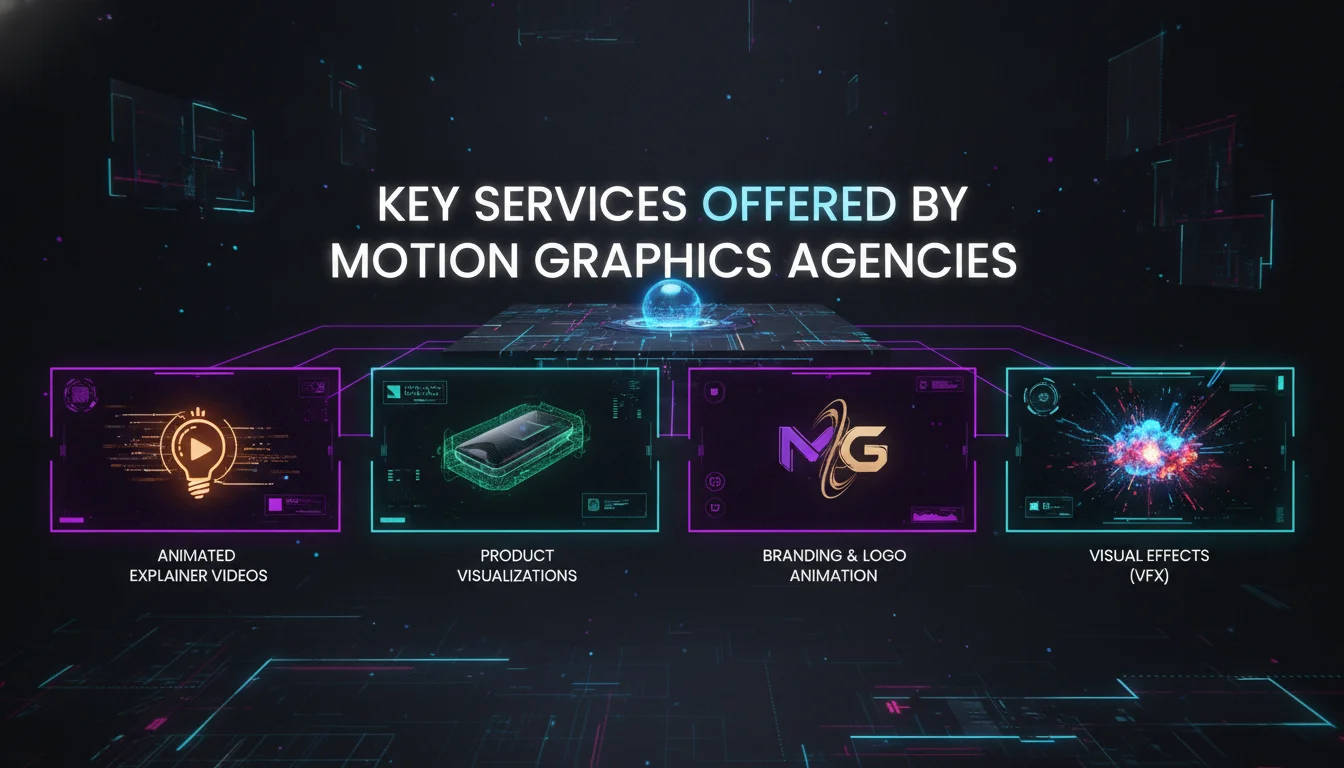
A full-service motion graphics agency offers far more than animation files. The strongest studios cover the entire creative pipeline, from concept to campaign deployment.
1. Animation Services
- 2D Animation: Versatile, fast to produce, and ideal for social media and digital advertising. 2D is the workhorse of most motion campaigns.
- 3D Animation: Adds depth and realism. Perfect for product demonstrations, architectural visualization, and immersive brand experiences.
- UI Animation: Used by UX and web designers to improve customer experience. UI animations bring digital products to life and guide user behavior intuitively.
- Branded Motion Graphics: Intros, outros, lower thirds, and transitions that make your video content instantly recognizable as yours.
2. Video Production
- Sizzle Reels: Short, punchy videos that showcase the best of your product or service. Built to create emotional connection fast.
- Explainer Videos: The clearest way to communicate a complex offer. Used across landing pages, sales decks, and paid campaigns.
- Product Videos: Combine 2D and 3D techniques to educate, entertain, and convert. Especially effective for e-commerce and SaaS brands.
- Campaign Films: Full narrative productions for brand launches, events, and multi-channel campaigns. FEVR’s work for brands like Dior, Netflix, and PepsiCo shows what this looks like at the highest level.
3. Digital Marketing Integration
- Social Media Strategy: Tailoring motion content for each platform – vertical for Reels, square for feeds, horizontal for YouTube. One creative vision, built to work everywhere.
- Analytics and Reporting: Measuring how motion content performs against real marketing goals, not just view counts.
- SEO Optimization: Ensuring animated content is structured and tagged to rank in search and surface in AI-powered discovery tools.
Pros and Cons of Hiring a Motion Graphics Agency
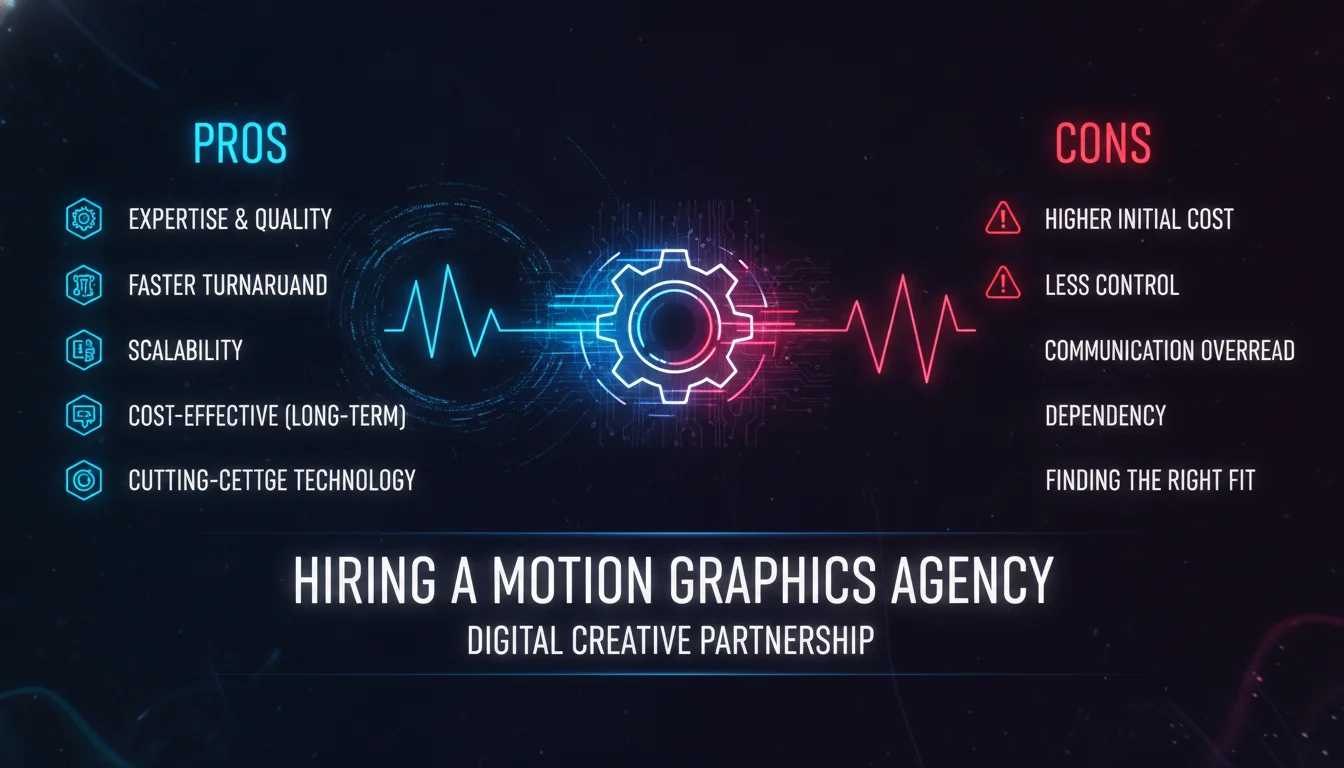
Hiring a motion graphics agency is a strategic decision with real trade-offs. Here’s an honest look at both sides.
Pros
- Access to specialist talent: You get animators, motion designers, sound designers, and creative directors working as a team – skills that are nearly impossible to replicate with a single in-house hire.
- Faster turnaround at scale: Agencies built for volume can produce multiple assets simultaneously, which matters when you’re running multi-channel campaigns with tight deadlines.
- Strategic creative thinking: The best motion graphics agencies don’t just execute briefs. They challenge assumptions, push creative boundaries, and bring industry knowledge your internal team may not have.
- Platform-ready output: Experienced agencies deliver content formatted for every platform – horizontal, vertical, square – without you having to brief each variation separately.
Cons
- Higher upfront cost: Quality motion work requires skilled labor and time. Expect to invest meaningfully, especially for 3D animation or complex campaign films.
- Creative alignment takes time: The first project with any agency involves a learning curve. Expect revision rounds while the team calibrates to your brand voice and visual standards.
- Less control day-to-day: Outsourcing means trusting another team’s process. If communication isn’t strong, projects can drift from your original vision.
- Not all agencies understand your industry: As Superside notes, many creative agencies are unfamiliar with what generates views in specific industries. Vetting for relevant experience is essential.
How to Choose the Right Motion Graphics Agency
Choosing the right motion graphics agency starts with one question: does their work make you feel something? If the answer is yes, dig deeper into these factors.
1. Portfolio and Expertise
Review the agency’s portfolio with your brand’s goals in mind. Look for stylistic range, technical quality, and projects in your industry or adjacent ones. A studio that’s done exceptional work for a fintech brand may not be the right fit for a lifestyle product launch – and vice versa.
2. Client Testimonials and Case Studies
Client feedback reveals what the portfolio doesn’t: how the agency handles revisions, missed deadlines, and creative disagreements. Case studies that show measurable outcomes – increased engagement, campaign performance data, conversion lifts – are worth more than a reel full of beautiful but context-free animations.
3. Communication and Collaboration
The creative process is collaborative by nature. An agency that listens well in the first meeting will listen well throughout the project. Watch for how quickly they respond, how clearly they explain their process, and whether they ask smart questions about your brand before pitching ideas.
4. Flexibility and Pricing Model
Some agencies work on fixed-price projects. Others offer monthly subscription models that give you ongoing access to a full creative team. If you need consistent output across multiple campaigns, a subscription model often delivers better value than one-off project pricing. Discuss both options before committing.
Cost Considerations for Motion Graphics Services
Motion graphics pricing varies more than most clients expect. Understanding what drives cost helps you budget realistically and avoid surprises.
| Cost Factor | Impact on Price | What to Ask |
|---|---|---|
| Project Scope | High | How many deliverables, formats, and revision rounds are included? |
| Animation Style | Medium-High | Is this 2D, 3D, or mixed media? 3D typically costs more. |
| Agency Reputation | Medium | What’s their track record with brands at your scale? |
| Turnaround Time | Medium | Is there a rush fee for expedited delivery? |
| Usage Rights | Variable | Are you licensing the work or buying it outright? |
Complex 3D productions and multi-platform campaign films sit at the higher end of the investment range. Simpler 2D explainers or social motion graphics are more accessible for growing brands. The key is aligning scope with budget before the first frame is drawn.
Future Trends in Motion Graphics for 2026
The motion graphics industry is evolving fast, and the agencies staying ahead are the ones building new capabilities now.
1. AI-Assisted Production Workflows
AI tools are becoming part of the motion design workflow, allowing teams to move faster through early-stage concepting and asset generation. The best agencies use AI to accelerate production without sacrificing the creative judgment that makes work distinctive. As School of Motion and the broader MoGraph community are actively exploring, the question isn’t whether to use AI – it’s how to use it with taste and control.
2. Interactive Motion Content
Interactive motion graphics are gaining real traction. Viewers can now engage with animated content rather than just watch it – choosing paths, triggering animations, and exploring products in ways that static or linear video can’t support. UI animation principles, including easing, masking, and parallax, are moving from app design into marketing content.
3. Platform-Native Motion Design
Every screen. Every format. Every time. The strongest motion graphics agencies in 2026 design with platform constraints built into the brief from day one – vertical for TikTok and Reels, square for feeds, horizontal for YouTube and connected TV. One creative vision, executed across every surface without losing visual integrity.
4. Motion as Brand Infrastructure
The smartest brands aren’t treating motion as a campaign tactic. They’re building motion identity systems: animated logos, branded transitions, sound-on and sound-off versions of every asset, and a consistent visual language that travels across every touchpoint. As Motionographer’s Federico Masini noted in 2026, the brands that build lasting equity treat their visual characters and motion systems as permanent infrastructure – not seasonal decoration.
Top Motion Graphics Agencies Worth Knowing
The motion graphics world has no shortage of talented studios. These names consistently appear in industry conversations and award circuits.
- FEVR (New York / Los Angeles): A full-service production company known for high-end campaign films and branded event content. Clients include Dior, Netflix, PepsiCo, and Coinbase.
- DEPT / Studio Dumbar: A global creative agency with deep motion design capabilities, co-organizers of DEMO Festival – described as the biggest motion festival in the world.
- Superside: An AI-enhanced design company offering motion graphics at scale, with a subscription model built for marketing teams that need volume and flexibility.
- Scorch Motion (London): An edgy MoGraph studio whose work spans 3D to flat 2D animation, highlighted by School of Motion as one of the studios pushing the industry forward.
- Device (Barcelona): A studio that consistently bridges commercial work and artistic ambition, also featured in School of Motion’s list of studios redefining what motion can do.
For a deeper look at how we approach motion and video production at Emin Media, explore our full services page. You can also read our take on brand storytelling and visual strategy in our creative blog.
Frequently Asked Questions
What are the top companies for motion graphics?
Leading motion graphics agencies include FEVR, DEPT, Superside, Giant Ant, Oddfellows, and Thinkmojo, among others. The best choice depends on your industry, budget, and the style of animation that fits your brand. Reviewing portfolios and case studies is the most reliable way to identify the right fit.
What services do motion graphics agencies offer?
A full-service motion graphics agency typically offers 2D and 3D animation, UI animation, explainer videos, sizzle reels, branded motion content, and digital marketing integration. Many also provide social media strategy and campaign analytics to ensure motion assets perform against real business goals.
How can motion graphics improve my marketing strategy?
Motion graphics increase viewer retention, simplify complex ideas, and build brand recognition across every platform. They’re shareable by nature, which extends organic reach beyond paid media. For brands competing in crowded digital spaces, motion content consistently outperforms static alternatives in engagement and recall.
What should I look for when choosing a motion graphics agency?
Start with the portfolio: does their work feel right for your brand? Then evaluate client testimonials for insight into process and reliability. Finally, assess communication style – an agency that asks smart questions before pitching is almost always a better long-term partner than one that leads with a reel.
Are motion graphics agencies only for large companies?
Not at all. Motion graphics agencies serve businesses of every size, from early-stage startups to global brands. Many studios offer tiered pricing, subscription models, or project-based packages specifically designed for growing companies that need professional motion content without enterprise-level budgets.
What is the future of motion graphics in 2026 and beyond?
AI-assisted production, interactive content, and platform-native design are the three forces reshaping the motion graphics industry right now. Agencies that combine creative craft with these new capabilities will define the next era of brand communication. Motion is no longer a nice-to-have – it’s the primary language of digital brand identity.
Ready to make your brand move? Contact Emin Media for a free brand consultation and let’s build something bold together.
Enjoyed this article?
Contact Emin Media for a free brand consultation and let's create something amazing together.
Get in TouchRelated Articles
Digital Marketing for Creatives: A Bold Guide
Digital marketing for creatives builds real visibility and sales. Learn strategies for social media, SEO,…
Branding & Design Agency Tips That Actually Work
Discover branding and design agency tips to choose the right partner, set clear goals, and…
Creative Agency Pitch Deck Tips That Win Clients
Master creative agency pitch deck tips that win clients in 2026. Learn storytelling, design, and…