Marketing Video Production: Strategy & ROI Guide 2026
Marketing video production is the end-to-end process of planning, filming, and distributing video assets built to hit commercial goals like awareness, engagement, and sales. It blends creative craft with strategy so storytelling turns into measurable return.
Key Takeaways
- video production combines pre-production strategy, filming, and distribution into one system, not three separate jobs.
- According to Prodigium Pictures, 94% of marketers say video production for marketing provides a high ROI.
- Per Wyzowl data cited by Swarmify, 89% of businesses used video as a marketing tool in 2025.
- Amazon Ads defines effective video ads by three criteria: simplicity, quality, and memorability.
- Skipping pre-production strategy (goals, audience, budget, video type) is the fastest way to waste a production budget.
- Choosing between a creative marketing agency and a video production company depends on whether you need full-funnel strategy or specialized production craft.
For commercial teams, this type of production is not a nice-to-have anymore. It’s the connective tissue between brand strategy and the action you actually want your audience to take. This guide pulls together the production process, vendor selection, and self-marketing insights that most guides treat as separate topics, so you can make sharper calls heading into 2026.
What Is Marketing Video Production?
Defining the Core Concept
this kind of production is the practice of creating film content specifically built to advertise a product, service, business, or cause. According to Prodigium Pictures, a marketing video is a film produced as part of a video marketing campaign to advertise a product, service, business, or non-profit. Amazon Ads defines video production as the entire process of making a video, from creative development and planning through execution.
marketing video sits at the intersection of craft and commerce. Unlike pure filmmaking, every shot, edit, and distribution choice gets evaluated against a business objective, not just an artistic one.
How Marketing Video Production Differs from General Video Production
General video production often chases storytelling and aesthetics as the end goal. video production uses the same visual tools but anchors them to a campaign structure. The final cut gets judged not just on whether it looks good, but on whether it builds awareness, generates leads, or drives sales.
This distinction matters when you’re briefing a vendor. A production house might hand you gorgeous footage that goes nowhere. A marketing-aware partner connects that footage to your audience segments, funnel stages, and platform behavior from the first meeting.
Why Commercial Buyers Invest in Video
The case for investment is strong and it’s not just a hunch. Prodigium Pictures reports that 94% of marketers say video production for marketing provides a high return on investment. They also note that weekly video consumption has climbed from nearly 16 hours in 2020 to 19 hours today. Separately, Swarmify’s 2026 guide cites Wyzowl data showing 89% of businesses used video as a marketing tool in 2025.
Those figures don’t mean video works automatically. They mean video has become table stakes for reaching people where they already spend their attention, according to brand research from Prodigium Pictures and Wyzowl. The differentiator is whether the production is strategic or purely decorative.
Types of Marketing Video Production
Brand and Commercial Videos
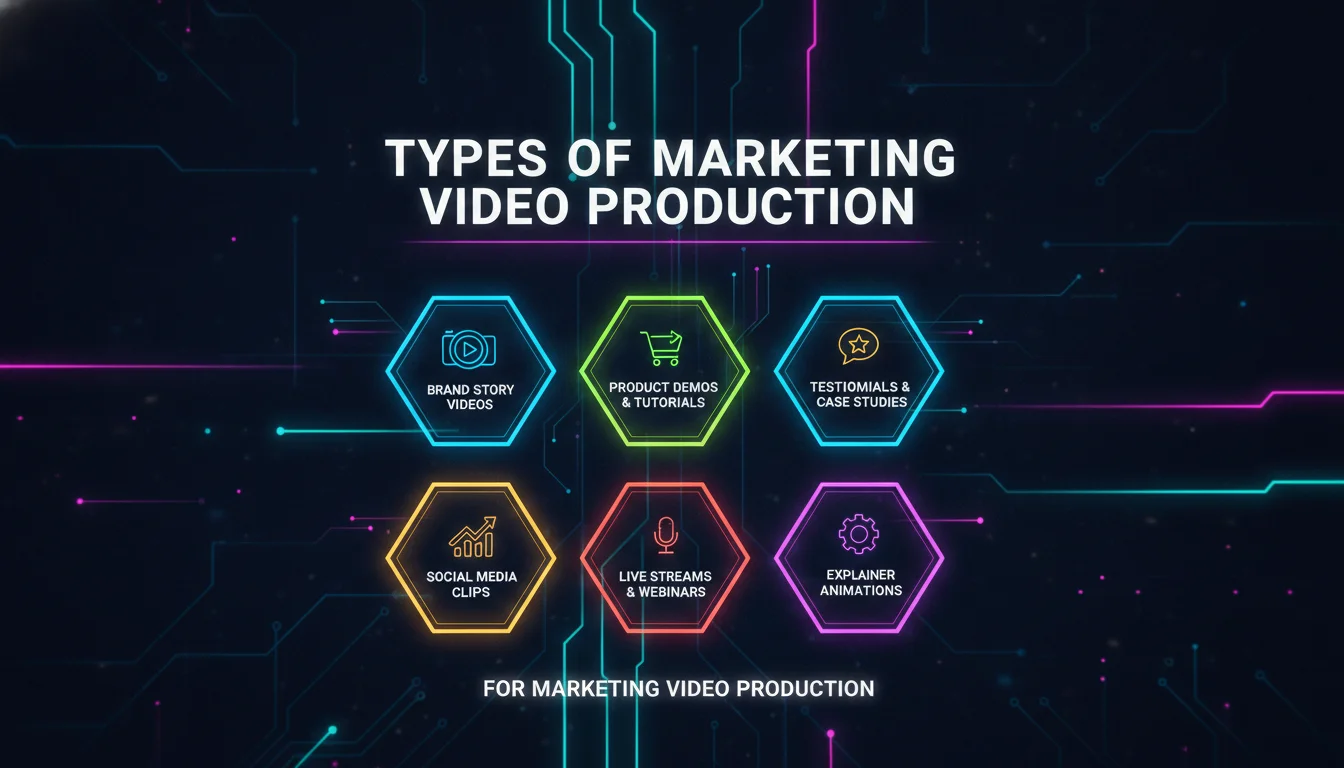
Brand videos are typically the polished, identity-building spots you see on TV and streaming platforms. Amazon Ads identifies brand videos as 60-, 30-, or 15-second video ads for broadcast TV, streaming TV, online, or social media. Prodigium Pictures adds commercial video production that puts products, brands, or organizations on screens of every size.
Product, Explainer, and E-Commerce Videos
Product videos demonstrate features and benefits in action. Explainer videos answer customer questions before a prospect even has to ask. E-commerce videos, per Prodigium, help collect five-star reviews and build the kind of trust that makes site traffic climb. Promotional videos, according to Amazon Ads, can run from 30 seconds to over two minutes and live on a brand’s website, YouTube, or social channels.
Social Media and Digital Out-of-Home Videos
Social media video production is one of the most direct ways to engage customers on the platforms they already scroll, according to Prodigium. Amazon Ads defines digital out-of-home videos as digitized displays visible in public spaces like streets or gathering areas such as shopping malls. These formats play different roles: social is interactive and shareable, while digital out-of-home is ambient and built on repetition.
| Video Type | Typical Length | Primary Goal | Common Channels |
|---|---|---|---|
| Brand video | 60, 30, or 15 seconds | Build awareness and identity | Broadcast TV, streaming TV, social |
| Promotional video | 30 seconds to 2+ minutes | Promote product, brand, or service | Website, YouTube, social media |
| Product video | Varies by product | Showcase features and drive purchase | E-commerce, social, ads |
| Explainer video | Typically short-form | Answer questions and educate | Website, email, YouTube |
| Social media video | Short-form | Engage and share | TikTok, Instagram, LinkedIn |
| Digital out-of-home video | Looping short clips | Public visibility and awareness | Streets, malls, transit |
The Marketing Video Production Process
Step 1: Set Strategic Goals Before Anything Else
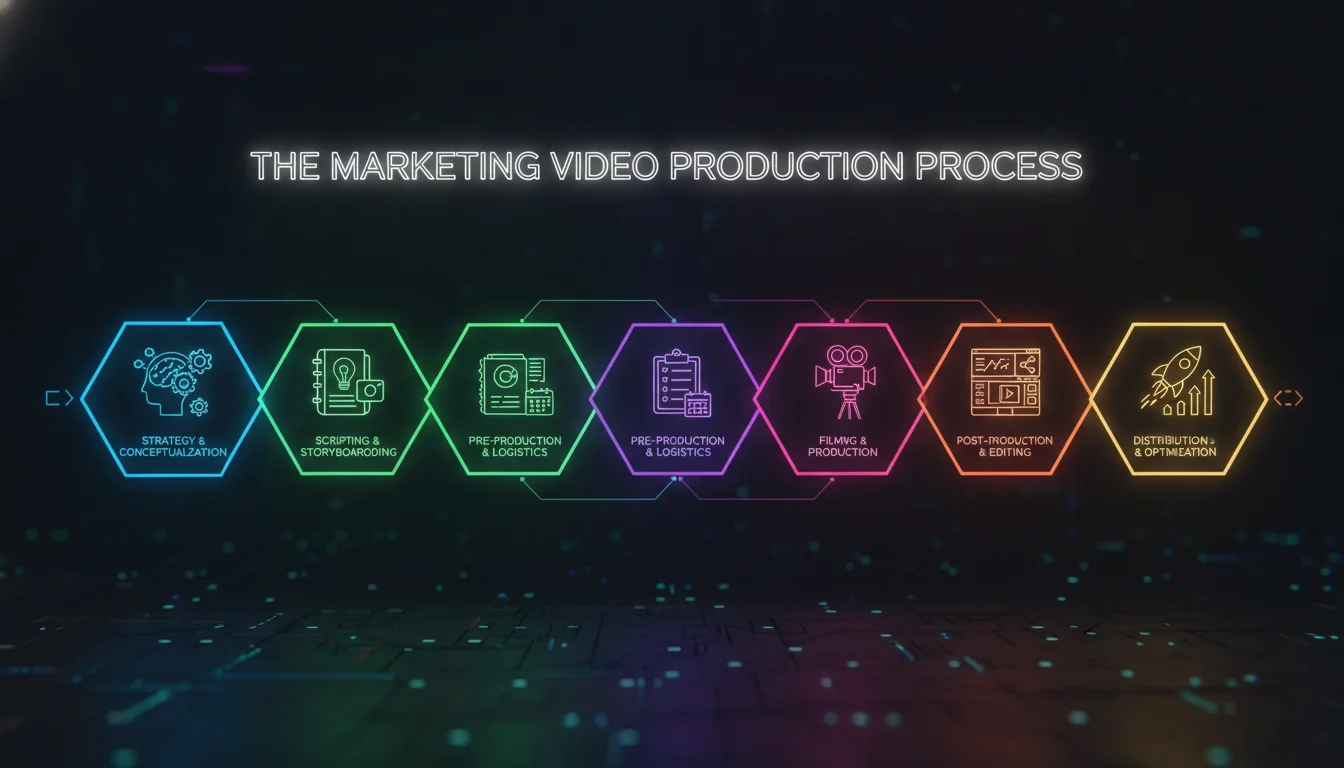
Strategic goals come first because they determine every creative decision that follows. Pretzel Logic Productions emphasizes that planning before production is vital to limit wasted time and money, and their pre-production sequence starts with defining whether the video is educational, promotional, or product-focused, and what the audience should walk away knowing.
Step 2: Identify the Target Audience
Your target audience shapes tone, pacing, and even the platform you’ll cut for. Build creative materials around that audience’s personalities and interests to actually hold their attention, not just fill airtime.
Step 3: Create a Budget and Timeline
Budget and timeline are connected: stretching one always affects the other. Longer timelines cost more, so breaking the project into smaller deadline targets keeps spend efficient and keeps the whole team accountable.
Step 4: Choose a Video Type and Style
Choosing animation versus live action is one of the earliest creative forks in the road. Match your distribution channels to the format. a punchy vertical cut for social looks nothing like a 30-second broadcast spot, and it shouldn’t.
Production: Execution and Creative Direction
Charter’s blog notes that high-quality brand films require professional equipment, an experienced crew, and clear narrative intent. Prodigium Pictures describes a collaborative flow: after specifications are discussed, they present creative ideas and storyboards in a pitch, then bring clients into decisions on scripts, casting, and filming locations.
This stage is where strategy becomes footage. The production partner’s job isn’t just to capture images. It’s to protect the strategic thread that pre-production already laid down.
Post-Production: Editing, Distribution, and Optimization
Post-production covers editing, sound design, color grading, and motion graphics, but the commercial value of marketing video production goes further than the edit bay. Prodigium notes that after production wraps, they help with distribution and build social impact strategies custom-fit to the organization. Amazon Ads emphasizes that the process spans every stage from creative ideation to execution, which in practice means versioning for platforms and tracking performance.
Without a distribution plan, even a beautifully produced video just becomes another file sitting in a folder. The final cut needs to be packaged, titled, captioned, and placed exactly where your audience already spends time.
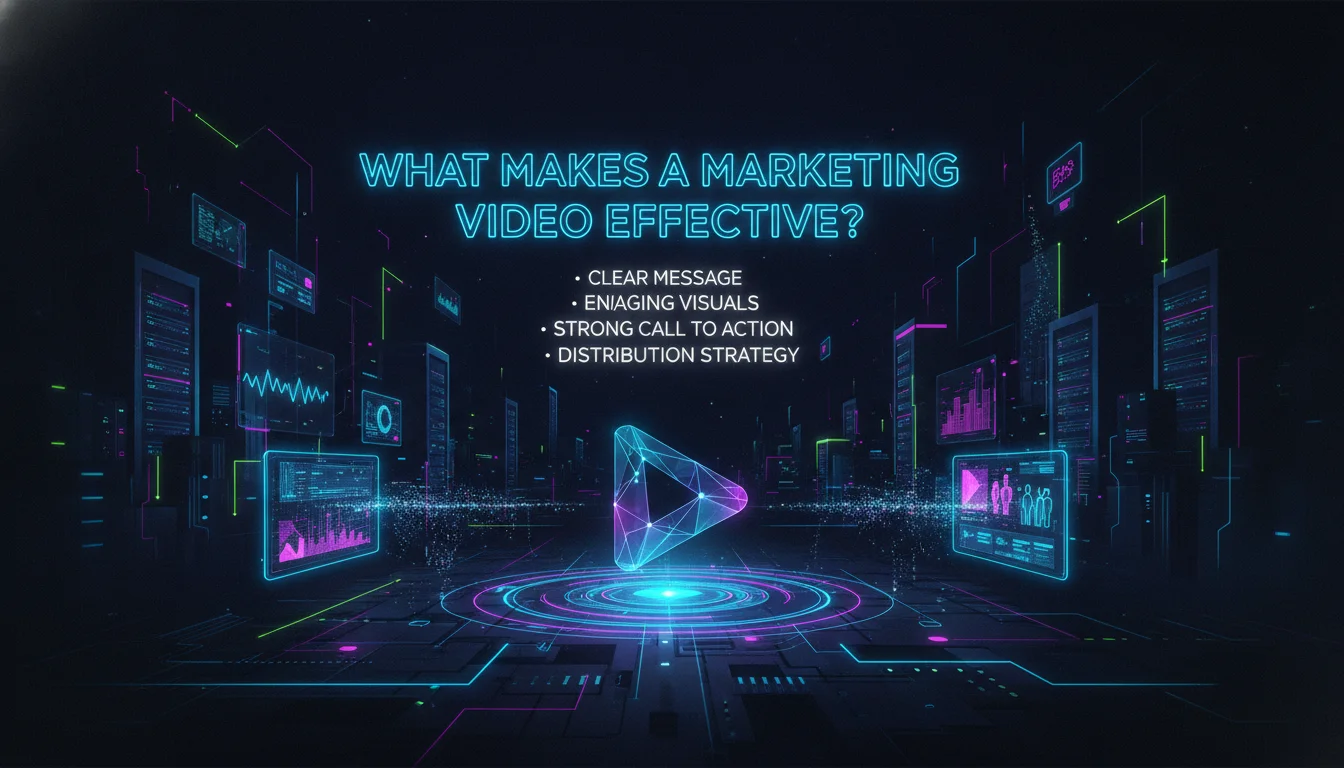
What Makes a Marketing Video Effective?
Simplicity: No More Than Two Points
An effective marketing video communicates one, maybe two, ideas clearly instead of trying to say everything at once. Amazon Ads identifies simplicity as the first universal criterion for effective video ads: communicate key information about the brand or product in a clear, concise way, focusing on at most two points. Overloading the message dilutes recall and kills action.
Quality: Production Value and Story Edit
Quality doesn’t necessarily mean the biggest budget in the room. Amazon Ads defines quality as high production value paired with a well-crafted edit that pushes the story forward while holding attention. Charter’s insight backs this up: professional equipment and crew matter, but only when they serve a clear narrative intent.
Memorability: Distinctive Brand Connection
Memorability comes from telling an original story that connects your brand to its product in a way competitors can’t easily copy. This is where creative differentiation actually lives. A generic testimonial or feature list might inform someone, but it won’t stick with them.
These three criteria, simplicity, quality, and memorability, give you a practical rubric for evaluating any marketing video production effort, whether it’s built in-house or with an outside partner.
Visual Trends Shaping Marketing Video Production in 2026
As of 2026, brand films are leaning harder into real-time production tools and bolder visual identities than they did even a couple years ago. Charter’s blog, which tracks production and marketing trends closely, points to virtual production techniques, including LED volume stages and real-time rendering through engines like Unreal Engine, as a growing part of how commercial and branded work gets made. These tools let creative teams build immersive environments without location shoots, which changes both the budget math and the creative possibilities.
Beyond the technical side, brands are also investing more in social impact storytelling and cause-driven video, a category Prodigium Pictures specifically builds services around. If your brand has a genuine social impact story, this year is a strong moment to tell it on video rather than burying it in a blog post nobody reads.
How to Choose Between a Creative Marketing Agency and a Video Production Company
What a Creative Marketing Agency Does
A creative marketing agency guides your project from the first idea through final implementation, not just the shoot day. According to VMG Studios, a creative marketing agency is a resource from start to finish, guiding the project from ideation and scripting through design and implementation. They oversee, strategize, develop, and deploy creative content, acting as an extension of your own team.
What a Video Production Company Does
A video production company typically focuses on the executional craft: pre-production, filming, editing, and finishing, but may not own the upstream strategy or downstream distribution. Prodigium Pictures illustrates how blurry this line has gotten, since many production companies now offer strategic services like social impact marketing and distribution support alongside the camera work.
Hybrid Models and Key Vetting Questions
VMG Studios describes itself as a hybrid creative marketing agency and video production studio, constantly defining itself against what each client actually needs. When vetting suppliers for your next marketing video production project, ask whether they can tie video output to your actual marketing KPIs, not just hand you a polished file. The right partner explains how their process maps to your funnel before you even sign anything.
How to Market Your Own Video Production Company
SEO and Portfolio Optimization
Getting found starts with a website built to rank, not just look nice. Swarmify’s 2026 guide to marketing a video production company prioritizes website SEO to attract organic traffic and a strong portfolio that highlights your best work. For a service business, that portfolio isn’t just proof of quality. It’s your primary conversion asset.
Social Media and Email Nurturing
Social and email aren’t optional extras for a production company chasing new clients. Swarmify also recommends using social media and email marketing to nurture leads over time. The demand signal is already there: if 89% of businesses used video as a marketing tool in 2025, your prospects are already sold on video’s value. Your job is simply to be the obvious choice when they’re ready to spend.
Networking and Referral Systems
Referrals convert faster because they arrive with built-in trust nobody has to earn from scratch. Swarmify lists networking with industry peers as a proven strategy for a reason. In a crowded supplier market, relationships often outperform cold outreach by a wide margin.
Budgeting and ROI Expectations for Marketing Video Production
What Drives the Cost of a Marketing Video?
Timeline is one of the biggest cost drivers in any marketing video production budget. Pretzel Logic Productions advises that budget depends somewhat on timeline, and stretching that timeline out increases total cost. Other drivers include crew size, equipment, animation complexity, location fees, and talent. Amazon Ads notes that in-house creative production and editing services fit a wide range of budgets, which means there are entry points for smaller brands willing to prioritize wisely.
Measuring ROI Across the Funnel
The 94% high-ROI figure reported by Prodigium Pictures reflects marketer sentiment, but real measurement means linking video to specific funnel actions: views, click-throughs, form fills, or sales. A marketing video production strategy should define success metrics before the first storyboard gets drawn, not after the video goes live.
Scaling Video Without Sacrificing Quality
One practical path forward is modular production: shoot your core brand assets once, then cut platform-specific versions from that same footage. Amazon Ads’ guidance on crafting effective video ads, simplicity, quality, memorability, applies equally to a high-budget commercial and a low-cost social cut. The discipline lives in the creative approach, not just the size of the check.
Common Mistakes in Marketing Video Production
Skipping Pre-Production Strategy
Pretzel Logic warns that starting production without clear goals risks creating a chaotic mess of a video. The most expensive mistake isn’t a bad camera angle. It’s a beautifully produced video that speaks to the wrong audience, or no audience at all.
Overloading the Message
Amazon Ads’ simplicity criterion directly pushes back against the urge to say everything at once. If a video tries to communicate six product benefits and three brand values, it ends up communicating none of them clearly. Stick to no more than two points.
Ignoring Distribution and Optimization
Prodigium Pictures explicitly folds distribution and optimization into its post-production scope, and for good reason. A video nobody sees can’t generate ROI, no matter how good it looks. Build the distribution plan before production even begins, including where the video will live, how it gets captioned, and which KPIs it needs to move.
Pros and Cons of Investing in Professional Marketing Video Production
Pros
- Video consistently drives higher engagement and recall than static content across most channels
- A single shoot can be cut into multiple assets for social, web, and paid campaigns
- Professional production signals credibility and builds trust faster than DIY content
- Video assets have a longer usable life span than most other creative formats
Cons
- Upfront costs can be a barrier for smaller brands without a clear budget plan
- Poor pre-production planning can waste both time and money quickly
- Turnaround times can slow campaign launches if timelines aren’t managed carefully
- Without a distribution strategy, even great footage can sit unused
Building a Smarter Marketing Video Production Strategy
Bringing It All Together
Marketing video production isn’t a single deliverable you check off a list. It’s a system connecting strategy, creative execution, and distribution into one continuous loop. The strongest competitors in your space are using video as a measurable business lever, not decoration. Creative industry data from Prodigium, Amazon Ads, Pretzel Logic, and Swarmify all point toward the same conclusion: success comes from pre-production rigor, creative discipline, and audience-first distribution.
A great brand film can define how people see your company, and the partner you choose to make it is often the difference between a video that lands and one that quietly disappears, according to Charter’s production insights.
Your Next Steps
Start by auditing your current video library against the three Amazon Ads criteria: simplicity, quality, and memorability. Then decide whether you need a strategic agency, a production partner, or a hybrid of both. Finally, build your distribution and measurement plan before you brief the next project. With a disciplined approach, marketing video production becomes one of the highest-leverage investments in your commercial toolkit this year.
Ready to turn your next campaign into something people actually remember? Contact Emin Media for a free brand consultation, and let’s build something bold together.
Frequently Asked Questions
How much does it cost to make a marketing video?
Costs vary based on crew size, animation complexity, location, and timeline. Amazon Ads notes that in-house production and editing services fit a wide range of budgets, while Pretzel Logic Productions advises that longer timelines increase total cost.
What are the five stages of video production?
While frameworks vary slightly by source, the core stages are pre-production, production, post-production, distribution, and measurement. Amazon Ads includes everything from creative ideation through execution, and Prodigium Pictures adds distribution and optimization after production wraps.
What does video marketing do?
Video marketing uses video content to build brand awareness, engage audiences, generate leads, and drive sales. Prodigium Pictures lists goals including building authority, boosting website traffic, and cultivating customer loyalty.
How do I get clients for my video production company?
Swarmify recommends optimizing your website for SEO, building a strong portfolio, using social media and email marketing to nurture leads, and networking with industry peers for referrals.
What is the difference between video production and video marketing?
Video production is the process of creating video content, while video marketing is the strategic use of that content to hit business goals. Marketing video production blends both by tying every production decision to campaign objectives from the start.
Enjoyed this article?
Contact Emin Media for a free brand consultation and let's create something amazing together.
Get in TouchRelated Articles
Digital Marketing for Creatives: A Bold Guide
Digital marketing for creatives builds real visibility and sales. Learn strategies for social media, SEO,…
Video SEO for Creative Agencies: The 2026 Playbook
Video SEO for creative agencies is how you turn portfolio reels into search traffic. Get…
Creative Brand Photography: The Complete Guide
Creative brand photography is your visual voice. Learn how to plan shoots, find the right…