Influencer Marketing Trends 2026: What Actually Works
Influencer marketing trends 2026 are defined by performance accountability, micro and nano creator dominance, AI-powered workflows, social commerce, and long-term partnerships. Brands are shifting budgets to creator programs and measuring success through ROI, CAC, AOV, and revenue, not likes.
Key Takeaways
- Performance replaces vanity metrics: Influencer marketing trends 2026 are judged by ROI, CAC, AOV, and revenue, not likes or impressions.
- Micro and nano influencers dominate: Creators with under 100,000 followers (micro) and under 10,000 followers (nano) drive higher engagement and conversions than celebrity accounts.
- AI and social commerce are core infrastructure: 86% of creators already use generative AI; TikTok Shop and YouTube Shopping turn content into direct sales.
- Long-term partnerships win: Ambassador-style deals and co-created content consistently outperform one-off sponsorships.
- Hybrid compensation is now standard: Base fees plus 10-15% commissions and tiered bonuses align creator incentives with brand revenue goals.
- Community beats the algorithm: Creators are building owned spaces where engagement runs deeper than any feed can deliver.
Influencer Marketing Trends 2026: The Performance Accountability Shift
From Reach Metrics to Revenue Metrics
Performance-driven influencer marketing is an approach where creator partnerships are evaluated by revenue outcomes, customer acquisition cost (CAC), average order value (AOV), and return on investment (ROI), rather than exposure alone. For years, brands measured success by likes, impressions, and follower counts. That model is now obsolete. According to impact.com, during Cyber Week 2025, social media influencers nearly doubled their share of total orders year-over-year, while influencer-driven spend jumped 51 percent and commission costs stayed flat. That is not an awareness metric. It is proof that the infrastructure for creator commerce now works.
The financial scale behind this shift is significant. CreatorIQ reports that the creator marketing market reached $33 billion in 2025, up from under $10 billion in 2020. Creator marketing budgets expanded 171% in 2025, with 71% of brands committing to invest more year over year and nearly two-thirds reallocating funds from traditional channels to creator-focused strategies. In 2026, 74 percent of brands are moving budget into creator programs, according to impact.com. These brands are not treating creators as experiments. They are making them a core strategy judged by the same standards as paid media. The influencer marketing trends 2026 driving this shift are not speculative; they are backed by measurable changes in spend and outcomes.
Why 2026 Demands Full-Funnel Accountability
Platform behavior keeps users in-app longer, reducing clean click-through signals. As Realize explains, this forces brands to think beyond last-touch attribution. Many teams are now layering in incrementality testing, lift studies, and blended attribution models to understand the true contribution of creators across the full funnel. Without this infrastructure, campaign ROI remains a black box.
Accountability also shows up in contracts. Realize notes that 63 percent of businesses now include ROI-specific targets in influencer contracts. Agreements increasingly include performance benchmarks, content ownership clauses, exclusivity windows, and clearly defined disclosure requirements aligned with FTC regulations. Content licensing and usage rights are becoming standard, so brands pay not only for organic distribution but also for reusable creative assets across paid media, ecommerce, and owned channels.
The Role of Attribution and Incrementality
Attribution in influencer marketing is the process of assigning credit for conversions and revenue to specific creator touchpoints across the customer journey. Improved attribution tracking highlights what content and campaigns resonate with an audience and what underperforms. Affiliate programs allow brands to track, to the dollar, exactly how much revenue each creator partnership generates. As of 2026, performance-based compensation models combining a base fee with conversion or revenue shares are becoming more common as both sides seek aligned incentives.
This is precisely why influencer marketing trends 2026 prioritize measurement infrastructure. Without accurate attribution, brands cannot justify increased budgets, and creators cannot negotiate fair performance bonuses. The result is a more transparent, efficient market for everyone involved.
“Creator marketing is now judged by CAC, AOV, and ROI, the same standards as paid media. Infrastructure beats one-off campaigns every time.” – impact.com, Influencer Marketing Trends 2026
Micro and Nano Influencers Continue to Dominate
Defining Micro, Nano, and Mid-Tier Creators
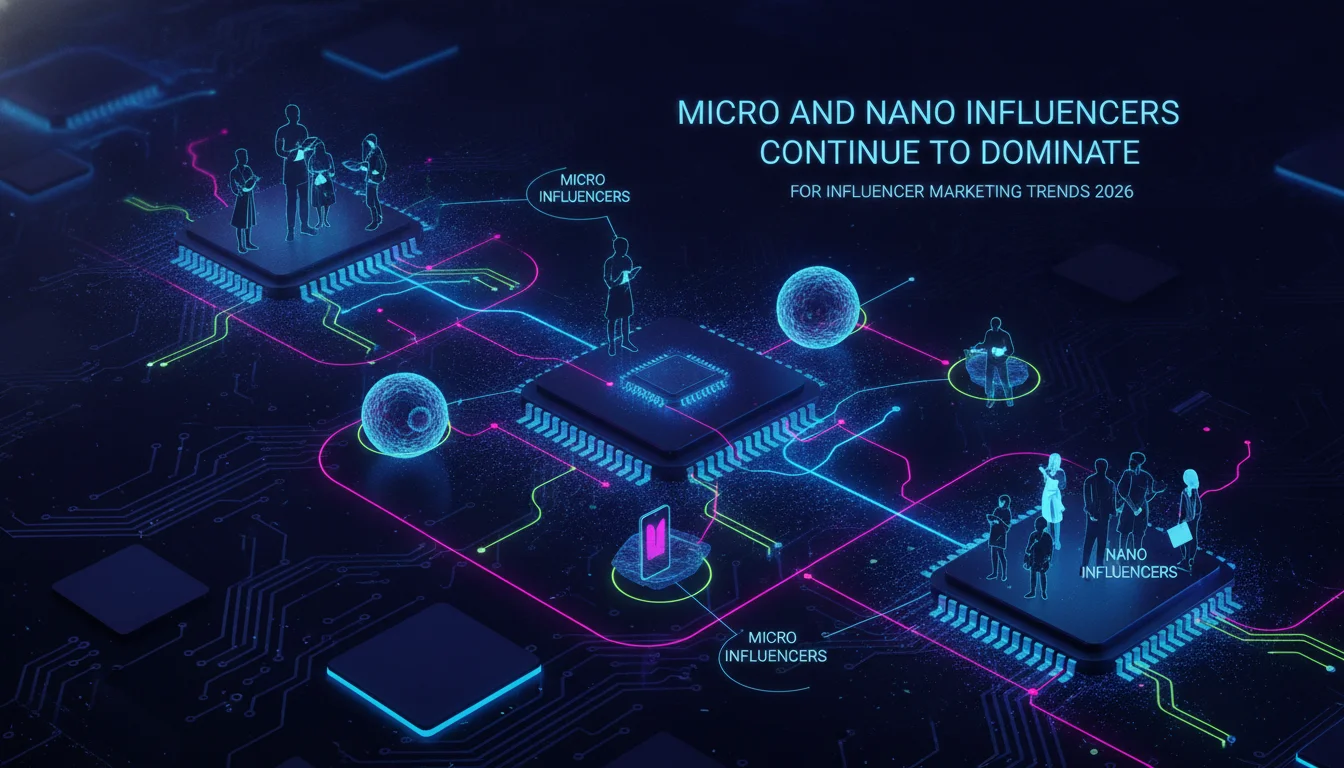
Follower size is no longer the primary determinant of creator value. A nano influencer is a creator with fewer than 10,000 followers. A micro influencer has between 10,000 and 100,000 followers. These definitions align with the framework used by Realize in its 2026 trends report. Mid-tier creators generally fall between 100,000 and 500,000 followers, while macro and mega influencers exceed those thresholds. What matters more than the number is the depth of community trust a creator has built.
Nano and micro influencers often maintain hyper-engaged communities. Their followers trust their recommendations because the creator can engage one-on-one with many audience members, creating an authentic, two-way relationship. This personal connection makes brand advertising feel personal rather than promotional, which is exactly what audiences in 2026 demand.
Why Smaller Creators Deliver Higher Engagement and Conversion
Multiple industry sources confirm that smaller creators outperform bigger names on the metrics that matter. Printful states that nano and micro influencers consistently deliver higher engagement than larger accounts. Modash survey data found that niche micro-creators are outperforming mega-influencers. Printful notes that a 20-year-old with 8,000 TikTok followers can often outperform celebrity endorsements. This is especially pronounced in the beauty, fashion, food, and wellness industries, according to Realize.
From a performance standpoint, micro creators drive stronger conversions because their recommendations feel like peer advice. Their communities are more targeted, their content costs less to produce, and the result is better ROI for brands. impact.com emphasizes that micro-creators outperform bigger names on CAC, AOV, and ROI. These influencer marketing trends 2026 make one thing clear: follower count is no longer the primary driver of campaign success.
Cost-Effective Scaling with Multiple Niche Creators
Brands with tight budgets can work with multiple micro and nano influencers for the cost of a single larger influencer. This approach spreads risk, diversifies audience touchpoints, and often yields higher aggregate engagement. The table below compares creator tiers for 2026 campaign planning.
| Creator Tier | Follower Count | Strengths | Best Use in 2026 | Typical Cost Efficiency |
|---|---|---|---|---|
| Nano | Under 10,000 | Highest engagement, deep trust, one-on-one interaction | Hyper-local or niche product launches, UGC creation | Very low; can engage many for one macro budget |
| Micro | 10,000–100,000 | High engagement, authentic communities, strong conversion | Targeted campaigns, affiliate programs, long-term partnerships | Low to moderate |
| Macro | 100,000–1 million | Broad reach, polished content, brand awareness | Product launches requiring wide visibility | Moderate to high |
| Mega/Celebrity | Over 1 million | Massive reach, media attention | National campaigns, brand lift, awareness | High; often lower engagement per dollar |
This tiered approach is not about choosing one over another. It is about matching creator size to campaign goal. For direct response and community penetration, nano and micro are the clear winners in 2026.
AI-Powered Creator Workflows and Virtual Influencers
Generative AI for Content Production
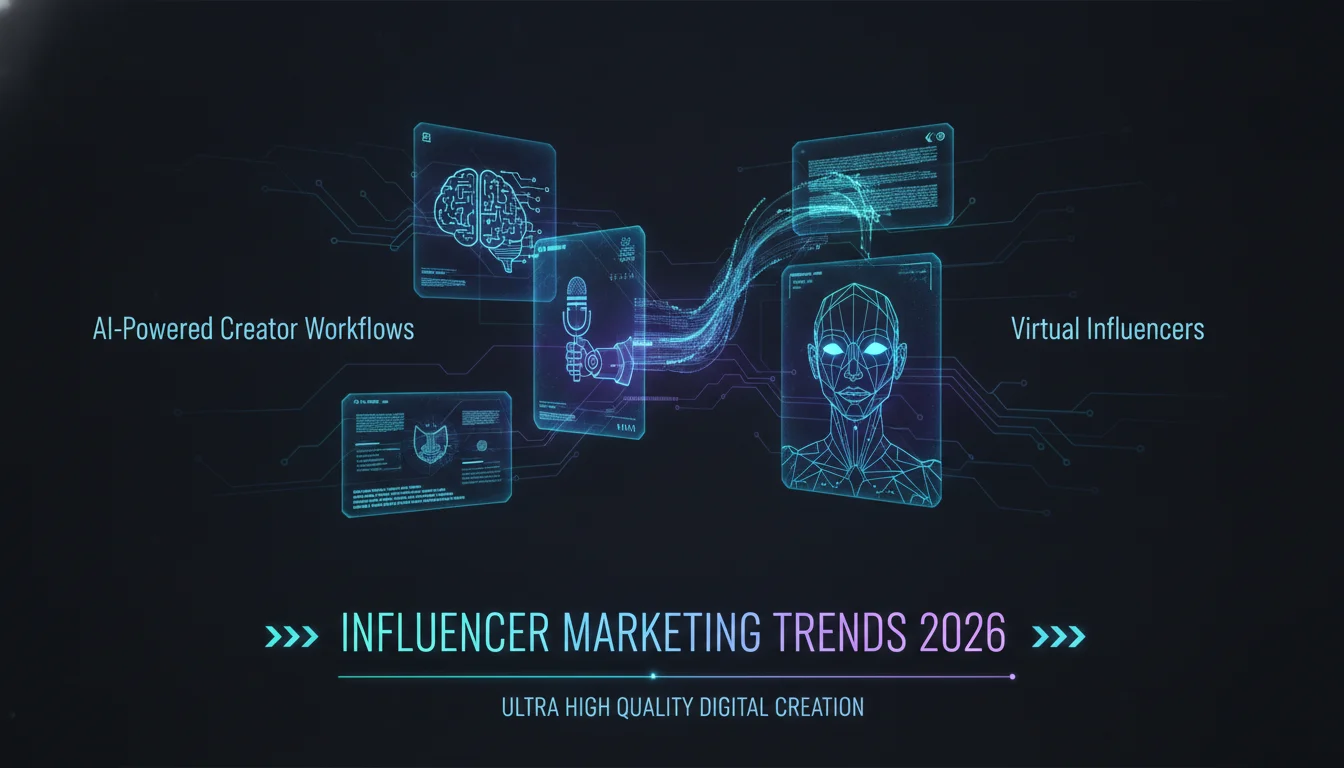
AI-driven creator content is the use of generative artificial intelligence tools to brainstorm ideas, generate assets, produce voice-overs, and polish content for videos, static ads, podcasts, and other media. According to CreatorIQ, 86 percent of creators already use generative AI to power their content, and in 2026 many of the remaining 14 percent are expected to join. AI generation and cost-cutting measures allow brands to do more with less and contribute additional funds to creative budgets.
This does not mean human creativity is irrelevant. AI handles repetitive production tasks, freeing creators to focus on strategy, storytelling, and audience engagement. The result is higher output without sacrificing authenticity. Across all influencer marketing trends 2026, AI has moved from novelty to core infrastructure.
AI in Influencer Discovery, Forecasting, and Admin
Beyond content creation, AI is taking over influencer marketing’s administrative work. Modash identifies AI as the top tool for streamlining admin tasks in 2026. impact.com describes AI as powering precision at scale through real-time insights, predictive payouts, and smarter partner matching. Printful adds that AI tools help brands find creators, forecast campaign performance, and track results more efficiently.
These capabilities reduce the time from brief to launch and improve budget allocation. Instead of manually sifting through thousands of profiles, brands use AI to identify creators whose audience demographics, engagement patterns, and content style match campaign objectives. That is a meaningful operational advantage.
Virtual Influencers and Digital Creators
Virtual influencers are computer-generated personas with social media followings, built using CGI and AI. Captiv8 highlights that AI tools and digital creators are gaining traction, enabling brands to explore new creative possibilities. While these digital creators offer efficiency and complete message control, brands must still prioritize authenticity to maintain audience trust. Virtual influencers work best for highly stylized campaigns, product visualizations, or brand-owned media, not as replacements for human connection.
Social Commerce and Influencer Marketing Trends 2026
TikTok Shop, Instagram, and YouTube Shopping
Social commerce is the process of selling products directly within social media platforms, without requiring users to leave the app. CreatorIQ reports that over a third of marketing agencies believe social commerce is a primary market disruptor heading into 2026. Printful notes that TikTok Shop and YouTube Shopping are turning creator content into direct sales. Instagram, with its shopping features, also participates heavily in this shift.
Influencers are the connective tissue between content and commerce. They demonstrate products, share discount codes, and host live shopping events, converting entertainment into transaction. Because the purchase happens in-platform, the path from discovery to conversion is shorter than traditional ecommerce referrals. This is a defining element of influencer marketing trends 2026: purchase intent is captured at the exact moment of discovery.
Affiliate and Influencer Marketing Merge
Modash identifies the merger of affiliate and influencer marketing as a major trend shaping creator programs this year. Affiliate links, promo codes, and UTMs are now foundational tools in influencer campaigns. This convergence allows brands to pay creators based on performance, tying compensation directly to sales. impact.com recommends hybrid compensation as non-negotiable: base fees plus 10-15 percent commissions plus tiered bonuses. This structure aligns creator incentives with brand revenue goals and reduces wasted spend on campaigns that do not convert.
Measuring Social Commerce Revenue
Measuring social commerce revenue requires tracking in-app purchases, affiliate conversions, and post-campaign lift. The challenge is that platform retention reduces click-through signals, so last-touch attribution underprices creator influence. Brands are therefore adopting blended attribution and incrementality tests. Realize notes that 86 percent of U.S. marketers reported working with influencers in 2025, reinforcing that this measurement challenge is not theoretical but a daily operational reality for most marketing teams.
Community-Owned Spaces: The New Algorithm
One of the most significant influencer marketing trends 2026 is the shift toward community-owned spaces. Creators are moving audiences from public feeds into private communities: Discord servers, newsletters, Substack publications, and membership groups. These owned channels give creators direct access to their most loyal followers without depending on platform algorithms to distribute content.
For brands, this shift creates a new partnership opportunity. Sponsoring a creator’s newsletter or community space often delivers higher engagement than a standard feed post, because the audience has actively opted in. According to impact.com, community is the new algorithm. Creators who build owned spaces where engagement and loyalty run deeper are becoming the most valuable long-term partners a brand can have.
“The creators building owned communities, newsletters, and membership spaces are the ones brands will fight to partner with in 2026. The algorithm can’t touch what you own.” – Emin Media Creative Strategy Team
Long-Term Partnerships and the Professional Creator
Why One-Off Campaigns Are Losing to Ambassador Deals
A long-term influencer partnership is an extended collaboration where a creator works with a brand over months or years, often as an ambassador, rather than for a single sponsored post. Printful states that long-term creator partnerships generate stronger results than one-off campaigns. Modash agrees that long-term creator partnerships remain the best approach, despite a minor dip in their frequency. These relationships build audience familiarity, trust, and consistent messaging over time.
Long-term deals also reduce negotiation overhead and allow creators to develop deeper product knowledge. For brands, this means higher-quality content and more authentic endorsements. In the context of influencer marketing trends 2026, long-term partnerships reduce risk and build compound returns that one-off posts simply cannot replicate.
Creator Professionalization and Brand Selectivity
Content creator is now a legitimate career path, not a pastime or side hustle. CreatorIQ reports that two-thirds of creators acknowledge the professional nature of their roles. These creators are more selective about brand alliances because a wrong association can negatively impact their image and negate their influence. As a result, they seek enduring, ambassador-style relationships with carefully vetted companies.
Brands must present clear value: competitive compensation, creative freedom, usage rights, and long-term vision. The largest creators have more followers than many countries and command attention comparable to media brands, so partnerships must be mutually beneficial to attract and retain top talent.
Contract Maturity: Usage Rights, Exclusivity, and Compliance
Influencer contracts in 2026 are more sophisticated than ever. Realize highlights that agreements now include performance benchmarks, content ownership clauses, exclusivity windows, and clearly defined disclosure requirements aligned with FTC regulations. Content licensing is normalized: brands pay for reusable creative assets across paid media, ecommerce, and owned channels, not just organic distribution. Performance-based compensation combines a base fee with conversion or revenue shares. This contractual maturity protects both parties and ensures campaigns are legally compliant and commercially accountable.
Authenticity, Personal Stories, and UGC-Style Content
Personal Narratives Outperform Polished Ads
Audiences in 2026 prefer real, unscripted content over polished productions. Modash survey data shows that personal stories are outperforming polished ad-style content. Printful confirms that authenticity drives purchasing decisions: audiences trust real, unscripted content over highly produced commercials. This rewards creators who share genuine experiences, struggles, and behind-the-scenes moments related to a brand.
For brands, this means loosening creative control. Overly scripted briefs can kill the very authenticity that makes influencer marketing effective. The best campaigns feel like a friend’s recommendation, not a television ad. Authenticity remains the through-line connecting all influencer marketing trends 2026.
Co-Creation Instead of Briefing
Co-creation is a collaborative process where brands and influencers jointly develop content ideas, rather than brands dictating a top-down brief. Modash identifies that brands are co-creating content with influencers rather than just briefing them. This approach uses the creator’s understanding of their audience and voice, resulting in more genuine content. It also gives creators ownership and motivation to perform at their best.
Co-creation often involves multiple rounds of ideation, shared mood boards, and creator input on product placement. The outcome is content that feels native to the platform and resonates more strongly with the target audience.
Regifting and the Need for Authenticity Planning
Influencer regifting is the practice of a creator giving away or reselling products received from a brand’s gifting campaign. Modash survey data reveals that nearly one in two marketers have seen a creator regift or resell products from a gifting campaign. Regifting itself is not always harmful. A creator might regift a product to a family member who will actually use it, as influencer marketing manager Nicole Ampo described. However, if a creator praises a product and then openly resells it a week later, the brand appears disposable and the partnership feels inauthentic. Brands can protect their reputation by adding a regifting clause to contracts.
Platform and Format Evolution: Short-Form, Offline, and Podcasts
Short-Form Video Dominance on TikTok and Instagram
Short-form video is any video content typically under 60 seconds, designed for vertical viewing on mobile. Modash reports that short-form videos on Instagram and TikTok are dominating over every other content format. This shapes influencer marketing trends 2026 by forcing brands to create snackable, high-impact clips rather than long-form narratives. Creators who excel at quick hooks and visual storytelling are in high demand across every category.
Offline Experiences Return
After years of digital-only engagement, offline influencer experiences are making a strong comeback. Captiv8 notes that influencers are hosting events, meet-and-greets, and pop-ups, bringing digital engagement into the real world. These experiences create memorable interactions and deepen audience loyalty. For brands, sponsoring or co-hosting such events can amplify reach beyond the creator’s feed and generate user-generated content from attendees that extends campaign life.
Podcasters as Influencers
Podcasters have become power players in influencer marketing. Captiv8 emphasizes that long-form audio continues to influence audiences in unique ways. Partnerships with podcast hosts offer brands sustained engagement, thought-leadership positioning, and cross-channel amplification. Because podcast listeners often trust hosts deeply, these collaborations function like modern word-of-mouth at scale, a quality no banner ad can replicate.
Market Saturation and Rethinking Creator Criteria
Market saturation is pushing brands to rethink how they select creators. With more sponsored content flooding every feed, audiences are developing sharper filters for what feels genuine versus what feels paid. Modash identifies this as a defining pressure point: brands can no longer rely on follower count or even engagement rate alone to predict campaign success.
The new creator criteria in 2026 include audience quality (not just size), content-brand alignment, past conversion data, and community sentiment. Brands that audit these factors before signing are seeing stronger returns than those who move fast on surface-level metrics. Saturation is not a threat to influencer marketing trends 2026; it is a filter that rewards brands with sharper selection processes.
Planning for Creator Drop-Off Risk
Even the best creator relationships carry risk. Modash identifies creator drop-off as a trend brands need to plan for, not just react to. A creator might go quiet, pivot their content focus, face a public controversy, or simply burn out. Without a contingency plan, a brand’s entire campaign can stall.
Smart brands in 2026 are building creator rosters rather than relying on a single partner. Diversifying across three to five creators per campaign reduces single-point-of-failure risk and gives brands flexibility to shift budget quickly. Include performance review checkpoints in contracts and maintain a pipeline of vetted backup creators. This is operational discipline, not pessimism.
Pros and Cons of Influencer Marketing in 2026
Pros
- Measurable ROI: Performance-based models with affiliate links, UTMs, and incrementality testing make creator spend as accountable as paid search.
- Authentic reach: Micro and nano creators deliver peer-level trust that traditional advertising cannot manufacture.
- Social commerce efficiency: In-platform purchasing through TikTok Shop and YouTube Shopping shortens the path from discovery to conversion.
- AI-powered scale: Generative AI reduces production overhead, allowing brands to run more campaigns with the same budget.
- Content asset value: Licensed creator content can be repurposed across paid media, email, and owned channels, extending campaign value beyond the original post.
Cons
- Attribution complexity: In-app behavior and multi-touch journeys make clean attribution difficult without significant measurement infrastructure investment.
- Creator drop-off risk: Relying on a single creator leaves campaigns exposed to burnout, controversy, or pivot in content direction.
- Market saturation: Audiences are developing stronger filters for sponsored content, raising the bar for what feels authentic.
- Contract complexity: Sophisticated agreements covering usage rights, exclusivity, FTC compliance, and performance benchmarks require legal resources many small brands lack.
- Regifting and authenticity gaps: Gifting campaigns carry reputational risk if creators do not genuinely connect with the product.
How to Build a 2026-Ready Influencer Marketing Strategy
Step 1: Define Performance KPIs
Start by setting clear, measurable objectives. The key performance indicators for influencer marketing trends 2026 are customer acquisition cost (CAC), average order value (AOV), return on investment (ROI), and revenue. Use affiliate links, promo codes, and UTMs to track conversions. Layer in incrementality testing and blended attribution to account for in-app behavior. This step ensures every creator dollar is accountable from day one.
Step 2: Choose Creator Tiers and Compensation
Select nano and micro creators for conversion-focused campaigns and macro creators for awareness. Adopt hybrid compensation models: a base fee plus 10-15 percent commission and tiered bonuses for hitting performance thresholds. Include usage rights, exclusivity windows, disclosure requirements, and regifting clauses in contracts. This aligns incentives and protects brand integrity throughout the partnership.
Step 3: Implement AI and Tracking Infrastructure
Use AI tools for creator discovery, content generation, forecasting, and admin work. Platforms powered by AI can match brands with creators based on audience demographics and engagement data. Invest in attribution software that tracks affiliate revenue and social commerce conversions. The goal is to reduce manual overhead and gain real-time performance visibility across every active campaign.
Step 4: Build Long-Term, Authentic Partnerships
Shift from one-off posts to ambassador-style relationships. Co-create content with creators, allow personal storytelling, and explore offline or podcast collaborations to diversify touchpoints. Monitor regifting and authenticity risks through contract clauses and open communication. Build a creator roster of three to five partners per campaign to reduce drop-off risk. Review performance regularly and optimize the mix of creators, platforms, and content formats.
The brands that win on influencer marketing trends 2026 will treat creators as performance partners, not billboards. By combining micro-creator trust, AI efficiency, social commerce, and long-term partnerships, you can turn influence into measurable revenue. The infrastructure is here. The strategy is the differentiator.
Ready to build something bold? Contact Emin Media for a free brand consultation and let’s design a creator program that performs.
Frequently Asked Questions
What are the trending marketing topics for 2026?
Trending topics include performance-driven influencer marketing, micro and nano creator partnerships, AI-powered content workflows, social commerce, and long-term ambassador programs. Brands are also focusing on authenticity, community-owned channels, and cross-channel measurement to prove creator ROI.
What is the 5-3-2 rule on Instagram?
The 5-3-2 rule is a content ratio strategy: for every 10 posts, share 5 curated or valuable content pieces, 3 original or owned content pieces, and 2 promotional or product-focused posts. It helps maintain audience engagement without over-promoting, which is especially relevant as audiences grow more selective about sponsored content in 2026.
What are 5 niches commonly used by influencers?
Common niches include beauty, fashion, food, wellness, and fitness. According to Realize, micro and nano influencers in beauty, fashion, food, and wellness industries often outperform larger creators on engagement and conversion metrics.
What are the new trends in influencer marketing?
New trends in influencer marketing trends 2026 include performance-based compensation, AI-generated content and virtual influencers, social commerce integration through TikTok Shop and YouTube Shopping, regifting management, co-creation, community-owned spaces, and offline influencer events like meet-and-greets and pop-ups.
How are brands measuring influencer marketing ROI in 2026?
Brands measure ROI using customer acquisition cost (CAC), average order value (AOV), revenue, affiliate conversions, and incrementality tests. Realize reports that 63 percent of businesses now include ROI-specific targets in influencer contracts, making performance accountability a contractual standard rather than an afterthought.
Are virtual influencers replacing human influencers?
Virtual influencers are rising but not replacing human creators. They offer efficiency and message control for brands, but authenticity remains critical to audience trust. Micro and nano human creators continue to deliver higher engagement and deeper community connection than any digital persona can replicate.
Enjoyed this article?
Contact Emin Media for a free brand consultation and let's create something amazing together.
Get in TouchRelated Articles
Creative Brand Photography: The Complete Guide
Creative brand photography is your visual voice. Learn how to plan shoots, find the right…
Digital Storytelling for Brands: The Complete Guide
Digital storytelling for brands builds real audience connections through narrative. Learn proven techniques, formats, and…
Creative Direction for Video Shoots: A Complete Guide
Master creative direction for video shoots with proven steps, tools, and strategies that build brand…