How to Measure Brand Awareness: KPIs & Metrics
How to Measure Brand Awareness: KPIs, Metrics, and a Framework That Actually Works
How to measure brand awareness is the process of combining survey-based recall and recognition data with behavioral signals like branded search volume, social mentions, and share of voice to quantify how familiar your target audience is with your brand.
Key Takeaways
- Brand awareness spans recognition, recall, sentiment, preference, and loyalty. Each layer tells a different part of the story.
- Combine survey metrics (unaided recall, aided recognition, brand sentiment) with behavioral signals (branded search volume, social mentions, share of voice, Google Trends) for a complete picture.
- No single metric captures how to measure brand awareness perfectly. The most reliable approach tracks both what people say and what people do, over time.
- A four-step framework – set goals, select KPIs, collect multi-source data, benchmark results – keeps measurement aligned with real business outcomes.
- Regular tracking with quality data from representative audiences is what connects brand awareness to growth, not one-off snapshots.
This guide synthesizes the most practical tactics from brand tracking experts, research platforms, and social media analytics tools. It explains which metrics matter, how they work together, and how to build a measurement framework that proves the value of brand marketing without needing a large research agency.
What Is Brand Awareness and Why It Matters
Brand awareness is a measure of how familiar people are with your brand, including whether they recognize its name, recall its products, or understand what sets it apart. According to Attest, brand awareness is the foundation of brand growth, keeping a brand top-of-mind and helping it stand out in a crowded market. Drive Research similarly defines brand awareness as how consumers recognize and remember a brand and its associated products or services.
YouGov breaks brand awareness into distinct forms: brand recognition (simply recognizing a name or logo), brand recall (recalling the brand when prompted with a product category), brand preference (choosing a specific brand over competitors), and brand loyalty (repeat purchasing and active advocacy). These layers matter because they show that awareness is not a single yes-or-no question. It is a spectrum of consumer familiarity, and each layer requires a slightly different measurement approach.
“Brand awareness is a marketing strategy that aims to distinguish and measure a brand’s reputation, familiarity, and favorability. The ultimate goal is to grow market share with a wider audience by ensuring the target customer recognizes and remembers the brand when they are ready to buy.” – LinkedIn Business
The Business Case for Measuring Brand Awareness
Measuring brand awareness helps marketers prove the impact of their campaigns, understand consumer perception, benchmark against competitors, identify growth opportunities, and build stronger customer relationships. When awareness shifts over time, teams can link campaigns to real outcomes and double down on what drives recognition. Without that data, brand marketing gets treated as a cost center rather than a growth driver.
Brand awareness also shapes the buyer’s journey long before a purchase happens. According to LinkedIn Business, B2B buyers do not move in a predictable linear order. They loop between various brand and sales touchpoints before deciding. Being present during those loops is what brand awareness enables, and measuring it shows whether that presence is working.
Brand Awareness vs. Brand Equity
Brand awareness is one component of brand equity, which also includes perceived quality, brand associations, and loyalty. Awareness measures whether people know the brand. Equity measures how much that knowledge is worth. Tracking awareness over time is a leading indicator of equity: you cannot build equity without first building awareness, but high awareness alone does not guarantee positive equity if sentiment or associations are negative.
Pros and Cons of Measuring Brand Awareness
Pros
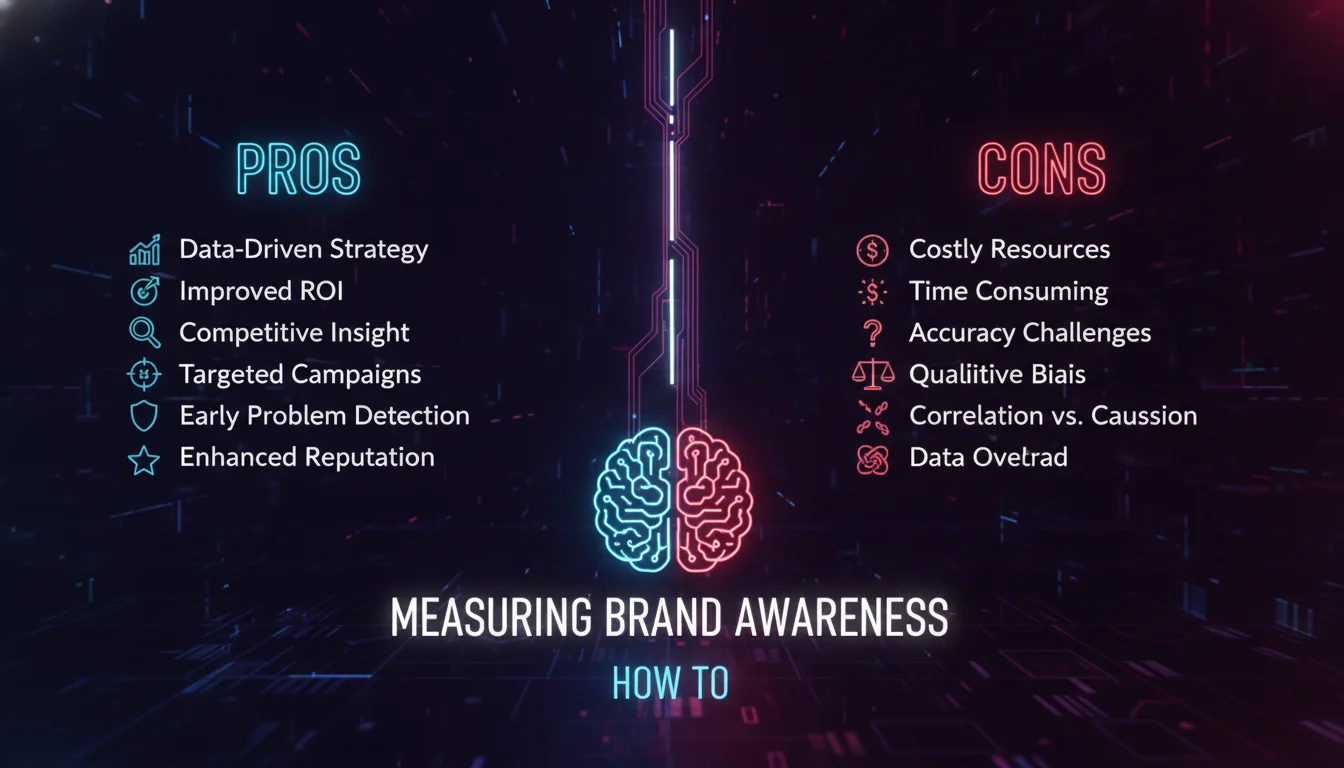
- Proves marketing impact: Tracking awareness over time lets you directly connect campaigns to shifts in recognition and recall, making the case for brand investment with evidence rather than opinion.
- Reveals competitive position: Metrics like share of voice show exactly where you stand relative to competitors, not just against your own past performance.
- Guides smarter budget decisions: When you know which channels drive the most awareness lift, you can reallocate spend toward what actually works.
- Surfaces audience perception gaps: Sentiment and attribute association data reveal whether your brand messaging is landing as intended or creating unintended associations.
- Supports long-term brand building: Consistent measurement creates a historical record that shows how brand health evolves across campaigns, seasons, and market shifts.
Cons
- No single perfect metric: Every method has blind spots. Surveys capture stated memory but miss passive awareness. Behavioral signals capture actions but not recall. You need multiple data sources, which adds complexity.
- Slow-moving signal: Brand awareness changes gradually. Short measurement windows often produce inconclusive results, which can frustrate teams expecting quick feedback loops.
- Survey costs and sample bias: Quality brand tracking surveys require representative samples and consistent methodology. Done poorly, they produce misleading data that is worse than no data at all.
- Hard to isolate causation: A spike in branded search volume after a campaign could reflect the campaign’s effect, a competitor’s misstep, or a cultural moment. Attribution is rarely clean.
How to Measure Brand Awareness: Core Survey Metrics
Survey-based metrics are the most direct way to measure brand awareness because they capture what people actually remember, not just what they do online. The two foundational survey metrics are unaided recall and aided recognition.
Unaided Brand Recall
Unaided recall asks respondents to name brands in a category without any prompting, such as “What clothing brands come to mind?” This metric captures top-of-mind awareness, which is the most valuable form because it reflects spontaneous memory. High unaided recall means consumers think of your brand first when considering a purchase.
To assess unaided brand awareness, survey questions typically ask respondents to list all brands they can think of in a category, then record whether your brand appears and in what position. The first brand mentioned is the top-of-mind leader. Track both mention order and frequency across respondents to understand your standing relative to the field.
Aided Brand Recognition
Aided recognition presents a brand name or logo and asks whether consumers recognize it. This captures a broader level of awareness than unaided recall because recognition requires only a cue, not spontaneous memory. Many consumers may know a brand when they see it but not recall it unprompted. Tracking both unaided and aided metrics gives a more complete picture of mental availability.
Aided questions can be simple: “Have you heard of Brand X?” or “Which of these brands have you seen in the past three months?” Include a few fictitious brand names as control options to separate genuine recognition from guessing.
Brand Sentiment and Perception
Brand sentiment measures the general feeling consumers have toward a brand, gathered through surveys, social media listening, and reviews. According to Sprout Social, customer sentiment is one of the top metrics for measuring brand awareness. Sentiment data explains not just whether people know the brand but how they feel about it, which is critical for positioning and messaging strategy.
Perception questions ask consumers to describe the brand in their own words or select attributes they associate with it. For example, a survey might ask “Which words describe Brand X?” with options like innovative, reliable, expensive, or outdated. Shifts in these associations over time reveal whether brand messaging is landing as intended.
How to Measure Brand Awareness with Digital Behavioral Signals
Digital behavioral signals show what people actually do when they think of a brand, not just what they say in surveys. These signals complement survey data by capturing real-world actions at scale, and they are available continuously rather than at survey intervals.
Branded Search Volume
Branded search volume is the number of searches for your brand name or branded terms in search engines. It is a direct behavioral proxy for awareness because people search for a brand only if they already know it exists. In Google Analytics, identify branded queries by filtering search terms that include your brand name or common misspellings. A rise in branded search volume often follows a successful awareness campaign and is one of the clearest signals that how to measure brand awareness efforts are producing real results.
Google Trends Data
Google Trends shows relative interest in a search term over time and across geographies. It is useful for measuring brand awareness KPIs because it normalizes search data and allows comparisons between your brand and competitors. Enter your brand name alongside a competitor’s to see how interest has shifted after a product launch or media event.
Google Trends data is an index, not absolute volume, so it works best for tracking direction and seasonality rather than exact counts. Use it to identify regional pockets of high or low awareness and to validate spikes from other channels.
Website Traffic and Direct Visits
Direct traffic and branded organic traffic are strong indicators of brand awareness. When consumers type your URL directly or search for your brand name and click through, they are demonstrating recall. According to Attest, checking branded search volume in Google Analytics is one of the ten essential tactics for how to measure brand awareness. Look at the share of new versus returning users from branded queries and how that ratio changes after campaigns.
Comparison of Brand Awareness Measurement Methods
| Method | What It Measures | Strengths | Limitations |
|---|---|---|---|
| Surveys (unaided/aided recall) | Direct memory and recognition | Clear, specific, controlled | Expensive, sample bias, slow |
| Branded search volume | Active search behavior | Real-time, low cost, scalable | Only captures searchers, not all aware consumers |
| Social listening and mentions | Public conversation and sentiment | Rich context, real-time | Noisy, incomplete without full social coverage |
| Share of voice | Competitive visibility | Benchmarkable against rivals | Requires consistent category definition |
| Google Trends | Relative search interest | Free, geographic and seasonal insights | Index, not absolute volume |
| Referral traffic and backlinks | Earned media and authority | Shows trust and third-party endorsement | Hard to isolate pure awareness effect |
Social Listening and Share of Voice
Social listening is one of the richest sources of brand awareness data available. It captures organic, unprompted conversation about your brand at scale, giving you both volume signals and qualitative context that surveys alone cannot provide.
Tracking Brand Mentions
Brand mentions are any instance of your brand being named on social media, forums, blogs, or news sites. Social listening tools aggregate these mentions and analyze their volume, sentiment, and context. Attest recommends tracking brand name mentions as a core tactic because an increase in unprompted mentions usually signals growing awareness.
When Tangle Teezer collaborated with pet influencer @Noodle and Tilde, the resulting post generated around 680K plays and 14K likes, according to Sprout Social. That spike in mentions and engagement provided a measurable signal of increased brand visibility, even without directly measuring recall. It is a good example of how influencer-driven exposure can be quantified as part of a broader approach to how to measure brand awareness.
Share of Voice and Share of Impressions
Share of voice (SOV) is the percentage of total conversation or media impressions in your category that mention your brand compared to competitors. It answers: out of all brand-related chatter in the market, how much is about you? Share of impressions measures a similar ratio for ad impressions or content visibility. Both require defining a competitor set and category keywords, then monitoring consistently over time.
SOV is valuable because it benchmarks your awareness level against competitors, not just against your own past. If your SOV rises while total category conversation stays flat, your brand is capturing more attention relative to the field.
Sentiment Analysis in Social Listening
Sentiment analysis classifies brand mentions as positive, negative, or neutral. Share of voice tells you how much people talk about your brand. Sentiment tells you how they talk about it. A brand can have high share of voice but negative sentiment, which indicates a reputational problem rather than a win. Combining SOV with sentiment gives a more complete view of brand health than either metric alone.
“Measuring brand awareness accurately depends on quality data drawn from representative audiences and verified responses. Reliable data ensures your awareness metrics reflect real-world recognition, not noise.” – YouGov
Brand Awareness Surveys: Design That Produces Reliable Data
How you ask the questions shapes the quality of the awareness data you collect. Surveys can be run in-house using panel tools, through market research firms, or with lightweight in-app or email questionnaires. The design choices matter as much as the channel.
Writing Unaided Recall Questions
Unaided recall questions ask respondents to name brands spontaneously from a category. Examples include: “When you think of athletic shoes, which brands come to mind?” or “What companies do you think of when you hear the term cloud storage?” The first brand mentioned is the top-of-mind leader. Record both mention order and frequency across respondents to understand your position in the competitive set.
These questions work best when the category is specific and familiar to respondents. Vague categories produce noisy data, so define the market clearly and screen respondents for category relevance before asking.
Writing Aided Recognition Questions
Aided recognition questions list brand names or show logos and ask whether respondents recognize them. Example: “Which of the following brands have you heard of? Check all that apply.” Include your brand, competitors, and a few fictitious brands to detect false claiming. Aided awareness is typically higher than unaided awareness because recognition is easier than recall.
To measure depth, follow up for recognized brands: “How familiar are you with this brand?” on a scale from “not at all familiar” to “very familiar.” That gives graded recognition rather than a binary answer, which is far more useful for tracking progress over time.
Combining Recall with Sentiment and Purchase Intent
Beyond simple awareness, surveys should capture sentiment and purchase intent to understand whether awareness is translating into preference. After a recall or recognition question, ask: “Would you consider purchasing from this brand?” or “What is your overall opinion of this brand?” These questions connect awareness to the downstream behaviors that matter for revenue.
Research platforms recommend asking both unaided and aided questions to get a complete picture of how to measure brand awareness, then layering on attribute association questions to assess perception quality.
Search Data and Google Trends for Brand Tracking
Search data is one of the most accessible and continuous signals available for brand tracking. Unlike surveys, it requires no fieldwork and updates in near real time.
Using Google Trends for Seasonal and Regional Insights
Google Trends normalizes search interest into a 0-100 index and allows filtering by geography, time range, and category. For brand awareness, this reveals whether interest in your brand spikes during certain seasons, after specific campaigns, or in particular regions. A sustained increase in your brand’s relative search interest after a PR push is a positive awareness signal worth noting in your reporting.
Because Google Trends provides relative data, always compare your brand term against a stable baseline or a competitor to interpret the index meaningfully. Moving from a low index score to a significantly higher one over several months is a meaningful trend, even if the absolute numbers seem abstract.
Branded vs. Non-Branded Search Queries
In web analytics, separating branded from non-branded queries is essential. Branded queries contain your brand name or common misspellings. Non-branded queries are generic category terms like “athletic shoes” or “cloud storage.” A high share of branded search indicates existing awareness, while growth in non-branded search that later converts may indicate your content or ads are reaching new audiences who did not previously know you.
Use Google Search Console or your analytics platform to pull query reports, then classify queries using regex or manual review. Track the branded query click-through rate and conversion rate separately because they behave very differently from generic queries.
Limitations of Search Data
Search data only captures people who are actively searching. Many consumers may be aware of your brand but never search for it until they are ready to buy, or they may use voice search with different phrasing. Privacy changes and “not provided” keywords also reduce visibility into exact queries. Search metrics should be one input among several, not the sole measure of how to measure brand awareness in your category.
How to Measure Brand Awareness on Social Media
Social media offers a continuous, real-time window into brand awareness, but the metrics require careful interpretation. Not all social signals are created equal.
Follower Growth and Audience Reach
Social media followers indicate the size of your potential audience. Attest lists checking social media followers as one of its ten strategies for how to measure brand awareness. However, follower count alone is a vanity metric if engagement is low. Track follower growth rate alongside reach, which measures how many unique users saw your content. A brand can have many followers but low organic reach if the algorithm suppresses content, so both numbers matter together.
Engagement Rate and Content Performance
Engagement rate is interactions (likes, comments, shares, saves) divided by impressions or followers. High engagement signals that your content is resonating with people who are already aware of your brand. Sprout Social recommends analyzing the performance of popular posts to identify which platforms, post types, and influencers best promote your brand to a wider audience.
If a viral post drives a spike in brand mentions and engagement, that indicates increased mental availability, even if you cannot prove direct recall without a follow-up survey. Track the content that generates the most shares and saves, because those actions imply the viewer found it valuable enough to return to or pass on.
Influencer and User-Generated Content Impact
Influencer campaigns and user-generated content (UGC) can expand brand awareness well beyond your owned channels. The Tangle Teezer example from Sprout Social shows how a pet influencer collaboration generated around 680K plays and 14K likes. That level of exposure is measurable and can be linked to subsequent increases in brand mentions and search volume, even if the direct recall effect requires a follow-up survey to confirm.
To measure influencer impact on awareness, tag campaign-specific hashtags, track referral codes, and monitor branded search volume during and after the campaign. Compare those signals to a pre-campaign baseline to isolate the campaign’s contribution.
Content Engagement, Earned Media, and Referral Traffic
Earned media and referral traffic are often underused signals in brand awareness measurement. They capture third-party endorsement, which carries more credibility than owned or paid channels.
Earned Media Coverage
Earned media is publicity you did not pay for: press articles, reviews, blog features, and broadcast segments. Attest recommends analyzing performance with earned media as a core tactic for how to measure brand awareness. Earned media is a strong signal because it represents third-party endorsement, which often drives both awareness and credibility simultaneously. Track the volume, sentiment, and domain authority of earned media placements over time.
Backlinks and Referral Traffic
Backlinks from reputable sites send both direct referral traffic and search engine authority signals. When a publication writes about your brand and links to your website, that is evidence of earned awareness. In your analytics, examine referral traffic to see which sources send the most engaged visitors. A spike in referral traffic from a particular article or influencer post tells you that your brand was mentioned and acted upon, which is a much stronger outcome than an impression alone.
Referral traffic is especially useful because it captures behavior, not just exposure. If visitors from an earned media placement spend time on site, view product pages, or sign up, that is a meaningfully stronger outcome than a passive mention.
Public Relations and Press Mentions
Traditional PR metrics like media impressions, reach, and share of voice in press coverage can be integrated into a brand awareness dashboard. Use a media monitoring tool to track the number of articles mentioning your brand, their estimated readership, and whether the mention is positive or neutral. Combine this with Google Trends and branded search data to see whether press coverage moves the needle on active search behavior.
How to Measure Brand Awareness: A Step-by-Step Framework
Rather than cherry-picking metrics, a structured framework ensures that measurement is aligned with business goals and actually actionable. The steps below synthesize Benamic’s four-step approach with the multi-metric tactics from Attest and Sprout Social.
A Four-Step Measurement Process
- Step 1: Define clear goals and objectives. Specify what you want to learn. For example: “increase unaided brand recall by 20% among millennials within six months.” Align goals with business outcomes so that awareness measurement connects to revenue conversations.
- Step 2: Select the right KPIs. Choose metrics that directly reflect each goal. Use share of voice for top-of-mind awareness or branded search volume for digital presence. Prioritize quality over quantity – three well-chosen KPIs beat ten loosely defined ones.
- Step 3: Collect data across multiple sources. Combine survey data with web analytics, social listening, and search tools. Use consistent definitions and regular collection intervals so that results are comparable over time.
- Step 4: Analyze, report, and iterate. Compare results to benchmarks and competitor data. Report business impact and refine messaging or budget accordingly. Measurement should improve with each cycle.
Why This Framework Works
This framework avoids the common mistake of measuring a single metric in isolation. It forces alignment between goals, KPIs, and data sources, and it builds in iteration so that measurement improves over time. By following these steps, you can prove the value of brand marketing with evidence rather than opinion, which is what every creative investment ultimately needs to survive a budget review.
Applying the Framework to a Real Campaign
Consider a brand launching a new product with a goal to increase unaided recall in a target region. It selects KPIs: regional survey recall score, branded search volume, and share of voice. During the campaign, it collects weekly social listening data and monthly search data, then runs a follow-up survey after launch. Comparing pre- and post-campaign results shows which channels contributed most to awareness growth and where to invest next.
Brand Tracking Software and Tools
The right tools make how to measure brand awareness repeatable and scalable. The category breaks into three buckets: survey platforms, social listening tools, and search analytics.
Survey-Based Brand Tracking Tools
Dedicated brand tracking software automates recurring surveys and dashboards for recall, recognition, and sentiment metrics. Platforms like Attest, Latana, and Qualtrics offer panel access and trend tracking. These tools reduce the manual work of survey design and data cleaning, making in-house brand tracking more accessible than it has ever been. Choose a tool that provides representative samples and allows you to segment results by demographics or market.
Social Listening and Analytics Platforms
Tools like Sprout Social, Brandwatch, and Mention aggregate social media conversations, calculate share of voice, and perform sentiment analysis. They are essential for tracking brand mentions and engagement at scale. When evaluating a social listening tool, look for coverage of the networks where your audience is active, historical data access, and the ability to export raw mentions for deeper analysis.
Search and Web Analytics Tools
Google Analytics, Google Search Console, and Google Trends are free or low-cost tools for measuring branded search volume, referral traffic, and relative search interest. YouGov and other research platforms add representative audience data and verified responses, which improve the reliability of awareness metrics. Pull data from all three into a central dashboard or spreadsheet so that survey, social, and search metrics are viewed together rather than in silos.
Common Mistakes When Measuring Brand Awareness
Most brand awareness measurement programs fail not because of bad tools but because of avoidable process errors. Here are the ones we see most often.
Focusing on Vanity Metrics Only
Follower counts, pageviews, and impressions are easy to report but do not prove awareness. Sprout Social notes that metrics should capture subtle impressions, not just raw volume. A brand can buy followers or run ads that generate impressions but fail to create memory. Always pair vanity metrics with survey-based recall or branded search data to confirm whether exposure turned into actual awareness.
Ignoring Qualitative Feedback
Quantitative metrics miss the “why” behind awareness trends. Social listening, open-ended survey questions, and customer interviews reveal the context: are people mentioning your brand positively or negatively? What words do they use? Ignoring this qualitative layer leads to misinterpretation. A spike in mentions might be driven by a crisis rather than a successful campaign, and you will not know the difference without qualitative data.
Measuring Irregularly or Without Benchmarks
Awareness changes slowly, and one-off measurements provide no context. You need a baseline before a campaign, regular tracking during it, and follow-up after. Without competitor benchmarks, you cannot tell whether a recall increase is strong or weak relative to the market. Establish a measurement cadence and stick to it, comparing results across comparable time periods.
How to Improve Brand Awareness Once You Measure It
Measurement without action is just reporting. Once you know where your brand stands, the next step is closing the gaps your data revealed.
If unaided recall is low but aided recognition is high, your brand has visibility but not top-of-mind presence. The fix is usually increased frequency: more touchpoints, more consistent messaging, more channels where your audience already spends time. If sentiment is negative despite high share of voice, the problem is not reach. It is perception, and that requires a messaging or product experience intervention, not more ads.
Referral programs, co-branded partnerships, and content series are three of the most effective tactics for building awareness among audiences who do not yet know you. Each creates a reason for existing fans to introduce your brand to new people, which is the most credible form of awareness-building available. Pair these with consistent tracking so you can see which tactics move the needle on the specific KPIs you set in Step 1 of the framework above.
For deeper guidance on building brand presence from the ground up, explore our resources on brand strategy and creative services at Emin Media.
Conclusion
How to measure brand awareness is not a single question with a single answer. The most effective approach combines survey data on recall and recognition with behavioral signals like branded search volume, social mentions, share of voice, and referral traffic. By setting clear goals, selecting the right KPIs, and measuring consistently, you can prove the impact of brand marketing and make smarter decisions about where to invest next. Use the comparison table and step-by-step framework in this guide to build a measurement system that works for your brand, whether you are a startup or a scaling enterprise.
Ready to build a brand that people actually remember? Contact Emin Media for a free brand consultation and let’s build something bold together.
Frequently Asked Questions
What is the best way to measure brand awareness?
The best way to measure brand awareness is to combine survey metrics such as unaided recall and aided recognition with behavioral signals like branded search volume, social mentions, and share of voice. No single metric is sufficient on its own. According to YouGov, reliable measurement depends on quality data drawn from representative audiences and verified responses.
What is a good brand awareness KPI?
A good KPI depends on your specific goal. For top-of-mind awareness, use unaided recall or share of voice. For digital presence, use branded search volume or referral traffic. Align each KPI directly with the objective you set before the campaign begins, not after.
How do you measure brand awareness on social media?
Track follower growth rate, engagement rate, reach, brand mentions, and sentiment using a social listening platform. Compare these to a pre-campaign baseline and complement them with surveys or branded search data to confirm that exposure translated into memory, not just impressions.
How often should you measure brand awareness?
Track fast-moving digital metrics like social mentions and branded search volume monthly. Run brand awareness surveys quarterly or after major campaigns to capture shifts in recall and recognition. Consistency matters more than frequency: a regular cadence beats sporadic deep dives every time.
What is the difference between brand awareness and brand recognition?
Brand awareness is the broad measure of familiarity, including recall, recognition, sentiment, preference, and loyalty. Brand recognition is one component of that: the ability to identify a brand when prompted with a name, logo, or other cue. You can have high recognition but low recall, which means people know you when they see you but do not think of you first.
Can you measure brand awareness without surveys?
Yes. Behavioral proxies like branded search volume, Google Trends, social mentions, share of voice, and referral traffic all provide awareness signals without fieldwork. However, as Instreamly’s brand research notes, these metrics capture actions rather than memory, so surveys remain the most direct method for measuring recall and recognition specifically.
Enjoyed this article?
Contact Emin Media for a free brand consultation and let's create something amazing together.
Get in TouchRelated Articles

Digital Storytelling for Brands: The Complete Guide
Digital storytelling for brands builds real audience connections through narrative. Learn proven techniques, formats, and…

Design Thinking for Marketing: A 2026 Guide
Design thinking for marketing builds campaigns around real user needs. Learn the 5 phases, common…

Creative Direction for Video Shoots: A Complete Guide
Master creative direction for video shoots with proven steps, tools, and strategies that build brand…