How to Build a Brand Identity (2026 Guide)
How to build a brand identity is the process of creating the visual, verbal, and experiential elements that make your business instantly recognizable and trusted. Done right, it goes far beyond a logo. It’s the full system that shapes how people feel about you.
Key Takeaways
- Brand identity is the collection of visual, verbal, and experiential elements that create a recognizable image and differentiate a business.
- A strategic framework like the 5 Ps (Purpose, Promise, Personality, Positioning, Presentation) aligns your identity with business goals.
- Consistency across all touchpoints builds trust and recall. The 3-7-27 rule ensures every interaction reinforces the brand.
- Building a brand identity involves research, design, and ongoing management, never just a logo or color palette.
- A brand style guide is non-negotiable. According to a VistaPrint survey, 86% of small business owners say visual branding is important to their overall business success.
What Is Brand Identity?
Brand identity is the set of visual, verbal, and experiential elements a company creates to convey a distinct image to its audience. According to the American Marketing Association, brand identity encompasses “visual and symbolic elements that represent a brand,” including name, logo, colors, typography, and design. But brand identity extends beyond visuals. As Harvard Business School Professor Jill Avery explains, it “captures the meaning intent of the firm,” shaping how consumers understand and value a product or service.
Brand Identity vs. Branding vs. Brand Image
Branding is the ongoing practice of shaping perception, while brand identity is the tangible expression a company controls. Brand image is how the world actually perceives the brand, a result of every interaction. As entrepreneur Seth Godin defines it, “A brand is the set of expectations, memories, stories, and relationships that, taken together, account for a consumer’s decision to choose one product or service over another.” So when you learn how to build a brand identity, you’re crafting the assets and messages that will shape that image.
The Components of Brand Identity
A complete brand identity includes:
- Visual elements: logo, color palette, typography, imagery, packaging
- Verbal elements: brand name, tagline, voice and tone, messaging
- Experiential elements: customer service scripts, product unboxing, retail environment
These work together to communicate a brand’s core values and promise, creating a cohesive story that drives recognition.
The Business Case for a Strong Brand Identity
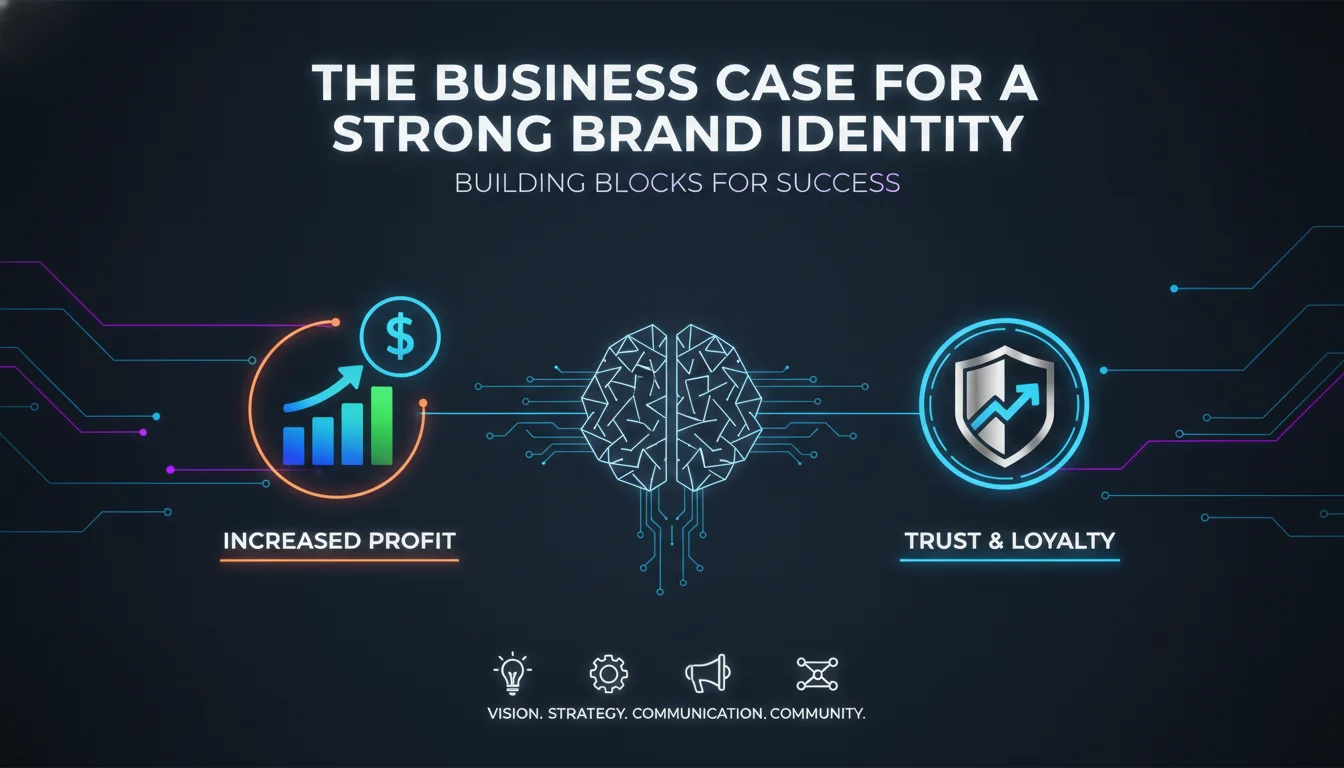
A strong brand identity directly influences buying decisions, loyalty, and even what customers are willing to pay. An Akeneo study on consumer behavior found that 52% of respondents were willing to pay more for products that communicate their company’s brand values, with 82% willing to spend up to 30% more. That’s not a soft metric. That’s pricing power.
Impact on Consumer Behavior
When consumers recognize and connect with a brand, they become advocates. They refer friends, defend the brand online, and return without being retargeted. That organic loyalty reduces marketing costs and increases lifetime value in ways that no single campaign can replicate.
Internal Benefits for Organizations
Internally, a strong brand identity gives employees a sense of purpose and connection. It aligns teams around shared values and attracts talent who genuinely identify with the mission. That internal cohesion translates into consistent external experiences, reinforcing the brand at every touchpoint.
According to a survey conducted by 99designs by Vista (a VistaPrint design service), 86% of small business owners reported that visual branding is important to their overall business success, with 78% saying it significantly contributes to revenue growth.
Pros and Cons of Building a Brand Identity
Pros
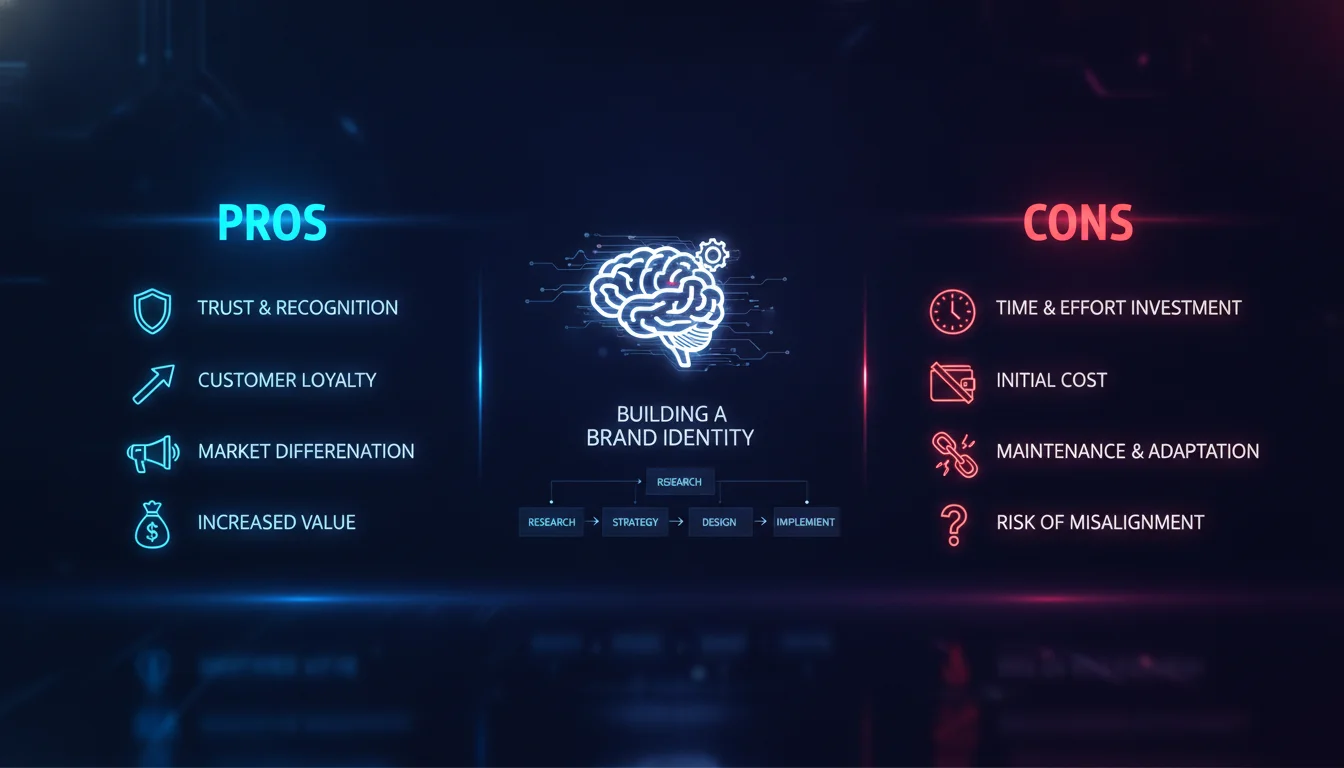
- Builds instant recognition across every channel and touchpoint
- Commands premium pricing by communicating clear value and trust
- Attracts aligned customers and talent who share your values
- Reduces long-term marketing costs through organic advocacy and recall
- Creates internal alignment so every team member represents the brand consistently
Cons
- Requires significant upfront investment in strategy, design, and research
- Takes time to build equity – recognition doesn’t happen after one campaign
- Demands ongoing management to stay consistent as the business scales
- Rebranding carries risk of losing hard-earned recognition if not handled carefully
| Approach | Pros | Cons |
|---|---|---|
| DIY Branding | Low cost, full creative control, quick iterations | May lack strategic depth, professional polish, and consistency; time-intensive learning curve |
| Professional Agency | Strategic expertise, cohesive execution across channels, saves time | Higher upfront investment, requires clear briefs and collaboration, potential loss of intimate brand knowledge |
The 5 Ps of Brand Identity: A Strategic Framework
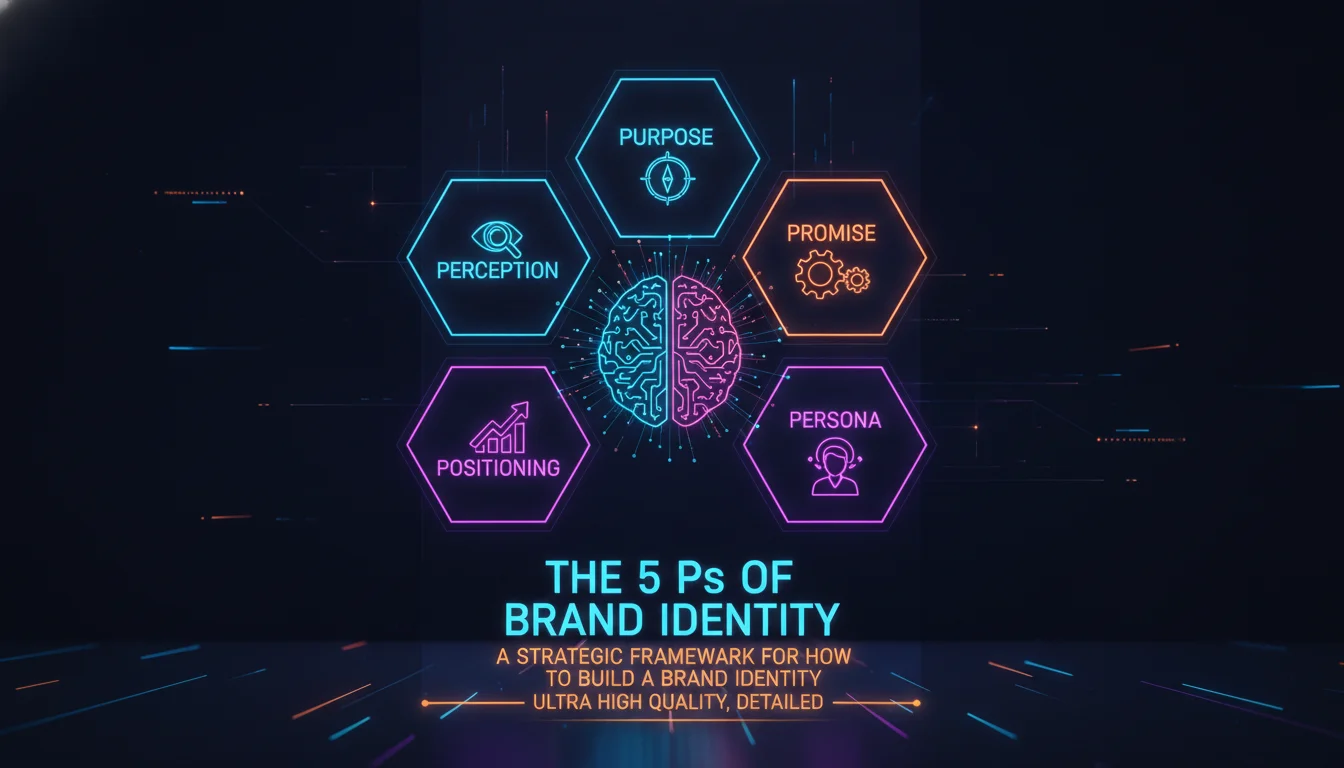
The 5 Ps framework aligns every brand identity decision with your core business strategy. Unlike the traditional marketing mix, these 5 Ps focus entirely on what the brand stands for and how it shows up.
Purpose
Your brand’s reason for existing beyond profit. A clear purpose drives every identity decision, from visual style to voice. It answers the question your audience is always quietly asking: why should I care about you?
Promise
The commitment you make to customers, expressed through taglines and experiences. Your brand identity must consistently deliver on this promise to build trust. Break it once and you spend months rebuilding what took years to earn.
Personality
The human traits your brand embodies: playful, authoritative, empathetic. Personality shapes the brand voice, imagery, and even the emotional weight of your color palette. Think of it as the character your audience is choosing to spend time with.
Positioning
How you differentiate in the market. Your identity should signal a unique value proposition, making it clear why customers should choose you over every alternative, including doing nothing.
Presentation
The visual and verbal execution of all the above: the logo, website, social media presence, packaging. This is where how to build a brand identity becomes tangible and testable in the real world.
How to Build a Brand Identity: The Complete Process
How to build a brand identity that lasts requires a structured approach moving from strategy to execution. The following three-phase process ensures every element serves a purpose and works together as a system, not a collection of pretty assets.
Phase 1: Strategy and Discovery
- Define your brand’s core values and purpose. Start with why your business exists. What problem do you solve? What impact do you want to have? Document these as the foundation for all creative decisions. Without this, every design choice is just decoration.
- Research your audience and competitors. Create detailed buyer personas covering demographics, psychographics, and pain points. Conduct a competitive analysis to identify gaps and opportunities using tools like Semrush for digital insights. Build a competitor research spreadsheet to map positioning gaps you can own.
- Develop your brand personality and voice. Choose 3 to 5 personality traits. Decide how your brand speaks: formal or casual, technical or simple? This voice will guide every piece of content you ever publish.
Phase 2: Design and Creation
- Pick a brand name and write a slogan. A memorable name should be easy to spell, evoke the right feeling, and be available as a domain. A slogan distills your promise into a phrase people can repeat without thinking.
- Design your visual identity system. Create a logo that works across sizes, select a color palette based on color psychology, choose typography that matches your personality, and define imagery guidelines. Tools like Canva and Adobe Creative Cloud streamline this process for teams of any size.
- Craft your brand story and core messaging. Develop a narrative that connects your purpose with your audience’s needs. Build a message hierarchy: tagline first, then value proposition, then supporting proof points.
Phase 3: Launch and Management
- Implement across all touchpoints. Apply the visual and verbal identity consistently on your website, social media profiles, email templates, packaging, and physical spaces. A brand style guide ensures anyone creating assets stays on track, whether that’s an in-house designer or an external agency.
- Monitor and adapt. Collect feedback, track brand health metrics like awareness and sentiment, and be ready to evolve. Rebranding should be strategic, preserving equity while staying relevant. As Column Five Media notes, with 15+ years of experience building brand identities, the most common mistake is treating the launch as the finish line.
“Brand identity captures the meaning intent of the firm. These glasses color how consumers understand, experience, and value a product or service.” – Professor Jill Avery, Harvard Business School, Creating Brand Value
The 3-7-27 Rule of Brand Touchpoints
The 3-7-27 rule is a framework for ensuring brand consistency across every customer interaction. It suggests that a brand makes an impression within three distinct windows of time:
- 3 seconds – visual recognition (logo, colors)
- 7 seconds – verbal recognition (tagline, voice)
- 27 seconds – experiential recognition (service interaction, unboxing)
Applying this rule to how to build a brand identity means designing for speed and coherence. Your visual identity must register instantly, your messaging must connect in a phrase, and your overall experience must form a lasting memory.
Designing for the First 3 Seconds
Focus on a distinctive logo, a signature color, and a consistent visual pattern. McDonald’s golden arches or Tiffany’s blue box are classic examples where recognition is near-instant, no words required.
Crafting the 7-Second Message
Your tagline or headline must convey your value proposition quickly. Think of Nike’s “Just Do It” or Apple’s “Think Different.” Both demand rigorous clarity about what the brand actually stands for.
Building the 27-Second Experience
Every touchpoint – website load time, customer service tone, packaging tactile feel – should reinforce the identity. Consistency here builds emotional connection and trust that no single ad can manufacture.
Key Elements of a Cohesive Brand Identity
Logo
A logo is the most recognizable symbol of your brand. It should be simple, scalable, and relevant. The Nike swoosh implies movement and victory without a single word. Design it to work on a tiny favicon and a trade-show wall.
Typography
Fonts convey personality. Serif fonts suggest tradition (The New York Times), while sans-serif suggests modernity (Google). Choose a primary typeface and a complementary pair for hierarchy, then use them consistently everywhere.
Color Palette
Colors evoke emotions: blue for trust, red for energy, green for nature. A consistent palette across all assets strengthens brand recall. Tools like Coolors or Adobe Color help build harmonious schemes that hold up across print and digital.
Brand Storytelling: The Narrative Behind the Identity
Why Your Brand Story Matters
A brand story connects emotionally with audiences in ways that product specs never will. It explains founding motivations, the customer challenges you solve, and the vision you’re building toward. According to Column Five Media, a strong brand identity is rooted in a clear narrative that differentiates and engages – and that narrative has to come before the logo, not after.
Elements of a Compelling Brand Story
- Protagonist: Your customer, not your brand. Frame them as the hero.
- Conflict: The problem your product or service solves.
- Resolution: How you enable transformation, supported by your brand promise.
Integrating Story into Visual Identity
Your logo, color choices, and imagery should all reflect chapters of your story. An outdoor apparel brand might use earthy tones and rugged typography to echo its wilderness heritage. Every visual choice is a sentence in the narrative.
Maintaining Consistency Across Channels
The Role of a Brand Style Guide
A brand style guide documents all identity rules: logo usage, color codes (HEX, Pantone), typography, voice examples, and imagery guidelines. VistaPrint emphasizes that a style guide ensures anyone creating brand assets stays on track, whether an in-house designer or an external agency. Without one, every new hire or vendor becomes a brand liability.
Digital vs. Physical Consistency
Digital touchpoints (website, social media, apps) require responsive design adaptations, while physical ones (packaging, signage) need print-ready specifications. Both must feel unmistakably from the same brand. Your Instagram visual treatment should match the mood of your product packaging. If they feel like two different companies, you have a problem.
Auditing Your Brand Touchpoints
Regularly review every customer interaction: emails, customer service calls, trade show booths. Brand monitoring tools can detect off-brand content before it damages perception. Schedule a quarterly audit and treat it like a financial review.
When to Rebrand: Triggers and Process
Rebranding is sometimes the right move, but it should never be impulsive. The clearest triggers include a merger or acquisition, a significant shift in target audience, a reputation crisis, or simply an identity that no longer reflects where the business is going. Minor refreshes every few years keep your brand current. A full rebrand is warranted after major business shifts. Always audit what brand equity exists before changing anything – some elements are worth preserving even when everything else evolves.
“A strong brand identity doesn’t happen overnight. You can’t just pick a few colors and haphazardly slap a logo together. You need to approach your design strategically to build an identity that truly reflects your brand and can support you as you grow.” – Column Five Media, with 15+ years of brand identity experience
Legal Considerations: Protecting Your Brand Identity
Once you’ve built your brand identity, protect it. Trademark your logo and brand name through your country’s intellectual property office before you scale. A name that works beautifully in your home market can create legal exposure if it’s already registered elsewhere. Check domain availability, social media handles, and trademark databases early in the process, not after you’ve printed 10,000 business cards. This step is often skipped by startups and becomes expensive to fix later.
Measuring Brand Identity Performance
You can’t manage what you don’t measure. Key metrics for tracking brand identity effectiveness include brand awareness (aided and unaided recall), Net Promoter Score (NPS) as a proxy for emotional connection, brand sentiment tracked through social listening tools, and direct traffic growth as a signal of unprompted brand recall. Run periodic brand lift studies, especially after major campaigns or rebrands, to understand whether your identity is landing the way you intended. The goal is a brand that people seek out, not one they stumble across.
Common Mistakes to Avoid When Building a Brand Identity
Skipping the Strategy Phase
Jumping straight into logo design without defining purpose, audience, and positioning leads to a shallow identity that fails to differentiate. How to build a brand identity that lasts always begins with thorough foundational work. The creative is only as strong as the strategy underneath it.
Inconsistency Across Touchpoints
When the tone on social media clashes with the website copy, or the packaging colors don’t match the app, customers become confused and trust erodes. A brand style guide and regular audits prevent this from becoming a slow-motion brand crisis.
Ignoring Customer Feedback
Brand identity should evolve based on real audience response, not just internal assumptions. Use surveys, social listening, and usability tests to refine elements over time. Your customers are telling you what’s working. The question is whether you’re listening.
Overcomplicating the Visual Identity
Too many colors, fonts, or design elements clutter the message. Simplicity enhances memorability. A minimal approach often performs better, especially in digital-first contexts where attention is measured in milliseconds.
Brand Identity Examples to Inspire Your Process
Global Brands That Get It Right
Apple’s clean, minimal design and human-centric language create a consistent experience from packaging to user interface. Apple demonstrates how a strong identity commands premium pricing and deep loyalty. Patagonia’s commitment to environmental activism is woven into every aspect of its identity, from organic materials to bold advocacy campaigns. Both brands prove that how to build a brand identity effectively means making every element mean something.
Small Business Success Stories
Many direct-to-consumer startups have built powerful identities on lean budgets. Glossier built its identity around “skin first, makeup second,” using soft pink hues and a conversational tone that turned customers into a community. These examples show that authenticity, not budget, is the real differentiator.
Tools and Resources for Building a Brand Identity
Design Tools
- Canva – Template-based design for non-designers, includes brand kits.
- Adobe Express – Professional-grade image and video creation with asset libraries.
- Figma – Collaborative interface design tool, ideal for digital brand systems.
Learning Platforms
- Brand Master Academy – Courses on brand strategy and identity design.
- Skillshare – Project-based classes on logo design, typography, and brand storytelling.
Market Research Tools
- Semrush – Competitor and SEO analysis to understand audience search behavior.
- Google Trends – Identify rising topics and brand interest over time.
Ready to stop guessing and start building something that actually works? At Emin Media, we’ve helped brand owners, startup founders, and marketing teams build identities that earn recognition and drive real business results. Contact Emin Media for a free brand consultation and let’s build something bold together.
Frequently Asked Questions
What is the difference between brand identity and brand image?
Brand identity is the visual and verbal expression a company deliberately creates, while brand image is the perception consumers form based on all their interactions with the brand. Identity is what you design and control. Image is what results from how well you execute it.
How do I create my own brand identity?
Start by defining your brand’s purpose, audience, and personality. Then translate those into a visual system (logo, colors, typography) and a verbal system (voice, messaging). Implement consistently across every touchpoint and refine based on real audience feedback over time.
What are the 5 P’s of brand identity?
The 5 Ps are Purpose, Promise, Personality, Positioning, and Presentation. They provide a strategic framework to align every identity element with business goals and customer expectations, ensuring the creative work is grounded in strategy.
What is the 3-7-27 rule in branding?
It’s a guideline for touchpoint effectiveness: a brand should make a visual impression in 3 seconds, a verbal impression in 7 seconds, and a full experiential impression in 27 seconds. It helps designers and marketers prioritize speed, clarity, and consistency across every interaction.
How often should I update my brand identity?
Minor refreshes every 3 to 5 years keep your brand current, while a full rebrand is warranted every 7 to 10 years or after significant business shifts like mergers or new target audiences. Always audit existing brand equity before making changes to protect what you’ve already built.
Can I build a brand identity without a graphic designer?
Yes, using DIY tools like Canva or Adobe Express, but the strategic thinking behind the visuals is what separates a memorable brand from a forgettable one. Without a clear strategy, the result may look polished but fail to differentiate. Online courses and brand frameworks can fill the knowledge gap.
Enjoyed this article?
Contact Emin Media for a free brand consultation and let's create something amazing together.
Get in TouchRelated Articles
Digital Marketing for Creatives: A Bold Guide
Digital marketing for creatives builds real visibility and sales. Learn strategies for social media, SEO,…
Branding & Design Agency Tips That Actually Work
Discover branding and design agency tips to choose the right partner, set clear goals, and…
Creative Agency Pitch Deck Tips That Win Clients
Master creative agency pitch deck tips that win clients in 2026. Learn storytelling, design, and…