How to Brand a Business: 9 Steps That Work
How to brand a business is the process of defining your audience, researching competitors, clarifying your purpose, and building a consistent visual identity that earns recognition and trust. Done right, it turns a product into something people remember and return to.
Key Takeaways
- Branding is the combination of visual assets, messaging, and experiences that shape customer perception – far more than a logo or slogan.
- The most effective sequence starts with audience and competitor research, then moves to positioning, messaging, naming, visual identity, and guidelines.
- Liquid Death turned canned water into a differentiated brand by attacking competitor weaknesses, including plastic packaging and plain visual design.
- Consistency across every touchpoint – website, packaging, customer service – builds brand equity and long-term loyalty.
- Branding is an ongoing operating discipline, not a one-time design project.
What Is Branding?
Brand Defined
A brand is the combination of visual assets, messaging, and experiences that shape your identity. It goes beyond a logo, name, or slogan. It includes tone of voice, visual style, and the full customer experience. According to Adobe’s business blog, a strong brand helps you stand out in a crowded market and makes it easier to build awareness, strengthen loyalty, and turn customers into advocates.
Entrepreneur contributor John Williams puts it simply: your brand is your promise to your customer. It tells them what to expect from your products and services and separates your offering from everyone else’s. That promise comes from who you are, who you want to be, and who people already perceive you to be.
Brand vs. Logo vs. Branding
A logo is a mark that identifies your business. Branding is the ongoing process of shaping perception. Brand equity is the measurable value your brand adds to your company. According to The Hartford’s business strategy guide, brand equity can be measured through the price premium you can charge over a no-name product or through long-term customer loyalty. The Hartford also points to the four-step Customer Based Brand Equity Model as a framework for strengthening customer perception over time.
Some guides lead with the logo. Others, like Adobe and LivePlan, start with audience research. This is not a contradiction – it is a sequence difference. Logo-first works when you already know your audience. Audience-first works when you are building from scratch or entering a new market. For most founders, audience-first is the safer bet.
Why Branding Drives Business Outcomes
Strong branding differentiates your business, builds recognition, and creates trust. The EO Network highlights Liquid Death as a case study: the company sells canned water, yet it reported over $263 million in sales. Its edgy, sustainable branding attracts loyal customers and stands out from industry giants like Coca-Cola and Nestle. Liquid Death’s #DeathtoPlastic campaign capitalized directly on competitors’ reliance on plastic packaging by switching to aluminum cans.
Brands like Netflix and Apple have devoted followings because they crafted their identities deliberately and early. Branding is not a cosmetic layer. It is a business asset that shapes pricing power, customer acquisition, and retention.
“Your brand is your promise to your customer. It tells them what they can expect from your products and services, and it differentiates your offering from your competitors’.” – John Williams, Entrepreneur
Pros and Cons of Building Your Own Brand
Pros
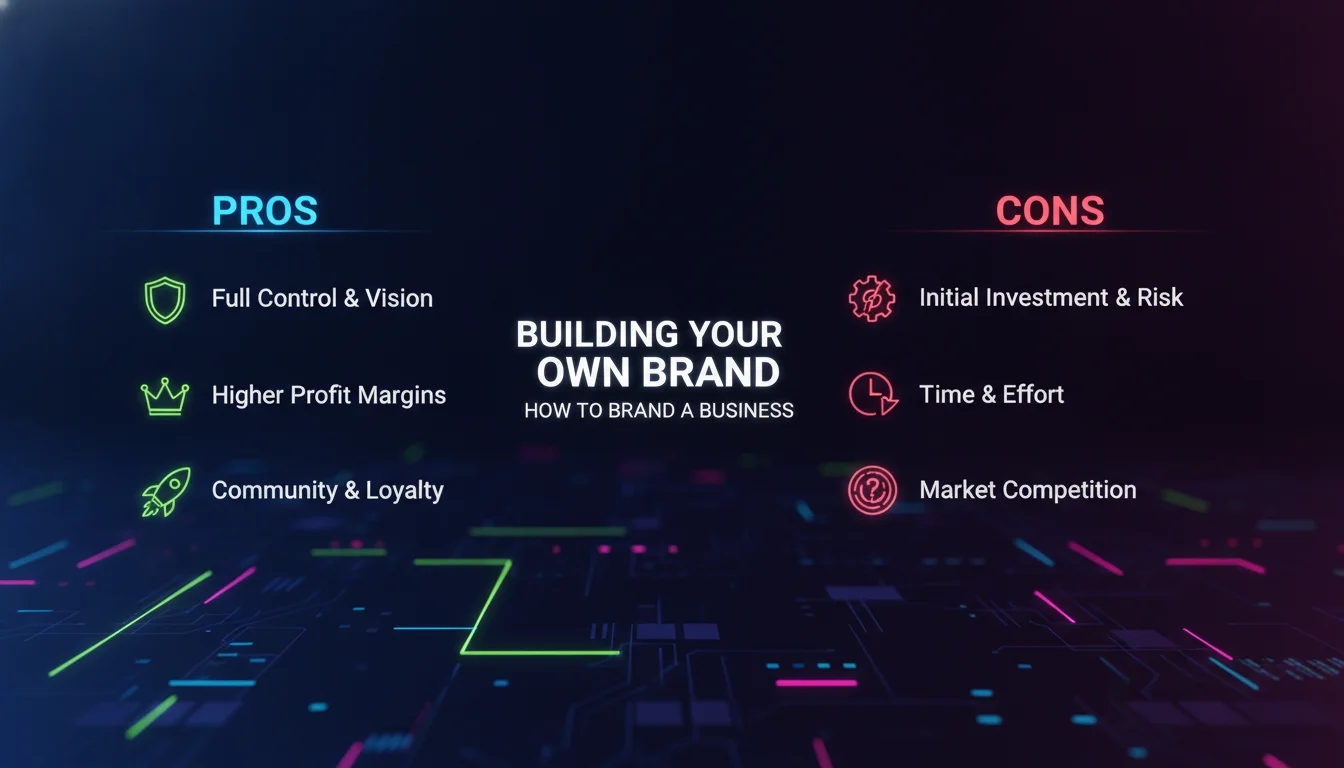
- Full creative control. You shape every visual and messaging decision to reflect your actual values and audience.
- Stronger differentiation. A well-researched brand positions you against competitors on an axis they are not occupying.
- Long-term equity. Consistent branding compounds over time, making customer acquisition cheaper and loyalty deeper.
- Pricing power. According to The Hartford, a strong brand lets you charge a premium over unbranded alternatives.
Cons
- Time investment is real. Audience research, competitor analysis, and guideline creation take weeks, not hours.
- Easy to skip the strategy. Many founders jump straight to logo design and skip the positioning work that makes a logo meaningful.
- Consistency is hard to maintain. Without documented brand guidelines, visual and messaging drift happens fast across channels.
How to Brand a Business: The Strategic Framework
The Audience-First vs. Logo-First Debate
Knowing how to brand a business means resolving one foundational question: where do you start? Entrepreneur opens with getting a great logo and placing it everywhere. Adobe’s eight-step process begins with identifying your audience. LivePlan’s guide, updated May 13, 2026, starts with understanding your target audience and competitors. Business.gov.uk begins with defining your business, then understanding your customer.
The synthesis is clear: logo-first is a tactical execution step. Audience-first is a strategic foundation step. If you skip audience research, any logo – no matter how polished – will struggle to resonate. Once you understand whom you serve and how you differ, visual execution becomes far easier and far less expensive to get right.
A Unified Step-by-Step Process
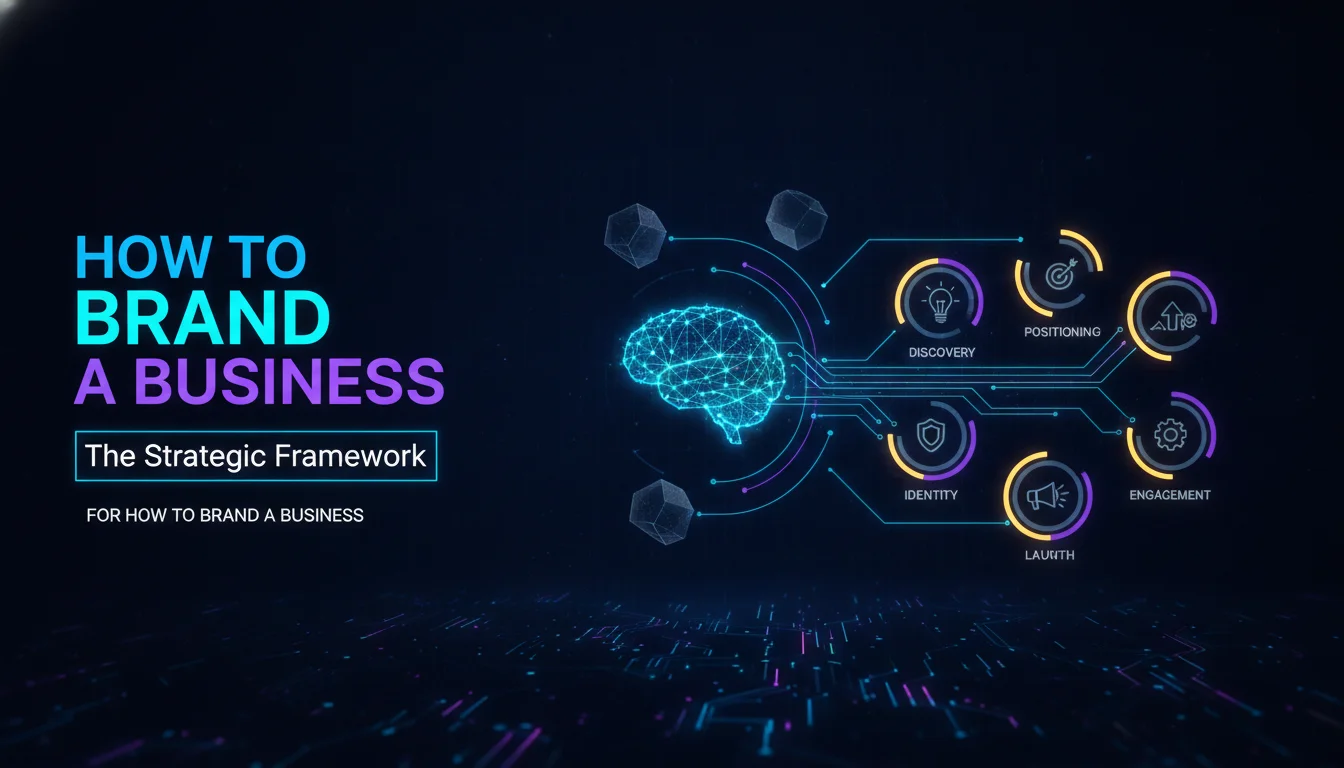
Based on the most complete operational frameworks available, here is a unified sequence for how to brand a business from scratch:
- Understand your target audience and competitors. Research needs, pain points, and competitor positioning.
- Define your brand focus and personality. Decide what you stand for and how you sound.
- Choose your business name. Select a name that is memorable and unlikely to need changing as you scale.
- Write your slogan. Distill your promise into a concise, repeatable phrase.
- Figure out your look. Choose colors, typography, and imagery that align with your personality.
- Design your logo. Create a mark that works across sizes and contexts – digital, print, and everything in between.
- Identify branding assets you need. Determine which materials – business cards, social templates, packaging – require branded design.
- Establish brand guidelines. Document rules for logo usage, color, voice, and application.
- Apply your brand and track its impact. Launch consistently and measure brand equity over time.
How to Brand a Business With or Without a Big Budget
How to brand a business does not require a massive agency retainer. Business.gov.uk suggests using graphic design tools or working with a designer to develop and test designs before committing. Many of the most important steps – audience research, competitor analysis, messaging, and guideline creation – are strategic work you can do with free or low-cost tools. The highest cost is usually in visual asset production, but consistency matters more than polish at every stage.
Step 1: Know Your Target Audience
Go Beyond Demographics
Before you think about a logo or even a business name, you need to understand your target audience deeply. Go beyond basic demographics like age, gender, and location. Ask: What do they care about? What problems do they face? How does your business solve them? Which factors drive their buying decisions?
Business.gov.uk frames this as understanding who your customer is, where they are, and how they behave. Different groups connect with different messages, visual styles, and brand personalities. A clear view of your audience makes every downstream decision feel grounded rather than guessed.
Use Existing Data and Research Tools
Start with data you already have: customer reviews, Google Analytics, CRM records. If you do not have customers yet, build an initial picture through industry trends and market research. The EO Network recommends tools like Exploding Topics to see how many people are searching for product keywords and to get a general description of that audience. For example, athletes and fitness enthusiasts are most likely to search for “cold plunge tub.”
Translate Insights into Brand Strategy
Your audience informs every part of your business, from product development and pricing to marketing and design. Adobe suggests creating buyer personas – profiles of your ideal customer that include demographic details, buying habits, product use cases, interests, and the brands they already follow. As your business grows, refine these personas using customer feedback and real data.
Step 2: Analyze Competitors
Identify Strengths and Weaknesses
Competitor analysis is where you find your opening. Weaknesses are opportunities. Ask what competitors are missing and how you can fill that gap. Liquid Death succeeded because most bottled water brands had plain packaging made from harmful plastics. The company’s aluminum-can positioning and #DeathtoPlastic campaign directly attacked that weakness and built a brand identity around it.
Mine Reviews and Build a Comparison Table
A practical method is to mine online reviews of your competitors and organize them into a table with columns for company, review, strength, and weakness. This forces you to see patterns rather than anecdotes. Business.gov.uk suggests finding out how much competitors charge, how they advertise, how they deliver their products, and what makes your business genuinely different.
Position Against Market Gaps
Adobe advises matching competitors’ strengths while capitalizing on weaknesses like market inefficiencies. Your goal is not to copy the market leader but to occupy a position they are not defending. Competitor positioning tells you what promises are already being made – best, cheapest, fastest – so you can choose a different axis and own it.
Step 3: Define Purpose, Mission, and Positioning
Purpose vs. Mission vs. UVP
A brand purpose is the reason you started your business – beyond making money. A mission is a roadmap for achieving that purpose. A unique value proposition (UVP) is a clear statement that shows how your business is valuable and better than existing options. The EO Network offers concrete examples: Patagonia’s purpose is building the best products while causing no unnecessary harm; Oatly includes a detailed to-do list to support its food sustainability mission; Airbnb’s UVP is unique, personalized travel experiences with local hosts.
| Brand Messaging Element | What It Is | Example |
|---|---|---|
| Brand purpose | The reason you started – beyond making money | Patagonia: build the best products, cause no unnecessary harm |
| Mission | Roadmap to achieve purpose or long-term impact | Oatly’s detailed to-do list for food sustainability |
| Unique value proposition | Clear statement showing value over existing options | Airbnb: unique, personalized travel experiences with local hosts |
| Voice | Personality of your brand expressed in language | Liquid Death’s edgy, irreverent tone |
Craft Your Unique Value Proposition
Look at your competitors’ weaknesses to form a UVP. If competitors are slow, your UVP might be speed. If they are impersonal, yours might be white-glove service. A strong UVP does not need to be clever. It needs to be clear, specific, and defensible over time.
Align Positioning with Audience Needs
Entrepreneur cautions that you cannot be all things to all people. Your brand should be built around who your target customers want and need you to be. Are you the innovative maverick or the experienced, reliable choice? Is your product the high-cost, high-quality option or the low-cost, high-value one? Choose one axis and align all messaging around it.
Step 4: Develop Brand Messaging, Voice, and Naming
Brand Messaging Elements
Brand messaging is the overarching way you communicate your business to your audience, partners, and investors. Think of your brand like a person. The table above maps purpose, mission, UVP, and voice. Start with those four elements before writing taglines or website copy – they are the architecture everything else hangs on.
Voice and Personality
Voice is the personality of your brand expressed in language. The Hartford advises that your brand should have personality and character, with a voice that is appropriate and reflects your positioning. Business.gov.uk says to think about tone of voice, characteristics, traits, language, and communication style. Is your brand sleek, modern, classic, or simple? Whatever you choose, apply it consistently across social media, customer service, and packaging.
Choose Your Business Name
LivePlan recommends choosing a memorable business name after you define your brand focus and personality. The name should be concise, easy to spell, and built to last as you scale. Brainstorm options with your audience and positioning in mind, then test them with real potential customers. Check domain availability and trademark conflicts before committing to anything.
Step 5: Build Visual Identity and Brand Guidelines
Logo Design
Entrepreneur emphasizes that your logo is the foundation of your brand’s visual system. Your website, packaging, and promotional materials should all integrate that logo consistently. But a logo alone is not a brand. Adobe places logo design after naming and after visual style decisions like color and typography. A good logo works in one color, at small sizes, and across both digital and print media.
Color, Typography, and Imagery
Business.gov.uk lists visual identity as logos, color schemes, fonts, photography, and illustrations. LivePlan calls this “figuring out your look,” with strategic choices in colors, typography, and imagery. These choices should flow directly from your brand personality. A playful brand might use bold colors and rounded type. A luxury brand might use restrained palettes and serif faces. Neither is wrong – both must be intentional.
Create Brand Guidelines
Once you have defined your brand personality and visual identity, formalize them in brand guidelines. According to Business.gov.uk, guidelines should set out your business values, explain how to use your logo and how not to use it, include your brand color scheme with color mode references, and show examples of correct applications. Guidelines turn a one-off design into a repeatable, scalable system.
“Once you have defined your brand personality and visual identity, you can formalise these in brand guidelines. Your brand guidelines should set out your business values and how the brand reinforces those.” – Business.gov.uk
How to Brand a Business: Integrate, Launch, and Measure
Integrate Across Touchpoints
Knowing how to brand a business means understanding that launch day is not the finish line. Every customer touchpoint – website, email signature, packaging, invoices, social media, customer service scripts – should reflect the same visual identity, voice, and messaging. Inconsistency erodes trust faster than a mediocre logo ever could. Entrepreneur says to integrate your brand and place your logo everywhere. Adobe’s eighth step reinforces this: integrate your brand into your business at every level.
Launch and Track Impact
LivePlan’s final step is to apply your brand and track its impact. This is where brand equity becomes measurable. The Hartford suggests you can measure brand equity through the price premium you can charge over a no-name product or through long-term customer loyalty. Use surveys, social listening, and sales data to see whether recognition is improving and whether your positioning is actually sticking.
When to Rebrand
Adobe’s process includes one final, often overlooked step: do not be afraid to rebrand. Rebranding may be necessary after a merger, a major strategy shift, or when your audience has evolved beyond your current identity. A rebrand is not a failure. It is a recognition that who you are today no longer matches how you are showing up. Use the same research process to guide a rebrand as you would a new brand.
Common Mistakes to Avoid
Inconsistency
The Hartford names consistency as a key aspect of branding. If your logo looks one way on your website and another way on your packaging, customers will not remember you. Consistency is more important than perfection. A simple, consistently applied brand beats a complex, inconsistently applied one every single time.
Skipping Audience Research
The EO Network and Adobe both place audience research as the first step in how to brand a business. Skipping it leads to a brand built on assumptions rather than evidence. The result is messaging that sounds good internally but fails to connect with the people you actually need to reach.
Overcomplicating the Brand
Many early-stage founders try to define every possible positioning at once. Entrepreneur warns that you cannot be all things to all people. Complexity confuses both employees and customers. A focused brand with one clear promise is easier to execute, easier to scale, and far easier for customers to remember.
Brand Spotlight: Liquid Death
If you want a masterclass in how to brand a business with a commodity product, look at Liquid Death. The product is canned water. The category is saturated. The competition includes some of the largest beverage companies on earth. And yet, according to the EO Network, Liquid Death reported over $263 million in sales by doing one thing exceptionally well: it chose a positioning axis that no competitor was defending.
Most bottled water brands leaned on purity, wellness, and soft blue palettes. Liquid Death went the opposite direction – heavy metal aesthetics, irreverent humor, and an environmental message wrapped in aluminum. The #DeathtoPlastic campaign turned the packaging itself into a brand statement. The lesson: your differentiation does not have to be about the product. It can be about the story, the values, and the visual world you build around it.
How to Brand a Business That Lasts
How to brand a business is not a single task. It is a sequence of strategic decisions that compound over time. Start with audience and competitor research. Define your purpose and positioning. Develop messaging and voice. Choose a name. Build a visual identity. Document guidelines. Then integrate and measure – consistently, across every channel and customer interaction.
The brands that endure – Liquid Death, Patagonia, Airbnb, Oatly – did not get there by accident. They made deliberate choices, repeated them consistently, and adjusted when the market shifted. As of 2026, the tools available to founders make this process more accessible than ever. Your business can follow the same structured path by treating branding as an ongoing operating discipline, not a one-time design project.
Ready to build something that people actually remember? Contact Emin Media for a free brand consultation and let’s build something bold together.
Frequently Asked Questions
What is the first step in branding a business?
The first step is understanding your target audience. Research who they are, what problems they face, and how your business solves them before designing any logo or name. Both Adobe and the EO Network place audience research at the very beginning of the process.
How much does it cost to brand a business?
Costs vary widely depending on scope and who does the work. You can start with free or low-cost tools for research and design, then invest in professional help as your budget grows. Strategic work like audience research and competitor analysis costs time, not necessarily money – and it is the most valuable part of the process.
Do I need a logo before a brand strategy?
No. A logo is an execution step, not a starting point. Your brand strategy – audience, positioning, messaging, and voice – should come first and then guide the visual identity system within which the logo lives. Skipping strategy and starting with the logo is one of the most common and costly branding mistakes.
How long does it take to build a brand?
Building a brand is an ongoing process. You can create a foundational brand identity in a few weeks, but building recognition, trust, and equity takes months or years of consistent application across every customer touchpoint.
Can I rebrand an existing business?
Yes. Rebranding is appropriate after a merger, a strategy shift, or when your audience has evolved beyond your current identity. Use the same research and step-by-step process you would use for a new brand – the sequence does not change, only the starting point does.
What is the difference between a brand and a logo?
A logo is a visual mark that identifies your business. A brand is the full combination of visual assets, messaging, and experiences that shape how people perceive your company. According to Adobe, a brand includes tone of voice, visual style, and customer experience – not just a graphic mark.
Enjoyed this article?
Contact Emin Media for a free brand consultation and let's create something amazing together.
Get in TouchRelated Articles
Digital Marketing for Creatives: A Bold Guide
Digital marketing for creatives builds real visibility and sales. Learn strategies for social media, SEO,…
Branding & Design Agency Tips That Actually Work
Discover branding and design agency tips to choose the right partner, set clear goals, and…
Creative Agency Pitch Deck Tips That Win Clients
Master creative agency pitch deck tips that win clients in 2026. Learn storytelling, design, and…