Digital Marketing Funnel Strategy: Stages & Metrics
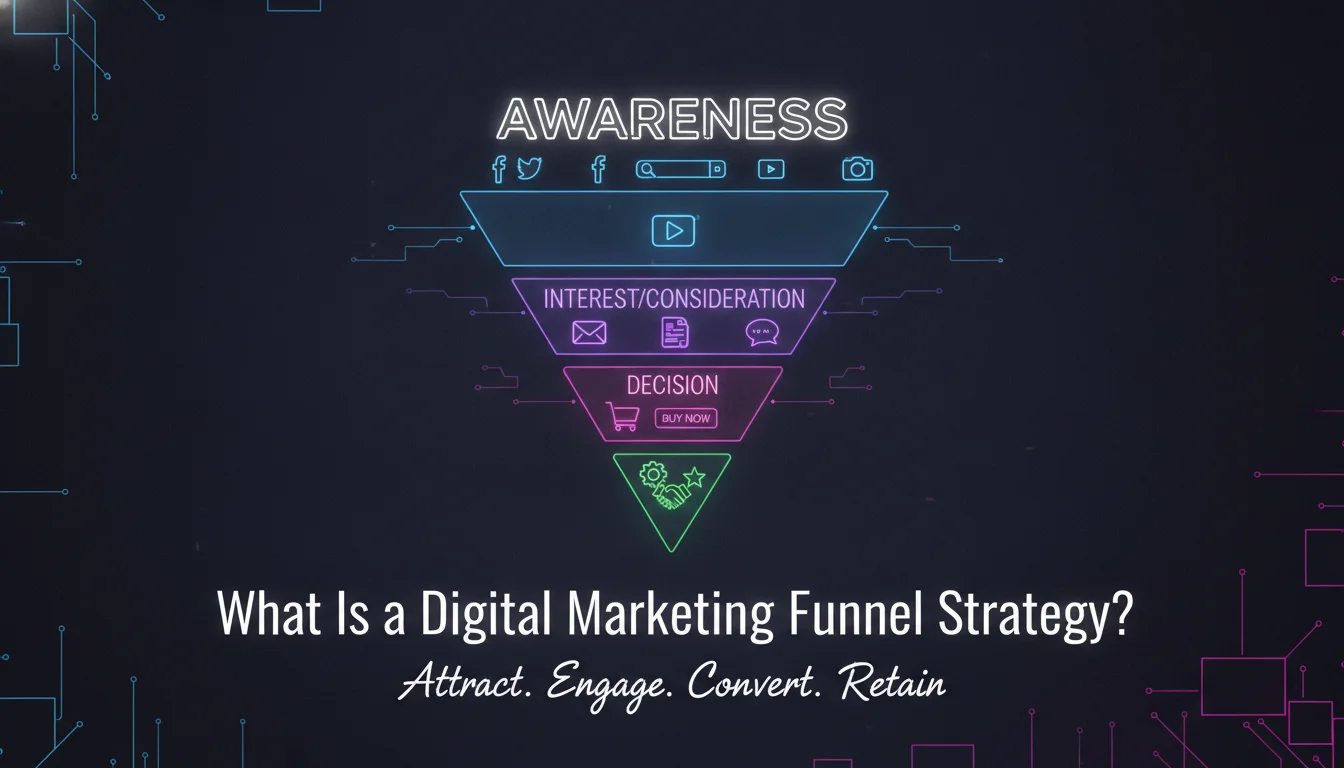
Digital Marketing Funnel Strategy: Stages, Models, and Metrics
A digital marketing funnel strategy is a structured model that maps how prospects move from first online contact to repeat purchase and advocacy, aligning channels, content, and metrics to each stage of awareness, consideration, conversion, and loyalty.
Key Takeaways
- A funnel strategy is not a diagram. It is a cross-functional plan that assigns objectives, messages, channels, and next actions to every stage of the buyer journey.
- No single funnel model fits every business. Models range from three stages to six, and the right choice depends on your sales cycle, market, and data maturity.
- Modern funnels must account for nonlinear journeys. According to Amazon Ads, 84% of shoppers begin their online product searches on digital channels that are not a brand’s owned website.
- Stage-specific metrics are non-negotiable. Track awareness reach, consideration engagement, conversion rate, and loyalty retention as separate signals.
- Real brands prove the model works. Funnel execution is visible across B2C and B2B contexts, from Nike to Airbnb to Peloton.
What Is a Digital Marketing Funnel Strategy?
Defining the Core Model
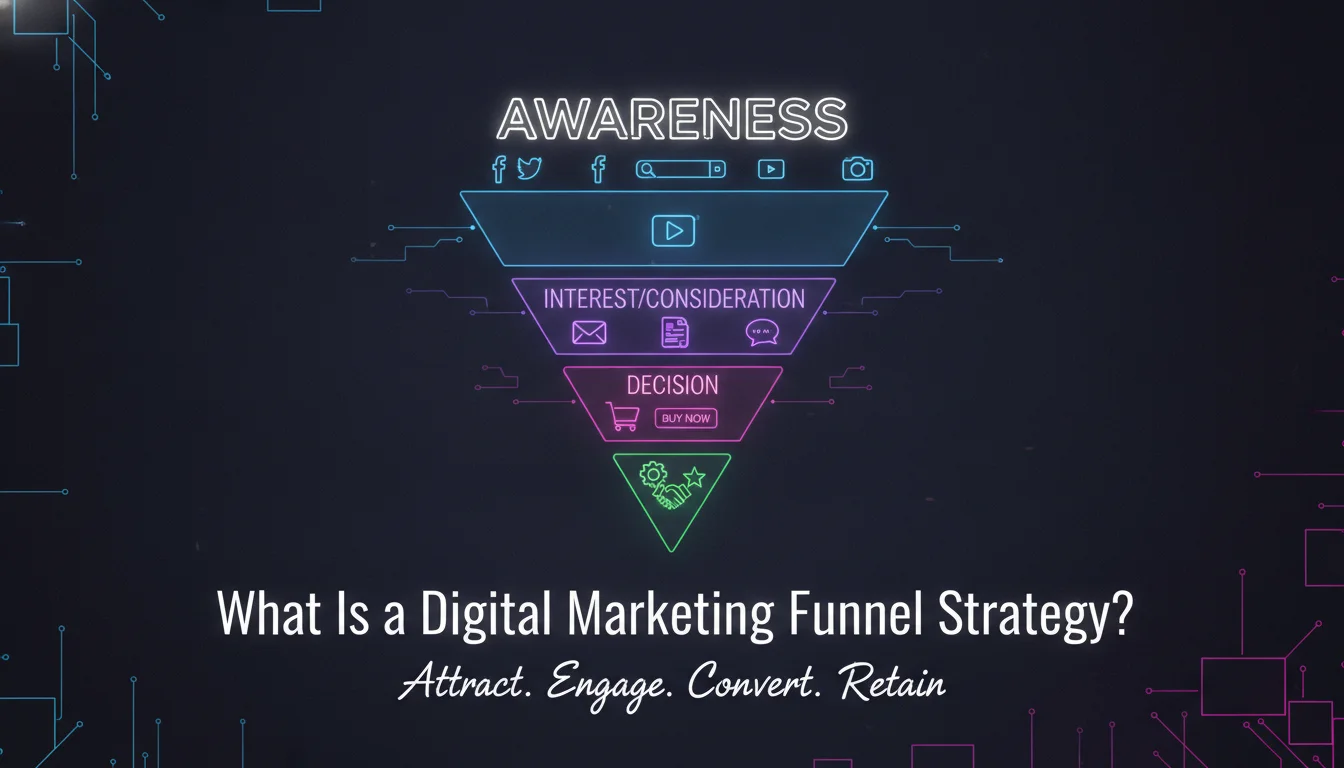
A this type of strategy is the deliberate application of a funnel model to plan, execute, and measure marketing activities across the entire customer journey. It starts with a broad pool of potential buyers and narrows them toward purchase and repeat engagement. According to Wrike, a purchase funnel is a visual representation of a customer’s journey toward purchasing a product or service, typically covering awareness, interest, consideration, and action. In digital contexts, that journey unfolds across search engines, social platforms, email, websites, and ads.
The word strategy is the operative term. A funnel diagram alone shows stages, but a this kind of funnel strategy assigns specific objectives, audience segments, content types, channel mixes, and conversion events to each stage. Landingi describes it as a model that groups customers by journey stage and assigns a specific objective, message, channel, and next action to each stage. That assignment is what transforms a theoretical model into a measurable growth system.
Why a Strategy Beats a Funnel Diagram Alone
Many teams own a funnel graphic but lack a coordinated the marketing funnel strategy. The difference is execution. A strategy answers four questions at every stage: who is the audience, what message do they need, which channel reaches them, and what action should they take next. Without those answers, marketing spend leaks between stages.
According to Salesforce data cited by Landingi, 68% of companies have not identified their funnel at all. That gap means most businesses cannot align content, advertising, and sales follow-up to specific buyer intent signals. A strategic approach also forces prioritization. Top-of-funnel awareness content may generate high traffic but weak lead quality, while bottom-of-funnel conversion pages may convert well but starve without enough prospects. A strategy balances those goals, connecting what Semrush calls top, middle, and bottom stages into one operating rhythm.
“Without a defined funnel, you risk losing leads and missing out on revenue. As Neil Patel notes, skipping key stages in the customer journey can cost you conversions.” – Landingi
Core Stages and Competing Models
The Four-Stage Standard
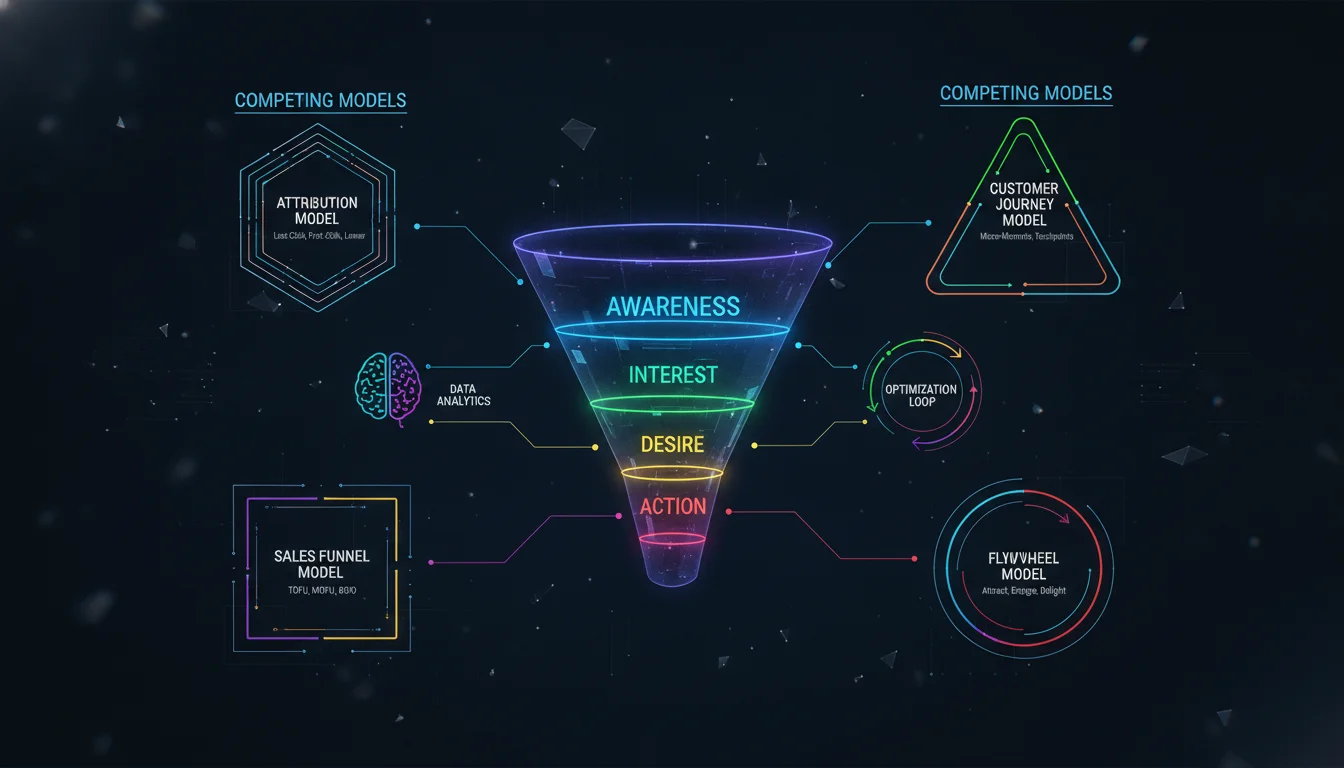
The most widely referenced digital marketing uses four stages: awareness, consideration, conversion, and loyalty. Amazon Ads and Coursera both describe this model. Awareness is brand familiarity. Consideration is the research and comparison phase. Conversion is the purchase action. Loyalty is repeat purchasing and advocacy. This four-stage structure maps cleanly onto common marketing team functions: brand marketing, demand generation, sales enablement, and customer marketing.
Amazon Ads notes that the marketing funnel concept has been around for over 100 years and that no universally accepted version exists. Some businesses use three stages, some five, and some six or more. The four-stage model remains popular because it balances simplicity with enough detail to guide cross-channel campaigns.
AIDA vs. Six-Stage Models
An older but still relevant model is AIDA: Attention, Interest, Desire, and Action. ELLE Education explains that AIDA traces a customer’s attitude toward a product through four sequential emotional states. AIDA works especially well for persuasive copywriting and landing page optimization, because each stage corresponds to a psychological trigger.
At the other end of complexity, West Virginia University outlines a six-element digital marketing funnel: exposure to the brand, discovery of the product, consideration of purchase, conversion of purchase, customer relationship commencement, and retention of customer. This model adds explicit post-purchase relationship building, which is often missing from simpler funnels. It suits B2B organizations with long onboarding and retention cycles.
The Three-Stage Simplified View
For teams that need a leaner structure, Semrush describes a basic marketing funnel with three stages: top of the funnel (ToFu), middle of the funnel (MoFu), and bottom of the funnel (BoFu). ToFu captures people becoming aware of the problem you solve. MoFu nurtures evaluation. BoFu drives purchase. This three-stage view is ideal for small marketing teams or early-stage startups that cannot resource separate awareness and loyalty programs.
| Model | Stages | Source | Best For |
|---|---|---|---|
| AIDA | Attention, Interest, Desire, Action | ELLE Education | Landing page and copy optimization |
| Four-stage standard | Awareness, Consideration, Conversion, Loyalty | Amazon Ads, Coursera | General B2C and B2B full-funnel campaigns |
| Three-stage basic | ToFu, MoFu, BoFu | Semrush | Small teams and quick campaign alignment |
| Six-stage operational | Exposure, Discovery, Consideration, Conversion, Customer Relationship, Retention | West Virginia University | Complex B2B journeys with long retention cycles |
No single model is universally correct. A funnel strategy should choose the model that matches the actual buying process, then adapt stage definitions to real customer behavior rather than theoretical ideals.
Why Digital Marketing Funnel Strategy Matters for B2B and B2C
Lead Generation and Nurturing
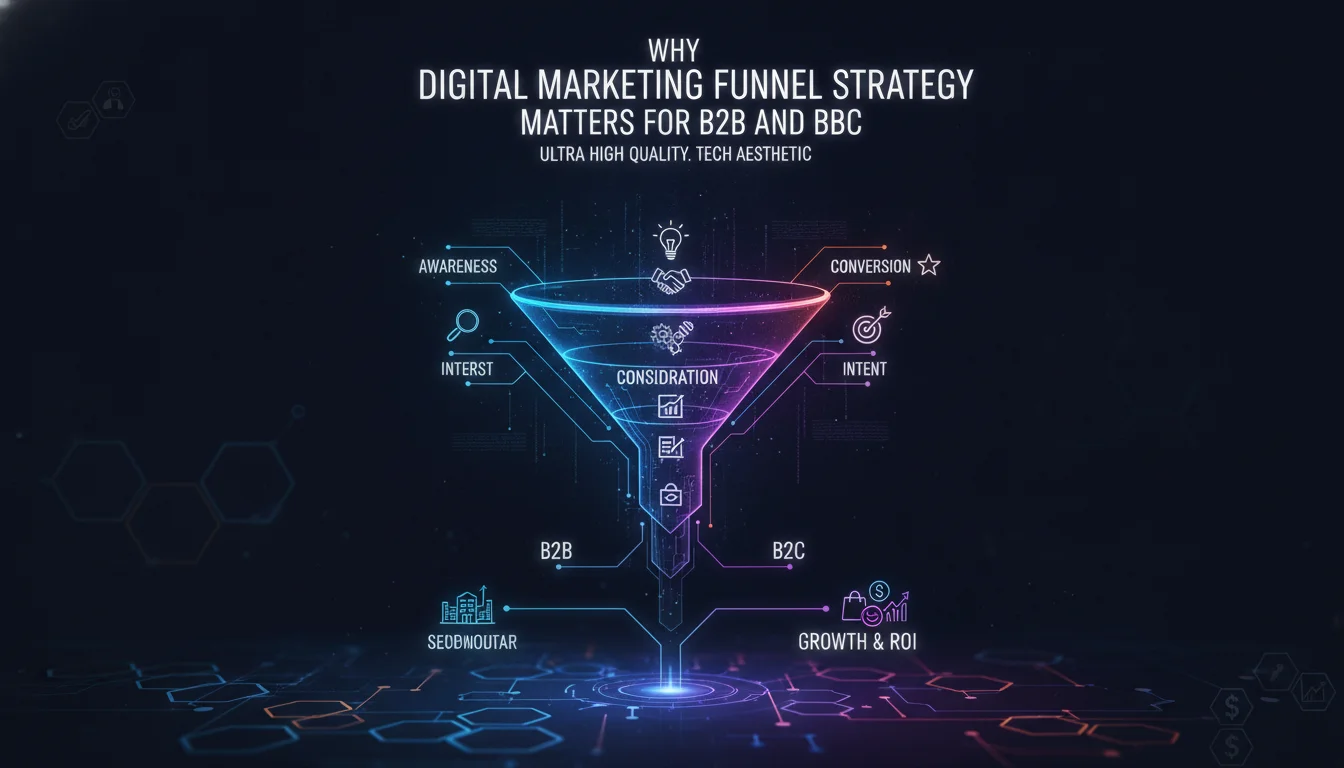
A this type of strategy is essential for both lead generation and lead nurturing, serving different functions at different stages. According to Amazon Ads, brands use awareness and consideration campaigns to attract new leads, then use decision and loyalty campaigns to nurture current leads and grow customers into advocates. In B2B, the consideration phase can involve extensive research across multiple stakeholders. In B2C, it may happen in minutes on a mobile device.
Coursera lists four benefits of funnel marketing: it helps you identify your target customer, increase conversion rates, gain valuable insights, and build customer relationships. Those benefits apply equally to B2B and B2C. The difference is the time horizon and content depth at each stage.
Customer Retention and Advocacy
Most revenue in subscription and repeat-purchase businesses comes after the first sale. Yet many marketers stop at conversion. A complete this kind of funnel strategy includes loyalty and advocacy as a measured stage, not an afterthought. According to WSI World, which references Sprout Social, a marketing funnel lets you know what your company must do to influence consumers at certain stages to drive sales and increase brand loyalty and awareness. That influence includes post-purchase content, referral programs, and community building.
Neglecting retention creates a leaky bucket. You can acquire customers profitably and still lose them before lifetime value exceeds acquisition cost. A the marketing funnel strategy treats loyalty metrics such as repeat purchase rate, churn, and net promoter score as first-class citizens, not vanity metrics.
Pros and Cons of a Digital Marketing Funnel Strategy
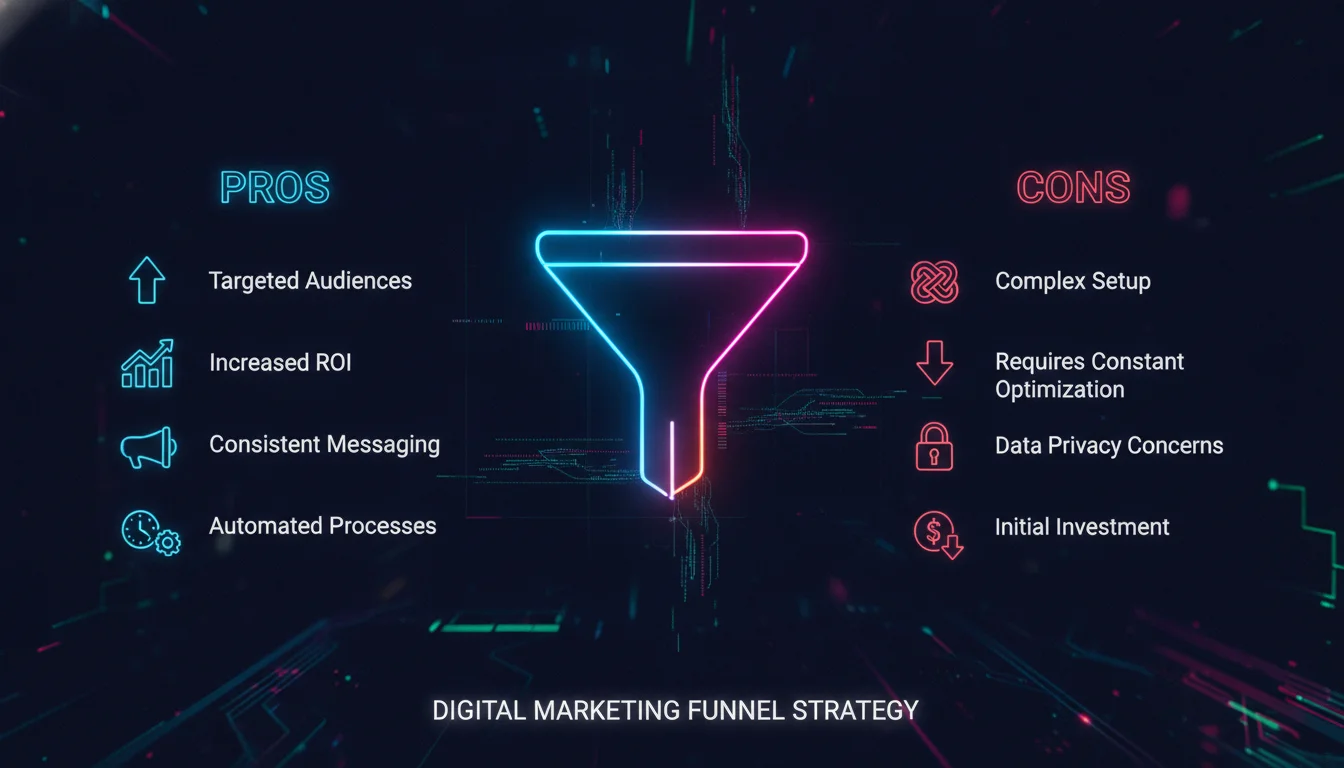
Pros
- Clarity across the team. Every channel, content piece, and campaign has a defined stage owner and objective.
- Better budget allocation. You can see exactly where prospects drop off and shift spend accordingly.
- Scalable lead nurturing. Automated sequences and stage-specific content replace guesswork with a repeatable system.
- Measurable growth. Stage-to-stage conversion rates give you a diagnostic view of the entire customer journey.
- Works for B2B and B2C. The model adapts to short impulse-buy cycles and multi-month enterprise sales alike.
Cons
- Funnels oversimplify real behavior. Customers enter, exit, and loop back. A rigid linear model can miss these nonlinear paths.
- Requires cross-functional buy-in. Marketing, sales, and customer success must all align on stage definitions and handoffs.
- Data setup takes time. Tracking stage-to-stage conversion rates requires proper analytics infrastructure before insights appear.
- Can neglect post-purchase. Teams focused on acquisition often under-invest in the loyalty and advocacy stages.
How to Build a Digital Marketing Funnel Strategy: Step-by-Step
Building a strategy is a systematic process. The steps below synthesize guidance from Wrike and Semrush into one actionable sequence.
- Define your target audience and buyer personas. Know who you are trying to attract and what problem they need solved.
- Select a funnel model. Choose three, four, five, or six stages based on your sales cycle and team resources.
- Map content offers to each stage. Assign blog posts, reports, webinars, pricing pages, and case studies.
- Choose channels for distribution. Align SEO, paid search, social media, email, and direct sales to stage goals.
- Define conversion events. Decide what counts as a micro-conversion and what counts as a purchase.
- Set stage-specific metrics. Track awareness reach, consideration engagement, conversion rate, and retention.
- Review and optimize weekly. Use funnel data to find drop-off points and reallocate budget.
Step 1: Set Objectives and Buyer Personas
Every digital marketing starts with the customer. Wrike recommends creating buyer personas to define your ideal audience before choosing channels or content. Ask what triggers the buyer to search, what questions they ask during consideration, and what proof they need to buy. Those answers determine the funnel stage definitions and the content calendar.
Objectives should be outcome-based, not activity-based. Instead of saying “publish four blog posts a month,” say “increase qualified top-of-funnel leads by a measurable percentage quarter over quarter.” Quantitative targets keep your digital marketing funnel strategy accountable to revenue, not just traffic.
Step 2: Map Channels to Stages
Not every channel performs equally at every stage. Awareness often benefits from social media, display ads, and SEO content. Consideration does well with webinars, comparison pages, and email nurture. Conversion relies on product pages, demos, and retargeting. Amazon Ads notes that 84% of shoppers begin their online product searches on digital channels that are not a brand’s owned website, so external touchpoints matter greatly at the top of the funnel.
Your digital marketing funnel strategy should specify which channels feed each stage and how budget shifts as prospects move deeper. An awareness campaign may direct visitors to a report or webinar registration page, while a conversion campaign uses a pricing, demo, trial, or purchase page. That channel-to-page alignment reduces friction and increases the probability of moving to the next stage.
Step 3: Define Metrics and Handoffs
Metrics make the funnel visible. Without stage-specific measurements, you cannot find the leaks. At minimum, track unique visitors and impressions for awareness; time on page, email opens, and content downloads for consideration; conversion rate and cost per acquisition for conversion; and repeat purchase rate and referral rate for loyalty.
Handoffs are just as important. In B2B, a marketing-qualified lead must pass to sales with context. In ecommerce, an abandoned cart should trigger an email sequence. Define these transitions in advance. A digital marketing funnel strategy that ignores handoffs creates a gap between marketing and sales where prospects stall and lose momentum.
Social Media Marketing Funnel Tactics by Stage
Social media plays a different role at each stage of a digital marketing funnel strategy, and treating every platform the same is one of the fastest ways to waste budget.
At the awareness stage, short-form video on platforms like Instagram Reels and TikTok builds brand recognition with cold audiences. Paid social campaigns using broad interest targeting introduce your brand to people who have never searched for you. The goal is reach and recall, not clicks.
At the consideration stage, social proof takes over. User-generated content, testimonials, and comparison posts address the questions buyers are already asking. Retargeting ads on Meta and LinkedIn re-engage people who visited your site but did not convert. Webinar promotions and lead magnet ads capture emails for deeper nurture sequences.
At the conversion stage, social ads shift to direct-response formats: product carousels, dynamic retargeting, and limited-time offers. The creative is specific, the audience is warm, and the call to action is unambiguous.
At the loyalty stage, social media becomes a community tool. Brand-owned groups, exclusive content drops, and referral campaigns reward existing customers and turn them into organic advocates. This is where a digital marketing funnel strategy pays dividends that no paid campaign can replicate.
Choosing the Right Funnel Model for Your Business
When to Use a Three-Stage Funnel
A three-stage funnel works well for businesses with short sales cycles, low average order value, or limited marketing headcount. Startups and local service providers often benefit from the top, middle, bottom structure described by Semrush. It forces focus on three questions: How do people discover us? How do we nurture interest? How do we close?
Use a three-stage funnel when you are just starting to track the customer journey and need a simple dashboard. Once you have enough data to differentiate research from purchase intent, you can expand to a more granular model.
When to Use a Six-Stage Funnel
Complex B2B organizations with multi-month sales cycles, implementation teams, and account management should consider a six-stage model like the one from West Virginia University. That model separates exposure from discovery, conversion from relationship commencement, and retention from advocacy. Each separation creates a distinct handoff point and a distinct metric set.
Six-stage funnels also help when customer onboarding is complex or when post-purchase expansion revenue matters. If your product requires training, setup, or adoption, a loyalty stage alone is too broad. You need to track whether customers actually start using the product and whether they stay.
Metrics and Measurement by Funnel Stage
Awareness Metrics
Awareness metrics tell you whether your brand is visible enough to enter the consideration set. Measure impressions, unique visitors, branded search volume, social mentions, and video views. According to ELLE Education, citing GWI market research, a typical internet user between the ages of 16 and 64 spends close to 7 hours online, creating massive exposure opportunities but also intense competition for attention. Because over half of all Google search visits take place on a mobile device, mobile experience is an awareness metric in disguise.
A low awareness score at the top will starve every later stage, no matter how optimized your checkout is. Fix the top before obsessing over the bottom.
Consideration and Conversion Metrics
Consideration metrics include email open rates, content downloads, webinar attendance, and page depth. They show whether prospects are actively evaluating your solution. Conversion metrics include add-to-cart rate, checkout completion, lead form submission, and cost per acquisition. The goal is not to maximize all metrics, but to reduce drop-off between stages.
Landingi warns, citing Neil Patel, that skipping key stages in the customer journey can cost you conversions. That means you should not jump straight from awareness ads to checkout pages without consideration-stage content. Track stage-to-stage conversion rates to find where prospects leak out of your digital marketing funnel strategy.
Loyalty and Advocacy Metrics
Loyalty metrics include repeat purchase rate, average order value over time, churn rate, and net promoter score. Advocacy metrics include referral traffic, social shares, and user-generated content volume. These matter because acquiring a new customer is typically more expensive than retaining an existing one, though the available competitor data does not provide a specific acquisition cost multiple.
Report loyalty metrics alongside acquisition metrics. If conversion rate is rising but churn is also rising, the funnel is leaking after purchase. Fix the post-purchase experience before scaling top-of-funnel spend.
Common Mistakes and How to Fix Them
Ignoring Nonlinear Journeys
The digital path to purchase is anything but linear. Amazon Ads states that consumers enter and exit and move around the funnel, and their shopping is not limited to a single store or geographic area. A rigid digital marketing funnel strategy that assumes a straight line from awareness to conversion will miss prospects who start with a review site, leave, and return via a social ad weeks later.
Fix this by building retargeting and cross-channel nurture paths. Accept that a prospect may enter at consideration after reading a competitor comparison, or at conversion after a referral. The funnel is a framework for assigning content and messages, not a law of customer behavior.
Skipping Stages Without Tracking
Many teams run awareness campaigns and conversion campaigns but ignore the middle. Or they treat the funnel as a one-time campaign rather than an ongoing system. Landingi notes that skipping key stages can cost conversions. The fix is to build a content library for every stage and map every ad, email, and page to a stage.
Another mistake is using vanity metrics. A million impressions do not indicate a healthy funnel if no one moves to consideration. Use stage-to-stage conversion rates, not absolute numbers, to diagnose problems. If awareness is high but consideration is low, your message may not match intent. If consideration is high but conversion is low, your offer or pricing page may have friction.
“A marketing funnel lets you know what your company must do to influence consumers at certain stages to drive sales and increase brand loyalty and awareness.” – Sprout Social, via WSI World
Digital Marketing Funnel Strategy Examples and Templates
Brand Spotlight: How Mature Brands Run the Full Funnel
Landingi examines funnel examples from Nike, Airbnb, and Peloton. While the source does not detail their exact tactics, the inclusion of these brands highlights that mature consumer companies treat the funnel as a repeatable system, not a one-off project. Nike likely uses aspirational awareness content, product-focused consideration pages, and loyalty programs. Airbnb uses search and social proof to drive consideration, then booking and review loops to drive retention. Peloton uses high-consideration content like free classes and community referrals to move prospects from awareness to purchase.
These examples show that a digital marketing funnel strategy is not about a single channel. It is about orchestrating paid, owned, and earned media across the entire journey. Your brand may not have Nike’s budget, but the structural principles still apply at any scale.
Template Elements for Execution
A practical funnel strategy template should include the following columns for each stage: stage name, target audience segment, core message, primary channel, secondary channel, content offer, conversion event, metric, and owner. Fill this table for every stage, then review it weekly. Wrike recommends breaking marketing projects into actionable tasks, which works well when each funnel stage is treated as a project phase with assigned owners.
Also include a drop-off column. For every stage-to-stage transition, record the conversion rate and the primary reason for abandonment. That column turns a static template into a living diagnostic tool. A digital marketing funnel strategy is only as good as the team’s willingness to act on that data.
As of 2026, the most effective teams we work with at Emin Media review their funnel templates monthly, not quarterly. Markets move fast. Your funnel review cadence should match that speed.
Frequently Asked Questions
What are the stages of a digital marketing funnel?
The most common four stages are awareness, consideration, conversion, and loyalty, as described by both Amazon Ads and Coursera. Some models use three stages (ToFu, MoFu, BoFu) and others use six. The right number depends on your sales cycle and how granularly you need to track customer behavior.
How does a digital marketing funnel differ from a sales funnel?
A sales funnel typically focuses on sales-owned activities from lead to closed deal. A digital marketing funnel covers the full online customer journey, including awareness, consideration, and post-purchase advocacy. The two overlap at the conversion stage, which is why marketing and sales alignment at that handoff point is critical.
What is the AIDA model in digital marketing?
AIDA stands for Attention, Interest, Desire, and Action. It is a persuasion model used to structure ads, landing pages, and emails that move a prospect emotionally toward purchase. According to ELLE Education, each stage corresponds to a distinct psychological state in the buyer’s attitude toward your product.
Why do companies fail with funnel marketing?
Companies often fail because they skip stages, ignore nonlinear journeys, or do not track stage-to-stage conversion rates. According to Salesforce data cited by Landingi, 68% of companies have not identified their funnel at all, meaning most businesses are running campaigns without a coherent framework to connect them.
How do I choose between a 3-stage and 4-stage funnel?
Choose a 3-stage funnel if you have a short sales cycle and limited marketing resources. Choose a 4-stage funnel if you need to separate conversion from loyalty and measure post-purchase behavior as a distinct growth lever. Start simple, then add stages as your data matures.
What metrics should I track in a digital marketing funnel?
Track awareness reach, consideration engagement, conversion rate, and loyalty retention. Stage-to-stage conversion rates are more diagnostic than absolute volume numbers, because they show exactly where prospects are leaving your digital marketing funnel strategy rather than just how many entered it.
Ready to build a funnel that actually converts? Contact Emin Media for a free brand consultation and let’s build something bold together.
Enjoyed this article?
Contact Emin Media for a free brand consultation and let's create something amazing together.
Get in TouchRelated Articles
Digital Storytelling for Brands: The Complete Guide
Digital storytelling for brands builds real audience connections through narrative. Learn proven techniques, formats, and…
Design Thinking for Marketing: A 2026 Guide
Design thinking for marketing builds campaigns around real user needs. Learn the 5 phases, common…
Creative Direction for Video Shoots: A Complete Guide
Master creative direction for video shoots with proven steps, tools, and strategies that build brand…