30 Creative Marketing Campaign Ideas for 2026
Creative marketing campaign ideas are original, attention-earning concepts that connect brands to audiences through unexpected, useful, or emotionally resonant experiences. Unlike routine promotions, the best creative marketing campaign ideas are engineered to earn attention rather than purchase it.
Key Takeaways
- campaign ideas span gamification, zero-budget community tactics, influencer partnerships, physical activations, and content-driven SEO.
- The most effective campaigns entertain, take a stand, create an immersive experience, or solve a genuine consumer problem, according to Adobe.
- Zero-budget this type of ideas rely on existing customers, public spaces, and everyday objects as media channels.
- Gamification mechanics like quizzes, trivia, and Wheel-of-Fortune spins turn passive scrolling into active participation and lead generation.
- Measuring reach, engagement, conversion, and sentiment is enough to evaluate most this kind of campaign ideas without a massive analytics stack.
- The strongest campaigns combine a tight creative mechanism with a measurable behavior goal, not novelty alone.
What Are Creative Marketing Campaign Ideas?
the marketing campaign ideas are distinct concepts that make a brand memorable by combining utility, emotion, or interaction in ways competitors cannot easily copy. A digital marketing campaign is a strategic plan designed to promote a business online to boost brand awareness, engagement, and conversions. As of 2026, that definition has expanded: effective campaigns embed a brand within consumer conversation and lifestyle rather than simply interrupting it.
According to Adobe’s business blog, the campaigns that break through do not merely disrupt. They entertain, take a stand, create an immersive experience, or solve a genuine consumer problem. That dual function, utility plus emotion, is what separates strong ideas from ordinary advertising. Campaigns of the World organizes these ideas across film and video, digital, outdoor, print, and technology formats, giving marketers a live archive of what is actually earning attention right now.
The Definition That Matters in 2026
A creative marketing campaign idea is not a single tactic like a social media post or an email blast. It is the organizing concept that makes those tactics feel connected and memorable. Burger King’s ‘Leave The Flame Grilling To Us’ campaign, documented by Campaigns of the World, uses summer sunburn as a humorous entry point for its flame-grilling message. That insight, repurposing an everyday annoyance into brand memory, is the core idea. The tactics (print, outdoor, social) are just delivery vehicles.
Creativity in marketing means finding an ownable angle competitors cannot easily replicate. It can be visual, tonal, experiential, or structural. Dminusone’s The Life-Saving Receipt campaign turned grocery slips into a health lifeline. That is a structural creative idea. A tonal idea might make consumers laugh, which matters because, according to a HubSpot survey cited by Optimove, 49% of consumers say funny content is the most memorable.
Why Creativity Outperforms Convention
Most brand interactions are forgotten. Consumers scroll past hundreds of brand messages daily, and only unusual or genuinely useful moments break through. Optimove notes that bold marketing helps brands cut through the noise and become more memorable, highlighting gamification, trivia, and physical activations as high-engagement paths.
Influencer trust is another reason creative marketing outperform conventional ads. According to Splash, 69% of social media users trust recommendations made by the people they follow rather than brands. A creative campaign that uses influencers as co-creators, not just paid amplifiers, taps that trust while introducing fresh angles the brand team might never generate internally.
How to Turn an Idea into a Campaign
Start by identifying a customer tension or platform behavior that aligns with your brand. Then choose a mechanism: gamification, content, physical activation, influencer collaboration, or social purpose. Finally, design a measurable loop covering participation, capture, and follow-up. The best campaign ideas are not random stunts. They are systems that produce repeatable engagement.
The table below compares common campaign types by primary mechanism, ideal channel, and real-world example. Use it to shortlist approaches before committing resources.
| Campaign Type | Primary Mechanism | Best Channel | Example from Evidence |
|---|---|---|---|
| Gamification marketing | Points, quizzes, leaderboards | Website, app, social | Optimove Minigames trivia |
| Zero-budget community | User-generated content, word of mouth | Local, social, email | Free product for a week via community ask |
| Influencer partnership | Creator-led content, trust transfer | Instagram, YouTube, TikTok | Splash 69% trust finding |
| Physical activation | Eye-catching displays, QR codes | Outdoor, retail, events | Carlsberg Goal Posters |
| Content and SEO | Question-based articles, videos | Blog, YouTube, search | Aura 0 to 200K organic visits |
| Social purpose | Cause alignment, utility | Digital, PR, partnerships | Royal Society for Blind Children Bedtime Donations |
Pros and Cons of Creative Marketing Campaign Ideas
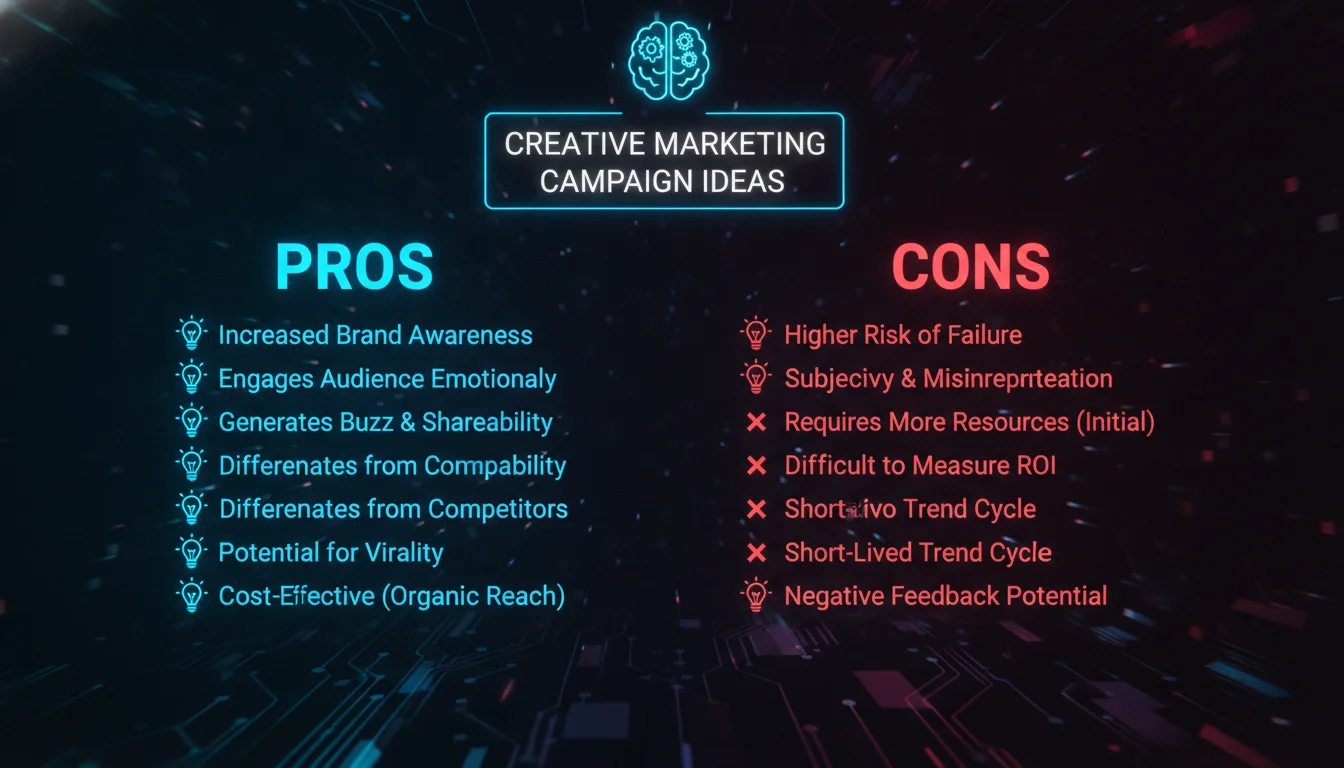
Pros
- Earned attention over paid reach: Strong this type of ideas generate press, social sharing, and word of mouth that paid media cannot replicate at the same cost.
- Emotional memorability: Campaigns built around humor, purpose, or surprise create lasting brand associations that outlive the campaign window.
- Compounding returns: Content-driven and community-led this kind of campaign ideas build organic reach over time rather than stopping the moment budget runs out.
- Audience co-creation: Gamified and user-generated approaches turn customers into active participants, deepening loyalty and generating authentic social proof.
- Scalable across budgets: Some of the most memorable the marketing campaign ideas require no paid media at all, only a sharp insight and the right everyday object.
Cons
- Novelty without relevance: A clever concept that does not connect to the product or brand values can generate laughs but zero leads.
- Difficult to predict virality: Creative campaigns are harder to forecast than performance ads, making budget justification challenging in data-driven organizations.
- Execution risk: Physical activations, stunts, and live events introduce logistical complexity that digital-only campaigns avoid.
- Measurement gaps: Earned attention and brand sentiment are real outcomes but harder to tie directly to revenue than a click-through rate.
Gamification and Interactive Creative Marketing Campaign Ideas
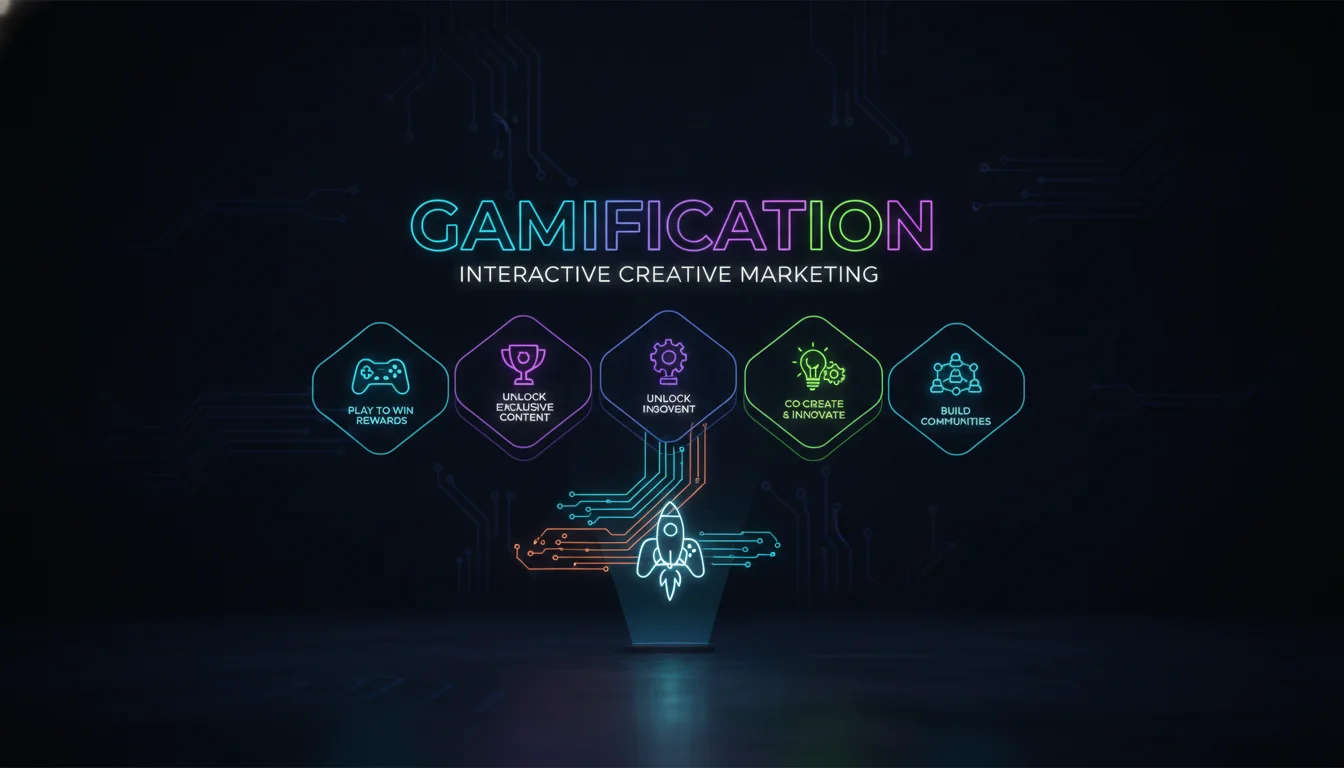
Gamification marketing is the practice of incorporating gaming elements into marketing campaigns to engage and motivate customers. It uses points, leaderboards, and rewards to create a game-like setting, and Optimove’s 2026 guide positions it as one of seven bold marketing approaches that make customers remember you.
Interactive mechanics work because they convert passive scrolling into active participation. A quiz, trivia round, or Wheel-of-Fortune spin captures attention while collecting zero-party data. The key is tying the game mechanic to a product benefit or brand value, not just generic fun.
Quizzes, Trivia, and Wheel-of-Fortune Mechanics
Quizzes and trivia are among the easiest gamified ideas to launch without writing a line of code. A skincare brand might run a skin-type quiz that leads to a personalized product recommendation. A B2B software brand might use a five-question industry trivia challenge to qualify leads. Optimove specifically highlights questionnaires and trivia games as high-engagement lead generation tools, pointing to platforms like Optimove Minigames as no-code starting points.
Wheel-of-Fortune mechanics add a chance-and-reward layer. Users spin to win discounts, content downloads, or early access. The perceived value of winning increases time on page and email capture rates. Pair the game with a follow-up email sequence to turn engagement into pipeline.
Game-Based Product Experiences
Game-based marketing turns product benefits into interactive experiences customers actually enjoy. Instead of listing features, a campaign might let users simulate the outcome of using a product. A financial brand could create a savings goal game. A travel brand could build a destination-matching personality quiz. The result is a product demo disguised as play.
This approach also works for complex B2B offerings. By gamifying a common customer problem, you make the solution tangible before a sales call. The game becomes a memorable proof point rather than a static case study sitting in a shared drive nobody opens.
Physical Activations with QR Bridges
Physical activations are eye-catching displays that boost attention and QR-driven interaction. Campaigns of the World documents several strong 2026 examples. Carlsberg’s Goal Posters turned outdoor ads into playable football goals, inviting passersby to interact physically and scan a QR code for rewards. That blend of outdoor scale and digital capture is a repeatable formula any brand with retail or event presence can adapt.
WWF’s Fire on Display turned TV showrooms into a wake-up call for wildfires. The installation used ambient imagery to make an environmental risk vivid, then directed viewers to action. QR bridges connect the physical moment to a landing page, donation link, or lead form, closing the loop between real-world attention and digital conversion.
Zero-Budget Creative Marketing Campaign Ideas
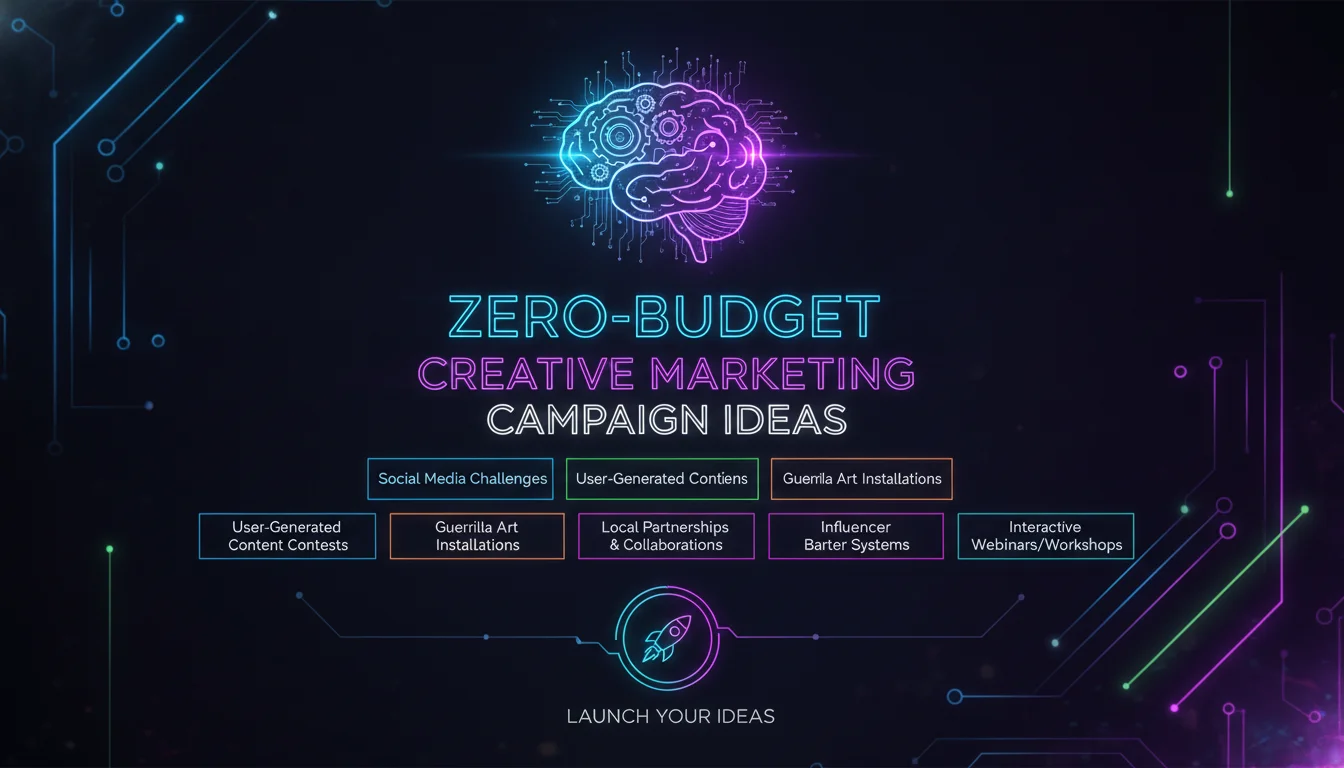
Not every creative marketing campaign idea requires paid media. Some of the most memorable campaigns start with a tiny budget and a sharp insight about community behavior. HubSpot’s video series on marketing campaigns reinforces that speed and creativity can substitute for agency retainers, presenting 22 proven approaches you can launch fast without a big budget or agency required.
Zero-budget creative marketing often rely on three resources: existing customers, accessible public spaces, and ordinary objects. The goal is to make the brand visible in places where ads normally do not appear, or to make customers the channel themselves.
Build on User-Generated Content and Community
User-generated content is marketing material created by customers rather than the brand. It can include reviews, photos, videos, or testimonials that showcase real product use. A zero-budget campaign might ask customers to share a specific moment with a branded hashtag, then republish those posts across official channels. The brand provides the creative prompt. The community provides the content.
Local businesses can use this especially well. A coffee shop might offer free product for a week and ask recipients to share their experience. Word of mouth and social proof then compound. The cost is the product itself, not media spend.
Partner with Micro-Influencers on a Value Exchange
Micro-influencer marketing is the practice of collaborating with creators who have smaller, highly engaged followings. Splash’s creative marketing ideas research highlights that 69% of social media users trust recommendations from people they follow rather than brands. Micro-influencers often trade product, access, or co-created content for promotion, making this a low-cash option for brands at any stage.
To run a value exchange, identify creators whose audience matches your niche. Offer exclusive early access, a behind-the-scenes look, or a collaborative product design. The creator shares authentic content that reads as personal endorsement rather than a sponsored ad, which is exactly why it converts better.
Turn Everyday Objects into Media
Ordinary objects become media when a creative idea repurposes them for brand communication. Dminusone’s The Life-Saving Receipt turned grocery slips into a health lifeline, as documented by Campaigns of the World. Polaroid’s ‘The Best Of Summer Is Analog’ campaign used the brand’s own product to make a case for living offline. Both examples use objects people already touch daily.
This tactic works because it inserts the brand into existing routines. A receipt, a lamp, a park bench, or a coffee cup becomes a canvas. The surprise factor makes people stop. The utility factor makes them share. Together, those two reactions are the engine of earned media.
Experiential and In-Person Creative Marketing Campaign Ideas
Experiential marketing creates live, tactile moments that forge emotional connections. Unlike digital ads, in-person experiences allow prospects to feel a product, hear a brand’s voice, and interact with real people. Splash’s event marketing research argues there is nothing like the magic of in-person connection for brand awareness, pipeline creation, or pipeline acceleration.
Even B2B brands are returning to fundamentals. According to Splash, with all the AI attention in the market right now, marketers need to bring human connection back, and virtual or in-person events are among the best ways to do that.
Host Live Events, Meetups, and Pop-Ups
Live events create memorable shared experiences ranging from intimate meetups to large product launches. The advantage is immediate feedback, real-time Q&A, and a genuine sense of community. For a small business, a local workshop or pop-up can generate more qualified leads than a month of banner ads.
To make live events feel like campaign ideas rather than standard trade show appearances, add an unexpected ritual or interactive element. A wine brand might host a blind tasting with personality quizzes. A software company might run a live problem-solving challenge. The key is a reason to attend beyond free food and branded tote bags.
Webinars, Live Streams, and Virtual Events
Webinars and live streams are among the most direct channels for connecting with potential customers. Splash notes that no other marketing channel enables direct connection like online events. They allow live product tours, informal explanations of complex subjects, and immediate feedback collection in real time.
Virtual events also solve geography and budget constraints. A B2B brand can run a live Q&A with an industry expert and repurpose the recording into YouTube SEO content. The registrant-to-attendee conversion is often strong because the topic solves a specific pain point the audience is already searching for.
Stunt Marketing with Real-World Objects
Stunt marketing uses surprising physical installations to generate press and social sharing. Burger King’s ‘Leave The Flame Grilling To Us’ campaign gave summer sunburn a humorous twist, as documented on Campaigns of the World. The idea takes an everyday annoyance and reframes it around flame-grilling. That kind of owned angle is exactly what this type of ideas should aim for: a point of view so specific that only one brand could own it.
WWF’s Fire on Display is another stunt-style activation that turns TV showrooms into wildfire warnings. Both examples show that a strong creative concept can be executed with one location and a clear visual metaphor, then amplified through earned media and social sharing far beyond the original footprint.
Content and SEO Creative Marketing Campaign Ideas
Content marketing remains a strong choice for competitive markets where paid advertising costs are too high. The best part is that customers can lead the strategy through question-based content that attracts inbound leads consistently. Splash’s former VP of Growth at Aura grew organic traffic from 0 to over 200K visitors in less than one year by listening to sales calls and aligning real customer problems to long-tail keywords.
Content-driven this kind of campaign ideas compound over time, but they require patience and a clear keyword architecture. The goal is to become the best answer for the questions your customers are already asking somewhere else.
Content Marketing That Answers Real Customer Questions
The most powerful content marketing strategy starts with sales call mining. Record the exact questions prospects ask, then turn each question into a long-tail SEO article. Aura’s team targeted terms like “How to remove your personal information from the internet” and “What to do if someone gets your social security number.” These are not glamorous topics, but they capture high-intent users at the exact moment of need.
For small businesses, this might mean a FAQ series, a comparison guide, or a how-to that addresses local pain points. The creativity lies in choosing questions competitors overlook and answering them with first-hand expertise that no AI summary can fully replicate.
YouTube SEO and Video Series
YouTube SEO works because customers want a mix of videos and interactive media, not just written text. Embedded videos enrich blog content and can bring consistent traffic to your website over months and years. Splash recommends focusing on search terms in titles and descriptions, then adding tags, categories, cards, hashtags, and custom thumbnails to improve click-through rates.
A creative YouTube series might follow a customer problem from diagnosis to solution, or feature real team members answering tough questions on camera. The channel becomes a discovery engine, not just a hosting platform. You can repurpose webinar recordings into short clips and long-form tutorials, stretching one piece of content across multiple the marketing campaign ideas.
Guest Posts and Collaborative Articles
Writing guest posts is a low-cost creative marketing idea that builds authority and referral traffic simultaneously. The tactic works best when you target niche publications where your ideal customers already read. Instead of a self-promotional piece, offer a data-driven or experience-led answer to a pressing industry question.
Collaborative articles with complementary brands or industry experts expand reach without paid media. Each collaborator brings their audience, and the resulting piece becomes a shared asset. This also supports the content marketing flywheel: more backlinks, more domain authority, more search visibility over time.
Digital and Platform-Specific Creative Marketing Campaign Ideas
Digital channels allow ideas to scale quickly across audiences that would take years to build through organic alone. Adobe’s digital marketing examples highlight that success requires integrating online and offline touchpoints, not just running ads in isolation. From Dove’s #Faceof10 campaign to JetBlue’s use of X for instant customer service, the common thread is real-time relevance and cultural awareness.
“The most effective campaigns are designed to embed a brand within the very fabric of consumer conversation and lifestyle. They transcend the simple act of advertising a product or service.” – Adobe for Business Blog
Social Media Campaigns That Earn Attention
Social media campaigns work when they tap a current conversation or emotional trigger rather than broadcasting a product message. Dove’s #Faceof10 campaign addressed unrealistic beauty standards for girls, earning massive organic shares. Orange France’s Les Bleues campaign used cultural pride to connect with audiences around a shared identity. JetBlue used X to provide instant customer service, turning a utility channel into a genuine brand differentiator.
The creative mechanism here is often social purpose or real-time response. Brands that listen, respond, and act humanly earn attention without a paid boost. A small business can replicate this by joining local conversations, offering unexpected help, or taking a clear values-based stance on something its customers already care about.
Influencer and Creator Partnerships
Influencer partnerships bring fresh eyes and built-in trust to creative marketing. Splash advises focusing on both macro and micro-influencers to target different follower segments. A B2B thought leader can co-create a webinar. A B2C influencer can launch a product challenge. The creative idea often comes from the influencer, not the brand, which breaks internal echo chambers and produces content that actually sounds human.
The 69% trust finding from Splash underscores why influencer-led campaigns outperform brand-led messages. When an influencer frames a product within their own story, it feels like peer advice rather than advertising, and that distinction is everything in a skeptical media environment.
Email and Referral Campaigns
Email and referral campaigns become campaign ideas when they borrow from game mechanics or social proof. Lyft’s referral program, cited by Adobe, rewarded both the referrer and the new user, creating a viral loop that grew the user base without proportional ad spend. Slack’s word-of-mouth marketing relied on product experience and community enthusiasm rather than paid campaigns.
Creativity in email might mean a countdown sequence, a personalized video, or a micro-interactive quiz inside the message. Referral creativity means designing an offer that feels generous to both sides, then making the ask at a moment of high customer satisfaction rather than at a random point in the funnel.
Real-World Examples of Creative Marketing Campaign Ideas
Looking at real campaigns helps clarify what this type of ideas look like in actual execution. The examples below come from Adobe’s digital marketing campaign archive and Campaigns of the World’s 2026 featured work, both of which curate based on creative merit and measurable cultural impact.
CeraVe, Dove, and Heineken: Anti-Advertising and Social Purpose
CeraVe’s anti-advertising campaign deliberately avoided glossy beauty tropes to build credibility with dermatologists and everyday consumers. Dove’s #Faceof10 campaign used a social experiment to shift the conversation about girls’ self-image. Heineken’s The Boring Phone campaign took a stand against constant digital distraction. None of these campaigns relied on traditional product benefit messaging. They aligned with a cultural value their audience already held.
This approach works because it earns press and social conversation the brand could not buy. The creative idea is the point of view, not the product. Brands that can articulate a clear, relevant point of view on a customer tension will generate earned attention that outlasts the campaign itself.
Burger King, Carlsberg, and WWF: Outdoor and Ambient Ideas
Burger King’s sunburn twist, Carlsberg’s playable goal posters, and WWF’s TV showroom wildfire warning all repurpose physical environments into creative marketing campaign ideas. Campaigns of the World curates these because they demonstrate that outdoor ideas are still powerful in a digital-first era. The common thread is an unexpected use of a familiar object or setting that stops people mid-stride.
These campaigns also create strong visual assets for social sharing. One photo of a creative installation can travel further than the physical foot traffic alone. For brands with retail or local presence, ambient ideas turn owned spaces into media without buying a single ad placement.
Royal Society for Blind Children and Dminusone: Purpose-Driven Utility
Royal Society for Blind Children’s Bedtime Donations campaign turned nightly reading into free audiobooks, directly linking a routine action to a charitable outcome. Dminusone’s Life-Saving Receipt turned grocery slips into health information. Both campaigns are utility first, brand second. They solve a problem while demonstrating the organization’s mission in a single gesture.
Purpose-driven utility is a strong model for creative marketing campaign ideas because it creates an emotional bond and a practical reason to engage. Nonprofits often lead this space, but commercial brands can adopt the same structure by aligning with a cause that genuinely connects to their product or service rather than bolting on a charity partnership for optics.
“Bold marketing helps brands cut through the noise and become more memorable. Gamification, trivia, and physical activations are among the highest-engagement paths available to marketers today.” – Optimove, 2026
How to Plan Creative Marketing Campaign Ideas
Planning creative marketing campaign ideas does not start with brainstorming slogans. It starts with a clear understanding of the audience, the constraint, and the desired behavior. Use the following step-by-step process to move from insight to launch without burning budget on unproven concepts.
Step-by-Step Process from Insight to Launch
- Mine customer language. Review sales calls, support tickets, reviews, and social comments to find recurring questions and frustrations. This is where the best creative marketing campaign ideas actually begin.
- Choose a mechanism. Decide whether gamification, content, event, influencer, or physical activation best matches the audience platform and available resources.
- Define the measurable behavior. Specify the action you want: email capture, product trial, social share, donation, or attendance. Vague goals produce vague results.
- Draft the creative hook. Write one sentence that makes the tension visible and ties it to the brand. Test it with three customers for clarity before investing in production.
- Build a minimal version. Launch a pilot before scaling. Use a small audience segment, a single location, or a limited run to validate the concept.
- Measure and iterate. Track participation, conversion, cost per lead, and sentiment. Double down on what resonates. Cut what does not.
Measuring Campaign Success Without Big Budgets
You do not need a massive analytics stack to evaluate creative marketing campaign ideas. Start with four metrics: reach (how many saw it), engagement (how many interacted), conversion (how many took the desired action), and sentiment (how people felt). Use UTM parameters, unique QR codes, landing page traffic, and post-campaign surveys to capture each layer.
For zero-budget creative marketing campaign ideas, measure word-of-mouth proxies like social mentions, referral traffic, and repeat visits. The goal is to learn which mechanism drives the lowest cost per meaningful action, then reinvest in that channel with confidence.
Common Pitfalls and How to Avoid Them
One common mistake is novelty without relevance. A funny gag may get laughs but no leads if it does not connect to the product. Another is chasing virality instead of utility. Aim for a campaign that would be useful even if it never went viral. Finally, avoid overcomplicating the ask. A campaign that requires five steps to participate will lose most of its audience before they reach step two.
To avoid these pitfalls, keep the customer tension central. Ask whether the campaign would still make sense if the logo were removed. If not, tighten the link between brand and idea. The best creative marketing campaign ideas are both immediately recognizable and genuinely brand-owned, not concepts any competitor could run with a logo swap.
Frequently Asked Questions
What are creative marketing campaign ideas?
Creative marketing campaign ideas are original concepts that earn attention through unexpected, useful, or emotionally engaging experiences. They range from gamified quizzes and zero-budget community stunts to influencer partnerships and real-world physical activations that generate earned media.
How do I run a creative marketing campaign with no budget?
Use existing customers, public spaces, and ordinary objects as your media. Encourage user-generated content with a branded hashtag, partner with micro-influencers on a value exchange, and turn everyday items like receipts or outdoor surfaces into brand touchpoints that cost nothing beyond the creative concept itself.
What types of creative campaigns work for B2B?
Webinars, live streams, question-based content marketing, and gamified product demos work well for B2B audiences. Splash highlights that live events and virtual events are among the best ways to rebuild human connection in B2B marketing, especially as AI-generated content makes authentic interaction more valuable.
How do I measure creative marketing campaign performance?
Track reach, engagement, conversion, and sentiment using UTM parameters, QR codes, and landing page analytics. For low-budget creative marketing campaign ideas, monitor social mentions, referral traffic, and repeat visits to gauge word-of-mouth impact without a complex attribution stack.
What is gamification marketing?
Gamification marketing is the practice of incorporating gaming elements like points, leaderboards, and rewards into marketing campaigns to engage and motivate customers. It turns passive browsing into active participation and can generate qualified leads through quizzes, trivia challenges, and spin-to-win mechanics.
Ready to build something that actually earns attention? Contact Emin Media for a free brand consultation and let’s turn your next campaign into a creative marketing campaign idea worth talking about.
Enjoyed this article?
Contact Emin Media for a free brand consultation and let's create something amazing together.
Get in TouchRelated Articles
Brand Engagement on Instagram: 2026 Guide
Master brand engagement on Instagram with proven strategies for Reels, carousels, saves, and shares. Boost…
AI in Creative Marketing: The 2026 Guide
AI in creative marketing is reshaping how brands create, personalize, and scale campaigns. Discover tools,…
10 Types of Digital Marketing Explained
Explore the 10 essential types of digital marketing—from SEO to video—and learn which channels fit…