AI in Creative Marketing: The 2026 Guide
AI in creative marketing is the use of artificial intelligence to generate content, personalize campaigns, and optimize creative assets at scale. It works alongside human creativity rather than replacing it, giving marketing teams a faster, smarter production engine.
Key Takeaways
- creative marketing is a collaborative tool that enhances, rather than replaces, human creativity.
- It enables hyper-personalization, rapid content generation, and data-driven decision-making at scale.
- Marketers must address ethical concerns around bias, authenticity, and data privacy when deploying AI.
- Successful implementation requires integrating AI into ideation, production, and analysis workflows.
- Tools like generative AI platforms (DALL·E, ChatGPT) and ad creative generators (AdCreative.ai) are reshaping how campaigns get made.
- As of 2026, the marketers winning with AI are the ones who treat it as a creative partner, not a content vending machine.
What Is AI in Creative Marketing?
this type of marketing is the integration of artificial intelligence technologies, including machine learning, natural language processing, and computer vision, into the creative processes that drive marketing campaigns. Unlike traditional marketing automation, which follows predefined rules, this kind of creative marketing uses algorithms that learn from data to generate novel ideas, personalize content, and optimize creative assets in real time. A study published in the Journal of Interactive Marketing describes AI as an “instrumental resource” that acts like a paintbrush for modern marketers, extending their creative toolkit without supplanting human intuition.
At its core, the in creative marketing works by analyzing vast datasets, from consumer behavior patterns to visual design trends, to produce outputs that would be impossible for humans to generate manually at the same speed. Generative AI models like OpenAI’s GPT-4 and DALL·E exemplify this capability, producing text and images that rival human-made content. The human marketer remains indispensable for defining brand voice, ensuring emotional resonance, and making strategic decisions that AI alone cannot grasp.
The Evolution of AI in Creative Roles
Historically, creative roles in marketing were purely human-driven. The emergence of AI changed this dynamic, first by automating routine tasks like image resizing and keyword insertion, and later by generating entire ad concepts. According to the Harvard Division of Continuing Education, routine tasks like writing copy, mining consumer data, and creating visuals that once took hours can now be done in minutes with AI assistance. This evolution has moved AI from a backend efficiency tool to a front-end creative partner, reshaping job roles and skill requirements across the industry.
Pros and Cons of AI in Creative Marketing
Pros
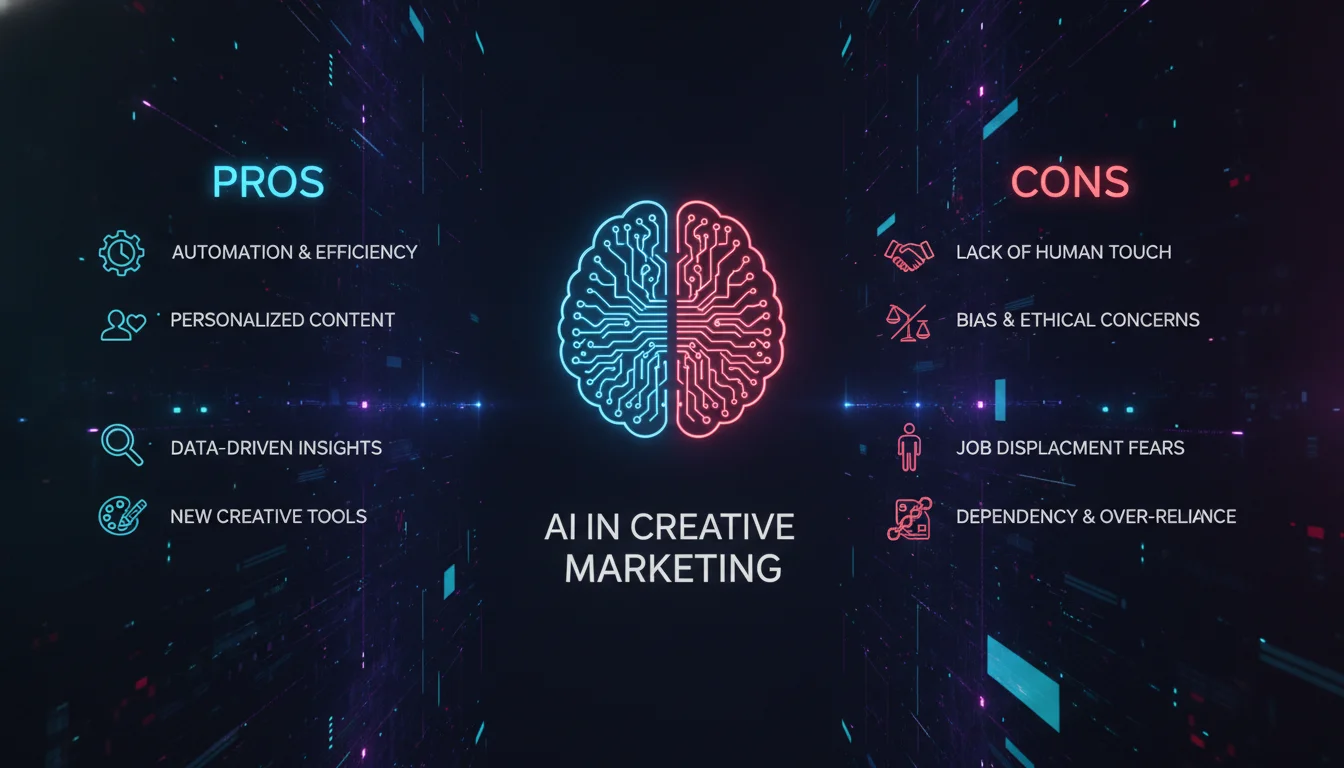
- Speed at scale: AI compresses hours of creative production into minutes, freeing teams for higher-order thinking.
- Hyper-personalization: AI analyzes individual consumer data to deliver messages that feel one-to-one, even at mass scale.
- Data-backed creative decisions: Platforms like AdCreative.ai train on patterns from over $35 billion in ad spend data, making creative choices less guesswork and more science.
- Lower production barriers: Small brands can now produce video ads, product photography, and multi-format campaigns without large agency budgets.
- Continuous optimization: AI automates A/B testing cycles, identifying winning creative faster than manual review ever could.
Cons
- Algorithmic bias: AI models learn from historical data. If that data carries societal bias, the outputs will too.
- Authenticity risk: Overreliance on AI-generated content can produce campaigns that feel generic and disconnected from a brand’s true character.
- Data privacy obligations: Personalization requires data collection, which triggers GDPR, CCPA, and other regulatory requirements.
- Skill gap: Teams that don’t invest in AI literacy will struggle to prompt, evaluate, and refine AI outputs effectively.
- Creative homogenization: When every brand uses the same AI tools with similar prompts, the market risks looking and sounding identical.
Types of AI Technologies Used in Creative Marketing
Generative AI Tools
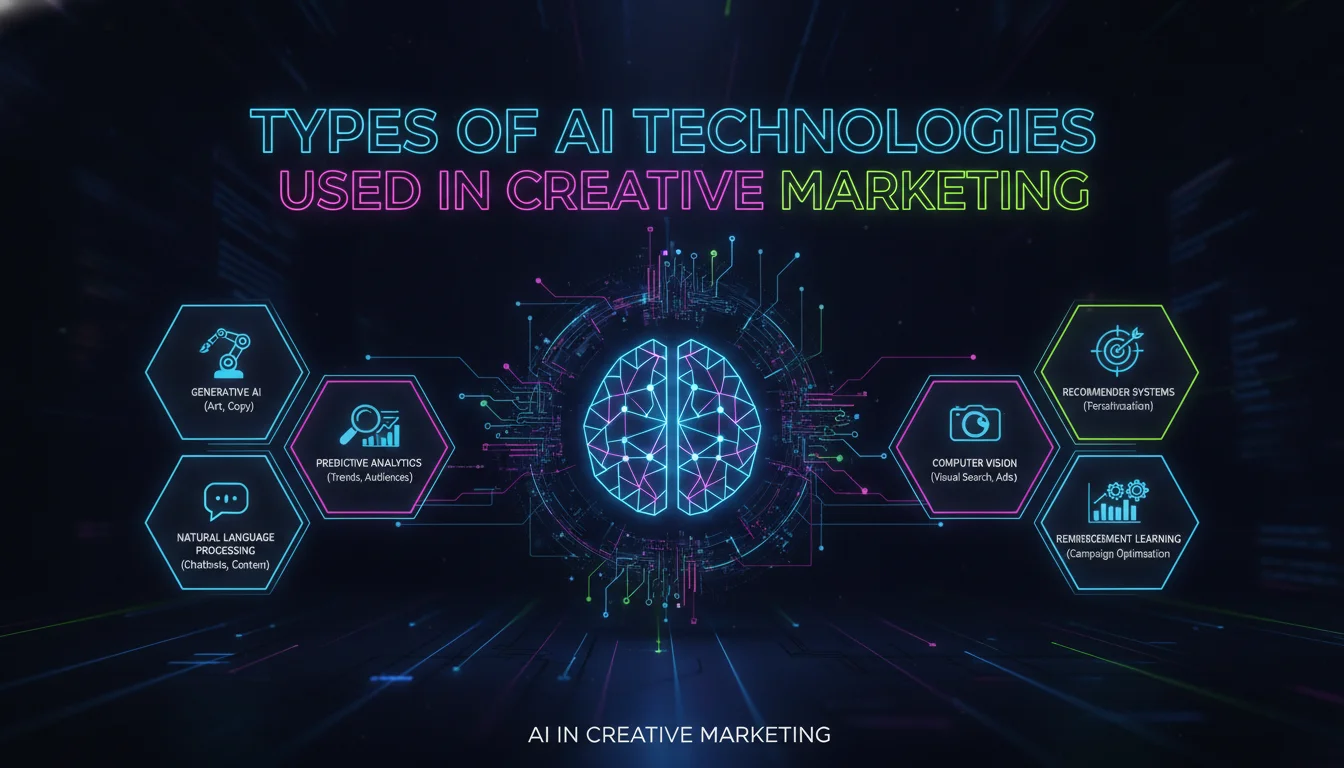
Generative AI is the most visible category within marketing. These tools create content, including text, images, audio, and video, from scratch based on training data. As Kadence International explains, generative AI goes beyond traditional AI’s decision-making role to produce entirely new data that mimics human creativity. Platforms like DALL·E for image generation and ChatGPT for copywriting have become staples in marketing departments, enabling teams to rapidly prototype ad visuals, social media posts, and video scripts. AdCreative.ai uses generative AI to create high-converting ad creatives, training on patterns from over $35 billion in ad spend data to optimize outputs.
Predictive Analytics and Audience Insights
AI-powered predictive analytics help marketers forecast trends and tailor creative campaigns to specific audience segments. By analyzing historical engagement data, AI models can predict which color schemes, messaging tones, or ad formats will resonate most with a target demographic. This capability moves well beyond simple A/B testing, enabling continuous campaign optimization. Harvard DCE highlights how platforms like HubSpot and Mailchimp now integrate AI to personalize email content and predict customer behaviors, making creative decisions more data-informed without sacrificing originality.
Automation and Optimization Platforms
Beyond content generation, AI automates the iterative aspects of creative marketing. Tools described by Insight take over repetitive tasks such as generating multiple ad copy variations, resizing images for different platforms, and scheduling A/B tests. This frees creative teams to focus on high-level strategy and storytelling. AdCreative.ai’s “Creative Insights” feature analyzes ad performance and suggests optimizations, effectively automating the cycle of creative production and refinement.
How AI Enhances the Creative Process
Idea Generation and Brainstorming
One of the most immediate benefits of ai in is its capacity to break creative blocks. AI tools assist in brainstorming by generating dozens of concepts in seconds, drawing from cross-industry data and unconventional pattern combinations. The Journal of Interactive Marketing study identifies AI as a “catalyst for idea exploration,” capable of simulating scenarios and visualizing possibilities outside typical human thought patterns. Marketers can input a brief and receive multiple campaign angles, taglines, or visual styles, which then serve as springboards for human refinement. This collaborative ideation accelerates the creative process while preserving the human touch necessary to filter and adapt ideas for brand relevance.
Content Creation and Variation
Generative AI excels at producing variations at scale. Whether it’s creating 50 versions of an ad headline for split testing or generating platform-specific content from a single brief, AI ensures consistency while allowing for granular customization. Taoti Creative emphasizes that AI can “supercharge creative problem solving” by rapidly producing assets that would otherwise require hours of manual design work. This scalability is especially valuable for multichannel campaigns where creative must be adapted to Instagram, Facebook, LinkedIn, and display networks simultaneously.
Personalization at Scale
Personalization is the hallmark of modern marketing, and creative marketing makes it achievable at an unprecedented level. By analyzing individual consumer data, AI can dynamically generate personalized email content, product recommendations, and tailored ad visuals. The Sage study highlights that AI enables hyper-personalized experiences by sifting through vast customer datasets to deliver messages that resonate on an individual level. This blend of creativity and data turns generic campaigns into bespoke interactions, driving engagement and conversion rates upward.
The Role of Human Creativity in an AI-Driven World
Empathy and Emotional Connection
AI can replicate patterns. It cannot genuinely understand human emotion. IENYC argues that empathy, imagination, and ethics are uniquely human traits that AI struggles to emulate. Effective marketing still hinges on storytelling that resonates emotionally, a capacity rooted in lived human experience. AI can suggest emotional triggers based on data, but the marketer must craft the narrative that connects authentically with the audience’s hopes, fears, and aspirations.
Ethical Oversight and Authenticity
The Sage study warns of a “loss of human authenticity” when overreliance on AI-generated content leads to generic, soulless campaigns. Maintaining brand integrity requires human oversight to ensure that AI outputs align with brand values and do not inadvertently perpetuate biases. According to Christina Inge, instructor at Harvard DCE, “your job will not be taken by AI; it will be taken by a person who knows how to use AI.” That quote should be printed on every creative brief in 2026. The human role is to guide, critique, and validate AI-generated work, ensuring it stays authentic and ethical.
“Your job will not be taken by AI. It will be taken by a person who knows how to use AI.” – Christina Inge, Instructor, Harvard Division of Continuing Education
Strategic Direction and Brand Voice
AI can optimize tactics, but only a human can set the overarching creative strategy. Defining a brand’s unique voice, personality, and long-term vision falls outside AI’s capabilities. AI tools can suggest on-brand language, but the final decision on what constitutes the brand’s identity must come from experienced marketers. This strategic layer ensures that this type of marketing serves as an amplifier of brand distinctiveness rather than a homogenizing force.
“AI serves three key functions in marketing creativity: an instrumental resource, a catalyst for idea exploration, and a tool to deconstruct the creative process.” – Jerry Wind & Margherita Pagani, Journal of Interactive Marketing (2025)
How to Use AI in Creative Marketing: A Step-by-Step Guide
Step 1: Define Your Creative Objectives
Before integrating this kind of creative marketing workflows, clarify what you want to achieve: improving ad performance, accelerating content production, or enhancing personalization. A clear brief is essential. AI tools function best when given precise parameters, such as target audience, brand guidelines, and desired tone. Without human-defined objectives, AI risks producing irrelevant or off-brand outputs.
Step 2: Select the Right AI Tools
Not all AI tools are created equal. Evaluate platforms based on your creative needs. For ad creative generation, AdCreative.ai offers specialized features including video ads, product photoshoots, and creative scoring. For copywriting, ChatGPT or Jasper AI may be more appropriate. For visual content, DALL·E and Midjourney are leaders. Consider ease of integration, training requirements, and output quality. Many platforms offer free trials, allowing teams to test before committing.
Step 3: Integrate AI into Your Workflow
Successful adoption of the in creative marketing involves weaving AI into existing processes, not replacing them. Start by automating repetitive tasks such as generating multiple ad sizes or social media captions, then gradually expand to ideation and data analysis. Insight recommends focusing on data triage and extraction first, building confidence before tackling more complex creative generation. Review AI outputs regularly to ensure alignment with brand standards and iterate based on performance metrics.
Step 4: Audit Outputs for Bias and Brand Fit
Every AI output needs a human editor. Check generated content for algorithmic bias, factual accuracy, and tonal consistency with your brand voice. This step is non-negotiable. The same data patterns that make AI efficient can also make it confidently wrong or culturally tone-deaf. Build a review checklist and assign clear ownership before any AI-generated asset goes live.
Step 5: Measure, Learn, and Iterate
Treat AI integration as a living experiment. Track performance metrics for AI-assisted campaigns against your baselines. Which AI-generated headlines outperformed human-written ones? Which visual styles drove higher click-through rates? Use those insights to refine your prompts, update your brand guidelines for AI, and train your team on what good AI output actually looks like. The feedback loop is where marketing pays its biggest dividends.
Best AI Tools for Creative Marketing Campaigns
Comparison of Leading AI Creative Platforms
The table below compares the most popular AI tools used in creative marketing, highlighting their primary functions and suitability for different creative tasks.
| Tool | Primary Use | Key Features | Pricing Model |
|---|---|---|---|
| AdCreative.ai | Ad creative generation | Conversion-focused ad creatives, video ads, competitor insights, creative scoring | Subscription with free trial |
| DALL·E (OpenAI) | Image generation | Text-to-image, inpainting, style variation | Credit-based (pay per use) |
| ChatGPT (OpenAI) | Copywriting & ideation | Long-form and short-form copy, brainstorming, content strategy | Freemium (GPT-4 subscription) |
| Jasper AI | Marketing copy & content | Brand voice customization, campaign workflows, integration with SEO tools | Subscription |
| Midjourney | Artistic image generation | Highly stylized visuals, concept art, rapid prototyping | Subscription |
Generative AI for Visual Content
Visual content is a foundation of creative marketing, and AI tools have democratized high-quality image and video production. Platforms like DALL·E and Midjourney allow marketers to create custom illustrations, product mockups, and social media graphics without needing a professional designer on standby. AdCreative.ai extends this into performance-driven ad visuals, using AI to predict which designs will yield higher click-through rates based on historical data. The result is a faster, more cost-effective creative process with a data-backed edge built in.
AI Copywriting and Ad Creatives
Copywriting for ads, emails, and landing pages benefits enormously from ai in creative marketing tools. ChatGPT and Jasper can generate dozens of taglines, subject lines, and body copy variations in seconds. AdCreative.ai includes an “Ad Copy Generation” feature that produces high-conversion-rate text tailored to platform specifications. These AI assistants help marketers overcome writer’s block and ensure messaging is optimized for specific audiences, but human editors are still needed to infuse brand personality and verify factual accuracy.
Video and Multimedia Generation
Video content is increasingly AI-generated. AdCreative.ai now offers “UGC Videos AI” and “AI Video Generation,” enabling brands to turn static product images into engaging video ads. These advancements lower production barriers, making high-quality video creative accessible even for small businesses. The creative marketer’s role shifts toward conceptualization and curation rather than technical execution.
Real-World Examples of AI in Creative Marketing
Personalized Campaigns at Scale
Spotify’s annual “Wrapped” campaign is a prime example of ai in creative marketing at work. The platform uses AI to analyze individual listening habits and generate personalized, visually engaging summaries that users eagerly share. This data-driven creative approach turns user data into a storytelling experience, blending AI’s analytical power with human-designed creative frameworks to achieve mass engagement.
AI-Generated Ad Creatives That Convert
Silk and Cashmere, a fashion brand, reported a 14.2% increase in online revenue after adopting AdCreative.ai, as documented on the platform’s website. By using AI to generate and test multiple ad variations, they identified which creatives resonated most with their audience, then scaled those winners. This use case demonstrates how ai in creative marketing not only speeds up production but directly impacts bottom-line metrics like return on ad spend.
Data-Driven Storytelling
Netflix uses AI to personalize thumbnail images based on viewer preferences, a creative decision driven by machine learning models. The streaming giant’s system selects frame captures and artwork most likely to appeal to each user, increasing the likelihood of a click. The creative assets are human-designed, but AI optimizes their deployment. That’s the symbiotic relationship between technology and creativity at its clearest.
Challenges and Ethical Considerations
Algorithmic Bias and Stereotyping
One of the most pressing concerns in ai in creative marketing is algorithmic bias. AI models learn from historical data, which may contain societal biases. According to the Sage study published in the Journal of Interactive Marketing, biased training data can lead AI to reinforce stereotypes or exclude certain demographics from campaign targeting. Marketers must audit AI outputs for fairness and diversity, implementing corrective measures to prevent discriminatory practices.
Loss of Human Touch and Authenticity
Overreliance on AI can result in campaigns that feel generic or disconnected from the brand’s true character. IENYC emphasizes that while AI can mimic styles, it lacks the genuine emotion and unpredictability that make marketing memorable. Maintaining a brand’s authenticity requires human curators who can infuse personality and cultural relevance that algorithms cannot replicate. The Sage study echoes this, warning against “loss of human authenticity” in an AI-saturated market.
Data Privacy and Consent
Personalization via AI relies on extensive data collection, raising real concerns about user privacy. The Sage study highlights concerns around data security and the need for explicit consumer consent. Regulations like GDPR and CCPA impose strict guidelines, and marketers must ensure that AI-driven campaigns comply with these laws. Transparency in how data fuels creative decisions is essential to maintaining audience trust.
The Future of AI in Creative Marketing
Emerging Trends and Technologies
Looking ahead, ai in creative marketing will see deeper integration with augmented reality, virtual reality, and immersive brand experiences. AI-generated virtual influencers and context-aware conversational marketing are already moving from experimental to mainstream. The Sage study suggests that AI will continue to evolve from a tool into a true creative collaborator, pushing the boundaries of what campaigns can achieve. As of 2026, the brands investing in this direction now will have a significant head start.
The Collaborative Future: Humans and AI
The consensus among experts is clear: the future is collaborative. Harvard DCE’s instructor Christina Inge notes that marketers who learn to work with AI will have a competitive edge. This partnership model, where AI handles data-heavy and iterative tasks while humans provide strategic oversight, emotional intelligence, and ethical judgment, will define the next era of creative marketing. Organizations that build this collaboration into their culture will produce campaigns that are both innovative and authentic.
Preparing Your Team for AI Integration
To thrive in this new landscape, marketing teams must upskill. Training in AI tool operation, data literacy, and ethical AI practices will become as fundamental as creative skills. Companies should invest in pilot programs, workshops, and cross-functional teams that blend data science with creative strategy. By embracing ai in creative marketing as a partner rather than a shortcut, brands can achieve new levels of efficiency while protecting the human elements that make marketing truly connect.
Want to see what this looks like in practice? Explore how we approach brand strategy and creative production at Emin Media, or read our take on the latest in digital marketing and brand storytelling.
Ready to build something bold with AI at your side? Contact Emin Media for a free brand consultation and let’s map out a creative strategy that’s built for 2026 and beyond.
Frequently Asked Questions
What is AI in creative marketing?
AI in creative marketing is the use of artificial intelligence to generate content, personalize campaigns, and optimize creative assets. It acts as a tool to augment human creativity rather than replace it, enabling faster production and more data-informed creative decisions.
How do I use AI for creative marketing?
Start by defining your creative objectives, then select AI tools suited to your needs, such as DALL·E for images or ChatGPT for copy. Integrate these into your workflow beginning with repetitive tasks, then expand to ideation and performance analysis as your team builds confidence.
What are the benefits of AI in creative marketing?
AI accelerates content production, enables hyper-personalization, improves campaign performance through data analysis, and frees human creatives to focus on strategy. It also reduces costs associated with traditional content creation, making high-quality creative accessible to brands of all sizes.
Can AI replace human creativity?
No. While AI can mimic patterns and generate ideas, it lacks emotional intelligence, empathy, and the ability to understand cultural nuance. Human creativity remains essential for authentic storytelling, ethical judgment, and strategic vision that connects with real people.
What are the best AI tools for creative marketing?
Popular tools include AdCreative.ai for ad creatives, DALL·E and Midjourney for visuals, ChatGPT and Jasper for copywriting, and emerging video platforms for multimedia production. The best choice depends on your specific campaign goals and the creative tasks you need to accelerate.
What are the ethical concerns of AI in marketing?
Key concerns include algorithmic bias, loss of brand authenticity, and data privacy obligations under regulations like GDPR and CCPA. Marketers must audit AI outputs regularly, ensure transparency in data usage, and maintain human oversight to keep campaigns fair, accurate, and on-brand.
Enjoyed this article?
Contact Emin Media for a free brand consultation and let's create something amazing together.
Get in TouchRelated Articles
Digital Marketing News Today: What’s Shaping Brands
Digital marketing news today covers AI shifts, platform changes, and bold brand campaigns. Stay ahead…
AI Marketing: Strategy, Tools & Real Results
AI Marketing is reshaping how brands grow. Discover the top tools, three-layer strategy, and step-by-step…