AI Marketing: Strategy, Tools & Real Results
AI marketing is the use of artificial intelligence technologies like machine learning, generative AI, and agentic AI to automate, optimize, and personalize marketing tasks. It helps businesses make data-driven decisions, improve customer experiences, and drive measurable ROI.
Key Takeaways
- marketing uses machine learning, generative AI, and agentic AI to automate and optimize marketing tasks.
- It operates across three layers: content creation, predictive analytics, and autonomous execution.
- Unified customer data and documented brand knowledge are mandatory prerequisites for success.
- Top tools include Claude for copywriting, Surfer for SEO, Gumloop for automation, and HubSpot AI for CRM.
- Businesses that adopt this type of marketing see improved ROI, faster decision-making, and enhanced personalization.
- According to IBM Institute for Business Value research, almost 80% of executives believe AI will contribute significantly to business revenue by 2030.
What is AI Marketing?
this kind of marketing is the discipline of applying advanced AI technologies, including agentic AI, machine learning, and reinforcement learning, to help businesses achieve their marketing goals. It goes far beyond simple automation or content generation. It uses customer data to orchestrate the end-to-end customer journey and maximize measurable outcomes like conversion, retention, and customer lifetime value. According to the IBM Institute for Business Value (IBV) “The enterprise in 2030” study, almost 80% of executives believe AI will contribute significantly to business revenue by 2030, and two-thirds expect agentic AI to be the driving force in marketing and other fields (Hightouch).
The Evolution of AI in Marketing
The marketing industry has moved well past basic chatbots and generic content generation. Today, ai has matured into a multi-layered system that integrates generative AI, predictive machine learning, and autonomous agentic execution. Early on, AI was primarily used for rule-based automation like email drip campaigns. Now, large language models and neural networks enable real-time personalization, dynamic content creation, and self-optimizing campaigns. This evolution is fueling a shift toward data-driven, hyper-personalized experiences that were previously impossible at scale.
Key Components of AI Marketing
A successful marketing strategy relies on several core components: unified first-party data, operational brand knowledge, and a blend of AI capabilities. Data is the fuel. Without clean, integrated customer data, algorithms produce biased or generic outputs. Brand knowledge ensures that AI-generated content stays on-brand and aligned with strategic goals. The AI capabilities themselves span natural language processing, computer vision, recommendation engines, and reinforcement learning, all working together to deliver personalized messages across channels.
The Three Layers of AI Marketing
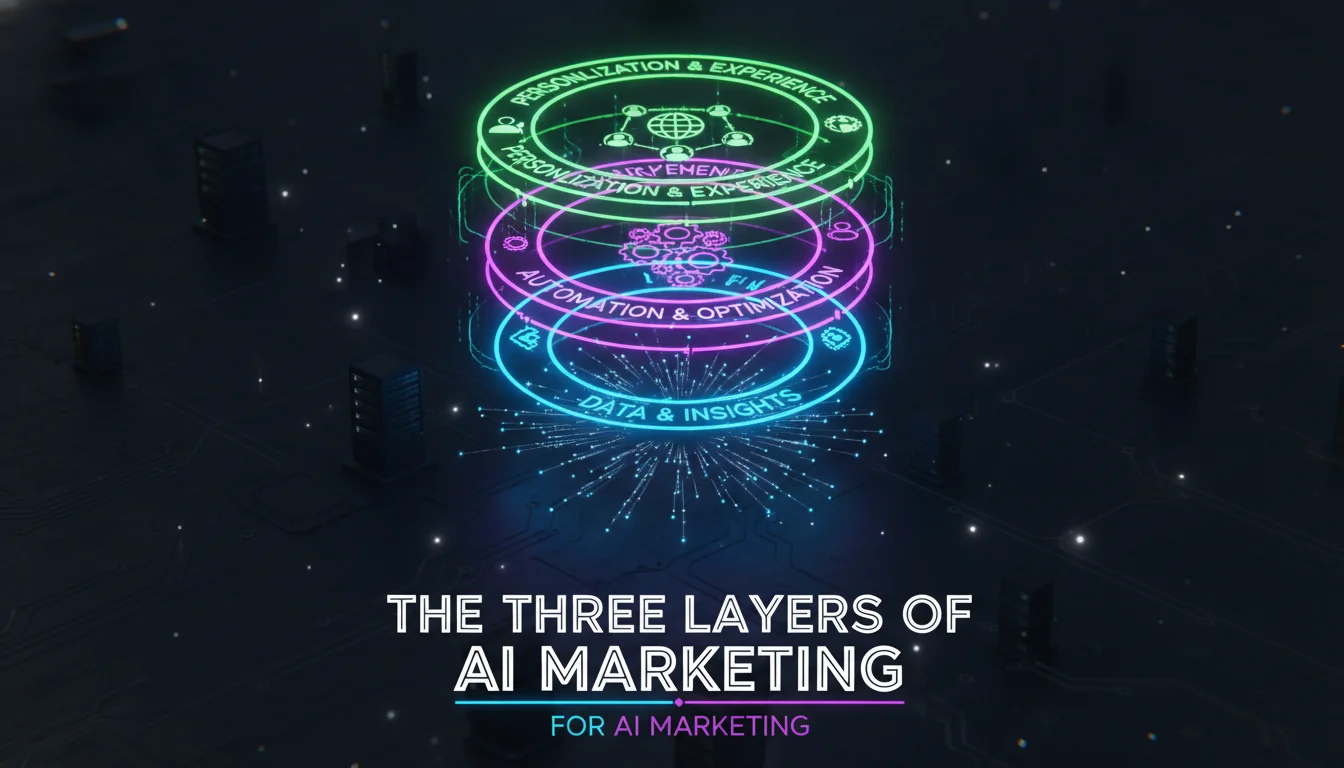
this type of marketing operates across three structural layers, each solving a different operational bottleneck. You can adopt the layer that matches your data maturity today without being forced into a rigid sequence.
Layer 1: Generative AI for Content Creation
Generative AI serves as the baseline layer, producing marketing assets like ad copy, social media posts, images, and video scripts. Tools such as Claude and Jasper use large language models to generate drafts, brainstorm ideas, and adapt messaging for different audiences. Generative AI alone is limited, though. It responds to prompts but lacks strategic insight. Without a strong brand-context layer, it produces generic or off-brand outputs. Simply adopting a generative tool does not equal a full this kind of marketing implementation.
Layer 2: Predictive Machine Learning for Analytics
The second layer uses predictive ML models to analyze historical data and forecast future customer behavior. These models can score leads, predict churn, recommend next-best actions, and optimize campaign targeting. An e-commerce company might use predictive analytics to identify which customers are most likely to convert based on past browsing patterns, then serve them personalized offers in real time. This layer turns raw data into actionable insights, driving smarter marketing decisions.
Layer 3: Agentic AI for Autonomous Decision-Making
Agentic AI represents the most advanced layer, where AI systems autonomously execute marketing actions and optimize for a north-star metric. These agents decide what message to send, through which channel, at what time, and then learn from the results to improve future actions. Rather than simply generating content or making predictions, agentic AI closes the loop by continuously optimizing the entire marketing workflow. According to the same IBV study, almost 60% of executives say their competitive advantage will depend on such advanced AI (Hightouch).
Pros and Cons of AI Marketing
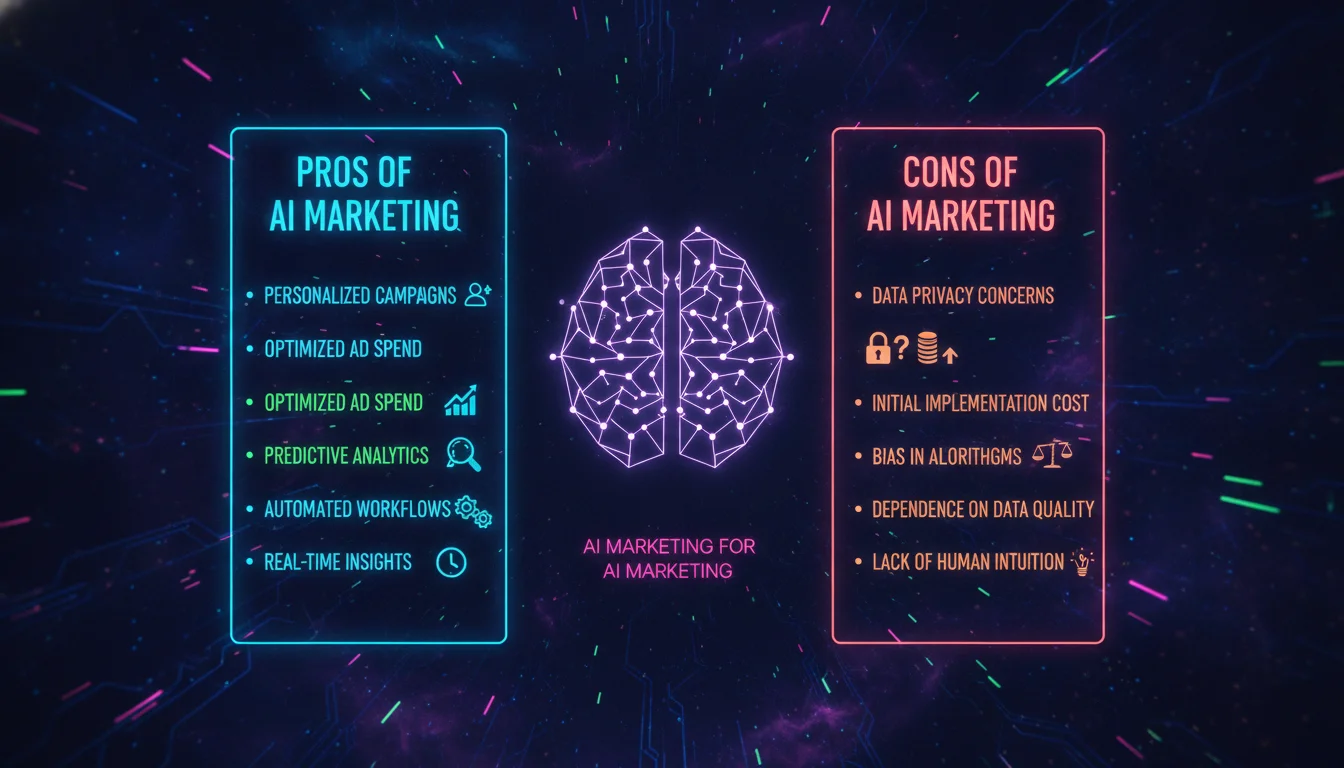
Pros
- Speed at scale: AI processes vast amounts of data in near real-time, enabling faster decisions than any human team could manage manually.
- Hyper-personalization: Individual behavior analysis allows brands to deliver tailored content, offers, and recommendations to each customer.
- Improved ROI: AI tools identify the most effective channels, ad placements, and audiences, reducing wasted spend and improving attribution.
- Operational efficiency: Automating repetitive tasks like lead scoring, email sequencing, and reporting frees teams to focus on strategy and creativity.
- Continuous optimization: Agentic AI systems learn from outcomes and self-improve, meaning campaigns get smarter over time without manual intervention.
Cons
- Data dependency: AI is only as good as the data it consumes. Siloed or incomplete data leads to poor model performance and off-target messaging.
- Brand consistency risks: Without a structured brand-context layer, generative AI can produce content that deviates from your voice or amplifies bias.
- Skill gaps: Effective ai requires practitioners who understand both marketing strategy and data science, a combination that’s still rare.
- Ethical and privacy concerns: Data collection at scale raises legitimate questions around consent, transparency, and regulatory compliance.
- Implementation complexity: Moving from pilot to full-scale marketing requires significant investment in data infrastructure, tooling, and change management.
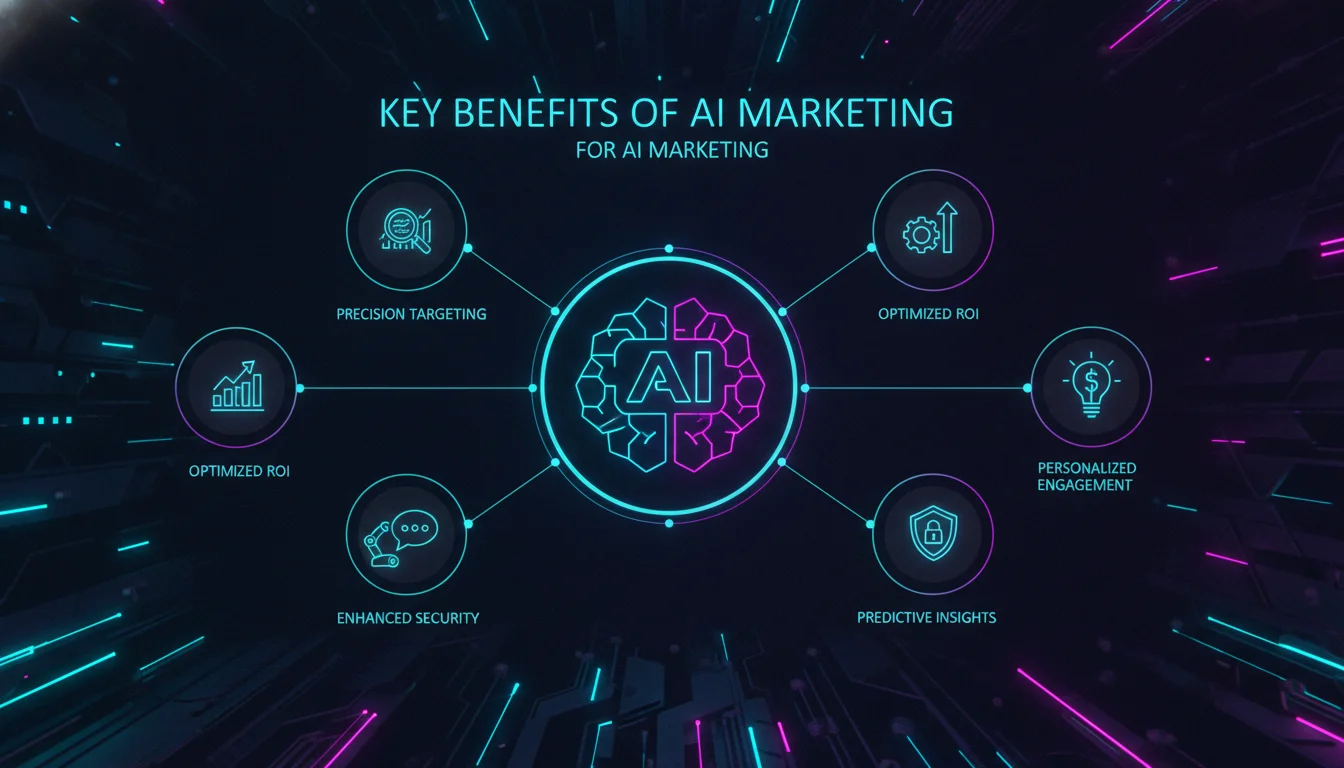
Key Benefits of AI Marketing
Faster and Smarter Decision-Making
this type of marketing platforms process vast amounts of data in near real-time, enabling teams to react quickly to market shifts. Instead of waiting for weekly reports, marketers get instant dashboards highlighting which creatives perform best, which segments are engaging, and where to reallocate budget. Machine learning algorithms can also perform sentiment analysis on social media, revealing how customers truly feel about a brand, as noted by Marketermilk. That speed of insight is invaluable in competitive industries.
Improved ROI and Performance Measurement
One of the most compelling advantages of this kind of marketing is its ability to boost return on investment. AI tools pinpoint the most effective channels, ad placements, and audiences, reducing wasted spend. They also enable attribution modeling that links revenue directly to specific campaigns. According to IBM Think, AI-enhanced dashboards help marketers measure KPIs more accurately and justify marketing spend with concrete data.
Enhanced Personalization and Customer Experience
AI enables hyper-personalization at scale. Instead of broad segments, AI analyzes individual behavior to deliver tailored product recommendations, emails, and offers. Streaming services like Netflix and e-commerce platforms like Shopify already use AI to personalize user experiences, increasing engagement and loyalty. By serving the right content to the right person at the right time, businesses can significantly improve customer satisfaction and lifetime value.
“Businesses should view AI as an opportunity to provide more customized and relevant marketing experiences for their customers and ultimately drive their business forward.” – Christina Inge, Marketing Analytics author and Harvard DCE instructor (Harvard DCE)
AI Marketing Tools and Platforms
The right ai tool depends on where you are in your journey. Here’s a breakdown of the tools practitioners are actually using in 2026.
Content Creation and Copywriting Tools
For many marketing teams, the entry point into marketing is through content generation tools. Claude, developed by Anthropic, has become a favorite for drafting long-form blog posts, ad copy, and social media content because of its contextual understanding and natural writing tone. One Reddit user on r/MarketingAutomation put it plainly: Claude is “way better than ChatGPT for marketing copy” (Reddit). Jasper is another popular option, especially for generating meta descriptions and short-form copy at scale.
SEO and Optimization Tools
For search engine optimization, Surfer SEO remains a top choice among marketers. It analyzes top-ranking pages and provides real-time recommendations to improve content structure, keyword usage, and readability. In the same Reddit thread, a practitioner noted that “Surfer still beats most AI alternatives” for SEO. Meanwhile, Perplexity is emerging as a powerful AI research assistant, helping marketers quickly gather competitive intelligence and generate sourced summaries. That’s a critical capability for data-driven this type of marketing teams.
Automation and All-in-One Platforms
Beyond point solutions, all-in-one platforms like HubSpot AI integrate CRM, email automation, lead scoring, and content tools into a single ecosystem. For workflow automation, Gumloop allows no-code building of custom AI agents that can monitor brand sentiment, compile competitor reports, or trigger personalized messages. These functions are redefining what this kind of marketing can achieve for lean teams (Marketermilk).
“In 2026, marketing is all about having the right data, giving AI instructions on how to interpret that data, and creating AI agents that can help you execute based on the first two.” – Omid G, Marketermilk (Marketermilk)
| Tool | Primary Function | Best For | Key Advantage |
|---|---|---|---|
| Claude (Anthropic) | Content generation & brainstorming | Copywriting, ad copy, long-form content | Contextual understanding, natural tone |
| Surfer SEO | SEO optimization | Content strategy, SERP analysis | Data-driven recommendations for ranking |
| Gumloop | Marketing automation & sentiment analysis | Automating workflows, social media monitoring | No-code automation, AI agent builder |
| HubSpot AI | All-in-one marketing platform | CRM, email automation, lead scoring | Integrated with existing HubSpot ecosystem |
| Perplexity | AI-powered research | Competitor analysis, market research | Real-time, sourced information retrieval |
Step 1: Plan and Prepare Your AI Marketing Foundation
The first step in any ai implementation is defining clear objectives and identifying the north-star metric you want to move: conversion rate, customer lifetime value, or retention. Next, audit your existing data infrastructure. AI is only as good as the data it consumes, so unifying first-party data from your CRM, website, and other sources is non-negotiable. Finally, document your brand voice, style guidelines, and strategic boundaries to ensure AI outputs stay on-brand from day one.
Step 2: Select Tools and Run a Pilot Project
Choose tools that match your maturity level and budget. Start with a pilot project, such as using Claude to draft blog posts or Surfer to optimize existing content, rather than attempting full-scale automation immediately. A small, controlled experiment lets you measure impact and gain stakeholder buy-in with minimal risk. During this phase, focus on integrating AI into one workflow and set clear success metrics before expanding.
Step 3: Scale, Optimize, and Iterate
Once the pilot proves successful, gradually expand AI across more marketing functions. Implement predictive models for lead scoring, use agentic tools to automate multi-channel campaigns, and continuously feed data back into the system for improvement. Regularly review performance dashboards to ensure AI is actually moving your north-star metric, not just generating vanity outputs. marketing is a journey of iterative optimization, not a one-time setup.
Real-World AI Marketing Examples
Shopify: Personalization at Scale
Shopify uses this type of marketing tools to personalize product recommendations and email content for its millions of merchants and their customers. By analyzing browsing and purchase history, Shopify’s AI engines deliver tailored shopping experiences that boost conversion rates. This is a prime example of how this kind of marketing can be embedded into an e-commerce platform to drive results at scale.
Instacart: AI-Driven Recommendations
Instacart uses AI to power its recommendation engine, suggesting grocery items based on past orders, dietary preferences, and seasonal trends. According to Marketermilk, Instacart is among the brands using AI marketing tools internally to gain a competitive edge. The result is higher basket sizes and stronger customer satisfaction through convenience.
Airbnb: Dynamic Pricing and Customer Support
Airbnb applies AI marketing principles to dynamic pricing models that adjust nightly rates based on demand, seasonality, and local events. AI-powered customer support tools handle common queries, freeing human agents for complex issues. This blend of operational efficiency and revenue optimization highlights the full value of AI marketing when applied across the business.
Overcoming Challenges in AI Marketing
Data Quality and Integration
The biggest hurdle in AI marketing is often data fragmentation. Siloed, inconsistent, or incomplete data leads to poor model performance and off-target messaging. Without a unified customer view, even the best AI tools will fail. Prioritize data cleaning and integration projects before scaling AI. As Hightouch notes, “unified customer data and operational brand knowledge” are prerequisites without which “off-brand outputs scale disastrously” (Hightouch).
Maintaining Brand Consistency and Avoiding Bias
Generative AI can inadvertently produce content that deviates from brand guidelines or amplifies biases present in training data. To mitigate this, teams must craft detailed AI prompts and implement human-in-the-loop review processes. Ethical AI use is not just a compliance checkbox. It directly impacts brand reputation. Harvard Professional Development emphasizes the need for responsible AI, noting that marketers should “ensure ethical and responsible use” when evaluating AI tools (Harvard DCE).
Talent and Skill Gaps
Despite the promise of automation, AI marketing still requires skilled practitioners who understand both marketing strategy and data science. Many organizations lack personnel who can interpret model outputs, design effective prompts, or bridge the gap between technical teams and creative teams. Investing in training, such as HubSpot Academy’s free AI for Marketing course, can help close the expertise gap and build internal confidence faster.
The Future of AI Marketing
Rise of Agentic AI
Agentic AI is poised to reshape marketing by enabling fully autonomous campaign management. Instead of marketers manually setting rules, agents will handle everything from budget allocation to channel selection, continuously optimizing for the defined goal. According to the IBV study, two-thirds of executives expect agentic AI to drive marketing efforts by 2030. This shift will free marketers to focus on strategy and creative vision rather than operational details.
Hyper-Personalization and Real-Time Adaptation
As AI models become more sophisticated, personalization will move from broad segments to real-time individualization. Imagine a website that changes its layout, offers, and content for each visitor based on behavioral data collected in microseconds. Such experiences, powered by AI marketing, will become the norm, setting new expectations for customer engagement across every channel.
Ethical and Responsible AI
With great power comes real responsibility. The future of AI marketing will demand stronger governance around data privacy, transparency, and bias mitigation. Regulations like GDPR and emerging AI-specific laws will shape how businesses collect and use data. Marketers who proactively adopt ethical frameworks will build trust and differentiate themselves in a crowded market.
Where to Go From Here
We’ve covered the full spectrum of AI marketing: foundational definitions, three structural layers, practical tools, implementation steps, and real-world examples. The consensus among experts is clear. AI is no longer optional. It’s a competitive necessity. Businesses that unify their data, embrace AI layers incrementally, and prioritize ethical use will lead the next era of marketing.
Start small, but start now. Experiment with a content generation tool like Claude, or run a pilot predictive analytics project. Document your brand knowledge, clean your data, and define a north-star metric. As you build confidence, layer in more advanced capabilities. The journey into AI marketing is one of continuous learning, and the rewards, including efficiency, insight, and growth, are well worth the effort.
Ready to build something bold? Contact Emin Media for a free brand consultation and let’s map out your AI marketing strategy together.
Frequently Asked Questions
What is AI marketing?
AI marketing is the use of artificial intelligence technologies like machine learning, natural language processing, and agentic AI to automate and optimize marketing tasks, personalize customer experiences, and improve decision-making based on data. It spans content creation, predictive analytics, and autonomous campaign execution.
How can AI be used for marketing?
AI can generate content, analyze customer data for insights, automate email campaigns, optimize advertising spend, provide chatbots for customer service, and predict future customer behavior to recommend next-best actions. The most advanced applications use agentic AI to autonomously manage entire campaign workflows.
How do I start AI marketing?
Begin by unifying your customer data, defining a clear north-star metric, and running a pilot project with a simple tool like an AI writing assistant. Gradually expand to more complex automations and predictive analytics as you build internal expertise and prove ROI from early experiments.
What are the best AI marketing tools?
Top tools include Claude for content creation, Surfer SEO for optimization, Gumloop for automation, HubSpot AI for all-in-one marketing, and Perplexity for AI-powered research. The right tool depends on your specific goals and technical maturity.
Can AI replace human marketers?
No. AI augments human capabilities rather than replacing them. It automates repetitive tasks and provides data-driven insights, but creative strategy, emotional intelligence, and ethical judgment still require human oversight. The best results come from teams that combine AI efficiency with human creativity.
Is AI marketing any good?
Yes, when implemented correctly. AI marketing delivers measurable improvements in personalization, campaign efficiency, and ROI. The key is starting with clean data, clear objectives, and a realistic implementation plan rather than expecting overnight results from any single tool.
Enjoyed this article?
Contact Emin Media for a free brand consultation and let's create something amazing together.
Get in TouchRelated Articles
AI in Creative Marketing: The 2026 Guide
AI in creative marketing is reshaping how brands create, personalize, and scale campaigns. Discover tools,…
Digital Marketing News Today: What’s Shaping Brands
Digital marketing news today covers AI shifts, platform changes, and bold brand campaigns. Stay ahead…