Creative Content Marketing: Strategy Guide 2026
Creative content marketing is the strategic process of crafting and distributing original content to attract, engage, and persuade a target audience. It goes beyond volume. In 2026, it’s the difference between being remembered and being scrolled past.
Key Takeaways
- content marketing is essential for attracting and engaging audiences who are increasingly immune to generic output.
- Utilizing various content formats, from video to interactive tools, enhances brand visibility and deepens audience interaction.
- Measuring the effectiveness of your content strategy is crucial for continuous improvement and budget justification.
- As of 2026, AI-generated content has raised the bar: originality and point of view are now the primary differentiators.
- Brands that commit to authentic storytelling consistently outperform those chasing volume alone.
Understanding this type of marketing
What is Creative Content Marketing?
this kind of marketing refers to the practice of developing unique, high-quality content that resonates with a specific audience. This includes blog posts, videos, infographics, interactive tools, podcasts, and data-driven storytelling. The goal is to provide genuine value, differentiate from competitors, and build a real connection with the people you’re trying to reach.
Definition and Importance
At its core, this discipline is the process of crafting original content that captures attention and builds trust over time. According to a Semrush survey of 1,700 business owners and marketers cited by Pipedrive, 97% of respondents said content marketing had been successful for them. That’s not a niche finding. It reflects how deeply content has become woven into the modern buyer’s journey.
Key Elements of Creative Content Marketing
- Originality: Content must be unique and offer fresh perspectives that competitors haven’t already covered.
- Quality: High-quality execution is essential for maintaining audience interest and earning shares.
- Relevance: Content should directly address the needs, challenges, and interests of your target audience.
- Commitment: A real point of view, not hedging, is what gets cited by AI answer engines and remembered by humans.
Why is Creative Content Marketing Important?
Creative content marketing is vital because it builds brand visibility, earns audience trust, and drives sales in a way that paid promotion alone cannot replicate. As Ceros puts it plainly: AI made publishing free. It didn’t make anything worth reading. When every competitor can spin up a thousand posts, the differentiator stops being output and starts being taste.
Building Brand Awareness
Original content creates memorable experiences that stick. Unique work is more likely to be shared, which compounds reach without compounding ad spend. Companies like Evernote use social media content to keep their audience informed and connected, replying to user comments and questions to build a reputation for genuine helpfulness. That kind of earned trust reduces churn and increases sales over time.
Enhancing Audience Engagement
Engaging content invites audiences into a conversation rather than broadcasting at them. According to Ceros, interactive formats hold attention longer than static content, and the Content Marketing Institute has reinforced this finding consistently. Give a buyer something to click or explore, and you’ve earned more time than any paragraph could on its own.
“Generic content gets scrolled past. Creative content gets shared, cited, and remembered – the same reason millions of people wait for Spotify Wrapped every December.” – Ceros, Creative Content Marketing in 2026
How Creative Content Marketing Actually Works
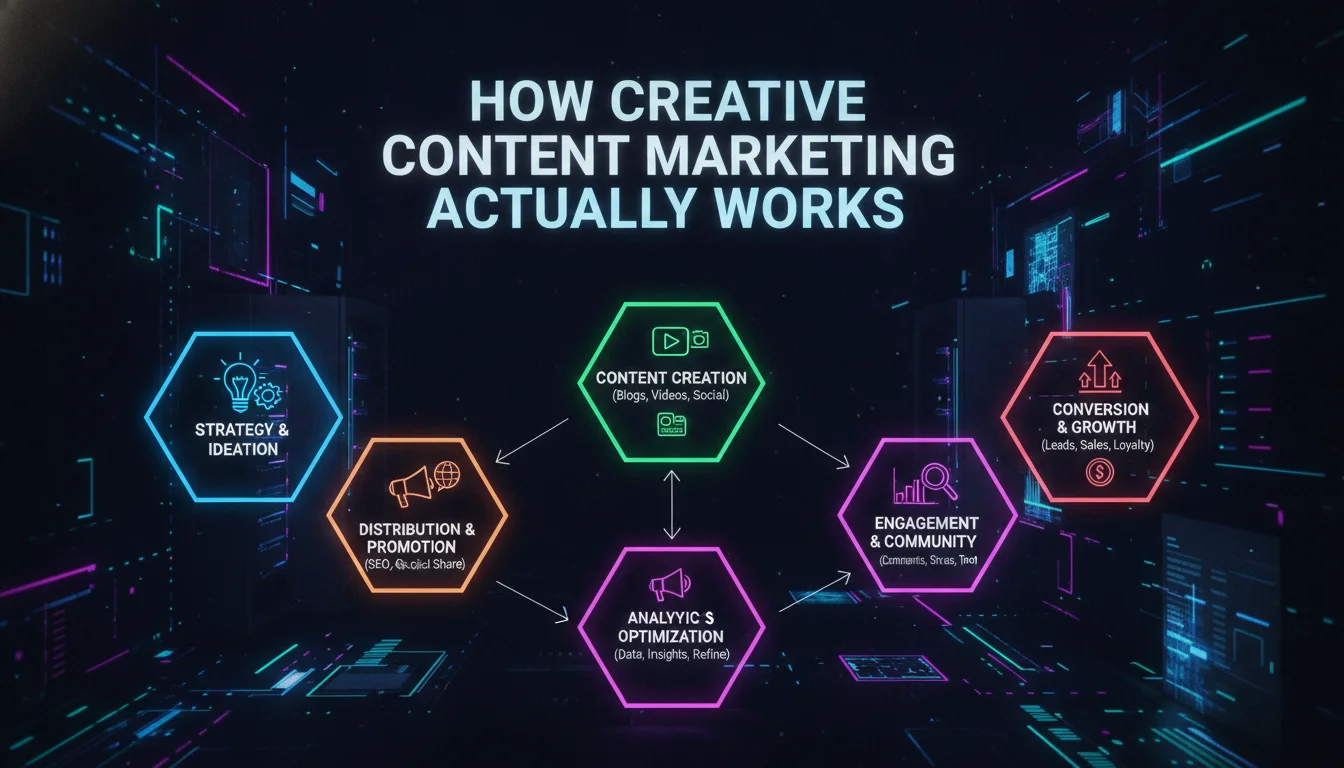
Creative content marketing works by replacing interruption with attraction. Instead of pushing a message at an audience, you create something they actively seek out, share, or return to. The mechanics run in a clear loop.
First, you identify a specific audience problem or desire. Then you produce content that addresses it in a format your audience prefers. That content gets distributed across channels where your audience already spends time. It earns attention, which builds trust. Trust converts to action, whether that’s a subscription, a purchase, or a referral. Analytics then tell you what resonated, and you refine the next cycle.
What separates creative execution from generic execution is the middle step: the format and the point of view. A blog post that says what everyone else says earns nothing. A blog post with original research, a contrarian take, or a genuinely useful framework earns links, shares, and AI citations. The same logic applies to video, infographics, and interactive tools.
Answer Engine Optimization (AEO) has added a new layer to this loop as of 2026. Tools like ChatGPT and Perplexity pull answers directly from content that commits to something specific. Vague, hedging content doesn’t get quoted. Confident, structured content does. That means the creative choices you make, including how you open a section, how you define a term, and how you structure a list, now directly affect whether AI surfaces your brand in answer results.
“AEO rewards content that commits to something specific. Vague content doesn’t get quoted. Confident content does.” – Ceros, 2026
Types of Creative Content Marketing
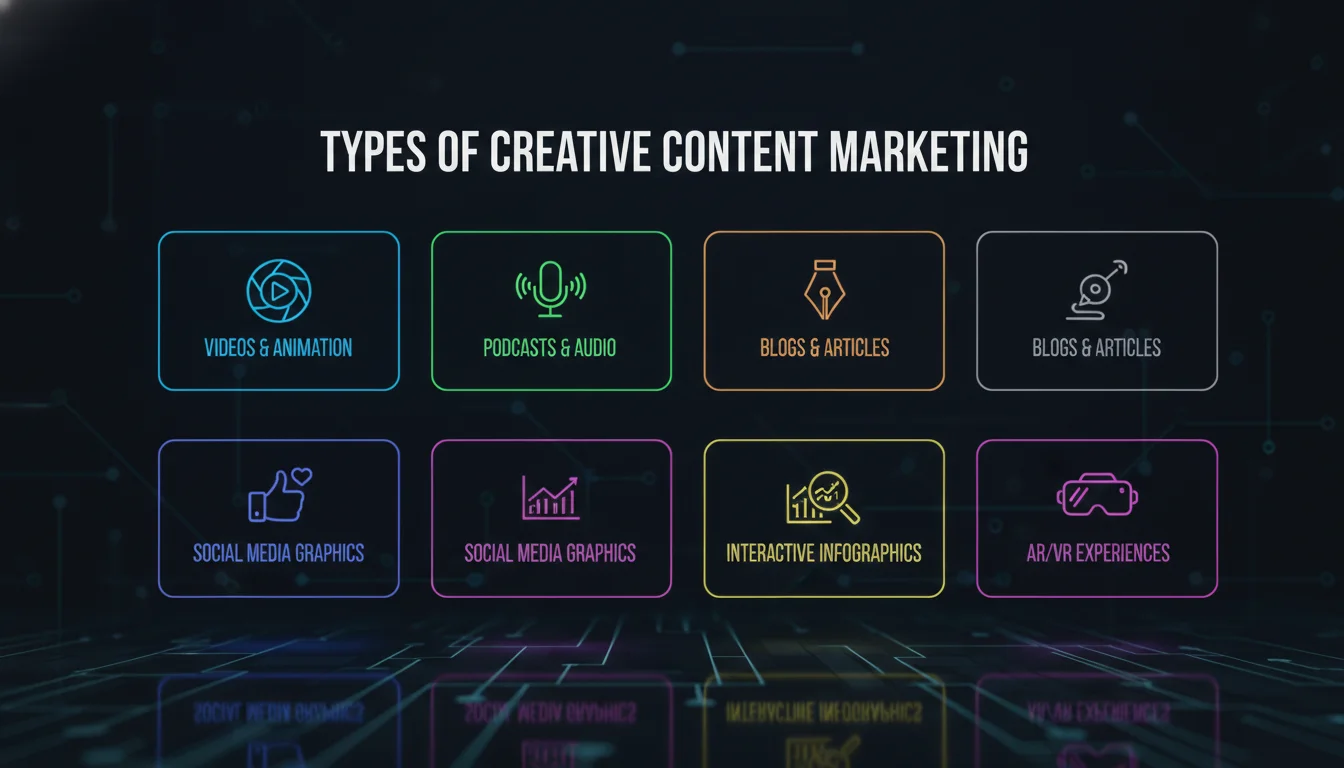
There are many formats businesses can use in their content strategies. Each serves different purposes and appeals to different audience preferences. The strongest programs mix and match rather than defaulting to one format.
1. Blog Posts
Blog posts are a foundation of content marketing. They provide valuable information related to a brand’s products or services, and when optimized for search, they drive consistent organic traffic. The key is to go deeper than competitors, not just longer.
2. Videos
Video has become a non-negotiable part of any content mix. According to MoJo Active, citing Wyzol Research, 92% of video marketers reported a positive ROI from video. Formats include tutorials, product demos, behind-the-scenes footage, and brand storytelling.
3. Infographics
Infographics translate complex data into visual stories. Slack, for example, uses infographics to present research findings so users can digest key insights in minutes rather than reading a full report. Tools like Canva, Visme, and VistaCreate have made professional-quality infographic production accessible to in-house teams.
4. Podcasts
Podcasts build loyal audiences and establish thought leadership. The format creates a sense of personal connection between host and listener that few other content types can replicate. Listeners often feel they know the hosts, which translates into higher retention and brand affinity.
5. Interactive Content
Quizzes, assessments, calculators, and polls give audiences something to do rather than just read. This format lowers bounce rates, increases time on site, and generates first-party data that informs future campaigns. It’s one of the most underused formats in B2B marketing.
6. Case Studies and eBooks
Long-form content like case studies and eBooks serves the bottom of the funnel. Buyers who are close to a decision want proof. A well-structured case study showing real outcomes is more persuasive than any product page.
Comparison: Creative Content Marketing Formats at a Glance
Different formats serve different goals. Use this table to match your content type to your current priority.
| Format | Best For | Production Effort | Audience Stage | Shareability |
|---|---|---|---|---|
| Blog Post | SEO, thought leadership | Low to Medium | Top of funnel | Medium |
| Video | Brand storytelling, demos | High | All stages | High |
| Infographic | Data visualization, shares | Medium | Top of funnel | High |
| Podcast | Thought leadership, loyalty | Medium | Mid funnel | Medium |
| Interactive Tool | Engagement, lead gen | High | Mid funnel | Medium |
| Case Study | Conversion, proof | Medium | Bottom of funnel | Low |
| eBook | Lead generation, authority | High | Mid to bottom | Low |
Pros and Cons of Creative Content Marketing
Creative content marketing delivers compounding returns, but it’s not without real trade-offs. Here’s an honest look at both sides.
Pros
- Compounding ROI: Unlike paid ads, great content keeps earning traffic and trust long after publication.
- Brand differentiation: Original work sets you apart in markets flooded with AI-generated sameness.
- Measurable performance: Content marketing is easier to track than most offline channels, with clear metrics for traffic, engagement, and conversion.
- AI citation potential: Well-structured, confident content gets surfaced by tools like ChatGPT and Perplexity, extending reach beyond traditional search.
- Audience trust: Consistent, valuable content builds the kind of trust that shortens sales cycles and reduces churn.
Cons
- Time investment: High-quality content takes time to produce. There are no real shortcuts that don’t cost you credibility.
- Delayed results: Content marketing is a long game. Most programs take months before organic traction builds meaningfully.
- Resource intensity: Doing it well requires writers, designers, strategists, and sometimes video producers. That’s a real budget commitment.
- Content saturation: The bar for standing out keeps rising. Average work gets ignored faster than ever in 2026.
- Consistency pressure: Audiences and algorithms both reward regularity. Inconsistent publishing undermines even strong individual pieces.
Strategies for Effective Creative Content Marketing
Effective strategy is what separates brands that publish from brands that grow. Here are the approaches that consistently move the needle.
1. Understand Your Audience
Researching your audience is the starting point for everything else. Understanding their preferences, challenges, and information habits lets you create content that feels made for them, not broadcast at them. Audience research tools, customer interviews, and social listening all feed this process.
2. Utilize Multiple Formats
Diversifying content formats expands your reach and serves different learning styles. Combining blog posts, videos, infographics, and interactive content means you’re not leaving audience segments behind because they prefer watching over reading.
3. Commit to a Point of View
The brands that get cited, shared, and remembered are the ones that say something specific. Hedging and covering all sides might feel safe, but it produces forgettable content. Pick a position and defend it with evidence.
4. Measure and Optimize
Regularly measuring content performance is how you stop guessing. Use analytics tools to track engagement metrics, time on page, conversion rates, and organic rankings. Adjust based on what the data shows, not what you assumed would work.
5. Refresh Existing Content
According to Siege Media, top-ranking content is typically refreshed within the past two years on average. Updating older posts with new data, examples, and structure often delivers faster results than publishing something brand new.
How to Apply Creative Content Marketing: A Step-by-Step Approach
Applying creative content marketing effectively means moving from strategy to execution with a clear process. Here’s how we approach it at Emin Media.
Step 1: Define your audience with precision. Go beyond demographics. Map out what your audience is trying to accomplish, what’s blocking them, and where they go for information. The more specific your audience profile, the more targeted your content can be.
Step 2: Audit what already exists. Before creating anything new, review what you’ve already published. Identify your highest-performing pieces and your biggest content gaps. This audit shapes your editorial calendar and prevents duplicating effort.
Step 3: Choose formats that match your audience’s habits. Are they watching short-form video on Instagram? Reading long-form analysis on LinkedIn? Listening to podcasts during commutes? Format selection should follow audience behavior, not internal preference.
Step 4: Build a content calendar with clear ownership. Consistency requires structure. Assign each content piece an owner, a deadline, a format, and a distribution channel. Ambiguity is where content programs stall.
Step 5: Produce with quality as the non-negotiable. One exceptional piece outperforms ten average ones. Invest in strong writing, clean design, and accurate information. This is where most brands underinvest.
Step 6: Distribute actively, not passively. Publishing is not distribution. Share your content across every relevant channel, repurpose it into multiple formats, and put budget behind your best pieces to accelerate reach.
Step 7: Measure, learn, and iterate. Set clear KPIs before you publish. Review performance at 30, 60, and 90 days. Use what you learn to inform the next cycle. Content programs that improve over time are the ones that compound.
Examples of Successful Creative Content Marketing
Examining real campaigns reveals what separates work that earns attention from work that gets ignored. These three examples have become reference points in the industry for good reason.
1. Spotify Wrapped
Spotify’s annual Wrapped campaign is one of the most studied examples of this discipline done right. It gives users personalized insights into their listening habits and makes sharing those insights feel natural and fun. The result is millions of organic social posts every December, all generated by users, not Spotify’s ad budget. The creative insight was simple: people love data about themselves, especially when it’s presented beautifully.
2. Nike’s Storytelling
Nike has built its entire content identity around emotional narrative. Rather than leading with product features, Nike leads with human stories: athletes overcoming obstacles, underdogs proving doubters wrong. This approach connects on a level that product-focused content rarely reaches, building brand loyalty that transcends any single campaign.
3. Airbnb’s User-Generated Content
Airbnb turned its community into its content team. By showcasing real experiences from real users, the brand built authenticity at scale. User-generated content works because it’s inherently credible. Potential guests trust the word of fellow travelers more than they trust polished brand copy. Airbnb’s creative decision was to get out of the way and let its community tell the story.
A Realistic Scenario: How a Mid-Size Brand Might Apply This
Imagine a B2B software company selling project management tools to marketing teams. They’re producing blog posts, but traffic has plateaued and leads from content are thin. Here’s how a creative content approach would change their program.
First, they’d audit their existing content and find that their most-visited posts are all comparison articles: their tool versus competitors. That’s a signal. Their audience is in active evaluation mode when they hit those pages.
Next, they’d produce an interactive assessment tool: “What’s your team’s project management maturity score?” It takes two minutes to complete, delivers a personalized result, and captures an email address. The tool addresses a real question their audience has, delivers immediate value, and generates leads without feeling like a lead form.
They’d then repurpose the aggregate data from the assessment into an infographic: “How 500 marketing teams manage projects in 2026.” That infographic gets picked up by industry newsletters and earns backlinks. The backlinks lift their organic rankings. The rankings drive more traffic to the assessment. The loop compounds.
This is what creative content marketing looks like in practice: not a single viral moment, but a connected system where each piece feeds the next.
Common Mistakes to Watch Out For
Most content programs that underperform share the same handful of errors. Recognizing them early saves significant time and budget.
1. Producing for Volume Instead of Value
Publishing more content than your team can execute well is a trap. Ten mediocre posts earn less than two exceptional ones. Quality signals to both audiences and search engines that your brand is worth paying attention to.
2. Ignoring Distribution
Creating content without a distribution plan is like opening a store with no sign outside. The best content in the world earns nothing if the right people never see it. Build your distribution strategy before you start producing.
3. Skipping the Audience Research
Content built on assumptions about what your audience wants almost always misses. Real audience research, including customer interviews, search data, and social listening, is what separates content that resonates from content that sits unread.
4. Treating Every Channel the Same
A LinkedIn article and an Instagram caption require completely different approaches. Brands that copy-paste the same content across every channel signal that they don’t understand their audience on any of them.
5. Measuring the Wrong Metrics
Vanity metrics like total page views feel good but rarely connect to business outcomes. Track metrics that tie to revenue: lead quality, conversion rate from content, and customer acquisition cost from organic channels.
6. Giving Up Too Early
Content marketing is a long game. Most programs take months before organic traction builds. Brands that abandon their content strategy after six weeks never see the compounding returns that make it worthwhile.
Challenges in Creative Content Marketing
Even well-resourced content programs run into real obstacles. Knowing what’s coming helps you plan around it.
1. Content Saturation
The digital environment is saturated with content, and AI tools have accelerated that saturation dramatically in 2026. Standing out now requires genuine originality, not just competent execution. Brands that rely on templated, predictable content are increasingly invisible.
2. Evolving Trends
Consumer preferences shift faster than most editorial calendars can accommodate. What worked eighteen months ago may actively hurt you today. Building flexibility into your content program, rather than locking into rigid annual plans, is how you stay current.
3. Resource Allocation
Creating high-quality content requires time, skilled people, and real budget. Brands that treat content as a low-cost channel and staff it accordingly consistently underperform. The investment required to do this well is real, and the returns reflect that investment.
Future Trends in Creative Content Marketing
As of 2026, several forces are reshaping how brands approach content. Understanding them now gives you a head start on competitors still catching up.
1. AI as a Production Tool, Not a Replacement
Artificial intelligence is accelerating content production workflows, from research to first drafts to image generation. The brands winning with AI are using it to move faster on execution while investing their human creative energy in strategy, point of view, and quality control. AI that replaces thinking produces content that gets ignored.
2. Interactive Content as the New Standard
Quizzes, polls, assessments, and interactive data visualizations are moving from novelty to expectation. Audiences increasingly expect content to respond to them, not just inform them. Brands that build interactive experiences into their content mix will hold attention longer and collect richer audience data.
3. Authenticity as a Competitive Advantage
Consumers have developed a sharp instinct for detecting manufactured authenticity. Brands that showcase genuine stories, real people, and honest perspectives are building the kind of trust that polished corporate content cannot buy. This trend accelerates as AI-generated content becomes more prevalent and more detectable.
4. Answer Engine Optimization
Structuring content so AI tools can extract and cite it directly is the 2026 equivalent of optimizing for featured snippets. Brands that write with clear definitions, direct answers, and confident positions will earn citations in AI-generated responses. Those that hedge and generalize will not. For a deeper look at how we approach this at Emin Media, explore our digital marketing services.
The 3-3-3 Rule for Marketing: What It Means for Content
The 3-3-3 rule in marketing refers to reaching your audience through 3 channels, with 3 touchpoints, within 3 days of initial contact. Applied to content strategy, it means your content program should be present across multiple channels, designed to create repeated exposure, and timed to maintain momentum during the window when a prospect is most engaged. A single blog post rarely converts. A blog post followed by a social share, an email, and a retargeted video ad creates the repetition that moves people to action.
Frequently Asked Questions
What is creative content marketing?
Creative content marketing is the strategic process of producing original content to attract, engage, and persuade a target audience. It prioritizes genuine value and differentiation over volume, using formats like video, interactive tools, and data-driven storytelling to earn attention rather than buy it.
Why is creative content marketing important?
It builds brand awareness, earns audience trust, and drives sales in ways that paid promotion cannot replicate on its own. According to a Semrush survey cited by Pipedrive, 97% of business owners and marketers reported that content marketing had been successful for them, reflecting how central it has become to modern growth strategies.
What are some creative content marketing ideas?
Strong ideas include interactive assessments, original data reports, behind-the-scenes video series, user-generated content campaigns, and personalized data experiences like Spotify Wrapped. The best ideas solve a specific audience problem in a format that feels native to the channel where it lives.
How can I measure the success of my content marketing?
Track metrics that connect to business outcomes: organic traffic growth, lead quality from content, conversion rates, and customer acquisition cost from non-paid channels. Vanity metrics like raw page views are less useful than understanding which content pieces are actually moving people toward a purchase decision.
What types of content should I create?
Create a mix that serves different stages of the buyer journey. Blog posts and infographics work well at the top of the funnel. Podcasts, webinars, and interactive tools serve the middle. Case studies and detailed comparisons close deals at the bottom. The right mix depends on where your audience spends time and what format they trust most.
How can I stay updated with content marketing trends?
Follow publications like AdAge, Campaign, and the Content Marketing Institute. Study Cannes Lions case studies for creative inspiration grounded in real campaign performance. Attend industry webinars and pay attention to what formats are earning organic traction in your specific category, not just what’s trending broadly.
Does content marketing pay well as a career?
Content marketing roles span a wide range depending on specialization and seniority. Strategists, SEO-focused writers, and creative directors with measurable performance track records command strong compensation. The highest-earning practitioners are those who can connect content output directly to revenue, not just traffic.
Ready to build a content program that actually earns attention? Contact Emin Media for a free brand consultation and let’s build something worth reading.
Enjoyed this article?
Contact Emin Media for a free brand consultation and let's create something amazing together.
Get in TouchRelated Articles
Digital Storytelling for Brands: The Complete Guide
Digital storytelling for brands builds real audience connections through narrative. Learn proven techniques, formats, and…
Design Thinking for Marketing: A 2026 Guide
Design thinking for marketing builds campaigns around real user needs. Learn the 5 phases, common…
Creative Direction for Video Shoots: A Complete Guide
Master creative direction for video shoots with proven steps, tools, and strategies that build brand…