Creative Content Ideas for Brands: 25+ Frameworks
Creative Content Ideas for Brands: 25+ Proven Frameworks
Creative content ideas for brands are structured prompts and repeatable frameworks, such as content buckets, the Domino Effect, and user-generated content, that help marketers generate fresh, engaging posts consistently. Used together, they turn sporadic inspiration into a reliable content pipeline.
Key Takeaways
- Content buckets turn blank-page anxiety into a repeatable system for generating for brands.
- The Domino Effect multiplies one idea into five or more related assets across formats.
- AI-assisted ideation accelerates brainstorming but requires human refinement to stay on-brand.
- User-generated content and behind-the-scenes posts consistently outperform polished brand-only content.
- Reverse-engineering high-performing creators is faster and safer than starting from scratch.
- Consistency beats virality. A system that produces steady, relevant content wins over the long term.
As of 2026, the volume of social content is staggering. According to Hootsuite, more than 5 billion people use social media. That scale makes generic posting worthless. Brands need a system, not a one-off list.
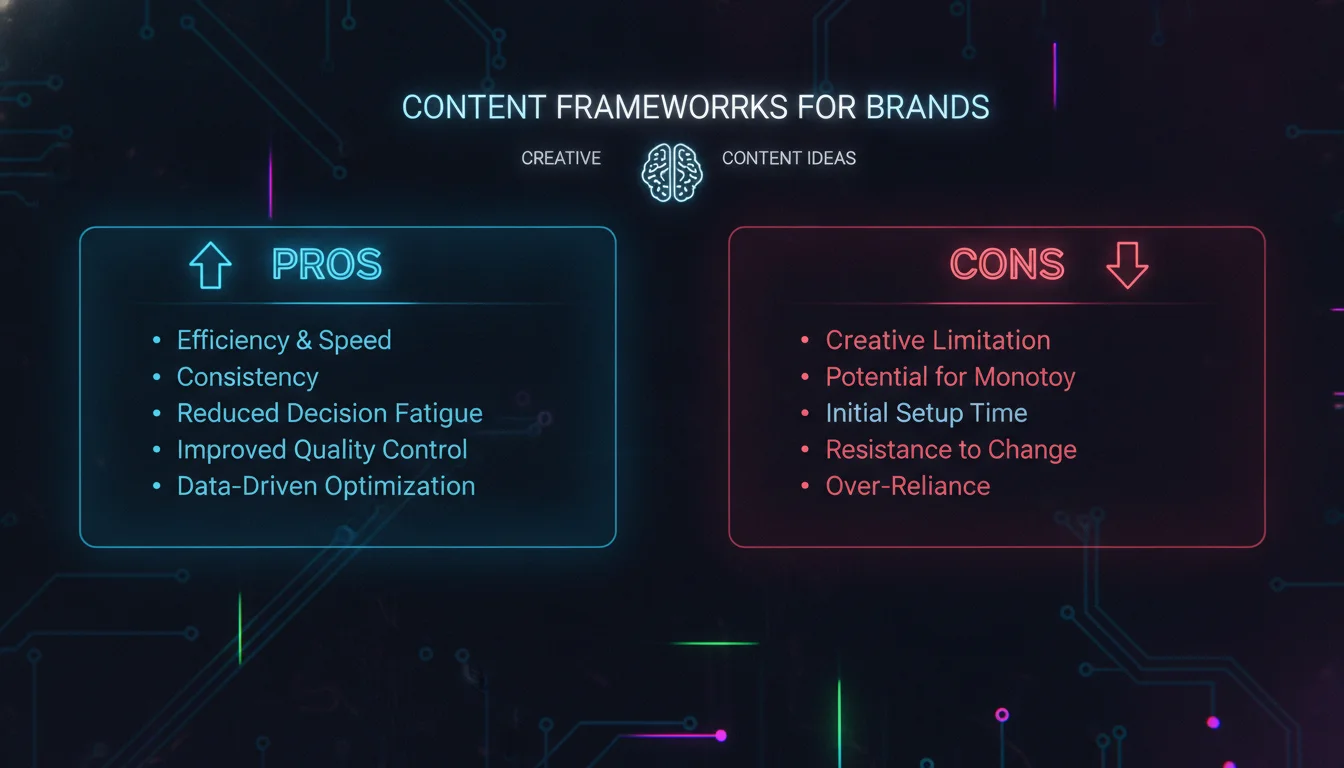
Pros and Cons of Using Content Frameworks for Brands
Pros
- Eliminates blank-page syndrome by giving every brainstorm a clear starting point
- Multiplies output: one core idea can produce five or more pieces of content
- Reduces production costs by reusing research across formats
- Builds topical authority through consistent, structured posting
- Scales easily for solo marketers and large teams alike
Cons
- Frameworks require upfront setup time before they produce results
- Over-reliance on AI without human editing produces generic, off-brand content
- Reverse-engineering competitors can lead to derivative work if structure is copied too closely
- UGC campaigns require an engaged customer base to generate meaningful volume
Why Creative Content Ideas for Brands Matter in 2026
this type of brands matter because generic posting no longer moves audiences. Feeds are louder, competition is bigger, and the bar for scroll-stopping content keeps rising.
The Content Fatigue Problem
Content fatigue is the exhaustion that sets in when brands recycle the same post formats and audiences stop responding. According to Sprout Social, modern social media marketers manage multiple profiles and are constantly tasked with keeping feeds active and strategic. The struggle leads to recycled posts and decreased engagement. this kind of for brands are not about more volume. They are about resetting the pattern.
When every post looks like the last, followers scroll past. The solution is not to post more often but to vary the underlying idea structure. A system of the content ideas for brands prevents the fatigue cycle by forcing different psychological triggers: authority, relatability, value, proof, and belief-shifting.
What the Data Says About Engagement
Hootsuite’s 2025 benchmarks show a clear shift: brands published 71% more short videos than the previous year, TikTok engagement climbed 35%, and Instagram carousels pulled in around 10% engagement. These numbers point to formats that favor quick, visual, swipeable storytelling. But the format is only half the equation. The underlying idea must still be fresh.
Short-form video works because it is fast and visual. Carousels work because they unfold an idea in steps. The common thread is that each creative content idea for brands must earn a thumb-stopping moment within the first second. Hootsuite’s data also indicates that user-generated content and customer-driven formats consistently outperform brand-only posts.
From Random Acts to Repeatable Systems
A repeatable content system is a predefined set of categories, templates, and workflows that removes guesswork from daily posting. Consistency, not occasional virality, builds audience trust. The best brands are not isolated sparks. They are outputs of a system.
Without a system, marketers sit down to brainstorm and waste hours. With a system, they start with a bucket and ask what can go in it today. That shift is the difference between a content calendar and a content engine.
Content Buckets: The Foundation of Creative Content Ideas for Brands
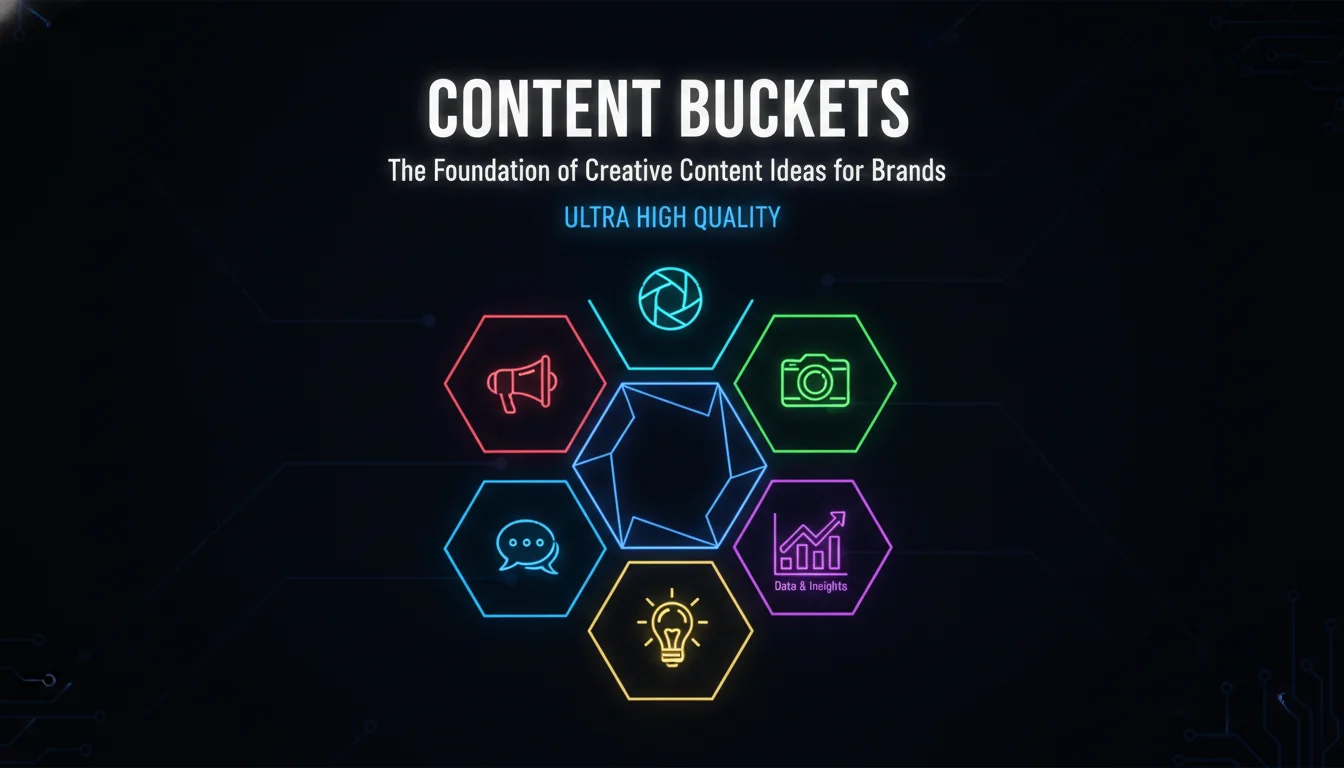
Content buckets are broad thematic categories tied to your expertise and audience that give every brainstorm a starting point, eliminating the blank-page problem entirely.
The Five Buckets That Eliminate Blank-Page Syndrome
Rachel Pedersen’s system organizes ideas into five buckets: Authority, Relatable, Value, Proof, and Belief-Shifting. Authority covers frameworks, systems, and methods. Relatable includes messy-middle moments, team culture, and real-talk posts. Value includes tutorials, how-tos, and breakdowns. Proof includes testimonials, screenshots, and case studies. Belief-Shifting includes myths, unpopular truths, and reframes.
“Trying to create content ideas without categories is like walking into Target without a list. You walk out with 17 things you don’t need and zero of what you came for.” – Rachel Pedersen, content strategist
Buckets save you from blank-page hell by giving every brainstorm a starting point. You don’t start with nothing. You start with a bucket and ask: what can I toss in here today?
How to Build Your Own Bucket System
Start with your audience’s three primary questions. Then map each question to a bucket. A B2B SaaS brand might use Authority for product methodology, Value for onboarding tutorials, Proof for case studies, Relatable for team moments, and Belief-Shifting for pricing myths. The buckets force you to balance promotional content with useful and human content.
You don’t need all five buckets in equal proportion. A new brand might lean heavily on Value and Proof, while an established brand can add more Belief-Shifting. Every post should fit a bucket, so no post is random.
Real-World Bucket Examples
Authority: a framework carousel. Relatable: a behind-the-scenes photo of a failed launch. Value: a step-by-step tutorial. Proof: a testimonial screenshot. Belief-Shifting: a post debunking a common industry myth. These are creative content that work across B2B and B2C because they reflect different psychological triggers.
For a consumer product brand, Authority might be a styling guide. Relatable might be a messy kitchen moment. Value might be a recipe hack. Proof might be a before-and-after customer photo. Belief-Shifting might be a myth about ingredient quality. The same five buckets generate entirely different content for different niches.
The Domino Effect: Multiplying Every Creative Content Idea
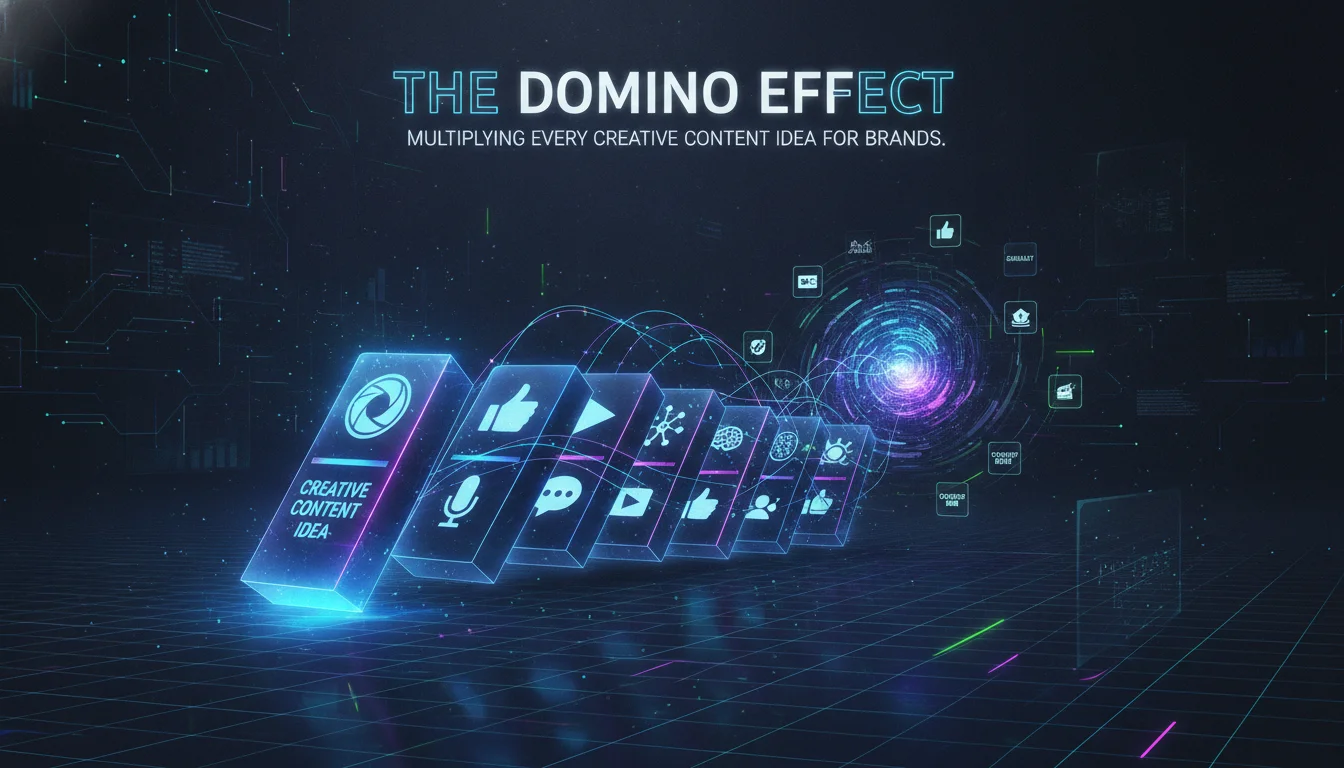
The Domino Effect is a content planning method where one core idea expands into multiple formats and angles, so each piece tips into the next and multiplies your output without multiplying your research time.
One Core Idea Becomes Five Pieces of Content
Pedersen’s example: the core idea “batching saves me 20 hours a week” becomes a Reel showing the setup, a carousel of three batching mistakes, a blog post on batching psychology, an Instagram Story of a mid-batch desk, and a podcast episode. One domino knocks down five pieces of content.
This method is not about posting once and moving on. If an idea is good, you squeeze it. The Domino Effect turns a single insight into a week’s worth of content, which is especially valuable for small teams.
Planning Your Domino Sequence
List your core idea first. Then map five formats: short video, carousel, long-form article, story, and audio. Adjust the order based on platform behavior. The sequence should cover authority, value, and proof buckets automatically.
A core idea about improving customer onboarding could become: a 45-second video showing the top mistake, a carousel of three fixes, a blog post explaining the psychology, an Instagram Story poll about onboarding pain points, and a podcast snippet with a customer story. The same idea now serves five different audience segments.
Why This Works for B2B and B2C Brands
Both B2B and B2C audiences consume content across platforms. A B2B brand can turn a single customer win into a LinkedIn carousel, a 60-second YouTube Short, a case study PDF, a podcast interview, and a quote graphic. This approach prevents content scarcity and builds topical authority.
The Domino Effect also reduces production costs because the research for one idea is reused across formats. Instead of starting from zero five times, you start once and adapt.
Steal Like a Scientist: Reverse-Engineering What Works
Reverse-engineering high-performing content means isolating the structural elements of a successful post and recombining them with your own expertise, not copying words but copying the pattern.
Analyzing Five to Ten Creators
Rachel Pedersen recommends studying five to ten creators you admire and asking three questions: What format did they use? What emotion did it tap into? What framework underpins it? This is not copying. It is pattern recognition. Originality comes from plugging your own expertise into proven formats.
Look at carousels, stories, reels, and text posts. Note the emotion: relief, outrage, curiosity, or validation. The framework might be a list, myth-busting, or a story arc. Once you see the pattern, you can reproduce it with your own material.
Copying Structure, Not Words
According to Rachel Pedersen, this method helped one reel generate $10,000 in sales, not because of magic but because the patterns already worked. Copying structure means using the same sequence of hook, problem, steps, and payoff, but filling each slot with your own expertise. This is faster than inventing a new structure and safer than copying words.
A Step-by-Step Reverse-Engineering Process
To reverse-engineer a high performer, first identify the format: carousel, story, or reel? Second, name the primary emotion: relief, curiosity, or outrage? Third, extract the framework: list, myth-busting, story arc, or comparison. Fourth, plug your own data or story into that skeleton. This is one of the most overlooked for brands.
The goal is not to replicate exactly but to learn which patterns resonate with your audience. Over time, you develop a library of proven structures that can be reused indefinitely.
AI-Assisted Ideation Without Losing Originality
AI-assisted ideation is the use of generative tools to produce draft concepts, captions, or content outlines based on prompts, giving teams a faster starting point without replacing human judgment.
How AI Tools Speed Up Creative Content Ideas for Brands
According to Sprout Social, tools like Sprout Social’s AI Assist can take basic concepts and keywords and refine them into social captions that are more likely to earn interactions. This saves time and sparks creativity when teams are burnt out. AI does not replace original ideas. It is a tool for ideation and efficiency.
The best use is to generate options, then refine prompts based on audience and brand voice. Sprout Social notes that using AI for social media posts requires human input to be effective. That human-in-the-loop approach is essential for this type of brands that still feel original.
Prompt Refinement Beats First Suggestions
The first suggestion from AI is rarely the best. Marketers should treat AI output as a draft, not a final post. Refining prompts by adding audience detail, tone, and specific constraints produces dramatically better results.
Instead of asking “give me social media post ideas”, ask “generate ten Value bucket post ideas for a B2B SaaS audience that struggles with onboarding, using a friendly but authoritative tone”. The specificity changes the output entirely.
Blending AI Output with Human Judgment
Pair AI with bucket systems and domino planning. Ask AI to generate ten variations of a Value bucket post. Then select two that fit your brand voice. This keeps the system fast while retaining editorial control.
AI can produce dozens of drafts in minutes, but only a human can judge whether the tone, context, and timing are right for the audience. This blend is a core part of modern this kind of for brands.
UGC, Behind-the-Scenes, and Community-Driven Content
User-generated content, behind-the-scenes posts, and interactive formats are among the most effective the content ideas for brands because they build trust through real voices and candid moments rather than polished production.
User-Generated Content as a Trust Engine
User-generated content (UGC) is any photo, review, video, or testimonial created by customers rather than the brand. NYT Licensing lists UGC as one of the top content marketing practices because it adds fresh, relevant content while building trust and credibility. Sprout Social includes UGC among the most effective post ideas that drive authentic engagement.
Brands should share, pin, retweet, and regram customer content. This fills the calendar and signals that real people use the product. UGC is especially powerful because it comes from an unbiased source, not the brand’s marketing team.
Behind-the-Scenes Authenticity
Behind-the-scenes content is candid, unpolished footage of a brand’s team, process, or daily operations. According to ITVibes, it is one of the simplest yet most powerful ways to build trust and authenticity. Show the creative process, team culture, or daily hustle rather than staged posts.
Focus on candid, unpolished moments. Show your team brainstorming ideas, prepping for a launch, or navigating a mistake. These glimpses make your brand feel more relatable and approachable, which is exactly what audiences reward with engagement.
Questions, Polls, and Interactive Formats
Sprout Social lists asking audience questions, polls, and interactive stickers as tried-and-tested ideas. Questions can range from weekend plans to product favorites. These formats generate comments and provide insights for future brands.
Interactive formats work because they require a response. A simple question sticker on Instagram Stories can reveal what your audience wants to see next. A poll can settle a debate and create a sense of participation. These low-effort ideas often produce high engagement.
Beyond the Basics: More Creative Content Ideas for Brands
Beyond the core frameworks, several additional content types consistently appear in top-performing brand strategies and deserve a place in your rotation.
Social Media Holidays and Seasonal Content
Seasonal content and social media holidays give brands a built-in reason to post that audiences already care about. Hootsuite lists celebrating social media holidays as one of its 40 recommended post ideas. The key is choosing holidays that align with your brand values, not just any trending date on the calendar.
Seasonal content also creates urgency. A limited-time offer tied to a cultural moment performs better than the same offer posted on a random Tuesday. Plan these moments at least four weeks ahead so creative production doesn’t become a scramble.
Contests, Giveaways, and Social-Exclusive Promotions
Contests and giveaways are among the fastest ways to grow reach and generate UGC simultaneously. Sprout Social includes launching a social media contest and running social-exclusive promotions in its list of 27 recommended post ideas. The mechanics are simple: ask followers to tag a friend, share a post, or submit a photo for a chance to win.
Flash sales and social-exclusive discount codes reward your existing community while creating urgency for new followers. These formats work especially well on Instagram Stories and TikTok, where the ephemeral nature of the content amplifies the sense of exclusivity.
Influencer Collaborations and Brand Partnerships
Collaborating with creators and complementary brands extends your reach to audiences you haven’t earned yet. Both Sprout Social and NYT Licensing recommend influencer collaborations and brand partnerships as core content strategies. The goal is not just reach but relevance: the right creator partnership signals to their audience that your brand belongs in their world.
Micro-influencers with highly engaged niche audiences often outperform mega-influencers on a cost-per-engagement basis. A partnership with a creator whose audience overlaps with your ideal customer is more valuable than a partnership with a larger creator whose audience is misaligned.
Employee Spotlights and Company Milestones
Employee spotlights humanize your brand from the inside out. Hootsuite recommends spotlighting employees and celebrating company milestones as reliable content formats. These posts perform well because they combine the authenticity of behind-the-scenes content with the social proof of a growing, thriving team.
A milestone post, whether it’s a work anniversary, a product launch, or a follower count achievement, gives your community a reason to celebrate with you. It also reinforces brand credibility without a hard sell.
Mini Infographics and Original Research
Data-driven content builds authority fast. Hootsuite lists sharing original research and designing mini infographics as two of its top 40 post ideas. A single proprietary data point, even from a small internal survey, can generate significant engagement because it offers something audiences can’t find anywhere else.
“The social media ideas that win in 2025 are fast, visual, swipeable, and customer-driven.” – Hootsuite, 2025 Social Media Benchmarks
Mini infographics work particularly well as carousels on Instagram and LinkedIn. They condense complex information into a visual format that’s easy to save and share, which signals value to platform algorithms.
Step-by-Step Process to Generate Creative Content Ideas for Brands in 60 Minutes
This process combines content buckets, the Domino Effect, reverse-engineering, and AI support into a single 60-minute workflow. Follow these four steps.
- Set up your content buckets: Write Authority, Relatable, Value, Proof, and Belief-Shifting. Under each, list three audience questions.
- Apply the Domino Effect: Pick one core idea and map it to five formats.
- Reverse-engineer three high performers: Note format, emotion, and framework, then adapt.
- Expand with AI and UGC: Generate caption drafts and request customer content.
Step 1: Set Up Your Content Buckets
Write down five buckets: Authority, Relatable, Value, Proof, and Belief-Shifting. Under each, list three audience questions or pain points. This takes about 15 minutes and eliminates blank-page syndrome before it starts.
Under Value, you might write “how to use our product in five minutes”, “the most common setup mistake”, and “a step-by-step tutorial for beginners”. Under Proof, you might write “a customer before-and-after”, “a testimonial screenshot”, and “a case study summary”.
Step 2: Apply the Domino Effect to One Idea
Pick one core idea from your Value bucket, for example a common mistake your customers make. Map it to five formats: a short video, a carousel, a blog post, a story, and a podcast snippet. This creates five creative content from a single insight.
Adapt the angle for each format. The video might show the mistake in action. The carousel might list three fixes. The blog post might explain the psychology. The story might poll the audience. The podcast snippet might feature a customer story.
Step 3: Reverse-Engineer Three High Performers
Identify three posts from non-competing creators that performed well. For each, note the format, emotion, and framework. Then adapt those structures to your own expertise. This typically yields three to six new ideas per session.
Don’t copy the words. Copy the structure. If a myth-busting carousel performed well for a fitness creator, use the same myth-busting structure for a marketing myth. If a story arc reel worked for a food brand, use a story arc for a product demo.
Step 4: Expand with AI and UGC
Use AI to generate ten caption drafts for the identified ideas. Add a UGC request to your next email or social story. Schedule the resulting 15 to 20 assets across the week. Total time: approximately 60 minutes.
AI can also suggest additional domino variations. Ask for five more formats for your core idea. Then ask your audience to submit their own examples, which feeds the UGC bucket. The system becomes self-reinforcing.
Comparison Table: Frameworks for Generating Creative Content Ideas
Different frameworks solve different constraints. Use this table to choose the right mix for your brand’s current situation.
| Framework | Core Mechanism | Best For | Source |
|---|---|---|---|
| Content Buckets | Five thematic categories to start any brainstorm | Teams that get stuck or over-post one topic | Rachel Pedersen |
| Domino Effect | One core idea expanded into five formats | Small teams that need high volume | Rachel Pedersen |
| AI-Assisted Ideation | Generative tools produce caption and concept drafts | Marketers facing writer’s block | Sprout Social |
| Reverse-Engineering | Analyze high performers and adapt structure | Brands entering a new niche | Rachel Pedersen |
| UGC and BTS | Customer and employee content builds trust | Brands with engaged customers | Sprout Social |
| Seasonal and Holiday | Timely cultural moments create urgency | Brands with strong seasonal demand | Hootsuite |
| Contests and Giveaways | Participation mechanics grow reach and UGC | Brands building community fast | Sprout Social |
How the Frameworks Compare
Content buckets provide structure. The Domino Effect provides volume. Reverse-engineering provides proven patterns. AI provides speed. UGC provides trust. They are not mutually exclusive. Most mature brands combine at least three.
No single framework solves everything. A brand that only uses AI may produce fast but generic content. A brand that only uses UGC may lose its own voice. The best strategy is a layered system that evolves as your audience grows.
Choosing the Right Mix for Your Brand
If you are a one-person marketing team, start with buckets and the Domino Effect. If you manage a large content calendar, add AI and UGC. If you are entering a competitive niche, prioritize reverse-engineering first.
The mix should also change over time. In the first month, focus on buckets and Domino to build volume. In month two, add reverse-engineering to improve quality. In month three, layer AI for speed and UGC for trust.
Common Pitfalls to Avoid
Don’t copy competitor words. Copy structure. Don’t rely on AI without human editing. Don’t post behind-the-scenes content that’s overly staged: authenticity is the point. And don’t forget to measure engagement to refine your creative content ideas for brands over time.
Another pitfall is treating creative content ideas for brands as a one-time list. The value comes from the system, not the list. When the system is in place, you never run out of ideas because every bucket, domino, and reverse-engineered pattern generates new ones automatically.
Building an Evergreen Creative Content Engine
The System Is the Strategy
Creative content ideas for brands are not a finite list. They are the output of a system that combines buckets, domino planning, reverse-engineering, AI assistance, and community content. The brands that thrive in 2026 will not post more. They will post with more intention.
This system does not depend on inspiration. It depends on categories, patterns, and workflows. That is why it works over the long term. When the system is running, you can produce dozens of creative content ideas for brands in a single hour without staring at a blank screen.
Your Next 30 Days
Set up buckets this week. Apply the Domino Effect to three core ideas. Reverse-engineer five creators. Introduce one AI tool and one UGC request. Within 30 days, you will have a backlog of creative content ideas for brands and a process that never runs dry.
The goal is not to find one viral post. The goal is to build an engine that consistently delivers relevant, fresh content to your audience. That engine is the real competitive advantage. Ready to build yours? Contact Emin Media for a free brand consultation and let’s build something bold together.
Frequently Asked Questions
How do I generate creative content ideas for brands quickly?
Use a bucket system to categorize ideas and a domino sequence to multiply one idea into five formats. This approach can produce dozens of creative content ideas for brands in under an hour without starting from scratch each time.
What are content buckets?
A content bucket is a broad thematic category tied to your expertise and audience, such as Authority, Relatable, Value, Proof, and Belief-Shifting. Buckets give every brainstorm a starting point and prevent over-posting in one topic area.
Can AI replace human content creators?
No. AI-assisted ideation accelerates drafts and captions, but Sprout Social emphasizes that AI requires human input to be effective. It is a tool for efficiency, not a replacement for original ideas or brand judgment.
What is the Domino Effect in content creation?
The Domino Effect is a method where one core idea expands into multiple related formats, such as a Reel, carousel, blog post, story, and podcast. One idea can produce five or more pieces of content without additional research.
Why is user-generated content important for brands?
UGC is any customer-created photo, review, or testimonial. It builds trust and adds fresh content without heavy production, according to NYT Licensing and Sprout Social, because it comes from an unbiased source rather than the brand’s own marketing team.
How many creative content ideas for brands do I need per week?
There is no fixed number, but systems like buckets and the Domino Effect can generate 15 to 20 assets from a few core ideas. The goal is consistency and relevance over raw volume.
Enjoyed this article?
Contact Emin Media for a free brand consultation and let's create something amazing together.
Get in TouchRelated Articles
Digital Storytelling for Brands: The Complete Guide
Digital storytelling for brands builds real audience connections through narrative. Learn proven techniques, formats, and…
Design Thinking for Marketing: A 2026 Guide
Design thinking for marketing builds campaigns around real user needs. Learn the 5 phases, common…

Creative Direction for Video Shoots: A Complete Guide
Master creative direction for video shoots with proven steps, tools, and strategies that build brand…