Creative Content Calendar 2026: The Complete Guide
A creative content calendar 2026 is a strategic planning system that maps your content themes, posting schedules, and key dates across every platform you publish on. Think of it as your brand’s editorial backbone for the year.
Key Takeaways
- A calendar 2026 is more than a schedule. It’s a full editorial system built around goals, themes, and measurable outcomes.
- Plan in four horizons: annual themes, quarterly pillars, monthly briefs, and weekly production. Each layer feeds the next.
- Build topic clusters, not isolated posts. Each content pillar should anchor multiple supporting pieces with deliberate internal links.
- Cadence beats volume. A consistent two posts per week outperforms an unsustainable five every time.
- Content decays faster in 2026. According to Digital Applied, refresh cycles have tightened from 18 months to roughly 6 to 8 months due to AI-generated content saturation.
- The right tools (Notion, Canva, Asana, Google Sheets) make the difference between a calendar that lives and one that dies in week six.
Why Your Creative Content Calendar 2026 Needs a Rethink
Most content calendars fail before February. Not because the team lacks ideas, but because the system underneath the calendar is broken. As of 2026, three forces have rewritten the rules of editorial planning: AI-generated content saturation, the shift from page-level to cluster-level search authority, and shrinking content refresh cycles. If your calendar is still just a spreadsheet with post dates, you’re already behind.
According to Digital Applied’s 2026 content strategy research, planning in four distinct horizons (annual, quarterly, monthly, weekly) is now the standard for teams that maintain consistent output. Brands that treat their calendar as a living system rather than a static schedule are the ones showing up in AI-generated search results, social feeds, and brand conversations.
The good news: building a this type of 2026 that actually works isn’t complicated. It just requires the right architecture from the start.
Understanding the Importance of a Creative Content Calendar
A content calendar is not just a schedule. It’s a complete framework that guides content creation and distribution from the first idea to the final publish.
1. Streamlined Planning
With a well-structured calendar, teams can plan their content in advance, reducing last-minute scrambles and ensuring that all content aligns with broader marketing goals. When you know what’s coming three weeks out, you can brief designers, brief writers, and brief your approval chain without the chaos.
2. Enhanced Collaboration
A content calendar builds collaboration among team members by clearly defining roles, responsibilities, and deadlines. This transparency helps avoid overlaps and ensures that everyone is working from the same source of truth. Per Canva’s social media calendar guide, the review cycle is often the longest part of the creative process, and a fixed calendar prevents delays caused by unclear ownership.
3. Improved Consistency
Consistency is the foundation of content marketing. A calendar helps maintain a steady flow of content, which is essential for audience retention and engagement. Capacity Interactive notes that authentic digital connection is more important than ever, and consistent, thumb-stopping content is what drives that connection.
How a Creative Content Calendar 2026 Actually Works
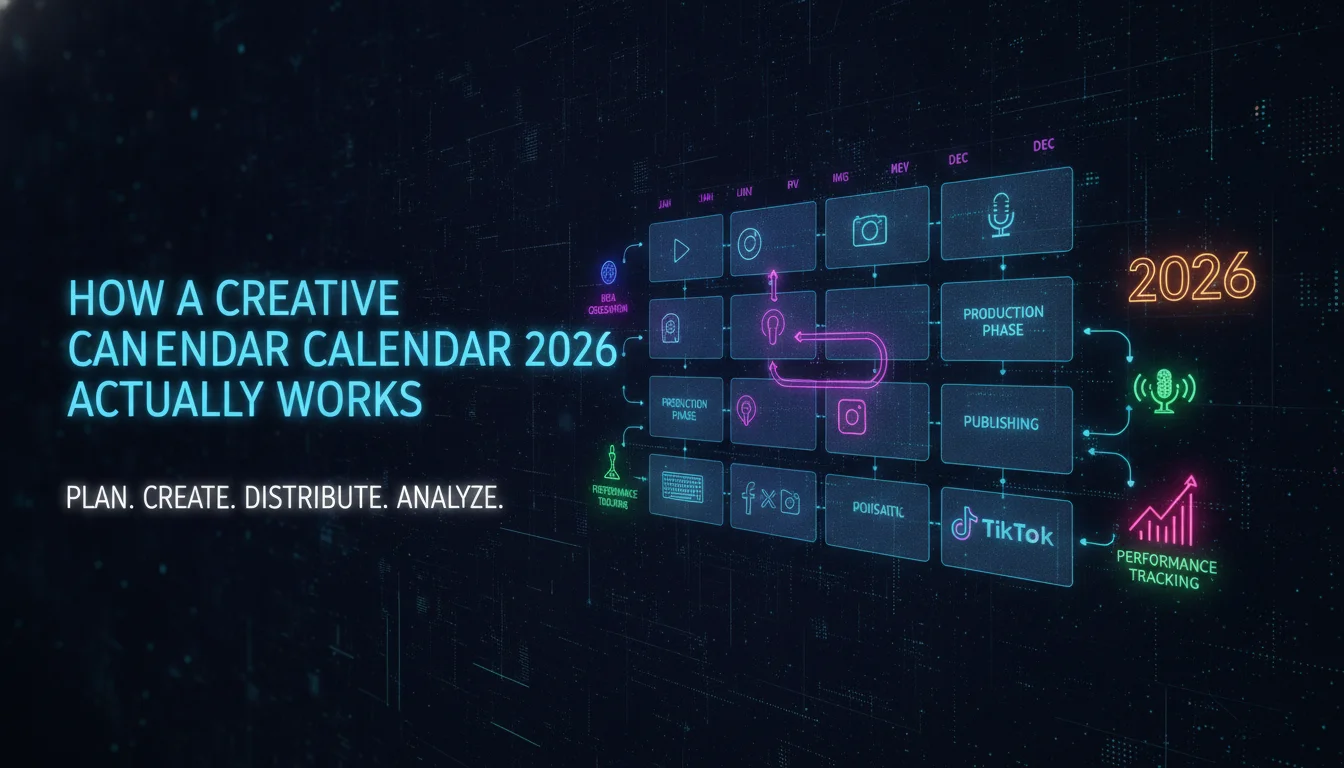
A this kind of calendar 2026 works by layering four planning horizons on top of each other, each one feeding the next with increasing specificity.
Think of it like a camera zooming in. At the widest angle, you see the whole year. Zoom in and you see the quarter. Zoom in again and you see the month. Zoom all the way in and you see this week’s production tasks. Here’s how each layer functions:
Horizon 1: Annual Themes
At the top level, you define two to four overarching brand themes for the year. These aren’t campaigns. They’re the strategic lenses through which all your content will be filtered. For a branding agency, annual themes might be “Visual Identity,” “Brand Voice,” “Campaign Storytelling,” and “Digital Growth.” Every piece of content you create in 2026 should connect back to at least one of these themes.
Horizon 2: Quarterly Pillars
Each quarter gets its own content pillar: a focused topic area that supports one of your annual themes. Q1 might be “Brand Foundations.” Q2 might be “Social Media Strategy.” These pillars anchor your campaigns and ensure your content has a through-line rather than feeling random.
Horizon 3: Monthly Briefs
Each month, you lock in specific topics, formats, and key dates. This is where your the content calendar 2026 gets tactical. You’re deciding which blog posts go live, which social series launches, and which holidays or awareness days you’ll activate around. According to Brandwatch’s 2026 social media holiday calendar, there’s a relevant social moment almost every single day of the year. Your monthly brief filters those down to the ones that actually matter for your brand.
Horizon 4: Weekly Production
This is the factory floor. Briefs go out, drafts come in, designs get reviewed, posts get scheduled. Digital Applied’s research is clear on this: separating editorial (ideation, briefing, QA) from production (writing, designing, scheduling) is why some calendars run smoothly and others stall at week six. Keep these two tracks distinct.
Key Components of a Creative Content Calendar 2026
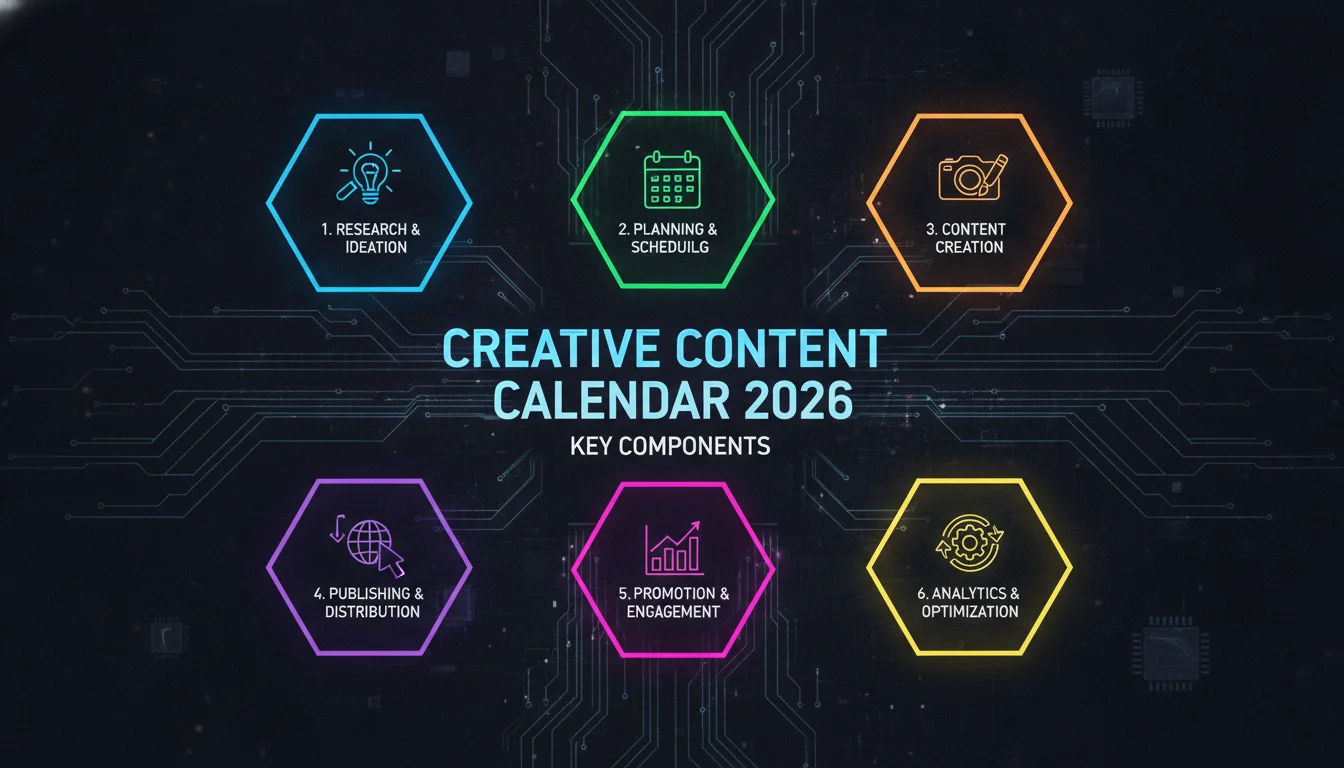
When building your creative content calendar 2026, several components determine whether it becomes a real system or just a pretty document nobody uses.
1. Content Themes
Establishing monthly or quarterly themes guides content creation and ensures that all posts resonate with the audience. January might focus on fresh starts and goal-setting. February centers around community and connection. March activates around Women’s History Month. These themes give your team creative direction without micromanaging every post.
2. Key Dates and Holidays
Incorporating important dates, such as holidays and awareness days, helps brands connect with their audience on a more personal level. Brandwatch’s 2026 social media holiday calendar is a solid reference point. Some standout dates for 2026 include New Year’s Day (January 1), Valentine’s Day (February 14), Lunar New Year (February 17), International Women’s Day (March 8), and World Mental Health Day (October 10). Pick the ones that genuinely connect to your brand values, not just the ones that trend.
3. Content Types and Formats
Different types of content (blog posts, social media updates, short-form video, carousels, newsletters) should be planned in advance. Bundle.social recommends mixing formats within each week: one educational post, one story-driven post, one proof or case study, one community prompt, and one short video. This variety keeps the audience engaged and caters to different consumption habits across platforms.
4. Topic Cluster Architecture
This is the component most brands skip, and it’s the one that matters most for search visibility in 2026. According to Digital Applied, each content pillar should anchor 8 to 15 supporting posts with deliberate internal links. Isolated articles don’t rank the way they used to. Your creative content calendar 2026 should map out which posts support which pillar, and which pages link to which.
5. Calendar Row Fields
Every row in your calendar should capture: status, owner, primary keyword, content cluster, channel, CTA, repurpose plan, and success metric. Anything less is a list, not a system. This level of detail is what separates a calendar that drives results from one that just tracks what got posted.
How to Create a Creative Content Calendar for 2026
Creating a creative content calendar 2026 follows a clear sequence of steps, each building on the last.
Step 1: Define Your Goals
Before creating a calendar, outline your content goals. Are you aiming to increase brand awareness, drive traffic to your website, or boost engagement on social media? Defining these goals will guide every decision you make downstream. Be specific. “Grow Instagram engagement” is a direction. “Increase saves and shares on educational carousel posts by Q2” is a goal.
Step 2: Choose Your Planning Horizons
Map out your annual themes first, then your quarterly pillars, then your monthly briefs. Don’t skip straight to “what do we post this week.” The four-horizon model from Digital Applied is the most reliable structure we’ve seen for teams that need to maintain output over a full 12-month cycle.
Step 3: Choose a Template
Utilizing a template simplifies the process significantly. Many platforms offer customizable templates for content calendars. Canva and Asana both offer free starting points. Notion has over 887 content calendar templates in its marketplace as of 2026, ranging from simple editorial planners to full creator operating systems. Bundle.social offers a free 2026 template with monthly themes, weekly workflow blocks, and columns for platform, format, owner, status, and asset links.
Step 4: Populate Your Calendar
Fill in your calendar with content ideas, key dates, and themes. Ensure that you include a mix of content types and formats. Bundle.social recommends drafting 6 to 12 post ideas per month per platform, then matching those ideas to the right format for each channel. A how-to piece becomes a Reel, a TikTok, and a LinkedIn post. One idea, three executions.
Step 5: Build Your Repurpose Plan
Every piece of content you create should have a repurpose path mapped out before it publishes. A blog post becomes a carousel. A carousel becomes a short video script. A short video becomes a quote graphic. This isn’t just efficiency. It’s how brands maintain presence across multiple platforms without burning out their creative team.
Step 6: Schedule Regular Reviews
Set aside time to review your calendar regularly. Monthly check-ins catch drift before it becomes a crisis. Quarterly reviews let you adjust pillars based on what’s actually performing. And because content decays faster in 2026, build refresh cycles directly into your calendar. If a post or article is 6 to 8 months old and still driving traffic, it needs an update, not a replacement.
Pros and Cons of Using a Creative Content Calendar 2026
A creative content calendar 2026 offers real advantages, but it also comes with trade-offs worth knowing before you commit to a system.
Pros
- Reduces creative panic. When you know what’s coming, you brief better, design better, and write better. Last-minute content is almost always weaker content.
- Improves team alignment. Everyone knows what’s due, who owns it, and when it publishes. No more “I thought you were handling that.”
- Enables smarter repurposing. Planning ahead lets you see where one piece of content can feed five others across different platforms.
- Supports SEO and cluster strategy. You can map internal links and topic clusters before content goes live, not after.
- Makes performance tracking easier. When content is planned and tagged by theme, channel, and goal, analyzing what works becomes straightforward.
- Keeps brand voice consistent. A shared calendar with clear briefs means every writer and designer is working from the same creative direction.
Cons
- Can become rigid. Over-planning leaves no room for reactive content around trending moments or breaking news in your industry.
- Requires upfront time investment. Building a real system takes hours, not minutes. Teams that rush the setup end up with a calendar nobody uses.
- Maintenance is ongoing. A calendar that isn’t reviewed and updated regularly becomes outdated fast, especially with 6 to 8 month content refresh cycles now standard.
- Tool sprawl is real. Using too many platforms (one for planning, one for design, one for scheduling, one for analytics) creates friction and confusion.
Common Mistakes to Watch Out For
Even well-intentioned content calendars collapse under the weight of avoidable errors. Here are the ones we see most often.
Mistake 1: Planning Content Without Planning Distribution
Creating a great piece of content and then figuring out where it goes is backwards. Your creative content calendar 2026 should specify the channel, format, and repurpose path for every piece before it enters production. Distribution is strategy, not an afterthought.
Mistake 2: Chasing Every Trend
As Canva’s social media calendar guide puts it, making posts on the fly is not sustainable, and chasing every microtrend makes even less sense. Your calendar should leave room for reactive content (roughly 20 to 30% of your output), but the core should be planned, intentional, and on-brand.
Mistake 3: Ignoring Content Decay
With AI-generated content flooding search results, older posts lose visibility faster than they used to. Digital Applied’s research shows refresh cycles have tightened to 6 to 8 months. If your calendar doesn’t include scheduled content audits and updates, you’re leaving traffic on the table.
Mistake 4: Measuring the Wrong Things
Rankings and traffic are lagging indicators. By the time they drop, the problem started months ago. Track leading indicators instead: briefs shipped on time, internal links added per month, average time-to-publish. These tell you whether your system is healthy before the numbers show the damage.
Mistake 5: Conflating Editorial and Production
Ideation, briefing, and quality review happen on a different tempo from writing, designing, and scheduling. When you mix these tracks, calendars stall. Keep them separate in your workflow, and assign different owners to each phase.
Mistake 6: Building a Calendar Nobody Can Access
A content calendar locked in one person’s Google Drive is not a system. It’s a document. Use a shared platform (Notion, Asana, or a shared Google Sheet) where every stakeholder can see status, deadlines, and assets in real time.
A Realistic Scenario: How a Brand Builds Its Creative Content Calendar 2026
Here’s what building a creative content calendar 2026 looks like in practice for a mid-sized creative agency.
Imagine a branding studio with a team of six. They serve brand owners, startup founders, and marketing managers. Their goal for 2026 is to grow organic traffic, build authority in the branding space, and convert readers into consultation requests.
Annual themes: Brand Identity, Visual Storytelling, Digital Campaigns, and Growth Strategy.
Q1 pillar: Brand Foundations. The team plans four blog posts, eight Instagram carousels, four short-form videos, and two long-form LinkedIn articles, all anchored around helping founders understand what makes a brand visually and strategically coherent.
Monthly brief for January: Fresh starts, brand audits, and goal-setting. Key dates activated: New Year’s Day (January 1) and Get to Know Your Customers Day (January 16, per Brandwatch’s 2026 holiday calendar). Content includes a “Brand Audit Checklist” blog post, a carousel on “5 Signs Your Brand Needs a Refresh,” and a short video on setting content goals for the year.
Weekly production: Every Monday, the content lead reviews the week’s briefs. Writers submit drafts by Wednesday. Design reviews happen Thursday. Posts schedule Friday for the following week. The whole system runs on a shared Notion workspace where every team member can see what’s in progress, what’s approved, and what’s live.
Result after Q1: The team published consistently across all planned channels, repurposed every blog post into at least two social formats, and identified two pillar posts that needed refreshing by April based on early traffic data. No panic. No last-minute scrambles. Just a system doing what systems do.
This is what a creative content calendar 2026 looks like when it’s built right. Not a spreadsheet. A living editorial engine.
Best Practices for Using Your Creative Content Calendar
To get the most from your creative content calendar 2026, these practices separate teams that thrive from teams that abandon their calendar by March.
1. Be Flexible
While planning is essential, flexibility is equally important. Be prepared to adjust your calendar based on current events, trends, and audience feedback. Leave 20 to 30% of your monthly slots open for reactive content. The best brands plan most of their content and stay ready to pivot the rest.
2. Track Performance
Use analytics tools to track the performance of your content. Understanding what works and what doesn’t will help you refine your strategy over time. Bundle.social recommends tracking which days and formats perform best so you can plan future content with real data, not assumptions.
3. Collaborate with Your Team
Encourage team members to contribute ideas and feedback on the calendar. This collaborative approach leads to more diverse and engaging content. Some of the best content ideas come from the people closest to your customers, not the people closest to the spreadsheet.
4. Repurpose Intentionally
Turn a how-to blog post into a Reel, a TikTok, and a LinkedIn post. Keep the hook native to each platform, but let the core idea do multiple jobs. This is how small teams punch above their weight in content volume without sacrificing quality.
5. Batch Your Scheduling
Batch-schedule content for the week so you’re not stuck posting at odd hours or making reactive decisions about what goes live. Bundle.social’s scheduler supports Instagram, TikTok, YouTube, LinkedIn, Facebook, and more, making this straightforward for multi-platform brands.
Comparison of Content Calendar Tools for 2026
| Tool | Best For | Key Features | Pricing |
|---|---|---|---|
| Notion | Teams wanting full customization | 887+ templates, database views, collaboration, AI features | Free + Paid options |
| Canva | Visual-first teams and solo creators | Design templates, Sheets calendar view, easy-to-use interface | Free + Pro options |
| Asana | Project-heavy marketing teams | Task management, calendar view, workflow automation | Free + Premium options |
| Google Sheets | Lean teams and budget-conscious brands | Customizable spreadsheets, easy sharing, free forever | Free |
| Bundle.social | Multi-platform scheduling and analytics | Scheduler, media library, analytics, API access | Paid (see site) |
Expert Insights on Creative Content Calendars
“A well-structured content calendar not only organizes your content but also aligns your marketing efforts with your business goals. It’s a roadmap for success in the ever-evolving digital landscape.” – Marketing Expert
“Plan in four horizons: annual themes set the strategy, quarterly pillars align campaigns, monthly briefs lock topics, and weekly production runs the factory. Anything less is a list, not a system.” – Digital Applied, Content Calendar Template 2026
“Making posts on the fly is just not sustainable. A well-structured, flexible content calendar will keep your brand more aligned and intentional, ensuring you stay true to your core values and in touch with your audience.” – Canva Team, June 2026
2026 Social Media Dates Worth Building Around
Your creative content calendar 2026 should include a curated selection of social moments that genuinely connect to your brand. Here are key dates sourced from Brandwatch’s 2026 social media holiday calendar and the Noun Project’s 2026 marketing calendar:
- January 1: New Year’s Day (#NewYearsDay) – fresh starts, brand audits, goal-setting content
- January 16: Get to Know Your Customers Day – community engagement, Q&A content
- February 8: Super Bowl Sunday – cultural moment, brand personality content
- February 14: Valentine’s Day – love, loyalty, customer appreciation
- February 17: Lunar New Year and Mardi Gras – cultural celebration content
- March: Women’s History Month – elevate female voices, representation content
- April: Earth Month – sustainability, brand values content
- October 10: World Mental Health Day – brand empathy, community support content
The rule: only activate around dates that connect authentically to what your brand actually stands for. Forced holiday content reads as forced. Audiences notice.
Internal Resources to Strengthen Your Strategy
If you’re building out your creative content calendar 2026 alongside a broader brand strategy, these resources from Emin Media will help you connect the dots. Our work across branding, video production, and digital campaigns gives us a front-row view of what separates content that performs from content that just exists. We’ve also written about social media strategy and brand storytelling frameworks that pair directly with the calendar-building process.
Conclusion
In 2026, a creative content calendar is more than just a scheduling tool. It’s a strategic asset that can significantly enhance your content marketing efforts. By understanding its importance, incorporating key components, and following best practices, brands can create engaging content that resonates with their audience. The brands winning in 2026 aren’t posting more. They’re planning smarter, repurposing intentionally, and building systems that hold up across all 52 weeks.
Ready to build something bold? Contact Emin Media for a free brand consultation and let’s build a creative content calendar 2026 that actually works for your brand.
Frequently Asked Questions
What is a creative content calendar?
A creative content calendar is a planning system that outlines content themes, posting schedules, key dates, and distribution plans across every platform a brand publishes on. It goes beyond a simple schedule to include ownership, formats, repurpose paths, and success metrics for every piece of content.
How do I create a content calendar for 2026?
Start by defining your annual themes and quarterly content pillars, then build monthly briefs around key dates and topic clusters. Choose a shared tool (Notion, Asana, Google Sheets, or Canva), populate it with content ideas and owners, and schedule monthly reviews to keep the system current throughout the year.
What are the benefits of using a content calendar?
The core benefits include streamlined planning, stronger team collaboration, improved publishing consistency, smarter content repurposing, and cleaner performance tracking. Brands that plan ahead also produce higher-quality content because they have time to brief, review, and refine before anything goes live.
Are there free templates available for content calendars?
Yes. Canva, Asana, Google Sheets, Notion, and Bundle.social all offer free content calendar templates as of 2026. Notion alone has over 887 content calendar templates in its marketplace, ranging from simple editorial planners to full creator operating systems.
How often should I review my content calendar?
Review your calendar monthly to catch production drift and adjust for trending topics or audience feedback. Do a deeper quarterly review to assess whether your content pillars are still aligned with your goals. And because content decays faster in 2026, build content refresh audits into your calendar every 6 to 8 months.
What types of content should I include in my calendar?
Include a mix of blog posts, social media carousels, short-form video, long-form LinkedIn articles, newsletters, and promotional content. Bundle.social recommends planning at least one educational post, one story-driven post, one proof or case study, one community prompt, and one short video per week per platform for a balanced content diet.
What are some important social media dates in 2026?
Key dates for your creative content calendar 2026 include New Year’s Day (January 1), Get to Know Your Customers Day (January 16), Valentine’s Day (February 14), Lunar New Year (February 17), Women’s History Month (March), Super Bowl Sunday (February 8), and World Mental Health Day (October 10), among many others sourced from Brandwatch’s 2026 social media holiday calendar.
Enjoyed this article?
Contact Emin Media for a free brand consultation and let's create something amazing together.
Get in TouchRelated Articles
Digital Storytelling for Brands: The Complete Guide
Digital storytelling for brands builds real audience connections through narrative. Learn proven techniques, formats, and…
Design Thinking for Marketing: A 2026 Guide
Design thinking for marketing builds campaigns around real user needs. Learn the 5 phases, common…

Creative Direction for Video Shoots: A Complete Guide
Master creative direction for video shoots with proven steps, tools, and strategies that build brand…