Brand Audit Checklist: 7-Step Guide for 2026
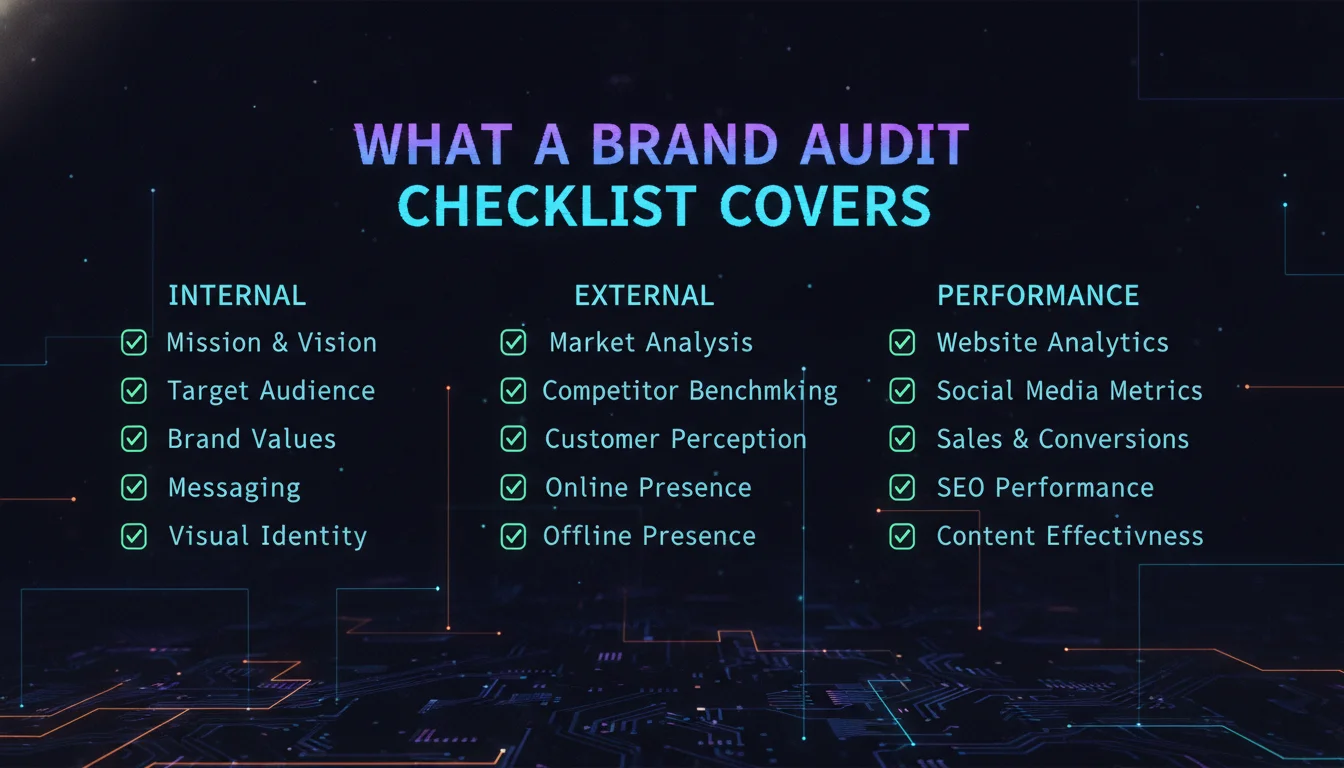
A brand audit checklist is a structured framework for evaluating how consistently your brand performs across identity, messaging, digital channels, and customer touchpoints. It closes the gap between internal intentions and external perceptions.
Key Takeaways
- Visual identity, verbal identity, digital experience, and market perception are the four core categories every audit checklist should cover.
- A seven-step process from defining objectives to building an action plan turns audit findings into measurable improvements.
- Regular audits close the gap between how you think your brand shows up and how your audience actually experiences it.
- According to a 2022 Gartner survey reported by Tiny Hunter, 68% of businesses that conduct annual brand audits see an average brand equity increase of 15% within the first year.
- Internal alignment matters as much as external consistency: sales teams, marketing leads, and partners must all tell the same brand story.
- Audits should run at least annually, or before any major campaign, rebrand, or market expansion.
A brand audit is not a one-time task. It is a diagnostic process that compares your stated brand identity with actual implementation and market perception, turning inconsistencies into an action plan.
– Emin Media brand strategy team
As of 2026, a brand is no longer just a logo or tagline. According to Tigrid Technologies, it is the experience, perception, and trust your audience associates with you. A comprehensive this type of checklist turns that abstract idea into a concrete, repeatable evaluation.
What a Brand Audit Checklist Covers
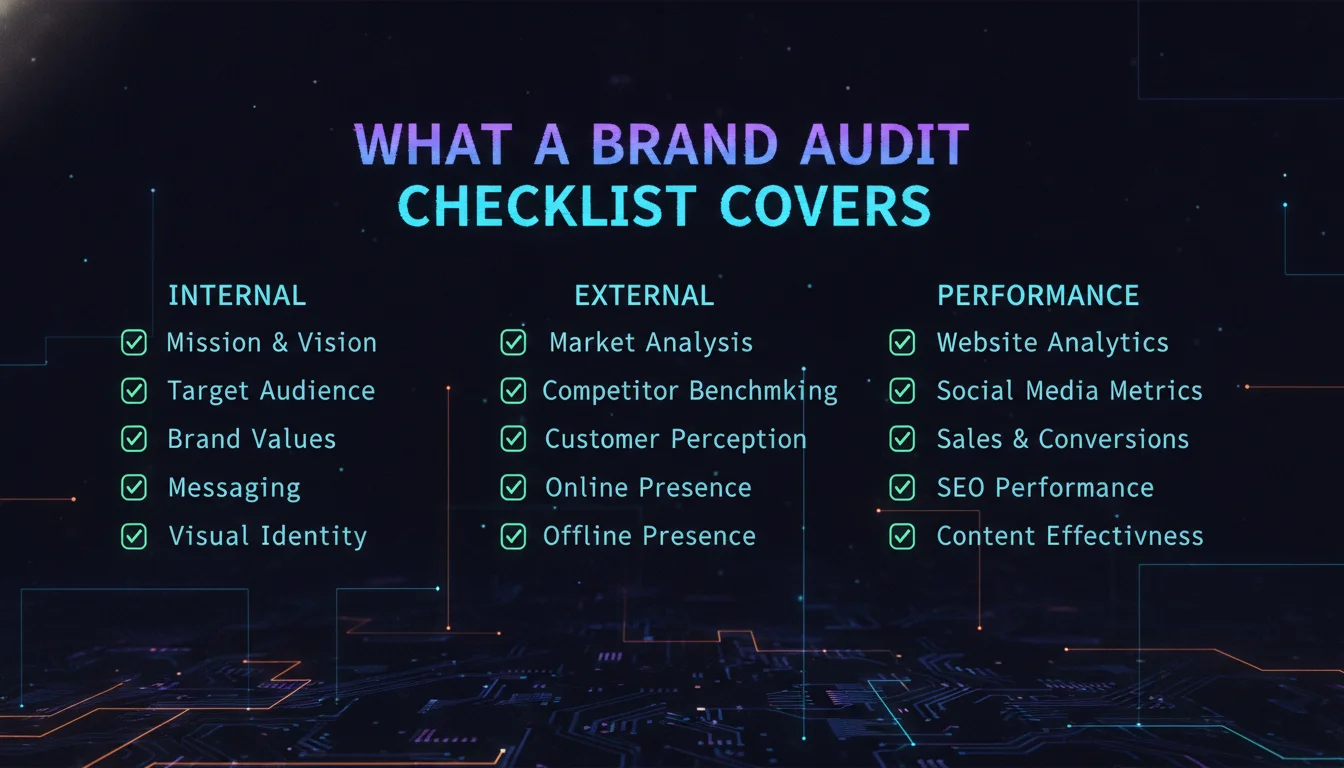
A this kind of checklist breaks the audit into manageable categories: core identity, visual identity, verbal identity, digital experience, and market perception. It helps teams move beyond subjective opinions and evaluate brand performance against concrete criteria. Think of it as a diagnostic instrument, not a scorecard. Each item should produce evidence rather than opinion.
Core Brand Elements in the Checklist
Every effective brand audit starts with foundational elements. These include the company’s purpose, values, target audience, and competitive positioning. According to Smartsheet’s brand audit templates, a comprehensive template typically covers core brand identity, verbal identity, visual identity, and brand evaluation analysis. This structure ensures the audit captures both strategic intent and tactical execution.
Core identity questions should address who the brand serves, what it promises, and how it differentiates from competitors. Without this baseline, later checks on logos or taglines lose context. A audit checklist that skips purpose and values often mistakes surface inconsistencies for root causes.
Visual and Verbal Identity Checks
Visual and verbal identity are the two most visible expressions of a brand. A this type of checklist must include checks for logo usage, color palette accuracy, typography consistency, imagery style, and tagline clarity. Frontify’s brand audit guide recommends auditing brand assets across departments and regions and inventorying core brand elements to spot inconsistencies.
Verbal identity includes tone of voice, messaging hierarchy, and value proposition. The checklist should ask whether the same voice appears on the website, social media, sales collateral, and customer support channels. Inconsistent verbal identity confuses audiences and weakens recall. Many brands discover through a this kind of checklist that their printed material, website, and sales teams use three different versions of the same elevator pitch.
Digital Experience and Market Perception
The digital experience is now a non-negotiable part of any brand audit. A thorough checklist examines website performance, mobile optimization, SEO health, social media activity, online reviews, and competitor positioning. These touchpoints reveal how the brand actually performs in the marketplace, not just how it is intended to perform.
Digital checks often produce the most actionable data because they are measurable. A webpage that loads slowly, a social profile with outdated branding, or a review that contradicts the brand promise are all concrete signals that the brand experience has drifted.
| Audit Dimension | Key Questions to Ask | Common Data Sources |
|---|---|---|
| Visual identity | Is the logo used consistently? Are colors exact? Is typography aligned? | Brand guidelines, website screenshots, social media profiles |
| Messaging | Does the tagline communicate value? Is tone consistent across channels? | Website copy, sales decks, customer emails, social posts |
| Digital presence | Is the website fast and mobile-friendly? Are SEO basics in place? | Google Analytics, PageSpeed Insights, search console |
| Customer feedback | Do customers perceive the brand as intended? What are review themes? | Surveys, Net Promoter Score, online reviews |
| Competitor positioning | How does the brand compare on messaging, visuals, and engagement? | Competitor websites, social media audits, market reports |
This comparison table works as a starting point when building or customizing your own audit checklist. Each row can be expanded with specific yes/no questions, rating scales, and evidence links.
Pros and Cons of Running a Brand Audit
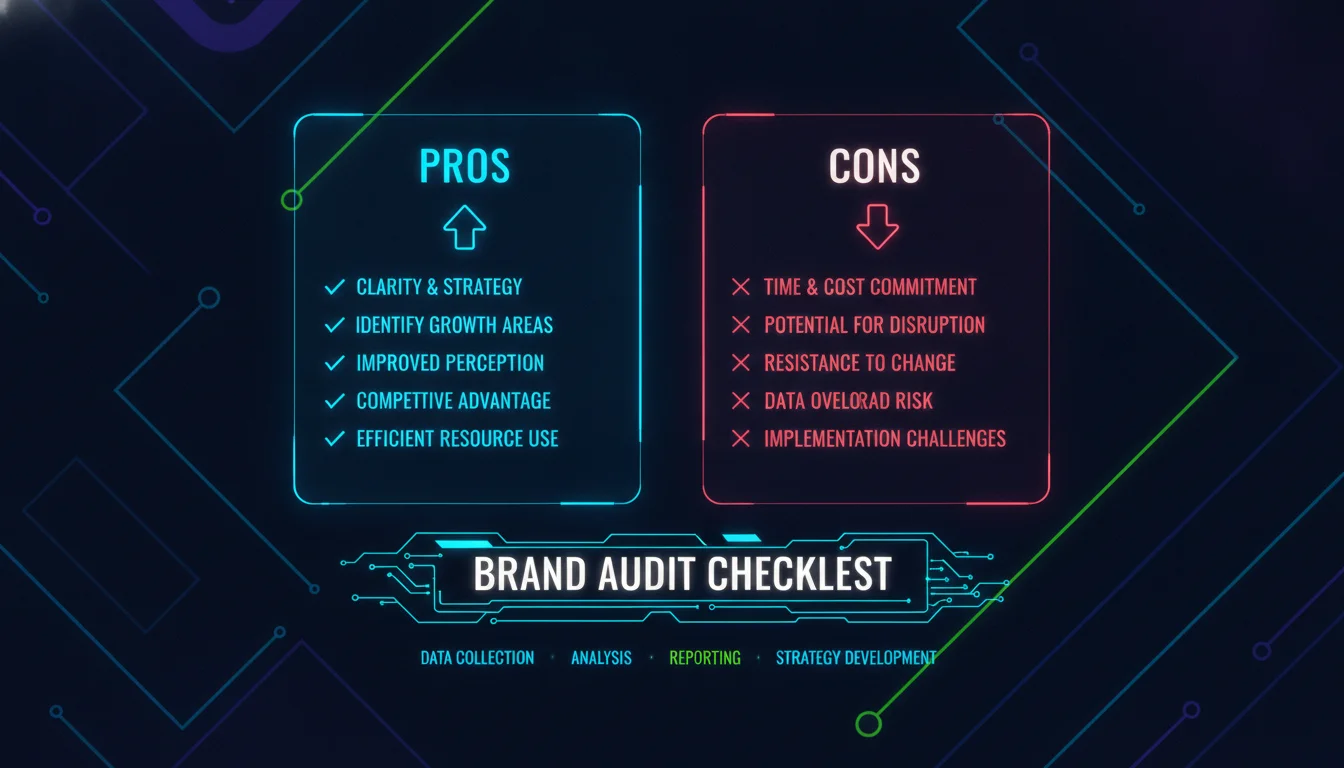
Pros
- Surfaces hidden inconsistencies across visual identity, messaging, and digital channels before they cost you deals or customer trust.
- Produces evidence-based decisions rather than gut-feel rebranding, saving budget and reducing risk.
- Aligns internal teams so sales, marketing, and leadership all tell the same brand story.
- Creates a measurable baseline for tracking brand equity growth year over year.
- Identifies differentiation gaps against competitors while the window to act is still open.
Cons
- Time-intensive: a thorough audit can span four or more weeks, requiring input from multiple stakeholders across the business.
- Can surface uncomfortable truths about internal misalignment that leadership may resist acting on.
- Results require follow-through: without assigned owners and deadlines, audit findings sit in a document and nothing changes.
- Scope creep is real: without clear objectives set upfront, the audit can expand endlessly and lose focus.
Why Your Brand Needs a Structured Audit in 2026

Brands today operate in an environment of AI-driven tools, hyper-personalized marketing, and shrinking attention spans. A structured audit turns assumptions into evidence, and evidence into action.
The Cost of Inconsistency
Brand inconsistency costs more than aesthetics. It creates friction in the buyer journey, reduces trust, and dilutes marketing ROI. A this type of checklist helps quantify where inconsistencies occur, from mismatched visuals in a sales deck to contradictory messaging across social platforms. The 2022 Gartner survey reported by Tiny Hunter found that 68% of businesses that conduct annual brand audits see an average brand equity increase of 15% within the first year. That is the strongest quantitative case for making audits a recurring discipline.
Inconsistent brands often look accidental. Audiences interpret a mismatched logo, a wandering tone of voice, or a broken mobile experience as a sign that the company is not paying attention. In B2B contexts, that can be the difference between a shortlist and a lost deal.
Internal vs. External Alignment
An audit is not complete if it only reviews external touchpoints. Internal adoption matters equally. Employees, sales teams, and partners must understand and use the brand consistently. Canny Creative’s B2B brand audit guide highlights that sales cycles are longer, more stakeholders are involved, and trust is built slowly. A brand that is inconsistent internally costs deals. Use the checklist to gather internal feedback through surveys, interviews, or cultural assessments.
Internal alignment is often the hidden layer of a this kind of checklist. A sales leader may describe the brand differently from a marketing leader, and both may differ from how customers actually experience it. Surfacing these gaps is the first step toward a unified brand story.
When to Run a Brand Audit
You do not need a crisis to justify a brand audit. Trigger events include entering a new market, preparing for a rebrand, noticing competitor visibility outpacing yours, or experiencing plateaued sales. A regular brand audit should be used annually or before any major brand initiative. According to Frontify, companies often have two goals: understanding internal performance or understanding external perception. Knowing your goal shapes which checklist sections to prioritize.
Some teams run a lightweight version quarterly and a full version annually. The quarterly version might focus on digital presence and customer feedback, while the annual version includes internal adoption and competitive positioning. This cadence keeps the audit checklist alive without overburdening the team.
The 7-Step Brand Audit Process
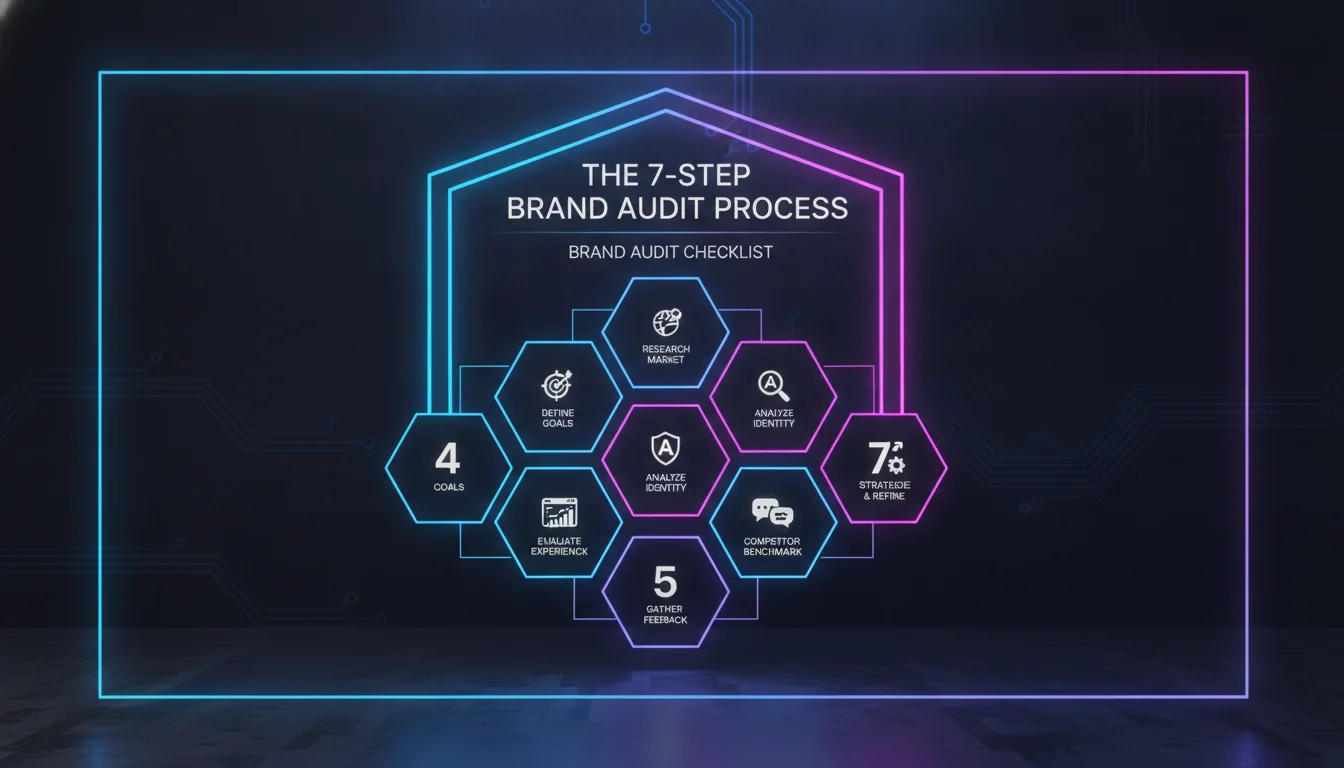
Using a this type of checklist becomes far easier when you follow a proven sequence. The steps below synthesize guidance from Frontify’s 10-step framework and Canny Creative’s B2B methodology into a practical seven-step flow for internal teams. Compress or expand the sequence depending on your audit objectives.
Preparation and Data Collection (Steps 1–3)
- Step 1: Define audit objectives and stakeholders. Clarify whether the audit focuses on internal adoption, external perception, or both. Identify key collaborators such as business leaders, brand managers, marketing leads, and sales leaders. A focused objective prevents the this kind of checklist from becoming an endless data-gathering exercise.
- Step 2: Gather internal brand data. Collect brand guidelines, templates, employee survey results, and asset inventories. Check if all teams use the same logo versions, fonts, and messaging. Document gaps immediately. Do not wait for the analysis phase.
- Step 3: Review brand collateral and touchpoints. Audit websites, social media profiles, sales materials, packaging, and internal communications. Smartsheet’s templates can help structure this inventory. Capture screenshots and download examples for side-by-side comparison.
Analysis and Action Planning (Steps 4–7)
- Step 4: Perform competitive analysis. Compare positioning, messaging, and visual identity against direct and indirect competitors. Identify where competitors are more consistent or more visible. Competitive benchmarking keeps your brand audit grounded in market reality.
- Step 5: Conduct audience and customer surveys. Measure brand preference, loyalty, recall, and perception. Include open-ended questions like “What three words describe our brand?” to surface unexpected gaps. Employee surveys matter equally. Frontline teams know what customers complain about.
- Step 6: Analyze consistency and identify gaps. Look for patterns across internal and external data. Create a gap list between intended brand identity and actual customer perception. Every observation in the audit checklist should tie back to one of these gaps.
- Step 7: Report findings and build an action plan. Prioritize improvements, assign owners, and set timelines. Use a dashboard or executive summary to communicate results to stakeholders. Frontify recommends presenting insights through executive summaries, detailed reports, dashboards, and data packs.
This seven-step process is not strictly linear. You may loop back to gather more data after initial analysis. The key is to use each step to feed the next and to document every finding in a central repository.
Visual Identity: The First Layer of a Brand Audit Checklist
Visual identity is the collection of visible elements, logo, color, typography, and imagery, that create instant recognition. A this type of checklist must evaluate whether these elements are consistent, accessible, and scalable across every platform. Visual identity is the quickest area to audit because the evidence is right in front of you, but it is also the easiest to let drift.
Logo, Color, and Typography Consistency
Start with the logo. Ask whether all teams use the correct logo file, clear space, and minimum size. Colors should be exact, not “close enough.” Typography should have a clear hierarchy for headlines, subheads, and body text. According to Tigrid Technologies, visual identity checks should confirm the logo is modern and scalable across devices, colors are consistent and accessible, and fonts align with brand personality.
Many companies discover through a this kind of checklist that their sales team uses an old logo file with a different color code, or that the website uses a font not found in the brand guidelines. These small inconsistencies compound into a sense of sloppiness that no campaign budget can fix.
Imagery and Platform Adaptation
Imagery is where many brands drift fastest. A strong brand audit checks whether photography and illustration styles are coherent across the website, social media, presentations, and packaging. Random stock images that feel off-brand signal a larger identity problem. Also verify that visuals are adapted smartly for each channel, mobile, print, and desktop, without losing core consistency.
Platform adaptation is not about creating a different brand for each channel. It means using the same visual language with format-appropriate asset dimensions and optimized files. A checklist item might ask: Does the Instagram grid reflect the same color palette as the annual report cover?
Accessibility and Scalability
Visual identity in 2026 must meet accessibility standards such as contrast ratios and legible font sizes. A scalable identity works in a small social avatar and on a large event banner. The checklist should include a technical review of contrast, alt text, and responsive behavior. Smartsheet’s logo audit checklist template offers a useful starting point for logo-specific questions.
Accessibility is no longer optional. Brands that ignore contrast and alt text exclude part of their audience and risk legal exposure. A this type of checklist that includes accessibility checks future-proofs the visual system.
Brand Messaging: Aligning Voice, Tone, and Value Proposition
Brand messaging is the system of verbal expressions a company uses to communicate its value, personality, and promise. Messaging checks are often the most revealing part of a brand audit checklist because they show whether internal teams and external audiences share the same understanding.
Tagline and Value Proposition
Evaluate whether your tagline communicates the value proposition clearly. Does it differentiate the brand or sound like every competitor? A weak tagline often mirrors weak positioning. The checklist should compare the stated value proposition with how customers describe the brand in surveys and reviews.
If customers use different words than your marketing team, that is a red flag. The brand audit checklist should capture both the intended message and the received message, then quantify the gap.
Tone and Voice Across Channels
Check whether tone of voice remains consistent from LinkedIn posts to Instagram captions to customer support emails. Tigrid Technologies highlights that tone and voice should be consistent across social media, website, and campaigns. A brand audit checklist should include samples from each channel side by side to spot jarring shifts, such as professional on LinkedIn and casual on Instagram without strategic reason.
Tone consistency does not mean every channel sounds identical. It means the brand personality is recognizable while adapting to context. A useful checklist question: if you removed the logo, could a customer still identify the brand from the writing alone?
Mission, Values, and Storytelling
Mission and values are not boilerplate. They should resonate with current audience expectations and guide storytelling. The checklist should ask whether content and campaigns reflect the stated mission. If the brand claims sustainability, does its imagery and packaging reflect that? Gaps here surface as trust issues, and trust issues surface as lost revenue.
A practical content audit within the brand audit checklist: take the last ten pieces of content and label each with the brand value it expresses. If some values never appear, the messaging is not bringing the mission to life.
Digital Presence and Social Media Audit
Digital presence is the primary storefront for most brands today. A brand audit checklist must assess website performance, social media consistency, and online reputation as core components. These channels generate measurable data, making them ideal for evidence-based audit decisions.
Website Performance and SEO
Start with the website. Ask whether it loads quickly, works well on mobile, and follows basic SEO best practices. A slow or non-responsive website undercuts every other brand investment. Check whether the design reflects the visual identity and whether calls-to-action are clear. According to Scribd’s brand audit template, website analysis should include user experience questions about navigation, mobile optimization, and clear calls-to-action.
SEO is part of brand visibility. If your brand audit checklist does not include a basic on-page SEO check, covering title tags, meta descriptions, image alt text, and internal linking, you may be missing a significant driver of perception and reach.
Social Media Consistency and Engagement
Audit each active platform for visual consistency of avatar, cover image, and post templates. Check tone of voice in comments and interactions. Measure engagement rates, posting frequency, and follower sentiment. Use questions from the Scribd template: Is the brand content aligned with core values? Are there signs of brand loyalty or advocacy among followers?
Engagement metrics vary by industry, so a brand audit checklist should compare performance to your own historical baseline and to relevant competitors rather than chasing arbitrary benchmarks.
Online Reputation and Reviews
Reviews on Google, LinkedIn, and industry sites are a direct window into customer perception. The checklist should collect review themes and compare them against intended brand promises. A 2026 brand audit checklist must treat online reputation as a strategic asset, not an afterthought.
Look for recurring words in reviews. If customers repeatedly mention slow support or confusing pricing, those are brand experience gaps that no logo refresh can fix.
Competitor Analysis and Market Positioning
A brand audit checklist is incomplete without a structured competitor comparison. The goal is not to copy competitors but to understand where your brand stands relative to their visibility, consistency, and differentiation. Competitor analysis anchors your audit in market reality.
Benchmarking Against Direct and Indirect Competitors
Identify three to five direct competitors and two to three indirect competitors. Compare their visual identity, messaging clarity, website experience, and social engagement. Frontify’s guide recommends comparing positioning, messaging, and visual identity against direct and indirect competitors. Use a simple scoring table to rank each brand on dimensions from your checklist.
A competitive benchmarking table can be as simple as a five-point scale for each dimension. The value comes from seeing where competitors are more consistent or more visible, not from chasing every competitor strength.
Identifying Differentiation Gaps
Differentiation is the reason a customer chooses you over everyone else. The audit should reveal where competitors are more consistent or more visible. If a competitor owns a color, a tone, or a value proposition more effectively, that is a gap to close or an opportunity to reposition. According to Canny Creative, B2B brands often face longer sales cycles and more stakeholders, so differentiation must be clear at every touchpoint.
A brand audit checklist should ask not only “What do we do differently?” but also “What do we do differently that customers actually value?” Differentiation without relevance is wasted effort.
Tracking Market Trends
Market trends shift faster in 2026 with AI-driven personalization and new channel dynamics. Your brand audit checklist should include a trend review, not to chase every fad, but to ensure the brand remains relevant. Ask whether competitors are adopting new formats or tools and whether your brand’s position still makes sense in the current market.
Trend tracking is qualitative. Note emerging design patterns, messaging shifts, and platform usage, then decide which trends align with your brand strategy. The checklist should require a rationale for any trend-related recommendation.
Downloadable Template Formats: Which One Fits Your Team
The right template format depends on how your team works. Smartsheet offers brand audit templates in Microsoft Word, Adobe PDF, Google Docs, and native Smartsheet formats. Each serves a different workflow.
Word and Google Docs templates work best for teams that need to write narrative observations alongside checklist items. PDF formats suit client-facing deliverables where formatting must stay locked. Spreadsheet formats, whether in Excel or Smartsheet, are better for teams that want to score each dimension numerically, track changes over time, or assign owners to specific line items.
For most internal teams running their first brand audit checklist, a Google Docs version is the lowest-friction starting point. It is shareable, editable in real time, and easy to convert to PDF for stakeholder presentations. As the audit practice matures, migrating to a spreadsheet format adds the scoring and tracking capabilities that make year-over-year comparison possible.
The best brand audit template is the one your team will actually complete. Start simple, build in scoring as you repeat the process, and let the format evolve with your audit maturity.
– Emin Media creative strategy team
Conclusion: Making the Brand Audit Checklist an Ongoing Discipline
A brand audit checklist is not a one-time project deliverable. It is a recurring strategic practice that keeps visual identity, messaging, digital presence, and customer perception aligned. The brand equity gains from annual audits, documented by Gartner and reported by Tiny Hunter, underscore that consistency pays off over time.
Prioritizing Improvements
After completing the audit, sort gaps into quick wins, medium-term fixes, and long-term initiatives. Quick wins might include correcting logo usage on social profiles or updating outdated taglines. Quick wins build momentum for larger changes.
Prioritization should be based on impact and effort. A simple two-by-two matrix can help the team see which items to tackle first. The brand audit checklist should produce an output that is immediately usable by leadership.
Assigning Ownership and Timelines
Every finding needs an owner and a deadline. Use a simple action log that lists the issue, recommendation, responsible team, and target date. Frontify’s action plan step recommends prioritizing improvements, assigning ownership, and creating a roadmap for ongoing brand growth.
Ownership prevents the audit report from sitting on a shelf. When a specific person is accountable for fixing a specific inconsistency, the brand audit checklist becomes a management tool rather than a document.
Measuring Success with KPIs
Define key performance indicators before you implement changes. These might include engagement rates, website conversion, brand recall in surveys, or review sentiment. A brand audit checklist should close the loop by measuring whether the recommended changes actually moved those metrics. Smartsheet’s brand engagement metrics tracker template can support this measurement.
Measurement turns the audit into a continuous improvement cycle. Track the same metrics year over year to see whether brand equity is compounding or eroding.
Use this brand audit checklist annually, before major campaigns, or whenever market conditions shift. The brands that stay consistent, relevant, and credible are the ones that treat the audit as a habit, not an event.
Ready to find out where your brand actually stands? Contact Emin Media for a free brand consultation and let’s build something worth remembering.
Frequently Asked Questions
What are the 5 C’s of auditing?
In a brand audit context, the 5 C’s often refer to company, customers, competitors, collaborators, and context. These dimensions help auditors organize data collection across internal, external, and market perspectives.
What is the 3 7 27 rule of branding?
The 3 7 27 rule is a guideline suggesting people need to encounter a brand three times to remember it, seven times to engage, and twenty-seven times to develop loyalty. A brand audit checklist can assess whether your touchpoints deliver enough consistent exposure to move audiences through that progression.
What should be included in an audit checklist?
A complete brand audit checklist should include sections for visual identity, messaging, digital presence, customer feedback, competitor comparison, and internal adoption. Each section should have specific yes/no questions and evidence fields so findings are documented rather than remembered.
What are the 5 P’s of brand identity?
The 5 P’s of brand identity are purpose, positioning, personality, presence, and performance. These elements form a framework for aligning strategy with execution during an audit, and each one should have corresponding checklist items.
How often should you perform a brand audit?
Most experts recommend performing a brand audit at least annually. According to the 2022 Gartner survey reported by Tiny Hunter, 68% of businesses that conduct annual brand audits see an average brand equity increase of 15% within the first year, making the annual cadence the strongest-supported frequency.
Can a small business use the same brand audit checklist as a large company?
Yes, the core dimensions are the same, but scope and depth can be scaled. A small business might use a simplified brand audit checklist focused on website, social media, and customer reviews, while large organizations add regional and departmental consistency checks.
Enjoyed this article?
Contact Emin Media for a free brand consultation and let's create something amazing together.
Get in TouchRelated Articles

Digital Marketing for Creatives: A Bold Guide
Digital marketing for creatives builds real visibility and sales. Learn strategies for social media, SEO,…
Branding & Design Agency Tips That Actually Work
Discover branding and design agency tips to choose the right partner, set clear goals, and…

Creative Agency Pitch Deck Tips That Win Clients
Master creative agency pitch deck tips that win clients in 2026. Learn storytelling, design, and…