Creative Branding Trends 2026: The Human-AI Portfolio
Creative branding trends 2026 are a portfolio of competing forces: human imperfection, sensory maximalism, AI-assisted personalization, and cultural specificity. Brands that treat these as modular choices rather than a checklist will build the most emotionally legible identities of the year.
Key Takeaways
- Anti-AI imperfection – naive design, hand-drawn letterforms, collage, and Brutalist edges – has become a measurable trust signal in 2026.
- Node-based AI design tools give creative teams transparent control over AI workflows while hyper-personalization moves branding from static to adaptive.
- Sensory and tactile depth – puffy textures, cinematic motion, immersive 3D – are retention mechanisms, not decorative extras.
- Purpose-driven branding is now a baseline expectation, especially among Gen Z and Gen Alpha audiences.
- The highest-performing 2026 brands combine bold typography, vibrant color, and motion with localized cultural flavor and tactile storytelling.
- A portfolio approach – selecting trend clusters by brand context and audience trust gaps – prevents both trend fatigue and missed opportunity.
This article synthesizes 2026 trend forecasts from Adobe, Behance, It’s Nice That, VistaPrint, and independent design educators. The goal is not another list. The goal is a strategic framework for choosing which trends 2026 to adopt – and which to skip.
1. The Strategic Tension at the Heart of Creative Branding Trends 2026
Why 2026 Rejects the Polished Default
this type of 2026 begin with a deliberate rejection of machine-perfect aesthetics. For years, brand visual identity defaulted to minimalist, perfectly aligned, digitally clean systems. The shift documented by Adobe’s 2026 Creative Trends Forecast is a turn toward organic, analog, realistic, and human-centered design. Adobe frames this as a backlash against the heavy influence of AI, AR, and gaming, with creative work indexing more heavily on “sometimes messy and chaotic (and glorious) humanity.”
The central competitive insight is that imperfection itself has become a differentiator, not a flaw. Consumers are digitally drained, as It’s Nice That observes through the rise of early-2000s tech nostalgia – old iPod Shuffles hiking in price on eBay as symbols of simplicity – and analogue design processes. This does not mean abandoning digital tools. It means using them to amplify human texture rather than erase it.
Defining Creative Branding Trends 2026 as a Portfolio, Not a List
this kind of trends 2026 are a set of visual and strategic patterns that brand teams can combine selectively to signal authenticity, emotional depth, and cultural relevance in an AI-saturated marketplace. A list approach fails because trends contradict each other: some lean maximalist and sensory, others neo-minimalist and micro-detailed; some embrace AI, others rebel against it. The more useful framing is a portfolio of trend clusters, selected by brand maturity, audience, and category.
A portfolio approach is a strategic method for selecting trend clusters based on brand context, competitive whitespace, and audience trust gaps, rather than adopting every visual trend as a checklist. This protects against the “trend soup” problem where a brand tries to be naive, brutalist, sensory, and AI-personalized all at once.
The Balance Between AI and Human Creativity
Behance’s 2026 design trend roundup describes the year as being about balance: “between AI and human creativity, between polished and imperfect, between experiential richness and performance.” This is not a single binary choice. Many brands will deploy node-based AI design tools for scalable production while simultaneously using hand-drawn letterforms and naive imagery to preserve emotional resonance.
The strategic error in 2026 is treating every trend as mandatory. The strategic win is knowing which tension your brand needs to resolve. A DTC consumer brand may prioritize sensory depth and collage, while a B2B SaaS brand may prioritize neo-minimalism and micro-maximalism with motion. The portfolio model prevents both under-adoption and trend fatigue.
2. The Sensory and Tactile Turn in Brand Identity
All Our Senses, to the Max
Sensory and tactile experiences are strong engagement drivers in the branding trends 2026. Adobe lists “All our senses, to the max” as its first 2026 design trend: puffy, soft, and squishy textures, hyper-realistic objects combined with playful distortions, and materials that mimic touch, sound, and motion. For brand identity, this means packaging and digital surfaces should reference physical texture and invite emotional immersion. A product unboxing that feels soft or a website background that suggests sand or stone can create a lasting physical memory.
It’s Nice That similarly documents a turn toward scanning, scrapbooking, collecting, and collaging to make work feel mismatched rather than flat. Sensory branding is the deliberate use of touch-like texture, sound cues, and motion references to create an immersive brand experience that feels physically present even in digital channels. In 2026, this is not a gimmick. It is a retention mechanism.
Organic and Imperfect Design as Trust Signal
Organic and imperfect design shows up in hand-rendered and letterpress-inspired fonts, earthy textures like sand, stone, and bark, and low-contrast minimal forms. VistaPrint’s research with the 99designs community concludes that brands with personality and “imperfect realness” are standing out against a sea of sameness. This is a trust signal because consumers increasingly associate machine-perfect visuals with automated, inauthentic brand behavior.
Imperfection, when intentional, communicates that a human hand was involved. The key is control: too much imperfection reads as careless, too little reads as corporate. Brand teams should test thresholds with real users before committing to a full visual system.
Local and Cultural Flavor as Differentiation
Adobe highlights local and cultural flavor as a core direction in 2026: patterns and symbols rooted in heritage, documentary or candid-style photography, and typography inspired by regional traditions. VistaPrint labels a related movement “Elemental Folk,” stemming from folk art and regional craft traditions, bringing folk motifs into clean, modern compositions. This style takes eclectic florals, animals, and ornamental borders and drops them into contemporary branding settings.
“We’re seeing a return to crafty old folklore patterns but expressed in a more fresh and contemporary way. This modern take draws from Northern European historical elements which feels warm, inviting and joyous.” – Mary Pho, Art Director, VistaPrint
This localization provides a cultural anchor that generic AI-generated branding cannot replicate. Brands must approach cultural references with genuine collaboration and respect, not aesthetic tourism. The risk of pastiche is as high as the opportunity for differentiation.
3. Typography and Layouts That Signal Human Presence
Exaggerated, Playful Letters and Humanized Letterforms
Typography in creative branding trends 2026 leans toward excess and the absurd: oversized sans-serifs, bubbly and puffy letterforms, wavy distorted fonts, handwritten scripts, and loopy cursives. Behance’s trend report calls this “humanized and imperfect letterforms,” with hand-drawn shapes, organic curves, and subtle flaws that add warmth and counterbalance AI-generated precision. The defining shift is that typography is no longer just functional. It is emotional and expressive, acting as a visual voice for the brand.
Humanized letterforms are type designs that intentionally include irregular curves, optical inconsistencies, and hand-rendered texture to signal a human maker. For startups and challenger brands, a custom or semi-custom display face can be the most cost-effective way to stand out in a crowded feed. For established brands, applying one humanized weight or ligature set can modernize an existing system without a full rebrand.
Freeform, Storytelling, and Zine-Style Layouts
Adobe predicts unpredictability in layouts, with loose, editorial-style compositions and zine-style layouts, overlapping elements and asymmetry for dynamic rhythm. This freer approach supports storytelling by letting content break the grid. For brand teams, this does not mean abandoning structure. It means choosing where controlled chaos can guide the eye and create narrative emphasis. The benefit is editorial credibility and a sense that the brand exists outside algorithmic feed constraints.
Freeform layouts work especially well for editorial brands, cultural institutions, and content-driven DTC companies that need to signal independent thinking. The operational rule is to keep the core brand lockup stable while allowing editorial templates to flex. This prevents recognition loss while still appearing contemporary and unpolished in the right places.
Collage and Layered Visual Elements for Narrative Depth
Collage and layered visual elements continue as a strong direction within creative branding trends 2026. The visible imperfections of overlapping layers offer depth and narrative texture. It’s Nice That’s 2026 trends explicitly reference cut-out trinket collections, pick-and-mix lettersets, and office-printer aesthetics as signals of human assembly. This cluster connects directly to the sensory and imperfect turn, but with a specific compositional tactic: layering analogue artifacts, textures, and graphic elements to create a scrapbook-like brand world.
Collage branding is a visual strategy that juxtaposes cut-out, scanned, and layered graphic elements to create narrative depth and visible human assembly. The collage approach is particularly effective on social media, where the hand-made quality of layered scans and awkwardly placed elements interrupts the polished scroll and earns a second look.
4. Color, Motion, and Immersive Storytelling
Vibrant Color Systems and Chromatic Expression
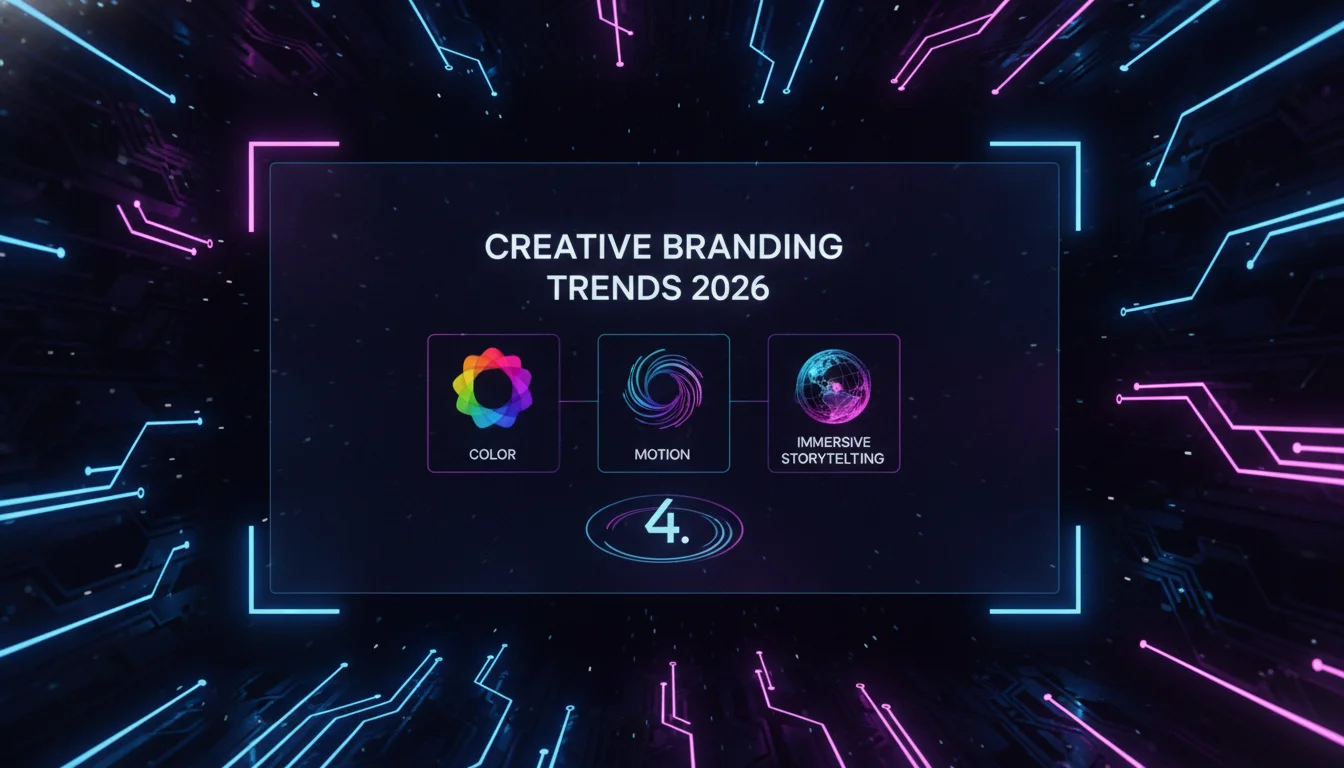
Color is a primary storytelling device in creative branding trends 2026. Behance says 2026 is bold with color again: dynamic palettes, gradient layering, duotones, and reactive color schemes that adapt to mood or context. Color represents brand emotion, energy, and inclusivity. Adobe describes an immersive, high-energy style with bright saturated color palettes and realistic textures mixed with surreal elements.
Brands should select a chromatic system that can flex across contexts without losing recognition. As Behance advises for neo-minimalism and micro-maximalism, one strong element should take the spotlight. Accessibility remains non-negotiable: balance saturation with contrast for legibility. A vibrant palette that fails contrast ratios loses both usability and credibility.
Cinematic Motion and Micro-Interactions
Motion design becomes a primary branding language in 2026, from subtle micro-interactions to cinematic transitions. According to Arman Malik’s analysis of creative branding trends for agencies and startups, static logos are giving way to dynamic, motion-first branding: logos that animate on app launch or brand systems that respond to interaction. Movement guides attention, conveys personality, and creates flow.
Motion-first branding is an approach in which animated logos, transitions, and micro-interactions are integral to brand identity, not decorative additions. Every animation should have a purpose: delight, inform, or direct. Motion that merely loops for novelty adds cognitive load without brand value. In 2026, performance is part of the creative brief, not a technical afterthought.
Immersive 3D and Spatial Interfaces
Behance also reports immersive 3D and spatial interfaces as a leading 2026 direction, from micro-3D interactions to full immersive environments. 3D becomes native to web and apps, enhancing storytelling and engagement. The key caution is performance: realism should never slow usability. Brands should treat 3D and spatial layering as an enhancement to core usability, not a replacement for clear hierarchy.
Immersive 3D branding is the use of depth, spatial relationships, and real-time motion to create an interactive environment that supports brand narrative. Practical entry points include a 3D product configurator, a spatial brand landing page, or micro-3D elements within an app. The goal is to make the interface feel more like a physical space, not to turn it into a video game. Keep file sizes tight and load times fast – a beautiful 3D environment that takes four seconds to render will lose the audience before they experience the brand.
5. Surreal, Absurdist, and Purpose-Driven Brand Storytelling
Surreal and Absurdist Imagery
Surreal and absurdist imagery is one of Adobe’s named 2026 design trends, and it belongs in any serious discussion of creative branding trends 2026. Being playful by including visual jokes, “Easter eggs,” and exaggerated scales in a surreal way can become a trademark of contemporary brand design. Collage-style compositions with unexpected juxtapositions and dreamlike digital collages allow brands to show their fun side and tap into the emotions of their audiences.
This is not randomness for its own sake. The best surreal brand moments are tightly controlled: one unexpected element inside an otherwise coherent visual system. Think of it as a controlled detonation – the surprise lands harder because everything around it is stable. For social content, a single absurdist visual can outperform a polished campaign by earning genuine curiosity rather than passive scrolling.
Purpose-Driven Branding as a Baseline
Purpose-driven branding is no longer a differentiator in creative branding trends 2026. It is a baseline expectation. According to Arman Malik’s analysis, consumers – especially Gen Z and Gen Alpha – expect brands to stand for something. Visual identity alone no longer cuts it. A company’s mission, values, and impact must be integrated into every brand touchpoint, from eco-conscious packaging to campaigns promoting mental wellness.
Startups and agencies that clearly communicate a cause or social mission and back it with action will earn deeper loyalty. The design implication is direct: the “why” behind the brand must be visible in the visual system, not buried in an About page. Color choices, photography direction, and typographic tone should all carry the brand’s values without a caption explaining them.
“Branding in 2026 is no longer just about aesthetics – it’s about identity, emotion, adaptability, and storytelling across ever-evolving platforms.” – Arman Malik, creative branding analyst
6. AI-Infused and Hyper-Personalized Creative Branding Trends 2026
Node-Based AI Design Tools as Creative Control Layer
Node-based AI design tools are a defining element of creative branding trends 2026. These tools let designers connect models, prompts, data, and logic in flexible, modular workflows, providing full control and transparency over AI processes. Unlike black-box generation, node-driven interfaces allow experimentation and speed without sacrificing oversight. Node-based AI design is a visual programming method for orchestrating AI models and data flows through connected nodes, making complex AI workflows adjustable and scalable. Behance notes that it gives designers full control and transparency over AI workflows, making complex processes easy to adjust, remix, and scale.
Hyper-Personalized Brand Experiences at Scale
Hyper-personalized brand experiences are another core direction in creative branding trends 2026. One-size-fits-all branding fades as brands use data and design to create custom experiences: email campaigns that adapt design based on user behavior, personalized packaging, digital unboxing experiences, and interactive storytelling tailored to preferences. Agencies are building modular identity systems that remain cohesive while flexing across segments.
The strategic challenge is maintaining brand coherence while enabling personalization at scale. Too much variation fragments recognition; too little feels generic. A modular identity system with locked core elements and flexible template modules is the operational answer. This is where AI-assisted production becomes valuable: generating on-brand variations without a human designer manually approving every asset.
AI as Co-Pilot, Not Substitute
Arman Malik writes that AI is not replacing creatives. It is enhancing their speed and scope. In 2026, startups use AI-powered tools to generate name ideas, create logo variations, refine tone of voice, and draft brand messaging. The key is to use AI as a co-pilot, ensuring authenticity and originality stay at the core.
The most durable brands built on creative branding trends 2026 will combine AI efficiency with intentional imperfection. AI can generate thirty logo directions in minutes, but a human creative director should select the one that carries cultural nuance and emotional warmth. The human decision layer is the moat.
7. Retro, Brutalist, and Imperfect Aesthetics
Naive Design and Deliberate Human Error
Naive Design is a 2026 style that embraces childlike drawings, awkward proportions, and visible “human error” as a way to reintroduce warmth and individuality into brand work. Lindsay Marsh, a design teacher to over 600,000 students globally, calls it a counter-movement similar to Brutalism in 2018 but with a softer, more emotional tone. She explains it is a counter response to the severe rigidity of modern polished brands, allowing brands to remain authentic and relatable.
This is a high-risk, high-reward trend: it requires intentional imperfection, not carelessness. The threshold is whether the audience reads the work as deliberately human or simply unprofessional. Brands should test naive design elements in controlled contexts – social posts, packaging inserts, or campaign microsites – before applying them to core corporate collateral.
Retro and Brutalist Aesthetics in Practice
Behance’s 2026 report names “Retro / Brutalist / Imperfect Aesthetics” as a top trend: rough textures, asymmetry, visible grids, and 90s nostalgia. Audiences crave human touch in an overly polished digital world. It’s Nice That contextualizes this through early-2000s tech nostalgia and a digitally drained consumer base turning to analogue approaches.
For brands, the retro reference must serve a current brand story, not just a nostalgic gimmick. The office-printer aesthetic, pick-and-mix lettersets, and cut-out trinket collections are not throwbacks for their own sake. They signal that a brand is willing to show its working process. This transparency is the underlying value, not the nostalgia itself.
Neo-Minimalism and Micro-Maximalism
The same Behance report balances imperfection with “Neo-Minimalism and Micro-Maximalism”: clean layouts paired with bold type, color pops, or intricate micro-details. This trend strikes a balance between clarity and personality, letting one strong element take the spotlight. It is the accessible entry point for brands that cannot commit to full naive or brutalist expression.
Micro-maximalism is a visual strategy that layers maximalist detail inside a minimal framework, concentrating intensity in a single focal element. This approach works well for B2B and professional services brands that need clarity but want to avoid the sea of sameness. A single oversized typeface, a surprising color block, or a detailed micro-icon can provide personality without overwhelming the user.
Pros and Cons of Adopting Creative Branding Trends 2026
Pros
- Emotional differentiation: Human imperfection, sensory depth, and cultural specificity create brand memories that polished, generic identities cannot.
- AI-assisted scalability: Node-based workflows and modular identity systems let small teams produce on-brand variations at a pace previously reserved for large agencies.
- Audience trust: Intentional imperfection and purpose-driven design signal authenticity to digitally drained consumers who are increasingly skeptical of machine-generated content.
- Creative flexibility: The portfolio model means brands can adopt one or two trend clusters without committing to a full rebrand, reducing risk and cost.
- Cultural relevance: Localized folk patterns and heritage references provide a competitive anchor that AI-generated branding cannot easily replicate.
Cons
- Execution risk: Naive design and deliberate imperfection require skilled creative judgment. Done carelessly, they read as unprofessional rather than intentional.
- Cultural misstep potential: Borrowing folk patterns or heritage symbols without genuine community collaboration can damage brand reputation faster than it builds it.
- Performance costs: Immersive 3D, cinematic motion, and spatial interfaces can slow load times significantly if not engineered carefully alongside the creative team.
- Brand incoherence: Hyper-personalization at scale risks fragmenting brand recognition if the modular system lacks locked core elements.
- Trend fatigue: Adopting too many clusters simultaneously creates visual noise. A brand that is naive, brutalist, sensory, and AI-personalized all at once confuses rather than connects.
8. How to Apply Creative Branding Trends 2026: An Operational Framework
Step-by-Step Brand Audit for 2026 Relevance
Use this six-step process to translate creative branding trends 2026 into a practical brand update.
- Step 1: Audit current assets for machine-perfect sameness. Review logos, color, typography, and layouts for uniformity, sterility, or lack of texture.
- Step 2: Select one or two human-imperfection trends. Choose from naive, organic, collage, or brutalist aesthetics based on audience trust gaps.
- Step 3: Map an AI-assisted production workflow. Use node-based AI tools to create scalable variants without sacrificing control.
- Step 4: Prototype branded motion and micro-interactions. Test animated logos, transitions, and spatial elements before full rollout.
- Step 5: Validate localized cultural references. Engage real community voices to ensure heritage patterns and symbols are used respectfully.
- Step 6: Measure engagement and trust metrics. Track time on page, return visits, social sharing, and perceived authenticity alongside aesthetic appeal.
Comparison of Trend Approaches for Different Brand Types
The table below maps 2026 trend clusters to common brand categories. This is a starting point for portfolio selection, not a prescription.
| Brand Type | Recommended Trend Cluster | Key Benefit | Main Risk |
|---|---|---|---|
| Consumer lifestyle DTC | Sensory Maximalism + Collage | Emotional immersion and shareability | Overstimulation or muddled hierarchy |
| B2B SaaS | Neo-Minimalism + Micro-Maximalism + Motion | Clarity with personality | Motion may slow performance |
| Heritage / local brand | Elemental Folk + Local Cultural Flavor | Authentic differentiation | Risk of pastiche or cultural misstep |
| Startup / tech | Node-Based AI + Hyper-Personalization | Scalable relevance | Brand incoherence across segments |
| Professional services | Organic Imperfect + Warm Personal Visual Style | Trust and approachability | Perceived lack of polish |
Creative Branding Trends 2026 Demand a Human-AI Portfolio
Summary of Strategic Imperatives
Creative branding trends 2026 are not a single direction but a set of competing tensions: human imperfection versus AI scale, sensory maximalism versus neo-minimalism, global personalization versus local cultural specificity. The brands that succeed will treat these as portfolio decisions, not checklists. Adobe’s forecast, Behance’s balance framework, VistaPrint’s imperfect realness research, and Lindsay Marsh’s rebellion thesis all point to the same conclusion: audiences want evidence of a human maker.
Whether that evidence shows up as naive illustration, collage texture, warm color, or localized pattern, it must be intentional and integrated into the brand system. The brands that fake imperfection without a coherent story will fail. The brands that use human signals to reinforce real values will win.
Immediate Next Steps
Begin with a brand audit. Identify one sensory or human-imperfection signal you can add without disrupting brand recognition. Then select one AI-assisted workflow to improve scalability. Prototype motion and micro-interactions last, after the visual foundation is stable. The goal is coherence, not trend adoption for its own sake. In 2026, the best creative branding is not the loudest or the most polished. It is the most emotionally legible.
Ready to build something that actually connects? Contact Emin Media for a free brand consultation and let’s find the right trend portfolio for your brand.
Frequently Asked Questions
What are the branding trends for 2026?
Branding trends for 2026 include sensory and tactile experiences, humanized imperfect letterforms, node-based AI design tools, hyper-personalization, retro and brutalist aesthetics, purpose-driven storytelling, and localized cultural flavor. Brands are balancing AI scale with deliberate human imperfection to build authentic connections with digitally drained audiences.
What are the brand design trends for 2026?
Brand design trends for 2026 emphasize bold typography, vibrant color systems, collage and layered visuals, cinematic motion, immersive 3D, surreal and absurdist imagery, and organic imperfect textures. These directions move away from sterile digital minimalism toward warm, human-centered expression that feels made rather than generated.
What are the hottest design trends for 2026?
The hottest design trends for 2026 are naive design, micro-maximalism, node-based AI workflows, immersive 3D, cinematic micro-interactions, elemental folk patterns, and purpose-driven visual identity. Each trend balances personality with performance, and the strongest brands will select two or three rather than attempting all of them at once.
What are the creative trends in advertising for 2026?
In advertising, creative branding trends 2026 include hyper-personalized brand experiences, motion-first storytelling, sensory-rich visuals, surreal and absurdist imagery, and localized cultural references. Advertisers are using AI for scale and human imperfection for emotional trust, with purpose-driven messaging becoming a baseline expectation rather than a differentiator.
How can a small business adopt creative branding trends 2026 without a large budget?
A small business can start with one trend cluster: choose organic imperfect typography, a simple collage texture, or a localized folk pattern. Free or low-cost AI tools can generate variations, and prioritizing one sensory or human touchpoint is more effective than attempting a full rebrand. The portfolio model works at any budget level.
Is AI replacing human designers in 2026 branding?
No. AI is a co-pilot that accelerates naming, logo variations, and message drafting. The 2026 backlash toward human imperfection shows that human judgment, cultural sensitivity, and emotional nuance remain essential differentiators. According to Arman Malik’s analysis of creative branding trends for agencies and startups, the key is using AI as a co-pilot while keeping authenticity and originality at the core.
Enjoyed this article?
Contact Emin Media for a free brand consultation and let's create something amazing together.
Get in TouchRelated Articles
Digital Marketing for Creatives: A Bold Guide
Digital marketing for creatives builds real visibility and sales. Learn strategies for social media, SEO,…
Branding & Design Agency Tips That Actually Work
Discover branding and design agency tips to choose the right partner, set clear goals, and…
Creative Agency Pitch Deck Tips That Win Clients
Master creative agency pitch deck tips that win clients in 2026. Learn storytelling, design, and…