Creative Ad Campaign Examples: 2026’s Best
Key Takeaways
- Creative ad campaign examples are coordinated executions built around one central insight, not one-off stunts.
- 2026 standouts use contrarian positioning, experiential OOH, and low-cost local craft to break through digital noise.
- Iconic campaigns such as Apple’s 1984 and Nike’s Just Do It still set the standard for storytelling and brand alignment.
- The strongest campaigns match format to channel, from interactive billboards to DIY local series.
- Use the step-by-step process below to turn inspiration into a measurable plan.
Creative ad campaign examples are coordinated executions that replace category clichés with a sharp insight, distinct craft, or cultural tension – built to earn attention rather than simply buy it.
The Strategic Foundation Behind Standout Ad Campaigns
Attention has become the scarcest resource in marketing. According to StoryChief’s review of the best marketing campaigns of 2025 and 2026, the campaigns that break through are not just louder. They are more relevant, more participatory, and easier to share. This shift changes what counts as effective creative: an ad that is simply seen is not enough. It must hold attention long enough to move a thought or a behavior.
Reviewing campaign examples across 2025 and 2026 shows that many of the most effective ideas are designed to be encountered, not just consumed. They appear in public spaces, trigger a pause, and often invite the audience to complete the message themselves.
The shift from interruption to participation
Traditional advertising was built on interruption: a 30-second spot in a broadcast, a banner on a page. Modern standout campaigns often invert that logic. Experiential marketing invites physical or digital participation, turning the audience into part of the message. When a billboard becomes a playable football goal, as Carlsberg did, the person is no longer a recipient. They are a co-creator of the moment.
That participatory quality matters because it generates a second layer of distribution. People photograph the interaction, share it socially, and extend the campaign’s reach without additional media spend. The strongest this type of examples are built with this pass-along behavior in mind.
How creativity connects to measurable outcomes
Creativity is not the opposite of performance. It is the mechanism that makes performance possible. A memorable campaign lowers the cost of future attention and improves the likelihood that a message will be recalled at the point of purchase.
“Nobody reads ads. People read what interests them. Sometimes it’s an ad.” – Howard Gossage
The job of a creative ad campaign is to become the thing that interests people. This is why studying this kind of campaign examples is a practical discipline, not a gallery tour. The patterns behind successful work – specific insight, clear conflict, and distribution built into the idea – can be reverse-engineered and applied by B2B and B2C teams alike.
Pros and Cons of Studying Creative Ad Campaign Examples
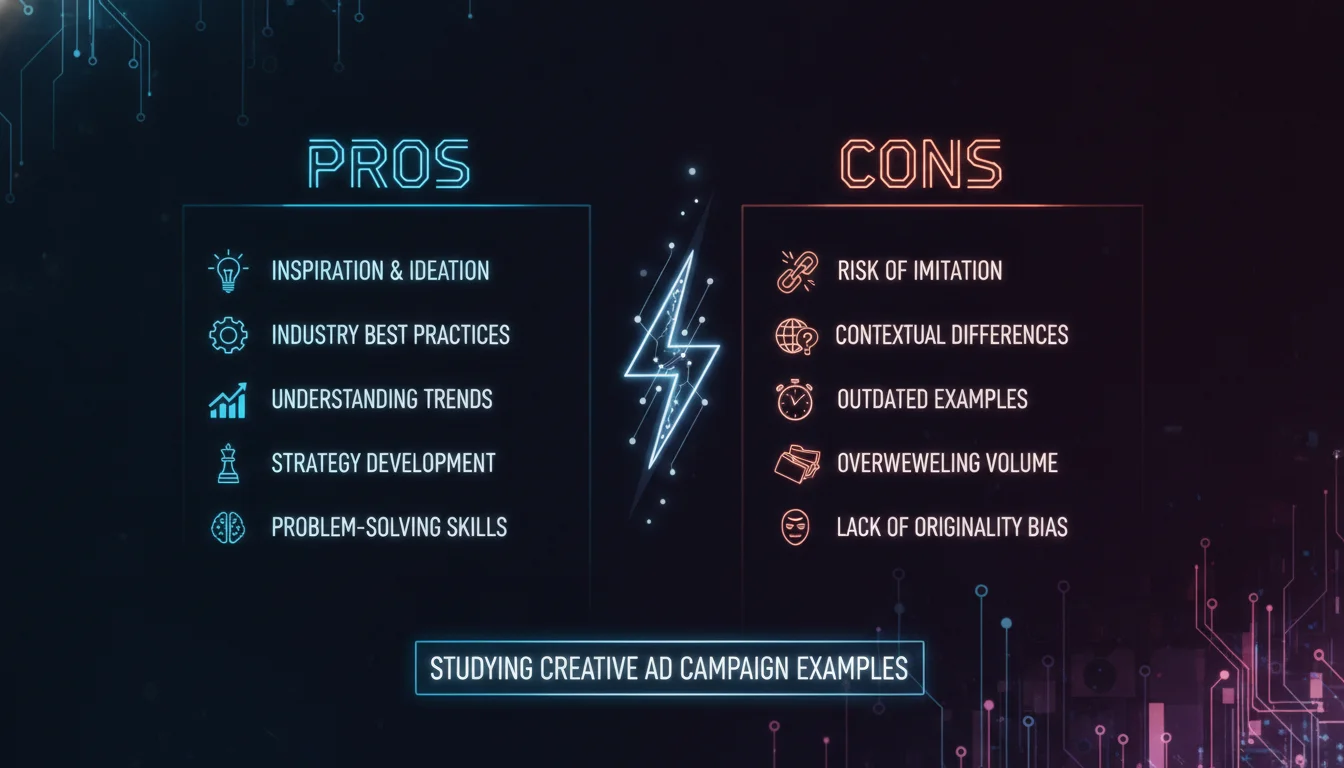
Pros
- Reveals repeatable patterns across formats, budgets, and industries
- Reduces creative risk by grounding new ideas in proven strategic logic
- Helps teams align on what “great” looks like before a brief is written
- Exposes channel-specific craft that generic marketing advice misses
Cons
- Risk of imitation over genuine insight if examples are copied rather than studied
- Iconic campaigns can set unrealistic budget expectations for smaller teams
- Recency bias: chasing 2026 trends can distract from timeless strategic principles
Standout Creative Ad Campaign Examples from 2025 and 2026
DuckDuckGo’s contrarian answer to AI glasses
One of the most talked-about the ad campaign examples in recent months is DuckDuckGo’s launch of “Normal F***ing Sunglasses.” Famous Campaigns lists the work among its trending campaigns, and the logic is immediate: while technology brands race to put screens on faces, DuckDuckGo – a privacy-focused search engine – offers the opposite. The product is a pair of sunglasses with no camera, no microphone, and no data collection.
The campaign works because it uses contrarian positioning. Contrarian positioning is a strategy where a brand deliberately states the opposite of category norms to stand out. By naming the product with profanity and pairing it with a deadpan visual identity, DuckDuckGo makes privacy feel like a cultural stance rather than a technical feature. This is a strong example of how brand voice and product truth can align.
Specsavers uses pop nostalgia to drive hearing checks
Specsavers, a UK optical and audiology brand, recruited British electronic duo Groove Armada to get Gen X to check their hearing. The campaign, highlighted by Famous Campaigns, taps into the audience’s own music nostalgia. The message is simple: if the songs you loved decades ago still sound muddy, it is probably time for a hearing test.
What makes this a standout among examples is the demographic precision. Rather than using a generic health warning, Specsavers borrowed the voice of a band Gen X already trusts. That alignment between the messenger and the audience reduces resistance and makes a routine health action feel culturally familiar.
Burger King turns sunburn into flame-grilled advertising
Burger King found a seasonal insight: summer sunburn looks a lot like the char marks on a flame-grilled burger. The campaign “Leave The Flame Grilling To Us” gave summer sunburn a humorous twist, as documented by Campaigns of the World. The work appeared across OOH and social, using the visual language of red, peeling skin to sell the brand’s cooking method.
This is a textbook example of turning a product truth into a seasonal cultural moment. Burger King’s creative ad repeatedly show how a simple visual equivalence – sunburn equals flame-grilled – can carry a campaign without over-explaining.
ChatGPT’s first brand campaign goes warm, not sci-fi
OpenAI launched ChatGPT’s first major brand push in 2025 by doing the opposite of what most expected. Rather than leaning into futuristic imagery, the campaign highlighted relatable, everyday moments where AI plays a helpful role: planning a trip, fixing a tricky recipe, helping at work. As StoryChief documented, the campaign repositioned a technology product through emotional context rather than technical capability. It is a strong reminder that even the most complex products benefit from human-scale storytelling.
Experiential and Out-of-Home Creative Ad Campaign Examples

Netflix traps a man above Sunset Boulevard
Netflix created a live billboard activation above Sunset Boulevard in Los Angeles, trapping a man in the structure to promote one of its entertainment titles. The stunt, covered by Famous Campaigns as experiential and OOH, works because it turns a static medium into a live performance. Passersby stop, film, and share – exactly the behavior the brand wants.
Out-of-home advertising (OOH) is any paid brand message placed in public spaces, including billboards, transit, and site-specific installations. Netflix’s activation demonstrates that OOH does not have to be static. When the location and the execution are inseparable, the medium becomes the message.
Carlsberg makes posters playable
Carlsberg transformed outdoor posters into playable football goals. The “Goal Posters” campaign, featured by Campaigns of the World, invites people to kick a ball at the poster and attempt to score. The experience is physical, immediate, and highly shareable.
This campaign is a leading example of how experiential OOH can convert a passive viewer into an active participant. It also shows the value of tying the brand to a passion point. Carlsberg is not just advertising during football season. It is making the advertising part of the game itself.
WWF uses showroom screens as a wildfire warning
WWF’s “Fire On Display” campaign turned television showrooms into a wake-up call for wildfires. As documented by Campaigns of the World, the installation used the screens already on display to simulate the look of a wildfire spreading across wall after wall. The result is a public service message that hijacks a familiar retail environment to deliver an urgent environmental warning.
This is one of the most effective cause-related campaign examples because it uses existing infrastructure rather than buying new attention. A strong idea can borrow context from the world and make a serious message impossible to ignore.
Small-Budget Campaigns That Rival Big-Budget Ideas
Mr. Submarine’s 50 commercials for 50 years
Chicago sub shop Mr. Submarine and its agency Quality Meats produced 50 commercials to celebrate 50 years in business. Writing on Medium, creative director John Kovacevich ranked this campaign at the top of his 2025 list, describing it as a “mixed bag of nostalgia, creativity, and chaos.” The key to pulling it off: a client that said “do whatever you want” and a production process that allowed for “no notes.”
The lesson for marketers is that volume and permission can outweigh polish. When a local brand embraces a low-fi, DIY style and local references, it creates authenticity that a highly produced spot cannot fake. This is one of the most repeatable creative ad campaign examples for businesses with limited budgets.
TD’s contextual billboards turn location into media
TD, a Canadian bank, wanted to promote its investing services without using the logos of desirable brands. Working with Ogilvy Toronto, the campaign placed billboards next to recognizable storefronts so the location supplied the context. The line “own a piece of it” did the rest. Kovacevich praised the legal team for allowing the idea forward and noted the smart practice of photographing the installations for social media.
This campaign demonstrates that a media plan is part of the creative idea. The placement, not the headline alone, delivers the message. Context is a creative medium – and sometimes the most persuasive one.
Polaroid helps audiences choose analog
Polaroid’s “The Best Of Summer Is Analog” campaign makes a case for living offline. The work, highlighted by Campaigns of the World, leans into the brand’s core identity: tangible, imperfect, and nostalgic. Instead of competing with high-definition smartphone cameras, Polaroid celebrates grain, light leaks, and the delayed gratification of a physical print.
For niche or heritage brands, creative ad campaign examples like Polaroid show that the strongest position is often the one only you can occupy. Lean into your difference rather than chasing the mainstream.
Iconic Campaigns That Still Define the Craft
Apple’s “1984” and the single-airing strategy
Apple’s “1984” launched the Macintosh with a dystopian Super Bowl film directed by Ridley Scott. According to the American Marketing Association, the ad aired just once during the Super Bowl and broke every advertising convention at the time: no product shots, no features – just a bold narrative that aligned Apple with freedom, creativity, and rebellion against IBM’s dominance.
The campaign remains a benchmark because it took a real risk. It did not explain what the Macintosh could do. It told a story about what the brand stood for. That alignment between narrative and values is still the foundation of the most memorable creative ad campaign examples.
Nike’s “Just Do It” as a universal platform
Nike launched its “Just Do It” slogan in 1988. The first commercial featured 80-year-old marathoner Walt “Iron Man” Stack jogging across the Golden Gate Bridge, according to the American Marketing Association. The ad connected with everyone from casual joggers to professionals by highlighting the universal desire to push limits and overcome challenges.
The brilliance of the platform is its simplicity. A platform idea is a central creative concept broad enough to support multiple executions over time. “Just Do It” did not describe a product. It described a mindset. That is why the campaign is still usable decades later, while most product-focused taglines expire.
Old Spice’s real-time response engine
Old Spice revitalized its brand in 2010 with “The Man Your Man Could Smell Like,” starring Isaiah Mustafa. The ad’s absurd humor, sharp writing, and charismatic delivery made it a viral sensation, according to the American Marketing Association. The campaign went further by creating follow-up videos that directly responded to fans’ social media comments.
This real-time response loop set a new standard for audience engagement. It proved that the conversation after the ad can be as valuable as the ad itself. Modern social and creator-led strategies still borrow from this playbook.
“The best campaigns of the past 12 to 18 months did not rely on one clever ad. They paired strong creative ideas with smart distribution, cultural timing, and simple ways for people to join in.” – StoryChief, 2026
How to Compare and Select a Campaign Format
A comparison table of campaign types
The table below summarizes six recurring formats found across the best creative ad campaign examples, along with when to use each and the primary lesson they teach.
| Campaign Format | Best Use Case | Example Campaign | Key Lesson |
|---|---|---|---|
| Cinematic TV or Film | Broad emotional storytelling at launch | Apple’s “1984” | One hero narrative can define a brand |
| Experiential OOH | Physical participation and social proof | Carlsberg Goal Posters | Turn media into utility |
| Real-Time Social Response | Conversation, humor, and engagement | Old Spice response videos | Speed and personality win attention |
| Local or DIY Volume | Budget-limited authenticity | Mr. Submarine’s 50 spots | Permission and volume can replace polish |
| Celebrity or Music Nostalgia | Demographic-specific relevance | Specsavers + Groove Armada | Match the messenger to the audience |
| Contrarian Positioning | Category differentiation | DuckDuckGo sunglasses | State the opposite to stand out |
Selecting the right format for your objective
Start with the business problem, not the format. If the goal is to launch a new product against an entrenched competitor, a contrarian or iconic narrative may work. If the goal is to drive foot traffic or local sales, a DIY volume campaign may outperform a polished national spot. The most effective creative ad campaign examples are those where the format is dictated by the objective and the audience’s context, not by what is trending.
Budgets also matter. A small team can execute a contextual billboard or a 50-spot local series. It cannot execute a Ridley Scott Super Bowl film. The range of recent work proves that creativity is not a function of spend. It is a function of choosing the right constraint and turning it into a feature.
A Step-by-Step Process for Developing Your Own Creative Ad Campaign
Step 1: Define the business problem before the creative idea
Step 1: Write down the specific behavior you need to change. Are you launching a new product, reactivating lapsed customers, or repositioning against a rival? According to Heyflow, a digital advertising campaign is a strategic plan to promote a product, service, or brand through a series of online advertisements. The creative idea follows the objective, not the other way around.
Step 2: Find a specific audience tension
Step 2: Look for a contradiction in your audience’s life. Specsavers found Gen X nostalgic for their music but reluctant to acknowledge hearing loss. Burger King found sunburn as a visual twin of flame-grilling. These tensions are the raw material for creative ad campaign examples that feel inevitable in hindsight.
Step 3: Choose a format that matches the channel
Step 3: Decide where the audience will meet the idea. A playable football goal belongs on a poster, not in a pre-roll. A real-time response belongs on social platforms, not a static billboard. The format and channel should be one decision, not two.
Step 4: Prototype, test, and refine against a measure
Step 4: Build a low-fidelity version of the idea and test it with a small audience. Measure recall, shareability, and message clarity before scaling. The best campaigns often start rough – Mr. Submarine’s 50 spots were deliberately low-fi – but the insight and execution remain clear. Refine what does not land, then invest in the version that does.
The Value of Studying Creative Ad Campaign Examples
These campaigns are not just inspiration. They are evidence. Across 2025 and 2026, the work that broke through – from DuckDuckGo’s profane sunglasses to WWF’s wildfire showroom – did so because it understood its audience, committed to a sharp insight, and chose a format that matched the message. The iconic work of Apple, Nike, and Old Spice still teaches the same fundamentals decades later.
The next step is to apply the patterns. Define the business problem, find a tension, select a format, and test before scaling. Whether you are a B2B marketer launching a lead-gen push or a B2C brand building cultural relevance, the principle is the same: make the ad worth the audience’s attention, and the attention will do the rest.
Ready to build something bold? Contact Emin Media for a free brand consultation and let’s turn your next brief into a campaign worth remembering.
Frequently Asked Questions
What are creative ad campaign examples?
Creative ad campaign examples are real-world executions that break category conventions and earn attention through insight, craft, or cultural timing. They serve as study material for marketers who want to understand how strategy and creativity connect to produce measurable results.
Which 2026 campaigns are most creative?
Standouts include DuckDuckGo’s “Normal F***ing Sunglasses,” Burger King’s flame-grilled sunburn work, Carlsberg’s playable Goal Posters, and WWF’s wildfire showroom takeover. Each uses a distinct format and a clear audience tension to earn attention without simply buying it.
How do small brands create effective campaigns?
Small brands can succeed by choosing a narrow audience, using local references, and producing volume over polish. Mr. Submarine’s 50 commercials for 50 years is a strong example of how low-budget authenticity can outperform a highly produced national spot.
What makes an ad campaign iconic?
An iconic campaign usually combines a simple universal truth, a distinctive creative execution, and alignment with the brand’s values. Apple’s “1984” and Nike’s “Just Do It” endure because they are about mindsets, not product features.
What is the difference between a creative ad campaign and a one-off ad?
A creative ad campaign is a coordinated series of ads built around one central idea, while a one-off ad is a single execution with no thematic connective tissue. Campaigns are more durable, easier to measure over time, and far more likely to build lasting brand recognition.
Enjoyed this article?
Contact Emin Media for a free brand consultation and let's create something amazing together.
Get in TouchRelated Articles
Digital Storytelling for Brands: The Complete Guide
Digital storytelling for brands builds real audience connections through narrative. Learn proven techniques, formats, and…
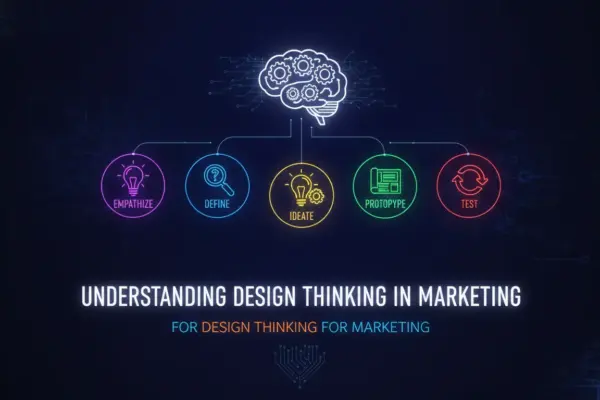
Design Thinking for Marketing: A 2026 Guide
Design thinking for marketing builds campaigns around real user needs. Learn the 5 phases, common…
Creative Direction for Video Shoots: A Complete Guide
Master creative direction for video shoots with proven steps, tools, and strategies that build brand…