Corporate Video Production: The Complete 2026 Guide
Corporate video production is the strategic process of planning, filming, and editing business videos, from brand films to product demos, to build trust and drive growth. Marketers who invest in video see revenue grow roughly 49% faster than those who don’t, according to Vidyard.
Key Takeaways
- video production combines strategy, filming, and editing into one connected system, not a single job.
- Marketers who use video grow revenue roughly 49% faster than non-video users, according to Vidyard’s research.
- Six primary project types cover everything from testimonials to live event coverage and product demos.
- A structured 5-step process keeps every shoot on-brand and tied to measurable ROI.
- As of 2026, AI-assisted editing and purpose-driven storytelling are reshaping how brands approach this type of production.
- Full-service agencies can now deliver finished videos in as little as four weeks, compared to 8-12 weeks for complex projects.
What Is Corporate Video Production?
Definition and Scope
this kind of production is the full process of planning, filming, and editing content that serves a business’s internal or external communication goals. It’s less about pretty footage and more about solving a business problem on camera. Unlike a consumer ad chasing mass appeal, corporate video speaks to a defined audience: employees, investors, recruits, or B2B buyers, through formats like training modules, brand films, and product demos.
Corporate Videography vs. Corporate Video Production
Corporate videography and corporate video overlap but aren’t interchangeable. Videography is the on-site capture, a person behind the camera managing lighting, framing, and sound for a few hours. video production is the whole engine: strategy, scriptwriting, storyboarding, location scouting, talent direction, editing, motion graphics, and multi-channel distribution.
Think of it this way: if you need someone to point a camera at a CEO for a quick internal update, you need a videographer. If you’re building a brand film meant to carry your company’s voice across YouTube, sales decks, and trade show floors for the next two years, you need a full production team behind it.
Why It Matters in 2026
Video has become the default language of business communication, and the gap between companies that use it well and those that don’t keeps widening. Marketers who lean into video consistently outperform those who treat it as an afterthought, growing revenue roughly 49% faster according to Vidyard. Meanwhile, IBISWorld reports the media production industry has grown steadily through 2025 and into 2026, fueled by enterprise appetite for professional video content.
“Video isn’t a marketing line item anymore, it’s how companies build trust before a single sales call happens.” This shift is why brand research consistently shows video-first companies close deals faster and retain talent longer.
Types of Corporate Video Projects
What are the main types of corporate video?
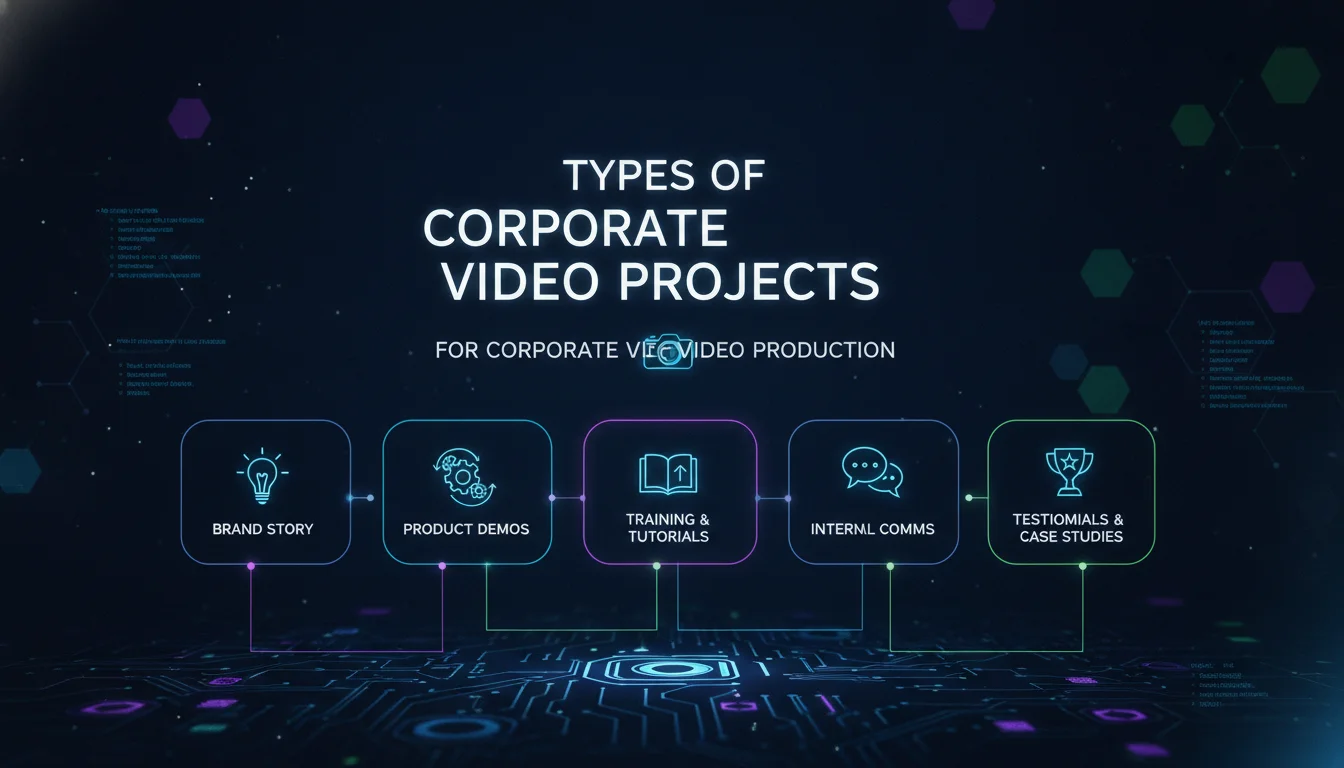
The six primary types are brand and promotional videos, event coverage, testimonials, internal and training content, culture and recruitment videos, and product demos or explainers. Each one plays a distinct role depending on where your audience sits in the funnel.
Brand and Promotional Videos
These are your flagship assets, the ones that articulate mission, values, or a campaign message with real visual ambition. They live on your website, YouTube channel, and paid social feeds. A well-produced brand video builds emotional connection and staying power, while a promotional video pushes a time-bound offer or product launch across the finish line.
Testimonial and Customer Story Videos
Nothing sells credibility like a real client talking on camera. Testimonial videos capture authentic experience and perform well as bottom-funnel content. They typically run 60 to 90 seconds and get repurposed constantly, on landing pages, in email signatures, inside sales decks.
Training, Internal Communications, and Culture
This bucket covers onboarding, safety training, leadership messaging, and culture videos. Training content cuts down on repetitive live sessions and keeps knowledge transfer consistent across teams and locations. Culture and recruitment videos show real workplace moments, which matters when you’re trying to win talent on LinkedIn against a hundred other job posts.
The 5-Step Corporate Video Production Process
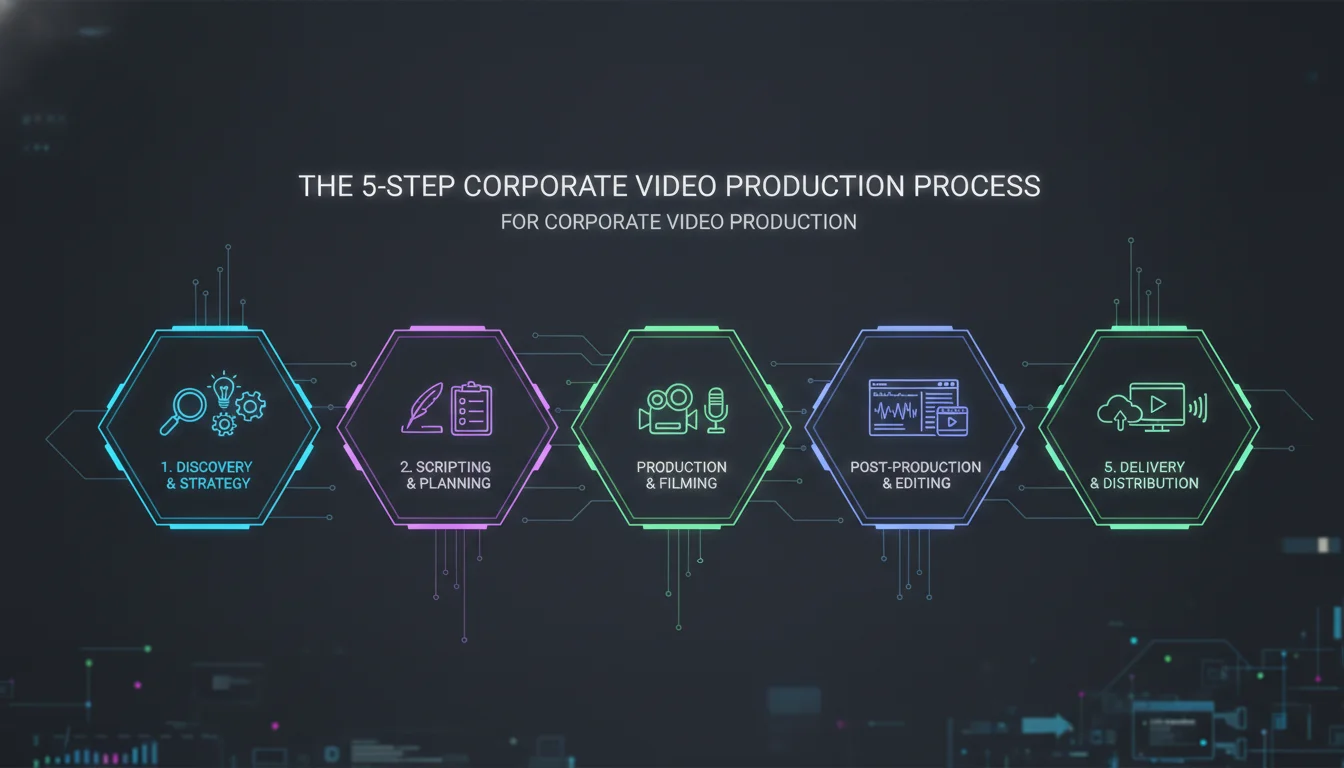
Step 1: Define Goals and Audience
Every strong project starts by locking down the objective, the target audience, the core message, and how success gets measured. This phase usually involves a creative brief, competitor analysis, and a round of stakeholder interviews to get everyone aligned before a single shot is planned.
Step 2: Build the Pre-Production Plan
Scriptwriting, storyboarding, location scouting, casting, and scheduling all happen here. A tight pre-production plan is what prevents an expensive scramble on shoot day. The deliverable is essentially a production bible, the document that keeps everyone, from director to client, working from the same playbook.
Step 3: Film On-Site
Professional crews bring cinema-grade cameras, lighting, and audio gear to capture every shot on the plan. A director guides talent while a producer keeps the day moving on schedule. Complex shoots with multiple locations or large casts can stretch across several days.
Step 4: Edit in Post-Production
Editors assemble footage, layer in motion graphics, color-grade, and mix audio until the story feels tight. Most projects go through two to three rounds of client revisions before landing on a final cut. That final edit gets rendered in the right format for its destination, 16:9 for YouTube, 1:1 or 9:16 for Instagram and TikTok.
Step 5: Distribute and Track Performance
The finished video gets exported and published across chosen channels: website embed, YouTube, social platforms, email campaigns, or internal portals. Sharper teams set up tracking pixels and UTM parameters to measure views, engagement, and conversions, feeding those insights straight back into the next this type of production cycle.
Key Benefits of Professional Corporate Video Production
Does corporate video actually drive revenue?
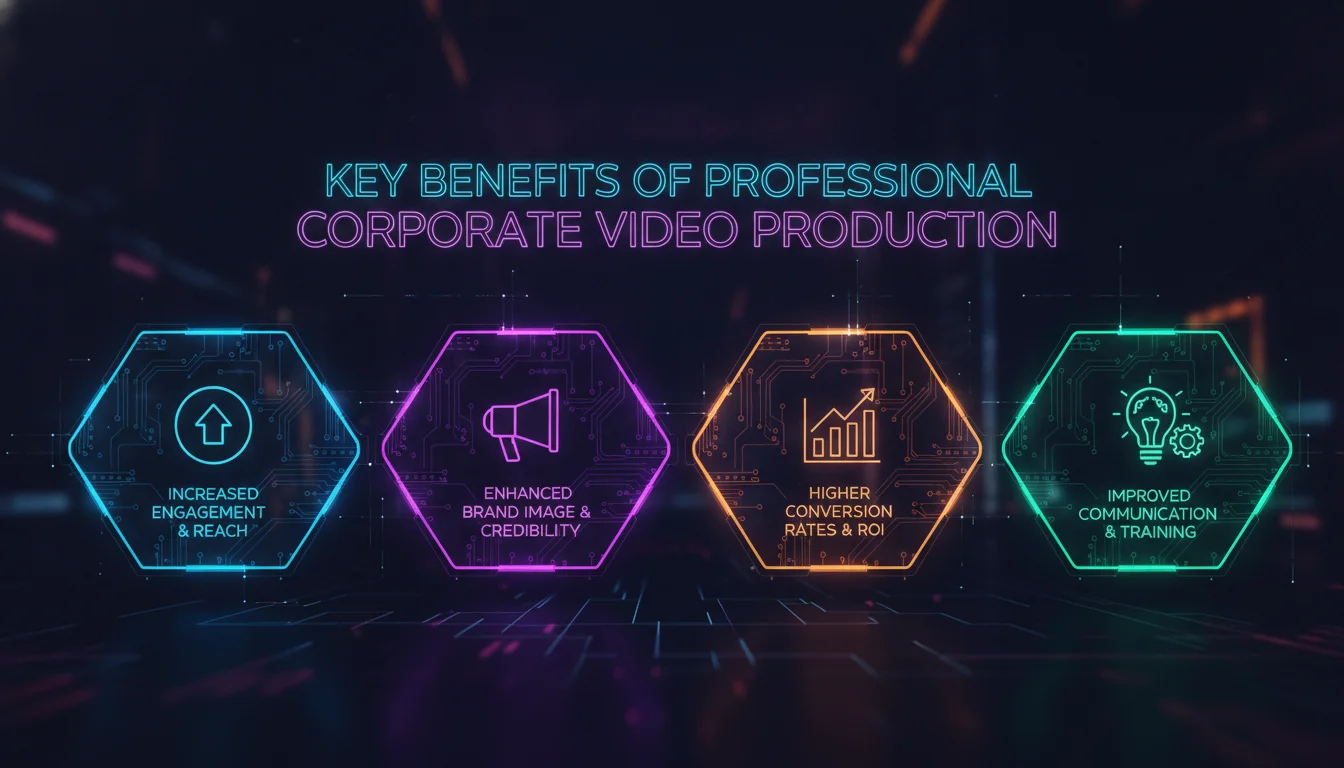
Yes, companies that treat video as a strategic asset rather than a one-off expense see real, compounding returns. The 49% faster revenue growth figure from Vidyard’s research reflects what happens when brands commit to video as an ongoing channel instead of a single campaign push, higher engagement, shorter sales cycles, and more qualified leads entering the pipeline.
Enhanced Brand Perception and Trust
High-quality production signals competence before a prospect ever picks up the phone. A polished video elevates how partners, prospects, and even your own employees perceive the brand, while shaky, amateur footage quietly erodes credibility. Visual polish is a trust signal now, not a luxury.
Scalable, Multi-Channel Reach
One well-crafted video can be repurposed across five major channels: YouTube, website embed, office lobby displays, email signatures, and trade show screens. That reach means a single production budget stretches across external marketing and internal communication at the same time.
Distribution Channels for Maximum Impact
Where should you distribute a corporate video?
The strongest results come from combining owned, earned, and internal channels rather than relying on one platform. Website embeds, social media, and internal hubs each serve a different part of the buyer or employee journey.
Website Embeds and Landing Pages
Placing a corporate video above the fold on a homepage or product page tends to keep visitors on-site longer and increases engagement with surrounding content. A responsive HTML5 player ensures smooth playback whether someone’s on a laptop or scrolling on their phone during a commute.
Social Media Platforms
LinkedIn, Instagram, and YouTube remain the top organic channels for B2B corporate content as of 2026. Paid promotion on LinkedIn and targeted video ads on YouTube extend reach to precisely defined audiences. Each platform has its own preferred aspect ratio and caption style, so plan your edits with that in mind rather than force-fitting one master file everywhere.
Internal Hubs and Live Events
For internal communications, video circulates through company intranets, Slack channels, and digital signage in break rooms or lobbies. At trade shows, a looping brand film on a large screen pulls booth visitors in and reinforces messaging without requiring a live demo every single minute.
How to Choose a Corporate Video Production Company
What should you look for in a corporate video production company?
Look for versatility, a clear process, and proof of results, not just a flashy showreel. A company that can produce sleek 3D explainers, documentary-style testimonials, and live event coverage with equal polish is far more valuable than one that’s a one-trick pony.
Evaluating Portfolios and Style
Review case studies as closely as the showreel itself. Their past work should already feel aligned with your brand’s visual identity, not something you’d need to force into your world after the fact.
Understanding Pricing Models
Pricing varies widely based on video length, production style, and team size. Some agencies charge per finished minute, others price by project. When comparing quotes, ask exactly what’s included: scriptwriting, actors, sets, music licensing, and revision rounds. Full-service this kind of production companies often deliver a more turnkey experience with faster timelines, sometimes as little as four weeks from brief to final file.
Key Questions to Ask
- Can you walk me through your typical production process?
- Who will be the day-to-day project manager?
- Do you provide a detailed timeline with milestones?
- What metrics do you track to prove ROI?
- How do you handle rights and licensing for music, stock footage, and talent?
Corporate Video Production Costs in 2026
How much does corporate video production cost?
Costs typically range from a few thousand dollars for a simple interview-style shoot to $50,000 or more for a high-end brand film with animation and multiple locations. The final number depends on length, production style, crew size, and location expenses.
Factors That Influence Cost
Variables include video length, production style (live-action, animation, or a mix of both), number of shoot days, crew size, need for specialized equipment like drones or gimbals, and post-production complexity such as 3D modeling or heavy VFX work. Travel, location permits, and talent fees add to the budget fast if they’re not planned for early.
Comparing Full-Service, Freelance, and In-House
| Factor | Full-Service Agency | Freelancer | In-House Team |
|---|---|---|---|
| Upfront cost | High | Low-medium | Very high (salaries, gear) |
| Expertise breadth | Specialists in every role | Varies; often one-person band | Limited to hires |
| Turnaround | As fast as 4 weeks | 2-4 weeks, but dependent on one person | 2-8 weeks, depending on bandwidth |
| Quality consistency | High, with robust QA | Inconsistent; tied to individual | Dependent on team skill |
| Best for | Brand films, complex projects | Simple event recaps, low-budget needs | High-volume, quick-turnaround content |
Maximizing Your Budget
Start by aligning every decision with a strategy-first approach instead of chasing the cheapest quote. Repurpose footage into multiple asset lengths, a 2-minute master version, a 60-second social teaser, and a 15-second clip for Reels or TikTok. Batching filming into a single production day also spreads setup costs across more deliverables, which stretches the budget considerably further.
2026 Trends Reshaping Corporate Video Production
What trends are shaping corporate video production in 2026?
AI-assisted editing, purpose-driven storytelling, and interactive video formats are the three biggest shifts happening right now. Each one is changing not just how videos get made, but what audiences expect from them.
AI-Assisted Video Creation
AI tools now speed up script drafting, auto-transcription, and even rough-cut editing. Generative AI can produce on-brand motion graphics in minutes rather than hours, while AI-powered analytics help teams identify which cuts perform best with different audience segments. This year, we’re seeing more agencies fold these tools into pre-production, not just post.
Sustainability and Purpose-Driven Storytelling
Brands increasingly use corporate video to document ESG efforts, carbon-neutral operations, and community impact work. Creative industry data shows that storytelling connecting profit with purpose resonates with both values-driven consumers and employees who want to work somewhere that stands for something. It’s not a trend you can fake convincingly on camera, either the substance is there or it isn’t.
Interactive and Shoppable Videos
Interactive hotspots let viewers click within the player to pull up product specs, download a PDF, or add an item to cart mid-watch. This blurs the line between brand storytelling and direct conversion, and platforms like YouTube and Vimeo continue expanding support for these formats.
According to HubSpot’s marketing research, video content consistently outperforms static formats for engagement across nearly every major social platform, a pattern that’s held steady for several years running.
Pros and Cons of Investing in Corporate Video Production
Pros
- Builds trust and credibility faster than text or static images alone
- Repurposes across five or more channels from a single production budget
- Improves training consistency and reduces repetitive live sessions
- Strengthens recruitment by showing authentic culture and workplace moments
- Supports measurable ROI tracking through UTM parameters and analytics
Cons
- Upfront costs can run high, especially for animation-heavy or multi-location shoots
- Full-service production timelines can stretch to 8-12 weeks for complex projects
- Quality varies significantly between freelancers, in-house teams, and agencies
- Requires ongoing investment to stay effective rather than a single one-off video
Frequently Asked Questions
What is corporate video production?
corporate video is the full process of creating video content for a business, covering strategy, scripting, filming, editing, and distribution, to achieve marketing, training, or communication goals. It’s a system, not a single deliverable.
How much does corporate video production cost?
Costs range from a few thousand dollars for a simple interview shoot to $50,000 or more for a high-end brand film. Length, animation complexity, crew size, and location expenses all factor into the final number.
How much does it cost to hire a video production company?
Hiring a full-service corporate video production company typically starts around $5,000 to $15,000 for a short promotional video. Retainer agreements for ongoing content can lower the per-video cost over time.
What are the most common types of corporate videos?
Brand films, testimonials, training videos, product demos, event recaps, and culture or recruitment pieces are the six most common types. Each one serves a distinct purpose depending on where the audience sits in the funnel.
How long does a corporate video take to produce?
A streamlined full-service agency can deliver a finished video in as little as four weeks. Complex projects involving animation, multiple shoot locations, or extensive stakeholder reviews may take 8 to 12 weeks.
Ready to turn your company’s story into something people actually remember? Contact Emin Media for a free brand consultation, and let’s build something bold together.
Enjoyed this article?
Contact Emin Media for a free brand consultation and let's create something amazing together.
Get in TouchRelated Articles
Digital Marketing for Creatives: A Bold Guide
Digital marketing for creatives builds real visibility and sales. Learn strategies for social media, SEO,…
Branding & Design Agency Tips That Actually Work
Discover branding and design agency tips to choose the right partner, set clear goals, and…

Creative Agency Pitch Deck Tips That Win Clients
Master creative agency pitch deck tips that win clients in 2026. Learn storytelling, design, and…