Branding vs Marketing Strategy: What’s the Real Difference?
Key Takeaways
- Branding strategy defines who you are, your purpose, values, and the perception you want in customers’ minds.
- Marketing strategy covers the tactics and campaigns used to promote your brand, reach audiences, and drive conversions.
- Branding vs marketing strategy isn’t a competition. They’re interdependent, and the best companies build both at once.
- Branding plays the long game while marketing chases short- to medium-term wins.
- Integrating branding and marketing strategy creates a consistent customer experience that builds trust and loyalty.
- A clear brand strategy sharpens marketing effectiveness by giving every channel the same story to tell.
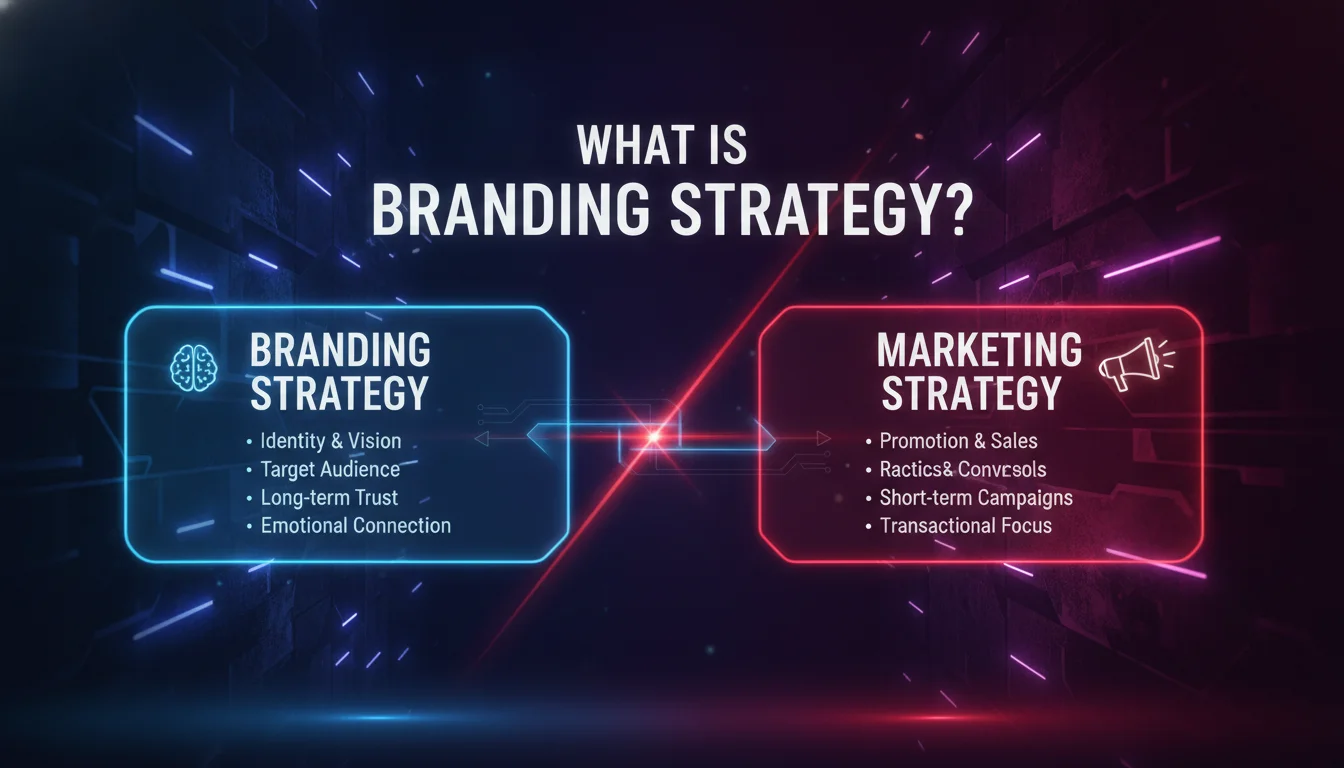
Branding vs marketing strategy is a comparison between defining your business‘s identity and executing the campaigns that promote it. One builds meaning, the other builds momentum, and together they shape the customer experience.
What Is Branding Strategy?
Definition and Core Components
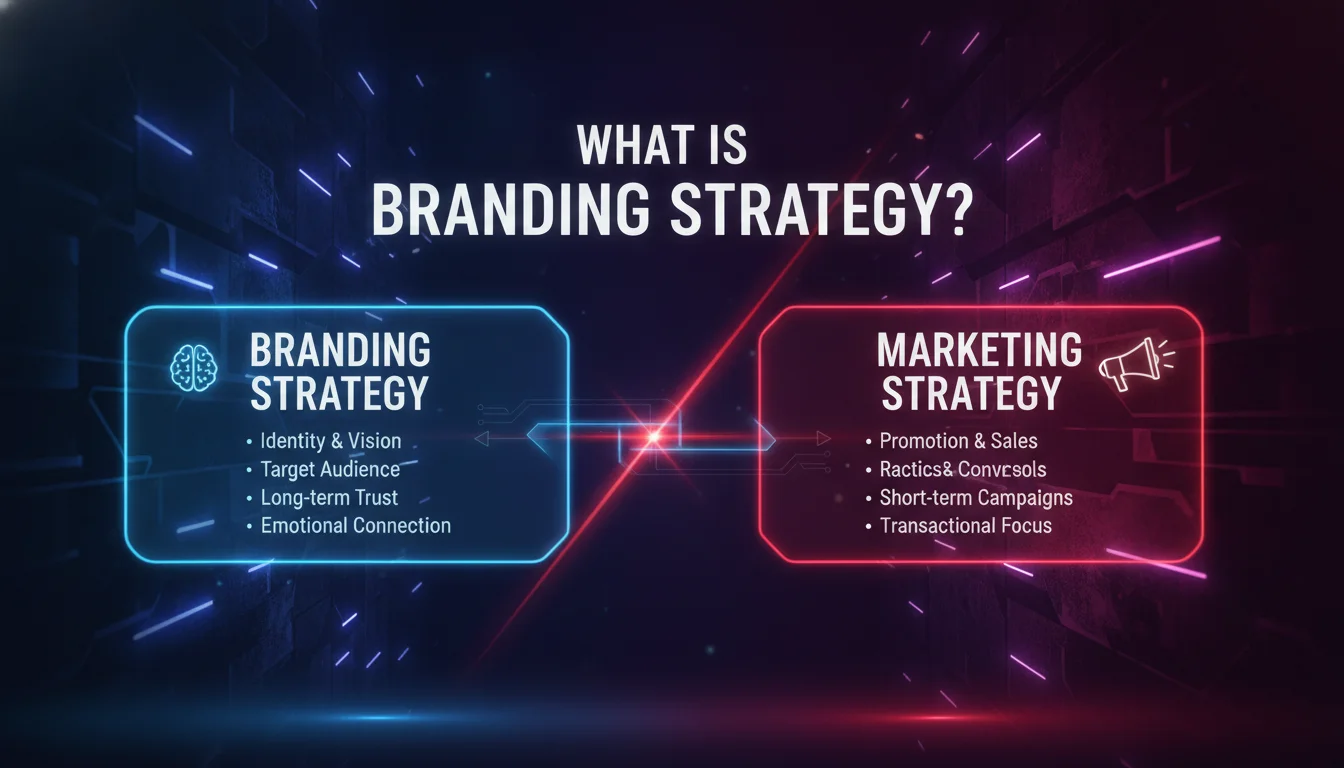
Branding strategy is the plan that shapes how your business gets perceived by the people you want to reach. It goes beyond a logo or color palette to cover purpose, mission, values, and personality. According to Kantar, branding is “the activity of connecting a product with a particular name, symbol, etc. or with particular features or ideas, in order to make people recognize it and want to buy it.” This foundation answers the questions that matter most: Why does this company exist? What makes it different? What feeling should customers walk away with?
The core pieces of a branding strategy are purpose, positioning, value proposition, voice and tone, and visual identity. These elements work as a system, not a checklist, creating a consistent brand experience everywhere a customer bumps into you. Indeed built its entire model around a single value, “Job seeker first,” letting that principle guide decisions even when they don’t generate immediate profit. According to CXL, that commitment has helped the platform attract over 250 million job seekers every month.
“Branding is the activity of connecting a product with a particular name, symbol, etc. or with particular features or ideas, in order to make people recognize it and want to buy it.” – Kantar
Pros of a Strong Branding Strategy
- Builds long-term customer loyalty: A well-defined brand creates emotional connection. Brand research from Motto found that 89% of consumers stay loyal to brands that share their values.
- Differentiates from competitors: In a crowded market, a distinct identity makes the choice easier for customers.
- Creates internal alignment: Teams across departments understand the mission, which sharpens decision-making and culture.
- Supports premium pricing: Strong brands can charge more because customers perceive greater value.
- Enhances marketing efficiency: A clear brand makes marketing messages more consistent and resonant, cutting wasted spend.
Cons of Neglecting Branding Strategy
- Inconsistent messaging: Without guidelines, customer communications feel disjointed, and trust erodes.
- Commoditization: The business competes on price alone, an easy target for competitors with stronger identities.
- Difficulty attracting top talent: A weak employer brand makes recruiting and retention harder.
- Limited customer recall: A forgettable brand disappears in a sea of options.
- Vulnerability during crises: Without goodwill in the bank, one setback can do serious damage.
What Is Marketing Strategy?
Definition and Core Components
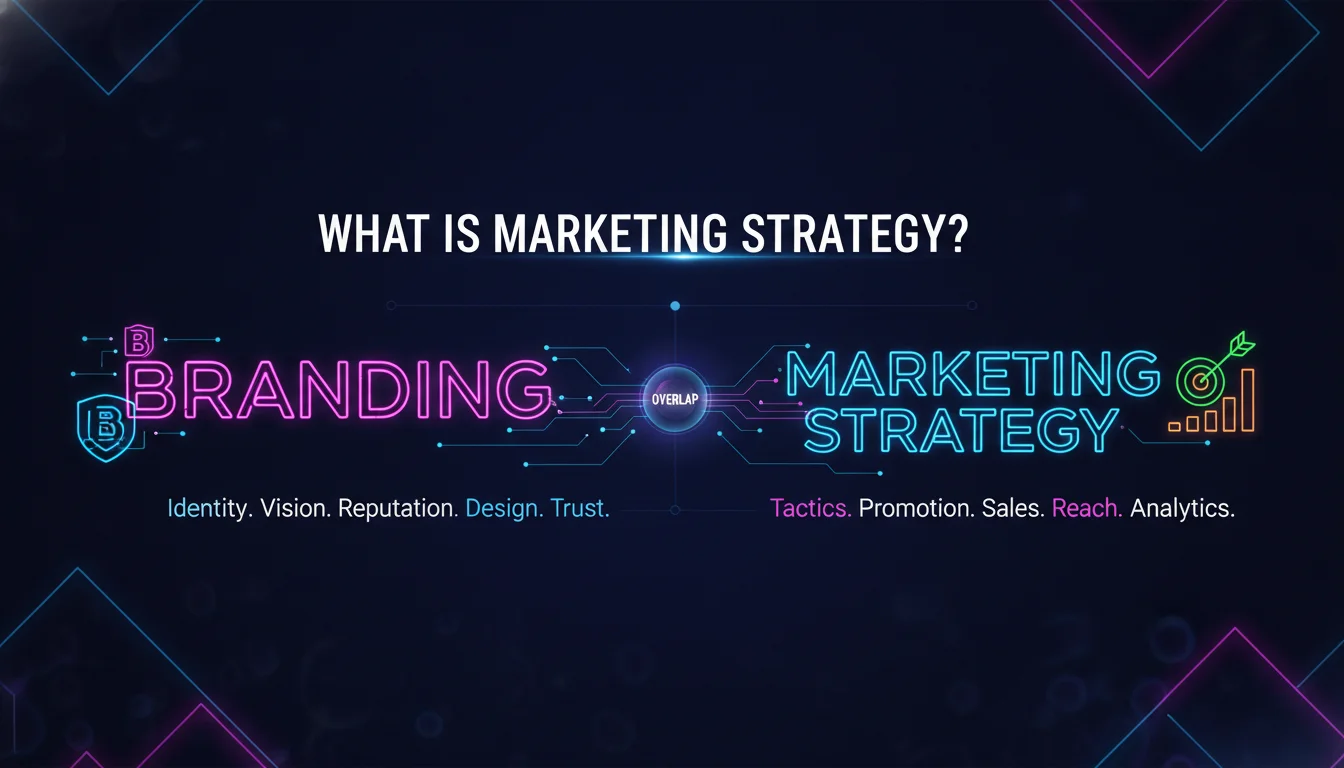
Marketing strategy is the actionable plan for promoting products or services to hit specific goals like sales, leads, or market share. It covers market research, audience segmentation, channel selection, and campaign execution. Marketing is dynamic by nature. It shifts with trends and consumer behavior in ways branding, by design, does not.
Core components include the classic 4 Ps, Product, Price, Place, and Promotion, alongside digital tactics like SEO, social media, content marketing, and email, plus performance metrics like ROI and customer acquisition cost. A strong marketing strategy makes sure the right message reaches the right audience at the right moment. A seasonal promotion, for example, might combine paid ads and email campaigns to drive short-term sales while still reinforcing the bigger brand story.
Pros of a Strong Marketing Strategy
- Drives immediate revenue: A well-executed campaign can boost sales or foot traffic fast.
- Adaptable to market changes: Tactics can shift in real time based on data and feedback.
- Generates measurable results: Click-through rates, conversions, and ROI give you clear accountability.
- Expands reach and awareness: Targeted advertising and content connect brands with new audiences quickly.
- Supports business growth: Consistent marketing fuels lead generation and scales the business.
Cons of Neglecting Marketing Strategy
- Invisible brand: As branding expert Anneli Hansson puts it, “Without marketing, branding is invisible.” A great brand nobody knows about can’t win.
- Missed opportunities: Competitors capture market share simply by showing up more often.
- Stagnation: Without active promotion, growth slows and relevance fades.
- Wasted brand equity: A strong brand left unmarketed is a treasure buried, generating no return.
- Difficulty testing new offers: Marketing creates the feedback loop that refines products and messaging.
Branding vs Marketing Strategy: Key Differences at a Glance
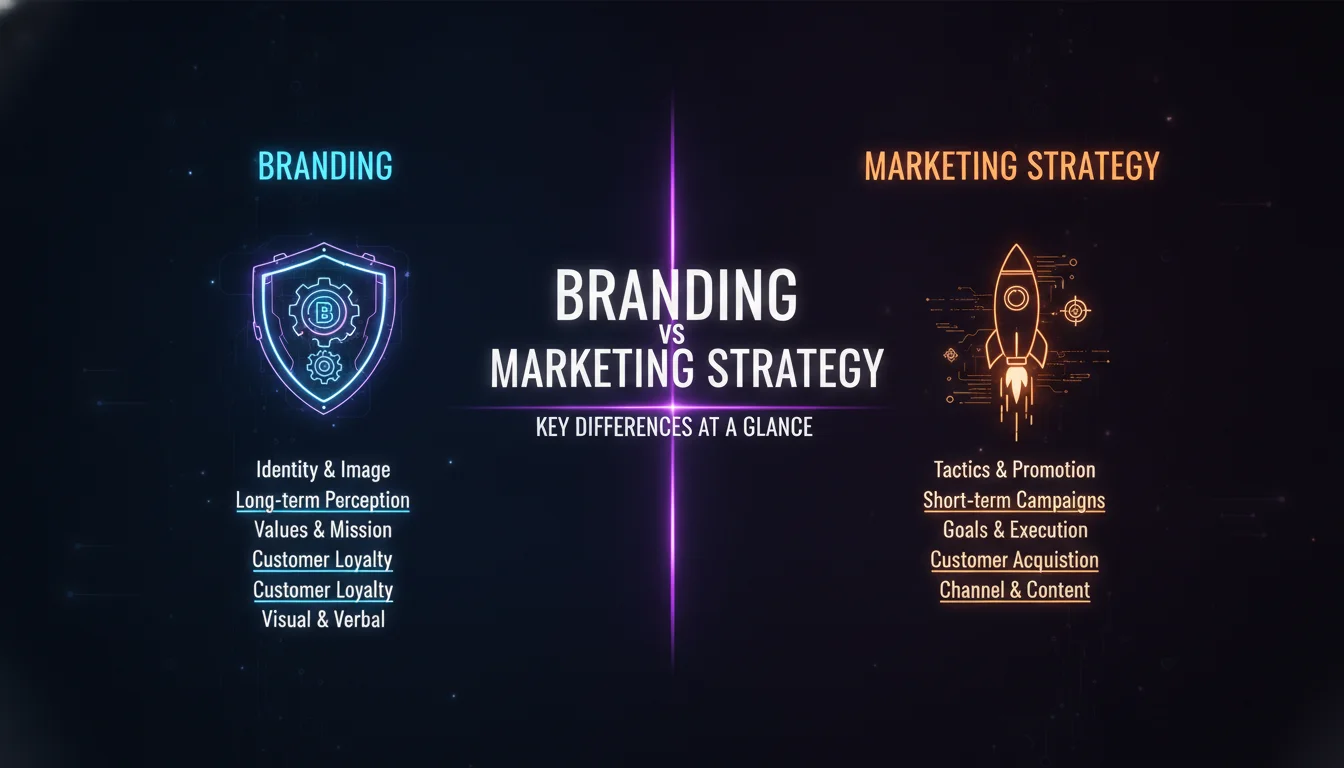
The core difference in branding vs marketing strategy comes down to identity versus action: branding shapes perception over years, marketing drives measurable results over weeks and months. The debate around branding vs marketing strategy often stems from overlapping roles, but each serves a distinct function. The table below breaks down the primary differences across the criteria that matter most.
| Criteria | Branding Strategy | Marketing Strategy |
|---|---|---|
| Primary Focus | Identity, purpose, perception | Promotion, reach, conversions |
| Time Horizon | Long-term (years to decades) | Short- to medium-term (weeks to quarters) |
| Key Metrics | Brand awareness, loyalty (NPS), sentiment | ROI, CAC, leads, sales, traffic |
| Core Activities | Defining values, positioning, visual identity | Advertising, content marketing, SEO, events |
| Outcome | Emotional connection, trust, memorability | Immediate action, revenue, market share |
| Audience Engagement | Builds relationships and community | Encourages transactions and responses |
| Flexibility | Evolves slowly, must stay consistent | Adapts quickly to market changes and data |
Understanding these differences matters when you’re allocating budget and headcount. Treat branding vs marketing strategy as a rivalry instead of a partnership, and you risk diluting your message or leaving growth on the table.
Is Branding a Subset of Marketing?
This gets debated constantly in creative circles, and honestly, there’s no single right answer. Some practitioners argue branding is one piece of the marketing mix (it shows up inside the classic 4 Ps as part of Product and Promotion). Others see branding as the parent discipline, the thing marketing exists to serve. We land somewhere in the middle: branding sets the destination, marketing builds the roads to get there. Whichever framing you prefer, the practical takeaway is the same. Neither function works well in isolation.
How Branding and Marketing Strategy Work Together
Why One Without the Other Fails
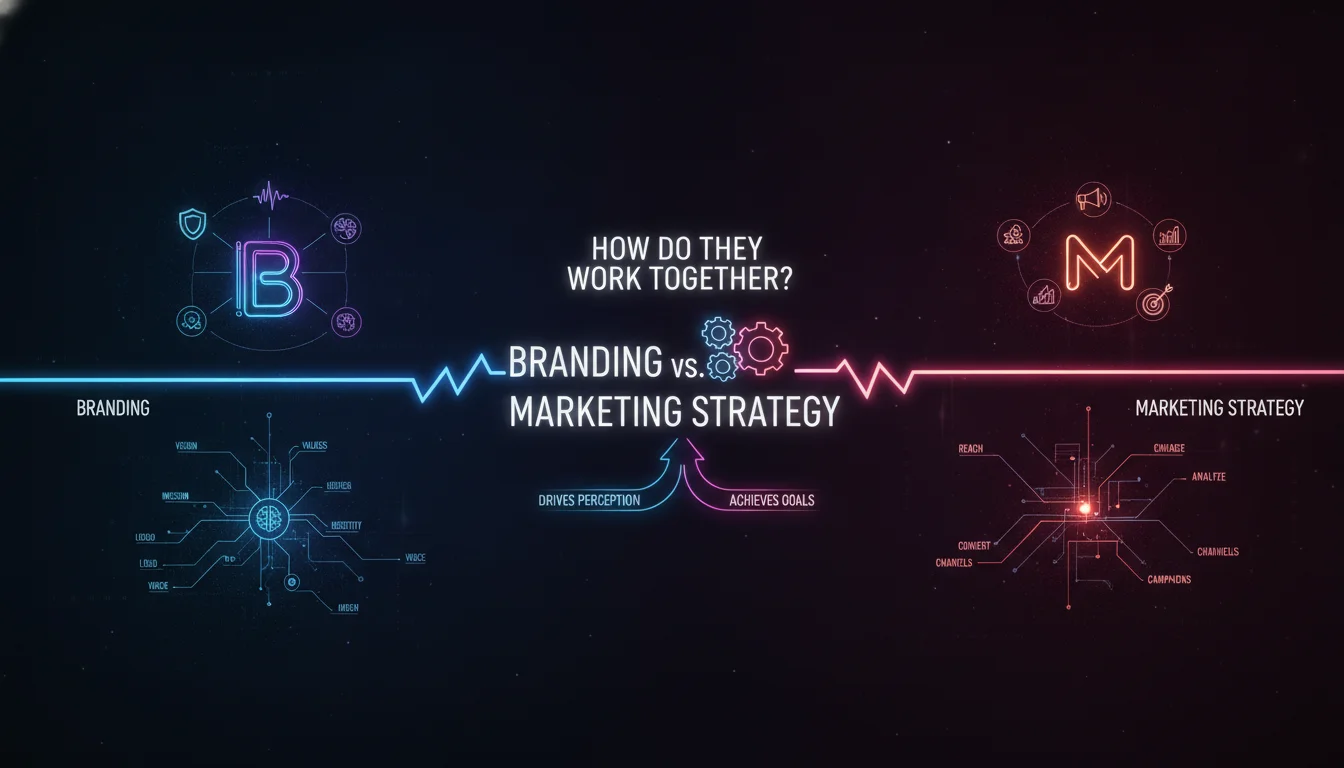
Branding and marketing strategy fail independently because branding without visibility never reaches an audience, and marketing without identity has nothing meaningful to say. Branding expert Anneli Hansson captured it well: “Without branding, marketing is hollow. Without marketing, branding is invisible.” When the two align, they build a flywheel: branding earns trust and differentiation, which makes marketing messages land harder, and marketing amplifies the brand, reinforcing identity through repeated exposure. Per the Edelman Trust Barometer, customer trust ranks as a top buying consideration for over 80% of consumers, according to data cited by Ramotion. That trust gets built through consistent branding and nurtured through targeted marketing.
Disconnect the two, and confusion follows. A campaign promising bargain pricing while the brand stands for premium craft tells customers something’s off. Or a brand with a genuinely inspiring purpose but zero marketing behind it sits at exactly zero awareness. Think of brand strategy as the “why” and marketing strategy as the “how,” and most of the tension disappears.
“Branding is who you are. The brand is people’s perception of you. Branding is shaping the perception. Marketing is how you tell people who you are, what you offer, and get them to engage.” – Anneli Hansson, Chief Branding Officer
A Step-by-Step Framework to Integrate Brand and Marketing
To harmonize branding vs marketing strategy instead of letting them compete for budget, work through this five-step process.
- Step 1: Define your brand core. Nail down purpose, mission, values, and personality. This becomes the foundation every marketing decision builds on.
- Step 2: Translate brand into messaging pillars. Turn your brand essence into a value proposition and key messages people can actually repeat.
- Step 3: Align marketing channels with brand identity. Pick channels that fit your brand’s personality. A buttoned-up B2B brand probably leans into LinkedIn and industry events, while a playful B2C brand shows up on TikTok and Instagram.
- Step 4: Execute campaigns with brand consistency. Every ad, post, and email should reflect your visual identity, voice, and values. Build brand guidelines if you don’t have them yet.
- Step 5: Measure both brand and marketing metrics. Track brand health (awareness, sentiment, loyalty) next to marketing performance (leads, sales, CAC) so you can adjust with a full picture, not half of one.
Follow this framework and you sidestep the classic mistake, disjointed effort, building instead a unified experience that drives short-term wins and long-term equity at the same time.
When to Prioritize Branding vs Marketing Strategy
Deciding whether to prioritize branding or marketing strategy depends on your business stage: startups without an identity should lead with branding, while established brands with low visibility should lead with marketing. Here’s how to figure out where to place your first dollar, or whether to split it evenly.
Focus on Branding Strategy First If…
- You’re a new startup with no established identity. You need a clear brand before you promote something vague.
- Your current branding feels inconsistent, or your team can’t articulate what sets you apart.
- Customer trust is low and you’re seen as a commodity. Rebranding can shift that perception.
- You’re entering a new market and need to build a meaningful presence from scratch.
- Long-term differentiation matters more than quick sales, think luxury goods or B2B professional services.
Focus on Marketing Strategy First If…
- You have a solid brand but low awareness. It’s time to turn existing equity into visibility.
- You’re launching a time-sensitive promotion or product and need traction now.
- Market data shows untapped demand you can capture quickly with targeted campaigns.
- Your model relies on high-volume, transactional sales where price and promotion dominate, like e-commerce flash sales.
- You need quick wins to generate cash flow for future brand investment.
In practice, even when one gets prioritized, the other never disappears entirely. A phased approach works best: build a minimal viable brand, start marketing to learn what resonates, then refine the brand based on what you hear back.
What Are the 4 C’s of Brand Strategy?
The 4 C’s of brand strategy are Clarity, Consistency, Character, and Connection, a framework many brand strategists use to test whether an identity is actually working. Clarity means anyone can explain what you stand for in one sentence. Consistency means that story shows up the same way whether someone meets you on Instagram or in a sales call. Character is your personality, the thing that makes you recognizably you and not a competitor. Connection is the emotional bond, the self-congruity effect where customers see a reflection of who they want to be in your brand. Miss any one of the four, and the whole structure gets shaky.
Pros and Cons
Pros
- Aligning branding vs marketing strategy creates a consistent customer experience across every touchpoint, building trust faster.
- Clear brand direction makes marketing campaigns more efficient, since creative teams aren’t guessing at tone or message.
- Balanced investment in both protects you from short-term revenue dips and long-term irrelevance alike.
Cons
- Running both disciplines well requires more coordination, and sometimes more headcount or outside help, than focusing on just one.
- Measuring brand impact is harder than measuring marketing ROI, which can tempt leadership to underfund branding.
- Without clear ownership, branding and marketing teams can end up duplicating work or contradicting each other’s messaging.
Conclusion: The Verdict on Branding vs Marketing Strategy
The real answer to branding vs marketing strategy isn’t picking a side. It’s understanding how deeply the two depend on each other. Branding gives your business its soul and long-term direction. Marketing gives it momentum and market share. Companies that pull ahead, think Apple, Nike, or Indeed, invest heavily in both, making sure every campaign reinforces one cohesive, compelling identity. As brand research shows, consumers stay loyal to brands that share their values, and buying decisions are shaped heavily by trust. Those connections get forged through branding and activated through marketing.
As of 2026, the smartest move is to stop pitting them against each other. Build a brand strategy that acts as your compass, then deploy marketing strategy that brings that brand to life across every channel you touch. When the two move in sync, you’re not just running a business that sells. You’re building one that matters.
Ready to align your brand and marketing strategy so every campaign actually sounds like you? Contact Emin Media for a free brand consultation, and let’s build something bold.
Frequently Asked Questions
What comes first, branding or marketing?
Branding typically comes first because it defines your company’s identity and core message before you spend a dollar promoting it. Without a clear brand, marketing efforts tend to feel disjointed and forgettable. That said, early marketing experiments can sometimes help uncover which brand direction actually resonates with your audience.
What are the 4 types of branding?
According to Kantar, the four main types of branding are corporate branding (your overall company identity), product branding (specific product lines), service branding (the customer experience itself), and personal branding (individuals like founders, executives, or influencers).
What are the 4 C’s of brand strategy?
The 4 C’s are Clarity, Consistency, Character, and Connection. Together they test whether your brand identity is clear enough to explain quickly, consistent enough to recognize anywhere, distinct enough to stand apart, and emotionally resonant enough to build real loyalty.
Can a company succeed with just branding and no marketing?
Rarely. Branding builds the foundation, but marketing creates the awareness and drives the sales that keep a business running. Even the strongest brand strategy stays invisible to potential customers without marketing to carry it forward.
How do branding and marketing strategy differ in digital strategy?
In digital strategy, branding focuses on consistent visual identity, voice, and user experience across every platform, while marketing strategy relies on SEO, social media, and paid ads to attract and convert audiences. Both need to align closely, or your online presence starts feeling fragmented.
Enjoyed this article?
Contact Emin Media for a free brand consultation and let's create something amazing together.
Get in TouchRelated Articles
Digital Marketing for Creatives: A Bold Guide
Digital marketing for creatives builds real visibility and sales. Learn strategies for social media, SEO,…
Branding & Design Agency Tips That Actually Work
Discover branding and design agency tips to choose the right partner, set clear goals, and…
Creative Agency Pitch Deck Tips That Win Clients
Master creative agency pitch deck tips that win clients in 2026. Learn storytelling, design, and…