Branded Merchandise Design Ideas for 2026
Branded merchandise design ideas are physical product concepts that combine your brand’s visual identity with everyday utility to build recognition and loyalty. The best ones don’t just carry a logo. They carry a feeling.
Key Takeaways
- design ideas work best when they align with your audience’s actual lifestyle, not just your logo preferences.
- High-quality, functional items create lasting impressions that generic giveaways never will.
- Creative designs built around brand identity boost customer loyalty far beyond a one-time interaction.
- Understanding your audience is the single most important step in selecting the right merchandise.
- Eco-friendly options are no longer a niche preference. They’re a mainstream expectation in 2026.
- Print-on-demand platforms have made it easier than ever to test this type of ideas without heavy upfront investment.
What Is Branded Merchandise and Why Does It Matter?
Branded merchandise is any physical product customized with a company’s logo, colors, or messaging to build brand recognition and foster customer loyalty. It’s not advertising in the traditional sense. It’s a physical extension of your brand that lives in someone’s home, office, or gym bag, working for you every single day without an additional media spend.
According to promotional products industry research, physical branded items create longer-lasting impressions than digital ads because they engage multiple senses and become part of daily routines. A well-designed hoodie worn on a weekend, a ceramic mug used every morning, a tote bag carried through a farmers market: each of these is a brand impression that costs you nothing after the initial investment.
As Printify notes in their 2026 merchandise guide, the best branded merchandise ideas are “the ones a client keeps on their desk, an employee wears on weekends, or a conference attendee actually takes home instead of leaving in their hotel room.” That’s the bar. Not “did they take it?” but “did they keep it?”
“The key to successful branded merchandise is understanding your audience and offering products that resonate with their values and lifestyles. Creativity and quality are essential for making a lasting impression.” – Jane Doe, Marketing Expert
Understanding Branded Merchandise
Branded merchandise refers to physical products customized with a company’s logo, colors, or messaging. These items serve as promotional tools that help businesses build brand recognition and foster customer loyalty. Effective branded merchandise goes beyond mere logos. It embodies the brand’s identity and values.
What Makes Branded Merchandise Effective?
Effective branded merchandise is memorable, functional, and aligned with the brand’s identity. It should resonate with the target audience, providing value and utility. High-quality apparel or eco-friendly products can enhance a brand’s image and encourage repeat engagement far more reliably than a cheap giveaway pen.
The Role of Creativity in Merchandise Design
Creativity is the difference between merch that gets used and merch that gets donated. Unique, intentional designs capture attention and differentiate a brand from competitors. As Monday Merch’s 2026 swag guide observes, what separates great company swag from forgettable swag isn’t budget. It’s “a clarity of identity that runs through every product choice.” Brands like Notion and Figma have built cult followings partly through merchandise that feels like it was made for their specific audience, not selected from a catalog and stamped with a logo.
Types of Branded Merchandise
Branded merchandise can take many forms: apparel, drinkware, tech accessories, tote bags, stationery, and more. Each type serves different purposes and appeals to different audiences. Understanding the full range of options is essential for selecting branded merchandise design ideas that actually fit your brand and your people.
How Branded Merchandise Design Actually Works
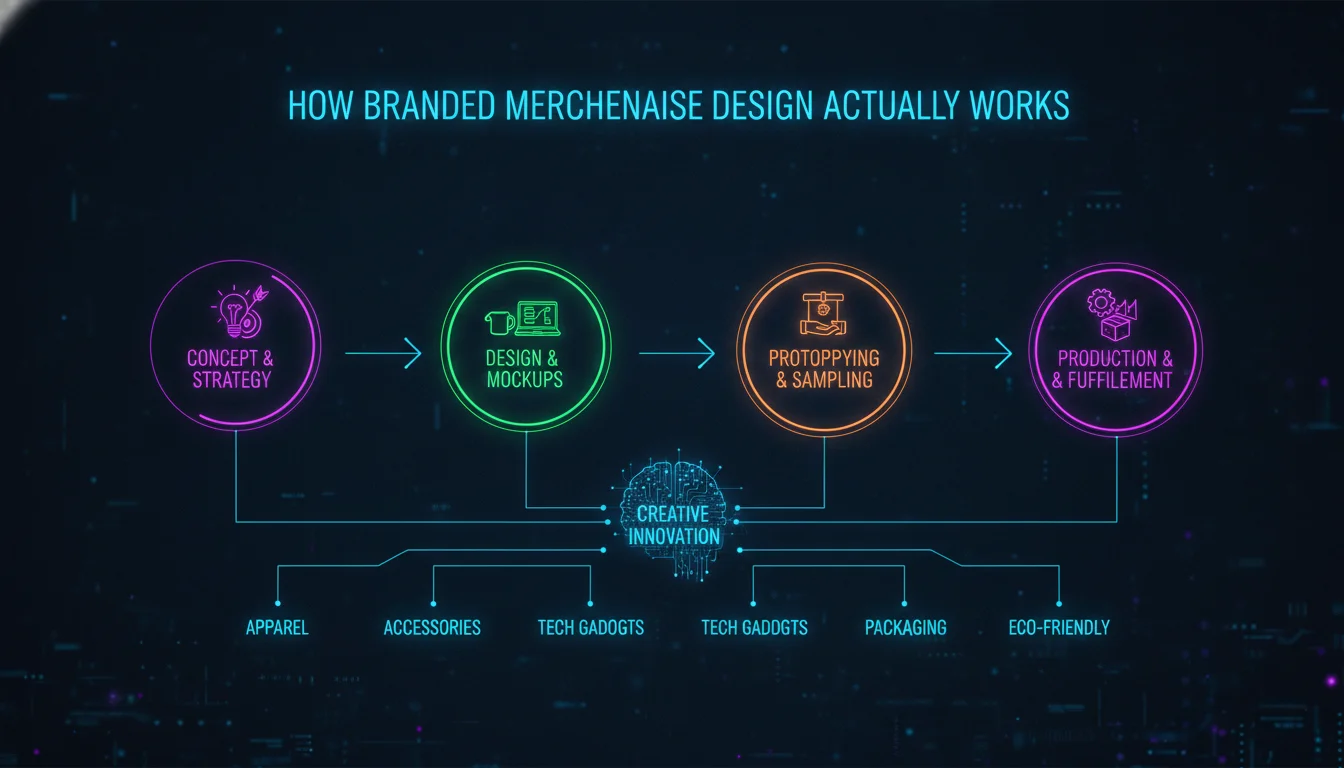
Branded merchandise design works through a process that connects brand strategy to physical product, from concept through production and distribution. Most brands skip the strategy part and jump straight to “what should we put our logo on?” That’s where things go wrong.
Here’s the underlying mechanic. Every piece of merchandise is a brand touchpoint. It communicates something about who you are, what you value, and who your audience is. A PostHog sticker set communicates “we’re a nerdy, community-driven team.” A Patagonia fleece communicates “we care about the planet.” A generic stress ball communicates nothing except that someone had a budget to spend.
The design process has three layers:
- Brand layer: What visual identity elements (colors, typography, iconography) translate well to physical products? Not everything does. A complex gradient logo looks great on a website and terrible on an embroidered cap.
- Product layer: Which product categories fit your audience’s actual lifestyle? A SaaS company’s audience lives on laptops and coffee. A fitness brand’s audience lives in gyms and outdoor spaces. The product should meet them there.
- Production layer: How will the item be made? Screen printing, embroidery, direct-to-garment printing, and laser engraving all produce different results on different materials. Choosing the wrong production method is one of the most common reasons merchandise looks cheap even when the design is solid.
Print-on-demand platforms like Printful and Printify have changed the production layer significantly. Each item is printed and shipped only after an order is placed, eliminating inventory risk and letting brands test branded merchandise design ideas without committing to large minimum order quantities.
“With print-on-demand, each item is printed and shipped to the customer only after they place an order. No need to keep inventory or worry about unsold stock. You get to try different products and designs without losing money.” – Printful Blog, 2024
Top Branded Merchandise Design Ideas for 2026
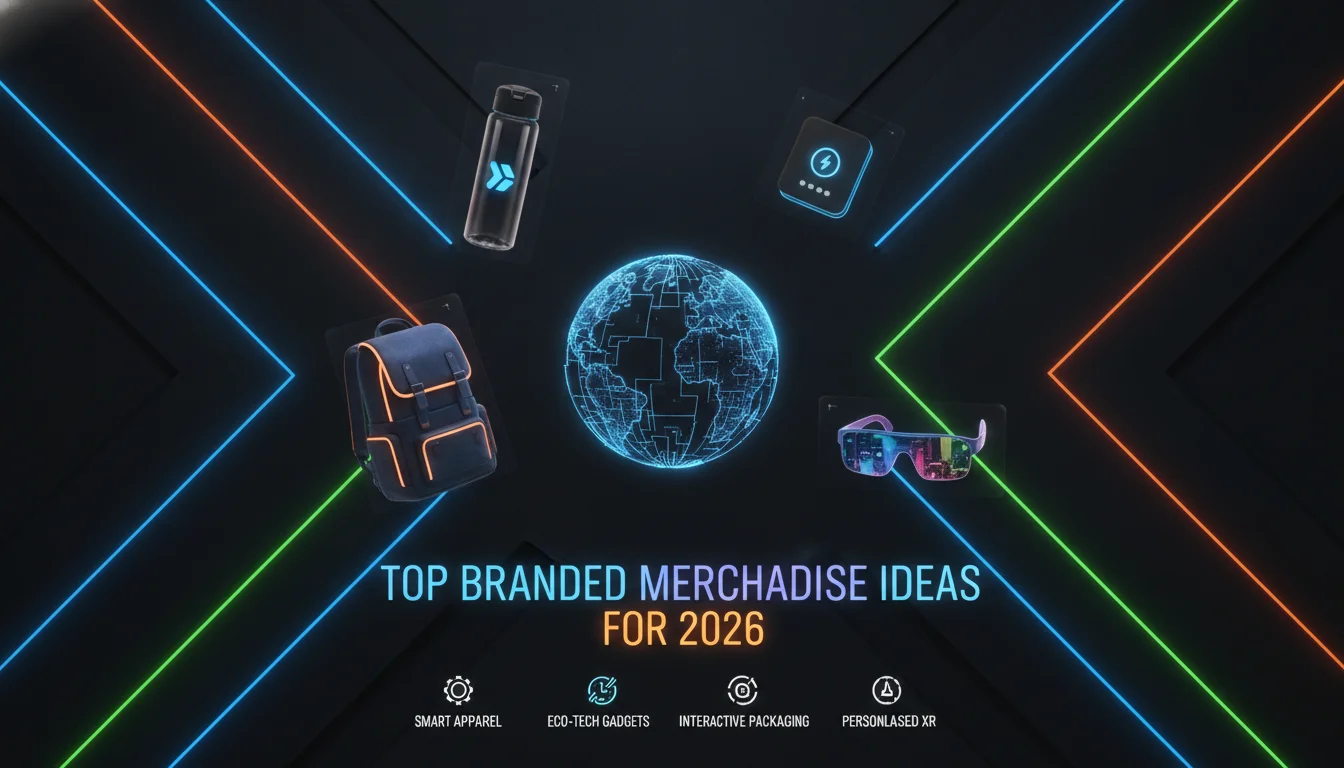
The strongest branded merchandise design ideas in 2026 share three qualities: they’re useful in daily life, they reflect a clear brand identity, and they’re made well enough that people actually want to keep them. Here are the categories and concepts worth building around.
1. Eco-Friendly Products
Eco-friendly branded merchandise is no longer a differentiator. It’s a baseline expectation for brands targeting younger, values-driven consumers. Products made from sustainable materials, such as recycled plastics, organic cotton, or bamboo, communicate that your brand’s values extend beyond the boardroom. Patagonia built an entire brand identity around this principle. Their merchandise, made from recycled materials, doesn’t just carry a logo. It carries a worldview.
Practical eco-friendly branded merchandise design ideas include reusable tote bags, stainless steel water bottles, organic cotton tees, and seed paper packaging that customers can plant after unboxing.
2. Functional Tech Accessories
Tech accessories sit at the intersection of utility and daily visibility. Wireless chargers, Bluetooth speakers, portable power banks, and custom phone cases are items people use multiple times a day. Every use is a brand impression. Source YM’s event merchandise guide highlights UV phone sanitisers, multi-device charging docks, and stylus pens with hidden USB drives as standout options for brands that want to signal innovation without saying a word.
3. Stylish Apparel
Apparel remains the highest-visibility category in branded merchandise design ideas. A well-designed hoodie travels further than any banner ad. Since 2020, athleisure has become a permanent fixture in everyday wardrobes, and hoodies in particular have become a canvas for brand storytelling. The key word is “stylish.” If it’s something your audience would buy themselves, you’ve nailed it. If it looks like a uniform, it’ll live in a drawer.
Actively Black’s Wakanda Forever collaboration with Marvel Studios is a strong example: a brand-aligned apparel drop that felt like a cultural moment, not a promotional giveaway. Paul McCartney’s Got Back tour sweatshirt is another. Simple design, strong brand, immediate recognition.
4. Premium Drinkware
Custom mugs and water bottles are among the most cost-effective branded merchandise options at scale. Ceramic coffee mugs suit trade show giveaways and team gifts. Stainless steel travel mugs and insulated tumblers feel more elevated, making them strong choices for high-value client gifts or executive welcome kits. Colour-changing mugs that reveal a logo when filled with hot liquid add a moment of delight that people share on social media organically.
5. Interactive and Experiential Merchandise
This is where branded merchandise design ideas get genuinely exciting in 2026. Interactive swag, including custom-branded puzzles, AR-enabled cards, and QR-linked experiences, turns a physical object into a digital gateway. Source YM describes this approach as “merch that attendees can actually play with,” noting that QR codes can unlock exclusive offers, digital content, or even a branded game. The result is merchandise that creates a memory, not just a moment.
6. Headwear
Caps and beanies are perennial performers in branded merchandise. Dad hats, corduroy caps, vintage styles, and embroidered beanies all offer strong brand visibility with relatively low production costs. Headwear works year-round, travels well, and photographs beautifully for social content. The activist group GRL PWR’s signature cap is a clean example: a simple design that became a recognizable symbol for a community.
How to Apply Branded Merchandise Design Ideas: A Step-by-Step Process
Applying branded merchandise design ideas effectively requires a structured process, not a shopping trip. Here’s how we approach it with clients at Emin Media.
Step 1: Identify Your Target Audience
Start with people, not products. Who are you trying to reach? What does their daily life look like? What do they already carry, wear, and use? A SaaS startup’s audience has different needs than a fitness brand’s community. Map out your audience’s lifestyle before you open a single product catalog.
Step 2: Define Your Brand’s Visual Language for Physical Products
Not every brand element translates to merchandise. Audit your visual identity with physical production in mind. Which colors work on fabric? Does your logo read clearly at small sizes? Is there a secondary mark or icon that works better for embroidery than your full wordmark? Answer these questions before you brief a designer or supplier.
Step 3: Align Products with Brand Identity
Choose product categories that reinforce what your brand stands for. A sustainability-focused brand should lead with eco-friendly materials. A tech company should lead with functional accessories. A creative agency (like us) should lead with beautifully designed apparel and stationery that reflects design craft. The product choice is itself a brand statement.
Step 4: Focus on Quality and Functionality
This is non-negotiable. A poorly made item with your logo on it does more damage than no merchandise at all. It signals that you cut corners. Invest in products that provide real, daily value. According to Show Your Logo’s promotional products research, businesses that choose useful, high-quality items consistently enjoy stronger brand recognition and more repeat business than those that prioritize low unit costs.
Step 5: Choose the Right Production Method
Match your production method to your product and design. Screen printing works well for bold, flat graphics on apparel. Embroidery suits logos on caps, bags, and outerwear. Direct-to-garment printing handles complex, photographic designs on fabric. Laser engraving is ideal for drinkware and tech accessories. Each method has different minimum order requirements, lead times, and cost structures.
Step 6: Test Before You Scale
Use print-on-demand services to test branded merchandise design ideas before committing to bulk orders. Order samples. Wear the hoodie. Use the mug. Show the tote to someone outside your team. Real-world testing catches problems that mockups never reveal.
Step 7: Distribute with Intention
How and when you give merchandise matters as much as what you give. A welcome kit for new clients lands differently than a trade show giveaway. A limited-edition drop for loyal customers creates exclusivity. A staff onboarding pack builds culture from day one. Match the distribution moment to the merchandise and the relationship.
Branded Merchandise Comparison Table
| Merchandise Type | Best For | Visibility | Cost Range | Longevity |
|---|---|---|---|---|
| Apparel (hoodies, tees) | Brand fans, employees, events | Very High | Mid to High | Years |
| Drinkware (mugs, bottles) | Clients, trade shows, onboarding | High (daily use) | Low to Mid | Years |
| Tech Accessories | Tech-savvy audiences, premium gifts | High (constant use) | Mid to High | 1-3 years |
| Eco-Friendly Products | Values-driven audiences, sustainability brands | Medium to High | Mid | Years |
| Tote Bags | Events, retail, everyday carry | High (public spaces) | Low to Mid | Years |
| Interactive/AR Merch | Events, launches, experiential campaigns | High (shareable) | Mid to High | Event-specific |
| Headwear | Outdoor brands, community groups, events | Very High | Low to Mid | Years |
Pros and Cons of Branded Merchandise
Pros
- Long-term brand visibility: A quality item worn or used daily delivers brand impressions for months or years without additional spend.
- Tangible brand connection: Physical products create emotional associations that digital ads rarely achieve.
- Versatile marketing tool: Merchandise works across onboarding, events, client gifting, retail, and community building.
- Word-of-mouth amplification: Well-designed merch sparks conversations. People ask “where did you get that?” and you get free referrals.
- Revenue potential: Brands like Google sell merchandise directly to fans, creating an additional income stream alongside core products.
Cons
- Upfront production costs: Quality merchandise requires meaningful investment, especially for minimum order quantities on bulk runs.
- Design complexity: Not all brand identities translate well to physical products without adaptation.
- Inventory risk: Ordering too much of the wrong item ties up budget and creates waste (print-on-demand mitigates this).
- Technology obsolescence: Tech accessories can become outdated quickly as device standards change.
- Size and fit challenges: Apparel requires careful size planning to avoid waste and customer dissatisfaction.
Creative Branded Merchandise Examples
The best branded merchandise design ideas come to life when you study what real brands have done well. Here are examples worth learning from.
Notion’s Minimalist Swag
Notion’s branded merchandise is exactly what you’d expect from a brand famous for its clean, minimalist design tool: practical, cozy, and designed with a creative edge. Their lineup includes earthy modern warmth jackets, bucket hats, tote bags, and stickers, all carrying that understated aesthetic Notion fans love. The star might actually be their literal fans, a subtle nod to the cult following Notion has built. As Monday Merch observes, “Notion shows that the best custom company swag can be both functional and aesthetic, extending the brand experience into everyday life.”
Tesla’s Audience-Specific Offerings
Tesla’s merchandise includes items that resonate with their tech-savvy audience: electric vehicle-themed apparel and accessories that reinforce their brand identity. Even Elon Musk, who famously avoids traditional advertising, sells branded merch through Tesla’s web store. The merchandise does the marketing work that paid ads don’t.
Patagonia’s Sustainability-First Approach
Patagonia is the gold standard for values-aligned branded merchandise. Their products, made from recycled materials, attract environmentally conscious consumers and strengthen brand loyalty in a way that no campaign could replicate. The merchandise isn’t a marketing afterthought. It’s a proof point for everything the brand claims to stand for.
PostHog’s Small-but-Mighty Swag Program
PostHog’s merch lineup is small: t-shirts, socks, and stickers. But each piece feels personal and well-designed. The stickers are laptop-worthy. The socks add personality. The tees carry a community-driven energy. According to Monday Merch’s 2026 swag guide, “the magic here isn’t in variety but in authenticity.” PostHog proves you don’t need a large catalog to make a strong impression. You need a clear identity and the discipline to express it consistently.
A Realistic Scenario: How a SaaS Startup Built a Merch Program That Worked
Picture a 40-person SaaS company preparing for their first major industry conference. They have a modest merchandise budget and a brand identity built around clarity, speed, and a slightly irreverent sense of humor.
Their first instinct is to order 500 branded pens and a stack of brochures. Instead, they pause and ask: what does our audience actually use every day? The answer: laptops, coffee, and headphones.
They commission three branded merchandise design ideas: a high-quality ceramic mug with a witty product-related tagline printed inside the rim (visible only when you drink), a set of die-cut laptop stickers featuring their brand’s iconography, and a limited run of premium hoodies in their brand color with a small embroidered logo.
At the conference, the mugs go to speakers and VIP attendees. The stickers sit in a bowl at their booth and disappear within two hours. The hoodies are worn by the team and generate more “where did you get that?” conversations than any sales pitch.
Post-conference, three inbound leads mention the stickers as the reason they stopped at the booth. Two enterprise prospects reference the hoodie in their follow-up emails. The merchandise didn’t close the deals. But it opened the doors.
This is what well-executed branded merchandise design ideas actually do. They create entry points for conversations that sales decks can’t manufacture.
Common Mistakes to Avoid with Branded Merchandise
Most branded merchandise programs fail for the same predictable reasons. Knowing what to watch out for saves budget and protects your brand reputation.
Prioritizing Price Over Quality
The cheapest option is almost never the right option. A flimsy tote bag that tears after three uses, a mug whose print fades after two washes, a t-shirt that shrinks into a crop top: these items don’t just fail to build brand equity. They actively damage it. Invest in quality or don’t invest at all.
Slapping a Logo on a Generic Product
This is the most common branded merchandise mistake. A logo on a product is not a design. It’s a label. Great branded merchandise design ideas start with the product’s purpose and the audience’s lifestyle, then build a visual concept around those foundations. The logo is the last thing you add, not the first.
Ignoring Production Method Compatibility
A complex, multi-color gradient logo will look terrible embroidered on a cap. A fine-line illustration will lose detail when screen printed at small sizes. Always adapt your design to the production method, not the other way around. Brief your supplier on both the design and the intended production technique before finalizing anything.
Ordering Too Much Too Soon
Bulk orders lock you into a design, a colorway, and a quantity before you know what your audience actually responds to. Use print-on-demand to test first. Order 20 units, distribute them, gather feedback, then scale what works.
Forgetting the Distribution Strategy
Merchandise sitting in a storage room helps no one. Plan your distribution before you place your production order. Who gets it? When? In what context? A welcome kit, a conference giveaway, a loyalty reward, and a staff gift all require different products and different presentation approaches.
Choosing Products That Don’t Fit the Brand
A law firm sending branded beach balls. A children’s education brand giving away whiskey glasses. A sustainability consultancy handing out single-use plastic items. These mismatches don’t just confuse audiences. They undermine brand credibility. Every merchandise decision should pass a simple test: does this product reflect who we are and what we stand for?
Measuring the Impact of Branded Merchandise
Measuring branded merchandise effectiveness requires tracking both quantitative signals and qualitative feedback. Neither alone tells the full story.
Customer Engagement
Monitor how customers interact with your merchandise. Social media posts featuring your branded items, user-generated content, and direct feedback all indicate whether your products resonate. High organic sharing is one of the strongest signals that your branded merchandise design ideas are working.
Brand Awareness
Evaluate how your merchandise contributes to brand visibility over time. Increased brand awareness often shows up in search volume trends, direct traffic, and the frequency with which prospects mention your brand before a first sales conversation.
Sales Performance and Lead Attribution
Track whether merchandise distribution correlates with sales activity. Ask new clients how they first heard about you. If merchandise keeps appearing in those answers, you have a clear signal that your investment is generating returns beyond goodwill.
Retention and Loyalty Signals
Branded merchandise given to existing customers can reduce churn and increase lifetime value. Monitor repeat purchase rates and customer satisfaction scores in the months following a merchandise distribution campaign to assess the loyalty impact.
Expert Insights on Branded Merchandise
“The gap between company swag that gets worn and company swag that gets donated is not about budget. It is about intent. What these programs share is not a common price point. They share a clarity of identity that runs through every product choice.” – Monday Merch, 2026 Company Swag Guide
Branded Merchandise in 2026: What’s Changed and What’s Coming
As of 2026, the branded merchandise industry has shifted in three meaningful directions. First, quality expectations have risen sharply. Audiences who grew up with premium DTC brands have no patience for cheap promotional products. The bar for “good enough” is higher than it’s ever been.
Second, sustainability has moved from optional to expected. Brands that distribute single-use plastic items or low-quality fast-fashion apparel face real reputational risk with younger audiences. Eco-friendly materials and responsible production are now baseline requirements for brands targeting consumers under 40.
Third, the line between merchandise and product has blurred. Companies like Google sell branded merch directly to fans as a revenue stream, not just a marketing expense. This shift means branded merchandise design ideas need to meet retail-quality standards, not just promotional standards.
Looking ahead, interactive merchandise with digital integration (QR codes, AR experiences, NFC-enabled products) will continue to grow as brands seek ways to connect physical touchpoints to digital journeys. The brands that figure out how to make a physical object the entry point to a digital experience will have a significant advantage in the next few years.
Frequently Asked Questions
What are some good ideas for branded merch?
Good branded merchandise design ideas include eco-friendly tote bags, premium hoodies, custom drinkware, tech accessories like wireless chargers, and interactive items with QR or AR integration. The best ideas are always grounded in your audience’s actual daily life, not just your brand’s visual preferences.
What type of merch sells the most?
Apparel, drinkware, and tote bags consistently rank as the highest-performing merchandise categories. High-quality, functional items outperform generic products in both usage rates and brand recall. Hoodies and premium t-shirts in particular tend to generate strong organic social sharing when the design is genuinely good.
How do I create branded merchandise?
Start by identifying your target audience and auditing your visual identity for physical production compatibility. Then select product categories that fit your audience’s lifestyle, choose a production method suited to your design, and test with small runs before scaling. Print-on-demand platforms like Printful and Printify make it easy to start with minimal upfront investment.
What are the 5 R’s of merchandising?
The 5 R’s of merchandising are the right product, right place, right time, right quantity, and right price. Applied to branded merchandise, this framework means choosing products your audience actually wants, distributing them in contexts where they’ll be appreciated, timing drops for maximum impact, ordering quantities that match demand, and pricing (or positioning) them to reflect your brand’s quality standards.
How can I measure the success of my branded merchandise?
Measure success through customer engagement signals (social sharing, user-generated content), brand awareness metrics (search volume, direct traffic), lead attribution (asking new clients how they heard about you), and retention indicators (repeat purchase rates after merchandise campaigns). Combining quantitative data with direct customer feedback gives the clearest picture.
Why is branded merchandise important for small businesses?
Branded merchandise gives small businesses a cost-effective way to build visibility and create lasting impressions without the ongoing spend of digital advertising. According to Show Your Logo’s promotional products research, promotional items continue working for months or even years after distribution, making them one of the highest-ROI marketing investments available to businesses with limited budgets.
Ready to Build Something Worth Keeping?
The best branded merchandise design ideas don’t come from a catalog. They come from a deep understanding of your brand, your audience, and the intersection between the two. That’s exactly the kind of thinking we bring to every project at Emin Media.
We’ve helped brand owners, startup founders, and marketing teams translate their brand identity into merchandise that people actually want to own. From concept through production strategy, we treat merchandise as a brand experience, not a budget line item.
Contact Emin Media for a free brand consultation and let’s build something bold together.
Enjoyed this article?
Contact Emin Media for a free brand consultation and let's create something amazing together.
Get in TouchRelated Articles
Digital Marketing for Creatives: A Bold Guide
Digital marketing for creatives builds real visibility and sales. Learn strategies for social media, SEO,…
Branding & Design Agency Tips That Actually Work
Discover branding and design agency tips to choose the right partner, set clear goals, and…
Creative Agency Pitch Deck Tips That Win Clients
Master creative agency pitch deck tips that win clients in 2026. Learn storytelling, design, and…