Branded Content Strategy: Build Stories That Stick
A branded content strategy is a plan for telling your brand’s story in a way that earns attention rather than buying it. It defines how to create content that audiences choose to watch, share, and remember, without relying on interruptive ads.
Key Takeaways
- A strong content strategy centers on audience understanding, brand truth, and format fit, not just campaign goals.
- Branded content drives 59% higher brand recall than display ads, according to Don’t Panic London.
- Emotional campaigns generate roughly 1.7x more brand effects than rational, message-only work, per 30 years of IPA case studies analyzed by Binet & Field.
- Branded content differs from content marketing in its focus on emotional storytelling over lead generation and direct promotion.
- Video is the most powerful format for branded content, but a multi-format approach consistently outperforms single-channel execution.
- As of 2026, AI tools accelerate content production but require a robust this type of strategy to keep brand voice consistent.
This article synthesizes insights from leading agencies and content marketing experts to explain what a this kind of strategy is, why it matters, and how to build one that works. We draw on perspectives from Content Marketing Institute, Don’t Panic London, and others to clarify a discipline that is often misunderstood.
What Is a Branded Content Strategy?
Defining Branded Content and Strategy
Branded content is content that tells a story, sparks emotion, or shares something useful while staying true to your brand’s voice and values. It doesn’t scream “buy now.” Instead, it builds trust by showing who you are and what you stand for. According to the Content Marketing Institute, branded content is “a content creation tactic, typically produced through a sponsored or paid partnership between the brand and the media, that encourages audiences to engage with the brand based on its entertainment, information, and/or educational value.”
A branded content is the overarching plan that guides the creation, distribution, and measurement of that content. It goes beyond campaign slogans or performance metrics and into the territory of culture, behaviour, and shared experience. The strategy determines who you are speaking to, what format your message takes, where it shows up, and how it connects emotionally and culturally.
Importantly, a content strategy is not the same as a content marketing strategy, though the two overlap. Branded content is specifically designed to build awareness and affinity by associating the brand with content that shares its values, rather than directly promoting a product or service. It is often delivered through partnerships with media outlets or creators.
Branded Content vs. Traditional Advertising
Traditional advertising interrupts an audience with a sales message. Branded content, by contrast, invites the audience into a story. The best branded content feels less like an interruption and more like something you would choose to watch, share, or send to a friend. It doesn’t shout for attention. It rewards it. This distinction is fundamental: the audience isn’t told, they’re invited.
According to Don’t Panic London, branded content drives 59% higher brand recall than display ads. That figure underscores why this approach has become essential for brands facing declining traditional ad performance. When a brand shows up in someone’s feed, inbox, or timeline, it better have a reason to be there. Not just a message, but a story, a point of view, a pulse.
“The best content stems from a clearly defined brand personality and values. It’s not about jumping on the latest tone trend, but finding a voice that’s yours, grounded, distinct, and aligned with what you stand for.” – Anna Iuliana Petrescu, Don’t Panic London
The Strategic Function of a Branded Content Plan
A this type of strategy serves a clear business purpose: to build trust, recall, and affinity over time. It does this by aligning content with the brand’s long-term identity, not just short-term sales goals. The strategy answers five key questions: Who are you speaking to? What format will the message take? Where will it show up? How will it connect emotionally and culturally? And how will it earn not just views, but trust?
This strategic function is why agencies like Brand Content Strategy, based in Amsterdam and Pune, offer modular services that include brand desirability, design and development, sales communication, sonic branding, customer retention, and advertising copy optimized for AI discovery. That broad scope reflects the reality that a this kind of strategy touches every customer-facing communication, from websites to soundscapes to CRM implementation.
The Core Pillars of a Branded Content Strategy
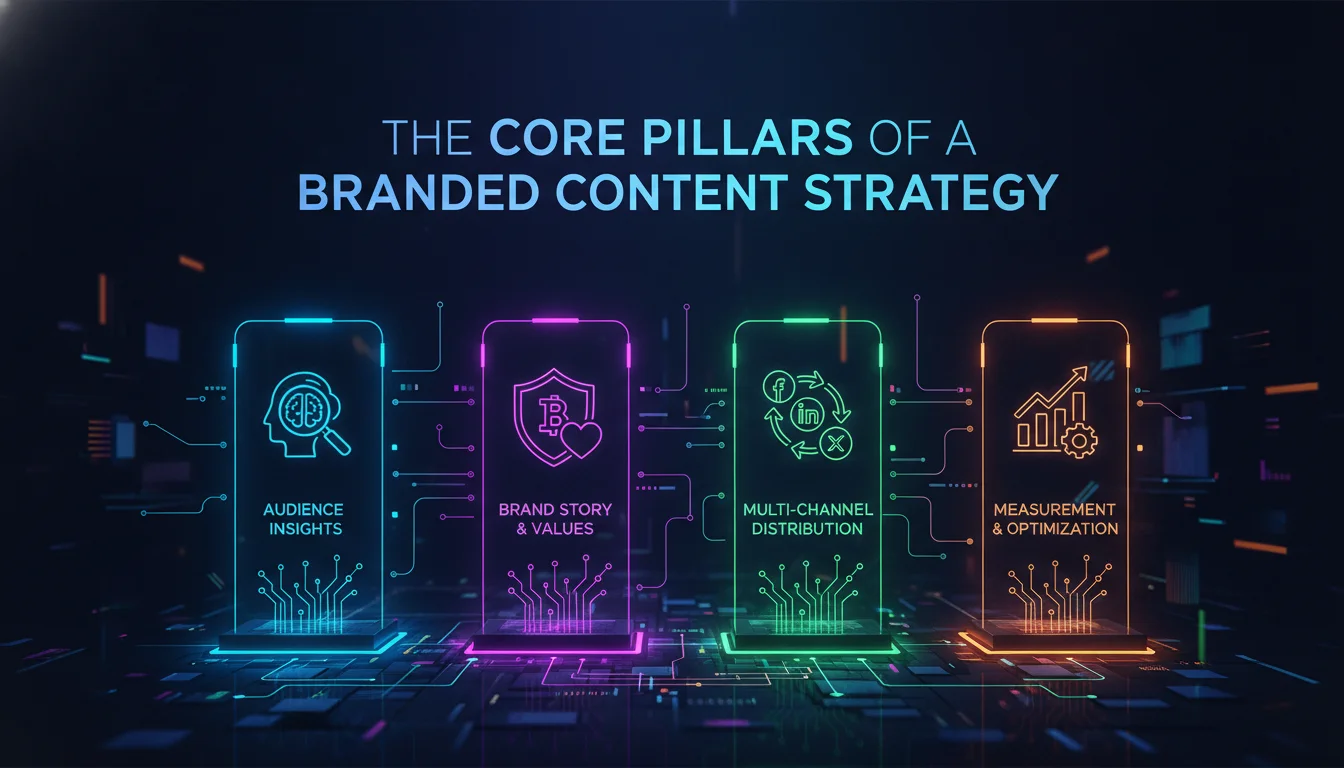
Pillar 1: Audience Understanding Over Funnel
You can’t earn attention if you don’t know whose attention you’re trying to earn. The strongest branded content strategies start not with a product or campaign goal, but with a deep understanding of the audience: what they value, what they scroll past, and what makes them stop. This means going beyond basic demographics. What are their pain points? Their motivations? Their memes of the moment?
Use search data, social discourse, and content performance data to understand what they need, not just what you want to tell them. Build audience personas rooted in emotional drivers, not just business segments. Think “the over-scroller who wants to feel seen” rather than “urban Gen Z female, 22-26.” This emotional grounding is what separates a branded content from a content calendar filler exercise.
Pillar 2: Brand Truth and Emotional Resonance
A strong content strategy ladders up to a clear brand truth, not a one-off campaign line. It’s the difference between a clever ad and a story that earns trust over time. Great branded content reflects a bigger picture. While audiences may connect with different aspects, such as values, product, or employee stories, those narratives should all ladder up to a cohesive brand idea. Avoid fragmentation. Aim for dimension.
Nike doesn’t only tell you to “Just Do It.” It builds worlds where everyone is an athlete, over years, through voices, formats, and lived stories. The numbers agree: emotional campaigns generate roughly 1.7x more brand effects than rational, message-only work, according to 30 years of IPA case studies analyzed by Binet & Field. That is a powerful argument for building a strategy around emotional resonance rather than product features.
Pillar 3: Format and Platform Fit
A branded content strategy must specify what format the message takes and where it belongs. This can include film, social media, experiential activations, podcasts, articles, and interactive features. Platform choice matters because each channel has its own culture and consumption behaviour. A branded content strategy that works on Instagram may not translate directly to LinkedIn or YouTube.
According to Templafy, video is now the most powerful form of branded content. Rich multimedia formats, including video and audio, enable a more immersive and emotionally resonant experience than text or static images alone. The strategy should prioritize formats that match both the brand’s strengths and the audience’s consumption habits. A B2B brand might use documentary-style video and thought leadership articles, while a B2C brand might lean into short-form video and interactive social campaigns.
Pros and Cons of a Branded Content Strategy
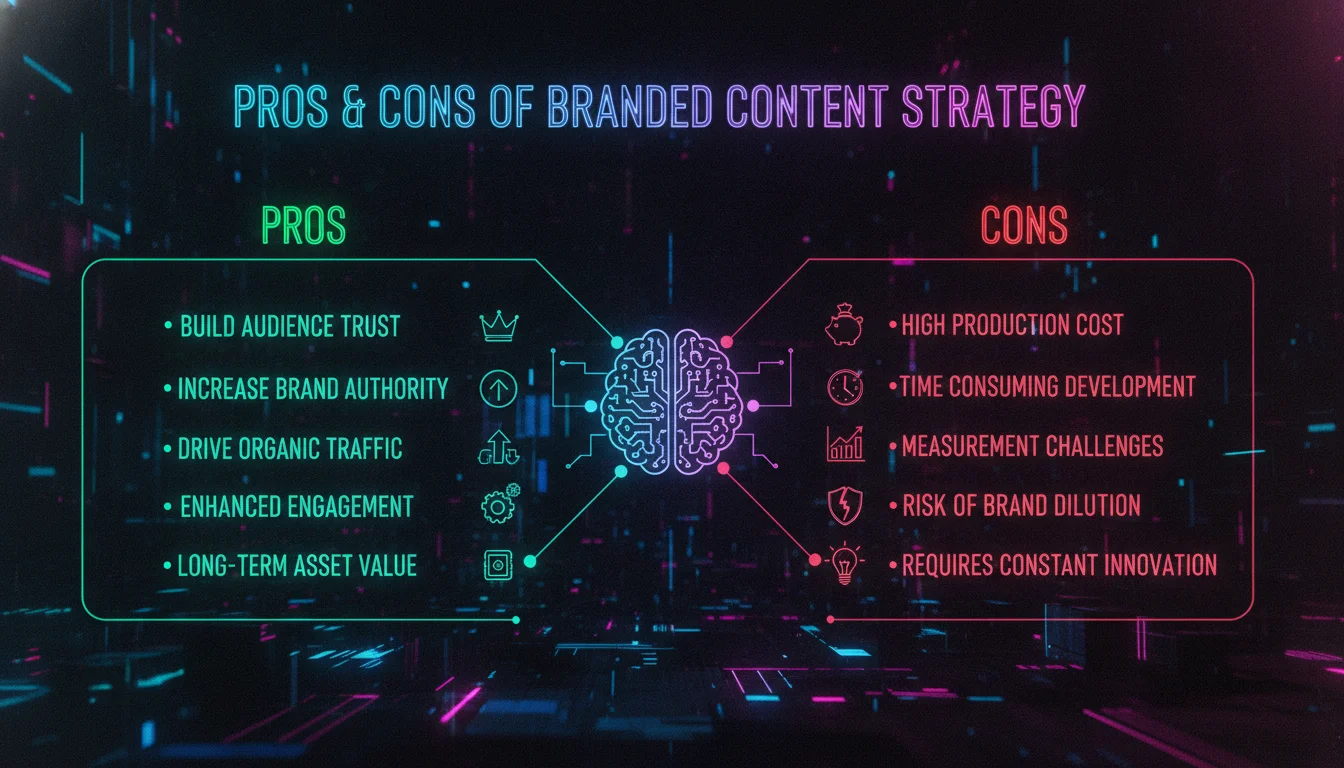
Pros
- Higher brand recall: Branded content drives significantly stronger recall than display advertising, making your brand more memorable long after the first exposure.
- Emotional connection: Stories build trust and affinity in ways that product-focused ads simply cannot replicate.
- Audience-chosen engagement: People opt in to branded content rather than being interrupted by it, which means higher quality attention.
- Long-term brand equity: Effects compound over months and years, building a brand asset rather than a one-time campaign spike.
- Cultural relevance: Partnerships with media outlets and creators give your brand credibility and reach beyond owned channels.
Cons
- Harder to measure short-term ROI: Unlike performance marketing, branded content rarely drives immediate conversions, which can make budget justification difficult.
- Requires significant creative investment: High-quality storytelling demands skilled production, thoughtful strategy, and often external partners.
- Results take time: Brand affinity and recall build slowly. Brands expecting quick wins will be disappointed.
- Brand consistency risk: Especially with AI-assisted production, maintaining a consistent voice across all content requires strong guardrails and oversight.
Branded Content vs. Content Marketing: 7 Key Differences
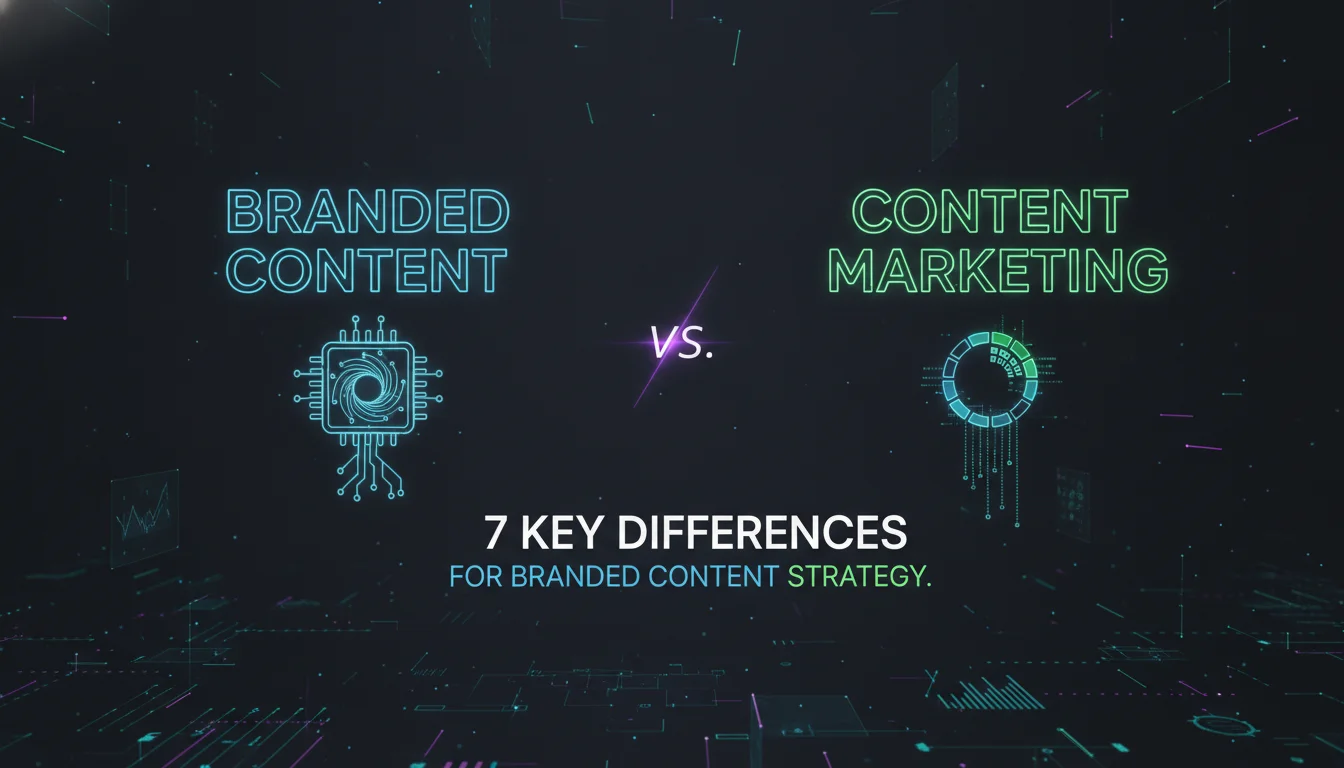
Many marketers confuse branded content with content marketing, but they are distinct approaches with different goals and execution methods. Understanding the differences helps you allocate resources effectively. The table below summarizes seven key distinctions.
| Dimension | Branded Content | Content Marketing |
|---|---|---|
| Placement of the brand | Brand appears adjacent to the content or is only subtly referenced. | Brand is the publisher; content lives on owned channels. |
| Primary focus | Emotional connection, storytelling, entertainment, and education. | Practical, helpful information that attracts and educates potential customers. |
| Level of brand promotion | Low, may make little or no direct mention of the brand or products. | Moderate, content is useful but often includes calls-to-action or brand references. |
| Audience engagement goals | Build awareness, affinity, and recall over the long term. | Drive leads, conversions, and support the buying process. |
| Time frame | Long-term brand building; results accrue over months and years. | Can be both short-term and long-term; often tied to funnel stages. |
| Content lifecycle and planning | Campaign-based, often produced with media partners or creators. | Evergreen, planned on a content calendar, published on owned channels. |
| Return on investment (ROI) | Measured through brand recall, affinity, and cultural relevance. | Measured through traffic, leads, conversion rates, and revenue attribution. |
Why the Distinction Matters
Making the right choice depends on business objectives, audience needs, and available resources. Some brands find success focusing on branded content, while others rely mostly on content marketing. Many combine both for stronger results: content marketing builds the foundation of useful information, while branded content creates emotional spikes that make the brand memorable. A branded content strategy should clarify which approach leads at each stage of the customer journey.
Common Misconceptions
One common misconception is that any content created by a brand qualifies as branded content. In reality, branded content is a specific tactic that involves storytelling and audience value, not a sales pitch. It often involves a media partnership or creator collaboration. Another misconception is that branded content is only for B2C brands. According to Templafy, B2B brands can tell great stories too, from social videos to proposals and pitch decks, the goal is the same: create content that people actually want to engage with.
How to Develop a Branded Content Strategy in 5 Steps
Building a branded content strategy requires a systematic approach. The following five steps synthesize best practices from multiple sources, including Brafton and LinkGraph.
Step 1: Define Your Brand Voice and Values
Before you create any content, you must know who you are as a brand. This includes your mission, values, personality, and tone of voice. According to Don’t Panic London, the best content stems from a clearly defined brand personality and values. Avoid jumping on the latest tone trend. Find a voice that is grounded, distinct, and aligned with what you stand for. Document this in a brand voice guide that can be shared across teams and partners.
Step 2: Research Your Audience’s Emotional Drivers
Conduct audience research that goes beyond demographics. Use surveys, social listening, search analytics, and customer interviews to understand what your audience cares about, fears, hopes for, and finds entertaining. Build personas around emotional drivers: what makes them feel seen, understood, or inspired? This step is critical because a branded content strategy earns attention by connecting with shared values, not by pitching features.
Step 3: Choose Formats and Channels
Select the formats and platforms that best suit your brand and audience. Video, podcasts, interactive articles, and social campaigns all have different strengths. Consider where your audience already spends time and how they consume content. According to Templafy, video is the most powerful form of branded content, but that doesn’t mean you should ignore other formats. A multi-format approach often works best, with each format reinforcing the same brand truth.
Step 4: Create a Distribution and Partnership Plan
Branded content often involves partnerships with media outlets, creators, or publishers. These partnerships give your content cultural relevance and reach beyond your owned channels. Identify potential partners whose values align with yours. Plan how the content will be distributed, via sponsored placements, co-created series, or creator collaborations. Include a timeline and budget for each partnership.
Step 5: Measure and Optimize
Define success metrics before you launch. Branded content is typically measured through brand recall, sentiment, engagement, and cultural impact, rather than direct conversions. Use surveys, social listening tools, and brand lift studies to track performance. Review results regularly and adjust your strategy based on what resonates. Branded content is a long-term investment. Results compound over time. As Brafton notes, a content strategy is a roadmap that guides your efforts to reach business goals. Your journey will look different from anyone else’s, and measurement is how you stay on course.
Real-World Examples of Effective Branded Content
Historical Milestones: JELL-O and the 1904 Cookbook
Branded content is not new. According to Trend.io, the term “branded content” first hit the airwaves in 2001, but the practice goes back much further. JELL-O kicked off branded marketing in 1904 with its JELL-O cookbook, which was a huge success despite featuring unusual recipes like “JELL-O salad.” That cookbook is a perfect early example: it provided value through recipes while associating the brand with useful, engaging content, with no direct product pitch required.
Modern Campaigns That Earned Attention
Modern examples show the same principle at work. Don’t Panic London has built branded content that made people “laugh, cry, protest, donate, and press replay.” Their campaigns demonstrate that the best content stems from a clear brand personality and values, not from jumping on trends. Branded content campaigns that make little or no direct mention of the brand often perform best, because they feel like something worth sharing on its own merits.
“When answers get AI-commoditised, the quality of questions matter. BCS blends the science of persuasion, technology and data-driven insight.” – Brand Content Strategy, Amsterdam
B2B Branded Content: Proving It’s Not Just B2C
Business-to-business brands can also succeed with branded content. Templafy points out that B2B brands can tell great stories too, from social videos to proposals and pitch decks. A branded content strategy for a B2B company might include documentary-style customer stories, industry thought leadership series, or interactive tools that solve a real problem. The key is the same: create content that people actually want to engage with, and make sure it looks and sounds like your brand every time.
Why Branded Content Strategy Matters in an AI-Driven Era
The Decline of Traditional Ad Performance
With traditional ad performance in decline, branded content has become a go-to approach for businesses that want to connect with their audience in a more meaningful way. More shoppers are using ad blockers, and audiences have learned to ignore interruptive messages. A branded content strategy offers a way to earn attention rather than pay for it, and to build recall that lasts. The 59% higher brand recall figure from Don’t Panic London is a direct response to this challenge.
AI Tools and the Consistency Challenge
As businesses race to adopt AI, branded content has never been more important. AI-powered tools are helping teams boost productivity and speed up content creation. But with all that speed comes a new challenge: making sure your brand still shows up clearly and consistently in everything you create. Templafy warns that with AI, teams must ensure that brand voice and values remain intact across all generated content. A robust branded content strategy provides the guardrails that AI tools need to stay on-brand.
Standing Out When Answers Are Commoditized
Brand Content Strategy, an agency based in Amsterdam and Pune, puts it plainly: “When answers get AI-commoditised, the quality of questions matter.” When AI can generate generic answers to any query, brands must differentiate by asking better questions and telling stories that AI cannot replicate. A branded content strategy is precisely that: a plan to create human, emotional, and culturally specific stories that cut through the noise of automated content. This is the new frontier for brand marketing in 2026 and beyond.
Best Practices for Implementing a Branded Content Strategy
Build a Cohesive Brand Idea
Avoid fragmentation. Every piece of branded content should ladder up to a single, cohesive brand idea. While audiences may connect with different aspects, including values, product, and employee stories, those narratives all reinforce the same core truth. Use a brand truth document to keep all content aligned. This is the foundation that prevents your brand from becoming a collection of disconnected campaigns.
Partner with Media and Creators
Branded content often works best when produced with a media partner or a creator who brings cultural credibility. These partnerships allow your brand to tap into existing audiences and storytelling expertise. Choose partners whose values align with yours and whose voice complements your brand. According to the Content Marketing Institute, the best branded content campaigns take an immersive, sensory-driven approach that often requires professional production capabilities beyond in-house teams.
Avoid the Sales Pitch
The cardinal rule of branded content: don’t sell. Great branded content balances entertainment and information without ever feeling like an ad. It may make little or no direct mention of the brand or its products. If your content answers a question, tells a meaningful story, or makes someone feel something, the brand association will follow naturally. That’s the difference between earning attention and buying impressions.
Consider Sonic Branding as Part of Your Strategy
One often-overlooked dimension of a branded content strategy is sound. Sonic branding, including audio logos, branded soundscapes, and music identity, creates emotional associations that visual content alone cannot achieve. Agencies like Brand Content Strategy in Amsterdam and Pune offer sonic branding as a dedicated module, recognizing that how a brand sounds is as important as how it looks. As audio content and video continue to dominate consumption, building a consistent sonic identity is a smart extension of any branded content strategy.
Measuring the Impact of Branded Content
Brand Recall and Affinity Metrics
Branded content is primarily a brand-building tool, so measurement should focus on recall, recognition, and sentiment. Brand lift studies, often conducted with media partners, can quantify how much more likely audiences are to remember your brand after exposure. Social listening tools can also track shifts in sentiment and share of voice over time.
Emotional Response and Behavioral Shifts
Because branded content aims to create emotional connections, you should also measure emotional engagement. This can include time spent with content, completion rates, shares, comments, and qualitative feedback. The IPA research showing roughly 1.7x more brand effects from emotional campaigns suggests that these behavioral signals are leading indicators of long-term brand performance. Track them consistently to understand what resonates.
Long-Term vs. Short-Term ROI
Branded content is a long-term investment. Unlike performance marketing, its effects compound over months and years. You may not see immediate conversions, but you will see increases in brand affinity and customer loyalty. Balance your measurement framework with both short-term engagement metrics and long-term brand health metrics, such as Net Promoter Score, brand preference, and unbranded search volume. As Brafton notes, a strong content strategy equals a strong brand, and that brand equity pays dividends far beyond a single campaign.
The Future of Branded Content Strategy
A branded content strategy is no longer optional. In a world where attention is scarce and traditional ads are ignored, the brands that win will be those that tell stories worth listening to. The evidence is clear: emotional content drives more brand effects, and branded content delivers significantly higher recall than display ads. The path forward is to build a strategy around audience understanding, brand truth, and format fit, then execute with partners who can bring your story to life.
The future will be shaped by AI, but the brands that succeed will use AI to scale their content without losing their human voice. They will ask better questions, create more meaningful stories, and measure what truly matters: not just impressions, but earned attention. Your branded content strategy should be the roadmap that gets you there.
Ready to build something bold? Contact Emin Media for a free brand consultation and let’s create content that earns its place in your audience’s world.
Frequently Asked Questions
What are the 5 pillars of brand strategy?
The five pillars typically include purpose, positioning, personality, perception, and promotion. In the context of a branded content strategy, the core pillars are audience understanding, brand truth, format and platform fit, distribution partnerships, and measurement. These pillars ensure your content consistently reinforces the brand’s identity.
What is the 3-7-27 rule in branding?
The 3-7-27 rule suggests that a brand message should be communicated in 3 seconds, 7 words, and 27 characters. It is a guideline for creating memorable, concise brand messages. A branded content strategy uses this principle by ensuring every piece of content can be distilled to a clear, memorable essence.
What are the 7 most commonly used branding strategies?
Common branding strategies include product branding, corporate branding, personal branding, service branding, cultural branding, co-branding, and private label branding. A branded content strategy often uses cultural branding and co-branding to associate the brand with shared values and third-party credibility.
What is the 3-3-3 rule in marketing?
The 3-3-3 rule in marketing typically refers to three messages, three audiences, and three channels. For branded content, it can mean telling one story in three formats, targeting three audience segments, and distributing across three platforms to maximize reach and resonance.
What is the difference between branded content and content marketing?
Branded content focuses on emotional storytelling and brand association, often through media partnerships and immersive formats. Content marketing focuses on delivering practical, helpful information to attract and educate customers. Branded content builds awareness and affinity; content marketing drives leads and supports the buying process.
How do I measure branded content ROI?
Measure branded content ROI through brand lift studies, recall surveys, social sentiment, engagement metrics, and long-term brand health indicators like Net Promoter Score. Direct revenue attribution is rare. Instead, track how the content shifts awareness, affinity, and ultimately customer behavior over time.
Enjoyed this article?
Contact Emin Media for a free brand consultation and let's create something amazing together.
Get in TouchRelated Articles
Digital Marketing for Creatives: A Bold Guide
Digital marketing for creatives builds real visibility and sales. Learn strategies for social media, SEO,…
Branding & Design Agency Tips That Actually Work
Discover branding and design agency tips to choose the right partner, set clear goals, and…
Creative Agency Pitch Deck Tips That Win Clients
Master creative agency pitch deck tips that win clients in 2026. Learn storytelling, design, and…