Brand User Generated Content: Strategy Guide 2026
Brand user generated content is authentic photos, videos, reviews, and social posts created by customers and fans rather than the brand itself, used to build trust, boost conversions, and lower production costs.
Key Takeaways
- generated content includes customer photos, videos, reviews, and social posts created outside the brand’s own production pipeline.
- Consumers trust user-created moments: 92% prefer authentic UGC over polished ads, according to the American Marketing Association.
- Campaigns integrating UGC see a 29% boost in web conversions, per AMA data.
- A scalable program requires rights management, clear creative briefs, and a mix of organic, employee, advocate, and paid creator content.
- The global UGC market is projected to reach $32.6 billion by 2030, up from $4.4 billion in 2022, according to Grand View Research.
- Brands that treat UGC as strategic infrastructure, not a free content hack, consistently outperform those running one-off hashtag campaigns.
What Is Brand User Generated Content?
A Practical Definition
this type of content is any brand-related image, video, review, or social media post created by customers, fans, employees, or advocates rather than by the brand itself. According to the American Marketing Association, UGC is genuine content created by individuals about their experiences with a brand, offering a real and authentic perspective amid traditional corporate advertising. This definition matters because it separates earned media from paid production: the brand does not direct the camera, write the caption, or control the moment the way it controls an ad campaign.
Adobe Business describes this kind of generated content as authentic and scalable social proof that validates a brand’s promise, functioning as the digital equivalent of word-of-mouth at mass scale (Adobe Business). For marketing leaders, that distinction opens a path to lower production costs and higher trust. A single customer unboxing video can carry more decision weight than a studio product shot because the viewer reads it as unbiased.
The Difference Between UGC and Influencer Content
User-generated content is not the same as influencer marketing. A UGC creator is a person who specializes in making sponsored content that looks and feels like a genuine customer post, and that content is typically used directly on a brand’s channels without requiring personal profile exposure, according to the AMA. An influencer, by contrast, usually posts to their own audience for reach. the user generated content may come from everyday customers, brand loyalists, social media followers, or UGC creators, but the common thread is that the content reads as authentic, relatable, and usable across the brand’s owned assets.
Greenfly explains that a UGC image or video created by a “normal person” is not professionally made or shot in a studio, making it more authentic, realistic, and relatable than staged promotional content (Greenfly). That does not mean paid UGC is inauthentic. Paid UGC creators are briefed to preserve a genuine look while meeting brand specifications.
Why the Definition Matters for Strategy
When a brand treats UGC as just free content, it often fails. When it treats content as a strategic engine for trust and conversion, it builds a durable asset. The distinction matters because rights, quality standards, and creative briefs differ depending on whether content comes from organic fans, employees, brand advocates, or paid creators. A clear definition also helps internal teams agree on what qualifies and what requires copyright clearance, disclosure, or legal review.
Why Brand User Generated Content Matters in 2026

Trust Has Shifted Away from Polished Advertising
Audiences have fundamentally changed how they evaluate brand promises, and polished ads are losing the argument. The American Marketing Association reports that 92% of consumers prefer the authenticity of user-created moments over polished ads (American Marketing Association). This is not a marginal preference. It is a structural shift. Younger consumers, in particular, can see through professional photoshoots and scripted brand messages, according to Greenfly, and they increasingly rely on recommendations from real people.
Business.com adds that 93% of marketers said user-generated content performs notably better than traditional branded content (Business.com). Those two data points explain why brand user has moved from a social media experiment to a board-level priority: the audience prefers it, and the marketers measuring performance see the difference.
The Conversion Impact Is Measurable
Campaigns that integrate UGC see a 29% boost in web conversions, according to the AMA. That lift comes from social proof: prospective customers see real people using the product, read unfiltered reviews, and overcome objections without relying solely on brand claims. A product page with customer photos and video reviews answers questions a polished spec sheet cannot.
The market reflects that confidence. Grand View Research, cited by Coursera, projects the global user-generated content market to reach $32.6 billion by 2030, up from $4.4 billion in 2022 (Coursera). This expansion includes platforms, creator networks, and brand-side UGC production tools.
Brand User Generated Content Drives Loyalty and Advocacy
Featuring customer content makes buyers feel seen and valued, transforming them from passive purchasers into active community members. PwC’s Customer Loyalty Survey, highlighted by the AMA, found that 52% of people demonstrate their loyalty by recommending brands to others (American Marketing Association). When a brand reposts a customer’s photo, it reinforces that recommendation loop and deepens emotional connection.
More than 50% of millennials report that their purchasing decisions are heavily influenced by recommendations from friends and family, according to the AMA. Each reposted customer story becomes a peer recommendation visible to thousands, not just a one-to-one conversation. That is the operational power of generated content done right.
Pros and Cons of Brand User Generated Content
Pros
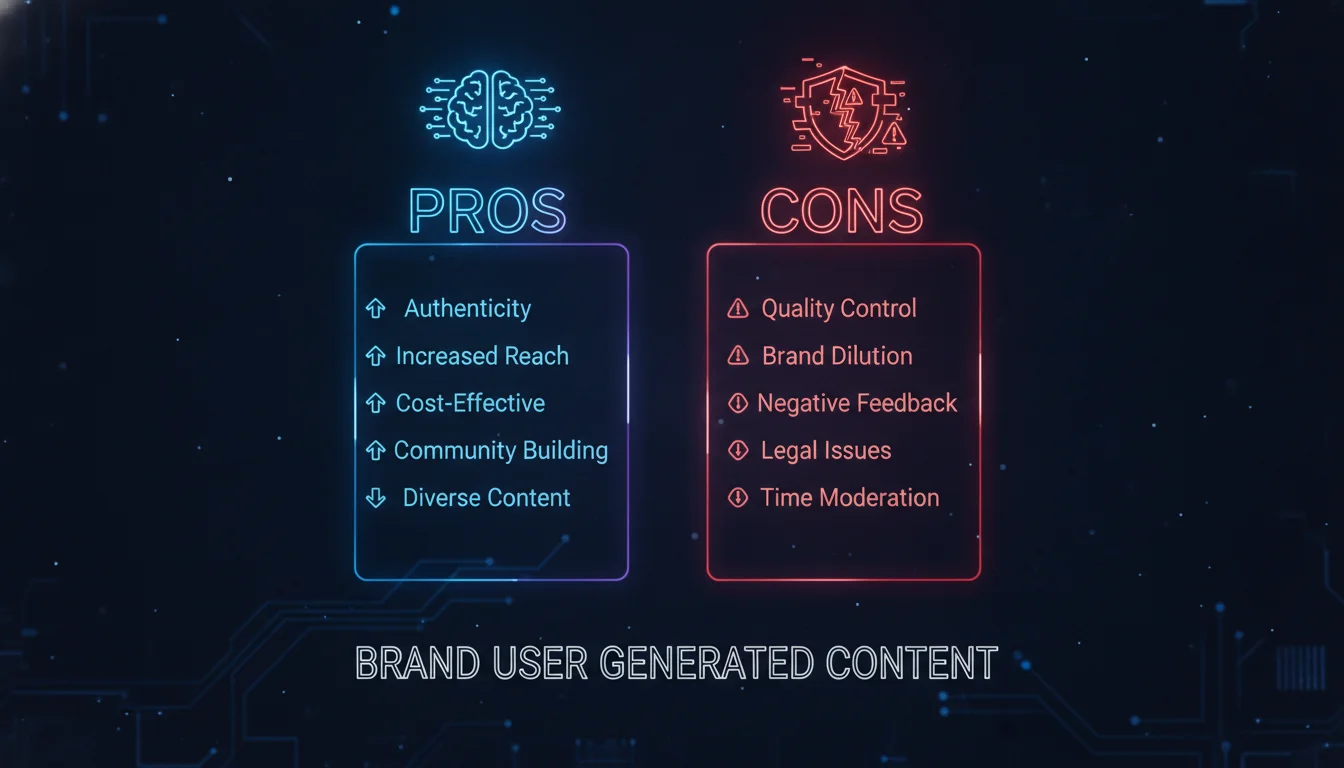
- Lower production costs: Brands tap a continuous stream of authentic assets instead of commissioning expensive photoshoots for every campaign.
- Higher trust and authenticity: Real people in real settings carry more credibility than scripted brand messages, driving stronger engagement and conversion.
- Built-in social proof: Customer photos, reviews, and videos answer buyer objections at the moment of decision, shortening the sales cycle.
- Community and loyalty: Inviting customers to create content turns them into active brand advocates, deepening long-term relationships.
- Scalability: A well-structured program generates a self-replenishing content pipeline across organic fans, employees, and paid creators.
Cons
- Quality is unpredictable: Organic UGC varies widely in production value, and not every customer post will meet brand standards.
- Rights management complexity: Brands must secure explicit permission before reposting customer content, adding legal and operational overhead.
- Disclosure requirements: Paid UGC must be clearly identified as sponsored content, which can reduce the perceived authenticity that makes UGC valuable in the first place.
- Attribution is messy: Organic this type of content often influences purchases without a clean last-click attribution path, making ROI harder to isolate.
- Risk of off-brand content: Without clear prompts or guidelines, customers may create content that misrepresents the brand or conflicts with campaign messaging.
The Core Benefits of a User-Generated Content Strategy

Cost-Effective Content Production
User-generated content eliminates the steep costs associated with professional content creation and high-profile influencer partnerships, according to the AMA. Instead of commissioning expensive photoshoots for every campaign, marketing teams can draw from a constant stream of authentic, on-brand content from customers and advocates. Adobe Business makes this efficiency central to its UGC framework: this kind of generated content dramatically reduces the cost and time required to produce high volumes of campaign assets (Adobe Business).
This does not mean UGC is always free. Paid creator programs, usage rights platforms, and editing still carry costs. But the direct investment per usable asset is typically lower than studio production, and the authenticity of customer endorsements often lifts engagement and conversion rates alongside those savings.
Stronger Social Proof and Authenticity
Social proof is the psychological tendency to follow the actions and opinions of others when making decisions. A the user generated content strategy supplies social proof at scale because it shows real people celebrating products rather than actors reading scripts. The AMA highlights that trust in personal recommendations significantly outweighs trust in traditional advertising, and more than half of millennials rely on friends and family recommendations when deciding what to buy.
That authenticity also protects the brand from skepticism. When a customer shares an unfiltered unboxing video or a candid product photo, it cuts through the noise of polished ad campaigns because it is perceived as genuine and unbiased, a point Adobe Business makes central to UGC’s value proposition.
Improved Engagement and Community Building
Inviting customers to create content turns them from mere buyers into active members of the brand story, building a deep sense of community and loyalty. This engagement drives repeat business and encourages advocacy. A brand that consistently features customer content signals that it listens, values its audience, and is willing to share the spotlight.
Warner Bros. and PhotoRoom’s Barbie Selfie campaign is a standout example of UGC virality, according to the AMA. The campaign invited users to create their own Barbie-inspired images, and the resulting flood of selfies demonstrated how a creative prompt can generate widespread visibility without a traditional media buy. Low friction plus cultural relevance equals outsized reach.
“User-generated content is authentic and scalable social proof that validates your brand’s promise. It’s the digital equivalent of word-of-mouth, operating at a mass scale to build trust and influence purchasing decisions in a way that brand-created content often cannot.” – Adobe Business
Types of User-Generated Content and Where They Fit
Written, Visual, and Audio-Video Formats
Business.com groups user-generated content into three forms: written content such as reviews, comments, testimonials, and social media posts; visual content such as images, photos, graphics, and infographics; and audio and video content such as video reviews, unboxing videos, tutorials, and podcasts (Business.com). A healthy content strategy uses all three because each serves a different purpose in the marketing funnel.
Adobe Business emphasizes visual content as the most common form, including images and videos that can be quickly repurposed for high-impact social media, email, or campaign use. Video content such as product unboxings or demos is especially compelling because it shows potential buyers how the product works in real life, not just how it looks in a studio.
Organic UGC vs. Paid UGC
Consumers who create and produce user-generated content without financial compensation fall under the category of organic UGC, according to Coursera. Examples include customer photos, social media posts, reviews on Google or Yelp, and blog mentions. Paid UGC campaigns occur when a brand pays a content creator to make videos or take photos promoting or using its product, and those posts must disclose sponsored content (Coursera).
Organic brand user carries the highest authenticity, while paid UGC offers more control and guaranteed delivery. Many brands combine both: organic content for social proof and community, paid creator content for product launches, retargeting ads, and always-on creative testing.
Comparing UGC Sources and Use Cases
| Content Source | Typical Formats | Best Use Case | Level of Brand Control |
|---|---|---|---|
| Customers (organic) | Reviews, photos, social posts, unboxings | Product pages, social proof, email | Low |
| Brand loyalists | Testimonial videos, community posts, stories | Advocacy campaigns, loyalty programs | Medium |
| Employees | Behind-the-scenes photos, demos, day-in-the-life | Employer brand, culture content | Medium-high |
| Paid UGC creators | Product-in-action videos, testimonial videos, lifestyle photos | Paid social, ads, website creative | High |
| Brand advocates | In-depth reviews, tutorials, unboxings | Long-form content, community proof | Medium |
Sources: Combined from Adobe Business, American Marketing Association, Coursera, and Business.com. This table illustrates that no single source fits every goal. The most mature generated content programs blend multiple sources and match the level of creative control to the channel and conversion objective.
How to Build a Brand User Generated Content Engine
A Scalable Process in Five Steps
- Step 1: Define objectives and KPIs. Decide whether the program targets trust, conversion lift, cost savings, or loyalty. Adobe Business advises tying UGC benefits to key performance indicators such as conversion rate, customer lifetime value, and marketing ROI.
- Step 2: Identify content sources. Segment contributors into customers, brand advocates, employees, social media followers, and UGC creators, as outlined by the AMA. Each group requires different outreach, incentives, and rights processes.
- Step 3: Set creative briefs and quality standards. Even authentic content needs clear guidelines. For paid creators, brief product-in-action videos, testimonial videos, unboxing videos, and lifestyle photos just as platforms like Trend do for brands (Trend). For organic UGC, provide hashtags, prompts, and shot lists that maintain authenticity without over-directing.
- Step 4: Collect, moderate, and secure usage rights. Always obtain permission before reposting customer content. Maintain a content library with metadata for creator, platform, and rights. Platforms such as Trend offer 100% licensing rights to content commissioned through their network, which reduces legal risk.
- Step 5: Distribute and measure across channels. Integrate UGC on product pages, email campaigns, social ads, billboards, and commercials. Track performance against the KPIs set in step one and iterate based on what actually converts.
Rights Management and Legal Essentials
User-generated content is not automatically free to use. Even when a customer tags your brand, you need explicit permission to repost the image or video on your website, paid ads, or packaging. Best practice includes direct messages asking for permission, a written release for commercial use, and clear recordkeeping. Paid UGC must be disclosed as sponsored content, according to Coursera, particularly on platforms where audiences may confuse creator endorsements with organic sentiment.
Brands should also consider platform-specific rules and local advertising regulations. A simple rights workflow, request, document, store, and monitor, can prevent takedown requests and protect the brand from copyright claims. This is not optional overhead. It is the foundation of a defensible this type of content program.
Using a UGC Platform Without Losing Authenticity
Dedicated platforms can scale brand user generated content by connecting brands with vetted creators and handling production logistics. Trend, for example, reports a curated network of over 3,700 creators, a waitlist of more than 15,000 creators, and delivery of more than 46,000 images and 31,500 videos to over 1,000 brands (Trend). That operational scale is now available to brands that want consistent UGC without building an in-house creator team from scratch.
The risk of platforms is overproduction that loses the raw, candid feel audiences prefer. The solution is to brief creators on genuine scenarios, use real settings, and avoid scripted dialogue. Greenfly emphasizes that UGC works because it is less staged and less promotional. Platforms should amplify that quality, not erase it.
“The image or video created by a ‘normal person’ isn’t professionally made or shot in a studio, and that makes it more authentic, more realistic, more relatable and less staged and less promotional.” – Greenfly
Real-World Examples of User-Generated Content in Action
Brand Campaigns Built on UGC
The best brand user generated content campaigns share a simple architecture: a clear prompt, a low-effort creation format, and a brand willing to celebrate customer creativity rather than control it. Coursera points to Coca-Cola, Apple, and LEGO as popular brands that have built UGC campaigns around exactly that formula (Coursera). Apple’s #ShotOniPhone campaign turns customer photography into global billboards. LEGO invites builders to submit custom creations. Each example uses a simple prompt to generate large volumes of brand-aligned content from passionate users.
The Warner Bros. and PhotoRoom Barbie Selfie campaign, cited by the AMA, is another standout. Users created their own Barbie-styled images using PhotoRoom’s editing tools, and the campaign’s UGC skyrocketed in popularity. The lesson: a low-friction creative tool plus a culturally relevant prompt can outperform a traditional push campaign on reach and resonance.
GoPro and the Action Camera Ecosystem
GoPro illustrates how brand user generated content can become the primary creative supply for an entire brand. Customers capture extreme moments, tag the brand, and GoPro reposts the best clips across social, product pages, and paid ads. This approach turns every customer into a potential content producer and keeps the pipeline full without a proportional increase in production spend. The model works because the product itself creates the incentive to share.
What These Examples Teach About Brand User Generated Content
Brands that try to make UGC look like a studio ad usually fail because audiences detect the polish. The campaigns that scale share three traits: a clear prompt or hashtag, a low-effort creation format, and a brand willing to let real settings, real faces, and real moments carry the message. Control less. Celebrate more.
Measuring the ROI of User-Generated Content
Core Metrics for UGC Performance
UGC ROI is measured through the same commercial lens as other marketing investments. Key metrics include web conversion rate, cost per acquisition, engagement rate, click-through rate, and customer lifetime value. The AMA reports a 29% boost in web conversions for campaigns with UGC, making conversion lift a primary benchmark. Brand user generated content also maximizes marketing ROI by reducing content production costs while improving engagement and conversion rates, according to Adobe Business (Adobe Business).
Operational efficiency is another metric worth tracking. Adobe Business frames UGC as a way to de-risk content investment: instead of betting the budget on one high-cost shoot, brands tap a continuous stream of authentic assets. Tracking cost per asset and time to publish reveals the efficiency gain alongside revenue impact.
Attribution and Testing Challenges
Measuring UGC is not without challenges. Organic brand user generated content may influence a purchase without a clean last-click attribution path, especially when it appears in social feeds, product reviews, or community forums. Brands that rely solely on last-click attribution will undercount UGC’s contribution to revenue. A better approach pairs full-funnel analytics with lift tests: run product pages with and without customer photos, or serve ads with UGC creative against studio creative, and compare conversion rates directly.
The 93% of marketers who said UGC performs notably better than traditional branded content, reported by Business.com, provides directional confidence. But your own testing should isolate the creative variable, channel, and audience segment to avoid treating UGC as a universal winner in every context.
Setting Realistic Expectations
Not every piece of UGC will go viral. Greenfly notes that although not every piece of user-generated content will catch fire on the internet, the potential for virality always exists. The goal is not a one-off viral moment but a consistent pipeline of authentic proof that lifts trust and conversion over time. A mature brand user generated content program measures cumulative performance, not just individual post spikes.
Making Brand User Generated Content a Competitive Advantage
The Strategic Takeaway
Brand user generated content is no longer a tactical add-on. It is a strategic infrastructure for trust, conversion, and cost efficiency. The evidence from the American Marketing Association, Adobe Business, and Business.com converges on one point: audiences prefer authentic customer stories, and brands that operationalize those stories outperform traditional advertising on key commercial metrics.
To turn brand user generated content into a durable advantage, marketing leaders must move beyond one-off hashtag campaigns. They need rights management, a clear content hierarchy, a mix of organic and paid creators, and measurement systems that link UGC to revenue. Brands that build this infrastructure will not just collect content. They will build a self-reinforcing community that markets on their behalf.
Next Steps for Your Brand
Start with a pilot focused on one product or campaign. Identify existing customer photos and reviews, secure permission, and test them on a high-traffic product page or ad set. Measure conversion lift against a control. Use those results to justify a larger UGC engine, whether that means hiring a community manager, commissioning paid creators, or adopting a platform like Trend for scaled production.
The shift toward authenticity is structural, not cyclical. Brands that embrace brand user generated content as a core operating model will be positioned to earn attention, trust, and revenue in 2026 and beyond. Ready to build something that actually resonates? Contact Emin Media for a free brand consultation and let’s build a UGC strategy that works as hard as your customers do.
Frequently Asked Questions
Is UGC still a thing in 2026?
Yes. User-generated content remains a central marketing strategy because consumers continue to prefer authentic customer stories over polished ads. The global UGC market is projected to reach $32.6 billion by 2030, according to Grand View Research data cited by Coursera.
Is UGC a legit way to make money?
Yes. Paid UGC creators earn money by producing photos and videos for brands, with content used directly on the brand’s channels. Platforms like Trend connect creators with brands and report a network of over 3,700 vetted creators delivering thousands of assets, showing a real paid ecosystem with consistent demand.
How to start UGC as a beginner?
Start by practicing product-in-action videos, unboxings, and testimonial-style content with everyday products. Build a portfolio, join creator platforms, and learn to brief and deliver content that looks authentic while meeting brand specifications.
What are examples of UGC content?
Examples include customer reviews, social media photos with a brand hashtag, unboxing videos, product demos, testimonials, and customer-submitted blog posts. Paid UGC includes product photography and video content commissioned by a brand from a creator who discloses the sponsorship.
What is the difference between organic UGC and paid UGC?
Organic UGC is created by customers without financial compensation, such as reviews or social posts. Paid UGC is created by a compensated creator who produces content under a brand brief, and that content must be disclosed as sponsored per platform and advertising guidelines.
Do brands need permission to use user-generated content?
Yes. Brands should obtain explicit permission before reposting customer content on owned channels, paid ads, or packaging. A rights workflow covering request, documentation, storage, and monitoring reduces legal risk and respects creator ownership.
Enjoyed this article?
Contact Emin Media for a free brand consultation and let's create something amazing together.
Get in TouchRelated Articles
Digital Storytelling for Brands: The Complete Guide
Digital storytelling for brands builds real audience connections through narrative. Learn proven techniques, formats, and…

Design Thinking for Marketing: A 2026 Guide
Design thinking for marketing builds campaigns around real user needs. Learn the 5 phases, common…

Creative Direction for Video Shoots: A Complete Guide
Master creative direction for video shoots with proven steps, tools, and strategies that build brand…