Brand Touchpoints Mapping: The Complete 2026 Guide
Key Takeaways
- Brand touchpoints mapping is the process of identifying and evaluating every interaction customers have with your brand across their journey.
- Effective brand touchpoints mapping reveals which moments build trust and which ones quietly push customers away.
- Most journeys break down into four stages: awareness, consideration, purchase, and post-purchase, each with distinct touchpoints.
- A structured brand touchpoints mapping exercise combines customer personas, journey documentation, and performance data.
- Consistency across touchpoints matters more than volume. A handful of standout moments beats a scattered pile of mediocre ones.
- Regularly revisiting your map keeps it useful as customer behavior and channels shift.
“Mapping brand touchpoints is not just about identifying interactions; it’s about understanding the emotional journey of the customer.” – Marketing Expert
touchpoints mapping is the process of identifying and analyzing every interaction a customer has with your brand throughout their journey. It covers direct moments like ads and checkout, plus indirect ones like reviews and word of mouth. Done well, it shows exactly where trust gets built or broken.
What is Brand Touchpoints Mapping?
this type of mapping is the practice of cataloging and studying every interaction a customer has with your brand, from a scroll-stopping ad to a follow-up email six months after purchase. This includes both direct and indirect interactions: advertisements, social media engagements, customer service calls, and product experiences. By mapping these touchpoints, brands gain a clearer picture of customer behavior, preferences, and friction points, which ultimately shapes the entire experience people have with you.
Think of it as building a mood board for your customer’s entire relationship with your brand, not just the pretty parts. Every screen, every email subject line, every hold-music loop is a brush stroke in that bigger picture.
Defining Brand Touchpoints
A brand touchpoint is any moment where a customer engages with a brand. These interactions happen at every stage of the customer journey, from initial awareness to post-purchase follow-up. Examples of brand touchpoints include:
- Digital Interactions: Website visits, social media posts, and email marketing.
- Physical Interactions: In-store experiences, product packaging, and events.
- Indirect Interactions: Online reviews, word-of-mouth referrals, and media mentions.
As LinkedIn’s collection of customer experience best practices puts it, touchpoint mapping should always start with real journeys, documenting actual experiences rather than idealized flowcharts, and should include the hidden moments too: onboarding emails, community threads, and the dead ends nobody planned for.
The Importance of Mapping Touchpoints
Mapping brand touchpoints matters for a few clear reasons:
- Understanding Customer Behavior: It shows how customers actually interact with you, not how you assumed they would, and which touchpoints carry the most weight.
- Improving Customer Experience: Analyzing touchpoints surfaces pain points and gaps, leading to a smoother overall experience.
- Enhancing Brand Loyalty: Positive touchpoint experiences build trust, and trust is what keeps people coming back instead of shopping around.
How Brand Touchpoints Mapping Actually Works
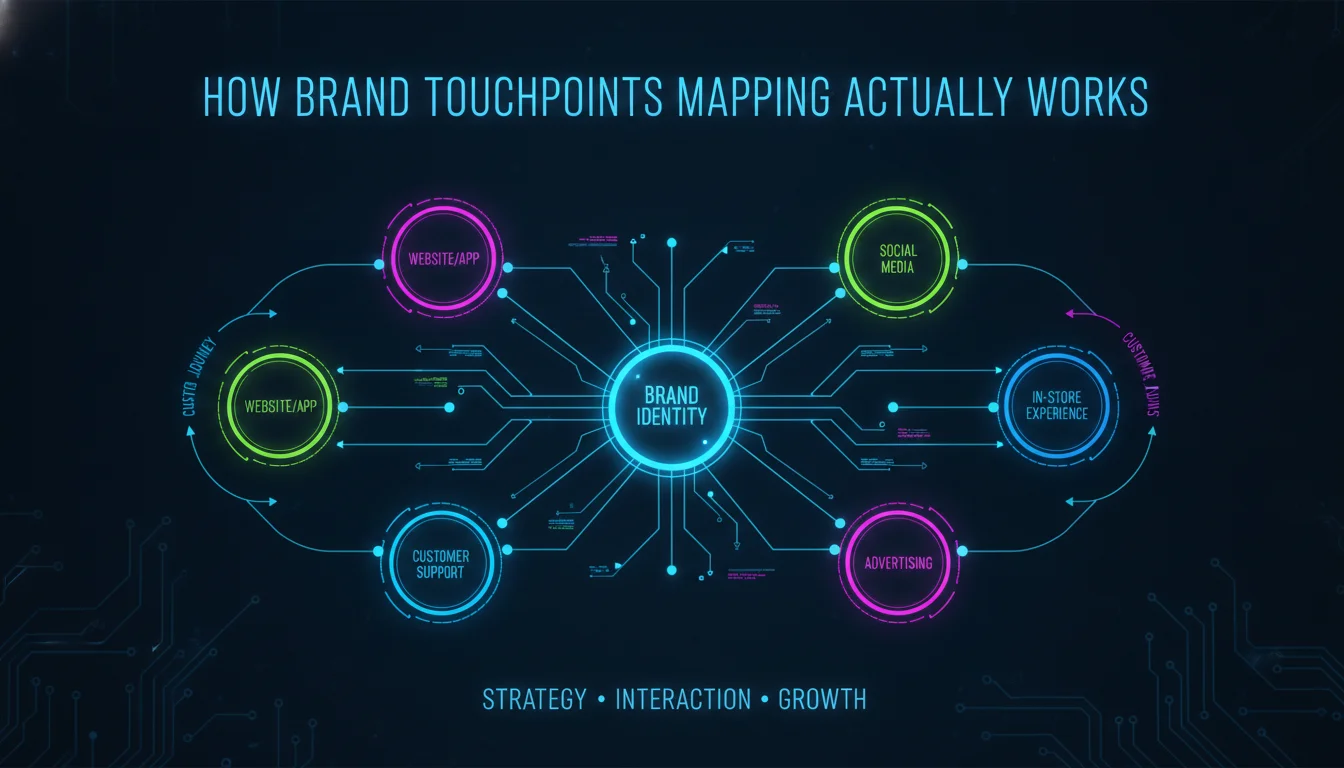
this kind of mapping works by pairing a documented customer journey with a full inventory of every interaction point, then scoring each one for impact and emotional weight. It’s part research project, part creative audit. You’re not just listing channels, you’re asking what each moment makes someone feel.
The mechanics generally follow this logic:
- Inventory: List every possible interaction, digital and physical, direct and indirect. This includes obvious ones (your website) and easy-to-miss ones (a shipping box, a hold-music track, a chatbot’s tone).
- Sequence: Place each touchpoint along the journey timeline, from first exposure to loyalty and advocacy.
- Score: Rate each touchpoint on frequency, emotional impact, and business outcome (does it drive conversion, retention, or referral?).
- Visualize: Turn the data into a map, usually a horizontal timeline or swimlane diagram, so teams can see the full picture at a glance.
- Act: Prioritize fixes and redesigns based on where the biggest gaps between expectation and experience show up.
According to UXPressia’s guidance on journey mapping, most teams should start with somewhere around 5 to 7 touchpoints as a baseline, since more always surface once you start digging into the actual business. That’s a useful gut check: if your first map has 40 touchpoints and no prioritization, you’ve built a spreadsheet, not a strategy.
Stages of the Customer Journey
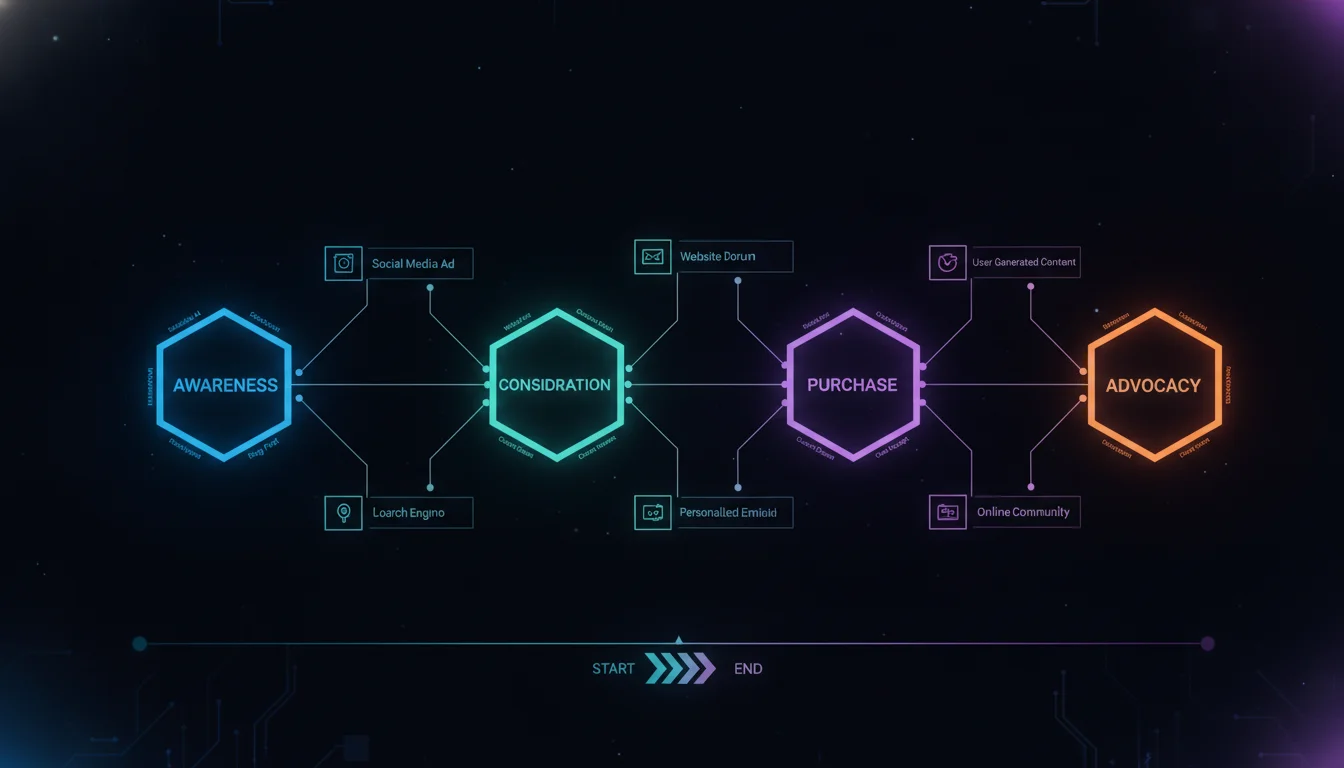
The customer journey can be divided into several stages, each with its own set of touchpoints. Understanding these stages is essential for effective brand touchpoints.
Awareness Stage
In the awareness stage, potential customers first encounter the brand. Key touchpoints include:
- Advertising: Digital ads, print ads, and social media promotions.
- Public Relations: Media coverage and press releases.
- Word of Mouth: Recommendations from friends or family.
Consideration Stage
During the consideration stage, customers evaluate their options. Important touchpoints include:
- Website: Product pages, blogs, and educational resources.
- Customer Reviews: Feedback from previous customers on review sites.
- Social Media: Engagement with the brand on platforms like Instagram and Facebook.
Purchase Stage
In the purchase stage, customers make their buying decision. Touchpoints here include:
- Sales Representatives: Interactions with sales staff, either in-store or online.
- Checkout Process: The ease of navigating the online or in-store checkout.
- Promotions: Discounts or loyalty incentives offered at the point of sale.
Post-Purchase Stage
After the purchase, customers continue to interact with the brand. Key touchpoints include:
- Customer Support: Assistance provided for product issues or inquiries.
- Follow-Up Communications: Emails or messages thanking customers for their purchase.
- Loyalty Programs: Rewards systems that encourage repeat purchases.
How to Apply Brand Touchpoints Mapping in Your Business
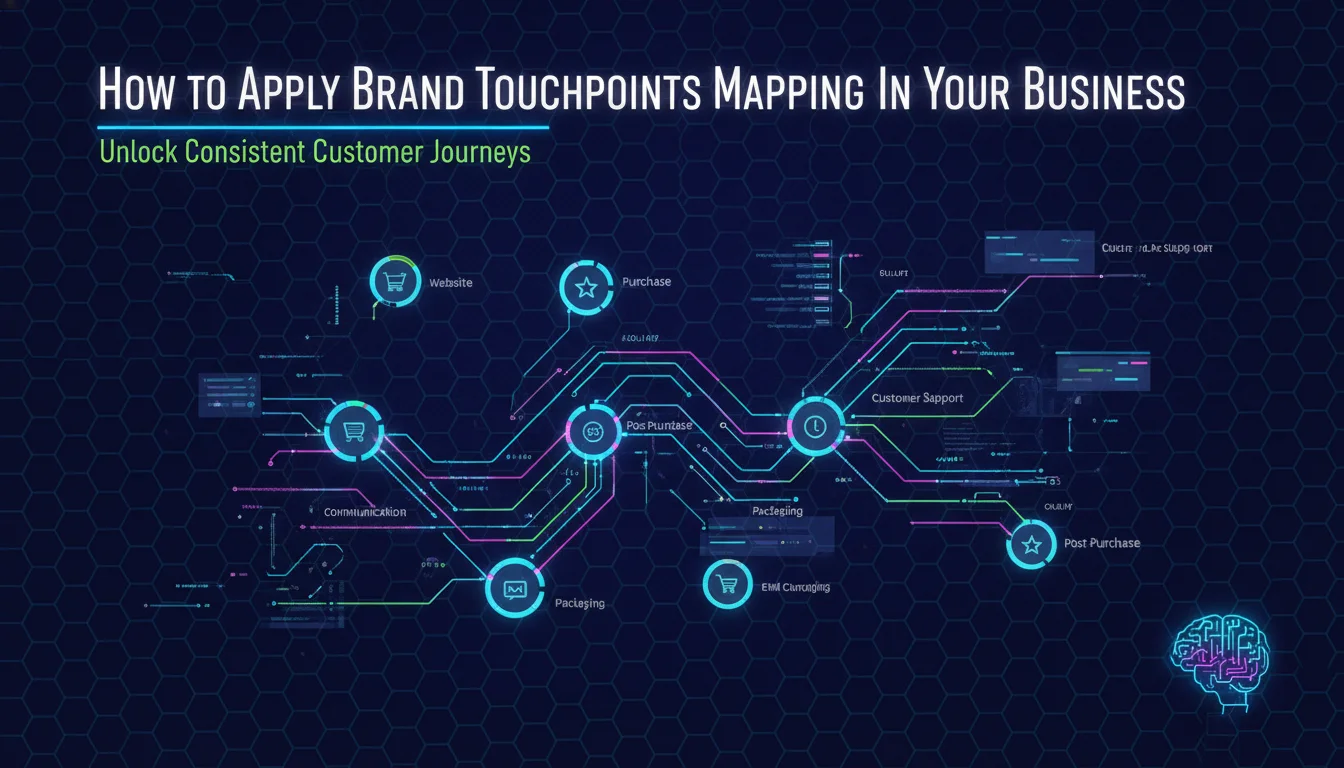
You apply touchpoints mapping by combining customer research, journey documentation, and cross-channel audits into one working map your team actually uses. Here’s the practical sequence we walk brands through:
- Build one focused persona. Pick a single user type and a single goal. Trying to map for every customer segment at once is how these projects die in committee.
- Walk the journey from their side. Sit down and move through the awareness, consideration, purchase, and post-purchase stages as your customer would, not as your org chart would.
- Log every touchpoint you find. Digital, physical, human. Include the ones that feel minor, like a delivery box or an automated text.
- Attach feelings, not just facts. Note where people feel confident, confused, delighted, or annoyed. Emotion is what actually drives loyalty or churn.
- Layer in data. Pull conversion rates, support ticket volume, review sentiment, and survey responses onto the map so it’s grounded in something more than opinion.
- Prioritize and fix. Find the moments causing the most drop-off or frustration and redesign those first. You don’t need to fix everything in one sprint.
Brand research from LinkedIn’s customer experience community reinforces this same order of operations: pick a persona, map the steps from their point of view, add every touchpoint, capture thoughts and feelings, enrich with data, then identify where to act.
Comparing Brand Touchpoints Mapping Approaches
Different tools and methods suit different team sizes and budgets. Here’s how the main approaches stack up:
| Approach | Best For | Strengths | Limitations |
|---|---|---|---|
| Whiteboard / sticky-note mapping | Small teams, early-stage brands | Fast, collaborative, cheap, great for workshops | Hard to update or share remotely; no data layer |
| Journey mapping software (e.g., UXPressia, Miro) | Mid-size teams needing shareable visuals | Templates, collaboration features, easy to revise | Still requires manual data input; learning curve |
| Analytics-driven mapping (e.g., Google Analytics) | Digital-heavy brands | Real behavioral data, tracks actual paths | Misses offline and emotional touchpoints |
| Survey-based mapping (e.g., SurveyMonkey) | Brands wanting the voice of the customer | Captures feelings and satisfaction directly | Self-reported, can miss silent churners |
| Blended agency-led mapping | Brands wanting strategic depth | Combines data, creative audit, and business strategy | Higher upfront cost; requires outside collaboration |
Most brands land somewhere in the middle: a blended approach that pairs a visual mapping tool with real analytics and direct customer feedback. No single tool tells the whole story on its own.
Best Practices for Brand Touchpoints Mapping
To effectively map brand touchpoints, consider the following best practices:
1. Start with Customer Personas
Understanding your target audience is crucial. Create detailed customer personas that outline demographics, preferences, and behaviors. This will help tailor touchpoints to meet their needs.
2. Map the Entire Customer Journey
Document every stage of the customer journey, from awareness to post-purchase. Identify all potential touchpoints and categorize them based on their significance.
3. Analyze Touchpoint Effectiveness
Evaluate the effectiveness of each touchpoint. Use metrics such as customer satisfaction scores, conversion rates, and feedback to assess performance.
Tools for Mapping Brand Touchpoints
Several tools can assist in the this type of mapping process:
1. Customer Journey Mapping Software
Tools like UXPressia and Miro provide templates and frameworks for visualizing customer journeys and touchpoints.
2. Analytics Platforms
Utilize analytics platforms like Google Analytics to track user interactions and gather data on touchpoint performance.
3. Survey Tools
Tools like SurveyMonkey can help gather customer feedback on their experiences with various touchpoints. SurveyMonkey’s own research on customer journey touchpoints groups examples into pre-purchase, during-purchase, and after-purchase buckets, which is a genuinely useful way to organize your first map.
A Worked Example: Mapping Touchpoints for a Growing DTC Brand
Picture a mid-size direct-to-consumer skincare brand that’s growing fast but starting to see repeat purchase rates soften. Leadership suspects something is off in the experience but can’t pinpoint where. This is a textbook case for this kind of mapping.
The team starts by building one persona: a returning customer, age 28-40, who found the brand through Instagram. They walk the journey step by step. Awareness comes through a paid social ad and an influencer mention. Consideration involves scrolling the website, reading reviews, and checking an ingredient glossary. Purchase happens through a mobile checkout that takes four steps. Post-purchase includes a shipping notification, an unboxing experience, and a 30-day check-in email.
When they overlay data, the map reveals two soft spots: the mobile checkout has a noticeably higher abandonment rate than desktop, and the 30-day check-in email has weak open rates compared to earlier messages in the flow. Neither issue was visible from looking at revenue alone. Once flagged, the fixes are targeted: simplify checkout to two steps, and rewrite the check-in email with a more personal subject line. That’s the entire value of brand touchpoints in one scenario: it turns a vague feeling that something’s wrong into a specific, fixable moment.
Common Mistakes in Brand Touchpoints Mapping
Even well-intentioned teams stumble on the same handful of mistakes when they start touchpoints mapping:
- Mapping from the inside out. Building the map around your org chart or internal process instead of the customer’s actual path is the single most common error.
- Ignoring the boring touchpoints. Packaging, invoices, and automated texts feel unglamorous, but they shape perception just as much as your homepage does.
- Treating the map as a one-time project. A map built once and never revisited goes stale fast as products, channels, and customer expectations shift.
- Mapping too many touchpoints without prioritizing. A 50-item map with no ranking is overwhelming and rarely gets acted on.
- Skipping the emotional layer. Logging what happens at each touchpoint without noting how it makes people feel misses half the insight.
- Working in channel silos. When social, email, and in-store teams each map their own slice separately, nobody sees the full, connected story.
Challenges in Brand Touchpoints Mapping
While mapping brand touchpoints is beneficial, several challenges may arise:
1. Data Overload
With numerous touchpoints, brands may struggle to analyze and prioritize data effectively. Focus on key touchpoints that significantly impact customer experience.
2. Changing Customer Expectations
Customer preferences and behaviors can shift rapidly. Regularly update touchpoint maps to reflect these changes and ensure relevance.
3. Integrating Across Channels
Brands often operate across multiple channels, making it challenging to maintain a consistent experience. Ensure that touchpoints are aligned and cohesive across all platforms.
Pros and Cons of Formal Brand Touchpoints Mapping
Is a formal mapping process worth the time investment? For most growing brands, yes, but it’s worth weighing the tradeoffs honestly before you commit a quarter to it.
Pros
- Surfaces friction points that revenue dashboards alone will never show you.
- Aligns marketing, sales, and support teams around one shared view of the customer.
- Creates a foundation for prioritizing design and content investment where it actually moves the needle.
- Builds institutional memory. New hires can see the full journey instead of piecing it together from tribal knowledge.
Cons
- Can turn into an academic exercise if it’s never tied back to specific fixes or campaigns.
- Requires ongoing maintenance. A map from two years ago may no longer reflect how people actually shop.
- Can be time-intensive to build properly, especially across omnichannel brands with dozens of touchpoints.
- Risk of analysis paralysis if teams try to fix every touchpoint at once instead of prioritizing.
Brand Spotlight: Where Small Details Compound
We’ve seen it play out again and again in our own client work: it’s rarely the flashy touchpoint, like the homepage hero video, that makes or breaks perception. It’s the quiet ones. A packaging insert. A confirmation email tone. A hold-music track. Campaign performance data indicates that consistent, well-designed micro-touchpoints compound over time into stronger brand recall than any single big campaign moment. That’s the mood-board mindset we bring to brand touchpoints mapping: every detail is a brushstroke, and the composition only works if each one pulls its weight.
Brand Touchpoints Mapping in 2026 and Beyond
As of 2026, brand touchpoints mapping has expanded well past the traditional website-and-storefront model. AI chat assistants, voice search results, and algorithm-driven social feeds are now legitimate touchpoints that shape perception before a customer ever visits your site. This year, more teams are treating these as first-class entries on their maps instead of afterthoughts bolted on at the end.
Looking ahead, the brands that win will be the ones who treat their touchpoint map as a living document, revisited quarterly rather than annually, with an eye on emerging channels as they show up in the data. Creative industry data shows that consistency across touchpoints remains one of the strongest predictors of brand trust, even as the channels themselves keep multiplying.
“Customer touchpoints function similarly to personal relationships. Each interaction, be it the first encounter or a later one, can either strengthen the relationship or lead to a departure,” notes Zendesk’s customer experience research team.
Conclusion
Brand touchpoints mapping is a vital strategy for understanding and enhancing customer interactions. By identifying and analyzing touchpoints, brands can improve customer experiences, foster loyalty, and drive growth. Regularly reviewing and updating your touchpoint map ensures your brand stays responsive to how customers actually behave, not how they behaved last year.
Ready to see your brand’s full picture? Explore our branding and creative services, or check out our thoughts on building a brand storytelling framework and this year’s social media trends for more ways to strengthen every touchpoint along the way.
Let’s build something bold. Contact Emin Media for a free brand consultation.
Frequently Asked Questions
What are the key stages in the customer journey?
The key stages in the customer journey are awareness, consideration, purchase, and post-purchase. Each stage has unique touchpoints that influence customer experience, and effective brand touchpoints mapping accounts for all four.
How can I identify my brand’s touchpoints?
Identify touchpoints by mapping the customer journey, analyzing interactions across every channel, and gathering direct customer feedback to understand their real experiences rather than assumed ones.
Why is consistency important in brand touchpoints?
Consistency in brand touchpoints builds trust and recognition, ensuring customers have a cohesive experience across every interaction with the brand, whether that’s a social post or a support call.
What tools can assist in touchpoint mapping?
Journey mapping software, analytics platforms, and survey tools can all assist in effectively mapping and analyzing brand touchpoints, though most teams get the best results by combining more than one.
How often should I update my touchpoint map?
Update your touchpoint map regularly, ideally every quarter, to reflect changes in customer behavior, new channels, and shifting market trends. Brand touchpoints mapping loses value fast once it stops matching reality.
What are the 7 touchpoints in branding?
There’s no single fixed list of seven touchpoints that applies to every brand, but many practitioners use 5 to 7 as a practical starting range covering awareness, consideration, purchase, and post-purchase moments. Industry guidance from journey mapping specialists like UXPressia treats that range as a baseline you’ll typically expand once you dig into your own business.
What’s the difference between brand touchpoints and marketing touchpoints?
Brand touchpoints focus on perception and identity, shaping how someone feels about who you are, while marketing touchpoints emphasize persuasion and conversion at specific moments in the funnel. Both work together, but brand touchpoints mapping typically takes the wider view, covering both categories across the full journey.
Enjoyed this article?
Contact Emin Media for a free brand consultation and let's create something amazing together.
Get in TouchRelated Articles
Digital Marketing for Creatives: A Bold Guide
Digital marketing for creatives builds real visibility and sales. Learn strategies for social media, SEO,…
Branding & Design Agency Tips That Actually Work
Discover branding and design agency tips to choose the right partner, set clear goals, and…
Creative Agency Pitch Deck Tips That Win Clients
Master creative agency pitch deck tips that win clients in 2026. Learn storytelling, design, and…