Brand TikTok Strategy: The 2026 Playbook
Brand TikTok Strategy: The 2026 Playbook
A brand TikTok strategy is a structured plan combining organic content, creator partnerships, paid ads, and TikTok SEO to drive measurable business results on the world’s fastest-growing discovery platform.
Key Takeaways
- Consistency beats virality: posting 3–5 times per week builds familiarity and primes audiences for conversions.
- The three-pillar model works: organic beats, creator partnerships, and paid peaks form a sustainable always-on presence.
- Data-driven experimentation using TikTok Analytics and creative testing tools helps refine what resonates with your specific audience.
- Creators and UGC amplify authenticity and can dramatically improve conversion rates when integrated into campaigns.
- TikTok Shop is a serious commerce channel, with sales projected to surpass $20 billion in 2026, according to Hootsuite.
- TikTok’s largest user base is aged 25 to 34, making it essential for reaching both Millennials and Gen Z with purchase intent.
What Is a Brand TikTok Strategy?
A tiktok strategy is a complete plan that defines how a business uses TikTok to hit marketing objectives: brand awareness, community building, lead generation, and sales. Unlike ad-hoc posting, it aligns every video, creator collaboration, and paid campaign with measurable KPIs and the brand’s unique voice. Below we break down the core definitions and foundational elements.
Defining TikTok Marketing for Brands
TikTok marketing is the practice of using TikTok to promote a brand, product, or service. According to Hootsuite, TikTok marketing includes influencer marketing, organic content, user-generated content, and paid content. A this type of strategy extends this by tying these tactics to a cohesive framework: it defines target audiences, content themes, posting frequency, creator selection criteria, ad budget allocation, and success metrics. For example, a strategy might specify that 70% of content will be original short-form videos, 20% will be creator collaborations, and 10% will be boosted posts to test audience response. That structure keeps every piece of content purposeful.
The Three Pillars of an Always-On TikTok Strategy
TikTok’s own guidance for brands outlines an “always-on” model built on three pillars: organic beats, creator partnerships, and paid peaks. Organic beats are the steady stream of near-daily posts that keep your brand visible and engaging. Creator partnerships involve collaborating with TikTok creators to tap into established audiences and authentic voices. Paid peaks are strategic campaigns that amplify top-performing organic content or launch new products. A sustainable this kind of strategy balances all three: organic builds trust, creators add credibility, and paid accelerates reach.
“A balanced combination of organic beats, creator partnerships and paid peaks will keep your brand dynamic and connected.” – TikTok for Business, Always-On Strategy Guide
Why TikTok Matters for Brands in 2026
TikTok is no longer just an entertainment app. It has become a critical channel for product discovery, search, and social commerce. Brands that ignore it risk missing engaged audiences and lower-cost customer acquisition. Here’s why a brand tiktok belongs in your 2026 marketing mix.
Audience Reach and Engagement Metrics
TikTok’s user base is massive and still growing. Hootsuite reports over 1.59 billion active users on the platform, with U.S. users spending an average of 44 hours per month on the app. Sprout Social notes that TikTok reached 1 billion users in September 2021, a record four years since its worldwide launch, whereas Facebook and Instagram each took eight years to hit that milestone. TikTok was also the first non-game app to generate $10 billion in consumer spending across the Apple and Google Play stores. Shopify projects TikTok could reach 2.2 billion users by 2027. About 90% of TikTok users access the app every day, and 53% of American TikTok users are over 30 years old, which dispels the myth that TikTok is only for teenagers. These numbers make a tiktok strategy essential for reaching both Gen Z and Millennial consumers with real purchase intent.
TikTok as a Search and Discovery Engine
TikTok’s search functionality has evolved into a genuine discovery engine. Hootsuite states that 64% of Gen Z use TikTok to search for products, tutorials, and reviews. The For You page algorithm shows videos based on interest signals rather than follower count, meaning a brand with zero followers can reach millions with a single video. This discovery-first model is unique among social platforms and requires a this type of strategy that prioritizes SEO-friendly captions, keywords, and relevant hashtags. TikTok SEO is becoming as important as traditional Google SEO for consumer brands.
Social Commerce and TikTok Shop
TikTok Shop has transformed the platform into a full-funnel commerce channel. Hootsuite projects TikTok Shop sales to surpass $20 billion in 2026. The in-app shopping experience shortens the path from discovery to purchase, letting users buy without leaving the app. A this kind of strategy that integrates TikTok Shop can drive direct sales and track performance through the platform’s affiliate marketing program, which lets creators earn commission on sales they generate. That combination of content and commerce makes TikTok a high-ROI channel for product-based brands.
How to Build Your Brand TikTok Strategy in 2026: Step-by-Step
Building a brand tiktok requires a deliberate, data-informed process. The following steps synthesize best practices from Hootsuite, Sprout Social, Shopify, and TikTok for Business. Follow them to create a scalable, repeatable approach.
Step 1: Define Goals and Research Your Audience
Start by clarifying what you want to achieve: brand awareness, engagement, lead generation, or sales. Your tiktok strategy must align with broader business objectives. Next, research your target audience using TikTok’s built-in analytics and third-party tools to understand demographics, interests, and content preferences. If your brand targets small business owners, you might find that educational how-to videos perform best. Audience research informs content themes, tone, and posting times. Sprout Social recommends creating a TikTok business account rather than a creator account to access full analytics and e-commerce features.
Step 2: Develop Content Pillars and a Consistent Cadence
Content pillars are the recurring themes your brand will own. Common pillars include behind-the-scenes, product tutorials, customer stories, and trend participation. A strong this type of strategy defines 3–5 content pillars and maps them to a weekly posting schedule. Consistency matters more than virality: posting 3–5 times per week builds familiarity and trains the algorithm to show your content. Use a social media management tool like Hootsuite or Sprout Social to schedule posts and monitor trends.
Step 3: Partner with Creators and Encourage UGC
Creator partnerships and user-generated content are essential for authenticity. TikTok’s Creator Marketplace connects brands with vetted creators. According to TikTok for Business, 48% of users said an ad was not intrusive after seeing an organic post from the brand, which highlights the priming effect of consistent organic content. Encourage customers to share their experiences using a branded hashtag. UGC feels more trustworthy than polished brand content and can be repurposed into paid ads. Driva, an Australian financial platform, worked with creators from TikTok Creator Marketplace and incorporated UGC into their video ads, achieving a 16% conversion rate and over 720,000 impressions.
Step 4: Amplify with Paid Ads and Measure Performance
Once organic content proves its worth, amplify top performers with TikTok Ads. The platform offers various formats including In-Feed Ads, Branded Hashtag Challenges, TopView ads, Branded Effects, and Spark Ads. A this kind of strategy should allocate a portion of budget to paid amplification to scale reach beyond organic followers. Measure everything: track views, engagement rate, click-through rate, conversion rate, and return on ad spend. Use TikTok Analytics to monitor audience demographics and content performance, then iterate. Double down on what works, cut what doesn’t, and test new creative formats regularly.
TikTok Ad Formats: What Brands Need to Know
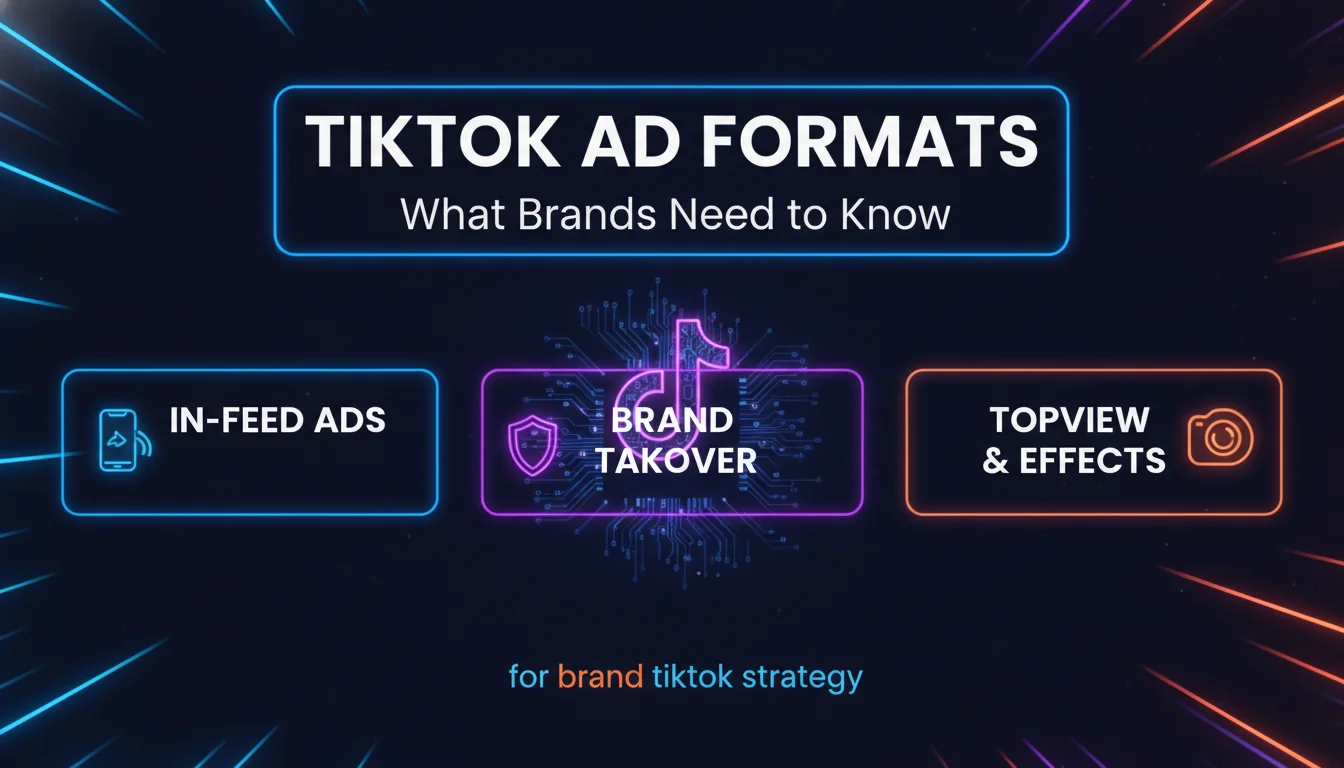
TikTok’s ad ecosystem offers more variety than most brands realize, and choosing the right format is a critical part of any brand tiktok. Each format serves a different objective and budget level.
- In-Feed Ads: Short videos that appear natively in the For You feed. Best for driving traffic, app installs, and conversions. They blend with organic content when done well.
- TopView Ads: Full-screen video that appears when users first open the app. Maximum visibility for product launches and brand awareness campaigns.
- Branded Hashtag Challenges: Invite users to create content around a branded theme. congstar used this format after building organic learnings, achieving a 26x average increase in organic content video views.
- Branded Effects: Custom AR filters and effects that users can apply to their own videos. Ideal for campaigns that want to generate UGC at scale.
- Spark Ads: Boost existing organic posts or creator content as paid ads. This format preserves the native feel of the content and works especially well when paired with the organic priming effect.
- Collection Ads: Combine video with a product catalog, letting users browse and buy without leaving the feed. A natural fit for brands running TikTok Shop.
“Brands should use a mix of organic and paid for best results. Organic content consistently, identify top performers, then boost them with paid spend to maximize ROI.” – TikTok for Business
Organic vs. Paid vs. Creator-Led: A Comparative Framework
A complete tiktok strategy uses a mix of organic, paid, and creator-led tactics. Each has distinct strengths, costs, and measurement approaches. The table below summarizes key differences to help brands allocate resources effectively.
| Aspect | Organic Content | Paid Advertising | Creator Partnerships |
|---|---|---|---|
| Primary Goal | Build brand familiarity and community | Scale reach, drive conversions | Leverage authentic voices, build trust |
| Cost | Low (time and creativity) | Medium to high (ad spend) | Medium (creator fees or commission) |
| Control | High (brand-created) | High (targeting, format) | Medium (co-created with creator) |
| Measurement | Views, engagement, follower growth | CTR, CVR, ROAS | Engagement, conversion, brand lift |
| Best For | Long-term brand building | Short-term campaigns, product launches | Authenticity and social proof |
Organic Content: Building Brand Familiarity
Organic content is the foundation of any this type of strategy. It lets brands experiment, learn what resonates, and build a loyal community without upfront media spend. Consistency is the engine: posting regularly keeps your brand visible and primes users for future paid campaigns. Chefs and Dogs, a pet-focused small business in Canberra, grew their TikTok audience to 2.5 million users largely through organic means by posting consistent, entertaining content and refusing to take themselves too seriously.
Paid Advertising: Scaling Reach and Conversions
Paid ads accelerate results by targeting specific audiences and appearing beyond your organic followers. A common and effective pattern is to post organic content consistently, identify top performers, then boost them with paid spend to maximize ROI. The 48% stat from TikTok for Business is worth repeating here: paid ads feel less intrusive when preceded by organic posts. That’s not a coincidence. It’s a system.
Creator Partnerships: Authenticity at Scale
Creator partnerships bring third-party credibility and access to niche audiences. TikTok’s affiliate program makes performance fully trackable, since creators earn commission on sales they drive. Sovereign Hill, a nonprofit tourism business, used trending sounds and popular hashtags created alongside creators to boost visibility, recording a 26,000 follower increase. Creator-led content often outperforms brand-created content because it feels native to the platform. A this kind of strategy should include a dedicated creator collaboration plan, not treat creators as an afterthought.
TikTok Business Account vs. Creator Account
Choosing the right account type is a foundational decision for any brand tiktok. The differences affect what tools you can access, how you schedule content, and whether you can run ads or open a TikTok Shop storefront.
| Feature | Business Account | Creator Account |
|---|---|---|
| Analytics Access | Full business analytics | Basic analytics |
| Sound Library | Limited (commercial sounds only) | Full access |
| Ecommerce Features | Storefront creation available | Not available |
| Third-party Tools | Scheduling and management integrations | Limited integration |
| Website Link | Available on profile | Available after 1,000 followers |
| Ad Tools | Full TikTok Ads Manager access | Not available |
For brands running a serious tiktok strategy, a business account is the only logical choice. Yes, you lose access to the full commercial sound library. But you gain analytics, ad tools, e-commerce integrations, and third-party scheduling, which are all non-negotiable for measuring ROI.
TikTok Content Formats and Creative Best Practices
The success of a this type of strategy hinges on creating content that feels native to TikTok. This section covers the core formats, trend participation, and UGC integration that drive real engagement.
Short-Form Video Fundamentals
TikTok is built on short-form vertical video, typically 15 to 60 seconds. High-performing videos hook viewers in the first three seconds. Use clear visuals, captions, and on-screen text to retain attention. TikTok recommends using auto-generated captions for accessibility and better consumption, as Sovereign Hill demonstrated. Content should entertain first, educate second, and sell last. Your brand TikTok strategy should define a consistent visual style, tone, and editing rhythm so that viewers recognize your content before they even see your name.
Leveraging Trends, Sounds, and Hashtags
Participating in trends increases discoverability. Monitor TikTok’s Creative Center and trending sounds to identify relevant opportunities. Use popular but relevant hashtags to appear in search and For You feeds. Don’t jump on every trend: select those that align with your brand voice and values. According to TikTok’s Next 2026 Trend Report, cited by Dash Social, audiences gravitate toward brands that embrace honesty, share behind-the-scenes moments, and clearly communicate product purpose rather than relying on polished sales messaging. Trend participation that fits your brand can boost visibility significantly. Trend participation that feels forced will hurt it.
User-Generated Content and Creator Collabs
UGC and creator collaborations are powerful because they feel authentic. Encourage customers to share their experiences with a branded hashtag, then repurpose the best content into ads, as Driva did to achieve a 16% conversion rate. Use CapCut for Business and TikTok Creator Marketplace to streamline production. Your brand TikTok strategy should allocate a dedicated portion of the content calendar to UGC and creator partnerships to maintain freshness and avoid creative fatigue.
Pros and Cons of Building a Brand TikTok Strategy
A brand TikTok strategy offers real advantages, but it also comes with genuine challenges. Here’s an honest look at both sides before you commit resources.
Pros
- Massive organic reach potential: TikTok’s algorithm surfaces content based on interest signals, not follower count. A brand-new account can reach millions with the right video.
- Lower cost of entry: Organic content requires creativity, not cash. Even small businesses with no dedicated team can compete with consistent, authentic posting.
- Full-funnel commerce integration: TikTok Shop connects discovery directly to purchase, shortening the buyer journey in a way no other platform currently matches.
- Creator ecosystem at scale: TikTok Creator Marketplace gives brands access to vetted creators across every niche, making authentic partnerships accessible at any budget level.
- Discovery-first algorithm: Unlike Instagram or Facebook, TikTok actively pushes content to new audiences, making growth faster for brands willing to post consistently.
Cons
- Content volume demands: Posting 3–5 times per week requires a real content operation. Brands that underestimate this burn out quickly.
- Limited commercial sound library: Business accounts lose access to trending music, which can make content feel less native if you’re not creative with original audio.
- Measurement complexity: Connecting TikTok views and engagement to actual revenue requires proper tracking setup and patience. Attribution is messier than paid search.
- Trend velocity: TikTok moves fast. A trend that’s relevant today may feel dated in 48 hours, which means your team needs to monitor the platform constantly.
- Platform risk: Regulatory uncertainty around TikTok in certain markets means brands should never make it their only channel.
Common Brand TikTok Strategy Challenges and Solutions
Implementing a brand TikTok strategy comes with predictable obstacles, and each has a practical solution. Many brands struggle to build a consistent presence due to resource constraints, content quality fears, and measurement complexity.
Limited Budget and Time
Small businesses often lack dedicated social media teams. The solution: start small. Commit to posting three times per week, batch-produce content in one sitting, and use free tools like CapCut for Business. Consistency beats perfection. Even simple videos shot on a phone can perform well, and a brand TikTok strategy can be scaled gradually as results justify more investment.
Content Quality Fears
Brands worry their videos aren’t polished enough. TikTok’s algorithm favors authenticity over production value. The 48% stat from TikTok for Business makes this concrete: organic, less-produced content builds the trust that makes paid ads feel welcome rather than intrusive. Behind-the-scenes clips, casual product demos, and employee takeovers often outperform glossy ads. Embrace the imperfection.
Measuring ROI and Avoiding Creative Fatigue
Measuring TikTok ROI requires tracking both top-funnel metrics (views, engagement) and bottom-funnel metrics (clicks, conversions, sales). Use TikTok Analytics and third-party tools to correlate content performance with business outcomes. To avoid creative fatigue, refresh content by testing new formats, sounds, and creators. Driva avoided creative fatigue by using creators to update content regularly. Your brand TikTok strategy should include a test-and-learn process where underperforming content is iterated or retired, not just repeated.
Brand TikTok Strategy Examples That Work
Real-world examples show how a brand TikTok strategy drives measurable results across different business sizes and industries. These cases are drawn from verified competitor evidence and TikTok for Business case studies.
Small Business Wins: Chefs and Dogs, Driva, Sovereign Hill
Chefs and Dogs, a pet-focused small business in Canberra, grew to 2.5 million TikTok users in under three years by posting consistent, entertaining content and refusing to take themselves too seriously. Driva, an Australian financial platform, used UGC from TikTok Creator Marketplace in their video ads, achieving a 16% conversion rate and over 720,000 impressions. Sovereign Hill, a nonprofit tourism business, used trending sounds and popular hashtags, added auto-generated captions, and recorded a 26,000 follower increase. These three cases prove that a focused brand TikTok strategy works for small and medium businesses, not just enterprise brands with massive budgets.
Enterprise Success: congstar and MaryRuth’s
congstar, a German telecom provider with over five million customers, started posting regular organic content featuring funny skits about everyday phone situations. After a few months, they launched a Branded Hashtag Challenge built on organic learnings, achieving a 26x average increase in organic content video views. Their profile grew from 1,700 to 3,200 followers in just six days. MaryRuth’s, a wellness brand, has built one of the most effective TikTok Shop operations on the platform, generating $25M+ in sales according to a LinkedIn post by a creator manager. They use data-backed content systems to identify viral formats and competitor creators rather than guessing. Enterprise brands can scale a brand TikTok strategy by integrating organic learnings with paid amplification and commerce features.
Making Your Brand TikTok Strategy Work in 2026
A successful brand TikTok strategy is not about chasing viral moments. It’s about building a sustainable, data-informed presence that compounds over time. The core principles stay consistent: authenticity, consistency, creator collaboration, and measurement.
Final Word on Organic Consistency
The clearest lesson across every source we reviewed: consistency matters more than virality. Posting 3–5 times per week, engaging with comments, and iterating based on analytics will yield better long-term results than sporadic attempts to go viral. A brand TikTok strategy must be treated as a continuous program, not a one-off campaign. Brands that commit to the long game win it.
Next Steps for Your Brand
To implement your brand TikTok strategy, start by creating a TikTok business account, define your content pillars, and commit to a posting schedule. Use tools like Hootsuite, Sprout Social, or TikTok’s native analytics to track performance. Partner with creators through TikTok Creator Marketplace and test paid amplification on top performers. Stay flexible: TikTok trends evolve quickly, and your strategy should evolve with them. If you want a team that’s already done this across branding, video production, and digital campaigns, we’re ready to help.
Ready to build something bold on TikTok? Contact Emin Media for a free brand consultation and let’s map out a brand TikTok strategy that actually moves the needle.
Frequently Asked Questions
What is the best marketing strategy for TikTok?
The best brand TikTok strategy combines consistent organic posting (3–5 times per week), creator partnerships for authenticity, and paid amplification on top-performing content. Start by defining your target audience and content pillars, then use TikTok’s Creative Center to follow trends and TikTok Creator Marketplace to find creators who match your audience. Measure everything and iterate based on what the data tells you.
Does TikTok pay $1 per 1000 views?
No. TikTok’s Creator Fund and other monetization programs do not pay a flat $1 per 1,000 views. Payments vary based on engagement, region, and program terms, and most creators earn significantly less per view. Brands should monetize through TikTok Shop, affiliate marketing, and sponsored content rather than relying on creator fund payouts.
What is the 3-second rule on TikTok?
The 3-second rule is a widely used best practice suggesting that videos must capture attention within the first three seconds to prevent viewers from scrolling away. Effective hooks include bold text, surprising visuals, or a compelling question. A strong brand TikTok strategy designs every video with this principle in mind from the very first frame.
How can I make $1000 a month on TikTok?
Brands and creators can earn money through TikTok Shop sales, affiliate commissions, sponsored posts, and live gifts. To reach $1,000 per month, focus on building a loyal audience, creating high-converting product content, and either partnering with brands as a creator or running your own brand’s TikTok strategy with commerce features fully activated.
Which tools are best for managing a brand TikTok strategy?
Hootsuite, Sprout Social, and TikTok’s native Business Suite are the top tools for scheduling, analytics, and engagement management. For creative production, CapCut for Business and TikTok Creative Center help brands stay on trend. For creator collaborations, TikTok Creator Marketplace is the essential starting point.
How often should a brand post on TikTok?
Posting 3–5 times per week is a sustainable cadence for most brands. Some brands post daily, but quality and relevance should never be sacrificed for volume. Track engagement rates over time to find your optimal posting frequency, then protect it.
Enjoyed this article?
Contact Emin Media for a free brand consultation and let's create something amazing together.
Get in TouchRelated Articles
Digital Storytelling for Brands: The Complete Guide
Digital storytelling for brands builds real audience connections through narrative. Learn proven techniques, formats, and…
Design Thinking for Marketing: A 2026 Guide
Design thinking for marketing builds campaigns around real user needs. Learn the 5 phases, common…

Creative Direction for Video Shoots: A Complete Guide
Master creative direction for video shoots with proven steps, tools, and strategies that build brand…