Brand Strategy Examples: 6 Brands That Got It Right
Key Takeaways
- Brand strategy is a long-term plan to outmanoeuvre competitors through differentiation, not a set of marketing tactics.
- The most successful brand strategy examples combine clear purpose, positioning, personality, and consistent visual identity.
- Purpose-driven brands like TOMS can generate stronger trust and recommendation: four to six times more, according to Zeno Group research of 8,000 global consumers.
- According to Harvard Business Review, consistent branding can increase revenue by up to 23%.
- Apple, Nike, Coca-Cola, Starbucks, and Tiffany & Co. each show a distinct strategic route: lifestyle, emotional storytelling, joy, experience, and color ownership.
Brand strategy examples are real-world cases showing how a defined purpose, clear positioning, and consistent visual identity drive customer loyalty and revenue. The cases below reveal practical frameworks you can adapt.
What Is a Brand Strategy?
Brand Strategy Definition
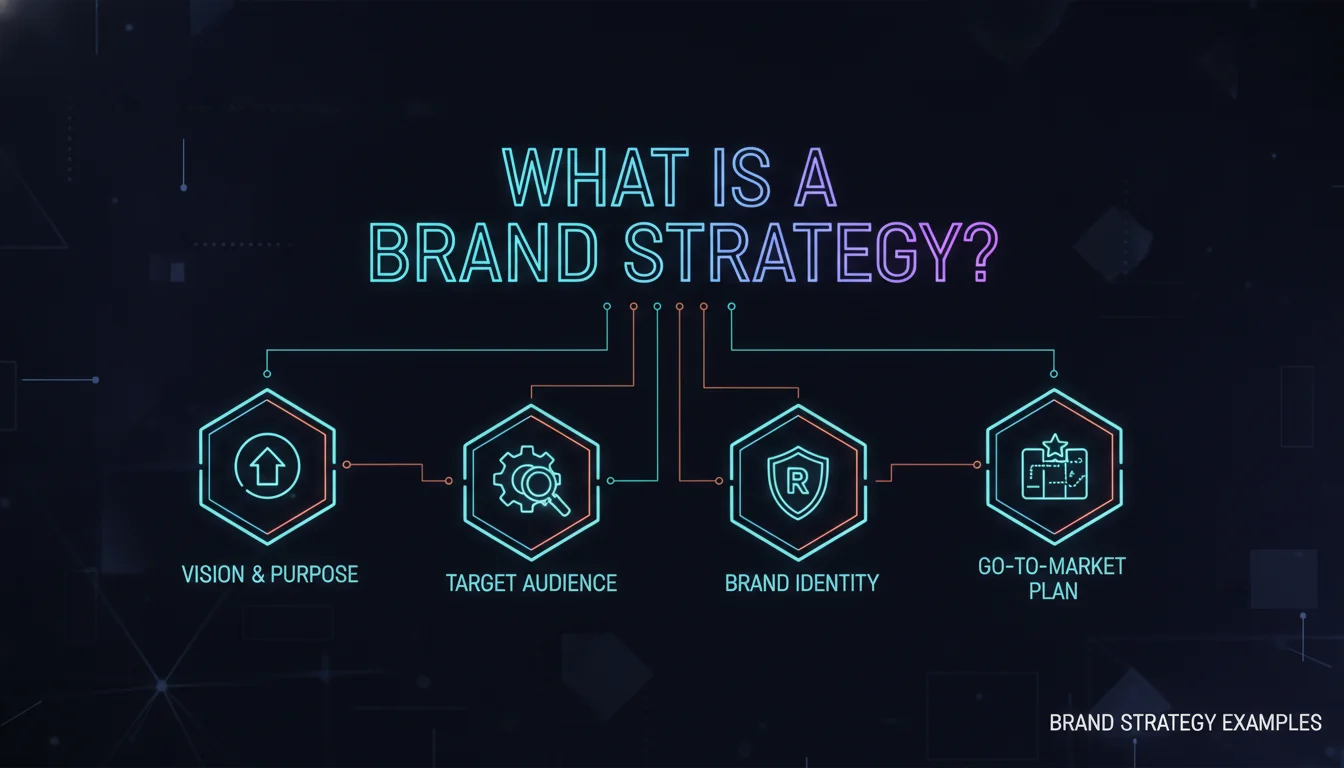
Brand strategy is the definition of a brand’s approach to who it targets, how it differentiates, and how it influences perceptions and decisions. Brand strategist Stephen Houraghan of Brand Master Academy uses this framing, and it cuts through the noise around branding. In practice, brand strategy is a long-term plan to outmanoeuvre competitors through radical differentiation, a definition often attributed to brand strategist and author Marty Neumeier. Unlike a marketing campaign, brand strategy does not change with the quarter. It is the stable foundation for every message, visual, and experience a business delivers.
“Brand Strategy is a long-term plan to out-manoeuvre competitors through radical differentiation.” – Marty Neumeier, brand strategist and author
Under this definition, a brand strategy is not a tagline, a logo, or even a mission statement by itself. Those are outputs. The strategy is the system that connects audience insight, competitive context, and brand capabilities to a repeatable market position.
Brand Strategy vs. Marketing Tactics
Brand strategy is often confused with marketing tactics such as social media marketing, advertising, or content marketing. Those activities are executional. They work best when they serve a larger strategic plan.
Marketing professor Mark Ritson captured the risk of ignoring this distinction: “Tactics without strategy is dumbing down our discipline.” Without strategy, marketers end up optimizing individual channels rather than building a coherent brand.
When studying strategy examples, look beyond a campaign’s cleverness. Ask: What underlying purpose, position, and perception does the brand repeat across every tactic? That repetition is the strategy working.
The Ten Core Brand Strategy Elements
Successful brands consistently use ten key elements to define their approach. According to Brand Master Academy, these are purpose, vision, mission, values, positioning, personality, voice and tone, brand story, heritage, and tagline. Not every brand leads with all ten, but each can drive a strategy or support others. TOMS leads with purpose, Apple leads with positioning and personality, and Tiffany & Co. leads with visual identity and heritage.
- Purpose is why the brand exists beyond money.
- Vision is where the brand is going.
- Mission is the commitment the brand makes to reach that vision.
- Values outline what the brand holds dear in how it operates.
- Positioning is the unique way the brand meets audience wants or needs.
- Personality gives the brand human characteristics.
- Voice and tone define how the brand sounds.
- Brand story is the narrative that connects the brand to its audience.
- Heritage is the history and proof that support credibility.
- Tagline condenses the brand idea into memorable language.
Why Brand Strategy Examples Matter
Purpose-Driven Brand Strategy Examples
Purpose is one of the strongest strategic levers in modern branding, and the data backs that up. According to a Zeno Group “Strength of Purpose Study” of 8,000 global consumers, people are four to six times more likely to buy from, trust, champion, and defend companies with a strong purpose. That is not a marginal preference. It is a decisive behavioral split that separates forgettable brands from ones people genuinely advocate for.
TOMS Shoes is a frequently cited case. Founder Blake Mycoskie traveled to Argentina in 2006 and saw children without shoes, which inspired a business built on giving. For every pair sold, TOMS gave a new pair to a child in need. The company now invests one-third of all profits into grassroots efforts. That purpose has become the strategy, not a side program.
Positioning and Differentiation Examples
Positioning is the most influential element in brand success, according to Brand Master Academy. It is the reputation a brand develops for meeting audience needs in a unique way. Good this type of examples show positioning in action: Apple positions around simplicity and innovation; Nike positions around ambition and athletic achievement; Coca-Cola positions around joy and togetherness. Each brand could compete on features, but instead they compete on a distinct emotional and perceptual promise.
Differentiation is not about being different in a vacuum. It is about being different in a way the target audience values. When a brand defines that difference clearly, every product, price, and campaign becomes easier to decide.
The Revenue Case for Consistency
Consistency turns strategy into measurable results. According to Harvard Business Review, consistent branding can increase revenue by up to 23%. That figure helps explain why brands like Coca-Cola and Tiffany & Co. maintain near-unchanged visual identities for decades. A consistent brand reduces cognitive load, builds memory structures, and makes future purchases more automatic.
Studying this kind of examples is not an exercise in creative admiration. It is a way to reverse-engineer the combination of purpose, positioning, and consistency that drives commercial results.
Brand Strategy Examples from Global Market Leaders
Apple: Lifestyle and Simplicity
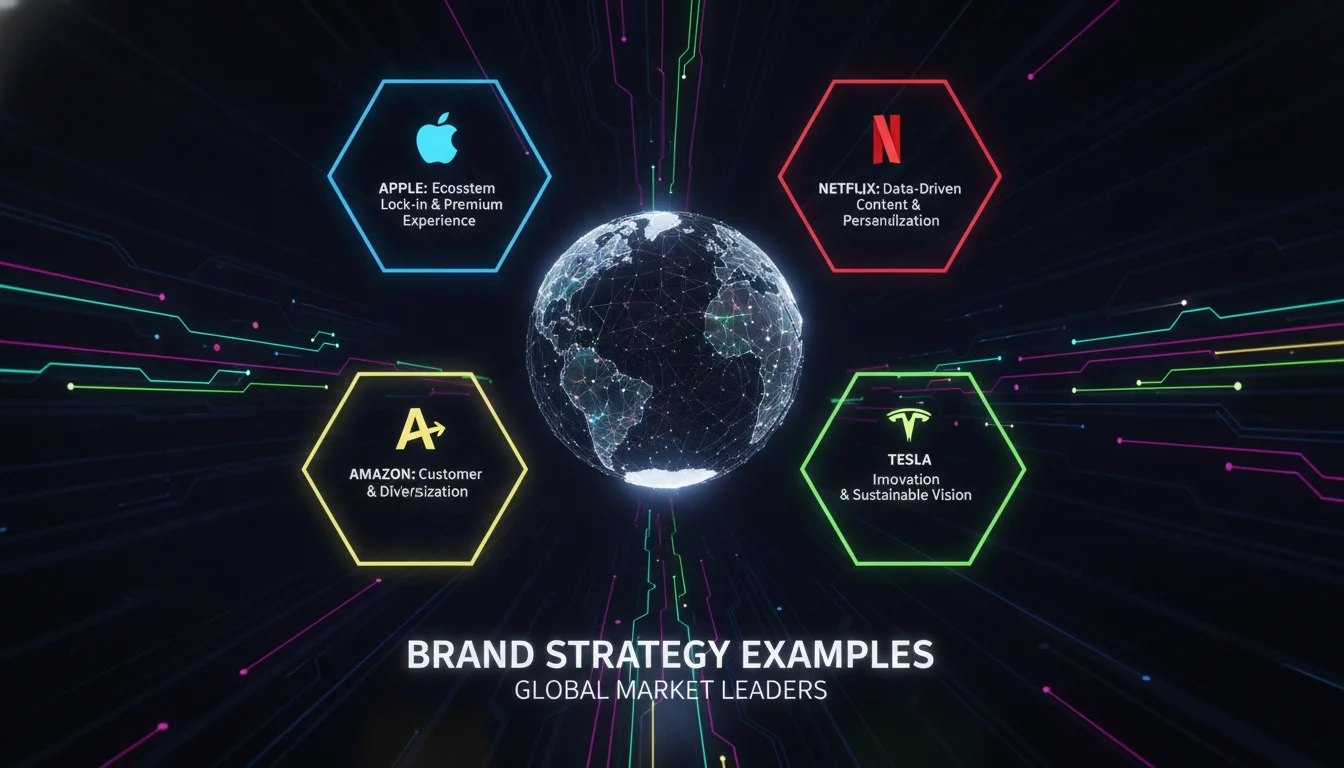
Apple’s brand strategy centers on positioning and simplicity, communicating innovation through every product rather than leading with technical specifications. The company promotes lifestyle marketing and turns devices into cultural symbols. The minimal design, silver-and-white palette, and clean typography reinforce a story of progress. Consistent experiences across hardware, software, and services build loyalty worldwide. This is a classic case among brand strategy where positioning and design carry the brand more than any single advertisement.
Apple’s strategic lesson is clear: define the customer’s self-image, not just the product. A brand can become a badge of belonging when every detail, from packaging to typography to retail environment, communicates the same value.
Nike: Emotional Athletic Storytelling
Nike’s brand strategy is built on a single belief: effort leads to greatness. Campaigns connect ambition with athletic performance, and the brand stands out through athlete endorsements and authentic storytelling. The swoosh logo, bold contrasts, and impactful typography ensure instant recognition. Engagement programs deepen customer relationships well beyond the transaction.
Unlike Apple’s minimalism, Nike’s strategy uses high-energy emotional narrative. The lesson from Nike among strategy examples is that emotion can be a platform. Nike does not just sell shoes. It sells a belief that is repeated across every channel, every season, every campaign.
Coca-Cola: Joy, Togetherness, and Consistency
Coca-Cola positions itself as the drink of joy and togetherness, and it has held that position with remarkable discipline for decades. Its Christmas ads and the “Share a Coke” campaign spark positive emotions. The brand reinforces recognition with its red-and-white palette and timeless script typography. Storytelling around happiness and personalized experiences increases loyalty across generations.
The “Share a Coke” campaign replaced the iconic logo with popular names on bottles, making the brand feel personal and immediate. That move also shows how a legacy brand can refresh engagement without abandoning its core strategy. Among this type of examples, Coca-Cola illustrates the power of a simple emotional promise maintained over decades.
Purpose-Driven Brand Strategy Examples
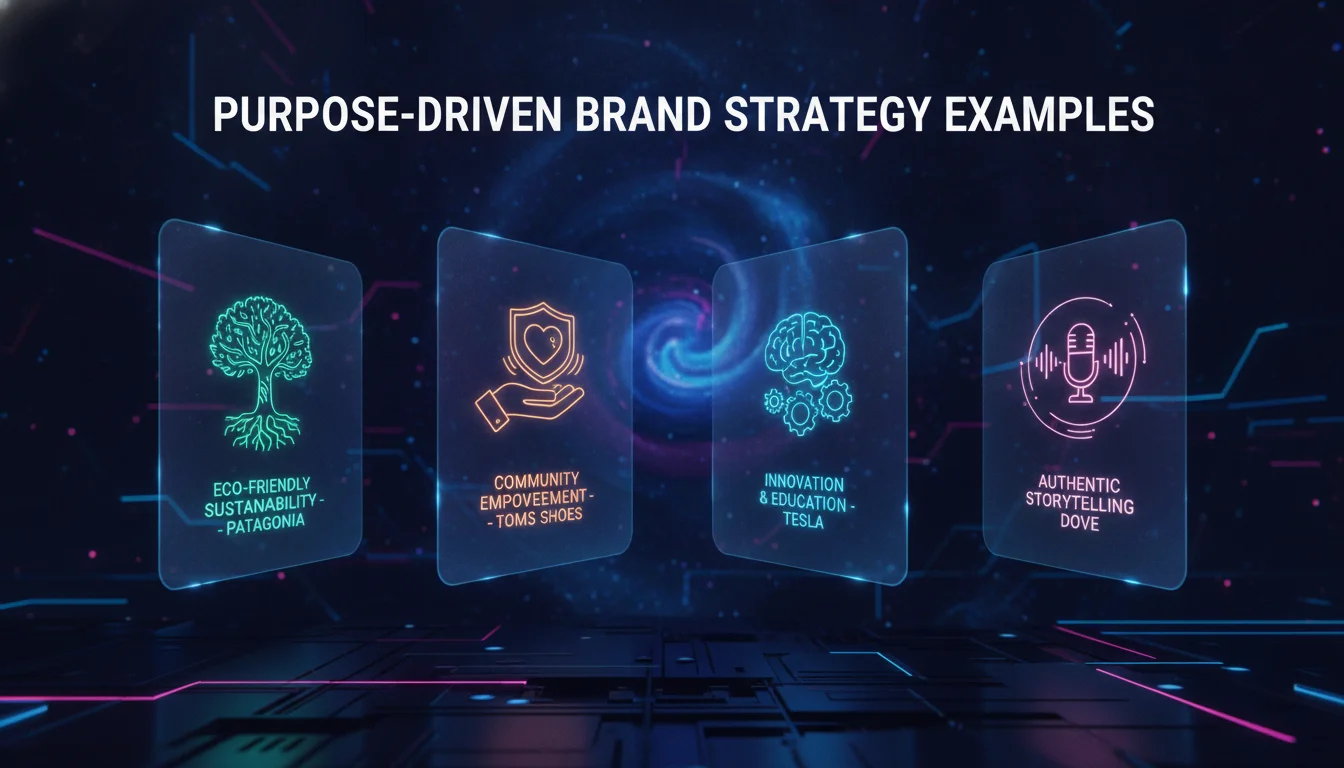
TOMS Shoes and the One-for-One Model
TOMS is one of the clearest this kind of examples of purpose driving the entire business model, not just a marketing message. The brand purpose statement is: “We believe in a future where all people have the chance to thrive.” Founder Blake Mycoskie traveled through Argentina in 2006 and experienced the hardships faced by children without shoes. That experience inspired him to create a brand with giving at its core: for every pair of shoes sold, a new pair would be given to a child in need.
TOMS still invests one-third of all profits into grassroots efforts. The 2021 Purpose Power Index ranks TOMS as #2 of the 20 most purposeful brands in the world. Purpose, executed this consistently, stops being a marketing angle and becomes the business itself.
Starbucks: Coffee as a Lifestyle Experience
Starbucks transforms coffee into a lifestyle experience, and that shift in category thinking is the core of its brand strategy. Customers return for seasonal drinks, rewards, and cozy spaces that feel familiar everywhere. Its brand strategy blends service differentiation with storytelling centered on community and connection. The green siren logo, earthy tones, and consistent store design reinforce warmth and ritual.
Starbucks shows that a brand can win by owning an experience category, not just a product category. Among purpose- and experience-driven brand strategy examples, Starbucks demonstrates how operational consistency and emotional warmth create a “third place” between home and work.
Visual Identity and Brand Strategy Examples
Tiffany & Co. and the Power of Color
Tiffany & Co. built its brand strategy around a single color, and that color now does more strategic work than most campaigns ever could. That shade of blue immediately signals luxury, elegance, and exclusivity. The clever use of color not only makes Tiffany’s products stand out but also anchors the brand in consumer memory. This is a textbook case among brand strategy examples of visual identity doing strategic work.
Color can be a legal and emotional asset. Tiffany Blue is so distinctive that it is part of the brand’s identity, instantly recognizable without a logo. That level of visual ownership is what many brands aspire to but few achieve.
Color Psychology in Brand Recognition
Colors help make a brand look good, but they also create a feeling. Red can signal excitement, blue trust, and gold luxury. Brands use color to tell a story before a single word is read. Coca-Cola’s red-and-white palette, Apple’s silver-and-white minimalism, and Tiffany’s blue each create a distinct emotional shortcut in the consumer’s mind.
For brands studying brand strategy examples, color is not decoration. It is a strategic asset that influences recognition, mood, and perceived value. A defined color system should align with the brand’s personality and positioning.
Typography and Cohesive Visual Systems
Typography plays a crucial role in branding, helping businesses express personality and maintain a cohesive visual identity. Coca-Cola’s timeless script, Apple’s clean sans-serif, and Nike’s bold contrasts each reinforce the brand’s character. A strong visual identity includes logo, palette, typography, imagery, and motion, all documented and used consistently.
The best brands do not treat visual identity as a collection of preferences. They treat it as a system. That system reduces variance, builds memory, and supports the brand promise across every touchpoint.
“Typography plays a crucial role in branding, helping businesses express personality and maintain a cohesive visual identity.” – Lettermine Studio, brand design research, 2026
How to Develop a Brand Strategy from These Examples
- Define Your Brand Purpose. Identify the reason the brand exists beyond money, and write it in one sentence. A clearly defined purpose helps the brand connect with the audience it serves. TOMS’ purpose statement, “We believe in a future where all people have the chance to thrive,” is a useful model for the level of clarity to aim for.
- Clarify Positioning and Target Audience. Specify the exact audience, their desire, and how the brand meets it uniquely. Positioning is the most influential element in brand strategy, according to Brand Master Academy. Be specific about who you serve and how you serve them differently from competitors.
- Build Visual and Verbal Identity. Translate the strategy into assets. Choose colors and type that match the brand personality. Tiffany’s blue expresses luxury; Nike’s bold type expresses energy. Define voice and tone, then document everything in brand guidelines. Consistent execution is what makes the strategy visible, and according to Harvard Business Review, it can increase revenue by up to 23%.
Comparing Brand Strategy Approaches
Overview of Approaches
Different brand strategy examples lead with different elements. The table below compares six well-known brands by primary strategic driver, execution style, and key lesson.
| Brand | Primary Strategic Driver | Execution Style | Key Lesson |
|---|---|---|---|
| Apple | Positioning and simplicity | Minimal design, lifestyle marketing | Own a cultural idea, not a feature |
| Nike | Emotional storytelling | Athlete endorsements, bold visuals | Make ambition the brand’s promise |
| Coca-Cola | Joy and togetherness | Classic red-and-white identity, personalization | Consistency builds generational loyalty |
| TOMS | Purpose | One-for-one giving model | Purpose can be the entire business model |
| Starbucks | Experience and community | Seasonal drinks, rewards, cozy spaces | Transform product into a lifestyle ritual |
| Tiffany & Co. | Visual identity | Tiffany Blue color ownership | A color can become a strategic asset |
Trade-Offs to Consider
Each approach involves trade-offs. A purpose-led strategy demands operational commitment, as TOMS’ giving model shows. An emotion-led strategy like Nike’s requires high creative investment to stay fresh. A visual-led strategy like Tiffany’s depends on strict color and design control. No single approach is universally best. The right one depends on market context, audience, and brand capabilities.
Pros and Cons of Building a Defined Brand Strategy
Pros
- Clarity across every channel. A defined strategy gives every team, from design to sales, a shared reference point. Decisions get faster and more consistent.
- Stronger customer loyalty. Brands with clear purpose and positioning build emotional connections that outlast any single campaign or product cycle.
- Revenue impact. According to Harvard Business Review, consistent branding can increase revenue by up to 23%, making strategy one of the highest-return investments a brand can make.
- Competitive differentiation. A well-defined position makes it harder for competitors to copy you, because they would have to copy your entire system, not just a logo or tagline.
Cons
- Requires long-term commitment. Brand strategy does not deliver results in a single quarter. Founders and marketing managers who need fast wins can find the timeline frustrating.
- Demands operational alignment. Purpose-led strategies like TOMS’ only work when the business model backs them up. Strategy that lives only in a deck is not strategy.
- Creative investment is ongoing. Emotion-led brands like Nike must keep producing high-quality storytelling to maintain relevance. The bar does not lower once you set it high.
Personal and Product Brand Strategy Examples
Personal Brand Strategy
Personal brand strategy applies the same ten elements to an individual rather than a company. A founder, creative director, or consultant who defines their purpose, positioning, and voice builds a reputation that travels with them across platforms and projects. The strategic logic is identical: clarity of difference, consistency of expression, and a clear audience in mind. As of 2026, personal branding has become a primary growth channel for founders and creative professionals, particularly across LinkedIn and short-form video.
Product Brand Strategy Examples
Product brand strategy focuses the strategy on a single product line rather than the parent company. This approach is common in consumer goods, where a company might own multiple product brands, each with its own positioning and personality. The parent company stays in the background while each product brand builds its own relationship with a specific audience segment. The strategic discipline required is the same: purpose, positioning, and visual identity must be defined and maintained at the product level.
Applying These Brand Strategy Examples to Your Business
Key Lessons to Remember
The best brand strategy examples are not imitated piecemeal. They are studied as systems. Apple’s minimalism works because it aligns with positioning, product, and retail. TOMS’ purpose works because it is embedded in the business model. Coca-Cola’s consistency works because it reinforces a simple emotional promise. To adapt these lessons, define your strategic elements, then execute them consistently across every touchpoint.
Next Steps for Marketers and Founders
Start by documenting your brand’s purpose, vision, mission, values, and positioning. Then audit your visual and verbal identity against that strategy. Close gaps in typography, color, and voice. Finally, measure consistency, because the payoff, according to Zeno Group and Harvard Business Review, is stronger trust and revenue growth. These brand strategy examples prove that strategy is the most practical brand investment you can make.
Ready to build something bold? Contact Emin Media for a free brand consultation and let’s define the strategy behind your brand.
Frequently Asked Questions
What is a brand strategy example?
A brand strategy example is a real brand’s defined approach to targeting, differentiation, and perception. Apple’s simplicity-led positioning and TOMS’ purpose-driven giving model are two distinct examples that show how strategy shapes every decision a brand makes.
What are the best brand strategy examples in 2026?
Leading examples include Apple, Nike, Coca-Cola, Starbucks, TOMS, and Tiffany & Co. Each leads with a different element: positioning, emotion, joy, experience, purpose, or visual identity. Studying all six gives you a full picture of the strategic options available.
How do brand strategy examples help a business?
They show how purpose, positioning, and consistency work together to build loyalty. According to Harvard Business Review, consistent branding can increase revenue by up to 23%, which means studying these cases is a practical, revenue-relevant exercise.
What is a purpose-driven brand strategy example?
TOMS Shoes is a classic case. Founder Blake Mycoskie built TOMS around giving a new pair of shoes for every pair sold, and the company now invests one-third of profits into grassroots efforts. The 2021 Purpose Power Index ranked TOMS #2 of the 20 most purposeful brands in the world.
Can a small business use these brand strategy examples?
Yes. Small businesses can adopt the same strategic elements, including purpose, positioning, personality, and consistent visual identity, without large budgets. The key is clarity and discipline. A well-defined strategy costs far less than years of inconsistent marketing.
What is the difference between brand strategy and marketing tactics?
Brand strategy is the long-term plan for differentiation and perception. Marketing tactics are the short-term actions, such as ads and social media posts, that execute that strategy. As Mark Ritson noted, tactics without strategy is dumbing down the discipline.
Enjoyed this article?
Contact Emin Media for a free brand consultation and let's create something amazing together.
Get in TouchRelated Articles
Digital Storytelling for Brands: The Complete Guide
Digital storytelling for brands builds real audience connections through narrative. Learn proven techniques, formats, and…

Design Thinking for Marketing: A 2026 Guide
Design thinking for marketing builds campaigns around real user needs. Learn the 5 phases, common…

Creative Direction for Video Shoots: A Complete Guide
Master creative direction for video shoots with proven steps, tools, and strategies that build brand…