Brand Perception Survey: The Complete Guide
A brand perception survey is a structured research tool that captures how customers, prospects, and stakeholders truly feel about your brand. It goes beyond awareness to reveal emotional associations, trust levels, and competitive positioning. Run one right, and you get a clear map of the gap between your intended brand and your lived brand.
Key Takeaways
- A perception survey captures emotional and cognitive associations, not just name recognition.
- Effective surveys mix quantitative rating scales with open-ended qualitative questions.
- Survey 10-12 questions maximum to protect completion rates and data quality.
- Run surveys after major campaigns, product launches, or brand repositioning efforts to track shifts over time.
- Insights should feed directly into marketing strategy, messaging, and product development, not just a slide deck.
- As of 2026, AI-powered analysis platforms are compressing turnaround from weeks to as little as 24 hours.
What Is a Brand Perception Survey?
A brand perception survey is a research tool designed to gauge how customers, prospects, and other stakeholders perceive a brand. It helps organizations understand the emotional and cognitive associations people hold, and how those associations influence purchasing behavior and loyalty.
Defining Brand Perception
Brand perception refers to the collective opinions and feelings consumers hold about a brand based on their experiences, interactions, and marketing communications. It covers brand identity, reputation, and emotional connection. Think about how Apple reads as cool, Yakult as healthy, or Harley-Davidson as rebellious. None of those associations happened by accident, and none of them live inside the brand. They live inside the customer.
As Qualtrics frames it, your customers own your brand. It is what they think it is. It promises what they say it promises. That framing should make every brand manager slightly uncomfortable, and appropriately motivated.
Brand Perception vs. Brand Awareness vs. Brand Identity
These three concepts get tangled constantly. Here is the clean separation:
- Brand awareness: Do people know you exist?
- Brand perception: How do people feel about you?
- Brand identity: How do you want people to feel about you?
A brand perception survey lives in the middle column. It measures the reality, not the intention. The gap between identity and perception is where most brand problems hide.
Why Brand Perception Surveys Matter
Conducting these surveys is vital because it allows brands to:
- Identify strengths and weaknesses in brand positioning.
- Understand customer sentiment and emotional attachment.
- Inform marketing strategies and brand messaging.
- Enhance customer loyalty by addressing negative perceptions.
- Support brand repositioning with real data, not assumptions.
According to Hanover Research, 95% of business leaders say measuring brand health has helped them improve customer satisfaction. That is a strong signal that perception research is not a nice-to-have. It is operational infrastructure.
How a Brand Perception Survey Works: The Underlying Mechanics
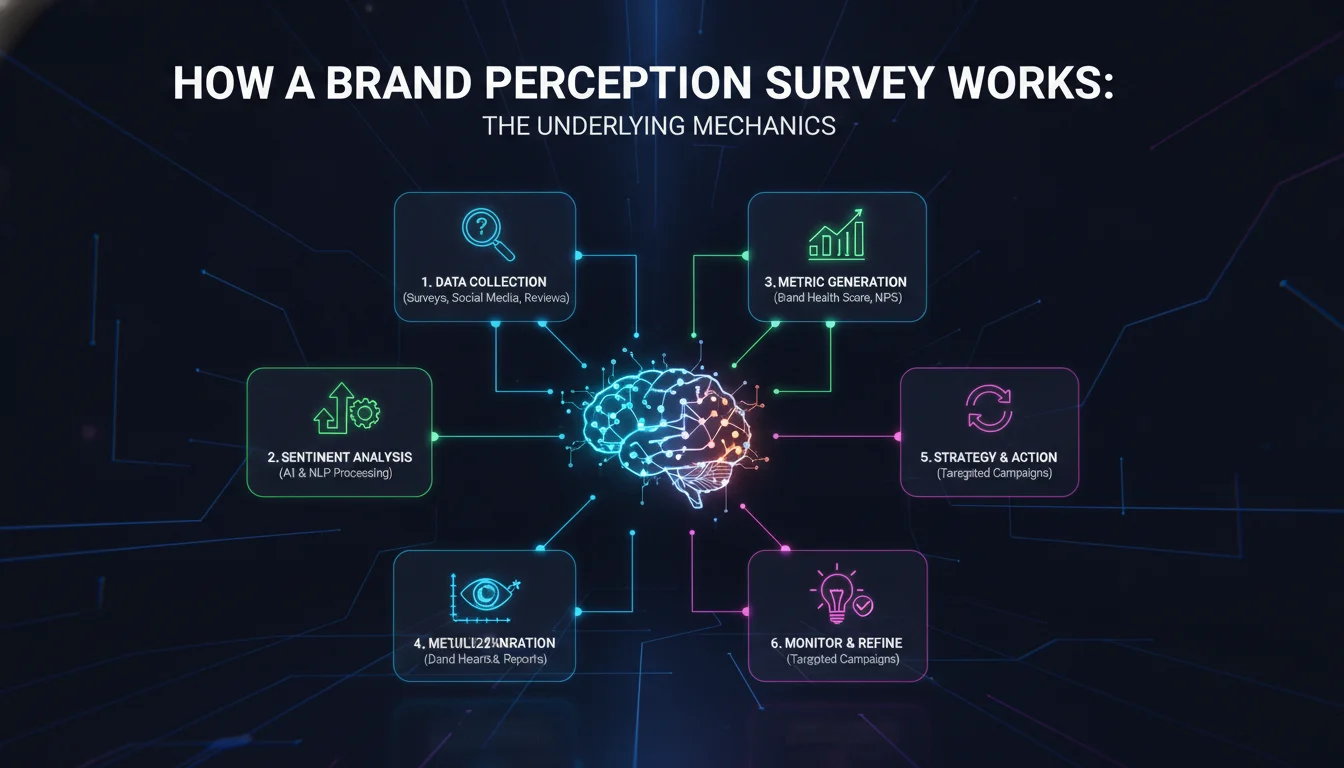
A brand perception survey works by systematically collecting responses across four core human factors that drive brand affinity, then analyzing patterns to reveal the gap between intended and actual brand image.
Qualtrics identifies these four factors as the engine behind every meaningful brand survey:
1. Cognitive Associations
These are the concepts and ideas a consumer connects to your brand. Cognitive questions surface the mental shorthand people use. When someone hears your brand name, what category, quality level, or personality type immediately comes to mind? Open-ended questions work best here first, followed by structured lists to quantify the patterns.
2. Emotional Connections
Emotion drives purchase decisions more than most marketers want to admit. Emotional questions identify whether your brand pulls people closer or pushes them away. Do customers feel trust, excitement, comfort, or skepticism? These answers explain loyalty and churn in ways that sales data alone never can.
3. Language and Description
How consumers describe your brand to others is your real brand voice. Not the one in your style guide. The language questions reveal the actual words your audience uses, which is gold for copywriting, ad creative, and positioning statements. If your customers describe you as “reliable and no-nonsense” but your website says “innovative and dynamic,” you have a messaging misalignment worth fixing.
4. Action and Experience
Past experience shapes future perception. Action questions assess the quality of every touchpoint: product use, customer service, packaging, and post-purchase support. Net Promoter Score (NPS) lives in this quadrant. So does the question that reveals your biggest retention risk.
The Survey Lifecycle
A well-run brand perception study follows a clear sequence. Hanover Research describes their process in four phases that apply whether you are running research in-house or with a partner:
- Project Kickoff: Define specific goals, target audience, and the decisions the data needs to support.
- Survey Design and Programming: Build the questionnaire with the right mix of question types, tested for clarity.
- Fielding: Launch through an online platform, monitor response rates, and review data quality in real time.
- Analysis, Reporting, and Delivery: Review responses, identify significant findings, and deliver recommendations tied to business decisions.
As of 2026, AI-powered analysis platforms like Hanover’s Rapid Insights are compressing the analysis phase dramatically, with interactive results available in as little as 24 hours for standard scopes. This changes the calculus for brands that previously avoided frequent surveying because the turnaround was too slow to be actionable.
Key Components of an Effective Brand Perception Survey
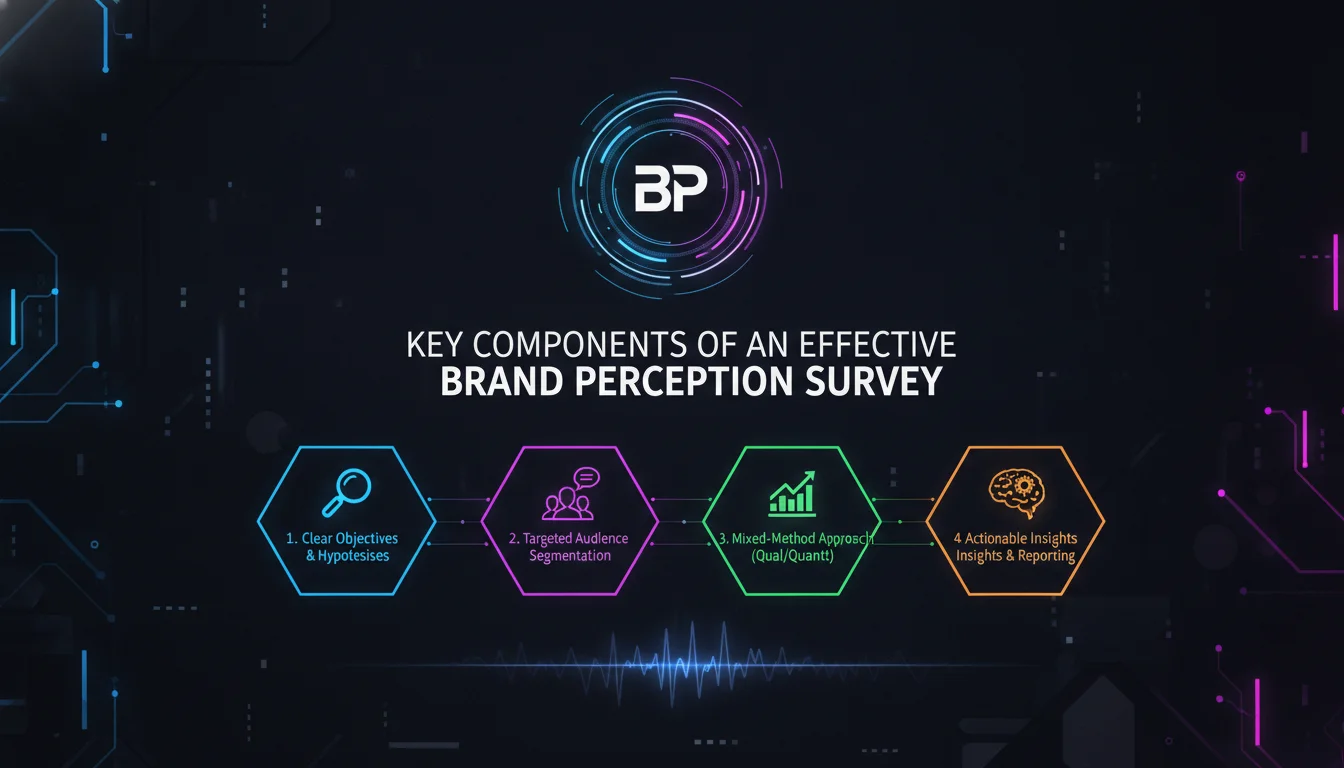
An effective brand perception survey combines the right question types, the right audience, and the right timing into a single coherent research instrument.
Survey Design and Structure
Surveys should include a deliberate mix of question types:
- Open-ended questions: Allow respondents to express thoughts freely, surfacing language and associations you did not anticipate.
- Multiple-choice questions: Provide structured options that make quantitative analysis clean and comparable over time.
- Rating scales: Measure the intensity of feelings or opinions, enabling trend tracking across survey waves.
- “Don’t know” or “N/A” options: Protect data quality by preventing forced responses that introduce noise.
Target Audience Selection
Identifying the right audience is as important as writing the right questions. Different segments provide fundamentally different data:
- Existing customers: Tell you how experience shapes perception after the sale.
- Prospects and non-customers: Reveal how your marketing and reputation land before anyone buys.
- Lapsed customers: Surface the perception shifts that drove churn.
- Industry stakeholders: Show how your brand reads in a professional or B2B context.
Tailoring the survey to specific demographics sharpens the relevance of every data point. A maternity wear brand surveying new mothers gets different, more actionable data than one surveying a general adult panel.
Timing and Frequency
Run surveys regularly to track changes in consumer attitudes over time. The most valuable moments to field a brand perception study include:
- After a significant marketing campaign or brand activation.
- Following a product launch or major product update.
- During or after a brand repositioning effort.
- After a public relations event, positive or negative.
- On a fixed annual or semi-annual cadence as a baseline health check.
Essential Questions to Include
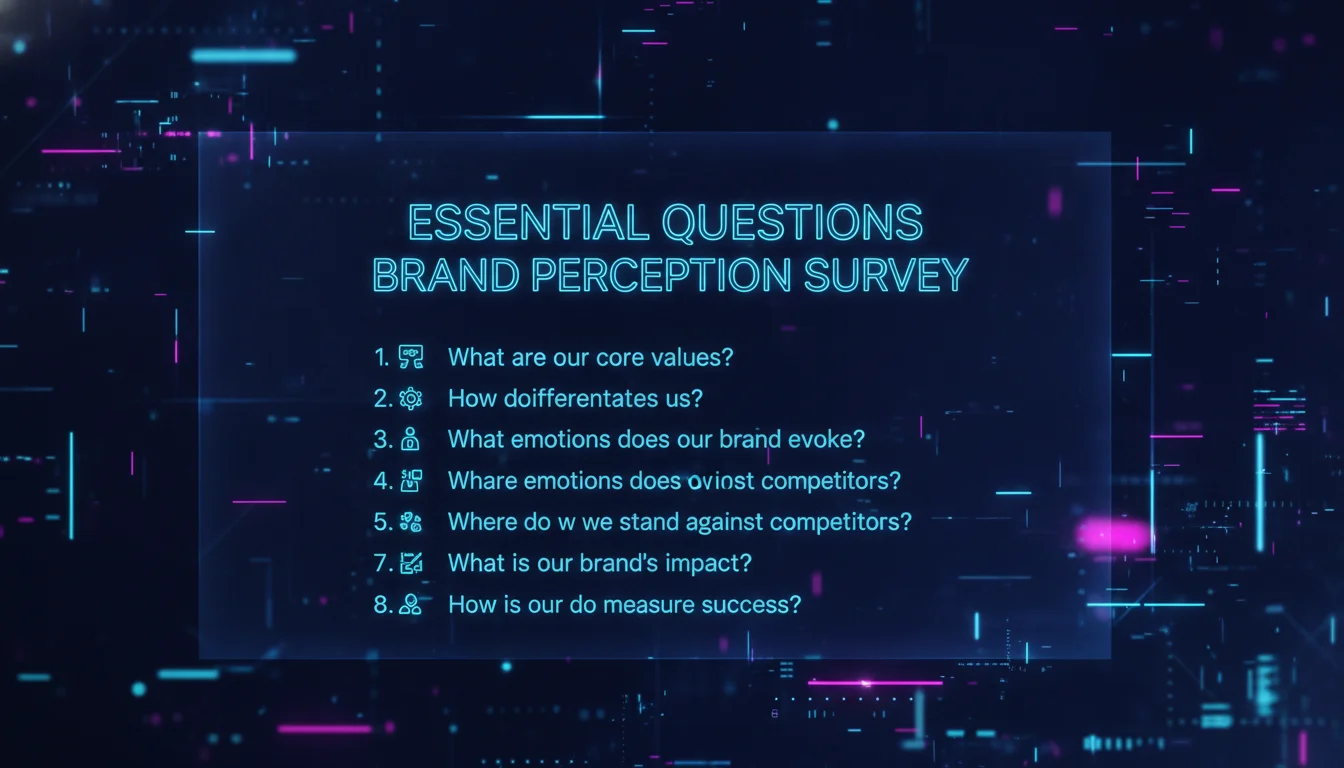
The questions in a brand perception survey should be crafted to elicit meaningful, actionable insights across all four brand affinity factors.
Understanding Brand Associations
- What three words would you use to describe [your brand]?
- What emotions do you feel when you think about [your brand]?
- Which of the following traits do you associate with [your brand]?
- When you think of [product/service category], which brand comes to mind first?
- Which messages do you associate with [your brand]?
Evaluating Brand Experience
- How would you describe your last experience with [your brand]?
- On a scale of 1-10, how likely are you to recommend [your brand] to a friend?
- What negative experiences have you had with [your brand]?
- How would you describe [your brand]’s customer service?
- What [your brand] product or service have you used, and how did you like it?
Assessing Brand Positioning
- How does [your brand] compare to competitors in terms of quality?
- What do you think about [your brand]’s pricing?
- Where do you think [your brand] sits in the market?
- Who do you think [your brand] is aimed at?
- What do you think about [your brand]’s advertising?
How to Run a Brand Perception Survey: Step-by-Step
Running a brand perception survey effectively requires a structured process from objective-setting through action, not just sending a form and hoping for useful data.
Step 1: Define Your Objectives
Before writing a single question, get clear on what decision this survey needs to support. Are you testing whether a rebrand landed? Diagnosing a drop in repeat purchases? Benchmarking against a competitor? Your objective shapes every subsequent choice. Vague objectives produce vague data.
Step 2: Identify Your Target Audience
Choose your respondent pool based on your objective. If you are measuring post-campaign perception, survey people who were exposed to the campaign. If you are diagnosing churn, survey lapsed customers. Match the audience to the question you are actually trying to answer.
Step 3: Design Engaging Questions
Write questions that are specific, unambiguous, and free of leading language. Mix open-ended and closed-ended formats. Start with broader brand association questions, then move to experience and positioning. Keep the total to 10-12 questions to protect completion rates.
Step 4: Make It Visually Appealing and Mobile-Friendly
A survey that looks broken on a phone will get abandoned. As of 2026, the majority of survey responses come from mobile devices. Use a clean, branded design. Keep questions visible without excessive scrolling. Progress indicators reduce drop-off.
Step 5: Pilot Test Before Launch
Run the survey with a small internal or external group before full launch. Look for confusing questions, technical errors, and questions that produce uniform answers (which means they are not discriminating between respondents). Refine based on what you find.
Step 6: Incentivize Participation Where Appropriate
Response rates improve when there is a reason to participate. This does not always mean cash. Early access to a product, a charitable donation in the respondent’s name, or a summary of findings can all drive participation without biasing responses.
Step 7: Distribute and Monitor
Launch through your chosen platform, monitor response rates daily, and check for data quality issues like straight-lining (respondents selecting the same answer for every question). Close the survey once you hit a statistically meaningful sample size for your audience.
Step 8: Analyze, Report, and Act
Use statistical analysis to identify trends and correlations. Prepare a report that includes key insights, specific recommendations, and clear next steps. Visualize data with charts and graphs. Then, critically, act on what you find. A survey that produces a report that produces nothing is a waste of everyone’s time.
Comparison of Brand Perception Survey Approaches and Tools
Choosing the right approach for your brand perception survey depends on your budget, timeline, audience size, and how deeply you need to analyze the results.
| Approach | Best For | Strengths | Limitations | Typical Turnaround |
|---|---|---|---|---|
| DIY Survey Tool (e.g., SurveyMonkey, LimeSurvey) | Small brands, quick pulse checks | Low cost, fast setup, easy distribution | Limited analysis depth, no expert design support | Days |
| Research Platform (e.g., Attest, Qualtrics) | Mid-size brands needing panel access | Built-in panels, stronger analytics, templates | Higher cost, learning curve | 1-2 weeks |
| Full-Service Research Firm (e.g., Hanover Research) | Enterprise brands, strategic decisions | Expert design, deep analysis, recommendations | Highest cost, longer timelines traditionally | 24 hours to weeks (AI-assisted) |
| In-House Custom Survey | Brands with internal research teams | Full control, proprietary methodology | Resource-intensive, requires expertise | Varies |
| Qualitative Only (interviews, focus groups) | Early-stage brand exploration | Rich, nuanced insights, unexpected findings | Not scalable, harder to quantify trends | 2-4 weeks |
Pros and Cons of Running a Brand Perception Survey
A brand perception survey is a powerful research instrument, but like any tool, it works best when you understand both what it does well and where it falls short.
Pros
- Direct customer voice: You hear exactly how your audience describes your brand, in their own language.
- Scalable and cost-effective: Surveys reach hundreds or thousands of respondents at a fraction of the cost of in-person research.
- Trackable over time: Repeat the same survey quarterly or annually to measure whether perception is improving or eroding.
- Flexible timing: Respondents complete surveys on their own schedule, which tends to produce more thoughtful answers than live interviews.
- Actionable outputs: Well-designed surveys produce specific, decision-ready insights for marketing, product, and brand teams.
- Competitive benchmarking: Include competitor questions to understand your relative position in the market.
Cons
- Self-report bias: People do not always behave the way they say they will. Stated preferences and actual behavior can diverge.
- Question design risk: Poorly written questions produce misleading data. Leading questions, double-barreled questions, and jargon all corrupt results.
- Response rate challenges: Survey fatigue is real. Getting a representative sample requires effort and sometimes incentives.
- Snapshot limitation: A single survey captures one moment. Perception shifts between waves can be missed without consistent cadence.
- Surface-level depth: Surveys rarely surface the “why” behind a perception as effectively as qualitative methods like interviews or focus groups.
Common Mistakes to Avoid
Most brand perception surveys fail not because the concept is flawed, but because the execution breaks down in predictable ways. Here are the patterns we see most often.
Asking Too Many Questions
A 30-question survey feels thorough to the person who built it. To the respondent, it feels like a punishment. Completion rates drop sharply as length increases. Keep it to 10-12 questions. If you have more ground to cover, run multiple focused surveys rather than one exhausting one.
Surveying Only Happy Customers
If you only survey your most engaged customers, you get a flattering but incomplete picture. The most valuable perception data often comes from lapsed customers, non-customers, and people who had a negative experience. Build your sample to include voices that challenge your assumptions.
Using Leading or Loaded Questions
“How much do you love our new packaging?” is not a research question. It is a compliment-fishing exercise. Questions that assume a positive or negative answer corrupt your data. Write neutral questions that give respondents genuine room to disagree.
Collecting Data Without Acting on It
This is the most common and most expensive mistake. Brands invest in research, receive clear findings, and then let the report sit in a shared drive while nothing changes. Survey data has a shelf life. Build an action plan before you launch the survey, so findings have a clear home when they arrive.
Skipping the Pilot Test
Questions that seem obvious to the writer are often confusing to the reader. A pilot test with five to ten people outside your team will surface ambiguous wording, technical issues, and questions that produce no useful variance. Skip this step and you risk fielding a flawed instrument at scale.
Ignoring Competitive Context
Brand perception does not exist in a vacuum. If you only ask about your brand without benchmarking against competitors, you miss the relative picture. Include questions that ask respondents to compare you to alternatives. That is where positioning clarity lives.
A Worked Example: How a Mid-Size Brand Used Survey Insights to Reposition
Consider a realistic scenario that reflects patterns we see across brand research engagements. A mid-size consumer goods brand, call them a specialty food company, had been investing heavily in premium packaging and upscale retail placement. Their internal team believed the brand read as “artisan and sophisticated.” Sales were flat despite strong distribution growth.
They ran a brand perception survey across three audience segments: current buyers, lapsed buyers, and non-buyers who fit their target demographic. The survey included cognitive association questions, emotional connection questions, and competitive positioning questions.
The findings were clarifying, and uncomfortable. Current buyers described the brand as “reliable” and “familiar,” not “artisan” or “premium.” Lapsed buyers cited pricing as a barrier, but more specifically, they felt the price was not justified by a perception of quality that matched it. Non-buyers had almost no emotional associations at all, suggesting the marketing was generating awareness without generating feeling.
The brand used these findings to make three specific changes. First, they adjusted their messaging to lean into “reliable quality” rather than aspirational premium language, because that was the perception they actually owned. Second, they introduced a mid-tier product line to reduce the price-perception gap for lapsed buyers. Third, they redesigned their social media content to build emotional associations with specific use occasions, targeting the non-buyer segment.
Within two survey cycles, roughly six months, their emotional association scores improved measurably and lapsed buyer return rates increased. The survey did not fix the brand. The decisions made from the survey data did.
“FLEXcon was interested in testing its value proposition for a new product. It was important for us to understand how current and potential stakeholders perceive a brand, product, and service in their purchase decision. Hanover helped us determine what is most valuable and how to position the product. We were highly satisfied with the results.” – Amit Roy, Business Development Manager, FLEXcon
“Brand is just a perception, and perception will match reality over time.” – Elon Musk, as cited in brand strategy research
Best Practices for Conducting Brand Perception Surveys
To get the most from your research investment, these practices separate surveys that generate insight from surveys that generate noise.
Keep Surveys Short and Focused
Surveys should contain 10-12 questions to maintain participant engagement and protect completion rates. Avoid overwhelming respondents with lengthy questionnaires. Every question should earn its place by connecting to a specific decision.
Incorporate Mixed Methods
Combining quantitative and qualitative approaches gives you a more complete picture. Quantitative data reveals trends and allows comparison over time. Qualitative responses surface the reasoning and emotion behind those trends. Use both.
Test and Iterate
Before launching at scale, conduct pilot tests with a small group to identify confusing questions or technical issues. Use that feedback to refine the survey for clarity and effectiveness. This step is not optional if you care about data quality.
Include “Don’t Know” Options
Forcing respondents to choose when they genuinely have no opinion introduces noise. “Don’t know” and “N/A” options protect the integrity of your data and often reveal useful information about brand familiarity gaps.
Benchmark Against Competitors
Ask respondents to compare your brand to alternatives. Competitive benchmarking, as Hanover Research describes it, sheds light on brand strengths and differentiators as well as areas where competitors are winning the perception battle.
Analyzing and Interpreting Survey Results
Once the survey is complete, the real work begins. Raw data is not insight. Analysis is what turns responses into decisions.
Data Analysis Techniques
Use statistical analysis tools to identify trends and correlations within the data. Look for patterns in responses that indicate overall sentiment. Cross-tabulate by audience segment to see whether perception differs between current customers, lapsed customers, and non-customers. Those differences are often where the most actionable findings live.
Reporting Findings
Prepare a clear report summarizing the findings, including key insights, specific recommendations, and areas for improvement. Visual aids like graphs, word clouds, and sentiment charts make the data accessible to stakeholders who did not run the research. According to brand research best practices, findings should always be tied to specific business decisions, not presented as abstract data.
Implementing Changes Based on Insights
Use the insights to inform marketing strategies, product development, and customer service improvements. Revisit and adjust strategies based on survey feedback on a regular cadence. Perception shifts slowly, but it does shift, and tracking it over time is how you know whether your interventions are working.
Brand Perception Survey Outlook for 2026 and Beyond
The practice of measuring brand perception is evolving quickly. Several trends are reshaping how brands approach this research in 2026.
AI-assisted analysis is the most significant shift. Platforms like Hanover’s Rapid Insights are delivering analysis with over 99% back-tested accuracy against research catalogs, with results available in as little as 24 hours. This makes frequent, lightweight perception checks viable for brands that previously could only afford annual studies.
Continuous listening programs are replacing point-in-time surveys for many enterprise brands. Rather than running one large annual study, brands are fielding smaller, more frequent surveys to maintain a real-time pulse on perception. This approach catches shifts faster and allows faster response.
Qualitative-quantitative integration is becoming standard. The best research programs combine survey data with social listening, review analysis, and customer interview data to build a richer, more reliable picture of brand perception than any single method can provide.
Stakeholder expansion is broadening who gets surveyed. Brand perception research increasingly includes employees, investors, and community stakeholders alongside customers, recognizing that brand reputation is shaped by more than the buyer relationship.
For brand owners and marketing managers, the implication is clear. The brands that will win the perception battle in the next few years are the ones treating perception research as an ongoing operational discipline, not a one-time project.
Frequently Asked Questions
What is the purpose of a brand perception survey?
A brand perception survey gathers insights on how customers and stakeholders actually feel about a brand, separate from how the brand intends to be perceived. It helps organizations identify strengths, weaknesses, and gaps between brand identity and market reality, then make informed decisions to close those gaps.
How often should brand perception surveys be conducted?
Most brand research practitioners recommend running a full survey at least annually, with lighter pulse checks after major campaigns, product launches, or brand repositioning efforts. As of 2026, AI-assisted analysis makes more frequent cadences practical for brands that previously found quarterly research too resource-intensive.
What types of questions should be included in a brand perception survey?
Include a mix of open-ended, multiple-choice, and rating scale questions that explore brand associations, emotional connections, language and description, and past experience. According to Qualtrics, these four factors (cognitive, emotional, language, and action) cover the full range of what drives brand affinity and should each be represented in the survey.
How can survey results be used to improve brand perception?
Survey results should feed directly into marketing strategy, messaging, product development, and customer service improvements. The most effective approach is to define the decisions the data needs to support before launching the survey, so findings have a clear action path when they arrive rather than sitting in a report.
What is the difference between brand perception and brand awareness?
Brand awareness measures whether consumers know a brand exists. Brand perception measures how they feel about it. You can have high awareness and deeply negative perception, which is often worse than low awareness, because you are known for the wrong things. A brand perception survey measures the quality of the mental real estate your brand occupies, not just whether it has any.
What are the biggest mistakes brands make with perception surveys?
The most common mistakes include making surveys too long, surveying only satisfied customers, writing leading questions that bias responses, and collecting data without building an action plan to use it. Skipping the pilot test and ignoring competitive context are also frequent errors that reduce the value of the research significantly.
Ready to find out what your audience actually thinks? Contact Emin Media for a free brand consultation and let’s build a research and brand strategy that closes the gap between who you are and how you’re seen.
Enjoyed this article?
Contact Emin Media for a free brand consultation and let's create something amazing together.
Get in TouchRelated Articles
Digital Marketing for Creatives: A Bold Guide
Digital marketing for creatives builds real visibility and sales. Learn strategies for social media, SEO,…
Branding & Design Agency Tips That Actually Work
Discover branding and design agency tips to choose the right partner, set clear goals, and…
Creative Agency Pitch Deck Tips That Win Clients
Master creative agency pitch deck tips that win clients in 2026. Learn storytelling, design, and…