Brand Identity Design Process: The Complete 2026 Guide
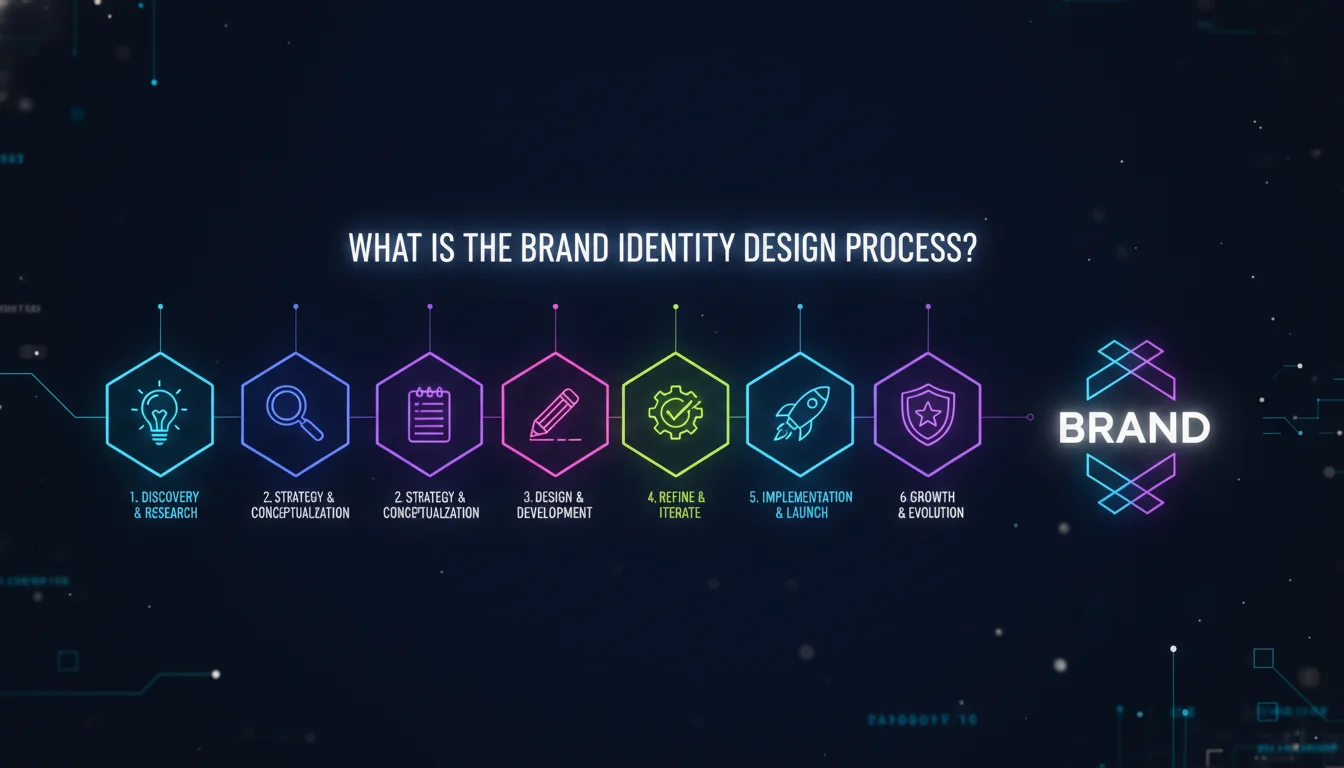
The brand identity design process is a structured sequence of research, strategy, visual development, and documentation that transforms a business concept into a cohesive system of logos, colors, typography, and guidelines. Most professional frameworks run six to ten distinct phases.
Key Takeaways
- The design process is a repeatable system, not a one-time creative sprint. Research, strategy, and documentation are just as critical as the visual work.
- Most professional frameworks include between 6 and 10 distinct phases, with research, concept development, and brand guidelines as common pillars.
- Leading designers like Brandon Moore now question the value of moodboards due to client confusion and wasted time. Showing real design directions in context works better.
- Successful brand identity work depends on clear client onboarding, competitive analysis, and iterative feedback loops.
- Final deliverables must always include a brand guidelines document to ensure consistency across every touchpoint.
- Brand identity is not static. Uber rebranded just four years after founding, while the NBA logo has endured for over 50 years with minimal change.
What Is the Brand Identity Design Process?
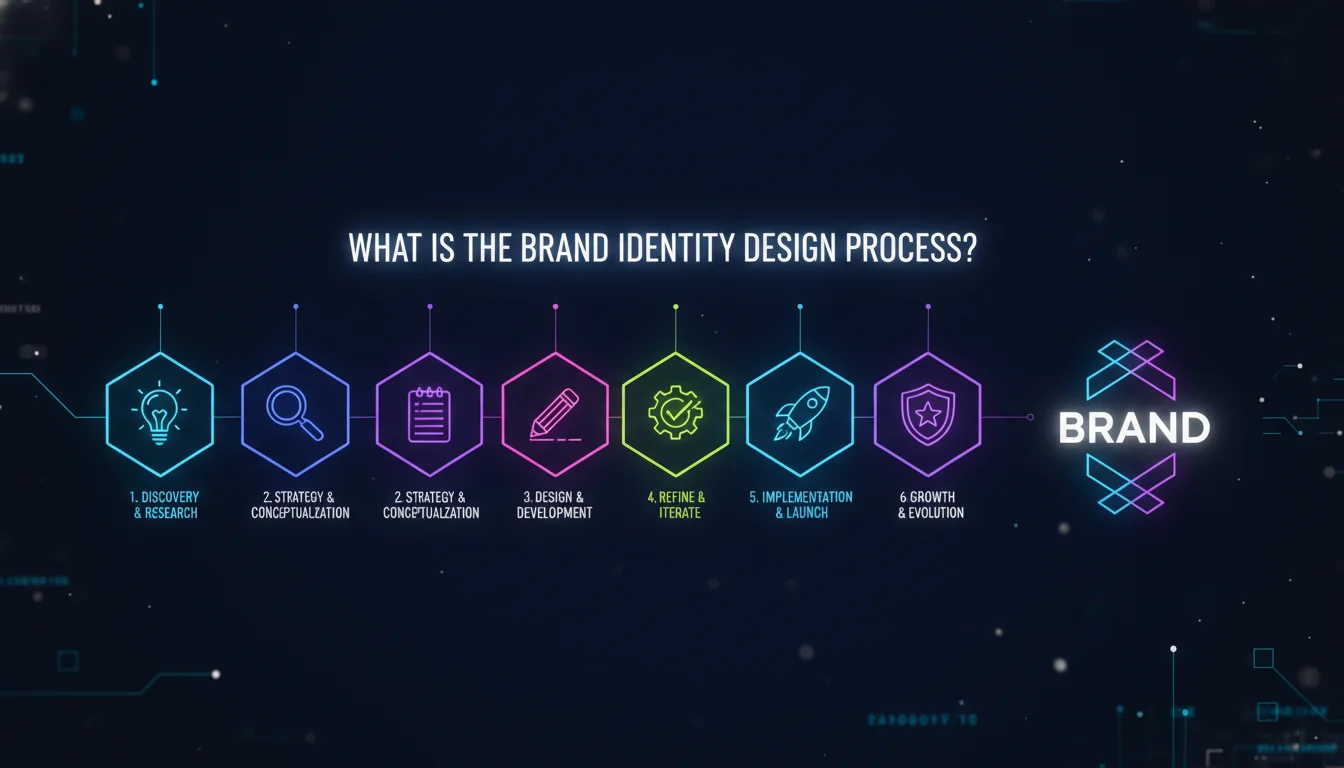
The this type of process is a defined creative and strategic workflow that takes a brand from concept to a fully realized visual system. It typically involves six to ten distinct phases depending on the designer and project scope.
Definition and Scope
Brand identity design is the practice of creating the visual and verbal elements that represent a brand to its audience. Unlike a logo alone, a brand identity encompasses a system of interconnected assets: logo variations, color palettes, typography, imagery styles, taglines, and usage rules. According to the Adobe Certified Professional team, these elements together help consumers recognize and connect with the brand on a deeper level. A well-executed this kind of design process ensures all these pieces align under one strategic direction.
The scope extends far beyond visual output. It begins with understanding a company’s mission, values, and audience, and ends with documented guidelines that govern how the identity appears across every channel, from social media avatars to print collateral. Stefan C. Asafti defines a process as “a series of steps taken to achieve a particular goal. In the branding world, it’s the steps required to transform an idea into reality.” That transformation is the core function of any serious the identity design process.
Why a Defined Process Matters
A structured process reduces risk for both designer and client. Stefan Asafti notes that without a process, designers often double or triple their efforts without extra pay, face scope creep, and compromise quality. Writing down every step minimized his risk of failure and improved client satisfaction. The process becomes a repeatable system you refine with each project.
For clients, a defined process sets clear expectations about timelines, deliverables, and payment terms. Jessica Jones, a brand identity designer, requires 50% upfront payment and 50% net 15 after completion. That practice protects her workflow and signals professional commitment. When both parties understand the sequence, the project runs more smoothly and the outcome is more predictable.
The Evolution from Linear to Agile Workflows
Historically, brand identity development was a linear, deliberate process built on the premise that an identity should be enduring. Siegel+Gale, a global brand consultancy, describes how the pace of innovation and the social media imperative have shortened timelines and forced once-sequential work streams to run in parallel. A modern brand identity often uses agile principles: overlapping phases, frequent feedback loops, and digital collaboration tools.
Will Paterson, a designer with over a million YouTube subscribers, presents a deep-dive process that moves from logo to full brand identity using team collaboration and AI-assisted ideation. Meanwhile, Brandon Moore advocates for simplicity, replacing formal briefs with a one-page project overview and integrating contracts into proposals to speed up onboarding. The evolution is from rigid milestones to flexible, client-inclusive journeys.
Core Elements of a Brand Identity
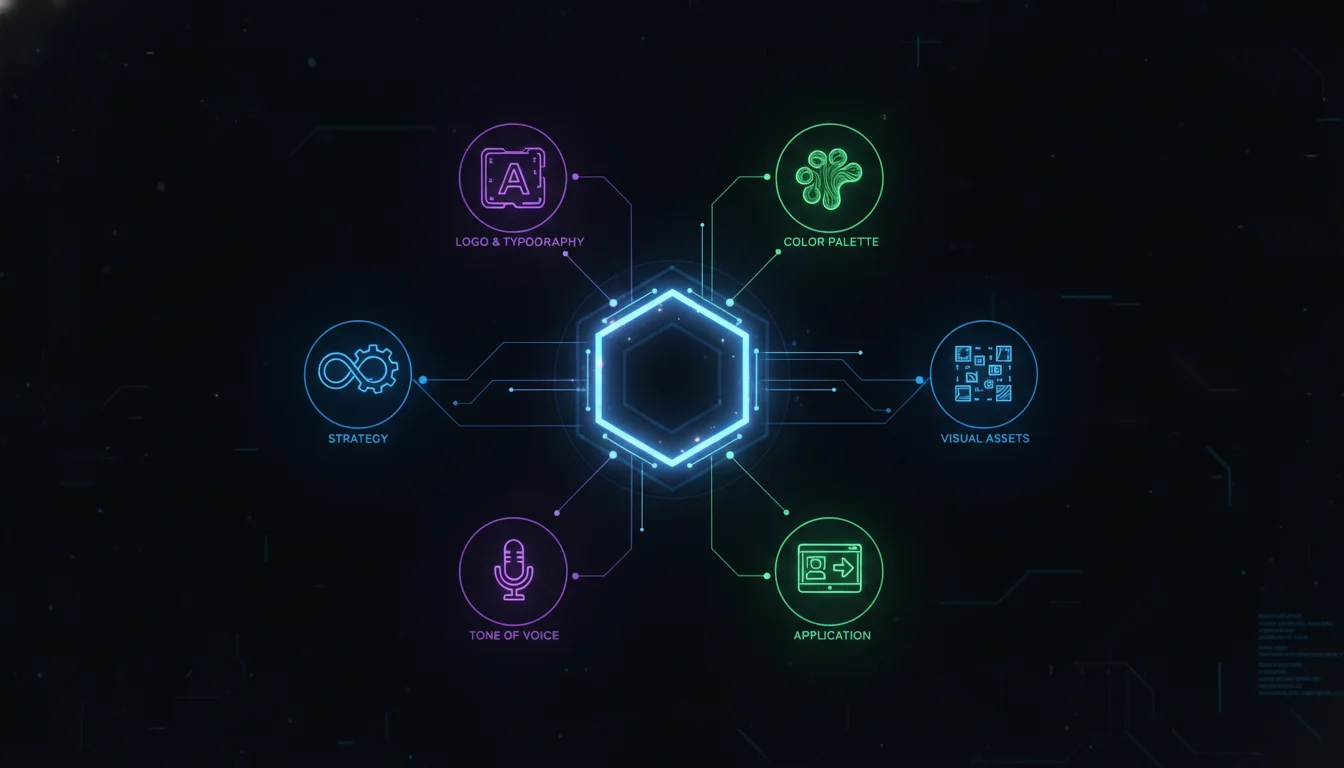
A brand identity is more than a logo. Every design process must address five foundational elements that work together as a system.
Logo Design
A logo is the graphical mark that anchors the entire identity system. Adobe’s guide states that a well-designed logo should be simple, distinctive, and relevant to the brand’s value and offerings. The logo often becomes the most recognizable aspect of a brand’s identity, but it should never be developed in isolation. In a robust this type of process, the logo emerges from strategy and gets tested across contexts, from favicon size to billboard scale.
Brandon Moore, a graphic designer and author, explains that many designers mistakenly develop a logo in black and white first, then choose colors. He advocates for evaluating the entire identity, logo, color, typography, and imagery together in sample layouts. This prevents a disconnect between the mark and the broader visual system.
Typography and Color Palettes
Typography refers to the typeface or family of fonts used across a brand’s communication materials. Consistent use of typography sets the tone, whether the brand reads as modern, classic, playful, or serious. Adobe emphasizes that fonts must be legible in contexts from mobile screens to print magazines. In the this kind of design process, type selection is not arbitrary. It reinforces the brand’s voice and must pair harmoniously with every other element.
A color palette is the set of colors most associated with a brand. A well-defined palette defines a brand’s personality and helps evoke particular feelings in consumers. Siegel+Gale created the green “Element” for Hewlett Packard Enterprise to signal a dynamic, forward-looking identity. When crafting a palette, designers often limit the number of colors to avoid overwhelming customers and diluting the message.
Imagery, Taglines, and Supporting Assets
Imagery, including photography and graphics, should align with a brand’s identity and messages while conveying its values and aspirations. Taglines reinforce a brand’s key message and can instantly convey a brand’s essence. These supporting assets are not afterthoughts. They are integral to a complete the identity design process.
Brand guidelines are a document that specifies rules for logo usage, color codes, and typography. Adobe’s guide lists the creation of brand guidelines as a distinct step in the process. Without guidelines, consistency deteriorates and the brand becomes fragmented across different applications. Any professional process should close with a comprehensive guidelines kit that covers all elements.
Pre-Design Research: The Foundation of Your Brand Identity Design Process
Research is the first substantive phase of any brand identity. It grounds the creative work in reality and prevents subjective detours.
Understanding Your Brand’s Nature and Values
Before designing anything, you need a deep sense of what the brand is all about. Adobe’s framework recommends conducting thorough interviews with the client to understand their brand’s mission, values, history, and future goals. This step establishes the direction for the entire design process. Nela Dunato, a brand designer, evaluates inquiries based on the client’s industry, deadline, budget, and whether the client seems reasonable, all part of ensuring a good fit before deep research begins.
A common tool is a pre-work PDF workbook. Jessica Jones sends a short PDF workbook to gather thoughts and put ideas on paper before the interview. This prepares the client and streamlines the discovery session. The output is often a simple one-page brief that captures the main points and guides the identity design. Brandon Moore uses a project overview instead of a formal brief, believing simplicity is easier for clients to understand.
Competitive Analysis and Differentiation
Understanding your competition is critical. Adobe advises looking at competitors’ brand identities to find common design approaches and trends within the industry, then analyzing what works and what doesn’t to find opportunities for differentiation. Jessica Jones includes competitor review in her Brand Finder interview, showing clients samples of their competitors’ branding to identify where they can stand out.
Nela Dunato goes a step further by evaluating whether the client’s industry aligns with her ethical principles. This ensures the designer can fully invest in the project. Competitive analysis in a modern design process is not just about tracking trends. It’s about finding a unique positioning the brand can own. According to Column Five, which brings over 15 years of experience to brand identity work, a strong brand identity requires an intimate understanding of who you are, what you do, and how you want to present your brand to the world, including how you differ from competitors.
Client Interviews and Stakeholder Alignment
The kickoff meeting sets the tone. Brandon Moore prefers a casual “kick-off conversation” rather than a formal meeting, using Google Meet or another video platform. He asks about the project, needs, goals, and why the project is important. This helps him write a project outline or proposal. He also includes a contract with the proposal to speed up onboarding, and proposals expire after 30 days.
Jessica Jones structures her kickoff differently: first a contact form, then a short call to discuss the project at a high level, then a proposal with payment terms. After agreement, she conducts a deep-dive Brand Finder interview with key stakeholders. This two-stage approach ensures the client is serious before investing time in detailed discovery. Both methods share one goal: align on expectations before design begins.
Step-by-Step Brand Identity Design Process
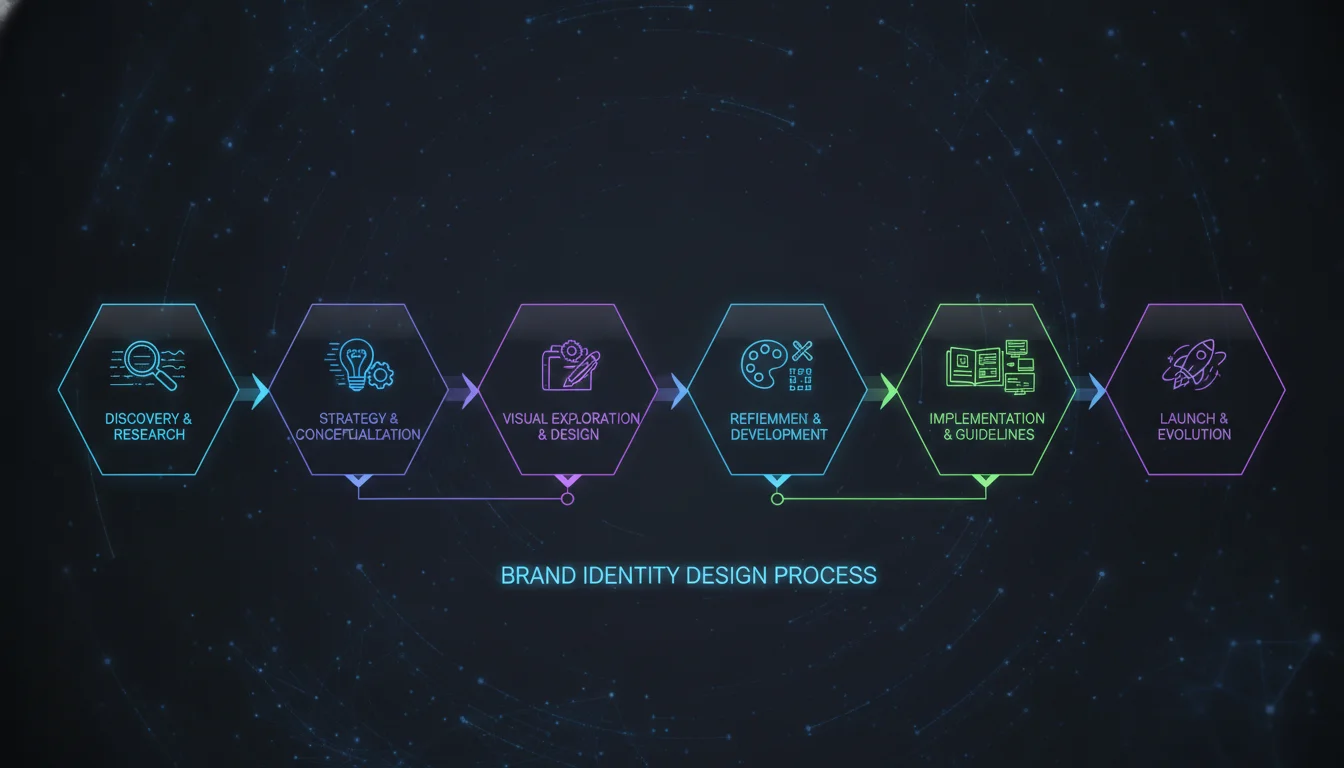
While every designer tailors their approach, a typical this type of process includes the following stages. This section synthesizes frameworks from Adobe, Stefan Asafti, Brandon Moore, Jessica Jones, and Big Cat Creative into a numbered sequence you can adapt.
Step 1–2: Kickoff and Project Overview
Step 1: Kickoff meeting or conversation. This initial contact establishes rapport, gathers high-level project goals, and determines if there is a good fit. Brandon Moore emphasizes keeping it casual to hear the client’s story, while Jessica Jones schedules a short call to talk about the problem being solved. At this stage, no design work occurs.
Step 2: Proposal and contract. After the kickoff, the designer sends a proposal outlining deliverables, timeline, and pricing. Brandon Moore includes a contract to make onboarding faster, and proposals expire 30 days from delivery. Jessica Jones requires 50% payment upfront to move forward and 50% upon completion, net 15. This step protects both parties and formalizes the engagement.
Step 3–5: Research, Strategy, and Concept Development
Step 3: Deep research. Using interviews, questionnaires, and competitive analysis, the designer gathers insights. Adobe’s framework includes understanding the brand’s nature and understanding the competition. Stefan Asafti writes down all required steps on paper to minimize risk. Big Cat Creative recommends using a project management tool like Asana to keep tasks organized and even bring clients into the system for accountability.
Step 4: Define brand strategy. This is the positioning, personality, and messaging that will guide design decisions. Adobe explicitly lists “Define a brand strategy” as a step. The output is often a one-page brief or strategy statement that summarizes the brand’s essence, audience, and differentiation. Without this, the visual work lacks direction.
Step 5: Concept development. Here the designer begins visual exploration: sketching, digital proposals, and preliminary logo directions. Stefan Asafti’s process includes digital proposals after research and paper sketches. Brandon Moore argues against traditional moodboards at this stage, preferring to show actual design directions in context. The goal is to generate a few distinct concepts that can be evaluated against the strategy.
Step 6–8: Design, Feedback, and Refinement
Step 6: Design presentation. Present the strongest concepts to the client for feedback. Jessica Jones designs the whole theme, logo, colors, fonts, shapes, and images in sample layouts so the client experiences the brand as a whole. This avoids the trap of choosing a logo in a vacuum. As Stefan Asafti puts it: “I am a firm believer that the process is the secret weapon that separates you from all the designers that barely possess it.”
Step 7: Feedback and revision. The client provides feedback. Brandon Moore notes that moodboards often lead to the comment “This doesn’t look like the moodboard,” indicating a breakdown in communication. A better approach is to iterate directly on the visual design based on strategic alignment. Typically, the number of revision rounds is defined in the contract to prevent scope creep.
Step 8: Refinement. The selected concept gets polished. This includes finalizing logo variations, testing color accessibility, refining typography, and ensuring the identity works across different media. Adobe’s best practices stress versatility: the identity must be agile across mobile screens and print magazines alike.
Step 9–10: Delivery and Brand Guidelines
Step 9: Brand guidelines creation. Document all design choices into a comprehensive guidelines document. Adobe lists this as a distinct step, and Jessica Jones includes it as a deliverable. The guidelines specify rules for logo usage, color codes, typography, and imagery. This ensures that anyone using the brand, whether internal teams or external vendors, can apply it consistently.
Step 10: Asset delivery and training. Deliver all final files in the required formats: vector, raster, web, and print. Big Cat Creative emphasizes delivering polished brand assets and gathering client testimonials. Some designers also provide a brand training session to walk the client through the guidelines. This final step closes the project and sets the stage for future brand management.
“A process is a series of steps taken to achieve a particular goal. In the branding world, it’s the steps required to transform an idea into reality. I am a firm believer that the process is the secret weapon that separates you from all the designers that barely possess it.” Stefan C. Asafti, brand identity designer
Pros and Cons of a Structured Brand Identity Design Process
Pros
- Reduces risk for both parties. A defined sequence sets clear expectations, minimizes scope creep, and protects the designer’s time and the client’s investment.
- Produces more consistent results. When every project follows the same research-to-delivery arc, quality becomes predictable rather than accidental.
- Builds client trust. Clients who understand each phase feel included in the creative journey rather than waiting for a “great reveal” that might disappoint.
- Creates a repeatable business asset. A documented process can be refined, delegated, and scaled as your studio grows.
- Improves strategic alignment. Grounding visual decisions in research and brand strategy means the final identity actually reflects the business, not just the designer’s aesthetic preferences.
Cons
- Can feel rigid for fast-moving projects. A thorough ten-step process may be too slow for startups that need a brand identity in weeks, not months.
- Requires client participation. Discovery interviews, workbooks, and feedback rounds only work if the client shows up prepared and engaged.
- Upfront investment is significant. Research and strategy phases add time and cost before a single visual is produced, which can be a hard sell for budget-conscious clients.
- Process documentation takes effort to maintain. As your practice evolves, keeping templates, contracts, and workflows current is ongoing work.
Common Mistakes and How to Avoid Them
Even a well-intentioned brand identity design process can go off the rails. Here are the most frequent pitfalls and how to sidestep them.
The Moodboard Trap
Brandon Moore has famously declared the “death of moodboards” in his process. A moodboard is a collection of visual references intended to establish a design direction. Moore argues that graphic designers use moodboards too abstractly, unlike architects or interior designers who pull samples of actual materials. Clients may interpret a moodboard literally, leading to the painful comment, “This doesn’t look like the moodboard.” Moore once spent a month working on three moodboards and felt it was a waste of time.
The solution is to show actual design directions in context rather than abstract inspiration. Jessica Jones advocates designing the whole theme in sample layouts so the client evaluates the real experience. If you must use a moodboard, keep it concrete: use actual colors, fonts, and materials that will be used, not vague vibes.
Skipping Research or Overcomplicating Design
Skipping the research phase leads to generic, ineffective identities. Adobe’s guide emphasizes that understanding the nature of the brand and the competition is crucial. Without it, the design lacks strategic grounding. On the flip side, overcomplicating the design can dilute the message. Adobe recommends simplicity: limit the number of colors, design logos with basic shapes and one or two colors, and aim for instant recognition.
Brandon Moore’s approach to contracts and one-page overviews is a direct reaction against bloated processes. He believes simplicity makes the process easier for everyone. A brand identity design process that is too complex can alienate clients and delay decisions. Keep the workflow lean, but never skip the foundational strategy.
Ignoring Consistency and Versatility
Consistency across all brand materials builds recognition and trust. Adobe’s best practices include creating a brand guidelines document to specify rules. Without it, a logo might be stretched, colors altered, or fonts substituted, eroding brand equity. Versatility is equally important: the identity must work in a tiny social media avatar and on a large trade show banner.
Siegel+Gale highlights how brand identity is no longer static or merely visual. It’s multi-sensory and interactive. The design must function across digital touchpoints, user experience, and physical environments. A brand identity design process that ignores these contexts will produce an identity that fails in the real world.
Traditional vs. Modern Approaches to Brand Identity Design
Not all brand identity design process frameworks are equal. Understanding the differences helps you choose the right approach for your project.
The Linear Waterfall Model
The traditional model proceeds sequentially: research, strategy, logo design, color selection, typography, and finally guidelines. This approach is thorough and built on the premise that an identity should be enduring. Siegel+Gale notes that visual identity development was once thorough, deliberate, and based on that premise. The NBA logo, created by Alan Siegel in 1969 and inspired by Jerry West, exemplifies a timeless mark that required minimal change over nearly 50 years.
This model has real drawbacks, though. It is slow, inflexible, and poorly suited to businesses that need to adapt quickly. The social media imperative and declining marketing budgets have forced a shift. According to Siegel+Gale, once-sequential work streams now often run in parallel. The linear model works best for brands with stable markets and long planning horizons.
The Agile and Iterative Model
Modern processes embrace agility. Designers like Will Paterson move from logo to brand identity in a workflow that includes team collaboration and AI-assisted ideation. The agile model features overlapping phases, rapid prototyping, and continuous client feedback. Jessica Jones, for example, shows clients entire theme layouts early to gather feedback before refining individual parts.
This approach aligns with Siegel+Gale’s observation that brand identity is now a dynamic, multi-sensory experience. The agile brand identity design process is particularly suited to startups and digital-first companies that need to test and iterate quickly. It also reduces the risk of a major reveal failing, because clients are involved throughout.
When to Use Which Approach
Choose a linear process when the brand’s core offerings are stable, the client values tradition, and timelines allow for thorough exploration. Choose an agile process when the market is fast-moving, the brand is new, or the client wants frequent check-ins. Some designers, like Stefan Asafti, blend both: a disciplined step-by-step structure with client inclusion at each phase to avoid the “great reveal” rejection.
The best brand identity design process is not one-size-fits-all. It should be tailored to the project’s complexity, budget, and stakeholder expectations. Brandon Moore has streamlined his process to six steps with a simple project overview, while Big Cat Creative recommends bringing clients into Asana for task-level transparency. Define your process upfront and communicate it clearly.
Tools and Deliverables in the Brand Identity Design Process
The right tools keep a brand identity design process on track and produce professional results.
Project Management and Collaboration Tools
Big Cat Creative recommends Asana for project management: it’s free, intuitive, and great for managing tasks. You can list every step of the process as a task, assign clients to specific tasks, and set due dates. Other tools in the mix include ClickUp, Kit, Loom, and Adobe Illustrator. Brandon Moore uses a visual timeline laid out in a deck because he finds calendar or project management software less effective for visualizing long time spans.
For communication, video conferencing tools like Google Meet handle kickoff meetings well. Email covers day-to-day updates. The goal is to keep all project information in one place and ensure nothing slips through the cracks.
Design Software and Asset Creation
Adobe Illustrator is the industry standard for logo and vector asset creation. Big Cat Creative explicitly lists it as a core tool. Will Paterson’s 2026 YouTube tutorial covers designing a brand identity from start to finish using AI tools, indicating that AI is becoming a genuine component of the creative process. It should augment, not replace, strategic thinking.
For moodboards, if you still use them, tools like Pinterest or Milanote can help. Keep Brandon Moore’s caution in mind. Final assets should be delivered in multiple formats: vector files for scalability, raster files for web, and PDF for print. Will Paterson offers a Brand Guidelines Template for $15.00 as a starting point for designers building their own delivery kits.
Final Deliverables: What Clients Should Receive
A complete brand identity design process should yield far more than a single logo file. According to Adobe’s guide, deliverables include the logo suite (primary, secondary, icon), color palette with exact codes, typography specifications, imagery guidelines, and a brand guidelines document. Jessica Jones adds that the design should be presented in sample layouts to show real-world application.
Some designers also provide a Welcome Guide (Nela Dunato) or a Rates and Services PDF (Brandon Moore) as part of the proposal stage, not the final delivery. The final package should empower the client to use the brand confidently across all channels without needing the designer for every small task.
“A strong brand identity doesn’t happen overnight. You can’t just pick a few colors and haphazardly slap a logo together. You need to approach your design strategically to build an identity that truly reflects your brand and can support you as you grow.” Column Five, brand identity agency with 15+ years of experience
Measuring Success and Iterating Your Brand Identity
A brand identity design process doesn’t end at launch. Measuring performance and knowing when to refresh are both critical disciplines.
KPIs for Brand Identity Performance
Qualitative and quantitative measures can indicate whether the identity is working. Siegel+Gale’s work on the Hewlett Packard Enterprise “Element” was created in parallel with business strategy, suggesting that brand performance is tied directly to business outcomes. Common KPIs include brand recall, customer sentiment, engagement rates, and consistency audits. Adobe recommends continuously monitoring how the brand is perceived among customers and introducing appropriate changes when necessary. This is an ongoing responsibility, not a one-time event.
When and How to Refresh a Brand Identity
Uber redesigned its logo in 2016, just four short years after its founding, because the company had transformed from a personal car service into a global transportation network. This example from Siegel+Gale shows that a refresh is warranted when the business model evolves significantly. On the other hand, the NBA logo has remained essentially unchanged for over 50 years, proving that some identities can last decades when they capture a timeless essence.
Adobe’s guide advises changing the typeface or other elements when there are significant changes in the company’s core business offerings. A refresh should be a strategic decision, not a reaction to design trends. Always revisit the original brand strategy to ensure any changes align with the brand’s mission and values.
Case Studies: NBA and Uber as Contrasting Examples
The NBA logo, designed by Alan Siegel in 1969 and inspired by the silhouette of Jerry West, became the exemplar for identity design in sports. After a slight refresh, it remains as expressive of excellence in professional basketball as it was at its creation. This demonstrates the power of a simple, potent mark executed well.
Uber’s 2016 rebrand signified its expanded capabilities, ambitions, and potential. Unlike the NBA, Uber could not rely on past achievements because its business had fundamentally changed. These two examples illustrate that a successful brand identity design process must consider the brand’s life stage and trajectory. Identity is not frozen. It evolves with the company.
Comparison Table: Four Professional Brand Identity Design Frameworks
| Framework Source | Number of Steps | Key Emphasis | Notable Practice |
|---|---|---|---|
| Adobe Certified Professional | 6 | Systematic progression from understanding to guidelines | Explicit step for “Define a brand strategy” |
| Stefan C. Asafti | 10 | Detailed client onboarding and creative process | Writes steps on paper; avoids surprise reveals |
| Brandon Moore | 6 | Simplicity and client alignment | Declares the death of moodboards; includes contract with proposal |
| Jessica Jones | 3 main phases | Kickoff, Brand Finder interview, Design | Designs whole theme in sample layouts; 50% upfront payment |
Ready to Build a Brand That Lasts?
The brand identity design process is where strategy meets craft. Get it right and you create something that works for your business for years. Get it wrong and you’re redesigning in 18 months. At Emin Media, we’ve built brands for founders, startups, and established businesses across industries, and we know the difference a disciplined process makes. Explore our branding services or contact Emin Media for a free brand consultation and let’s build something bold together.
Frequently Asked Questions
What is the first step in a brand identity design process?
The first step is typically a kickoff meeting or conversation with the client to understand their project, goals, and needs. This is followed by a proposal and contract, as seen in Brandon Moore’s and Jessica Jones’s workflows. No design work should begin until both parties have aligned on scope and expectations.
How long does a brand identity design process take?
Timelines vary widely depending on project scope, client responsiveness, and the designer’s process. Brandon Moore notes that timelines are estimates, but hard deadlines should be met. A typical full identity project can take several weeks to a few months depending on complexity and revision rounds.
Do I need a moodboard in my brand identity design process?
Not necessarily. Designer Brandon Moore has moved away from moodboards due to client confusion and time consumption. An alternative is to present actual design directions in context, as Jessica Jones does with full theme layouts. If you do use a moodboard, make it concrete with actual colors and fonts rather than abstract visual vibes.
What deliverables should I expect from a brand identity design process?
Expect a logo suite, color palette with exact codes, typography specifications, imagery guidelines, and a brand guidelines document. According to Adobe’s guide, these are the core elements of a complete identity system. The guidelines document is the most critical deliverable because it ensures consistency across all future uses.
Can a brand identity design process be automated with AI?
AI tools can assist with ideation and asset production, as seen in Will Paterson’s 2026 workflow. The strategic foundation, including research, positioning, and client alignment, still requires human judgment. AI works best as a supportive tool within the process, not a replacement for strategic thinking.
How often should a brand identity be refreshed?
Refresh when there is a significant change in the business, such as expanded offerings or new markets, like Uber’s 2016 rebrand. If the identity still captures a timeless essence, as the NBA logo has for over 50 years, no refresh is needed. Always tie the refresh decision back to business strategy, not design trends.
Enjoyed this article?
Contact Emin Media for a free brand consultation and let's create something amazing together.
Get in TouchRelated Articles
Digital Marketing for Creatives: A Bold Guide
Digital marketing for creatives builds real visibility and sales. Learn strategies for social media, SEO,…
Branding & Design Agency Tips That Actually Work
Discover branding and design agency tips to choose the right partner, set clear goals, and…
Creative Agency Pitch Deck Tips That Win Clients
Master creative agency pitch deck tips that win clients in 2026. Learn storytelling, design, and…