Brand Hashtag Strategy: The 2026 Complete Guide
A brand hashtag strategy is a planned, goal-driven approach to selecting and deploying hashtags across social platforms to increase content discoverability, build community, and drive measurable engagement. As of 2026, the rules have shifted: fewer, smarter hashtags beat volume every time.
Key Takeaways
- A focused hashtag strategy outperforms random tagging on every platform in 2026.
- Algorithms now reward fewer, more targeted hashtags over high-volume spray-and-pray approaches.
- Different platforms require different hashtag counts: 1-2 on X, 2-3 on LinkedIn, 3-5 on TikTok, 5-10 on Instagram.
- Branded, campaign, community, and trending hashtags each serve a distinct purpose in your mix.
- Shadowbanning is real: irrelevant or excessive hashtags can suppress your content without warning.
- Monitoring hashtag performance with dedicated tools is what separates brands that grow from brands that guess.
Understanding Brand Hashtags
A this type of strategy is a planned approach to selecting and using hashtags across social media platforms to enhance content discoverability and audience engagement. Hashtags categorize content, making it easier for users to find posts related to specific topics. In 2026, hashtags remain a powerful tool for marketers, despite evolving algorithms and platform guidelines.
What is a Hashtag?
A hashtag is a word or phrase preceded by the # symbol. It serves to categorize content on social media, allowing users to search for posts related to specific topics. For example, using #MarketingTips helps users find relevant content in the marketing niche. Chris Messina invented hashtags in 2007 with an offhand Tweet suggesting them as a way to group conversations, and they have shaped social media discovery ever since.
The Importance of Hashtags in Social Media
Hashtags play a critical role in social media marketing by increasing visibility and engagement. According to the American Marketing Association, brands using hashtags on X (formerly Twitter) see roughly 50% higher engagement than those that do not. That gap is significant, and it explains why a deliberate this kind of strategy remains worth the investment even as platforms evolve.
“Hashtags are one of the most effective tools for bridging the gap between your brand and new audiences on social media. When used strategically, they can amplify reach and spark organic engagement.” – Ryan Pecinka, Subject Matter Expert in Social Media Strategy, Brafton
Types of Hashtags
- Branded Hashtags: Unique to your business, these hashtags promote brand recognition and curate user-generated content around your name.
- Campaign Hashtags: Used during specific marketing campaigns to track engagement and unify conversation around a launch or event.
- Community Hashtags: Connect users with shared interests, building audience relationships that extend beyond a single post.
- Trending Hashtags: Time-sensitive tags tied to cultural moments or platform-wide conversations that can spike short-term reach.
How a Brand Hashtag Strategy Actually Works
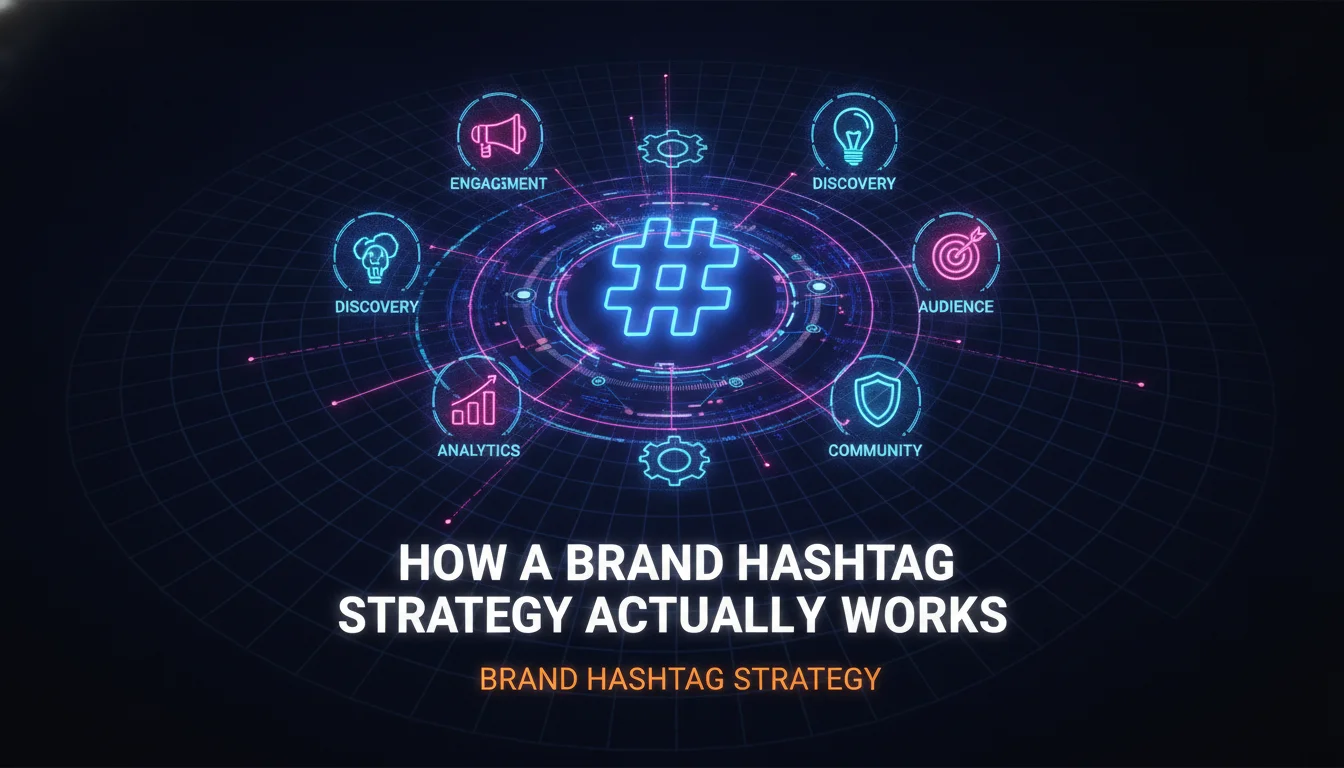
A brand hashtag works by turning your hashtags into a content classification system that platforms use to serve your posts to the right audiences. Think of it less like shouting into a crowd and more like filing your content into the exact folder your ideal customer is already browsing.
When you add a hashtag, the platform’s algorithm reads it as a topical signal. That signal does three things simultaneously: it categorizes your post for search results, connects it to active community feeds, and tells the recommendation engine what kind of user should see it next. According to Brandwatch, a well-chosen hashtag still categorizes content for platform search, connects posts to active communities, and signals topical relevance to recommendation algorithms – three outcomes that keyword-rich captions alone cannot fully replicate.
The mechanics shifted meaningfully between 2022 and 2026. Earlier, platforms boosted posts based on hashtag volume. Today, as the US Chamber of Commerce reports, platforms may actually penalize posts with excessive or irrelevant hashtags. Instagram is already testing a feature that limits certain users to five hashtags per post, with a warning message appearing if they try to add more. That is the algorithm telling you something important: quality of signal beats quantity of tags.
Your hashtag strategy should therefore function like SEO keyword selection. You research intent, pick terms with the right search volume for your audience size, and place them deliberately. MeetEdgar, a social media scheduling tool, puts it well: “While hashtags will not guarantee virality, they still help with long-term discoverability and search placement. They help platforms understand your content and make it more discoverable in search results, explore feeds, and recommended post sections.”
“Keep track of which hashtags have worked well on previous posts. Review your most popular posts and identify any trends in the hashtags you used. If specific hashtags consistently appear in your top-performing posts, make a point to include them in your future content.” – American Marketing Association
Developing a Brand Hashtag Strategy
Creating an effective this type of strategy involves several key steps that align with your marketing goals and audience behavior.
Step 1: Define Your Goals
Identify what you aim to achieve with your hashtag strategy. Common goals include increasing brand awareness, driving engagement, or promoting specific campaigns. Your goal determines which hashtag types to prioritize: branded tags for recognition, campaign tags for launches, community tags for relationship building.
Step 2: Research Relevant Hashtags
Use dedicated tools to discover trending and relevant hashtags in your industry. Hashtagify, RiteTag, and Keyhole are three platforms built specifically for this research. They surface hashtag volume, growth trends, and related tags so you can make data-informed choices rather than guessing. This research phase is where most brands underinvest, and it shows in their results.
Step 3: Create a Mix of Hashtags
Combine popular hashtags with niche ones to maximize reach. Popular hashtags attract a broader audience, while niche hashtags engage users more likely to be interested in your content. According to the Digital Marketing Institute, using hashtags that are detailed and specific leads to better results than broad or general ones, because specific hashtags connect you to a focused, relevant audience rather than a sea of noise.
Step 4: Build Your Branded Hashtag
Every brand needs at least one owned hashtag. According to Sprout Social, branded hashtags increase visibility, clicks, mentions, and overall reach. Keep it short, memorable, and unmistakably yours. Avoid generic phrases that other brands might also claim. Once you have it, put it in your bio, your email signature, your packaging, and every piece of content you publish.
Step 5: Schedule, Post, and Track
Execution without measurement is just noise. After posting, track which hashtags drive impressions, profile visits, and follows. Most native platform analytics show hashtag-level reach data. Third-party tools like Keyhole and Brandwatch go deeper, showing sentiment, competitor hashtag performance, and trend velocity. Review this data monthly and adjust your this kind of strategy accordingly.
How to Apply Your Brand Hashtag Strategy: A Practical Playbook
Applying a brand hashtag effectively means building repeatable systems, not one-off experiments. Here is how we approach it with clients at Emin Media.
Week 1: Audit and research. Pull your last 30 posts. Note which hashtags appeared on your highest-performing content. Cross-reference those with a tool like RiteTag to see current volume and competition levels. Build a master list of 30-50 candidate hashtags organized by type: branded, campaign, community, and trending.
Week 2: Create your hashtag sets. Group your candidates into platform-specific sets. Your Instagram set might include 2 broad tags, 4 niche tags, and 1 branded tag. Your LinkedIn set might be just 3 professional tags. Your TikTok set might be 3-5 trend-adjacent tags. Having pre-built sets saves time and keeps your strategy consistent across the team.
Week 3: Test and rotate. Do not use the same hashtag set on every post forever. Rotate through 3-4 different sets to avoid appearing repetitive to the algorithm. Test one variable at a time: swap one hashtag per set and measure whether reach improves or drops.
Week 4 and beyond: Monthly review. Pull your analytics. Retire underperforming hashtags. Add new ones based on emerging trends in your industry. A hashtag strategy is a living document, not a one-time setup.
Best Practices for Using Hashtags
To optimize your brand hashtag strategy, adhere to these best practices tailored for various social media platforms.
Platform-Specific Guidelines
- Instagram: Aim for 5-10 relevant hashtags, mixing broad and niche tags. Instagram is testing a 5-hashtag cap for some users, so lean toward quality over quantity now.
- X (Twitter): Use 1-2 trending hashtags to join ongoing conversations. Elon Musk has publicly discouraged hashtag overuse, and the platform’s own guidelines reflect a minimalist approach.
- LinkedIn: Limit to 2-3 professional, topic-specific hashtags to maintain a polished image.
- TikTok: Use 3-5 engaging, viral-friendly hashtags to tap into community trends.
- Facebook: Keep it to 1-2 hashtags. The platform never fully embraced hashtag culture, and overuse looks out of place.
- YouTube: Use 3-5 in the description plus 1-2 in the title for extra discoverability in search.
Monitor Hashtag Performance
Regularly analyze the performance of your hashtags to understand which ones drive engagement. Adjust your strategy based on this data to improve results over time. Native platform analytics are a starting point, but tools like Hashtagify, Keyhole, and Brandwatch give you the competitive intelligence to stay ahead.
Avoiding Common Pitfalls
Be cautious of overusing hashtags, as platforms like Instagram may penalize posts with excessive or irrelevant tags. Focus on quality over quantity to maintain a professional appearance and protect your content’s reach.
Hashtag Research Tools: What to Use in 2026
The right tools make your brand hashtag strategy faster and more precise. Here is a breakdown of the options most used by marketing teams this year.
| Tool | Best For | Key Feature | Pricing Tier |
|---|---|---|---|
| Hashtagify | Instagram and Twitter research | Hashtag correlation maps | Paid plans available |
| RiteTag | Real-time hashtag grading | Color-coded performance signals | Freemium |
| Keyhole | Campaign tracking and analytics | Hashtag reach and impression data | Paid plans available |
| Brandwatch | Enterprise-level social listening | Sentiment and trend analysis | Enterprise pricing |
| Sprout Social | Full social media management | Hashtag performance reporting | Paid plans available |
| Native Platform Analytics | Quick post-level review | Free, built-in reach data | Free |
Comparing Hashtag Approaches: Which Strategy Fits Your Brand?
Not every brand needs the same brand hashtag strategy. Your approach should match your audience size, content volume, and campaign goals. Here is how the main strategic models compare.
| Approach | Best For | Hashtag Volume | Primary Goal | Risk Level |
|---|---|---|---|---|
| Branded-Only | Established brands with large followings | 1-2 per post | Community ownership | Low |
| Niche-Focused | Startups and specialist brands | 5-8 per post | Targeted audience reach | Low-Medium |
| Trend-Riding | Consumer brands with fast content cycles | 1-3 trending tags | Short-term viral reach | Medium-High |
| Campaign-Driven | Product launches and events | 1 campaign tag + 3-5 support tags | UGC and campaign tracking | Low |
| Mixed/Layered | Most brands with consistent content | 5-10 per post (platform-adjusted) | Balanced reach and community | Low-Medium |
Pros and Cons of a Brand Hashtag Strategy
A brand hashtag strategy delivers real advantages, but it also comes with trade-offs worth understanding before you build your approach.
Pros
- Increased discoverability: Hashtags make your content findable by users who do not yet follow you, expanding your organic reach without paid spend.
- Community building: Branded and community hashtags create shared spaces where your audience can connect with each other and with your brand.
- Campaign tracking: A dedicated campaign hashtag lets you measure user-generated content, sentiment, and participation in real time.
- SEO crossover: As the Digital Marketing Institute notes, roughly 15% of consumers now prefer to search on social media over search engines. Hashtags help you show up in those searches.
- Cost-free reach: Unlike paid ads, a well-placed hashtag extends your content’s life at zero additional cost.
Cons
- Shadowban risk: Chronic misuse of irrelevant or excessive hashtags can suppress your content’s visibility without any notification from the platform.
- Algorithm dependency: Platform rules change frequently. A hashtag approach that worked in 2024 may underperform in 2026 without adjustment.
- Clutter and perception: Overloading posts with hashtags looks spammy to both algorithms and human readers, undermining the professional image you have worked to build.
- Research time investment: An effective brand hashtag strategy requires ongoing research and performance review, not a one-time setup.
- Platform inconsistency: What works on Instagram does not translate to LinkedIn or X, requiring separate strategies for each channel.
Case Studies of Successful Hashtag Strategies
Examining successful hashtag campaigns provides real insight into what an effective brand hashtag strategy looks like in practice.
Coca-Cola’s #ShareACoke Campaign
This campaign encouraged users to share photos of personalized Coke bottles, significantly increasing user-generated content and engagement. According to the American Marketing Association, the campaign increased U.S. sales by more than 2%, reversing over a decade of declining Coke consumption. The hashtag fostered a sense of community and personal connection that no paid ad could replicate at the same emotional depth.
ALS Ice Bucket Challenge
The #IceBucketChallenge went viral, raising awareness and funds for ALS research. This campaign effectively used a single, memorable hashtag to engage a wide audience and drive participation across platforms simultaneously. It remains one of the clearest examples of how a campaign hashtag can transcend a single brand and become a cultural moment.
A Realistic Scenario: A Mid-Size Fitness Brand
Imagine a fitness apparel brand with around 15,000 Instagram followers. They launch a new training collection and build a layered brand hashtag strategy around it. Their branded tag is #TrainWithUs. Their campaign tag is #SpringStrong2026. They support those with 5 niche tags like #FunctionalFitness and #AthleisureStyle, plus 2 broad tags like #Fitness and #Workout.
In the first two weeks, they track which posts using #SpringStrong2026 generate the most saves and profile visits. They find that posts combining the campaign tag with 3-4 niche tags outperform posts using only broad tags. They retire the underperforming broad tags mid-campaign and replace them with two more specific community tags. By the end of the campaign, their branded hashtag has accumulated user-generated posts from customers who adopted it organically. That is a brand hashtag strategy working exactly as designed.
Common Mistakes to Watch Out For
Even experienced marketers make avoidable errors with their brand hashtag strategy. Here are the ones we see most often.
Using the same hashtag set on every post. Algorithms interpret this as repetitive behavior and may reduce your reach over time. Rotate your sets and keep your tag selection fresh.
Chasing volume over relevance. A hashtag with millions of posts is not an opportunity. It is a crowded room where your content disappears in seconds. Niche hashtags with smaller but engaged communities consistently outperform mega-tags for most brands.
Ignoring platform differences. Copying your Instagram hashtag set into a LinkedIn post is a fast way to look out of touch. Each platform has its own culture and its own algorithm. Your brand hashtag strategy needs a separate playbook for each channel.
Never auditing performance. Most brands set their hashtags once and never revisit them. Hashtag performance degrades as trends shift and competition increases. A monthly review is the minimum.
Using banned or overused hashtags. Some hashtags have been flagged by platforms for spam or policy violations. Using them, even innocently, can trigger content suppression. Check your tags regularly against platform guidelines.
Forgetting to make your account public. This sounds basic, but it matters. Hashtags only work for discoverability on public accounts. If your business profile is set to private, your brand hashtag strategy is invisible to anyone who does not already follow you.
Challenges of Hashtags in 2026
While hashtags remain relevant, there are real challenges marketers must work around this year.
Algorithm Changes
Social media algorithms are increasingly prioritizing content quality over hashtag quantity. According to Brandwatch, the shift toward trending topics and AI-driven content recommendations means hashtags now work best as a supporting signal rather than the primary discovery mechanism. Brands that treat hashtags as their main growth lever will be disappointed. Brands that treat them as one strong signal among many will see consistent results.
Shadowbanning Risks
Excessive use of irrelevant hashtags can lead to shadowbanning, where your content becomes less visible without your knowledge. While social media platforms often deny the existence of shadowbanning, the American Marketing Association notes they do acknowledge hiding posts that violate their guidelines or appear inappropriate. The practical effect is the same: your reach drops and you do not get a notification explaining why.
User Experience Concerns
Overloading posts with hashtags clutters content and negatively affects how real people perceive your brand. A post buried under 30 hashtags reads as desperate, not strategic. Strive for clarity and relevance in every tag you choose.
The Rise of Keyword-Rich Captions
Platforms including Instagram and TikTok are increasingly using caption text as a discoverability signal, not just hashtags. This means your brand hashtag strategy in 2026 should work alongside strong, keyword-rich captions rather than replacing them. The brands winning at organic reach are doing both well.
The Near-Term Outlook: What Comes After Hashtags?
The honest answer is that hashtags are not going away, but their role is narrowing. As of 2026, AI-driven content recommendation systems on TikTok, Instagram, and YouTube are increasingly serving content based on what users watch and engage with, not just what they search. That shift reduces the weight of any single hashtag while increasing the importance of overall content quality and audience retention signals.
What this means practically: your brand hashtag strategy should evolve from a volume-based approach to a precision approach. Fewer tags, chosen with more care, placed on content that earns genuine engagement. The brands that will thrive are those treating hashtags as one layer of a broader discoverability system that includes strong captions, consistent posting cadence, and content that earns saves and shares.
For more on building a complete social media presence, explore our thinking on social media strategy and brand content and our full range of digital marketing services.
Conclusion
A well-executed brand hashtag strategy is essential for enhancing visibility, engagement, and community building on social media. By understanding the mechanics of how hashtags work, adapting to platform-specific guidelines, and monitoring performance consistently, brands can connect with their target audiences in ways that compound over time. The brands winning on social in 2026 are not using more hashtags. They are using smarter ones.
Ready to build something that actually moves the needle? Contact Emin Media for a free brand consultation and let’s build a social media presence worth following.
Frequently Asked Questions
What is the 5 hashtag rule?
The 5 hashtag rule suggests using a maximum of five relevant hashtags per post, particularly on platforms like Instagram, to avoid appearing spammy and to maintain engagement quality. Instagram has already begun testing a hard cap of five hashtags for some users, signaling that this guideline may become a platform-enforced rule rather than just a best practice.
What is the 5-3-1 rule on Instagram?
The 5-3-1 rule recommends using five relevant hashtags, three niche hashtags, and one branded hashtag to optimize reach and engagement on Instagram. It is a structured way to build a layered brand hashtag strategy that balances broad discoverability with targeted community reach and brand ownership.
What are the four types of hashtags?
The four types of hashtags are branded hashtags, campaign hashtags, community hashtags, and trending hashtags. Each serves a different purpose: branded tags build recognition, campaign tags track launches, community tags build relationships, and trending tags capture short-term cultural reach.
What’s replacing hashtags?
While hashtags remain relevant, platforms are shifting toward keyword-rich captions and AI-driven content recommendations as primary discoverability signals. This does not eliminate the value of a brand hashtag strategy, but it does mean hashtags work best as a supporting layer alongside strong caption writing and high-quality content that earns genuine engagement.
How do I create a branded hashtag that people actually use?
Create a branded hashtag that is short, memorable, and unmistakably connected to your brand identity. Promote it actively in your bio, your content, your packaging, and your email communications. Encourage use by featuring user-generated content that includes the tag, which creates a social incentive for your audience to participate.
How do I monitor hashtag performance effectively?
Use native platform analytics as a baseline, then layer in third-party tools like Keyhole, Hashtagify, or Brandwatch for deeper insight into reach, impressions, and competitor hashtag performance. Review your data monthly, retire underperforming tags, and continuously test new ones to keep your brand hashtag strategy current and effective.
Enjoyed this article?
Contact Emin Media for a free brand consultation and let's create something amazing together.
Get in TouchRelated Articles
Digital Storytelling for Brands: The Complete Guide
Digital storytelling for brands builds real audience connections through narrative. Learn proven techniques, formats, and…

Design Thinking for Marketing: A 2026 Guide
Design thinking for marketing builds campaigns around real user needs. Learn the 5 phases, common…

Creative Direction for Video Shoots: A Complete Guide
Master creative direction for video shoots with proven steps, tools, and strategies that build brand…