Brand Awareness Strategies That Build Lasting Memory
Brand awareness strategies are coordinated marketing activities designed to make your target audience recognize and recall your brand more reliably than competitors. They combine consistency, audience research, storytelling, and measurable touchpoints to move people from unfamiliarity to trust.
Key Takeaways
- Brand awareness is a memory system, not a one-off campaign. It includes brand recognition (identifying cues) and brand recall (remembering without prompts).
- Trust drives the financial payoff. According to Market Veep, 81% of consumers need to trust a company before buying. Qualtrics reports 46% would pay more for trusted brands.
- Consistency compounds. Brands with consistent presentation increase revenue by as much as 33%, according to Qualtrics.
- Existing customers are the overlooked lever. Return customers spend 67% more than new buyers, per Canva.
- Measurement requires both numbers and narratives. Direct attribution is difficult; qualitative tracking matters just as much as reach metrics.
What Brand Awareness Is and Why It Matters
The Definition You Can Actually Use
Brand awareness is a measure of how familiar and recognizable a brand is to a customer, client, or other target audience. This definition from Harvard Business School Online is deliberately broad because awareness applies to companies, products, services, and personal brands. In practice, awareness strategies operate on two levels: brand recognition and brand recall. According to The Branding Journal, brand recognition is the ability to identify a brand when exposed to its elements: a logo, packaging, jingle, or visual cue. Brand recall is the ability to remember the brand without being directly prompted.
Kevin Lane Keller’s foundational definition, cited by The Branding Journal, describes brand recognition as “consumers’ ability to confirm prior exposure to the brand when given the brand as a cue.” That distinction matters because recognition is easier to buy with reach, while recall requires repeated, distinctive, emotionally relevant experiences.
Most this type of strategies fail when they treat these two dimensions as identical. A paid social campaign can create recognition quickly, but if the brand doesn’t connect to a category need or emotional association, recall stays low. The best strategies pair broad visibility with repeated category entry points: audio signatures, visual metaphors, or consistent language that sticks.
The Trust and Familiarity Payoff
Awareness alone doesn’t guarantee revenue, but it creates the conditions for trust. According to Market Veep, 81% of consumers need to trust a company before making a purchase. Qualtrics adds that 46% of consumers would pay more to purchase from brands they trust. Those two data points explain why this kind of strategies are not vanity exercises. Familiarity reduces perceived risk.
Qualtrics also reports that brands with consistent presentation increase revenue by as much as 33%, and that brand awareness takes 5-7 impressions to create. A one-off viral moment is less valuable than systematic repetition across the buyer journey. Return customers reinforce the economics: Canva notes that return customers spend 67% more than new buyers and cost businesses five to seven times less to retain than acquiring new ones. The memory you build today becomes a margin advantage later.
Why Awareness Precedes Consideration
Harvard Business School Professor Jill Avery, who teaches the online course Creating Brand Value, points out that a name, logo, and design are “markers of the brand” but they remain “empty” until the brand develops a relationship with consumers and a cultural history. Without awareness, your brand’s value is hidden. A consumer cannot consider a product they don’t know exists.
That’s why brand awareness should be treated as the first stage of brand building, not a later add-on. The mental availability created by awareness makes all subsequent marketing more efficient: paid ads convert faster, partnerships feel more natural, and word of mouth travels further.
Employer branding shows the same logic in a different market. According to Qualtrics, companies with strong branding often see 50% more applicants for jobs than rivals, and 75% of applicants consider the brand before applying. When people know and respect a brand, they want to work for it. For B2B and consumer brands alike, awareness reduces both customer acquisition cost and talent acquisition friction.
Pros and Cons of Brand Awareness Strategies
Pros
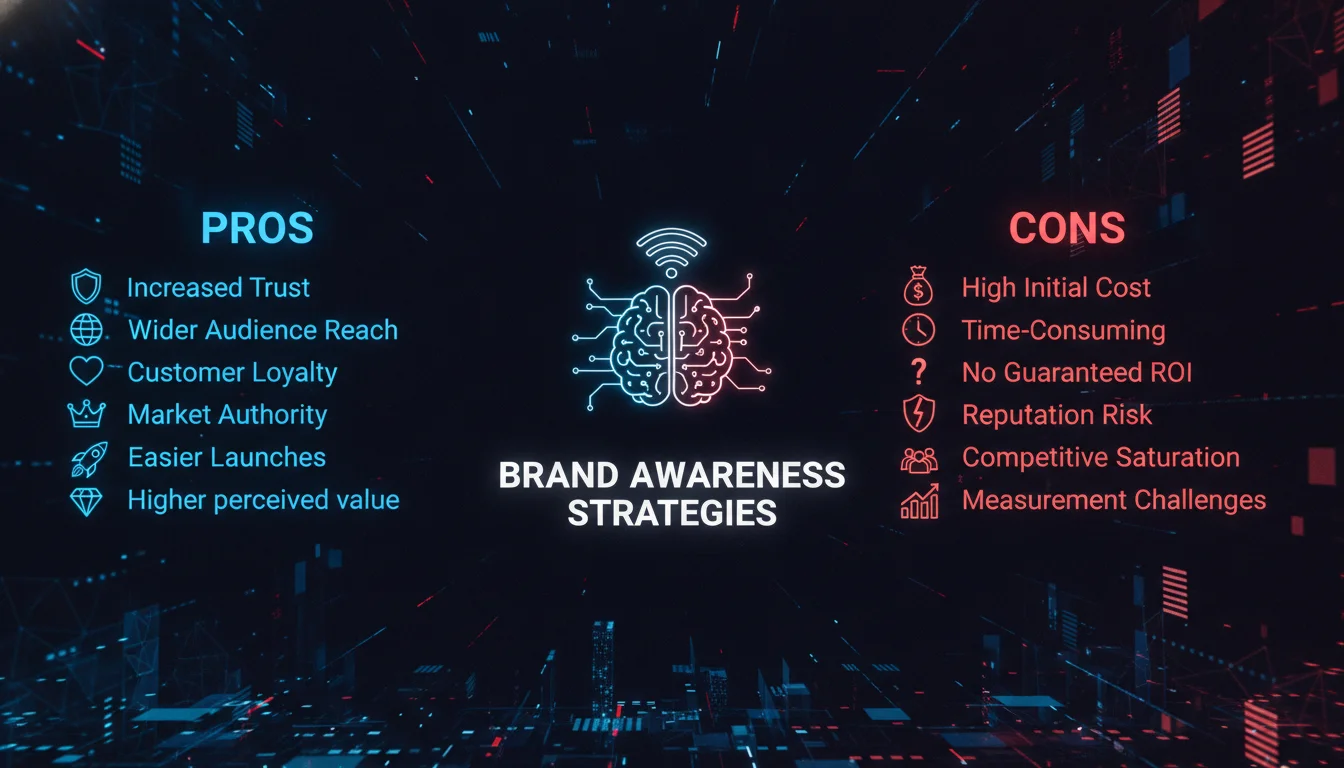
- Compounds over time. Every consistent touchpoint adds to a growing memory asset that makes future marketing more efficient.
- Reduces price sensitivity. Trusted brands command premium pricing. Qualtrics confirms 46 percent of consumers pay more for brands they trust.
- Drives loyalty and advocacy. Aware, trusting customers return more often and refer others, lowering your cost per acquisition.
- Attracts talent. Strong brand recognition draws better job applicants, reducing recruitment friction and cost.
- Makes every other marketing channel work harder. Paid ads, partnerships, and content all convert at higher rates when the audience already recognizes the brand.
Cons
- Slow to show results. Awareness builds over months and years. Teams that expect short-term ROI often abandon the strategy too early.
- Difficult to measure directly. No single metric captures brand awareness perfectly. You need a mix of proxies: branded search, share of voice, and recall surveys.
- Requires sustained investment. Sporadic campaigns don’t build durable memory. Consistency demands ongoing budget and creative commitment.
- Can backfire if the experience doesn’t match the promise. According to Forbes data cited by Canva, most customers factor in customer service when deciding brand loyalty. Awareness built on a weak product or poor service turns negative fast.
The Core Assets of Brand Awareness Strategies
Consistency as a Structural Asset
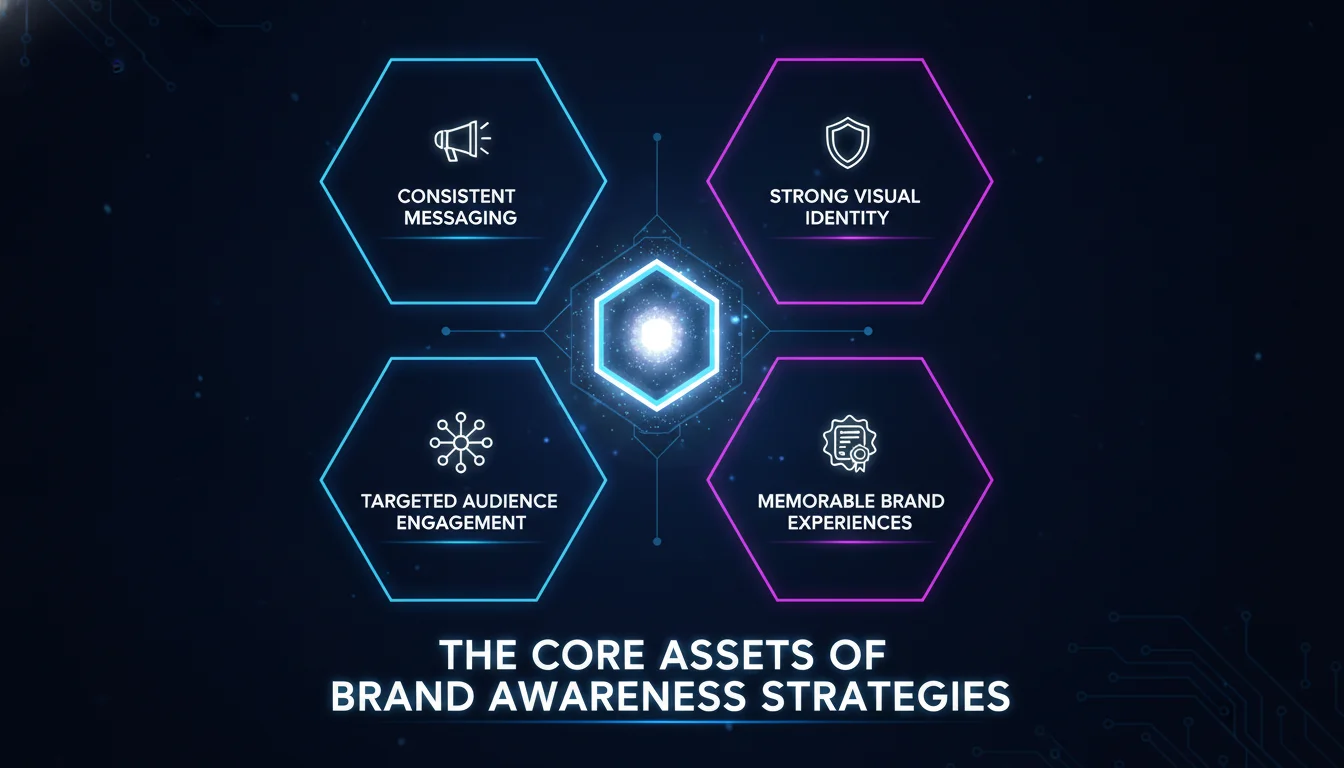
Consistency is the load-bearing wall of any brand awareness effort. It applies to visual identity, voice, message architecture, and customer experience. Qualtrics reports that brands with consistent presentation increase revenue by as much as 33 percent. Consistency works because the brain stores brand memories through repeated exposure to stable cues. If a logo, tone, or promise shifts too often, recognition and recall collapse.
For awareness strategies to compound, document your brand guidelines and enforce them across web, social, packaging, sales decks, and support interactions. Consistency isn’t rigid sameness. It’s coherent variation within a recognizable system.
Audience Empathy and Segmentation
Effective this type of strategies begin with audience research, not internal preference. You need to know who you’re trying to reach, what problems they face, and where they already spend attention. Smartcore, a B2B food and nutrition marketing partner, uses first-party data of over 409,000 ingredient buyers to help suppliers target the right decision-makers. Whether you have proprietary data or rely on interviews and social listening, the principle is the same: awareness is only valuable if it reaches people who can become customers.
Salesforce defines an awareness strategy as aiming to increase the number of people who recognize your brand as a market leader compared to competitors. That requires segmented messaging, not a single broadcast.
Proof, Purpose, and Non-Product Storytelling
The strongest brand awareness strategies go beyond product features. Qualtrics advises brands to stand for more than just products and to demonstrate that stance through action. Storytelling, social impact, community engagement, and transparent customer service all create memory hooks. Canva reinforces this by showing that customer experience is part of awareness: according to Forbes, 97 percent of customers in 2023 considered customer service when giving loyalty to a brand. If your service fails, the awareness you built can turn negative. Proof and purpose must be operational, not only promotional.
“Branding demands commitment; commitment to continual re-invention; striking chords with people to stir their emotions; and commitment to imagination. It is easy to be cynical about such things, much harder to be successful.” – Sir Richard Branson, as cited by Qualtrics
How to Create a Brand Awareness Strategy Step by Step
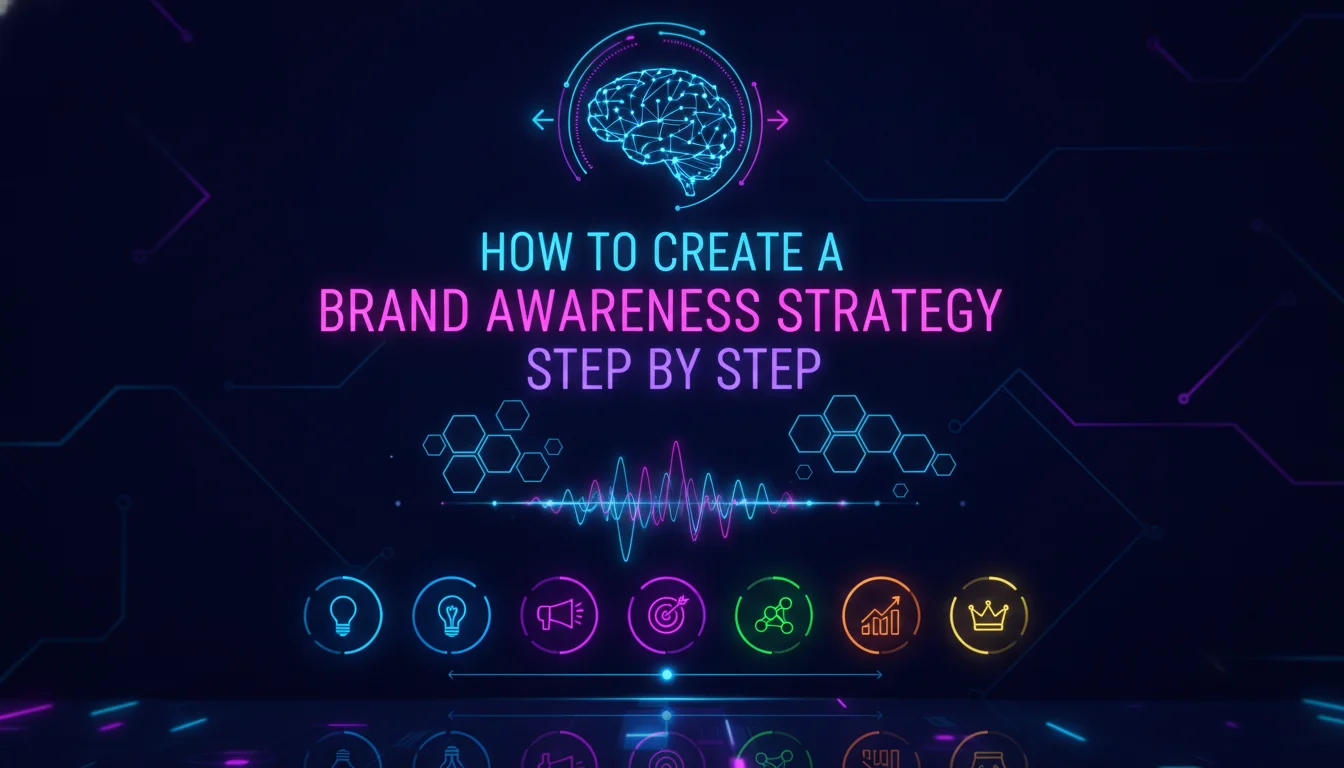
A Six-Step Implementation Framework
The following process synthesizes steps from Harvard Business School Online, Salesforce, and Smartcore into a practical sequence for building brand awareness strategies from the ground up.
- Define your brand identity. Document your mission, values, target audience, distinct value proposition, and proof points. HBS emphasizes that your brand must exist before you can build awareness.
- Research your audience deeply. Identify pain points, wants, and preferences. Salesforce recommends clarifying goals and doing audience research as foundational steps.
- Set measurable awareness objectives. Choose proxies such as branded search volume, direct traffic, share of voice, or aided recall. Awareness is difficult to measure directly, so define success in advance.
- Select channels where your audience already exists. Map media habits and choose a mix of social, search, content, events, and partnerships. No single channel builds memory alone.
- Create consistent, experience-led content. Ensure every touchpoint reflects the same brand identity and provides value. Canva warns that awareness is shaped by actual customer experience, not just ad impressions.
- Track, refine, and repeat. Use quantitative and qualitative signals to identify what’s sticking. Adjust creative, channel mix, and frequency without abandoning the core identity.
Aligning the Framework to Your Business Stage
Salesforce notes that awareness strategies are relevant for new companies, expanding businesses, and organizations that have changed direction. The audience and channel mix will differ by stage. A startup launching its first product may prioritize social proof and content marketing. An established business entering a new region may invest in awards, PR, and local partnerships. The underlying structure stays the same: clarify identity, understand audience, set goals, choose channels, deliver consistently, and measure.
Common Pitfalls During Implementation
The most common failure in brand awareness strategies is impatience. Awareness compounds over time, but many teams abandon a message before it reaches the 5-7 impressions Qualtrics says are needed to create it. Another pitfall is measuring only direct sales. Awareness drives future demand, so short-term attribution will understate its value. Finally, teams often confuse activity with progress. Posting daily is not a strategy if the content doesn’t reinforce a distinct, memorable brand position.
Digital Channels That Amplify Reach
Social Media, Content, and Search
Digital channels are the primary execution surface for modern brand awareness strategies. Social media builds familiarity through repeated exposure and engagement. Content marketing and search answer questions and establish authority. Each channel plays a different role in memory formation: social media tends to support recognition; search and content support recall; community and events support trust. A balanced plan uses all three, letting each reinforce the others rather than running in isolation.
Comparing Digital Channels for Brand Awareness
The table below compares major digital channels, based on common use cases and the competitor examples above.
| Channel | Primary Awareness Function | Example or Operational Note |
|---|---|---|
| Social media | Build recognition through repeated visual and interactive exposure | Short-form video, employee advocacy, brand voice consistency |
| Content marketing and SEO | Build recall by answering category questions | Blogs, guides, and tools that position the brand as a useful resource |
| Events, awards, and PR | Create cultural presence and third-party credibility | Telstra Best of Business Awards, cited by Salesforce |
| Influencer and partner marketing | Borrow trust and reach from established voices | Select niche voices aligned with the audience, not just large followings |
| Email and community | Deepen recall among existing contacts | Consistent newsletters, communities, loyalty programs |
The Role of Owned, Earned, and Paid Media
A balanced brand awareness strategy uses owned, earned, and paid media together. Owned media, such as your website, blog, and email list, gives you full control over message consistency. Earned media, such as PR, reviews, and word of mouth, adds credibility. Paid media accelerates reach and allows precise audience targeting. The goal isn’t to rely on any single type but to let each reinforce the others. A PR mention can be amplified with paid social, while an owned blog post can be shared through email to deepen recall. Treat media types as an integrated system, not separate budgets.
Measuring Brand Awareness Strategies Effectively
Quantitative Metrics That Matter
Because brand awareness is a mental state, no single metric captures it perfectly. Salesforce states that awareness is difficult to measure. Practical proxies include branded search volume, direct website traffic, share of voice, social mention volume, referral traffic, and survey-based aided or unaided recall. Qualtrics recommends brand tracking software to monitor awareness over time. The key is to establish a baseline before launching any campaign and measure shifts at regular intervals.
Qualitative Signals and Sentiment
Qualitative signals reveal whether awareness is positive or negative. Social listening, customer interviews, review analysis, and employee feedback can show how people describe your brand when unprompted. Canva highlights that most customers factor in customer service when deciding brand loyalty, so poor support can undermine even a well-funded awareness push. Monitor sentiment alongside reach. A spike in mentions driven by complaints is awareness, but not the kind that builds trust.
Why Attribution Is Harder Than Direct Response
Direct response marketing is measured by clicks and conversions in days. Brand awareness strategies operate with a longer time lag and multiple touchpoints. A person may see your brand 5-7 times before purchasing, as Qualtrics suggests, and each of those touchpoints may occur across different channels. Last-click attribution undercounts awareness efforts. Use a combination of multi-touch attribution, brand lift studies, and leading indicators such as branded search and return visits to evaluate real impact.
Common Mistakes That Undermine Brand Awareness Strategies
Chasing Reach Instead of Relevance
Canva cautions that brand awareness is not a popularity contest. Millions of impressions mean little if they come from people who will never buy. Luxury brands, for example, may intentionally limit promotions to select audiences. Effective brand awareness strategies prioritize the right audience over the largest one. Segment your targeting and measure relevance, not just reach.
Treating Awareness as a One-Time Push
Familiarity rarely happens in an instant. The Branding Journal describes awareness as a journey of moments, touchpoints, and gradual experiences. A single campaign, no matter how creative, won’t build durable memory. Consistency over time does more than sporadic bursts, as the 33 percent revenue premium for consistent presentation from Qualtrics confirms.
Ignoring Existing Customers in the Pursuit of New Ones
Many teams chase new audiences while neglecting the customers who already know them. This is a strategic error. Canva reports that return customers spend 67 percent more than new buyers and cost five to seven times less to retain. Existing customers are also a source of word of mouth, reviews, and social proof. Any serious brand awareness plan should include retention and advocacy, not only acquisition.
Industry Examples and Use Cases
B2C Recognition: Nike and the Swoosh
Qualtrics uses a thought experiment: two identical sneakers sit side by side. Add a black swoosh to one, and most people choose the Nike pair. The swoosh represents more than a logo. It carries identity, courage, athleticism, and history. This is the end state of effective brand awareness strategies: a symbol triggers a network of associations without explanation. Nike built that memory through decades of consistent branding, athlete partnerships, and emotional storytelling. The lesson for smaller brands is that every touchpoint should add to a coherent meaning, not just describe a product.
B2B Niche Authority: Telstra Best of Business Awards
Salesforce offers the Telstra Best of Business Awards as an example of brand awareness work in action. The awards celebrate small and medium-sized businesses shaping Australia. By associating the Telstra brand with business success and community contribution, the program reinforces recognition and trust within a specific segment. B2B brand awareness strategies often use awards, research reports, and events because they create credible third-party proof. The awareness goal isn’t mass reach but category authority.
Data-Driven B2B Targeting: Smartcore’s First-Party Audience
Smartcore illustrates how audience data sharpens awareness work in niche B2B markets. The company uses first-party data of over 409,000 food and nutraceutical ingredient buyers to help suppliers reach the right decision-makers. This is a reminder that brand awareness strategies can be highly targeted. Instead of broadcasting to the general public, B2B brands can build awareness only among prospects who have the authority and need to buy. Precision reduces waste and accelerates the path from unfamiliarity to consideration.
“Becoming familiar rarely happens in an instant but rather via a series of moments, touchpoints, and gradual experiences. This journey from stranger to familiar is what we call brand awareness.” – The Branding Journal, 2025
Turning Brand Awareness Strategies into a Compounding Asset
Brand awareness strategies succeed when they’re treated as infrastructure rather than campaigns. The evidence from Qualtrics, Harvard Business School Online, Salesforce, Canva, The Branding Journal, and Market Veep points in one direction: recognition and recall grow through consistent identity, deep audience understanding, relevant delivery, and persistent measurement. Trust is the multiplier. Without it, awareness may generate noise but not revenue.
Start by documenting your brand identity. Choose the channels where your audience already pays attention, and commit to a cadence of coherent touchpoints. Then measure branded search, share of voice, and sentiment to see whether your brand is becoming easier to remember. As of 2026, the brands winning attention aren’t necessarily the loudest. They’re the most consistent, the most relevant, and the most trusted. Build memory systematically, and you’ll enter the consideration set before competitors even introduce themselves.
Ready to build something bold? Contact Emin Media for a free brand consultation and let’s create a brand awareness strategy that actually sticks.
Frequently Asked Questions
What are brand awareness strategies?
Brand awareness strategies are planned marketing actions that increase how familiar and memorable your brand is to a target audience. They include consistent branding, audience research, content marketing, social media, events, and measurement systems that track recognition and recall over time.
What are some examples of brand awareness strategies?
Examples include maintaining a consistent visual identity across every channel, publishing educational content that answers category questions, running social media campaigns with a distinct brand voice, sponsoring events like the Telstra Best of Business Awards, and delivering customer service that reinforces brand trust.
What are the 7 most commonly used branding strategies?
Common strategies include consistency, audience segmentation, purpose-driven storytelling, social proof, influencer partnerships, content marketing, and community engagement. The exact list varies by framework, but they all share a focus on building memory and trust over time.
What are the 5 pillars of brand strategy?
Five pillars often referenced are brand purpose, positioning, personality, perception, and promotion. Some frameworks substitute identity, values, or experience, but the core idea is a coordinated system of decisions rather than isolated tactics.
How do you measure brand awareness strategies?
Measure through branded search volume, direct traffic, social mention sentiment, share of voice, and aided or unaided recall surveys. Because awareness is difficult to attribute directly, combine quantitative proxies with qualitative feedback from customer interviews and social listening.
Enjoyed this article?
Contact Emin Media for a free brand consultation and let's create something amazing together.
Get in TouchRelated Articles
Digital Storytelling for Brands: The Complete Guide
Digital storytelling for brands builds real audience connections through narrative. Learn proven techniques, formats, and…
Design Thinking for Marketing: A 2026 Guide
Design thinking for marketing builds campaigns around real user needs. Learn the 5 phases, common…

Creative Direction for Video Shoots: A Complete Guide
Master creative direction for video shoots with proven steps, tools, and strategies that build brand…