19 Brand Activation Ideas That Actually Work in 2026
19 Brand Activation Ideas That Actually Work in 2026
Brand activation ideas are customer engagement tactics that bring a brand to life through real-world or digital experiences, from pop-up shops to sampling events. The best brand activation ideas solve a customer problem, invite active participation, and tie directly to measurable objectives.
Key Takeaways
- A brand activation is an interactive experience that turns passive audiences into active participants. It is not a booth or a swag table.
- The most effective activation ideas solve a specific customer problem while aligning with a measurable business objective.
- Real examples from Apple TV+, IKEA, Guinness, and Slack show that immersive, participatory formats outperform static advertising.
- According to Salesforce’s Tenth Edition State of Marketing, 51% of marketers say campaigns sometimes feel generic. A well-designed activation cuts through that mediocrity.
- this type of ideas span physical and digital formats: pop-ups, VR, sampling, influencer collabs, gamified spaces, and PR stunts all qualify.
What Is Brand Activation?
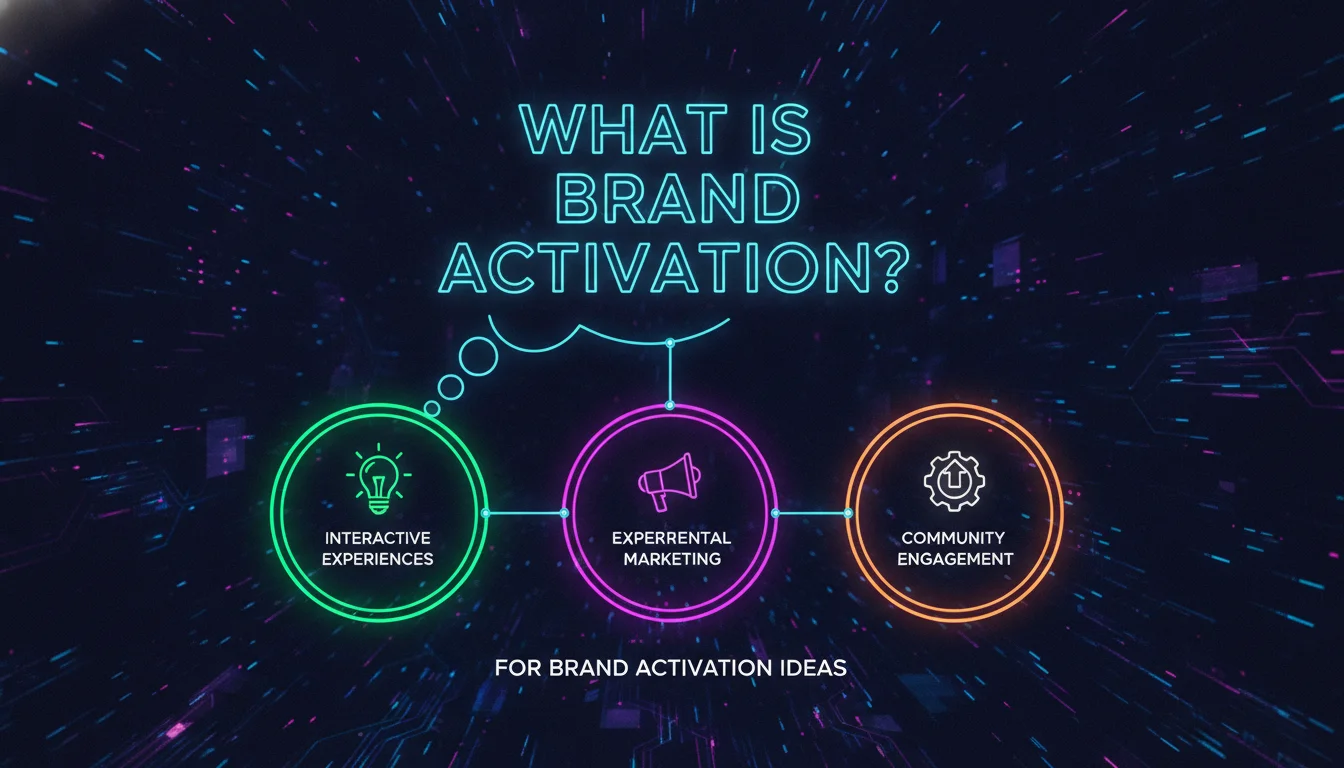
Brand activation is the strategic process of generating consumer action through immersive experiences that bring a company’s identity into the real world. That definition, from Salesforce, puts action at the center. Traditional advertising tells a story to an audience. A brand activation invites that audience into the story. Whether you build a physical pop-up shop or a gamified digital space, the goal is to let consumers test the product mechanics and feel the value proposition firsthand.
The term gets used interchangeably with experiential marketing, but the two are not identical. Experiential marketing is the broader discipline of creating memorable, hands-on brand interactions. Brand activation is the specific campaign that turns that interaction into a concrete consumer action: a purchase, a sign-up, a social share, or a lead. Sweeter describes brand activation as bringing a brand to life through experiences that feel fresh, interactive, and exciting. That hands-on approach outperforms static ads because it demands active cognitive engagement rather than a fraction of a second of attention.
Why Most Brand Activations Miss the Mark
Not all this kind of ideas are created equal. The failure mode is painfully common: a touchscreen trivia kiosk no one asked for, a swag table with branded pens, anything where the brand is present but the person is not actually engaged. This is activation for activation’s sake. If the experience does not solve a problem, invite genuine participation, or connect to the product, it becomes noise.
Salesforce’s Tenth Edition State of Marketing quantifies the challenge: over half of marketers (51%) say their campaigns sometimes feel generic, while 37% report inconsistent messaging. A generic activation that simply places a logo in a space is no better than a banner ad. Successful brand activation start with a clear objective and a specific audience insight, then use creativity to deliver that insight in a tactile, participatory way.
The Anatomy of a High-Performing Activation
A successful activation has three parts: a clear promise, an interactive mechanism, and a measurable outcome. The promise is what the experience gives the customer: entertainment, education, utility, status, or a sense of contribution. The mechanism is the physical or digital interaction: a game, a sample, a VR build, a photo moment, or a co-created product. The outcome is the action you want the customer to take, whether that is a purchase, a lead form, a social share, or a data point.
This anatomy separates a brand activation from a branded event. A branded event might have a stage and a speaker. A brand activation has a hands-on component that requires the attendee to make a choice, perform a task, or interact with the product. That active participation is what creates a memorable connection.
“Rather than talking at a passive audience, brand activations invite potential buyers to actively participate in the narrative. By moving beyond a traditional sales pitch, organizations create a dynamic environment where individuals can organically discover exactly how a service solves their specific problems.” – Salesforce Marketing Cloud
Pros and Cons of Brand Activation Ideas
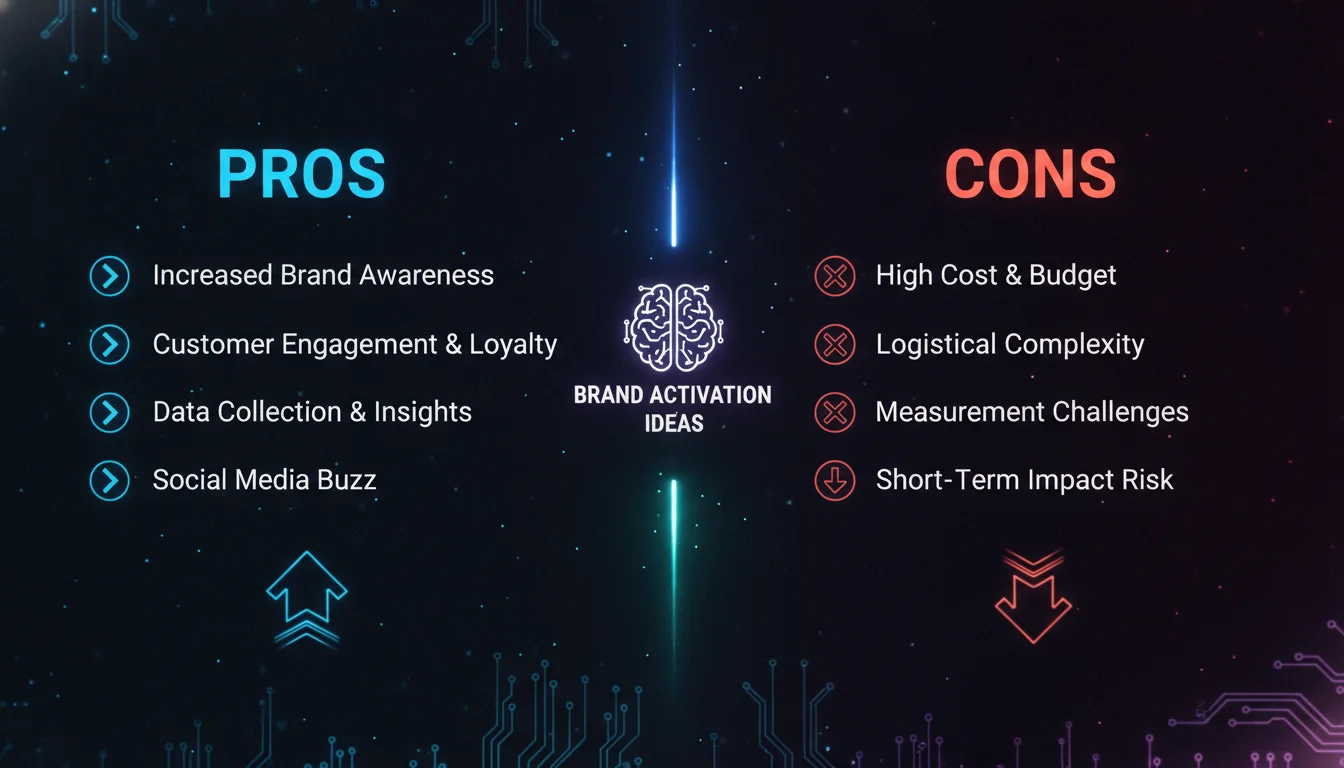
Pros
- Active engagement over passive exposure: Participants interact with your product directly, forming stronger memory associations than a banner ad can create.
- Measurable outcomes: Lead capture, dwell time, participation rates, and social shares give you concrete data to evaluate performance.
- Organic amplification: A well-designed activation gives attendees a story to tell. Social sharing extends reach far beyond the physical footprint at no additional media cost.
- Brand differentiation: In crowded markets, a distinctive activation experience signals confidence and creativity in ways that static advertising cannot.
- Flexible formats: activation ideas scale from a single branded vehicle at a local event to a full VR installation at a global trade show.
Cons
- Higher production complexity: Physical activations require logistics, permitting, staffing, and fabrication that digital campaigns do not.
- Risk of missing the mark: An activation that feels gimmicky or off-brand can damage perception faster than a generic ad ever would.
- Attribution challenges: Connecting an activation experience directly to downstream revenue requires deliberate tracking infrastructure built in from the start.
- Budget sensitivity: Immersive formats like VR setups or custom mobile escape rooms carry higher upfront costs than social media campaigns.
Brand Activation Ideas Organized by Customer Problem
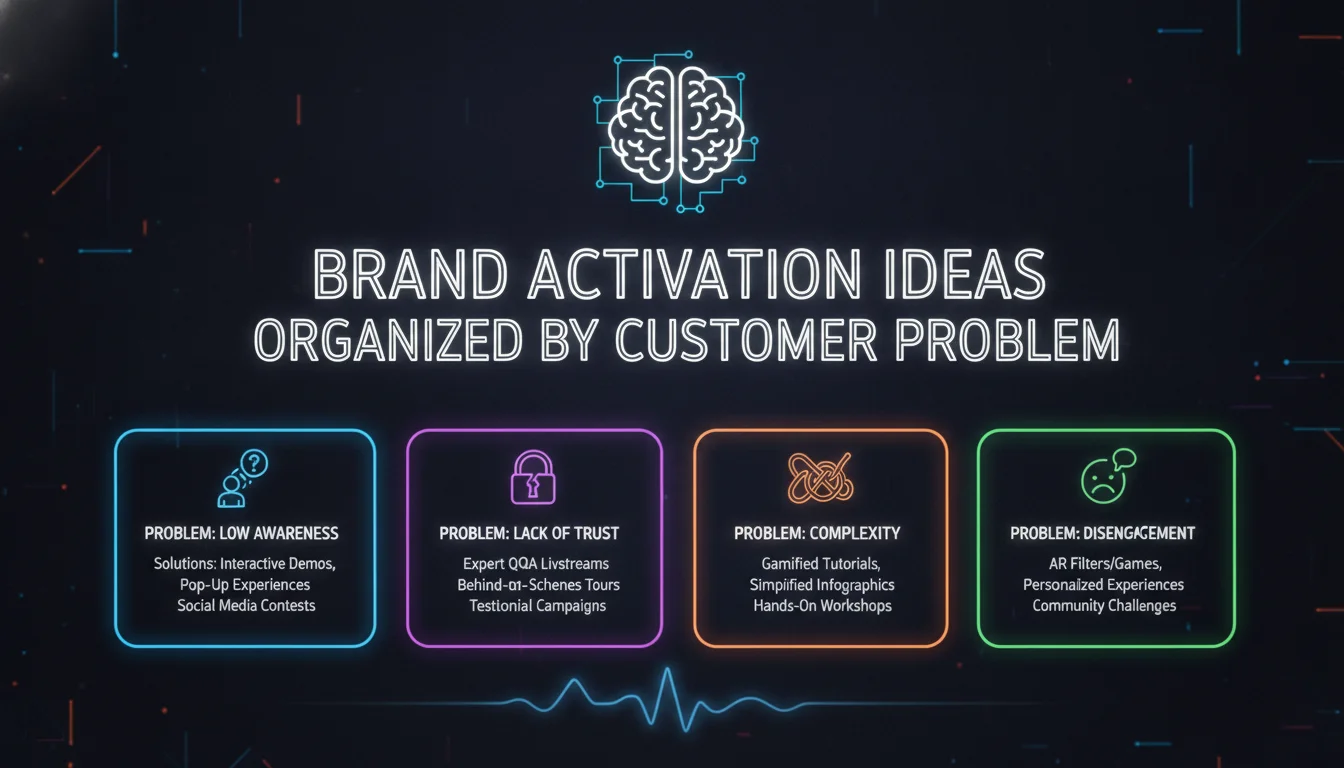
The most reliable way to shortlist this type of ideas is to ask what customer problem the experience solves. A problem-first approach prevents the trivia kiosk problem. Below are three problem categories with specific examples drawn from campaigns covered by Bizzabo, Cvent, and Activation Ideas.
Ideas That Let Customers Experience the Product
Product sampling and live demonstrations are classic, direct this kind of ideas. Cvent recommends allowing attendees to try products firsthand through samples, live demonstrations, or hands-on trials. The mechanic works because it removes risk and builds confidence: consumers can test the product and feel the value proposition themselves. For food and beverage brands, this might be a tasting. For software, a guided walkthrough. For consumer goods, a try-before-you-buy station.
Apple TV+ capitalized on binge-worthy TV by creating an activation that let attendees step into the world of a show. IKEA made its event interactive by letting visitors physically engage with room setups. The key is to make the product the hero, not the logo. A product experience works across B2C and B2B because it directly addresses the customer’s core question: what does this actually do for me?
Ideas That Generate Social Proof and Sharing
Some of the strongest brand activation are designed to turn customers into promoters. Sonic encouraged customer promotion by giving attendees a reason to create and share content. Warby Parker included its own team in the experience, which generated authentic word-of-mouth. Social sharing mechanisms, such as photo backdrops, Instagrammable installations, and shareable digital badges, extend the reach of an activation well beyond the physical footprint.
Activation Ideas, a site sharing activation ideas since 2010, curates icons like Dove’s Real Beauty Sketches and the Ice Bucket Challenge. Both succeeded because participants felt compelled to share their own version. A social-proof activation is not just a photo op. It is an experience that gives people a story to tell. Ask yourself: would an attendee describe this to a friend without being asked? If not, it is probably a swag table.
Ideas That Solve a Customer Pain Point
Some of the most memorable activation ideas address a real-world problem. Vitaminwater solved customer problems. Lucozade Sport addressed customer objections. Misereor helped customers do good, tapping into the desire to contribute. Ben and Jerry’s promoted brand values. These this type of ideas work because they connect the brand to something the customer already cares about.
Solving a pain point can be literal: a convenience store pop-up at a music festival, a free water station sponsored by a beverage brand, a workspace at a trade show. Or it can be emotional, such as a campaign that helps people donate or recycle. The activation becomes useful, not intrusive. That usefulness earns trust and attention that static advertising cannot buy.
| Activation Approach | Primary Objective | Example Brand from Evidence | Key Success Factor |
|---|---|---|---|
| Product sampling / demo | Let customers experience the product | Vitaminwater (solve customer problems) | Hands-on trial, not just a pitch |
| Pop-up shop / themed environment | Create urgency and exclusivity | Apple TV+ (binge-worthy TV world) | Immersive design that reflects brand aesthetic |
| Gamified digital space | Drive active engagement | Ready Player One (technology use) | Clear reward or prize mechanism |
| Influencer collaboration | Reach a broader audience | Starbucks (partner with influencers) | Authentic fit between influencer and brand |
| Social responsibility activation | Promote brand values | Ben & Jerry’s (promote brand values) | Alignment with core values, not a one-off |
| Shock / PR stunt | Generate buzz and media coverage | Lipton Iced Tea (shock your audience) | Bold but on-brand execution |
| B2B trade show booth | Generate leads and demos | Slack (360° customer experience) | Problem-solving, not logo-waving |
Immersive and Experiential Brand Activation Ideas
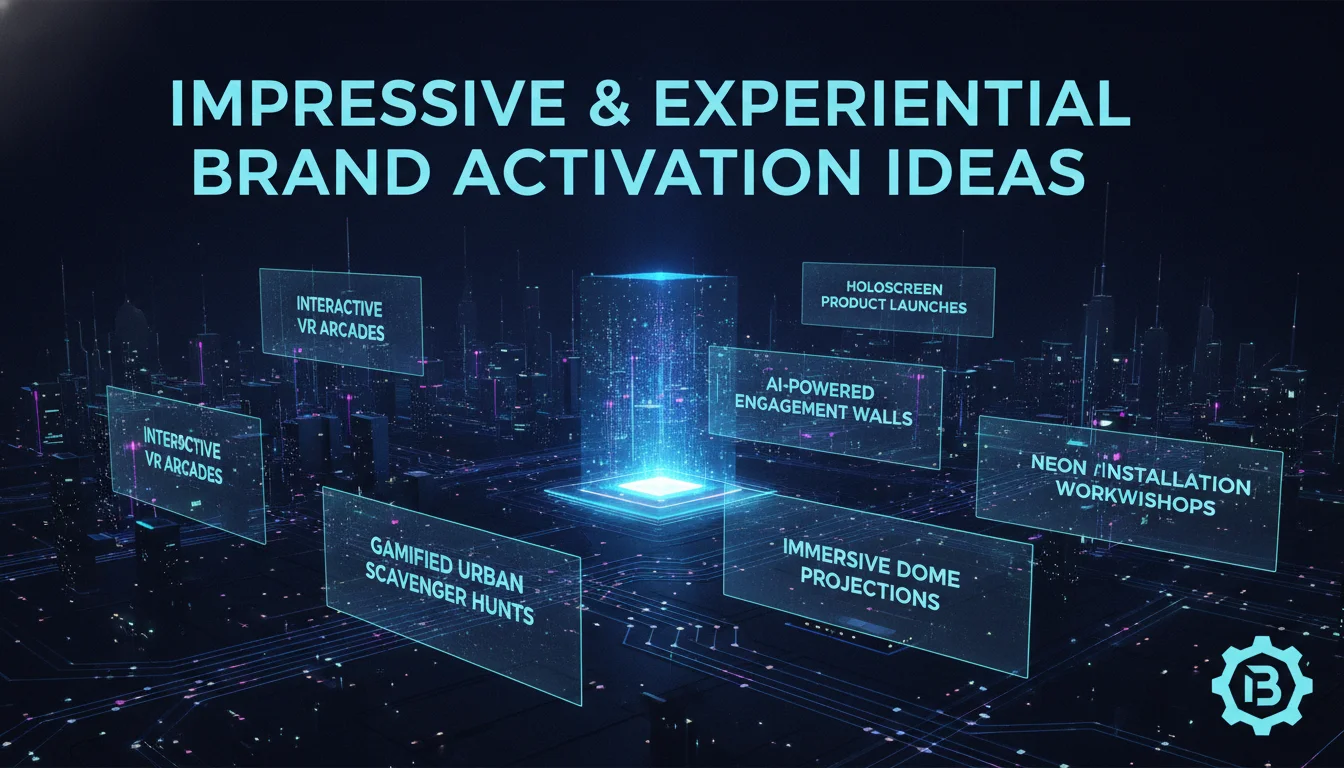
Immersive this kind of ideas place the customer inside the brand story rather than in front of it. These formats consistently outperform passive formats because they demand physical and cognitive participation from the moment the attendee steps in.
Virtual Reality and Mixed Reality Setups
Virtual reality (VR) and mixed reality (MR) are powerful brand activation because they transport customers to a world where the product’s benefits are obvious. Interactive Party, a corporate activation provider with locations in Hauppauge, New York; Gardena, California; and Bedford, Ohio, lists virtual reality and mixed reality as core catalog categories. Cvent also recommends creating immersive environments through VR setups that tell a brand story. These technologies work well for products that are difficult to demo in person: travel destinations, architectural designs, automotive features, or complex machinery.
The strength of VR is sensory immersion. A VR activation demands active cognitive engagement because the user must look, move, and choose. It is not a passive advertisement. Bizzabo’s list includes Ready Player One as an example of using technology to create a memorable experience. Whether it is a VR ski simulator or a mixed-reality product configurator, the activation should tie directly back to a customer benefit.
Pop-Up Shops and Themed Environments
Pop-up shops are temporary retail spaces in high-traffic areas that create urgency and exclusivity, as Cvent notes. They are among the most flexible activation ideas because they scale from a single branded vehicle, like Sweeter’s branded Citroën or Airstream trailers, to a full-store takeover. The environment itself becomes the message: the design, the lighting, the product displays, and the staff all communicate the brand without relying on a logo.
Themed environments take pop-ups one step further. Apple TV+ built an activation around binge-worthy TV, letting attendees step into a show’s universe. IKEA’s interactive event turned product testing into play. Activation Ideas has curated iconic work like the Fun Theory, which showed how environment design can change behavior. The space is not just decorated. It is designed for interaction.
Interactive Installations, Games, and Challenges
Interactive challenges and games are high-energy this type of ideas that reward participation with prizes or exclusive experiences. Cvent recommends engaging audiences with fun challenges, games, or contests. Interactive Party’s catalog includes giant games, arcade setups, the Pickleball Rivals Arcade, and the Giant Human Claw Machine. These installations generate lines, laughter, and social sharing, which builds buzz on-site and online.
Guinness tapped into customer aspirations, according to Bizzabo, turning a brand activation into an aspirational challenge. The activity should be easy to understand but hard to put down. A touchscreen trivia kiosk fails because it demands little and offers nothing. A giant claw machine or a pickleball arcade succeeds because it is viscerally fun. The best game-based this kind of ideas embed the product, or at least the brand’s personality, into the game mechanics themselves.
“The best activations are the ones that nailed engagement, drove results, and got people talking – not just the flashy ones.” – Sweeter Experiential Marketing
Digital and Social Brand Activation Ideas
Digital brand activation extend the reach of experiential campaigns beyond venue walls. They are not limited by geography or capacity, and they generate data at every touchpoint.
Gamified Digital Spaces
Gamified digital spaces are interactive activation ideas that bring the mechanics of a game to a website, app, or social platform. Salesforce describes this format as an interactive campaign that demands active cognitive engagement instead of a passive scroll. Bizzabo’s example of Ready Player One shows how technology can anchor a digital activation. Gamified spaces might include a digital prize vault, an interactive quiz, a virtual escape room, or an augmented reality (AR) filter that turns a phone into a product demo.
The advantage of digital this type of ideas is reach. A well-designed digital game can be played by large numbers of users simultaneously, each generating data on preferences, behaviors, and contact information. Interactive Party lists digital prize vaults and game shows among its virtual event offerings, showing that the format translates to hybrid and remote audiences.
Influencer and Collaborative Events
Partnering with influencers, other brands, or industry experts is a proven approach for expanding reach and borrowing credibility. Cvent recommends collaborative events as a way to reach a broader audience and add credibility. Bizzabo’s list features Starbucks partnering with influencers and Grillo’s Pickles partnering with other brands. The collaboration works because each party brings an existing, trusted audience to the experience.
A collaborative activation can be a co-hosted pop-up, a joint product launch, a live-streamed challenge, or an influencer takeover. The key is alignment: the partner’s values and audience must overlap with your own. A mismatched influencer will feel inauthentic, and 37% of marketers already report inconsistent messaging, according to Salesforce. The collaboration should feel like a natural extension of both brands, not a transaction.
Social Media Stunts and PR Moments
Some PR-led this kind of ideas are engineered to earn media coverage by doing something unexpected. Lipton Iced Tea shocked its audience, according to Bizzabo, while Activation Ideas curates PR stunts like the Whopper Sacrifice and KitKat Mail. These campaigns work because they are surprising, shareable, and have a self-contained narrative. A PR stunt is not just a gimmick. It is a story designed for the press and social media simultaneously.
Social media stunts require careful execution. The moment must be visually interesting, easy to capture on a phone, and tied to a brand truth. A brand that is playful can pull off a stunt that a conservative brand cannot. The risk is that the stunt overshadows the product. The best social-first brand activation ideas make the brand the punchline, not the afterthought.
Event-Based Brand Activation Ideas for Conferences and Trade Shows
Event-based brand activation ideas thrive in high-density environments where attention is scarce and competition for it is fierce. The brands that win are the ones that give attendees a reason to stop, stay, and share.
Trade Show Booth Experiences
Trade shows and conferences are high-density environments where brand activation ideas must compete for attention against hundreds of other exhibitors. A passive booth with a backdrop and a fishbowl of business cards is the B2B version of the failing trivia kiosk. Salesforce and Bizzabo suggest creating a 360° customer experience that lets visitors interact with the product in a meaningful way. Slack’s activation demonstrated how its platform works in a real office environment rather than just showing a slide deck.
Interactive Party lists trade shows and conferences as a core event type, with products like the Experiential Vending Machine and custom mobile escape rooms. These formats turn a booth into a destination. The goal is to make the booth a place where attendees choose to spend time, not a place they walk past. The more time they spend, the more opportunities there are for lead capture and product demonstration.
Product Sampling and Live Demos at Events
Event-based product sampling is a direct engagement tactic that works for food, beverage, technology, and consumer goods. Cvent explicitly recommends offering samples and live demonstrations. At a conference, a live demo station can show software in action. At a festival, a branded sampling vehicle can serve product to large crowds. Sweeter specializes in branded food trucks, mobile tours, and sampling sidecars, which bring the product directly to the crowd.
The advantage of sampling at events is immediacy. Consumers try the product in a positive, high-energy context, which creates a favorable association. The demo must be quick, easy, and followed by a clear next step: a purchase link, a lead form, or a social follow. Sampling without capture is just free product. The best sampling brand activation ideas are designed to convert trial into data.
Photo Activations and Shareable Moments
Photo activations are shareable moments that give attendees a visually striking backdrop, prop, or interactive display designed to be photographed and shared. Interactive Party lists photo activations as a catalog category. Cvent recommends social media integration for broader reach. A well-designed photo moment turns every attendee into a brand ambassador, because each share reaches their network with an implicit endorsement.
Durango Boots, from Bizzabo’s list, gave its audience what they wanted: a brand experience worth photographing. The best photo activations are unique to the brand, not a generic flower wall. They might feature a giant product replica, a themed scene, or an AR filter. The photo is the souvenir, but the social share is the real return on investment.
B2B and Corporate Brand Activation Ideas
B2B brand activation ideas follow the same principles as consumer-facing ones: solve a problem, invite participation, and measure the result. The audience is different, but the psychology of engagement is not.
Sales Meeting and Internal Activations
Brand activation ideas are not just for consumer audiences. B2B companies can use activations to align sales teams, educate employees, and launch new products internally. Warby Parker included its team in the activation, according to Bizzabo, which built authentic advocacy from the inside out. An internal activation might be a gamified product training, a collaborative build session, or a simulated customer scenario.
Interactive Party supports corporate events, employee appreciation, and team building with giant games, game shows, and competitive challenges. These internal approaches serve a dual purpose: they build employee engagement and turn staff into informed brand ambassadors. When employees understand the product through experience, they sell it more convincingly.
Client Appreciation and Hospitality Suites
Client appreciation events are an underused format for B2B brand activation ideas. Instead of a generic dinner, a hospitality suite can include a branded game show, a sports simulator, or a mixology class featuring the product. Interactive Party offers racing chairs, snowsports motion simulators, and multiball LED games for hospitality suites and client events. The activation becomes a relationship-building tool.
The key is to make the client feel valued while subtly reinforcing the brand’s value proposition. A software company might host a custom escape room that requires using its platform to solve a puzzle. A logistics company might run a racing-chair challenge that mirrors its speed and precision. The experience should be fun, memorable, and tied to a conversation about business outcomes.
Trade Show Traffic Builders and Lead Capture
Traffic builders are engagement mechanics specifically designed to draw attendees to a booth and capture their information. Interactive Party lists traffic builders and trade show lead capture as a category, with products like Crack the Code: Digital Prize Vault and custom mobile escape rooms. These attractions create a line, which itself signals popularity and draws more attendees.
The activation must be paired with a lead capture mechanism. A prize vault can require a badge scan or a form fill before play. A mobile escape room can end with a debrief that includes a product demo and a follow-up call. The traffic is the top of the funnel. The data is the conversion. Bizzabo emphasizes measuring the impact of brand activation ideas, not just counting leads but tracking engagement quality.
Design and Packaging as a Brand Activation Category
Design and packaging are standalone brand activation ideas that often get overlooked in favor of events and stunts. Activation Ideas organizes its curated work into categories including experiential, shopper and retail, promo, PR stunts, creative commerce, social media, events and sponsorship, design and packaging, and B2B and trade. That last category, design and packaging, is a reminder that the product itself can be the activation.
Iconic examples from Activation Ideas include Inglorious Fruits and Vegetables, which used packaging design to challenge food waste perceptions, and the Gift Bottle, which turned a standard product into a shareable moment. When packaging invites interaction, sparks conversation, or tells a story without any event infrastructure, it becomes one of the most cost-efficient brand activation ideas available. The shelf is the stage.
How to Plan a Brand Activation in 7 Steps
Planning brand activation ideas well requires a structured process. Creativity without a framework produces the trivia kiosk. The seven steps below sequence the build from objective to measurement.
- Step 1: Set Clear Objectives. Define what the activation should achieve: brand awareness, lead generation, sales, or loyalty. Cvent says clear goals guide the entire planning process.
- Step 2: Understand Your Audience. Identify what they value and what problem they need solved. Tailor the experience to meet those interests directly.
- Step 3: Choose the Right Format. Select a format – pop-up, VR, sampling, gamified digital space – that aligns with both the objective and the audience.
- Step 4: Design the Interactive Mechanism. Build the hands-on component that forces participation: a game, a demo, a challenge, or a photo moment.
- Step 5: Use Technology Thoughtfully. Mobile apps, AR, VR, or social integration extend reach and collect data. Use them where they serve the experience, not just for novelty.
- Step 6: Promote Widely. Use social media, email, and partnerships to create buzz before, during, and after the event. Sweeter’s playbook emphasizes matching the activation format to the campaign’s practical requirements: the physical vehicle, the staffing, the location, and the permit requirements.
- Step 7: Measure and Analyze. Track attendance, engagement, leads, and feedback. Use insights to refine future brand activation ideas, not just to report a vanity metric.
Measuring the Impact of Brand Activation Campaigns
Measuring brand activation ideas is not optional. Without measurement, you cannot distinguish a successful activation from an expensive party. Build the tracking infrastructure before the event, not after.
Engagement Metrics
Engagement is the first layer of measurement. For physical activations, track foot traffic, dwell time, participation rate, and social shares. For digital brand activation ideas, track click-throughs, completion rates, and time on page. Salesforce emphasizes that interactive campaigns demand active cognitive engagement, so the metric is not just views but actions. A high dwell time on a VR setup or a high game-completion rate indicates the activation held attention.
Interactive Party’s catalog includes gamified attractions that inherently produce engagement data: scoreboards, prize redemptions, and scan counts. These data points tell you which activation concepts resonated and which did not.
ROI and Lead Generation
ROI is the business result of a brand activation. Define the conversion action before the event: a lead form, a purchase, a booked demo, or a subscription. Then track how many attendees take that action. Bizzabo’s 19 brand activation ideas are framed around boosting engagement and driving ROI, with examples from brands like Radius and Refinery29 that created exclusivity and anticipation. The lead capture mechanism must be built into the experience, not bolted on at the exit.
For B2B activations, lead quality matters more than quantity. A custom mobile escape room might generate a modest number of leads, but if a strong portion of them are decision-makers who booked a follow-up, that outperforms a larger pile of badge scans from passersby. Pair the activation with a CRM integration to track the full funnel.
Qualitative Feedback and Brand Lift
Qualitative feedback captures the emotional impact of an activation. Surveys, social listening, and post-event interviews reveal whether attendees found the brand memorable, useful, and authentic. Salesforce’s data on inconsistent messaging (37% of marketers report it) is a warning: if attendees cannot articulate what the brand stands for after the activation, the message was not clear enough.
Activation Ideas has curated iconic work since 2010 precisely because those campaigns generated lasting qualitative buzz. The Ice Bucket Challenge, Real Beauty Sketches, and the Fun Theory are remembered years later. That kind of brand lift is the ultimate measure of success, even if it is harder to quantify than a lead count.
The best brand activation ideas are the ones that solve a problem, invite participation, and produce measurable results. They are not stunts for stunts’ sake. They are strategic tools for turning passive audiences into active customers and active customers into vocal advocates.
Ready to build something bold? Contact Emin Media for a free brand consultation and let’s design a brand activation that earns attention, drives results, and gives your audience a story worth telling.
Frequently Asked Questions
What is a brand activation?
A brand activation is the strategic process of generating consumer action through immersive experiences that bring a company’s identity into the real world. It differs from a regular event by requiring active participation, such as trying a product, playing a game, or creating content, rather than passive attendance.
What are the best brand activation ideas for small budgets?
Product sampling, interactive photo backdrops, and gamified digital quizzes are accessible brand activation ideas that require less physical infrastructure. They can be scaled to fit a small space or a single event without sacrificing the core principle of active participation.
How do I measure the ROI of a brand activation?
Define a conversion action, such as a lead, sale, or demo booking, and track it through a scan, form, or code built into the experience. Also track engagement metrics like dwell time and participation rate, plus qualitative feedback from surveys and social listening.
What is the difference between experiential marketing and brand activation?
Experiential marketing is the broader discipline of creating hands-on brand interactions. Brand activation is the specific campaign that turns that interaction into a concrete consumer action, such as a purchase, sign-up, or social share.
Can brand activation ideas work for B2B companies?
Yes. B2B brand activation ideas include trade show traffic builders, custom mobile escape rooms, product demos, and client hospitality suites. The same principles of participation and problem-solving apply, with lead capture built into the experience from the start.
What makes a brand activation memorable?
A memorable brand activation solves a customer problem, invites genuine participation, and feels authentically on-brand. It is not a branded swag table. It is an experience the attendee would describe to a friend without being prompted.
Enjoyed this article?
Contact Emin Media for a free brand consultation and let's create something amazing together.
Get in TouchRelated Articles
Digital Storytelling for Brands: The Complete Guide
Digital storytelling for brands builds real audience connections through narrative. Learn proven techniques, formats, and…
Design Thinking for Marketing: A 2026 Guide
Design thinking for marketing builds campaigns around real user needs. Learn the 5 phases, common…
Creative Direction for Video Shoots: A Complete Guide
Master creative direction for video shoots with proven steps, tools, and strategies that build brand…