Best Compact Digital Travel Camera 2026
Key Takeaways
- Fujifilm X100VI: The top compact travel camera overall, with a 40.2MP APS-C sensor, 23mm f/2 lens (35mm equivalent), and film simulations.
- Ricoh GR IV: The best truly pocketable option, fitting in a trouser pocket with fast, modern performance.
- Sony RX100 VII: The most versatile pick, covering wide-angle to telephoto in an ultra-compact body with a 20.1MP 1-inch sensor.
- Compact cameras outperform smartphones in low light and for prints larger than A4.
- Budget-friendly picks start around $750 with the Canon PowerShot G7 X Mark II.
- Essential travel accessories include weather-sealing kits, spare batteries, and fast SD cards.
The best compact digital travel camera in 2026 is the Fujifilm X100VI, combining a 40.2MP APS-C sensor, a sharp 35mm-equivalent lens, and film simulations in a portable body. For true pocketability, the Ricoh GR IV leads. For zoom versatility, the Sony RX100 VII wins.
Why a Compact Camera Still Beats a Smartphone for Travel
The Sensor Size Advantage
A dedicated compact camera’s larger sensor gathers more light than any phone sensor, yielding better low-light performance, finer detail, and shallower depth of field. According to travel photographer David Fleet of The Cotswold Photographer, an A3 print from an iPhone 14 Pro looked “horrible” with plastic-like skin tones and gaudy colors. Step up to an APS-C sensor compact like the Fujifilm X100VI and those same scenes become wall-worthy prints.
Creative Control and Image Quality
The travel camera gives you full manual control over aperture, shutter speed, and ISO. That means intentional motion blur, long exposures, and genuine depth-of-field effects that smartphones can only simulate. The Fujifilm X100VI’s built-in film simulations, Classic Chrome and Acros among them, produce JPEGs that need no editing. You save hours of post-processing and share high-quality images immediately via built-in Wi-Fi.
When Your Phone Falls Short
Dimly lit churches, evening street scenes, fast-moving children, wildlife at a distance: these are the moments where even the best phone cameras produce noisy, smeared results. For prints larger than A4, a compact camera’s superior resolution and sensor quality make a visible difference. If any of those scenarios sound familiar, the best compact digital travel camera is a worthwhile investment.
Top Compact Travel Cameras of 2026
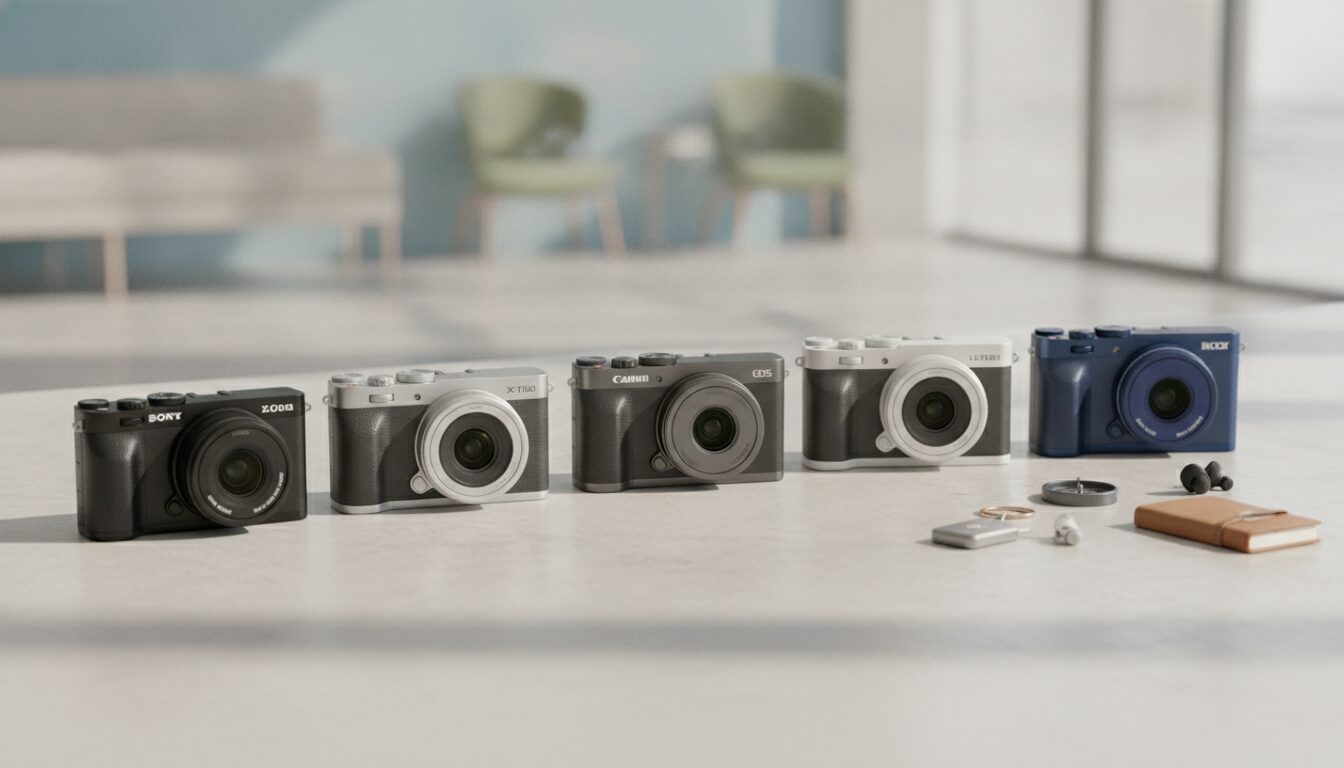
After analyzing the latest models and real-world field tests, three cameras consistently rise to the top for travel photography in 2026. The table below compares their core specifications.
| Camera Model | Sensor & Resolution | Lens (35mm equivalent) | Image Stabilization | Pocketability | Best For |
|---|---|---|---|---|---|
| Fujifilm X100VI | 40.2MP APS-C | 23mm f/2 (35mm) | In-body (IBIS) | Good (jacket pocket) | Overall image quality, film simulation |
| Ricoh GR IV | APS-C | Fixed wide-angle | In-body (IBIS) | Excellent (trouser pocket) | Discreet street & everyday carry |
| Sony RX100 VII | 20.1MP 1-inch | Versatile zoom (wide to tele) | Optical SteadyShot | Excellent (trouser pocket) | Zoom flexibility in ultra-compact size |
Fujifilm X100VI: The Best All-Rounder
The Fujifilm X100VI is the no-compromise compact that professionals reach for. Its 40.2-megapixel APS-C sensor, fixed 23mm f/2 lens (35mm full-frame equivalent), and in-body image stabilization deliver stunning sharpness and color in a 521-gram body. The hybrid optical/electronic viewfinder, 4K/60p video, and film simulations like Classic Chrome and Acros produce JPEGs that need no editing. David Fleet calls it “irreplaceable in my bag” after heavy use. Weather sealing requires an adapter ring and UV filter, a small addition that turns it into an all-weather companion. Battery life of around 450 shots per charge means a spare is wise for a full day of sightseeing.
“The Fujifilm X100VI is irreplaceable in my bag. The film simulations alone save hours of editing, and the APS-C sensor handles low light in a way no phone can match.” – David Fleet, The Cotswold Photographer
Ricoh GR IV: Pocketability Champion
If you need the best compact digital travel camera that slips into a trouser pocket, the Ricoh GR IV is your answer. David Fleet describes it as “the best truly pocketable camera in 2026” and notes it feels fast and modern compared with its predecessor. An APS-C sensor fits inside a body barely larger than a deck of cards, delivering sharp detail and excellent image quality. The fixed wide-angle lens suits street scenes and environmental portraits, and the menu system is built for one-handed operation. For travelers who want to stay light and never miss a moment, the GR IV is a powerhouse in a tiny package.
Sony RX100 VII: Zoom Versatility
The Sony RX100 VII earns its place as the best compact digital travel camera for zoom flexibility. Its 20.1-megapixel 1-inch sensor pairs with a versatile zoom lens covering wide-angle to telephoto perspectives, handling everything from sweeping landscapes to distant details. Laurence Norah of Finding the Universe names it the best pocketable travel camera, and Digital Photography Review has called it “the most capable pocket camera currently on the market.” The tilting touchscreen, built-in flash, and fast hybrid autofocus make it dependable across varied situations. The smaller 1-inch sensor can’t match APS-C in low light, but the lens reach keeps it relevant for wildlife and candid close-ups.
“The Sony RX100 VII remains the most capable pocket camera currently on the market for travelers who need zoom reach without sacrificing portability.” – Digital Photography Review
How to Choose the Best Compact Digital Travel Camera for Your Needs
Understanding Sensor Types: APS-C vs 1-Inch vs Full-Frame
The sensor is the heart of any camera. APS-C sensors, found in the Fujifilm X100VI and Ricoh GR IV, provide a significantly larger imaging area than a 1-inch sensor, resulting in cleaner low-light images and more natural background blur. For ultimate image quality, full-frame compacts like the Leica Q3, with its 60-megapixel sensor and Summilux 28mm f/1.7 lens, push the envelope at a premium price of around $6,500. Most travelers will find APS-C the sweet spot: compact enough for travel, yet a significant step up from smartphones.
Fixed Lens vs Interchangeable: Simplifying Your Kit
Compact digital cameras with a fixed lens eliminate the urge to carry extra glass and let you focus on composition. Travel photographer Jill Slagter left her interchangeable-lens setup at home for a family trip and relied solely on the X100VI’s 35mm-equivalent lens, wide enough for landscapes yet tight enough for portraits. Fixed-lens cameras also tend to be lighter and less obtrusive, making them ideal for street photography and casual travel.
Key Features: Viewfinder, Stabilization, and Weather Sealing
An electronic or hybrid viewfinder helps in bright sunlight and adds stability when composing. In-body stabilization (IBIS) in the X100VI and GR IV counters hand-shake, letting you shoot at slower shutter speeds. Weather sealing varies: the X100VI becomes sealed when you attach an adapter ring and protective filter, while the GR IV includes built-in dust reduction. Always check the details if you’ll be shooting in rain, snow, or dusty environments.
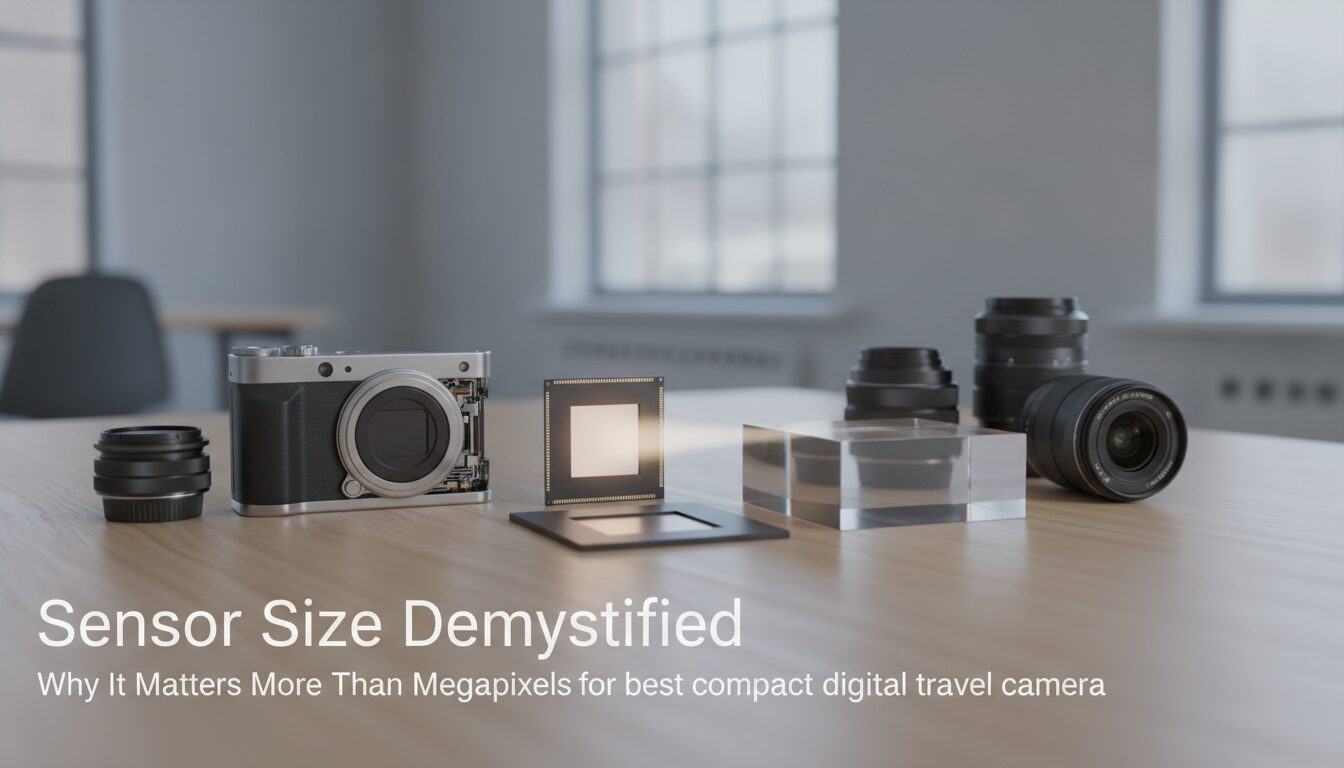
Sensor Size Demystified: Why It Matters More Than Megapixels
What Sensor Size Means for Your Travel Photos
Sensor size refers to the physical dimensions of the imaging chip. Larger sensors capture more light per pixel, yielding higher dynamic range, softer background blur, and less noise in low light. This is why a 20-megapixel APS-C camera can outperform a 20-megapixel 1-inch camera after sunset. The difference becomes especially noticeable when shooting at dusk, in interiors, or when you want to separate your subject from the background.
How Many Megapixels Do You Really Need for Travel?
For most travel photos shared online or printed up to A3, 20 megapixels is plenty. The real advantage of higher resolution, like the X100VI’s 40.2MP, is cropping flexibility: you can recompose a shot heavily and still retain excellent detail. David Fleet’s A3 print test with an iPhone 14 Pro shows that more megapixels alone don’t guarantee quality. Sensor size and lens quality matter far more.
The Compact Travel Camera Sensor Sweet Spot
APS-C strikes an ideal balance: large enough to deliver professional-grade image quality, yet small enough to enable truly portable bodies. Both the X100VI and GR IV prove you don’t need full-frame to get stunning travel photos. As of 2026, APS-C compacts remain the most popular choice among travel photographers who want quality without the weight of a full mirrorless kit.
Step-by-Step: Find Your Ideal Compact Travel Camera
Step 1: Define Your Budget and Priorities
Start with a clear budget. Under $800, the Canon PowerShot G7 X Mark II offers a 20.1MP sensor, f/1.8 lens, and compact size at around $750. Between $1,000 and $2,000, the Fujifilm X100VI and Sony RX100 VII are top contenders. Above $2,000, consider the Leica Q3 or a mirrorless system if you need interchangeable lenses.
Step 2: Evaluate Portability Requirements
Be honest about how you’ll carry the camera. If it must fit in a jean pocket, the Ricoh GR IV or Sony RX100 VII are your best bets. A jacket pocket or small bag opens up the slightly larger X100VI, which adds a viewfinder and better handling. The best compact digital travel camera is the one you’ll actually bring.
Step 3: Consider Your Primary Subjects
Landscapes? A wide 28mm or 35mm equivalent lens works beautifully. People and street scenes? Fast autofocus and film simulations help capture the moment. Wildlife or distant action? You’ll need a zoom lens. The RX100 VII’s telephoto reach, extending to around 200mm equivalent, is the strongest among compact travel cameras.
Step 4: Check Weather Sealing and Durability
Rain and dust are travel constants. For the Fujifilm X100VI, a Fujifilm LH-X100 lens hood and adapter ring paired with a B+W 49mm UV filter creates a sealed system. The Ricoh GR IV includes dust-removal mechanisms, and the Sony RX100 VII has robust build quality but isn’t fully weather-sealed.
Step 5: Test Ergonomics and Accessory Compatibility
If possible, handle the camera in a store or rent it before your trip. Check button placement, menu logic, and how it feels in your hand. Budget for extra batteries, a fast SD card (SanDisk Extreme Pro is widely recommended), and a comfortable strap like the Peak Design Leash.
Essential Accessories for Compact Travel Cameras
Weather Sealing Kits for Dust and Rain Protection
Many compact cameras aren’t weather-sealed out of the box. Photographer Jill Slagter relies on the Fujifilm LH-X100 adapter ring and B+W 49mm MRC Nano UV filter to protect her X100VI from sea spray, dust, and light rain. This simple combination gave her peace of mind during a trip to Mexico, keeping images crisp and the lens safe.
Straps, Bags, and Cases for On-the-Go Security
A lightweight, adjustable strap like the Peak Design Leash lets you quickly clip and unclip the camera, while the wrist variant provides extra security without bulk. For a minimalist carry solution, the Fjallraven Kanken Hip Pack fits an X100VI perfectly alongside a credit card, keys, and a spare battery.
Power and Storage: Batteries and SD Cards
The Fujifilm X100VI doesn’t ship with an external battery charger, so add one to your kit. Carry at least two SanDisk Extreme Pro SD cards for backup, and pack two or three spare batteries, especially if you’ll be away from power outlets all day. For the Sony RX100 VII and Ricoh GR IV, extra batteries are equally important, as compact cameras often have smaller cells.
Real-World Travel Scenarios: Which Camera Fits Your Trip?
City Breaks and Street Photography
In crowded cities, discretion matters. The Ricoh GR IV’s tiny size and silent shutter let you blend in completely. The Fujifilm X100VI’s film simulations and hybrid viewfinder add a creative edge, while its retro aesthetic often sparks conversations with locals. Both are excellent choices for documentary-style travel photography.
Beach and Outdoor Adventures
Sand and salt spray demand protection. A weather-sealed X100VI (with filter attached) handles the beach confidently, while the Sony RX100 VII’s zoom can isolate details from a safe distance. For underwater fun, a dedicated GoPro is the better choice. Pair it with a dome port for half-in, half-out shots, as Jill Slagter does for cenote swimming.
Wildlife and Safari Trips
Compact cameras aren’t the first choice for safari, but the Sony RX100 VII’s telephoto zoom, reaching up to 200mm equivalent, can capture animals at a watering hole. For serious wildlife photography, a mirrorless camera with interchangeable telephoto lenses is the stronger option. That said, if you want one camera that handles everything reasonably well, the RX100 VII’s zoom range is hard to beat in this size class.
Vlogging and Video-First Travel
If video is your priority, the Sony ZV-1 deserves a serious look. Built specifically for vlogging, it features a flip-out screen, directional 3-capsule microphone, and a background defocus button that works in one tap. The Fujifilm X100VI also shoots 4K/60p video with film simulation baked in, making it a strong dual-purpose option. For travelers who want to document their journey as much as photograph it, these two cameras represent the best compact digital travel camera choices for video-forward creators.
When You Need More: Mirrorless Systems for Serious Travel
Some trips demand more reach or flexibility than any fixed-lens compact can offer. The Sony A7C II and Canon EOS R50 are two mirrorless systems worth considering when you want interchangeable lenses without a massive bag. The A7C II pairs a full-frame sensor with a compact body under 514 grams, while the Canon R50 is one of the lightest APS-C mirrorless bodies available. These aren’t pocket cameras, but they bridge the gap between compact convenience and professional capability for travelers who shoot seriously.
Pros and Cons
Pros
- Significantly better low-light performance than smartphones, especially with APS-C sensors
- Full manual controls for creative photography that phones can’t replicate
- Purpose-built ergonomics: physical dials, viewfinders, and dedicated shutter buttons
- Film simulations (Fujifilm) and optical zoom (Sony) add creative and practical range
- Prints up to A3 and beyond hold up with far more detail than phone captures
Cons
- Higher upfront cost: quality compact travel cameras start around $750 and reach $6,500 for premium models
- An extra item to carry, charge, and protect compared to a phone you already own
- Battery life on compact cameras is limited, often requiring spare batteries for full-day shoots
- Weather sealing on most models requires additional accessories rather than being built in
Conclusion: The Best Compact Digital Travel Camera for Your Adventures
Choosing the best compact digital travel camera comes down to your priorities. If image quality and creative control top your list, the Fujifilm X100VI delivers professional results in a portable body. For supreme pocketability, the Ricoh GR IV is unmatched. For zoom flexibility that still fits in a pocket, the Sony RX100 VII is the clear winner. Whatever you pick, stepping up from a smartphone will transform your travel photos into keepsakes you’ll be proud to print and share.
Ready to build a travel kit that actually performs? Contact Emin Media for a free brand consultation and let’s create visual content that tells your story.
Frequently Asked Questions
What is the best compact digital travel camera overall in 2026?
The Fujifilm X100VI is widely regarded as the best compact digital travel camera, combining a 40.2MP APS-C sensor, 23mm f/2 lens (35mm equivalent), and in-body stabilization in a portable design. Its film simulations and weather-sealing capability make it a favorite among professionals and serious travel photographers alike.
Is the Sony RX100 VII good for travel photography?
Yes, the Sony RX100 VII is excellent for travel due to its pocket size, versatile zoom lens covering wide-angle to around 200mm equivalent, and fast hybrid autofocus. It’s the best choice if you need zoom flexibility without bulk, and Digital Photography Review has called it “the most capable pocket camera currently on the market.”
Which compact travel camera fits in a pocket?
The Ricoh GR IV and Sony RX100 VII are both small enough to fit in a trouser pocket. The Fujifilm X100VI fits in a jacket pocket or small bag, making it the slightly larger but more feature-rich option among the three top picks.
Do I need a camera with weather sealing for travel?
Weather sealing protects against dust, rain, and sand, which is genuinely valuable for outdoor travel. The Fujifilm X100VI becomes weather-sealed when used with a Fujifilm LH-X100 adapter ring and B+W 49mm UV filter, while the Ricoh GR IV has built-in dust reduction. The Sony RX100 VII has solid build quality but isn’t fully sealed.
What is the best budget compact digital travel camera?
For budgets under $800, the Canon PowerShot G7 X Mark II offers a 20.1MP sensor, f/1.8 lens, and compact body at around $750. The Mark III adds 4K video and a microphone input if you can find it in stock, making it a strong pick for vloggers on a budget.
Can a compact camera replace a smartphone for travel photos?
A dedicated compact camera delivers noticeably better image quality, low-light performance, and depth-of-field control than even the best smartphone. For prints larger than A4 or any serious photography, a compact is a worthwhile upgrade. According to travel photographer David Fleet, the difference at A3 print size is immediately visible.
Enjoyed this article?
Contact Emin Media for a free brand consultation and let's create something amazing together.
Get in TouchRelated Articles
Canon 5D Mark II Digital SLR Camera Review 2026
The Canon 5D Mark II digital slr camera delivers full-frame quality under $500. Read our…
Canon 550D Digital SLR Camera: Full 2026 Guide
The Canon 550D digital slr camera still delivers in 2026. Specs, Magic Lantern tips, lens…
Best Digital Zoom Camera: Top Picks for 2026
Find the best digital zoom camera for travel, wildlife, and vlogging. Compare top models, sensor…