Best Digital Travel Camera: Top Picks & Guide 2026
Key Takeaways
- A digital travel camera combines compact size with superior image quality, perfect for vacations and everyday adventures.
- The Fujifilm X100VI is our top overall pick for 2026, delivering 40MP images in a lightweight body.
- For ultra-portability, the Ricoh GR IV fits in a pocket and weighs just 262 grams.
- If zoom versatility matters, the Sony RX100 VII offers a 24–200mm f/2.8–4.5 Zeiss lens in a body under 310 grams.
- Beginners on a budget should consider the Sony a6700 or Canon EOS R50 for strong value under $1,500.
- Action cameras like the GoPro HERO12 fill a specific niche for adventure and vlog-style travel footage.
Best Digital Travel Camera: Top Picks & Buying Guide 2026
A digital travel camera is a compact, lightweight camera that delivers superior image quality over a smartphone, making it ideal for capturing vacations and adventures. Our top pick for most travelers in 2026 is the Fujifilm X100VI, with its 40MP sensor and travel-friendly design.
The term travel camera covers everything from fixed-lens compacts to mirrorless systems: any camera small enough to carry effortlessly while producing a noticeable step up from a phone. We draw on hands-on reviews and real-world testing from experts like The Cotswold Photographer and Finding the Universe to help you pick the right travel companion for 2026.
What Is a Digital Travel Camera?
The Evolution from Point-and-Shoot to Smartphone and Back
A this type of camera is any camera that mates portability with photographic performance beyond a typical smartphone. In the early 2000s, compact point-and-shoots dominated the market, but smartphones absorbed the entry-level tier almost entirely. According to Finding the Universe, a modern phone like the Samsung Galaxy S23 Ultra delivers impressive 3x and 10x optical zoom, yet it still can’t match a dedicated camera for low-light shooting, fast action, or large-format prints. Today’s best models sit in the sweet spot: light enough to forget you’re carrying them, but built around larger sensors and real optics that produce images looking natural and detailed even at A3 size.
Key Features That Define a Travel Camera
A true this kind of camera must balance size, image quality, and usability. Critical characteristics include a sensor of at least 1-inch, a fast lens (ideally f/2.8 or brighter), reliable autofocus, and a battery that lasts a full day of sightseeing. Many also incorporate in-body image stabilization (IBIS) to combat hand-shake, a tilting or articulating screen for awkward angles, and Wi-Fi or USB-C for quick file transfer. Weather sealing can be a practical necessity when you’re moving from dusty deserts to rainy cities in the same week.
Sensor Size and Image Quality Explained
The sensor is the heart of any digital travel. A larger sensor captures more light, leading to better low-light performance and shallower depth of field. Most compacts use either a 1-inch sensor (found in the Sony RX100 VII) or an APS-C sensor (like the 40MP X-Trans chip in the Fujifilm X100VI). Full-frame models such as the Sony A7C II also qualify as travel cameras when paired with a compact lens, though they tend to be heavier. As a rule, a camera with an APS-C sensor will outperform a smartphone in any lighting condition, and the difference becomes dramatic when viewing images on a large monitor or making prints above A4 size.
Why Choose a Digital Travel Camera Over a Smartphone?
Low-Light Performance and Night Photography
Dedicated cameras beat phones in dim conditions because larger sensors gather more light per pixel, producing cleaner, more natural results. A travel camera with a large sensor and fast lens can shoot handheld at night while retaining color and texture that phones simply smear away. The Canon EOS R50, for example, can push its ISO to 51,200, as Moment notes, while a phone would already show heavy processing artifacts at a fraction of that sensitivity. If you plan to photograph candle-lit dinners, night markets, or the northern lights, a dedicated camera is essential.
Optical Zoom vs. Digital Crop
Smartphones rely on digital cropping or multiple fixed-lens modules, which degrade image quality beyond their native focal lengths. A camera like the Sony RX100 VII offers a true optical 24–200mm zoom, giving you framing flexibility without loss of detail. The Ricoh GR IIIx, by contrast, uses a fixed 40mm equivalent lens: perfect for street work but less versatile. An optical zoom lets you capture a cathedral spire from a distance or isolate a subject without moving your feet, a capability no phone can fully replicate, according to Myles Katherine Photography.
Creative Control and RAW Editing
Shooting RAW on a dedicated this type of camera gives you far more flexibility to adjust shadows, highlights, and color in post. While phones now offer some RAW capture, the files from a 40MP sensor carry richer data and hold up to aggressive editing without falling apart. Photographers who enjoy fine-tuning their work or printing large will find a dedicated camera indispensable. Fujifilm’s X-series film simulations also produce beautiful JPEGs straight out of the camera, reducing post-processing time while maintaining a distinctive, film-like look.
Smartphone vs. APS-C: A Direct Image Quality Comparison
Put a flagship phone next to an APS-C this kind of camera in the same scene and the differences are clear in three areas. First, dynamic range: the APS-C chip holds highlight and shadow detail simultaneously in high-contrast scenes where a phone clips one or both. Second, subject separation: a fast prime on an APS-C body produces natural background blur that phone portrait modes simulate with software, often with visible edge artifacts. Third, fine detail at 100%: phone images show aggressive noise reduction that smooths skin, foliage, and fabric into a painted look, while APS-C files retain micro-texture. For casual social sharing, a phone is perfectly fine. For prints at 30 cm wide or larger, the APS-C camera wins every time.
Top Digital Travel Cameras of 2026: A Comprehensive Comparison
Best Overall: Fujifilm X100VI
The Fujifilm X100VI is the most balanced compact travel camera on the market right now. Its 40-megapixel APS-C sensor, 23mm f/2 fixed lens (35mm equivalent), and 5-axis in-body stabilization combine to produce sharp, vibrant images in almost any situation. The camera weighs 521 grams and delivers roughly 450 shots per charge, making it a reliable all-day companion. Its hybrid optical/electronic viewfinder and retro film simulations create a shooting experience that genuinely inspires creativity. The X100VI also becomes weather-resistant when an AR-X100 adapter ring and 49mm filter are added: a small but meaningful touch for travel in unpredictable climates.
“The X100VI is the rare camera that makes you want to shoot. The film simulations aren’t a gimmick – they’re a creative shortcut that produces gallery-worthy JPEGs before you open a single editing app.” – David Fleet, The Cotswold Photographer
Best Pocketable: Ricoh GR IV
For those who want the ultimate in discretion and portability, the Ricoh GR IV is the quintessential pocket travel camera. Weighing just 262 grams and measuring only 1.3 inches thick, it slides into a front trouser pocket with ease. Inside, a 26-megapixel APS-C sensor and an 18.3mm f/2.8 lens (28mm equivalent) deliver image quality that belies its tiny body. The GR IV also includes 5-axis stabilization and the famed Snap Focus mode for instantaneous street shooting. Its fixed focal length demands discipline, but the results are often indistinguishable from much larger systems.
Best Zoom Compact: Sony RX100 VII
If you want a zoom lens in a truly compact form factor, the Sony RX100 VII is the travel camera to beat. Its 24–200mm f/2.8–4.5 Zeiss lens covers wide landscapes to telephoto details, while a 1-inch stacked CMOS sensor and advanced autofocus keep up with fast action. The pop-up flash and 4K video with Active SteadyShot round out a feature set that outclasses many larger cameras. According to Myles Katherine Photography, the 24mm wide end is noticeably more inclusive than a 28mm phone lens for architecture and group shots. The body weighs 302 grams and fits in a jacket pocket.
Best Budget Mirrorless: Sony a6700
The Sony a6700 earns its spot as the best all-round travel mirrorless camera for those who want interchangeable lenses without an enormous outlay. Its 26-megapixel APS-C sensor and AI-based autofocus (shared with Sony’s professional bodies) ensure sharp, well-exposed images with minimal effort. At around $1,400 with a kit lens, it sits in the sweet spot of performance and value. Pair it with a compact 16–50mm lens and the total weight stays under 1.5 pounds, ideal for hiking or city breaks.
Best for Beginners: Canon EOS R50
The Canon EOS R50 is the friendliest entry point into the RF-S mirrorless system. At around $750 with a kit lens, it offers a 24.2-megapixel APS-C sensor, a guided shooting interface, and an ISO ceiling of 51,200 for low-light flexibility. The body weighs just 375 grams, and the RF-S lens mount opens the door to Canon’s growing lineup of compact primes. For a first-time buyer stepping up from a phone, it’s hard to argue with this combination of price, weight, and image quality.
Best Action Camera for Travel: GoPro HERO12 Black
Not every travel moment calls for a traditional camera. The GoPro HERO12 Black is the go-to digital travel for adventure footage: surfing, skiing, cycling, or any activity where you need a rugged, waterproof body that can be mounted to a helmet or chest harness. It shoots 5.3K video and supports HyperSmooth 6.0 stabilization, producing smooth footage even on rough terrain. At around $350, it’s an affordable complement to a primary stills camera rather than a replacement. For travel vloggers who want both photos and cinematic action clips, pairing a compact mirrorless with a GoPro covers virtually every scenario.
“Action cameras have matured to the point where the footage quality rivals dedicated video cameras from just a few years ago. For travel content creators, a GoPro alongside a compact mirrorless is the most versatile two-camera kit you can carry under 2 pounds.” – Finding the Universe, travel photography resource
Quick Comparison Table
| Camera Model | Sensor | Lens | Weight | Battery Life (CIPA) | Est. Price (USD) | Best For |
|---|---|---|---|---|---|---|
| Fujifilm X100VI | 40MP APS-C | 23mm f/2 (fixed) | 521 g | 450 shots | $1,599 | All-around travel & family |
| Ricoh GR IV | 26MP APS-C | 18.3mm f/2.8 (fixed) | 262 g | Improved endurance | ~$1,000 | Ultra-portable street photography |
| Sony RX100 VII | 20MP 1-inch | 24–200mm f/2.8–4.5 | 302 g | 260 shots | ~$1,200 | Zoom versatility in a compact body |
| Sony a6700 | 26MP APS-C | Interchangeable (E-mount) | 498 g (body only) | 550 shots | ~$1,400 | Value mirrorless with AI autofocus |
| Canon EOS R50 | 24.2MP APS-C | Interchangeable (RF-S) | 375 g | 370 shots | ~$750 (w/ kit lens) | Entry-level, low-light capable |
| GoPro HERO12 Black | 1/1.9-inch | Fixed wide (HyperView) | 154 g | ~70 min video | ~$350 | Adventure & vlog footage |
Pros and Cons of Choosing a Digital Travel Camera
Pros
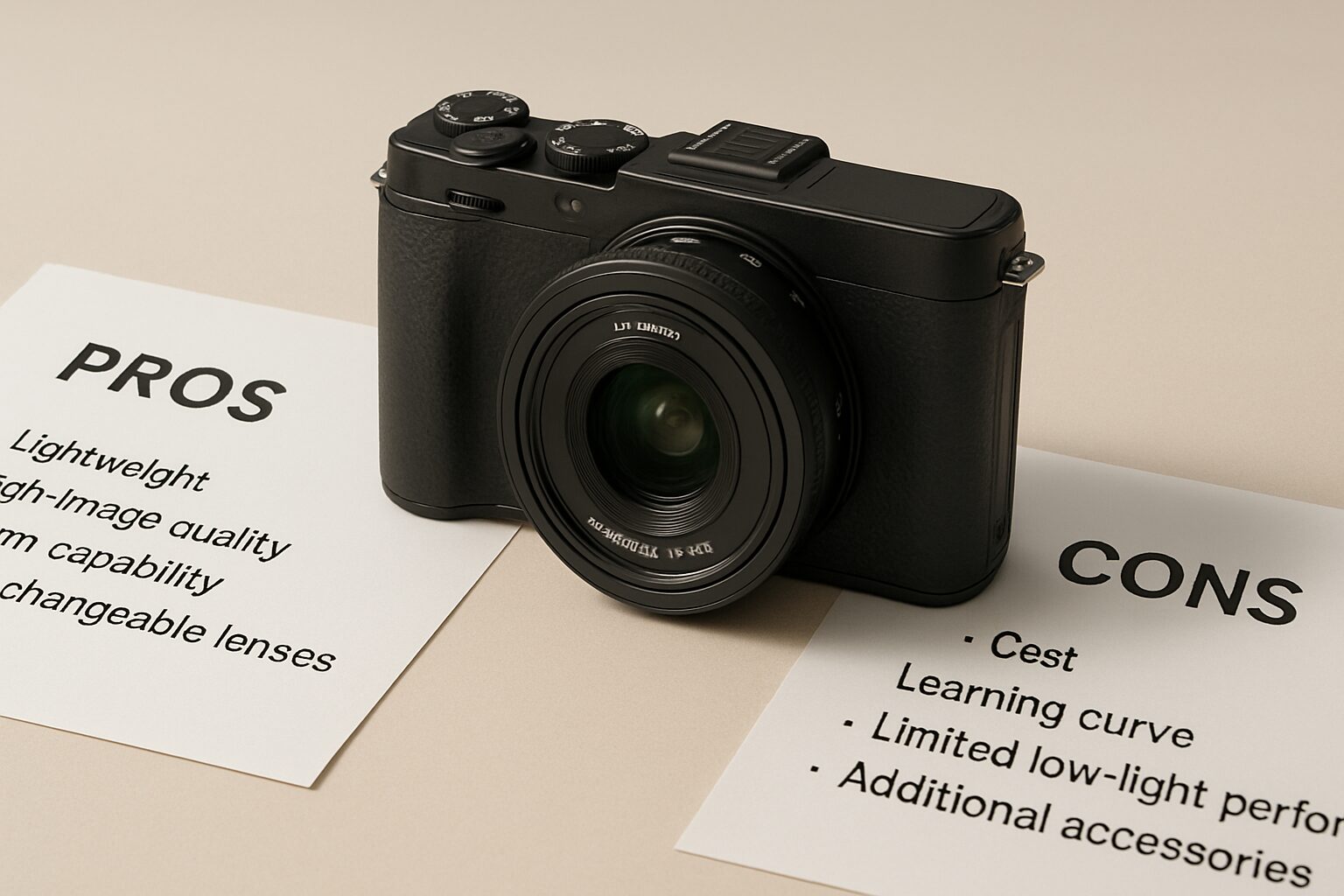
- Superior image quality: Larger sensors and real optics produce cleaner, more detailed images than any smartphone, especially in low light.
- True optical zoom: Cameras like the Sony RX100 VII deliver a genuine 24–200mm range without the quality loss of digital cropping.
- RAW file flexibility: Shoot in RAW and you have full control over exposure, color, and detail in post-production.
- Creative tools: Film simulations, manual controls, and interchangeable lenses open creative possibilities a phone simply can’t match.
- Better battery life: Most travel cameras deliver 260–550 shots per charge, far exceeding a phone’s camera endurance during a full day out.
- Dedicated ergonomics: Physical dials, viewfinders, and grip designs make shooting faster and more intuitive than tapping a phone screen.
Cons
- Extra weight and bulk: Even the lightest compact adds 150–500 grams to your bag compared to just using a phone.
- Higher cost: Quality travel cameras start around $750 and can exceed $3,000 for full-frame systems.
- Learning curve: Manual controls and RAW editing require time to master, which can feel overwhelming for casual shooters.
- Connectivity friction: Sharing to social media requires an extra Wi-Fi transfer step, unlike a phone where images are instantly shareable.
- Theft visibility: Carrying a visible camera makes you a more obvious target in busy tourist areas.
How to Choose the Right Travel Camera
Sensor Size: APS-C vs Full Frame vs 1-Inch
Sensor size is the single most important spec in any this type of camera because it determines noise performance, dynamic range, and depth of field. An APS-C chip (roughly 23.6 x 15.6 mm) offers a sweet spot: large enough to visibly outclass a phone, yet small enough to keep lenses compact. A 1-inch sensor (like those in the Sony RX100 series) is slightly smaller but still a significant upgrade over a phone. Full-frame sensors yield the highest image quality but demand larger, heavier lenses that offset the portability advantage. For most travelers, an APS-C this kind of camera provides the best balance of quality and packability.
Fixed Lens vs Interchangeable Lens
A fixed-lens camera forces you to work with one focal length, but in return you get a simpler, lighter, and often weather-resistant package. The Fujifilm X100VI and Ricoh GR IV are prime examples. Interchangeable-lens models like the Sony a6700 or Canon EOS R50 offer limitless flexibility, but you must also carry and change lenses, adding bulk and complexity. The choice comes down to whether you value spontaneity (fixed) or creative range (interchangeable).
Budget Considerations: From $350 to $3,000+
digital travels span a wide price range. Action cameras like the GoPro HERO12 start around $350. Entry-level mirrorless kits begin under $500 (the Canon EOS R100, for example), while premium compacts like the Fujifilm X100VI sit around $1,600. At the top end, full-frame travel-ready bodies such as the Canon EOS R5 II exceed $3,000. According to Finding the Universe, the sweet spot for most travelers is between $1,000 and $1,500, where you get modern autofocus, solid battery life, and a lens that suits the majority of scenarios.
Safari and Wildlife-Specific Recommendations
Safari photography has its own demands: long reach, fast autofocus, and weather resistance. A travel camera built for wildlife needs at least a 200mm equivalent focal length, which rules out most fixed-lens compacts. The Sony a6700 paired with a 70–350mm E-mount lens is a practical safari kit that stays under 2 kg. The Sony RX100 VII’s 200mm telephoto end can capture distant animals in a pinch, though serious wildlife shooters will want more reach. Weather sealing is also critical: dust and humidity are constant factors on safari, so prioritize bodies rated for the conditions.
AI-Powered Features in Modern Digital Travel Cameras
Subject Tracking and Autofocus
As of 2026, AI has transformed autofocus in every serious this type of camera. Systems now recognize and lock onto human eyes, animals, and birds with a tenacity once reserved for professional sports cameras. The Sony a6700 uses a dedicated AI processing unit to predict subject movement, making it nearly impossible to miss a sharp shot of a darting street dog or a toddler mid-run. Canon’s Dual Pixel CMOS AF II, found in the EOS R50, tracks subjects across the full frame with similar reliability at a fraction of the price.
In-Camera Composition Assistance
Some new cameras go beyond focus and actively help you compose. Fujifilm’s latest firmware updates include a framing-assist grid that suggests subject placement based on classic compositional rules. While not yet mainstream, these AI guides represent a meaningful step forward for travelers who want to improve their eye without reading a textbook. Expect this feature to spread across mid-range bodies within the next 12–18 months.
AI-Based Editing and Film Simulations
Built-in film simulations remain a hallmark of Fujifilm cameras, with 20 distinct looks available in the X100VI ranging from the punchy Velvia to the muted Classic Neg. Sony’s latest models offer “Creative Look” presets that replicate popular editing styles instantly. The advantage of a this kind of camera over a phone is that these simulations are applied to a high-resolution file, producing film-like texture rather than a smartphone’s artificial smoothing. For travelers who want great-looking images without hours in Lightroom, this is a genuine quality-of-life feature.
Building a Lightweight Travel Camera Kit Under 2 Pounds
Choosing a Lightweight Body
To build a sub-2-pound digital travel camera setup, start with a compact body. The Ricoh GR IV at 262 grams is the lightest APS-C option available. If you need interchangeable lenses, the Canon EOS R50 at 375 grams or the Sony a6700 at 498 grams are strong choices. Add a pancake prime (a 22mm or 24mm, for example) and you’ll stay well under the 2-pound threshold. A full-frame Sony A7C II with a small prime can also hit the target, though lens options tend to be heavier.
The One-Lens Travel Setup
Travel light by committing to a single versatile lens. For APS-C cameras, a 23mm or 35mm equivalent covers landscapes, street scenes, and environmental portraits without switching glass. On a full-frame body, a 35mm or 40mm pancake is ideal. This one-lens philosophy is exactly why so many travelers love fixed-lens cameras like the X100VI: they eliminate the temptation to drag along a bag of glass and force you to move your feet instead.
Minimalist Accessories That Don’t Weigh You Down
A few key accessories turn a bare camera into a travel-ready kit without adding bulk. A lightweight strap like the Peak Design Leash adds security and comfort. A small sling bag like the Fjallraven Kanken Hip Pack holds the camera plus a spare SD card and battery. An SD card reader for your phone lets you back up images on the go, a practice recommended by travel photographer Jill Slagter. With just these additions, your entire digital travel camera system stays under 2 pounds.
Accessories to Enhance Your Digital Travel Camera Experience
Must-Have Straps, Bags, and Cases
The right strap and bag make carrying a digital travel camera effortless. The Peak Design Leash is a favorite among travelers for its quick-adjust system and low profile. A wrist strap adds extra security in busy markets. For storage, a small hip pack or sling that doesn’t scream “camera bag” helps you blend in and deters opportunistic theft.
Memory Cards and Backup Solutions
Fast, reliable memory cards are crucial for any digital travel camera. SanDisk Extreme Pro SD cards, with read speeds up to 170 MB/s, are the gold standard for most APS-C bodies. Always carry at least two cards and swap them daily to avoid losing everything if one fails. A portable SSD like the Samsung T7 lets you offload images each night, giving you peace of mind on long trips.
Power Management: Batteries and Chargers
Nothing kills a travel photography day faster than a dead battery. The Fujifilm X100VI uses the NP-W126S and delivers 450 shots per charge. Carrying two spare batteries ensures you’ll never miss a sunset. Many modern digital travel cameras also support USB-C charging, so a power bank becomes a genuine lifeline during long days away from an outlet.
Tips for Getting the Best Photos from Your Digital Travel Camera
Master Composition and Lighting
Even the best digital travel camera can’t fix poor composition. Use the rule of thirds, look for leading lines, and avoid centering your subject unless it’s intentional. In harsh midday sun, switch to spot metering or dial in negative exposure compensation to protect highlights. Photographers like David Fleet of The Cotswold Photographer emphasize that learning to read natural light is the single most valuable skill for travel shooters, more valuable than any gear upgrade.
Shoot at the Right Time of Day
Golden hour (the hour after sunrise or before sunset) casts warm, soft light that flatters landscapes and portraits alike. Blue hour, just after sunset, is perfect for cityscapes with glowing windows and deep blue skies. Planning your outings around these windows will elevate the output of any digital travel camera from snapshot to something worth framing.
Back Up Your Photos on the Go
Travel is unpredictable, and hard-drive failures or theft can happen anywhere. Set up your digital travel camera to auto-transfer JPEGs to your phone via Wi-Fi, and periodically back up RAW files to a portable SSD or cloud storage. This habit ensures you never lose a once-in-a-lifetime shot to a technical failure.
Frequently Asked Questions
What is the best digital travel camera for beginners?
The Canon EOS R50 is an excellent entry point. It offers intuitive controls, a guided shooting interface, and interchangeable lens flexibility at a price under $800. Its 24.2-megapixel sensor and ISO ceiling of 51,200 make it forgiving in low light, and the RF-S mount gives you room to grow your kit over time.
Can a digital travel camera replace a smartphone?
For casual snaps and instant social sharing, a phone is perfectly fine. For low-light shooting, telephoto reach, or large prints, a digital travel camera is the better tool. It provides genuine optical zoom, a larger sensor, and manual controls that elevate photography beyond what any phone currently offers.
How do I choose between a compact and a mirrorless camera?
Choose a compact like the Sony RX100 VII if you want an all-in-one device that slips into a jacket pocket. Pick a mirrorless system if you want the freedom to swap lenses and grow your kit over time. Both qualify as a digital travel camera; the right one depends on how much creative flexibility you want versus how light you want to travel.
What sensor size is best for a travel camera?
An APS-C sensor is the best sweet spot for most travelers. It noticeably outperforms a smartphone in dynamic range, low-light noise, and fine detail, while keeping the body and lenses compact enough for everyday carry. A 1-inch sensor is a solid second choice if you need a zoom lens in a truly pocketable body.
Are there weather-sealed digital travel cameras?
Yes. The Fujifilm X100VI becomes weather-resistant when paired with an AR-X100 adapter ring and a 49mm filter. The Sony A7C II and Canon EOS R6 Mark III also offer robust sealing, making them suitable for rainy hikes or dusty safaris. Always check the manufacturer’s IP rating and pair the body with a sealed lens for full protection.
How can I transfer photos from my digital travel camera to my phone?
Most modern cameras have built-in Wi-Fi or Bluetooth. Install the manufacturer’s companion app, connect the camera, and download JPEGs directly to your phone for quick sharing. For RAW files, a USB-C card reader that plugs into your phone is faster and more reliable than a wireless transfer.
Enjoyed this article?
Contact Emin Media for a free brand consultation and let's create something amazing together.
Get in Touch