Best Branding Strategies for 2026
Best branding strategies are the systems that align purpose, audience understanding, consistent identity, and authentic communication to build lasting trust. They turn a brand promise into repeatable customer experiences that compound over time.
Key Takeaways
- Purpose drives performance. The world’s most valuable brands consistently answer the “why” question before anything else.
- Consistency compounds trust. Uniform visual and verbal messaging can boost revenue by up to 23% across platforms, according to Salesforce research.
- Audience understanding is non-negotiable. Over 80% of consumers need to trust a brand before considering a purchase, per Adobe’s brand research.
- Strategy precedes design. Logos and colors are outputs of positioning, value proposition, and brand essence – not the starting point.
- Best branding strategies are living frameworks. They retain a core promise or intentionally redefine it when culture and market conditions demand change.
- Small businesses can compete. Authentic identity and visual consistency are proven approaches regardless of company size.
What Is a Brand Strategy?
Definition and Core Elements
A brand strategy is an actionable plan for how a company presents itself to customers and shapes perception. It is not a logo, tagline, or color palette. It is the system that connects those elements to business goals. According to Podium’s brand strategy guide, the best branding strategies speak directly to your target audience and communicate your value proposition and what customers can expect. Brand strategy includes mission, vision, values, messaging, positioning, and the guidelines that keep every customer touchpoint coherent.
Brand strategy is a long-term plan, not a one-time project. It shapes how customers recognize, remember, and trust a business. Without it, marketing becomes reactive and visual choices become arbitrary.
Brand Strategy vs. Brand Identity
Brand identity is the visual and verbal expression of a brand: tone, graphics, color palette, typography, and more. Brand strategy is how you use those elements to shape consumer perception. Podium distinguishes these two concepts explicitly, noting that brand identity refers to the visual elements associated with your company, while branding strategy refers to how you use these elements to shape consumer perception. Royal Digital Agency similarly separates strategy from identity, noting that many businesses confuse a new logo with a complete rebrand. A logo can change without a strategy shift, and a strategy can evolve even if a logo stays the same.
Why Strategy Precedes Visual Design
Lean Labs argues that graphic design is only a small part of a comprehensive branding process. Brand aesthetics are a byproduct of carefully weighed decisions about core values, buyer personas, unique value propositions, and brand message. Without strategy, visuals become decoration. With strategy, they become recognition assets that reinforce a consistent promise. This is why the best branding strategies start with questions, not with a color palette.
Best Branding Strategies Start with Purpose and Audience
The “Why” Question
A brand strategist analysis of three global brand valuation studies – Kantar’s BRANDZ, Brand Finance, and Interbrand – finds that 34 brands appear on every one of the top 100 lists. These superbrands answer four core questions, the first being “Why do we exist?” BMW has used the same answer, “Sheer Driving Pleasure,” for over half a century. Meta retained Facebook’s mission – give people the power to build community and bring the world closer together – even after the corporate name change. The exact label matters less than the clarity: Meta calls it a mission, BMW calls it a brand essence, Accenture calls it a purpose, and IKEA calls it a vision. The discipline is answering the question, not debating the terminology.
A brand essence is the core idea or feeling a brand promises, and it must remain robust and future-oriented. BMW’s head of corporate and brand identity, Joachim Blickhäuser, explains that joy is universal and will remain relevant whether cars are electric, autonomous, or traditional.
Understanding Your Target Audience
Adobe reports that more than 80% of consumers say they need to trust a brand to consider purchasing. Trust requires relevance. According to the Salesforce Small and Medium Business Trends Report, nearly two-thirds of consumers expect personalized interactions, and 65% expect businesses to adapt to their changing needs and preferences. The best branding strategies therefore start with detailed buyer personas, customer interviews, and market research – not with font selection.
Case Examples: BMW, Meta, Microsoft
BMW demonstrates consistency. Even through identity, leadership, and business changes, the company has maintained the same brand essence. Meta demonstrates continuity under a new architecture: the corporate name changed, but the mission did not. Microsoft demonstrates when to change the answer entirely.
When Satya Nadella took over, he described the internal culture as “dire” and led a renewal that began with redefining mission, worldview, ambition, and culture on one page. According to brand strategist analysis citing Nadella’s own account, within three years Microsoft generated $250 billion in market value, saw stock soar 90%, and reached 95% approval on Glassdoor. Nadella was named the number one CEO in Brand Finance’s Brand Guardianship Index in 2022.
These examples show that the best branding strategies are not static documents. They are living frameworks that can retain a core promise or intentionally redefine it when culture and market conditions demand.
Pros and Cons of Investing in Brand Strategy
Pros
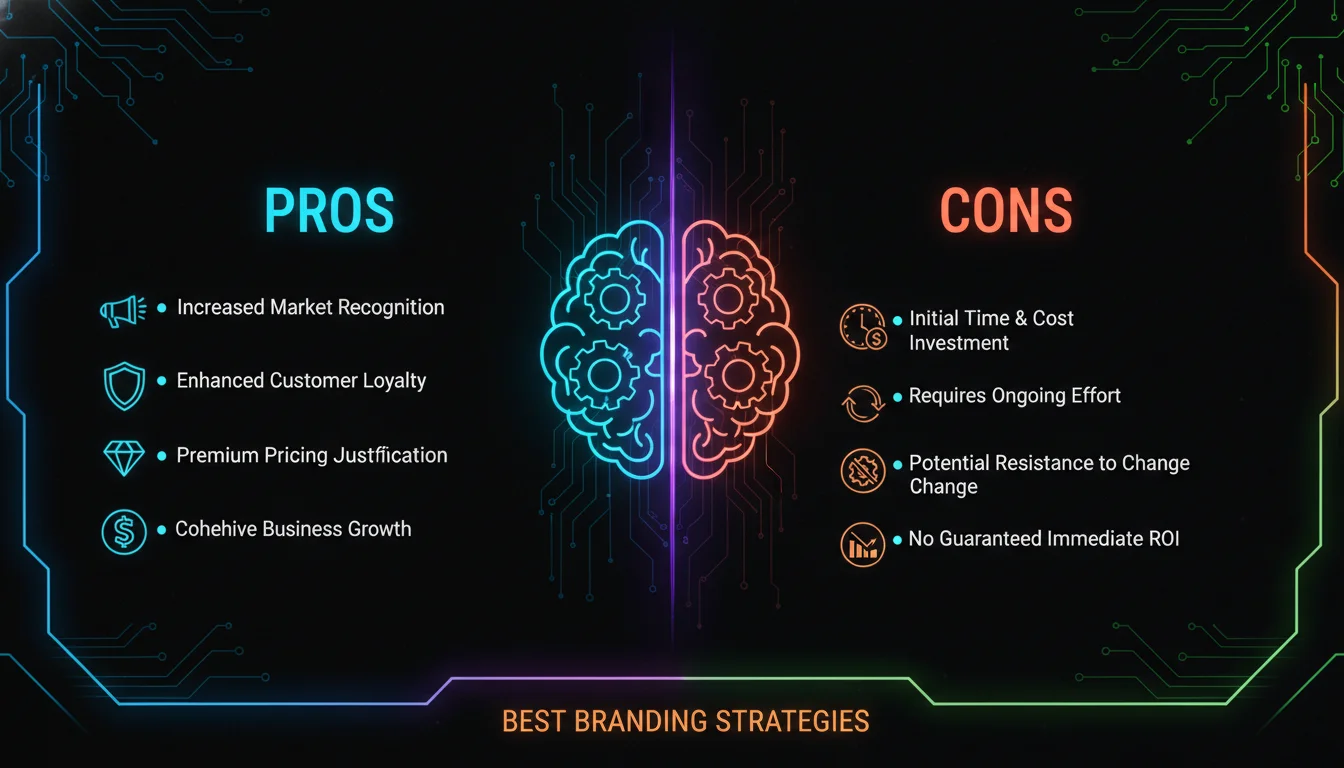
- Builds compounding trust. Consistent branding creates recognition that grows stronger with every customer interaction over time.
- Drives measurable revenue impact. Salesforce research shows consistent branding can boost revenue by up to 23% across platforms.
- Aligns internal culture. A clear brand strategy gives employees a shared purpose, which Microsoft’s turnaround proved is foundational to performance.
- Differentiates in crowded markets. Strong positioning tells customers exactly why you and not a competitor.
- Makes marketing more efficient. When strategy is clear, every creative decision has a filter. Less debate, faster execution.
Cons
- Takes time to show results. Brand equity builds over months and years, not campaign cycles. Leadership patience is required.
- Requires ongoing investment. Brand guidelines, audits, and creative consistency demand budget and dedicated attention.
- Can become rigid. A strategy that is too tightly defined can slow adaptation when markets shift or audiences evolve.
- Internal misalignment is a real risk. If employees do not live the brand values, the external promise becomes hollow fast.
The Most Effective Branding Strategies in Marketing
Corporate and Product Branding
Royal Digital Agency’s 2026 guide divides best branding strategies into clear categories. A corporate branding strategy applies one master brand to the entire organization, emphasizing reputation, values, and company-wide trust. Product branding strategy focuses on a specific offering, building a distinct identity that can stand alone or be endorsed by the parent brand. These two are not mutually exclusive: Microsoft uses corporate branding for the company and product branding for individual offerings like Windows and Office.
Personal and Service Branding
Personal branding strategy treats an individual as the brand, common for consultants, executives, and creators. Service branding strategy applies brand principles to intangible offerings, where trust and customer experience carry more weight than physical attributes. Royal Digital Agency includes retail and geographical branding as well, where a location or region becomes the brand promise. The Guardian Recruiters’ guide notes that branding dates back to approximately 2000 BC, when merchants marked goods to signify ownership and origin – an early precursor to modern brand identity.
Co-Branding and Online Branding
Co-branding strategy pairs two or more brands to create combined equity, expanding reach and transferring trust between audiences. Online branding strategy focuses on digital channels, from websites to social media to email, ensuring recognition across platforms. Podium emphasizes that brand guidelines are necessary for successful brand positioning and great customer experience. Strong guidelines help customers know what to expect, which builds trust and encourages long-term relationships.
Top 5 Proven Best Branding Strategies for Small Businesses
1. Authentic Brand Identity
Salesforce’s guide for small businesses identifies authentic brand identity as the foundation of effective best branding strategies. People connect with brands that are real, honest, and aligned with their values. According to the Salesforce Small and Medium Business Trends Report, 61% of customers feel companies treat them like a number, not an individual. A clear, consistent brand identity can bridge that gap. To define authenticity, small businesses must answer three questions: What is your mission? What are your values? Who is your audience?
Authenticity is not a marketing claim. It is alignment between what a brand says and what it does. When values guide decisions, customers notice.
2. Engaging Visual Branding
Visual branding is often the first impression customers have of a business. Salesforce notes that consistent branding can boost revenue by up to 23% across platforms. As of 2026, AI tools have made visual creation far more accessible: small businesses can use AI-powered platforms to create logos, color palettes, and storefronts quickly without large design budgets. Salesforce highlights Thnks, a gratitude platform, which unified its sales and marketing efforts and achieved a 400% boost in productivity by finding the “relationship” in CRM.
3. Consistency Across Every Touchpoint
Consistency is not just about aesthetics. It is about expectations. Podium’s brand guidelines explain that a repeatable experience across platforms and over time builds trust. Adobe adds that your brand has seven seconds to make a first impression. That first impression is repeated at every touchpoint: website, packaging, social media, customer service. The best branding strategies for small businesses treat every interaction as a promise kept or broken.
4. Audience-First Positioning
Before choosing a color or tagline, research the needs and desires of your target customers. Adobe states that researching target customers is the first step of crafting a good branding strategy. Salesforce echoes this with buyer personas and customer research. The best branding strategies are built on evidence, not assumption. Interview real customers, map their journey, and let their language shape your messaging.
5. Regular Strategy Refinement
A brand strategy that never gets reviewed quietly drifts out of alignment with the market. Adobe recommends analyzing and refining your strategy regularly. Podium recommends a brand guide to ensure consistency. A visual identity that evolves without a strategy will drift. A strategy that evolves without visual updates will stagnate. Quarterly check-ins and annual strategic reassessments keep both in sync.
How to Build a Brand Strategy: Step-by-Step
Adobe’s brand strategy guide outlines a six-step process that works for startups and global enterprises alike. The sequence matters because each step informs the next.
- Step 1: Identify your target audience. Create buyer personas based on needs, values, and behaviors.
- Step 2: Establish a unique position in the market. Define what makes you different and why that difference matters to your specific audience.
- Step 3: Craft a compelling message. Translate positioning into a promise that resonates emotionally and stays consistent across channels.
- Step 4: Develop an engaging visual identity. Choose colors, typography, and imagery that reflect your brand’s personality and positioning.
- Step 5: Use technology to reach your audience. Apply your brand consistently across digital and physical channels.
- Step 6: Analyze and refine your strategy regularly. Use customer feedback and performance data to iterate with intention.
Step 1 Deep Dive: Research Your Audience
Before choosing a color or tagline, research the needs and desires of target customers. Adobe states that researching target customers is the first step of crafting a good branding strategy. Salesforce echoes this with buyer personas and customer research. The best branding strategies are built on evidence, not assumption. Start with ten customer interviews before you open a design brief.
Step 2 Deep Dive: Position and Message
Design Bridge calls brand strategy a “north star” that shapes every interaction. A positioning statement is an internal declaration of the unique value a brand offers to a specific audience.
“The essence of strategy is choosing what not to do.” – Michael Porter
Once positioning is clear, messaging becomes a translation exercise rather than a creative gamble. You know what to say because you know exactly who you are talking to and what you are not willing to be.
Step 3 Deep Dive: Visual Identity and Iteration
Visual identity is a byproduct, not a starting point. Once positioning is clear, design choices become easier and faster. Adobe recommends analyzing and refining regularly. Podium recommends a brand guide to ensure consistency. A visual identity that evolves without a strategy will drift. A strategy that evolves without visual updates will stagnate. The best branding strategies treat both as a continuous loop, not a one-time project.
“Brand aesthetics are the byproduct of many carefully weighed decisions about core values, buyer personas, and unique value propositions.” – Lean Labs
Comparison Table: Choosing Among the Best Branding Strategies
The table below compares strategy types identified across competitor sources. Use it to shortlist options based on your business model, not just preference.
| Strategy Type | Core Focus | Best For | Example |
|---|---|---|---|
| Corporate Branding | Reputation, values, company-wide trust | Large organizations with multiple offerings | Microsoft |
| Product Branding | Distinct identity for a specific offering | Companies with standalone products | BMW’s “Sheer Driving Pleasure” |
| Service Branding | Trust and experience for intangible offers | Consultancies, agencies, software | Salesforce |
| Personal Branding | Individual expertise and credibility | Executives, creators, consultants | Satya Nadella |
| Co-Branding | Combined equity and reach | Partnerships and collaborations | Brand collaborations |
| Online Branding | Digital presence and cross-platform consistency | E-commerce, SaaS, content businesses | Thnks |
| Minimalist / No-Brand | Reduced visual noise | Premium or commodity products | Category-specific plays |
How to Read the Table
A strategy type is not a tagline. It is an operating principle. Corporate branding works when the company name carries more weight than any product. Product branding works when the offering must stand alone in a crowded category. Service branding works when the customer cannot see or touch the deliverable, so trust becomes the product itself.
Choosing by Business Stage
Startups often begin with personal branding or product branding, then evolve toward corporate branding as they scale. Small businesses may combine online branding with authentic identity to build local trust. The key is to choose one primary type and execute it consistently before adding complexity. Layering strategies too early creates confusion, not clarity.
Common Branding Strategy Mistakes to Avoid
Inconsistency Across Touchpoints
Podium states consistency is key for meeting customer expectations throughout all touchpoints in the buyer’s journey. Inconsistent branding creates cognitive dissonance and erodes trust. A customer who sees a polished website but a sloppy invoice will question the entire promise. The best branding strategies treat every touchpoint as part of one continuous conversation.
Chasing Attention Before Product-Market Fit
Lean Labs observes that brands often rush to scale marketing with the idea that more awareness equals more customers. They throw money into attention while slowly working on the product or service in the background. Customers buy because marketing succeeded at changing their belief, but they stay because the product delivered. Attention without a strong offer is wasted spend, and no amount of brand polish fixes a weak product.
Ignoring Internal Culture
Microsoft’s turnaround shows that brand strategy begins inside the organization. Satya Nadella’s first move was to answer “Why are we here?” for employees. That internal alignment preceded market performance. A brand promise that employees cannot deliver becomes a liability, not an asset. The best branding strategies are built from the inside out.
Skipping Brand Guidelines
Many businesses define a strategy but never document it. Without brand guidelines, consistency depends on individual memory rather than a shared system. Podium notes that brand guidelines create a repeatable experience for customers across platforms and over time. Guidelines covering tone, messaging, imagery, and color are must-haves, not nice-to-haves. They also serve as hiring guidelines, helping new team members understand what the brand stands for from day one.
Conclusion: Which Best Branding Strategies Fit Your Business?
Synthesis of Common Threads
The sources we reviewed disagree on how many strategies exist – some list five, some ten – but they agree on the core: the best branding strategies combine a clear why, a well-defined audience, consistent identity, and authentic communication. Podium says the best branding strategy speaks directly to your target audience and communicates your value proposition. Adobe says trust is the foundation. Salesforce says authenticity and visual consistency drive revenue. The synthesis is not a single tactic but a system that compounds over time.
Final Recommendation
Choose one primary strategy: corporate, product, personal, service, co-branding, or online. Execute it with consistency. Document brand guidelines, measure trust and recognition, and refine quarterly. The world’s most valuable brands do not chase every trend. They reinforce the same core promise over decades.
Next Steps
Start with the six-step process outlined above. Run a brand audit, interview ten customers, and align your visual identity, messaging, and customer experience with the strategy. The best branding strategies are built deliberately, not stumbled into. If you want a creative partner to help you build one, explore what Emin Media offers or read more on our blog for deeper dives into brand storytelling and digital marketing.
Ready to build something that lasts? Contact Emin Media for a free brand consultation and let’s create a brand strategy that actually moves the needle.
Frequently Asked Questions
What are the 7 most commonly used branding strategies?
The seven most commonly cited strategies are corporate branding, product branding, service branding, personal branding, retail and geographical branding, co-branding, and online branding. Royal Digital Agency lists these seven as key categories, while Podium and The Guardian Recruiters offer overlapping frameworks that confirm this grouping.
What are the most effective branding strategies?
The most effective branding strategies are those that align a clear purpose with a well-researched target audience and execute consistently across all touchpoints. Salesforce highlights authentic brand identity and engaging visual branding as proven approaches for small businesses. Adobe emphasizes trust and unique positioning as foundational to any strategy that drives long-term growth.
What is the 3 7 27 rule of branding?
The 3 7 27 rule is not defined in the source material reviewed for this article, so no universal definition can be verified here. The sources instead emphasize consistency, audience understanding, and value communication as the core drivers of brand recognition and recall.
What are the 5 C’s of branding?
The 5 C’s of branding is a framework not detailed in the competitor content analyzed here. The sources reviewed focus on five proven strategies for small businesses: authentic identity, visual branding, consistency, audience targeting, and regular refinement, rather than a formal 5 C’s model.
How do I choose the best branding strategy for my business?
Start by defining your brand identity, objectives, target audience, and competitive landscape, as Royal Digital Agency recommends. Then select a primary strategy type such as product, service, personal, or corporate, and document guidelines to ensure consistency across every customer touchpoint. Match the strategy type to your business stage, not just your preference.
How often should a branding strategy be reviewed?
Adobe recommends analyzing and refining your strategy regularly. Most practitioners find that quarterly reviews of brand consistency and annual strategic reassessments against market changes and customer feedback keep a brand sharp without creating constant disruption to creative teams.
Enjoyed this article?
Contact Emin Media for a free brand consultation and let's create something amazing together.
Get in TouchRelated Articles
Digital Marketing for Creatives: A Bold Guide
Digital marketing for creatives builds real visibility and sales. Learn strategies for social media, SEO,…
Branding & Design Agency Tips That Actually Work
Discover branding and design agency tips to choose the right partner, set clear goals, and…
Creative Agency Pitch Deck Tips That Win Clients
Master creative agency pitch deck tips that win clients in 2026. Learn storytelling, design, and…