What Is Brand Positioning? Strategy, Types & Examples
What Is Brand Positioning? Definition, Strategy, and Examples
What is brand positioning? It is the process of designing a company’s offering and image to occupy a distinctive place in the mind of the target market, defining how a brand differs from competitors and how customers perceive it.
Key Takeaways
- What is brand positioning in one sentence: it is the strategic act of claiming a specific mental space in your customer’s mind that competitors cannot easily occupy.
- A brand positioning statement is an internal document, not a public tagline, that guides every marketing and product decision.
- Effective positioning differentiates your brand, justifies your pricing, and builds customer loyalty over time.
- Positioning is an ongoing process, not a one-time exercise. Markets shift, and your position must shift with them.
- Real examples like Yellow Tail, Dove, and Apple show that the strongest positions are built on a single, credible, and consistent idea.
What Is Brand Positioning?
What is brand positioning, exactly? Marketing scholar Philip Kotler defined it as “the act of designing the company’s offering and image to occupy a distinctive place in the mind of the target market.” That definition, cited by The Branding Journal, has held up for decades because it captures something precise: positioning lives in the customer’s mind, not in your boardroom.
Amazon Ads frames it as the unique value a brand presents to its customer. It is a marketing strategy brands create to establish their brand identity while conveying their value proposition. That value proposition is the reason a customer would prefer one brand over another.
NIQ adds that what is brand positioning really about is defining a brand in the minds of consumers, in relation to the market and competitors, and within the larger public consciousness. The most effective positioning creates a specific and unique place in the market that reflects a company’s unique selling proposition while aligning with its target audience.
“Brands have never been more important. Consumers are looking to brands to create meaning in their lives – to make their consumption of everyday products and services more significant. As long as brands are meaning-makers, they will continue to create value for consumers and for firms.” – Professor Jill Avery, Harvard Business School, Creating Brand Value
Key Components of Brand Positioning
Brand positioning is not a slogan or a logo. It is a strategic framework with several interconnected components that must work together to create a clear mental association.
- Target audience: The specific group of customers the brand serves, defined by demographics, psychographics, or use cases.
- Market definition: The category or frame of reference in which the brand competes, allowing customers to compare alternatives.
- Point of difference: The unique benefit or attribute that separates the brand from competitors and makes it preferable.
- Reason to believe: The proof or evidence that supports the brand’s claim, such as material properties, performance data, or certifications.
- Brand personality and values: The human traits and principles that shape how the brand communicates and behaves.
These components work together. If a brand positions itself as the safest choice in protective eyewear, the point of difference might be titanium frames that return to their original shape after being bent. The reason to believe is the material’s physical property, and the brand personality might be rugged, reliable, and precise. Without any one of these elements, the positioning remains incomplete.
Brand Positioning vs. Brand Identity
Many people confuse brand positioning with brand identity, but they serve different roles. Brand identity is the visible expression of the brand: its name, logo, colors, typography, and visual language. Brand positioning is the strategic foundation that guides how that identity should be designed and communicated.
According to Harvard Business School Online, brand positioning describes how brands establish competitive advantages in consumers’ minds in the marketplace. Think of positioning as the mental territory you claim. Brand identity is the flag you plant on that territory.
A brand can update its visual identity without changing its positioning, but changing positioning usually requires rethinking identity, messaging, and product experience. Positioning provides the why. Identity provides the what.
Pros and Cons of Brand Positioning
Pros
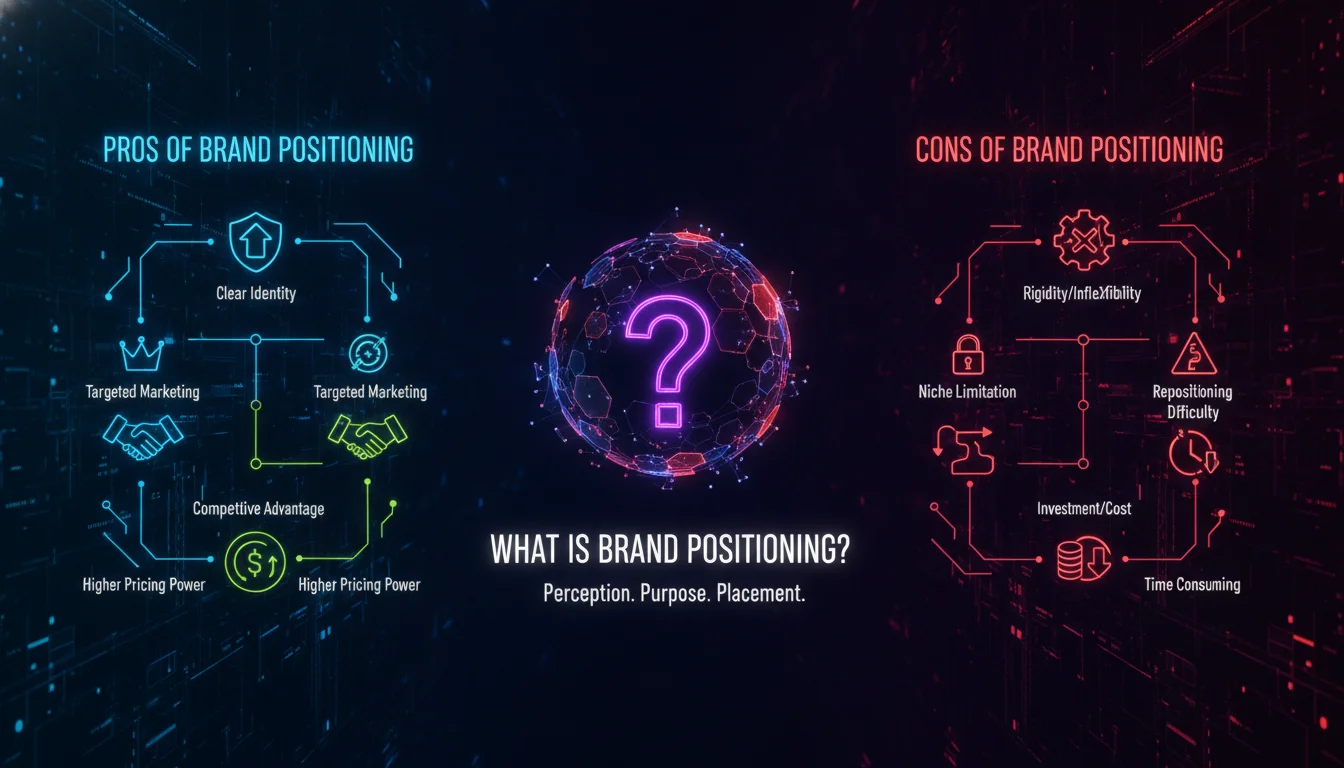
- Competitive differentiation: A clear position makes it obvious why customers should choose you over a nearly identical competitor.
- Pricing power: When positioning emphasizes quality or exclusivity, a higher price feels justified rather than arbitrary, according to Forbes.
- Customer loyalty: As The Branding Journal notes, brand positioning strategies are directly linked to consumer loyalty, consumer-based brand equity, and the willingness to purchase the brand.
- Internal alignment: A shared positioning gives designers, copywriters, and product teams a common decision-making filter, reducing inconsistency across campaigns.
- Long-term brand equity: Consistent positioning compounds over time, making the brand more recognizable and trusted with each customer interaction.
Cons
- Rigidity risk: A tightly defined position can make it harder to expand into new categories without confusing your existing audience.
- Requires ongoing investment: NIQ emphasizes that positioning is an ongoing process that must be monitored and adapted. It is not a set-it-and-forget-it exercise.
- Perception gap: Your intended position and your actual market perception can diverge, especially without regular consumer research to close the gap.
- Touchpoint consistency is demanding: Every product, price point, channel, and customer service interaction must reinforce the same position. One contradiction can erode years of work.
Why Brand Positioning Matters
Brand positioning matters because, without it, a brand risks becoming a commodity in a market full of nearly identical choices. Forbes contributor Samuel Thimothy argues that brand positioning is a process of getting your brand out there and establishing it as something worth thinking about. It is not a matter of what you do, but rather how you do it.
Differentiation and Competitive Advantage
Differentiation is the direct result of deliberate positioning. Consider two sunglasses brands: one with steel frames, one with titanium. The titanium brand can position itself as the manufacturer of the safest, most durable glasses on the market because its frames return to their original shape after being bent. That single point of difference becomes the foundation for a brand story competitors cannot easily copy.
Pricing Power and Customer Loyalty
Effective brand positioning also supports pricing strategy. Forbes notes that when a product’s price is high because of quality and exclusivity, and the brand positioning emphasizes those factors, the cost automatically becomes reasonable in the eyes of customers. The same logic applies to value brands: if the positioning focuses on affordability and accessibility, a low price reinforces the brand promise rather than cheapening it.
Customer loyalty follows from consistent positioning. The Branding Journal says that brand positioning strategies are directly linked to consumer loyalty, consumer-based brand equity, and the willingness to purchase the brand. A brand that occupies a clear mental space is easier to recall, trust, and choose again.
Internal Alignment and Creative Direction
Positioning is not only external. It gives internal teams a shared language and a decision-making filter. Harvard Business School Online calls the brand positioning statement the “North Star” that guides brand marketing strategies and messages. When designers, copywriters, product developers, and sales teams all understand the same positioning, they make more consistent choices.
Without clear positioning, employees improvise. Marketing might emphasize low prices while product development invests in premium features. Sales might promise one benefit while customer service delivers another. The result is a fragmented brand experience that confuses customers and erodes trust.
“We believe that the more you nurture the brand, the more value we’re going to get. When we work on the brand, and we do marketing and advertising around the brand, it’s just going to be that much more valuable in the long term as far as return on investment and customer feelings.” – Amy Murray, former VP of Global Marketing, McDonald’s, via Harvard Business School Online
What Is Brand Positioning Strategy?
A brand positioning strategy is the deliberate plan for establishing and maintaining a specific brand position over time. It involves analyzing the market, selecting a differentiated value proposition, and aligning all touchpoints to reinforce that position. According to Amazon Ads, companies can create and scale a brand positioning strategy in various ways depending on the size, mission, and segment of the brand.
Positioning Strategy vs. Positioning Statement
These two terms are often used interchangeably, but they are distinct. A positioning strategy is the broad, long-term approach: where you want to be, why, and how you will get there. A positioning statement is a concise internal summary of that strategy. Amazon Ads defines a brand positioning statement as an internal positioning summary that companies use to articulate and promote the value their brand brings to a target market.
Think of the strategy as a map and the statement as the destination written on that map. You need both: the statement keeps you focused, while the strategy guides the journey across products, campaigns, and customer interactions.
Common Positioning Strategy Approaches
Several strategic lenses can guide positioning. Some brands position on functional benefits (faster, safer, more durable). Others position on emotional benefits (belonging, confidence, joy). Some position on price (affordable luxury, everyday low price). Some position on a specific user or use case. The key is to choose a dimension that is meaningful to the target audience, credible for the brand, and differentiated from competitors.
A brand selling running shoes might position on performance (lightweight, responsive cushioning), on community (join a global movement of runners), or on sustainability (made from recycled materials). Each lens attracts a different audience and requires different proof points.
Types of Brand Positioning Strategies
There are several distinct types of brand positioning strategies, and choosing the right one depends on your product, audience, and competitive landscape.
Benefit-Based Positioning
This type focuses on the primary functional benefit a product or service delivers. A toothpaste might position itself as the best cavity protection. A software tool might position itself as the fastest way to build a website. The benefit must be relevant, distinctive, and provable. If the benefit is generic, such as “high quality,” it fails to differentiate.
Benefit-based positioning works best when the benefit solves a clear, measurable problem. A project management tool that positions itself around reducing project completion time has a concrete claim that can be tested and demonstrated. The more specific the benefit, the more credible the position.
Price-Based Positioning
Price-based positioning places a brand as either the most affordable option, the premium choice, or the best value for money. A budget airline might position itself as the cheapest way to fly, while a luxury watch brand positions itself as an investment in craftsmanship and exclusivity. The key is consistency: every touchpoint must reinforce the price perception.
Price positioning does not mean simply being cheap. Walmart positions itself on everyday low prices, but that position is supported by supply chain efficiency and massive scale. On the premium end, Rolex positions itself on exclusivity and investment value, justifying prices many times higher than functional alternatives.
Quality-Based Positioning
Quality positioning emphasizes superiority in materials, performance, or craftsmanship. The titanium sunglasses example from Forbes illustrates this well: the brand positions itself as the safest, most durable glasses on the market because its frames return to their original shape after being bent. Quality claims require proof, such as material specifications, testing data, or independent certifications.
Quality-based positioning can be vulnerable to price competition if the quality difference is not communicated clearly. That is why brands like Patagonia pair quality claims with environmental responsibility and repair guarantees, creating a multi-dimensional position that is harder to undercut.
Emotional or Lifestyle Positioning
Some brands position around a feeling, identity, or lifestyle. Dove positions itself around natural and real beauty, encouraging women to embrace their authentic selves. Apple positions itself as a brand for creative, innovative people who value design and simplicity. Emotional positioning can create deep loyalty, but it must be authentic and consistently reinforced across campaigns, products, and customer experience.
FlippingBook identifies five common types of brand positioning, noting that businesses can combine multiple types or stick to one that best reflects their goals. The exact mix depends on your product, audience, and competitive landscape.
How to Create a Brand Positioning Strategy
Creating a brand positioning strategy follows six clear steps. While individual frameworks vary, they all share the same core logic: understand your audience, analyze competitors, define your difference, articulate it, test it, and reinforce it consistently.
- Understand how your brand is currently positioned. Conduct an honest audit of your current brand perception, messaging, and customer feedback. Amazon Ads recommends this as the first step: know where you stand before deciding where to go.
- Determine your unique value proposition. Identify what your brand offers that no competitor can claim as credibly. This is the reason a customer would choose you. The value proposition should be specific, meaningful, and demonstrable.
- Identify your competitors and their positioning. Map the competitive landscape. Harvard Business School Online recommends using a perceptual map, a graphic representation of how consumers perceive your brand compared to competitors along dimensions such as price, quality, innovation, or customer service. Choose two attributes that accurately reflect customers’ wants and needs, then plot each competitor.
- Create your positioning statement. Distill your strategy into a concise internal statement. According to Amazon Ads, a brand positioning statement should answer four questions: Who is the target market or customer? What is your product or service category? What is the greatest benefit and impact? What is the proof of that benefit?
- Evaluate and test whether your positioning works. Expose the statement to real customers and internal stakeholders. Does it resonate? Is it credible? Is it different from competitors? Adjust as needed.
- Reinforce your brand’s differentiating qualities. Embed the positioning in every touchpoint: product design, packaging, visual identity, communications, customer service, and employee behavior. The Branding Journal notes that after choosing a positioning statement, the remaining challenge is to reflect it in everything you do.
How to Write a Brand Positioning Statement
Writing a brand positioning statement starts with a simple formula that forces clarity on who you serve, what you promise, and why customers should believe you.
The Classic Formula
A brand positioning statement is an internal document that succinctly articulates how a brand should be perceived. It is not a tagline or a public-facing slogan. Amazon Ads explains that it is an internal positioning summary companies use to articulate and promote the value their brand brings to a target market. The statement should balance aspiration and reality.
A common formula is: For [target audience], [brand] is the [category] that [differentiating benefit] because [reason to believe]. This structure forces clarity on who you serve, what you promise, and why customers should believe you.
Questions to Answer
- Who is the target market or customer? Be specific about demographics, psychographics, or use cases.
- What is your product or service category? Define the frame of reference consumers use to compare options.
- What is the greatest benefit and impact? This is the core value you deliver, not just a feature list.
- What is the proof of that benefit? Provide evidence: performance data, material properties, customer testimonials, or certifications.
According to The Branding Journal, an easy way to define a positioning statement is to summarize it in three words. For example, a brand might choose “vegan, traditional, and feminine.” Avoid generic words like “quality products,” “unique,” or “successful” because those are the aim of every brand, not a differentiator.
Example Statement Breakdown
Consider the Yellow Tail wine example from The Branding Journal. The brand’s positioning was summarized as “approachable, easy-to-choose, and fun.” A full positioning statement might read: For casual wine drinkers intimidated by traditional wine culture, Yellow Tail is the wine brand that makes choosing and enjoying wine simple and fun because its product is soft, sweet, and easy to drink, its packaging is colorful and jargon-free, and its price is under $10.
Examples of Effective Brand Positioning
The best brand positioning examples share one trait: every element of the brand, from product to price to packaging, tells the same story.
Yellow Tail Wines
The Australian brand Yellow Tail wanted to enter the US market and be perceived very differently from the vast majority of wine brands, which sell complicated products with sophisticated, hard-to-understand wine terminology. According to The Branding Journal, Yellow Tail focused its positioning on being “approachable, easy-to-choose, and fun.” The brand achieved this through the product (soft, sweet, easy-drinking), the name (fun and adventurous, referencing the kangaroo tail), the visual identity (colorful, unintimidating packaging without complex enological terms), the communication strategy (in-store activities and down-to-earth ads), and the price (less than $10). That complete alignment across every touchpoint is what made the positioning credible and durable.
McDonald’s
McDonald’s positions itself around exceptional service and consistency across its many locations. According to Amazon Ads, the company’s dedication to delighting customers through customer satisfaction and continuous operational improvement is received through the way the brand positions itself. Harvard Business School Online quotes former McDonald’s VP of global marketing Amy Murray: “We believe that the more you nurture the brand, the more value we’re going to get.” Positioning, in this case, is not a marketing tagline. It drives long-term investment in the brand.
Dove
Dove positions itself around the natural and real beauty of women. Amazon Ads notes that Dove’s brand positioning strategy emphasizes the way all women can embrace their authentic self through the use of personal care products. Dove uses brand campaigns and other marketing tactics to reinforce this position, making it one of the most recognizable emotional positioning examples in the industry.
Apple
Apple is a classic example of emotional and lifestyle positioning. FlippingBook observes that many people associate Apple with mobile phones in general, and the product’s value is clear to Apple users. According to FlippingBook, only 11% of Apple users would switch to Android, a figure that demonstrates strong customer loyalty and emotional connection. Apple consistently reinforces its positioning through recognizable visual identity, sleek design, and a product ecosystem that locks in value.
| Brand | Positioning Focus | Key Evidence |
|---|---|---|
| Yellow Tail | Approachable, easy-to-choose, fun | Soft sweet wine, colorful packaging, price under $10 |
| McDonald’s | Exceptional service and consistency | Operational focus, global consistency, brand investment |
| Dove | Natural and real beauty | Campaigns emphasizing authentic self, product alignment |
| Apple | Emotional connection, design, simplicity | Only 11% of users would switch to Android, sleek ecosystem |
Common Brand Positioning Mistakes to Avoid
Even well-resourced brands get brand positioning wrong. These are the four mistakes we see most often.
Choosing Generic Differentiators
The Branding Journal warns against positioning around generic words like “quality products,” “unique,” or “successful.” These are not differentiators. They are the price of entry for any brand. If your positioning could apply to any competitor, it is not a positioning. It is a wish.
Ignoring Consumer Perception
Positioning is not what you say it is. It is what consumers perceive. Harvard Business School Online emphasizes that success depends not only on your intent but on how consumers perceive, classify, and remember your brand relative to competitors. Brands that skip perceptual research often discover a gap between their intended position and actual market perception.
Failing to Align All Touchpoints
A positioning strategy falls apart when product, price, place, and promotion contradict the desired position. If a brand claims to be premium but discounts heavily or uses low-quality packaging, consumers notice. The Branding Journal says the remaining challenge after choosing a positioning is to reflect it in everything you do, from brand personality and packaging design to product, service, visual identity, and communications.
Treating Positioning as Static
NIQ notes that brand positioning is an ongoing process that must be monitored and adapted to changing organizational needs and customer preferences. Markets evolve. Competitors shift. Technologies change. A positioning that worked five years ago may no longer differentiate the brand. Regular brand audits and customer feedback loops help keep positioning fresh without abandoning the core identity.
Brand Positioning and Market Segmentation
Brand positioning does not exist in isolation. It sits within a larger branding continuum that includes market segmentation, brand awareness campaigns, and brand recognition efforts. NIQ describes positioning as part of this broader process, one that works to convert existing familiarity into favorable qualities like reliability and preference.
Market segmentation tells you who your audience is. Brand positioning tells you what to say to them and why they should care. Without segmentation, positioning becomes too broad to resonate. Without positioning, segmentation produces audience data with no creative direction to act on. The two disciplines reinforce each other, and the strongest brand strategies treat them as inseparable.
For brands running paid media, Amazon Ads notes that display ad audiences can connect advertising strategy directly with brand positioning, allowing brands to share unique brand insights with the right consumers at the right moment. That connection between media strategy and positioning is where many brands leave significant value on the table.
Why Understanding What Is Brand Positioning Is Essential for Growth
Understanding what is brand positioning is essential because it is the foundation of every marketing decision, from which customers to target to how to allocate budget across channels.
The Strategic Foundation for Marketing
Without clear positioning, marketing becomes reactive and inconsistent. With it, every campaign, product launch, and customer interaction reinforces a coherent story. A well-defined position also makes it easier to measure marketing effectiveness. When you know exactly what mental space you want to own, you can track whether consumer awareness, consideration, and preference are moving in the right direction.
This is also why we encourage every brand we work with at Emin Media to nail their positioning before investing heavily in creative production or paid media. A brilliant video campaign built on a vague position is expensive noise. The same budget behind a sharp position becomes a brand-building asset. You can see how this thinking shapes our approach in our work on brand strategy and creative direction.
Positioning as a Growth Lever
Strong positioning supports customer acquisition and retention. It helps justify pricing, reduce churn, and increase customer lifetime value. NIQ states that businesses that successfully create a strong position for their brand are not only more likely to connect with customers, but also better prepared to build the kinds of relationships that drive sales and long-term growth. Positioning is not a luxury for large brands. It is a competitive necessity for businesses of every size.
The Future of Brand Positioning
As of 2026, AI-driven search and generative engines are changing how consumers discover brands. Clear positioning is becoming even more valuable in this environment. When an AI assistant answers a question like “what is brand positioning,” it draws from content that defines terms precisely and connects examples credibly. Brands that articulate their position in simple, consistent language are more likely to be cited, recommended, and remembered. Brand positioning is not just a marketing concept. It is a durable asset in the digital age.
Ready to define your brand’s position with clarity and confidence? Contact Emin Media for a free brand consultation and let’s build something bold together.
Frequently Asked Questions
What is brand positioning in simple words?
What is brand positioning in plain terms? It is the process of designing a company’s offering and image to occupy a distinctive place in the mind of the target market. It defines how a brand is different from competitors and how customers perceive it relative to everything else they could choose.
What is a brand positioning statement?
A brand positioning statement is an internal summary that articulates the value a brand brings to a target market. According to Amazon Ads, it answers four questions: who the customer is, what the product category is, what the greatest benefit is, and what proof supports that benefit. It is not a public tagline.
What is the difference between brand positioning and differentiation?
Differentiation describes how a product is distinguished within a marketplace relative to the competition. Brand positioning is the broader process of defining a brand in consumers’ minds relative to competitors and the larger public, as NIQ explains. Differentiation is one input into positioning, not a synonym for it.
Why is brand positioning important?
Brand positioning creates competitive advantage, justifies pricing, and builds customer loyalty. It provides internal alignment so that all marketing efforts reinforce a consistent brand story. Without it, brands risk becoming commodities that compete only on price.
What are the types of brand positioning?
Common types include benefit-based, price-based, quality-based, and emotional or lifestyle positioning. FlippingBook identifies five common types in total. Brands can combine multiple approaches depending on their product, audience, and competitive landscape, as long as the combined message remains clear and consistent.
How do you create a brand positioning strategy?
Start by auditing your current position, then determine your unique value proposition, identify competitors using a perceptual map, create a positioning statement, test it with real customers, and reinforce it across all touchpoints. Amazon Ads outlines these six steps as the core process for building a brand positioning strategy that scales.
Enjoyed this article?
Contact Emin Media for a free brand consultation and let's create something amazing together.
Get in TouchRelated Articles
Digital Storytelling for Brands: The Complete Guide
Digital storytelling for brands builds real audience connections through narrative. Learn proven techniques, formats, and…

Design Thinking for Marketing: A 2026 Guide
Design thinking for marketing builds campaigns around real user needs. Learn the 5 phases, common…

Creative Direction for Video Shoots: A Complete Guide
Master creative direction for video shoots with proven steps, tools, and strategies that build brand…